Cloud RAN
(Tentative de traduction) Réseau d’accès radio basé sur
le Cloud
Loutfi Nuaymi,
Télécom Bretagne / Network, Security and Multimedia Department
IRISA/ REOP team
Supéléc, Cesson-Sévigné
17 Oct 2013
L. Nuaymi, Dépt RSM
Plan
!  1- Context and objectives
!  2- Definitions and concepts
2.1- full and partial centralization
!  3- Advantages and benefits of Cloud RAN
3.1- Associate with software-defined networks (SDN)
3.2- Associate with Active Antennas and beamforming
!  4- Normalization and commercialization
!  5- Identified research issues (not exhaustive)
!  6- State of the Art of research works
!  7- Our Work
!  References
page 1
L. Nuaymi, Dépt RSM
1- Context: the traffic-revenue gap
!  Well known wireless networks Energy Constraints: energy contribution of
ICT is XX % of the global energy consumption (Gartner, 2007)
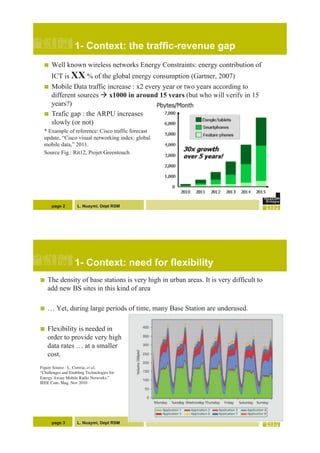
!  Mobile Data traffic increase : x2 every year or two years according to
different sources ! x1000 in around 15 years (but who will verify in 15
years?)
!  Trafic gap : the ARPU increases
slowly (or not)
* Example of reference: Cisco traffic forecast
update, “Cisco visual networking index: global
mobile data,” 2011.
Source Fig.: Rit12, Projet Greentouch
page 2
L. Nuaymi, Dépt RSM
1- Context: need for flexibility
!  The density of base stations is very high in urban areas. It is very difficult to
add new BS sites in this kind of area
!  … Yet, during large periods of time, many Base Station are underused.
!  Flexibility is needed in
order to provide very high
data rates … at a smaller
cost.
Figure Source : L. Correia, et al, !
“Challenges and Enabling Technologies for !
Energy Aware Mobile Radio Networks,” !
IEEE Com. Mag. Nov 2010"
page 3
L. Nuaymi, Dépt RSM
1- Context: the cloud paradigm
!  From Zander, Mahonen, IEEE Com. Mag., March 13 :
« - History has shown a constant shift between computational paradigms that
has adapted to computing and computational bottleneck.
- We have gone from the mainframe era in the 1960s, when both communication
and processing were expensive,
… to the PC era in the 1980s and 1990s when processing became cheap, but
communication still was a bottleneck.
- Now we are moving toward the cloud paradigm, where communication is
virtually free, and remote computing can be the most effective solution."
page 4
L. Nuaymi, Dépt RSM page 5
2- Definitions and concepts!
!  From [5]: the traditional base station solution uses antennas connected via
thick (and lossy) RF cables to the cabinet containing the RF modules and
baseband processing. !
The more recent remote radio head (RRH) or antenna-integrated radio
designs place the RF module next to the antenna to reduce cable losses. "
!
!
!
!
!
"
"
"
"
L. Nuaymi, Dépt RSM page 6
2- Definitions and concepts: BBU and RRH!
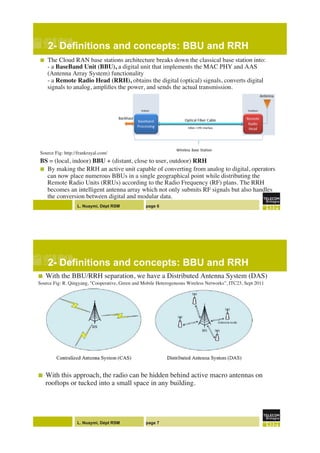
!  The Cloud RAN base stations architecture breaks down the classical base station into:!
- a BaseBand Unit (BBU), a digital unit that implements the MAC PHY and AAS
(Antenna Array System) functionality!
- a Remote Radio Head (RRH), obtains the digital (optical) signals, converts digital
signals to analog, amplifies the power, and sends the actual transmission. "
Source Fig: http://frankrayal.com/"
BS = (local, indoor) BBU + (distant, close to user, outdoor) RRH!
!  By making the RRH an active unit capable of converting from analog to digital, operators
can now place numerous BBUs in a single geographical point while distributing the
Remote Radio Units (RRUs) according to the Radio Frequency (RF) plans. The RRH
becomes an intelligent antenna array which not only submits RF signals but also handles
the conversion between digital and modular data. "
"!
L. Nuaymi, Dépt RSM page 7
2- Definitions and concepts: BBU and RRH!
!  With the BBU/RRH separation, we have a Distributed Antenna System (DAS)"
Source Fig: R. Qingyang, "Cooperative, Green and Mobile Heterogeneous Wireless Networks”, ITC23, Sept 2011 "
"
"
!  With this approach, the radio can be hidden behind active macro antennas on
rooftops or tucked into a small space in any building."
"!
L. Nuaymi, Dépt RSM page 8
2- Definitions and concepts: What is Cloud RAN?!
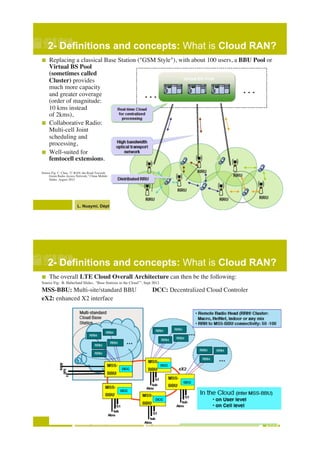
!  Replacing a classical Base Station ("GSM Style"), with about 100 users, a BBU Pool or
Virtual BS Pool "
(sometimes called "
Cluster) provides !
much more capacity !
and greater coverage !
(order of magnitude: !
10 kms instead !
of 2kms),"
!  Collaborative Radio: !
Multi-cell Joint !
scheduling and !
processing,"
!  Well-suited for !
femtocell extensions."
" ""
Source Fig: C. Chen, "C-RAN: the Road Towards !
Green Radio Access Network," China Mobile !
Slides, August 2012"
!
L. Nuaymi, Dépt RSM page 9
2- Definitions and concepts: What is Cloud RAN?!
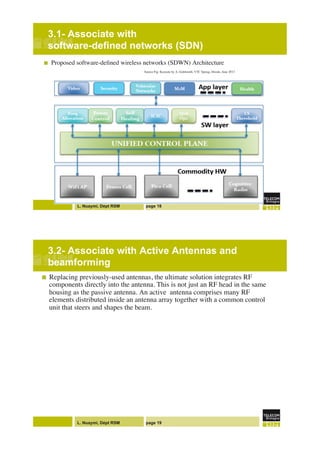
!  The overall LTE Cloud Overall Architecture can then be the following: "
Source Fig: B. Haberland Slides, "Base Stations in the Cloud”", Sept 2012"
MSS-BBU: Multi-site/standard BBU DCC: Decentralized Cloud Controler"
eX2: enhanced X2 interface"
"
!
L. Nuaymi, Dépt RSM page 10
2- Definitions and concepts: C-RAN starting
from a leagcy BS!
!  Different scenarios are possible!
!  Overlay scenario: introducing a new frequency band or a new radio standard to provide
larger network !
capacity. "
!  The methods !
mentioned !
can be combined !
together (see figure)"
Source [4] NGMN, Jan 13"
!
L. Nuaymi, Dépt RSM page 11
2.1- full and partial centralization!
!  The BBU and RRH separation has two possibilities. (From [1], modified) according to the
different function splitting between BBU and RRH, there are two kinds of C-RAN  
solutions:  !
!
- Solution 1: one  is  called  ‘full  centralization’,  where  baseband  (i.e.   layer 1) and
the layer 2, layer 3 BTS functions are located in BBU;!
!
- the  other (Solution 2)  is  called ‘partial centralization’, where  the RRH integrates not
only the radio function but also the baseband function, while all other higher layer
functions are still located in BBU. The BBU doesn’t  include the baseband function but is
still called BBU for simplicity."
"
"
Source Fig: [1]"
L. Nuaymi, Dépt RSM page 12
2.1- Full and partial (or distributed baseband
processing) centralization!
!  The architecture options are illustrated in this figure. ""
Source Fig: [6]"
!
L. Nuaymi, Dépt RSM page 13
2.1- full and partial centralization!
!  Other Illustration (Chen, CMRI, White Paper, Cite): C-RAN Architecture 2:
Partial Centralized Solution ""
Source Fig: [6] cite, see above"
!
L. Nuaymi, Dépt RSM page 14
2.1- full and partial centralization!
!  (Source: Chen CRI White Pap [1])"
!  Advantages of ‘fully centralized’ C-RAN architecture:"
- easy upgrading and network capacity expansion,!
- better capability for supporting multistandard operation, !
- maximum resource sharing, !
- more convenient towards support of multi-cell collaborative signal
processing. "
!  Its major disadvantage is the high bandwidth requirement between the
BBU and to carry the baseband I/Q signal between BBU and RRH. "
!  (according to CMRI, [1]) In the extreme case, a TD-LTE 8 antenna with
20MHz bandwidth will need a 10 Gpbs transmission rate."
"
L. Nuaymi, Dépt RSM page 15
3- Advantages and benefits of Cloud RAN!
!  The advantages of Cloud RAN are (1/2):"
From [1]:!
- Money-saving: Lower CAPEX (-15%) and OPEX (-50%)!
- Simpler (and then faster) system roll out!
- Lower energy consumption: up to 71% of traditional RAN Consumption.
Sharing the processing and thus the power between different cell areas is a way
to utilize the BS more effectively.!
- Easy extension of the network. The operator only needs to install new RRHs
and connect them to the BBU pool to expand the network coverage or split the
cell to improve capacity. If the network load grows, the operator only needs to
upgrade the BBU pool’s HW to accommodate the increased processing
capacity."
"
L. Nuaymi, Dépt RSM page 16
3- Advantages and benefits of Cloud RAN!
!  The advantages of Cloud RAN (China Mobile slides) are (2/2):"
(B. Haberland Slides, Base Stations in the Cloud, Sept 2012)"
- Operator Sharing: BBUs of different operators can share the RRH
configuration,"
- More efficient implementation of M2M Communication in the wireless network,!
(China Mobile Res. Inst.)"
- CRAN is based on open platform, can support multiple standards, and smooth
evolution. "
(Many other sources)"
- Allows macro cells to be easily complemented with a layer of small cells bringing
added capacity to end users. !
- Great flexibility to allocate the processing resources according to the traffic
evolution"
"
L. Nuaymi, Dépt RSM
3.1- Associate with
software-defined networks (SDN)
!  Software-defined networks (SDN) Common themes :
Source: Keynote by A. Goldsmith, VTC Spring, Dresde, June 2013
1- Separate control and data plane (Virtual Cell Concept, see [Salz12] /
**add and GreenTouch Project)
2- Open and programmable
3- Vendor-agnostic (interoperable)
4- Network abstraction offered to applications on top of the network =
ability to tailor network performance to applications.
5- Self-Organizing Networks (SON)
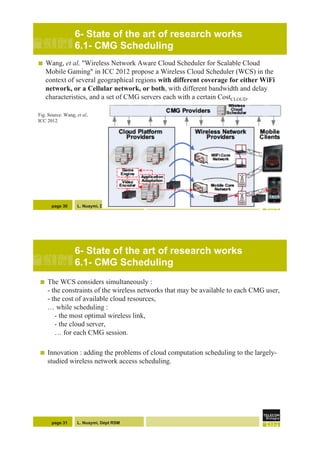
!  Future wireless networks will divorce HW and SW, with commodotized
HW and cloud SW to manage it (see architecture)
page 17
L. Nuaymi, Dépt RSM page 18
3.1- Associate with
software-defined networks (SDN) !
!  Proposed software-defined wireless networks (SDWN) Architecture"
" "Source Fig: Keynote by A. Goldsmith, VTC Spring, Dresde, June 2013"
!
L. Nuaymi, Dépt RSM page 19
3.2- Associate with Active Antennas and
beamforming!
!  Replacing previously-used antennas, the ultimate solution integrates RF
components directly into the antenna. This is not just an RF head in the same
housing as the passive antenna. An active antenna comprises many RF
elements distributed inside an antenna array together with a common control
unit that steers and shapes the beam."
L. Nuaymi, Dépt RSM
4- Normalization and commercialization
!  Many C-RAN Trials in Commercial Networks in China for dense urban city,
business street and campus ! see [1]
!  China Mobile signed C-RAN MoU with Orange
page 20
L. Nuaymi, Dépt RSM
4- Normalization and commercialization
!  NSN Liquid radio platform ([6]): Nokia Siemens Networks Liquid Radio, is a
fluid network architecture and platform paving the way for software- defined
networks.
!  These platforms are linked by high-capacity, low-latency transport networks in a
non-hierarchical, meshed architecture. They self-configure to use the available
hardware, interconnects and air interfaces in the best way. The Intelligent Self-
Organizing Networks (iSON) suite adds the ultimate liquidity to multitechnology
networks.
page 21
L. Nuaymi, Dépt RSM page 22
4- Identified research issues (not exhaustive)
!  1- Reliability and resiliency: a cloud network may have more sources of
failure than a physical counterpart.
!  2- Interoperability: standards, handover decision criterions and process
between different RATs (Radio Access Technologies).
One possible scheme is to use Software-defined Radio (SDR) to process
any protocol ([4], NGMN).
L. Nuaymi, Dépt RSM page 23
4- Identified research issues (not exhaustive)
!  3- RRM Issues and QoS Support : Cooperative Radio Resource
Management for multi-cells. The multi-cell RRM problem has already
been addressed in various academic studies (see [1]), using various
optimization techniques in trying to determine the best RRM solutions
(resource scheduling, power control, admission control) with regard to the
throughput and with some specific constraints.
!  Cooperative or multi-cell RRM in C-RAN has some specific
considerations, mainly large numbers and complexity. [1] proposes to
reduce the joint processing/scheduling to a number of cells in order
to reduce the complexity incurred in the C-RAN network architecture.
L. Nuaymi, Dépt RSM page 24
5- Identified research issues (not exhaustive)
!  Radio resource sharing for hybrid cellular networks: design of
cooperative radio algorithms that reduces interference between cells
and improve overall indoor capacity.
Source [4] NGMN, Jan 13"
L. Nuaymi, Dépt RSM page 25
5- Identified research issues (not exhaustive)
!  4- Cooperative Transmission and Receiving: (from [4], NGMN) Joint
processing and coordination techniques such as coordinated multipoint
(CoMP) transmission and reception can be even more efficient with the
centralized processing of C-RAN.
Joint processing includes not only CoMP defined in 3GPP, but also many
other technologies such as joint scheduling, joint interference alignment/
cancellation and other.
L. Nuaymi, Dépt RSM page 26
5- Identified research issues (not exhaustive)
!  (from [1]) 5- With virtual BBS or BBS pool:
The RRHs’ signal can be routed to any one of the BBUs in the pool.
Advantages:
! The dynamic carrier scheduling of resources within baseband pools
enhances redundancy and then overall operational reliability of the
baseband pool: when a baseband card or a carrier processing unit fails,
the work load can be promptly redistributed to other available resources
within the pool, and restore the normal operation.
! Load balance among BBUs according to dynamic network load
! Reduction of system power consumption.
!  According to [1], a large scale baseband inter-connect solution should be
able to support 10-1000 macro BS
L. Nuaymi, Dépt RSM page 27
5- Identified research issues (not exhaustive)
6- Energy Efficient/Green Infrastructure issues in C-RAN ([1]):
!  Firstly, with centralized processing of the C-RAN architecture, the number
of BS sites can be reduced several folds. Thus the air conditioning and
other site support equipment’s power consumption can be largely reduced.
In low-traffic periods, many virtual BSs (RRHs) may be served by one
BBU. Then, many other can be shutdown, leading to a reduced BBU pool
energy consumption (less cooling, cost, …).
!  Yet, this creates a new topic to address: BBU migration for real-time
services. When moving from one BBU to another a vBS (RRH) is silent
and this represents an interruption of several seconds* ! see C. Wang, et
al, "A Study on Virtual BS Live Migration – A Seamless and Lossless
Mechanism for Virtual BS Migration”, in PIMRC 2013
* According to E. Dahlman, “3G Evolution”, 2008, The maximum allowed
interruption time for LTE handover is 300 ms
L. Nuaymi, Dépt RSM page 28
5- Identified research issues (not exhaustive)
Energy Efficient/Green Infrastructure issues in C-RAN ([1]):
!  In addition, because the BBU pool is a shared resource among a large
number of virtual BS, it means a much higher utilization rate of processing
resources and lower power consumption can be achieved. /** Ongoing:
model to estimate the economy of the BSs
L. Nuaymi, Dépt RSM page 29
5- Identified research issues (not exhaustive)
!  7- Adaptability to Non-uniform Traffic [1]
!  C-RAN is very suitable for non-uniformly distributed traffic due to the load-
balancing capability in the distributed BBU pool. Though the serving RRH
changes dynamically according to the movement of UEs, the serving BBU
is still in the same BBU pool. As the coverage of a BBU pool is larger than
the traditional BS, non-uniformly distributed traffic generated from UEs can
be distributed in a virtual BS which sits in the same BBU pool.
L. Nuaymi, Dépt RSM
6- State of the art of research works
6.1- CMG Scheduling
!  Wang, et al, "Wireless Network Aware Cloud Scheduler for Scalable Cloud
Mobile Gaming" in ICC 2012 propose a Wireless Cloud Scheduler (WCS) in the
context of several geographical regions with different coverage for either WiFi
network, or a Cellular network, or both, with different bandwidth and delay
characteristics, and a set of CMG servers each with a certain CostCLOUD.
Fig. Source: Wang, et al,
ICC 2012
page 30
L. Nuaymi, Dépt RSM
6- State of the art of research works
6.1- CMG Scheduling
!  The WCS considers simultaneously :
- the constraints of the wireless networks that may be available to each CMG user,
- the cost of available cloud resources,
… while scheduling :
- the most optimal wireless link,
- the cloud server,
… for each CMG session.
!  Innovation : adding the problems of cloud computation scheduling to the largely-
studied wireless network access scheduling.
page 31
L. Nuaymi, Dépt RSM
6- State of the art of research works
6.2- Wireless Transmission on Optical Network
Wireless Signal Transmission on Optical Network challenges are summarized in
[1], section 4.1:
!  BBU-RRH Bandwidth Requirement
!  Transportation Latency, Jitter and Measurement Requirements
!  Data compression techniques on the LTE/LTE-A BBU-RRH, OBRI (Open BBU-
RRH Interface)
!  BBU-RRH Optical Fiber Networks: in order to avoid having every RRH fully
occupy two optical fibers on
a physically routed pair, the
RRHs can be connected to each
other in a cascaded manner
according to the CPRI/Ir/OBRI
interface specification. This
permits two different routing
trunk cables to form a ring and
be connected to the same BBU,
as shown in the Figure (from [1])
page 32
L. Nuaymi, Dépt RSM page 33
7- Our Work ?
!  Scheduler considering the energy cost?
!  Radio resource allocation issues:
We intend to work on Coordinated Radio resource allocation and power
allocation schemes for multi-cells.
!  Specific LTE-A environment
L. Nuaymi, Dépt RSM
References
!  [1] C. Chen, "C-RAN: the Road Towards Green Radio Access Network," China Mobile
Research Institute, White paper (same author, same title), October 2011 Slides,
August 2012
!  [2] J. Chen, et al, "Open Wireless System Cloud: An Architecture for Future Wireless
Communications System,” Network and Communication Technologies; Vol. 1, No. 2;
2012
!  [3] A. Goldsmith, ”Enabling the Wireless Cloud Through Software-Defined Networking,”
Vehicular Technology Conference, VTC Spring, Dresde, June 2013
!  [4] NGMN, ”Suggestions on potential solutions to C-RAN BY NGMN Alliance,” Jan 2013
!  [5] Manzalini, "Clouds of Virtual Machines in Edge Networks,» IEEE Com. Mag., July
2013
!  [6] NSN White Paper, « Liquid_Radio Let traffic waves flow most efficiently,» June2013
page 34

2013 10-17 nuaymi

  • 1.
    Cloud RAN (Tentative detraduction) Réseau d’accès radio basé sur le Cloud Loutfi Nuaymi, Télécom Bretagne / Network, Security and Multimedia Department IRISA/ REOP team Supéléc, Cesson-Sévigné 17 Oct 2013 L. Nuaymi, Dépt RSM Plan !  1- Context and objectives !  2- Definitions and concepts 2.1- full and partial centralization !  3- Advantages and benefits of Cloud RAN 3.1- Associate with software-defined networks (SDN) 3.2- Associate with Active Antennas and beamforming !  4- Normalization and commercialization !  5- Identified research issues (not exhaustive) !  6- State of the Art of research works !  7- Our Work !  References page 1
  • 2.
    L. Nuaymi, DéptRSM 1- Context: the traffic-revenue gap !  Well known wireless networks Energy Constraints: energy contribution of ICT is XX % of the global energy consumption (Gartner, 2007) !  Mobile Data traffic increase : x2 every year or two years according to different sources ! x1000 in around 15 years (but who will verify in 15 years?) !  Trafic gap : the ARPU increases slowly (or not) * Example of reference: Cisco traffic forecast update, “Cisco visual networking index: global mobile data,” 2011. Source Fig.: Rit12, Projet Greentouch page 2 L. Nuaymi, Dépt RSM 1- Context: need for flexibility !  The density of base stations is very high in urban areas. It is very difficult to add new BS sites in this kind of area !  … Yet, during large periods of time, many Base Station are underused. !  Flexibility is needed in order to provide very high data rates … at a smaller cost. Figure Source : L. Correia, et al, ! “Challenges and Enabling Technologies for ! Energy Aware Mobile Radio Networks,” ! IEEE Com. Mag. Nov 2010" page 3
  • 3.
    L. Nuaymi, DéptRSM 1- Context: the cloud paradigm !  From Zander, Mahonen, IEEE Com. Mag., March 13 : « - History has shown a constant shift between computational paradigms that has adapted to computing and computational bottleneck. - We have gone from the mainframe era in the 1960s, when both communication and processing were expensive, … to the PC era in the 1980s and 1990s when processing became cheap, but communication still was a bottleneck. - Now we are moving toward the cloud paradigm, where communication is virtually free, and remote computing can be the most effective solution." page 4 L. Nuaymi, Dépt RSM page 5 2- Definitions and concepts! !  From [5]: the traditional base station solution uses antennas connected via thick (and lossy) RF cables to the cabinet containing the RF modules and baseband processing. ! The more recent remote radio head (RRH) or antenna-integrated radio designs place the RF module next to the antenna to reduce cable losses. " ! ! ! ! ! " " " "
  • 4.
    L. Nuaymi, DéptRSM page 6 2- Definitions and concepts: BBU and RRH! !  The Cloud RAN base stations architecture breaks down the classical base station into:! - a BaseBand Unit (BBU), a digital unit that implements the MAC PHY and AAS (Antenna Array System) functionality! - a Remote Radio Head (RRH), obtains the digital (optical) signals, converts digital signals to analog, amplifies the power, and sends the actual transmission. " Source Fig: http://frankrayal.com/" BS = (local, indoor) BBU + (distant, close to user, outdoor) RRH! !  By making the RRH an active unit capable of converting from analog to digital, operators can now place numerous BBUs in a single geographical point while distributing the Remote Radio Units (RRUs) according to the Radio Frequency (RF) plans. The RRH becomes an intelligent antenna array which not only submits RF signals but also handles the conversion between digital and modular data. " "! L. Nuaymi, Dépt RSM page 7 2- Definitions and concepts: BBU and RRH! !  With the BBU/RRH separation, we have a Distributed Antenna System (DAS)" Source Fig: R. Qingyang, "Cooperative, Green and Mobile Heterogeneous Wireless Networks”, ITC23, Sept 2011 " " " !  With this approach, the radio can be hidden behind active macro antennas on rooftops or tucked into a small space in any building." "!
  • 5.
    L. Nuaymi, DéptRSM page 8 2- Definitions and concepts: What is Cloud RAN?! !  Replacing a classical Base Station ("GSM Style"), with about 100 users, a BBU Pool or Virtual BS Pool " (sometimes called " Cluster) provides ! much more capacity ! and greater coverage ! (order of magnitude: ! 10 kms instead ! of 2kms)," !  Collaborative Radio: ! Multi-cell Joint ! scheduling and ! processing," !  Well-suited for ! femtocell extensions." " "" Source Fig: C. Chen, "C-RAN: the Road Towards ! Green Radio Access Network," China Mobile ! Slides, August 2012" ! L. Nuaymi, Dépt RSM page 9 2- Definitions and concepts: What is Cloud RAN?! !  The overall LTE Cloud Overall Architecture can then be the following: " Source Fig: B. Haberland Slides, "Base Stations in the Cloud”", Sept 2012" MSS-BBU: Multi-site/standard BBU DCC: Decentralized Cloud Controler" eX2: enhanced X2 interface" " !
  • 6.
    L. Nuaymi, DéptRSM page 10 2- Definitions and concepts: C-RAN starting from a leagcy BS! !  Different scenarios are possible! !  Overlay scenario: introducing a new frequency band or a new radio standard to provide larger network ! capacity. " !  The methods ! mentioned ! can be combined ! together (see figure)" Source [4] NGMN, Jan 13" ! L. Nuaymi, Dépt RSM page 11 2.1- full and partial centralization! !  The BBU and RRH separation has two possibilities. (From [1], modified) according to the different function splitting between BBU and RRH, there are two kinds of C-RAN   solutions:  ! ! - Solution 1: one  is  called  ‘full  centralization’,  where  baseband  (i.e.   layer 1) and the layer 2, layer 3 BTS functions are located in BBU;! ! - the  other (Solution 2)  is  called ‘partial centralization’, where  the RRH integrates not only the radio function but also the baseband function, while all other higher layer functions are still located in BBU. The BBU doesn’t  include the baseband function but is still called BBU for simplicity." " " Source Fig: [1]"
  • 7.
    L. Nuaymi, DéptRSM page 12 2.1- Full and partial (or distributed baseband processing) centralization! !  The architecture options are illustrated in this figure. "" Source Fig: [6]" ! L. Nuaymi, Dépt RSM page 13 2.1- full and partial centralization! !  Other Illustration (Chen, CMRI, White Paper, Cite): C-RAN Architecture 2: Partial Centralized Solution "" Source Fig: [6] cite, see above" !
  • 8.
    L. Nuaymi, DéptRSM page 14 2.1- full and partial centralization! !  (Source: Chen CRI White Pap [1])" !  Advantages of ‘fully centralized’ C-RAN architecture:" - easy upgrading and network capacity expansion,! - better capability for supporting multistandard operation, ! - maximum resource sharing, ! - more convenient towards support of multi-cell collaborative signal processing. " !  Its major disadvantage is the high bandwidth requirement between the BBU and to carry the baseband I/Q signal between BBU and RRH. " !  (according to CMRI, [1]) In the extreme case, a TD-LTE 8 antenna with 20MHz bandwidth will need a 10 Gpbs transmission rate." " L. Nuaymi, Dépt RSM page 15 3- Advantages and benefits of Cloud RAN! !  The advantages of Cloud RAN are (1/2):" From [1]:! - Money-saving: Lower CAPEX (-15%) and OPEX (-50%)! - Simpler (and then faster) system roll out! - Lower energy consumption: up to 71% of traditional RAN Consumption. Sharing the processing and thus the power between different cell areas is a way to utilize the BS more effectively.! - Easy extension of the network. The operator only needs to install new RRHs and connect them to the BBU pool to expand the network coverage or split the cell to improve capacity. If the network load grows, the operator only needs to upgrade the BBU pool’s HW to accommodate the increased processing capacity." "
  • 9.
    L. Nuaymi, DéptRSM page 16 3- Advantages and benefits of Cloud RAN! !  The advantages of Cloud RAN (China Mobile slides) are (2/2):" (B. Haberland Slides, Base Stations in the Cloud, Sept 2012)" - Operator Sharing: BBUs of different operators can share the RRH configuration," - More efficient implementation of M2M Communication in the wireless network,! (China Mobile Res. Inst.)" - CRAN is based on open platform, can support multiple standards, and smooth evolution. " (Many other sources)" - Allows macro cells to be easily complemented with a layer of small cells bringing added capacity to end users. ! - Great flexibility to allocate the processing resources according to the traffic evolution" " L. Nuaymi, Dépt RSM 3.1- Associate with software-defined networks (SDN) !  Software-defined networks (SDN) Common themes : Source: Keynote by A. Goldsmith, VTC Spring, Dresde, June 2013 1- Separate control and data plane (Virtual Cell Concept, see [Salz12] / **add and GreenTouch Project) 2- Open and programmable 3- Vendor-agnostic (interoperable) 4- Network abstraction offered to applications on top of the network = ability to tailor network performance to applications. 5- Self-Organizing Networks (SON) !  Future wireless networks will divorce HW and SW, with commodotized HW and cloud SW to manage it (see architecture) page 17
  • 10.
    L. Nuaymi, DéptRSM page 18 3.1- Associate with software-defined networks (SDN) ! !  Proposed software-defined wireless networks (SDWN) Architecture" " "Source Fig: Keynote by A. Goldsmith, VTC Spring, Dresde, June 2013" ! L. Nuaymi, Dépt RSM page 19 3.2- Associate with Active Antennas and beamforming! !  Replacing previously-used antennas, the ultimate solution integrates RF components directly into the antenna. This is not just an RF head in the same housing as the passive antenna. An active antenna comprises many RF elements distributed inside an antenna array together with a common control unit that steers and shapes the beam."
  • 11.
    L. Nuaymi, DéptRSM 4- Normalization and commercialization !  Many C-RAN Trials in Commercial Networks in China for dense urban city, business street and campus ! see [1] !  China Mobile signed C-RAN MoU with Orange page 20 L. Nuaymi, Dépt RSM 4- Normalization and commercialization !  NSN Liquid radio platform ([6]): Nokia Siemens Networks Liquid Radio, is a fluid network architecture and platform paving the way for software- defined networks. !  These platforms are linked by high-capacity, low-latency transport networks in a non-hierarchical, meshed architecture. They self-configure to use the available hardware, interconnects and air interfaces in the best way. The Intelligent Self- Organizing Networks (iSON) suite adds the ultimate liquidity to multitechnology networks. page 21
  • 12.
    L. Nuaymi, DéptRSM page 22 4- Identified research issues (not exhaustive) !  1- Reliability and resiliency: a cloud network may have more sources of failure than a physical counterpart. !  2- Interoperability: standards, handover decision criterions and process between different RATs (Radio Access Technologies). One possible scheme is to use Software-defined Radio (SDR) to process any protocol ([4], NGMN). L. Nuaymi, Dépt RSM page 23 4- Identified research issues (not exhaustive) !  3- RRM Issues and QoS Support : Cooperative Radio Resource Management for multi-cells. The multi-cell RRM problem has already been addressed in various academic studies (see [1]), using various optimization techniques in trying to determine the best RRM solutions (resource scheduling, power control, admission control) with regard to the throughput and with some specific constraints. !  Cooperative or multi-cell RRM in C-RAN has some specific considerations, mainly large numbers and complexity. [1] proposes to reduce the joint processing/scheduling to a number of cells in order to reduce the complexity incurred in the C-RAN network architecture.
  • 13.
    L. Nuaymi, DéptRSM page 24 5- Identified research issues (not exhaustive) !  Radio resource sharing for hybrid cellular networks: design of cooperative radio algorithms that reduces interference between cells and improve overall indoor capacity. Source [4] NGMN, Jan 13" L. Nuaymi, Dépt RSM page 25 5- Identified research issues (not exhaustive) !  4- Cooperative Transmission and Receiving: (from [4], NGMN) Joint processing and coordination techniques such as coordinated multipoint (CoMP) transmission and reception can be even more efficient with the centralized processing of C-RAN. Joint processing includes not only CoMP defined in 3GPP, but also many other technologies such as joint scheduling, joint interference alignment/ cancellation and other.
  • 14.
    L. Nuaymi, DéptRSM page 26 5- Identified research issues (not exhaustive) !  (from [1]) 5- With virtual BBS or BBS pool: The RRHs’ signal can be routed to any one of the BBUs in the pool. Advantages: ! The dynamic carrier scheduling of resources within baseband pools enhances redundancy and then overall operational reliability of the baseband pool: when a baseband card or a carrier processing unit fails, the work load can be promptly redistributed to other available resources within the pool, and restore the normal operation. ! Load balance among BBUs according to dynamic network load ! Reduction of system power consumption. !  According to [1], a large scale baseband inter-connect solution should be able to support 10-1000 macro BS L. Nuaymi, Dépt RSM page 27 5- Identified research issues (not exhaustive) 6- Energy Efficient/Green Infrastructure issues in C-RAN ([1]): !  Firstly, with centralized processing of the C-RAN architecture, the number of BS sites can be reduced several folds. Thus the air conditioning and other site support equipment’s power consumption can be largely reduced. In low-traffic periods, many virtual BSs (RRHs) may be served by one BBU. Then, many other can be shutdown, leading to a reduced BBU pool energy consumption (less cooling, cost, …). !  Yet, this creates a new topic to address: BBU migration for real-time services. When moving from one BBU to another a vBS (RRH) is silent and this represents an interruption of several seconds* ! see C. Wang, et al, "A Study on Virtual BS Live Migration – A Seamless and Lossless Mechanism for Virtual BS Migration”, in PIMRC 2013 * According to E. Dahlman, “3G Evolution”, 2008, The maximum allowed interruption time for LTE handover is 300 ms
  • 15.
    L. Nuaymi, DéptRSM page 28 5- Identified research issues (not exhaustive) Energy Efficient/Green Infrastructure issues in C-RAN ([1]): !  In addition, because the BBU pool is a shared resource among a large number of virtual BS, it means a much higher utilization rate of processing resources and lower power consumption can be achieved. /** Ongoing: model to estimate the economy of the BSs L. Nuaymi, Dépt RSM page 29 5- Identified research issues (not exhaustive) !  7- Adaptability to Non-uniform Traffic [1] !  C-RAN is very suitable for non-uniformly distributed traffic due to the load- balancing capability in the distributed BBU pool. Though the serving RRH changes dynamically according to the movement of UEs, the serving BBU is still in the same BBU pool. As the coverage of a BBU pool is larger than the traditional BS, non-uniformly distributed traffic generated from UEs can be distributed in a virtual BS which sits in the same BBU pool.
  • 16.
    L. Nuaymi, DéptRSM 6- State of the art of research works 6.1- CMG Scheduling !  Wang, et al, "Wireless Network Aware Cloud Scheduler for Scalable Cloud Mobile Gaming" in ICC 2012 propose a Wireless Cloud Scheduler (WCS) in the context of several geographical regions with different coverage for either WiFi network, or a Cellular network, or both, with different bandwidth and delay characteristics, and a set of CMG servers each with a certain CostCLOUD. Fig. Source: Wang, et al, ICC 2012 page 30 L. Nuaymi, Dépt RSM 6- State of the art of research works 6.1- CMG Scheduling !  The WCS considers simultaneously : - the constraints of the wireless networks that may be available to each CMG user, - the cost of available cloud resources, … while scheduling : - the most optimal wireless link, - the cloud server, … for each CMG session. !  Innovation : adding the problems of cloud computation scheduling to the largely- studied wireless network access scheduling. page 31
  • 17.
    L. Nuaymi, DéptRSM 6- State of the art of research works 6.2- Wireless Transmission on Optical Network Wireless Signal Transmission on Optical Network challenges are summarized in [1], section 4.1: !  BBU-RRH Bandwidth Requirement !  Transportation Latency, Jitter and Measurement Requirements !  Data compression techniques on the LTE/LTE-A BBU-RRH, OBRI (Open BBU- RRH Interface) !  BBU-RRH Optical Fiber Networks: in order to avoid having every RRH fully occupy two optical fibers on a physically routed pair, the RRHs can be connected to each other in a cascaded manner according to the CPRI/Ir/OBRI interface specification. This permits two different routing trunk cables to form a ring and be connected to the same BBU, as shown in the Figure (from [1]) page 32 L. Nuaymi, Dépt RSM page 33 7- Our Work ? !  Scheduler considering the energy cost? !  Radio resource allocation issues: We intend to work on Coordinated Radio resource allocation and power allocation schemes for multi-cells. !  Specific LTE-A environment
  • 18.
    L. Nuaymi, DéptRSM References !  [1] C. Chen, "C-RAN: the Road Towards Green Radio Access Network," China Mobile Research Institute, White paper (same author, same title), October 2011 Slides, August 2012 !  [2] J. Chen, et al, "Open Wireless System Cloud: An Architecture for Future Wireless Communications System,” Network and Communication Technologies; Vol. 1, No. 2; 2012 !  [3] A. Goldsmith, ”Enabling the Wireless Cloud Through Software-Defined Networking,” Vehicular Technology Conference, VTC Spring, Dresde, June 2013 !  [4] NGMN, ”Suggestions on potential solutions to C-RAN BY NGMN Alliance,” Jan 2013 !  [5] Manzalini, "Clouds of Virtual Machines in Edge Networks,» IEEE Com. Mag., July 2013 !  [6] NSN White Paper, « Liquid_Radio Let traffic waves flow most efficiently,» June2013 page 34