Pg 1 |
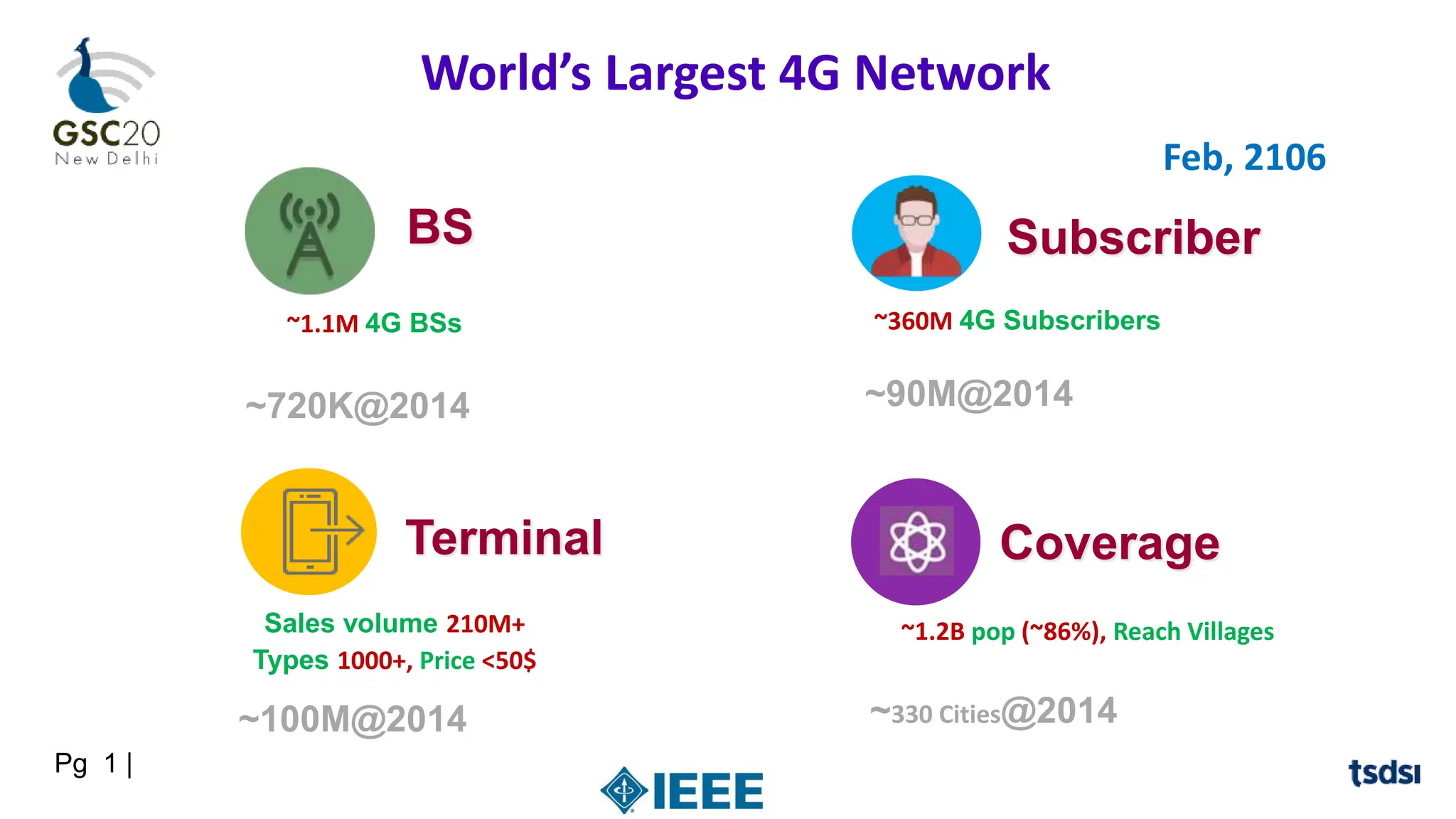
World’s Largest 4G Network
~1.1M 4G BSs
BS
~720K@2014
Terminal
Sales volume 210M+
Types 1000+, Price <50$
~100M@2014
~360M 4G Subscribers
Subscriber
~90M@2014
Coverage
~330 Cities@2014
Feb, 2106
~1.2B pop (~86%), Reach Villages
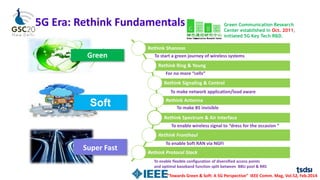
Green Communication Research
Center established in Oct. 2011,
initiated 5G Key Tech R&D.
Rethink Shannon
Rethink Ring & Young
Rethink Signaling & Control
Rethink Antenna
Rethink Spectrum & Air Interface
Rethink Fronthaul
Rethink Protocol Stack
To start a green journey of wireless systems
For no more “cells”
To make network application/load aware
To make BS invisible
To enable wireless signal to “dress for the occasion ”
To enable Soft RAN via NGFI
To enable flexible configuration of diversified access points
and optimal baseband function split between BBU pool & RRS
Green
Soft
Super Fast
“Towards Green & Soft: A 5G Perspective” IEEE Comm. Mag, Vol.52, Feb.2014
5G Era: Rethink Fundamentals
Pg 3 |
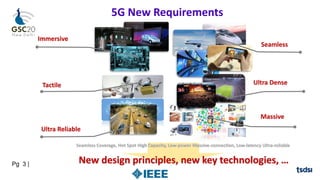
5G New Requirements
Immersive
Seamless
Tactile
Ultra Reliable
Massive
Ultra Dense
New design principles, new key technologies, …
Seamless Coverage, Hot Spot High Capacity, Low-power Massive-connection, Low-latency Ultra-reliable
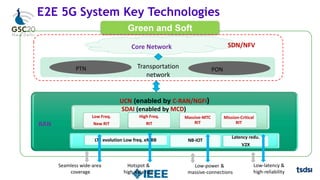
UCN (enabled by C-RAN/NGFI)
High Freq.
RIT
Low Freq.
New RIT
Massive-MTC
RIT
Mission-Critical
RIT
Low-latency &
high-reliability
Seamless wide-area
coverage
Hotspot &
high data rate
Low-power &
massive-connections
Green and Soft
SDAI (enabled by MCD)
LTE evolution Low freq. eMBB NB-IOT
Latency redu.
V2X
PTN PON
Transportation
network
Core Network SDN/NFV
RAN
E2E 5G System Key Technologies
Pg 5 |
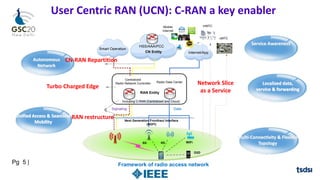
User Centric RAN (UCN): C-RAN a key enabler
Framework of radio access network
Localized data,
service & forwarding
Multi-Connectivity & Flexible
Topology
Autonomous
Network
Unified Access & Seamless
Mobility
Service Awareness
5G WiFi
4G
Signaling
Centralized
Radio Network Controller
广覆盖通用信令层
Macro signalling (data)
layer
本地数据接入点
Local Data Access
Data
D2D
Internet/App
Radio Data Center
RAN Entity
HSS/AAA/PCC
CN Entity
Smart Operation
Including C-RAN (Centralized and Cloud)
Next Generation Fronthaul Interface
(NGFI)
uMTC
mMTC
Mobile
Internet
CN-RAN Repartition
Turbo Charged Edge
RAN restructure
Network Slice
as a Service
Pg 6 |
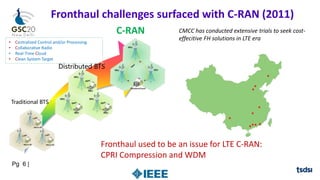
Fronthaul challenges surfaced with C-RAN (2011)
Traditional BTS
Distributed BTS
C-RAN
• Centralized Control and/or Processing
• Collaborative Radio
• Real-Time Cloud
• Clean System Target
Fronthaul used to be an issue for LTE C-RAN:
CPRI Compression and WDM
CMCC has conducted extensive trials to seek cost-
effecitive FH solutions in LTE era
Traditional BTS
Distributed BTS
Pg 7 |
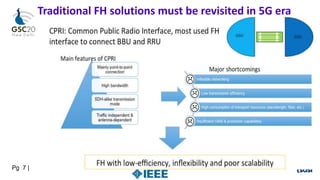
Traditional FH solutions must be revisited in 5G era
Pg 8 |
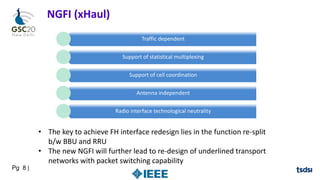
NGFI (xHaul)
Traffic dependent
Support of statistical multiplexing
Support of cell coordination
Antenna independent
Radio interface technological neutrality
• The key to achieve FH interface redesign lies in the function re-split
b/w BBU and RRU
• The new NGFI will further lead to re-design of underlined transport
networks with packet switching capability
Pg 9 |
Decoupling Ant./Non-ant. Related Processing
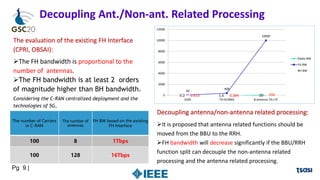
The evaluation of the existing FH Interface
(CPRI, OBSAI):
The FH bandwidth is proportional to the
number of antennas.
The FH bandwidth is at least 2 orders
of magnitude higher than BH bandwidth.
0.2 1.6 20
30
400
10000
0.013 0.384 150
0
2000
4000
6000
8000
10000
12000
GSM TD-SCDMA 8-antenna TD-LTE
Radio BW
FH BW
BH BW
Decoupling antenna/non-antenna related processing:
It is proposed that antenna related functions should be
moved from the BBU to the RRH.
FH bandwidth will decrease significantly if the BBU/RRH
function split can decouple the non-antenna related
processing and the antenna related processing.
Considering the C-RAN centralized deployment and the
technologies of 5G, FH is facing a bandwidth explosion.
The number of Carriers
in C-RAN
The number of
antennas
FH BW based on the existing
FH Interface
100 8 1Tbps
100 128 16Tbps
Pg 10 |
Decoupling cell/UE Processing
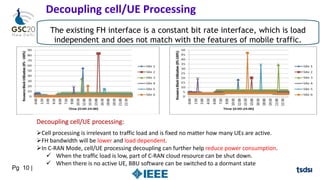
The existing FH interface is a constant bit rate interface, which is load
independent and does not match with the features of mobile traffic.
Decoupling cell/UE processing:
Cell processing is irrelevant to traffic load and is fixed no matter how many UEs are active.
FH bandwidth will be lower and load dependent.
In C-RAN Mode, cell/UE processing decoupling can further help reduce power consumption.
 When the traffic load is low, part of C-RAN cloud resource can be shut down.
 When there is no active UE, BBU software can be switched to a dormant state
Pg 11 |
S1 Termination
PDCP
RLC
Low MAC
Bit-level
Processing
Bit-level
Processing
Modulation
Layer Mapping
& Precoding
IDFT &
De-Modulation
Channel Estimation
& Equalization
Resource
Mapping & IFFT
FFT &
Resource De-Mapping
2
3
4
To RRU From RRU
5
High MAC
1"
1"
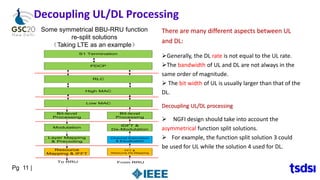
Some symmetrical BBU-RRU function
re-split solutions
(Taking LTE as an example)
There are many different aspects between UL
and DL:
Generally, the DL rate is not equal to the UL rate.
The bandwidth of UL and DL are not always in the
same order of magnitude.
 The bit width of UL is usually larger than that of the
DL.
Decoupling UL/DL processing
 NGFI design should take into account the
asymmetrical function split solutions.
 For example, the function split solution 3 could
be used for UL while the solution 4 used for DL.
Decoupling UL/DL Processing
Pg 12 |
NGFI Progress
下一代前传网络接口
白 皮 书
White Paper of
Next Generation Fronthaul Interface
Version 1.0
June 4th, 2015
China Mobile Research Institute
Alcatel-Lucent
Nokia Networks
ZTE Corporation
Broadcom Corporation
Intel China Research Center
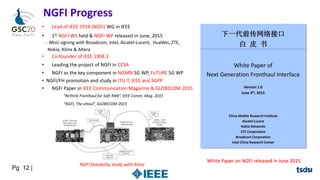
White Paper on NGFI released in June 2015
• Lead of IEEE 1914 (NGFI) WG in IEEE
• 1st NGFI WS held & NGFI WP released in June, 2015
- MoU signing with Broadcom, Intel, Alcatel-Lucent, HuaWei, ZTE,
Nokia, Xilinx & Altera
• Co-founder of IEEE 1904.3
• Leading the project of NGFI in CCSA
• NGFI as the key component in NGMN 5G WP, FuTURE 5G WP
• NGFI/FH promotion and study in ITU-T, IEEE and 3GPP
• NGFI Paper in IEEE Communication Magazine & GLOBECOM 2015
NGFI feasibility study with Xilinx
“Rethink Fronthaul for Soft RAN”, IEEE Comm. Mag. 2015
“NGFI, The xHaul”, GLOBECOM 2015
Pg 13 |
Challenges Ahead
 Mapping of FH to Ethernet packet, undergoing in IEEE 1904 WG
 Stage 1: CPRI encapsulation (applicable to 2G, 3G and 4G)
 Stage 2: NGFI encapsulation for 5G
 Latency
 To meet RT requirement of wireless communication
 Limited latency budget for FH (e.g. 250us defined in NGMN for LTE C-RAN)
 Synchronization
 LTE Frequency sync. of 0.05ppm & phase accuracy of +/-1.5us
 Higher in 5G
 Transport of FH packets
 Over IP, MPLS, etc.
 E2E QoS
O&M, protection etc.
Pg 14 |
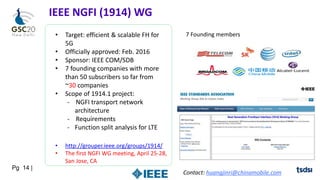
IEEE NGFI (1914) WG
7 Founding members
• Target: efficient & scalable FH for
5G
• Officially approved: Feb. 2016
• Sponsor: IEEE COM/SDB
• 7 founding companies with more
than 50 subscribers so far from
~30 companies
• Scope of 1914.1 project:
- NGFI transport network
architecture
- Requirements
- Function split analysis for LTE
• http://grouper.ieee.org/groups/1914/
• The first NGFI WG meeting, April 25-28,
San Jose, CA
Contact: huangjinri@chinamobile.com

GSC22_Session_5G-An Introduction and Overview.ppt

  • 1.
    Pg 1 | World’sLargest 4G Network ~1.1M 4G BSs BS ~720K@2014 Terminal Sales volume 210M+ Types 1000+, Price <50$ ~100M@2014 ~360M 4G Subscribers Subscriber ~90M@2014 Coverage ~330 Cities@2014 Feb, 2106 ~1.2B pop (~86%), Reach Villages
  • 2.
    Green Communication Research Centerestablished in Oct. 2011, initiated 5G Key Tech R&D. Rethink Shannon Rethink Ring & Young Rethink Signaling & Control Rethink Antenna Rethink Spectrum & Air Interface Rethink Fronthaul Rethink Protocol Stack To start a green journey of wireless systems For no more “cells” To make network application/load aware To make BS invisible To enable wireless signal to “dress for the occasion ” To enable Soft RAN via NGFI To enable flexible configuration of diversified access points and optimal baseband function split between BBU pool & RRS Green Soft Super Fast “Towards Green & Soft: A 5G Perspective” IEEE Comm. Mag, Vol.52, Feb.2014 5G Era: Rethink Fundamentals
  • 3.
    Pg 3 | 5GNew Requirements Immersive Seamless Tactile Ultra Reliable Massive Ultra Dense New design principles, new key technologies, … Seamless Coverage, Hot Spot High Capacity, Low-power Massive-connection, Low-latency Ultra-reliable
  • 4.
    UCN (enabled byC-RAN/NGFI) High Freq. RIT Low Freq. New RIT Massive-MTC RIT Mission-Critical RIT Low-latency & high-reliability Seamless wide-area coverage Hotspot & high data rate Low-power & massive-connections Green and Soft SDAI (enabled by MCD) LTE evolution Low freq. eMBB NB-IOT Latency redu. V2X PTN PON Transportation network Core Network SDN/NFV RAN E2E 5G System Key Technologies
  • 5.
    Pg 5 | UserCentric RAN (UCN): C-RAN a key enabler Framework of radio access network Localized data, service & forwarding Multi-Connectivity & Flexible Topology Autonomous Network Unified Access & Seamless Mobility Service Awareness 5G WiFi 4G Signaling Centralized Radio Network Controller 广覆盖通用信令层 Macro signalling (data) layer 本地数据接入点 Local Data Access Data D2D Internet/App Radio Data Center RAN Entity HSS/AAA/PCC CN Entity Smart Operation Including C-RAN (Centralized and Cloud) Next Generation Fronthaul Interface (NGFI) uMTC mMTC Mobile Internet CN-RAN Repartition Turbo Charged Edge RAN restructure Network Slice as a Service
  • 6.
    Pg 6 | Fronthaulchallenges surfaced with C-RAN (2011) Traditional BTS Distributed BTS C-RAN • Centralized Control and/or Processing • Collaborative Radio • Real-Time Cloud • Clean System Target Fronthaul used to be an issue for LTE C-RAN: CPRI Compression and WDM CMCC has conducted extensive trials to seek cost- effecitive FH solutions in LTE era Traditional BTS Distributed BTS
  • 7.
    Pg 7 | TraditionalFH solutions must be revisited in 5G era
  • 8.
    Pg 8 | NGFI(xHaul) Traffic dependent Support of statistical multiplexing Support of cell coordination Antenna independent Radio interface technological neutrality • The key to achieve FH interface redesign lies in the function re-split b/w BBU and RRU • The new NGFI will further lead to re-design of underlined transport networks with packet switching capability
  • 9.
    Pg 9 | DecouplingAnt./Non-ant. Related Processing The evaluation of the existing FH Interface (CPRI, OBSAI): The FH bandwidth is proportional to the number of antennas. The FH bandwidth is at least 2 orders of magnitude higher than BH bandwidth. 0.2 1.6 20 30 400 10000 0.013 0.384 150 0 2000 4000 6000 8000 10000 12000 GSM TD-SCDMA 8-antenna TD-LTE Radio BW FH BW BH BW Decoupling antenna/non-antenna related processing: It is proposed that antenna related functions should be moved from the BBU to the RRH. FH bandwidth will decrease significantly if the BBU/RRH function split can decouple the non-antenna related processing and the antenna related processing. Considering the C-RAN centralized deployment and the technologies of 5G, FH is facing a bandwidth explosion. The number of Carriers in C-RAN The number of antennas FH BW based on the existing FH Interface 100 8 1Tbps 100 128 16Tbps
  • 10.
    Pg 10 | Decouplingcell/UE Processing The existing FH interface is a constant bit rate interface, which is load independent and does not match with the features of mobile traffic. Decoupling cell/UE processing: Cell processing is irrelevant to traffic load and is fixed no matter how many UEs are active. FH bandwidth will be lower and load dependent. In C-RAN Mode, cell/UE processing decoupling can further help reduce power consumption.  When the traffic load is low, part of C-RAN cloud resource can be shut down.  When there is no active UE, BBU software can be switched to a dormant state
  • 11.
    Pg 11 | S1Termination PDCP RLC Low MAC Bit-level Processing Bit-level Processing Modulation Layer Mapping & Precoding IDFT & De-Modulation Channel Estimation & Equalization Resource Mapping & IFFT FFT & Resource De-Mapping 2 3 4 To RRU From RRU 5 High MAC 1" 1" Some symmetrical BBU-RRU function re-split solutions (Taking LTE as an example) There are many different aspects between UL and DL: Generally, the DL rate is not equal to the UL rate. The bandwidth of UL and DL are not always in the same order of magnitude.  The bit width of UL is usually larger than that of the DL. Decoupling UL/DL processing  NGFI design should take into account the asymmetrical function split solutions.  For example, the function split solution 3 could be used for UL while the solution 4 used for DL. Decoupling UL/DL Processing
  • 12.
    Pg 12 | NGFIProgress 下一代前传网络接口 白 皮 书 White Paper of Next Generation Fronthaul Interface Version 1.0 June 4th, 2015 China Mobile Research Institute Alcatel-Lucent Nokia Networks ZTE Corporation Broadcom Corporation Intel China Research Center White Paper on NGFI released in June 2015 • Lead of IEEE 1914 (NGFI) WG in IEEE • 1st NGFI WS held & NGFI WP released in June, 2015 - MoU signing with Broadcom, Intel, Alcatel-Lucent, HuaWei, ZTE, Nokia, Xilinx & Altera • Co-founder of IEEE 1904.3 • Leading the project of NGFI in CCSA • NGFI as the key component in NGMN 5G WP, FuTURE 5G WP • NGFI/FH promotion and study in ITU-T, IEEE and 3GPP • NGFI Paper in IEEE Communication Magazine & GLOBECOM 2015 NGFI feasibility study with Xilinx “Rethink Fronthaul for Soft RAN”, IEEE Comm. Mag. 2015 “NGFI, The xHaul”, GLOBECOM 2015
  • 13.
    Pg 13 | ChallengesAhead  Mapping of FH to Ethernet packet, undergoing in IEEE 1904 WG  Stage 1: CPRI encapsulation (applicable to 2G, 3G and 4G)  Stage 2: NGFI encapsulation for 5G  Latency  To meet RT requirement of wireless communication  Limited latency budget for FH (e.g. 250us defined in NGMN for LTE C-RAN)  Synchronization  LTE Frequency sync. of 0.05ppm & phase accuracy of +/-1.5us  Higher in 5G  Transport of FH packets  Over IP, MPLS, etc.  E2E QoS O&M, protection etc.
  • 14.
    Pg 14 | IEEENGFI (1914) WG 7 Founding members • Target: efficient & scalable FH for 5G • Officially approved: Feb. 2016 • Sponsor: IEEE COM/SDB • 7 founding companies with more than 50 subscribers so far from ~30 companies • Scope of 1914.1 project: - NGFI transport network architecture - Requirements - Function split analysis for LTE • http://grouper.ieee.org/groups/1914/ • The first NGFI WG meeting, April 25-28, San Jose, CA Contact: huangjinri@chinamobile.com