E3

                             Cognitive Radio:
                             Industry Perspective


                                                              Jens Gebert
                                                              Alcatel-Lucent


First IBBT-MIT Joint Workshop on Cognitive Radio Standardization & Markets

           May 11, 2009   Cognitive Radio: Industry Perspective      Slide 1
E3                    E3 – Overview

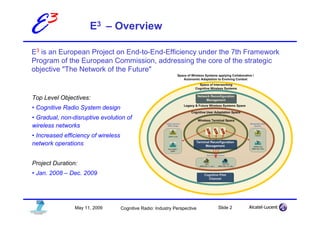
E3 is an European Project on End-to-End-Efficiency under the 7th Framework
Program of the European Commission, addressing the core of the strategic
objective "The Network of the Future"


Top Level Objectives:
• Cognitive Radio System design
• Gradual, non-disruptive evolution of
wireless networks
• Increased efficiency of wireless
network operations


Project Duration:
• Jan. 2008 – Dec. 2009


                May 11, 2009         Cognitive Radio: Industry Perspective   Slide 2
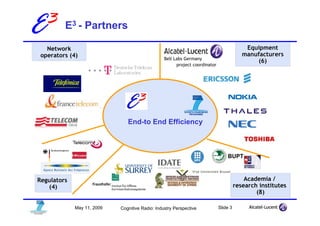
E3       E3 - Partners

   Network                                                                                 Equipment
 operators (4)                                                                            manufacturers
                                                 Bell Labs Germany
                                                                                               (6)
                                                       project coordinator


                               End-to End Efficiency


                                                                                 BUPT


Regulators                                                                                 Academia /
   (4)                                                                                 research institutes
                                                                                               (8)

             May 11, 2009   Cognitive Radio: Industry Perspective            Slide 3
E3Cognitive Radio Aspects: Evolution
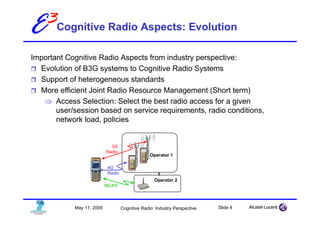
Important Cognitive Radio Aspects from industry perspective:
  Evolution of B3G systems to Cognitive Radio Systems
  Support of heterogeneous standards
  More efficient Joint Radio Resource Management (Short term)
   ⇒ Access Selection: Select the best radio access for a given
       user/session based on service requirements, radio conditions,
       network load, policies


                             3G
                           Radio
                                                 Operator 1

                           4G
                           Radio
                                                   Operator 2
                           WLAN


            May 11, 2009           Cognitive Radio: Industry Perspective   Slide 4
E3            Flexible Use of Spectrum

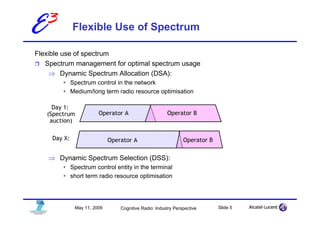
Flexible use of spectrum
   Spectrum management for optimal spectrum usage
     ⇒ Dynamic Spectrum Allocation (DSA):
        • Spectrum control in the network
        • Medium/long term radio resource optimisation

     Day 1:
   (Spectrum            Operator A                     Operator B
    auction)

     Day X:                  Operator A                        Operator B

    ⇒ Dynamic Spectrum Selection (DSS):
        • Spectrum control entity in the terminal
        • short term radio resource optimisation


              May 11, 2009       Cognitive Radio: Industry Perspective      Slide 5
E3           Examples for Flexible Use of Spectrum

Flexible use of spectrum (cont.)
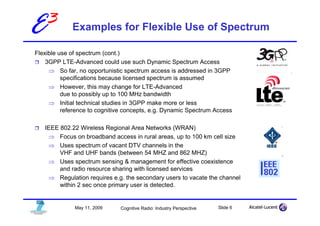
    3GPP LTE-Advanced could use such Dynamic Spectrum Access
     ⇒ So far, no opportunistic spectrum access is addressed in 3GPP
          specifications because licensed spectrum is assumed
     ⇒ However, this may change for LTE-Advanced
          due to possibly up to 100 MHz bandwidth
     ⇒ Initial technical studies in 3GPP make more or less
          reference to cognitive concepts, e.g. Dynamic Spectrum Access

   IEEE 802.22 Wireless Regional Area Networks (WRAN)
    ⇒ Focus on broadband access in rural areas, up to 100 km cell size
    ⇒ Uses spectrum of vacant DTV channels in the
        VHF and UHF bands (between 54 MHZ and 862 MHZ)
    ⇒ Uses spectrum sensing & management for effective coexistence
        and radio resource sharing with licensed services
    ⇒ Regulation requires e.g. the secondary users to vacate the channel
        within 2 sec once primary user is detected.


              May 11, 2009    Cognitive Radio: Industry Perspective   Slide 6
E3   Reconfigurable Base Stations and Terminals

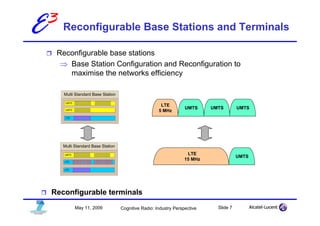
  Reconfigurable base stations
   ⇒ Base Station Configuration and Reconfiguration to
     maximise the networks efficiency

     Multi Standard Base Station
      UMTS
                                                      LTE
                                                                  UMTS     UMTS        UMTS
      LTE                                            5 MHz
      LTE


     Multi Standard Base Station
     UMTS                                                          LTE
                                                                                       UMTS
     LTE
                                                                  15 MHz

     LTE


 Reconfigurable terminals
             May 11, 2009          Cognitive Radio: Industry Perspective     Slide 7
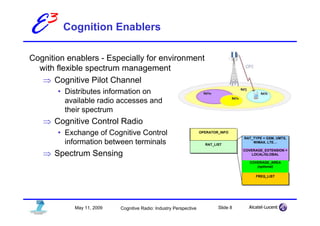
E3       Cognition Enablers

Cognition enablers - Especially for environment
  with flexible spectrum management
   ⇒ Cognitive Pilot Channel
       • Distributes information on
         available radio accesses and
         their spectrum
   ⇒ Cognitive Control Radio
       • Exchange of Cognitive Control                             OPERATOR_INFO
                                                                                     RAT_TYPE = GSM, UMTS,
         information between terminals                               RAT_LIST
                                                                                         WiMAX, LTE…

                                                                                     COVERAGE_EXTENSION =
   ⇒ Spectrum Sensing                                                                   LOCAL/GLOBAL

                                                                                       COVERAGE_AREA
                                                                                          (optional)

                                                                                          FREQ_LIST


            May 11, 2009   Cognitive Radio: Industry Perspective           Slide 8
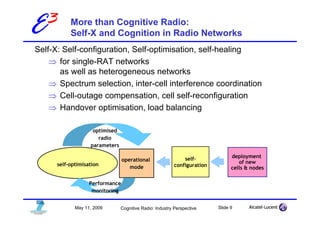
E3         More than Cognitive Radio:
           Self-X and Cognition in Radio Networks
Self-X: Self-configuration, Self-optimisation, self-healing
    ⇒ for single-RAT networks
       as well as heterogeneous networks
    ⇒ Spectrum selection, inter-cell interference coordination
    ⇒ Cell-outage compensation, cell self-reconfiguration
    ⇒ Handover optimisation, load balancing

                    optimised
                      radio
                   parameters

                                                              self-             deployment
                                 operational                                       of new
      self-optimisation             mode                  configuration         cells & nodes

                   Performance
                    monitoring


             May 11, 2009       Cognitive Radio: Industry Perspective     Slide 9
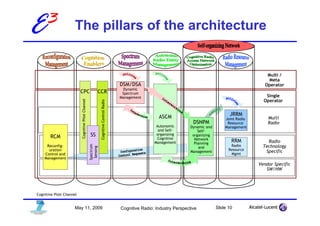
E3                   The pillars of the architecture


                                                                                                                                                               Multi /
                                                                                                                                                                Meta
                                                                                         DSM/DSA                                                              Operator
                                                                                          Dynamic
                          CPC                              CCR                            Spectrum
                                                                                         Management                                                           Single
                          Cognitive Pilot Channel


                                                               Cognitive Control Radio
                                                                                                                                                             Operator


                                                                                                           ASCM                                JRRM
                                                                                                                                             Joint Radio       Multi
                                                                                                                            DSNPM             Resource         Radio
                                                                                                          Autonomic        Dynamic and       Management
                                                                                                           and Self-           Self-
       RCM                                          SS                                                    organizing        organizing
                                                                                                          Cognitive          Network
                                                                                                         Management          Planning
                                                                                                                                                RRM            Radio
                                                    Spectrum


     Reconfig-                                                                                                                                  Radio        Technology
                                                     Sensing


                                                                                                                               and
      uration                                                                                                              Management          Resource       Specific
    Control and                                                                                                                                 Mgmt
    Management
                                                                                                                                                           Vendor Specific
                                                                                                                                                              SW/HW


Cognitive Pilot Channel


                     May 11, 2009                                                        Cognitive Radio: Industry Perspective           Slide 10
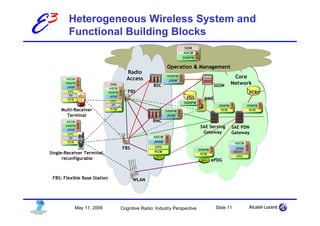
E3       Heterogeneous Wireless System and
         Functional Building Blocks


                                                     Operation & Management
                                 Radio
                                 Access                                               Core
                                               BSC                          SGSN     Network
                                  FBS                                                      PCRF
                                                               HSS      MME

      Multi-Receiver
        Terminal
                                              RNC
                                                                       SAE Serving   SAE PDN
                                                                        Gateway      Gateway


                               FBS
 Single-Receiver Terminal,
       reconfigurable                                                      ePDG


  FBS: Flexible Base Station         WLAN


            May 11, 2009       Cognitive Radio: Industry Perspective          Slide 11
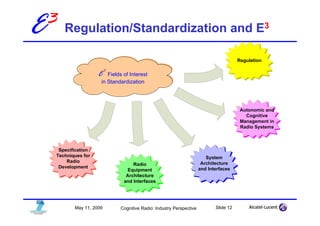
E3   Regulation/Standardization and E3

                                                                                     Regulation


                  E3 Fields of Interest
                   in Standardization


                                                                                      Autonomic and
                                                                                        Cognitive
                                                                                      Management in
                                                                                      Radio Systems


  Specification
 Techniques for                                                       System
     Radio                                                          Architecture
                                Radio
  Development                                                      and Interfaces
                              Equipment
                             Architecture
                            and Interfaces


        May 11, 2009       Cognitive Radio: Industry Perspective          Slide 12
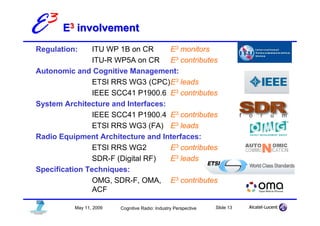
E3     E3 involvement
Regulation:     ITU WP 1B on CR     E3 monitors
                ITU-R WP5A on CR E3 contributes
Autonomic and Cognitive Management:
                ETSI RRS WG3 (CPC)E3 leads
                IEEE SCC41 P1900.6 E3 contributes
System Architecture and Interfaces:
                IEEE SCC41 P1900.4 E3 contributes
                ETSI RRS WG3 (FA) E3 leads
Radio Equipment Architecture and Interfaces:
                ETSI RRS WG2        E3 contributes
                SDR-F (Digital RF)  E3 leads
Specification Techniques:
                OMG, SDR-F, OMA, E3 contributes
                ACF

          May 11, 2009   Cognitive Radio: Industry Perspective   Slide 13
E3


                    Thank you!


 Acknowledgement
 This work was performed in project E3 which has received research funding from the
 Community's Seventh Framework program. This paper reflects only the authors' views and the
 Community is not liable for any use that may be made of the information contained therein. The
 contributions of colleagues from E3 consortium are hereby acknowledged.


              May 11, 2009       Cognitive Radio: Industry Perspective   Slide 14

Crsm 7 2009 Jens Gebert Alcatel Lucent

  • 1.
    E3 Cognitive Radio: Industry Perspective Jens Gebert Alcatel-Lucent First IBBT-MIT Joint Workshop on Cognitive Radio Standardization & Markets May 11, 2009 Cognitive Radio: Industry Perspective Slide 1
  • 2.
    E3 E3 – Overview E3 is an European Project on End-to-End-Efficiency under the 7th Framework Program of the European Commission, addressing the core of the strategic objective "The Network of the Future" Top Level Objectives: • Cognitive Radio System design • Gradual, non-disruptive evolution of wireless networks • Increased efficiency of wireless network operations Project Duration: • Jan. 2008 – Dec. 2009 May 11, 2009 Cognitive Radio: Industry Perspective Slide 2
  • 3.
    E3 E3 - Partners Network Equipment operators (4) manufacturers Bell Labs Germany (6) project coordinator End-to End Efficiency BUPT Regulators Academia / (4) research institutes (8) May 11, 2009 Cognitive Radio: Industry Perspective Slide 3
  • 4.
    E3Cognitive Radio Aspects:Evolution Important Cognitive Radio Aspects from industry perspective: Evolution of B3G systems to Cognitive Radio Systems Support of heterogeneous standards More efficient Joint Radio Resource Management (Short term) ⇒ Access Selection: Select the best radio access for a given user/session based on service requirements, radio conditions, network load, policies 3G Radio Operator 1 4G Radio Operator 2 WLAN May 11, 2009 Cognitive Radio: Industry Perspective Slide 4
  • 5.
    E3 Flexible Use of Spectrum Flexible use of spectrum Spectrum management for optimal spectrum usage ⇒ Dynamic Spectrum Allocation (DSA): • Spectrum control in the network • Medium/long term radio resource optimisation Day 1: (Spectrum Operator A Operator B auction) Day X: Operator A Operator B ⇒ Dynamic Spectrum Selection (DSS): • Spectrum control entity in the terminal • short term radio resource optimisation May 11, 2009 Cognitive Radio: Industry Perspective Slide 5
  • 6.
    E3 Examples for Flexible Use of Spectrum Flexible use of spectrum (cont.) 3GPP LTE-Advanced could use such Dynamic Spectrum Access ⇒ So far, no opportunistic spectrum access is addressed in 3GPP specifications because licensed spectrum is assumed ⇒ However, this may change for LTE-Advanced due to possibly up to 100 MHz bandwidth ⇒ Initial technical studies in 3GPP make more or less reference to cognitive concepts, e.g. Dynamic Spectrum Access IEEE 802.22 Wireless Regional Area Networks (WRAN) ⇒ Focus on broadband access in rural areas, up to 100 km cell size ⇒ Uses spectrum of vacant DTV channels in the VHF and UHF bands (between 54 MHZ and 862 MHZ) ⇒ Uses spectrum sensing & management for effective coexistence and radio resource sharing with licensed services ⇒ Regulation requires e.g. the secondary users to vacate the channel within 2 sec once primary user is detected. May 11, 2009 Cognitive Radio: Industry Perspective Slide 6
  • 7.
    E3 Reconfigurable Base Stations and Terminals Reconfigurable base stations ⇒ Base Station Configuration and Reconfiguration to maximise the networks efficiency Multi Standard Base Station UMTS LTE UMTS UMTS UMTS LTE 5 MHz LTE Multi Standard Base Station UMTS LTE UMTS LTE 15 MHz LTE Reconfigurable terminals May 11, 2009 Cognitive Radio: Industry Perspective Slide 7
  • 8.
    E3 Cognition Enablers Cognition enablers - Especially for environment with flexible spectrum management ⇒ Cognitive Pilot Channel • Distributes information on available radio accesses and their spectrum ⇒ Cognitive Control Radio • Exchange of Cognitive Control OPERATOR_INFO RAT_TYPE = GSM, UMTS, information between terminals RAT_LIST WiMAX, LTE… COVERAGE_EXTENSION = ⇒ Spectrum Sensing LOCAL/GLOBAL COVERAGE_AREA (optional) FREQ_LIST May 11, 2009 Cognitive Radio: Industry Perspective Slide 8
  • 9.
    E3 More than Cognitive Radio: Self-X and Cognition in Radio Networks Self-X: Self-configuration, Self-optimisation, self-healing ⇒ for single-RAT networks as well as heterogeneous networks ⇒ Spectrum selection, inter-cell interference coordination ⇒ Cell-outage compensation, cell self-reconfiguration ⇒ Handover optimisation, load balancing optimised radio parameters self- deployment operational of new self-optimisation mode configuration cells & nodes Performance monitoring May 11, 2009 Cognitive Radio: Industry Perspective Slide 9
  • 10.
    E3 The pillars of the architecture Multi / Meta DSM/DSA Operator Dynamic CPC CCR Spectrum Management Single Cognitive Pilot Channel Cognitive Control Radio Operator ASCM JRRM Joint Radio Multi DSNPM Resource Radio Autonomic Dynamic and Management and Self- Self- RCM SS organizing organizing Cognitive Network Management Planning RRM Radio Spectrum Reconfig- Radio Technology Sensing and uration Management Resource Specific Control and Mgmt Management Vendor Specific SW/HW Cognitive Pilot Channel May 11, 2009 Cognitive Radio: Industry Perspective Slide 10
  • 11.
    E3 Heterogeneous Wireless System and Functional Building Blocks Operation & Management Radio Access Core BSC SGSN Network FBS PCRF HSS MME Multi-Receiver Terminal RNC SAE Serving SAE PDN Gateway Gateway FBS Single-Receiver Terminal, reconfigurable ePDG FBS: Flexible Base Station WLAN May 11, 2009 Cognitive Radio: Industry Perspective Slide 11
  • 12.
    E3 Regulation/Standardization and E3 Regulation E3 Fields of Interest in Standardization Autonomic and Cognitive Management in Radio Systems Specification Techniques for System Radio Architecture Radio Development and Interfaces Equipment Architecture and Interfaces May 11, 2009 Cognitive Radio: Industry Perspective Slide 12
  • 13.
    E3 E3 involvement Regulation: ITU WP 1B on CR E3 monitors ITU-R WP5A on CR E3 contributes Autonomic and Cognitive Management: ETSI RRS WG3 (CPC)E3 leads IEEE SCC41 P1900.6 E3 contributes System Architecture and Interfaces: IEEE SCC41 P1900.4 E3 contributes ETSI RRS WG3 (FA) E3 leads Radio Equipment Architecture and Interfaces: ETSI RRS WG2 E3 contributes SDR-F (Digital RF) E3 leads Specification Techniques: OMG, SDR-F, OMA, E3 contributes ACF May 11, 2009 Cognitive Radio: Industry Perspective Slide 13
  • 14.
    E3 Thank you! Acknowledgement This work was performed in project E3 which has received research funding from the Community's Seventh Framework program. This paper reflects only the authors' views and the Community is not liable for any use that may be made of the information contained therein. The contributions of colleagues from E3 consortium are hereby acknowledged. May 11, 2009 Cognitive Radio: Industry Perspective Slide 14