06/06/2012
1
SEMINAIRE SCEE 
26 avril 2012
Supélec, campus de Rennes
Présentation : Vincent Savaux
April 17‐20, 2012
Poznań, Poland
An Iterative and Joint Estimation of SNR andAn Iterative and Joint Estimation of SNR and
Frequency Selective Channel for OFDM Systems
Authors :
Vincent Savaux , Yves Louët , Moïse Djoko‐Kouam and Alexandre Skrzypczak
Speaker: Vincent Savaux, PhD student
1,2 1 12
ECAM Rennes – Louis de Broglie, Rennes Campus, France
1 SUPELEC, Rennes Campus , France2
06/06/2012
2
An Iterative and Joint Estimation of SNR and
Frequency Selective Channel for OFDM Systems
1. Background
 System Model
 Estimation Methods
2. Proposed Method
 Presentation of the Algorithm
 Convergence of the Algorithm
3
3. Simulation Results
4. Conclusion
1.Background
System Model
In the frequency domain, the         received OFDM symbol is:
DFT size =
0
0
+
Matrix of the emitted
OFDM symbol
Frequency
channel response
AWGNVector of the received
OFDM symbol
4
with
: zero mean Gaussian process
: number of paths of the channel
:         path delay 
,
06/06/2012
3
1.Background
Estimation Methods ‐ Signal to noise ratio (SNR, noted    )
, with the second moment‐order of the received signal
[1]:         estimated thanks to the subtraction of two consecutive received
signal vectors
[2]:         estimated thanks to the subspace properties of the estimated
covariance matrix of the received signal
5
G. Ren, H. Zhang, and Y. Chang, “SNR Estimation Algorithm Based on the Preamble for OFDM Systems in Frequency Selective 
Channels,” IEEE Transactions on Communications, vol. 57, no. 8, August 2009.
X. Xu, Y. Jing, and X. Yu, “Subspace‐Based Noise Variance and SNR Estimation for OFDM Systems,” in IEEE Mobile Radio 
Applications Wireless Communication Networking Conference, March 2005, pp. 23 –26.
[1]
[2]
Our solution:         estimated thanks to the MMSE criterion
1.Background
Estimation Methods ‐ Noise estimation
MMSE criterion performed on the pilot (index   )
‐=
22
6
In practice: approximation of MMSE criterion
The noise variance estimation depends on the channel estimation quality 
06/06/2012
4
1.Background
Estimation Methods ‐ Channel estimation
Least square (LS) estimator: 
Linear minimum mean square error (LMMSE) estimator: 
,
with           the frequency covariance matrix of the channel
For the noise variance estimation:
7
LS estimator: not adapted for the noise variance estimation 
leads to 
LMMSE estimator: efficient estimator, adapted for the noise variance estimation 
requires nevertheless an estimation of the noise variance
2.Proposed Method
Presentation of the Algorithm
We suppose pilots as  
requiresProblem: , and  requires  
Solution an iterative algorithm
LMMSE 
channel 
estimation
Solution: an iterative algorithm
MMSE noise 
variance 
estimation
SNR
estimation
At each iteration   , we do
8
,
06/06/2012
5
2.Proposed Method
Presentation of the Algorithm
LMMSE 
h l
MMSE noise 
variance 
estimation
SNR
estimation
Initialization of the Algorithm:
If  , the LMMSE estimation is equivalent to the LS one: 
channel 
estimation
9
The initialization is chosen so that
2.Proposed Method
Convergence of the Algorithm ‐ noise variance
From the theoretical expression of the MMSE noise variance estimation:
eigenvalues of
C b l i ith
After some mathematical developments:
One example of f(x)
10
Convergence by solving                         with
Solution: the fixed point theorem
06/06/2012
6
2.Proposed Method
Convergence of the Algorithm
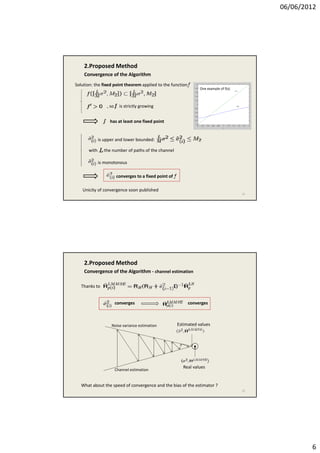
Solution: the fixed point theorem applied to the function            
One example of f(x)
is upper and lower bounded:
, so     is strictly growing 
has at least one fixed point
with the number of paths of the channel
11
is monotonous
converges to a fixed point of  
p
Unicity of convergence soon published
2.Proposed Method
Convergence of the Algorithm ‐ channel estimation
Thanks to 
Noise variance estimation
converges  converges 
Estimated values
12
Channel estimation
What about the speed of convergence and the bias of the estimator ?
Real values
06/06/2012
7
3.Simulation Results
Perfect covariance matrix: 
Approximate covariance matrix: 
Case 1:
Case 2:
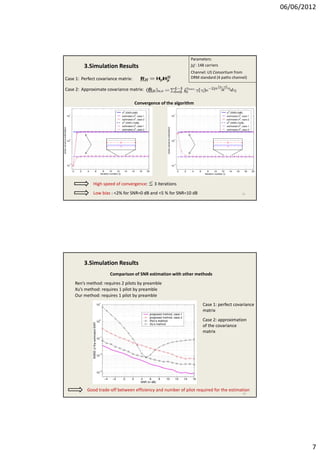
Convergence of the algorithm
Parameters:
: 148 carriers
Channel: US Consortium from
DRM standard (4 paths channel)
Convergence of the algorithm
13
High speed of convergence:      3 iterations   
Low bias : <2% for SNR=0 dB and <5 % for SNR=10 dB 
3.Simulation Results
Comparison of SNR estimation with other methods
Ren’s method: requires 2 pilots by preamble
Xu’s method: requires 1 pilot by preamble
Our method: requires 1 pilot by preamble
Case 1: perfect covariance
matrix
Case 2: approximation 
of the covariance
matrix
14
Good trade‐off between efficiency and number of pilot required for the estimation
06/06/2012
8
3.Simulation Results
Channel estimation
15
Proof by simulation of the convergence of the channel estimation
Gap between perfect estimation and Case 2 <0.5 dB (<0.1 dB in Case 1)
4.Conclusion
• New algorithm for joint estimation of SNR and multipath channel
• Proof of convergence of the algorithm
• Good quality of channel and SNR estimations with high speed of convergence
• Improvement of the trade‐off between the number of required pilots and quality of 
estimation, compared with existing methods in literature 
• Further works and publications :
‐Unicity of convergence of the algorithm
16
‐Development of a practical solution with an estimated frequency channel 
covariance matrix   
06/06/2012
9
Thank you for your attention
Questions ? …
17

2012 04-26 savaux