1


Principles of Economics


Chapter26

Saving,Investment,and the Financial System
2
What we learned 

from previous chapter	
•  Chapter23 :Components of GDP	
•  Chapter24 :Inflation rate CPI	
•  Chapter25 :A country's standard living depends on its ability
to produce goods and service and	
and productivity depends on	
–  physical capital	
–  human capital	
–  natural resources	
–  technological knowledge
3
	
	
How do we match one person's saving 	
with another person's investment?
4
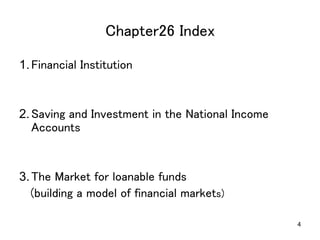
Chapter26 Index	
1. Financial Institution	
2. Saving and Investment in the National Income
Accounts	
3. The Market for loanable funds	
(building a model of financial markets)
5
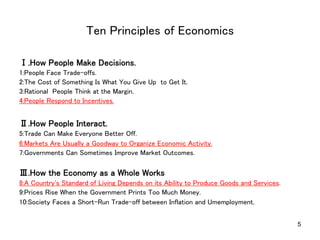
Ten Principles of Economics 	
Ⅰ.How People Make Decisions.	
1:People Face Trade-offs.	
2:The Cost of Something Is What You Give Up to Get It.	
3:Rational People Think at the Margin.	
4:People Respond to Incentives.	
	
Ⅱ.How People Interact.	
5:Trade Can Make Everyone Better Off.	
6:Markets Are Usually a Goodway to Organize Economic Activity.	
7:Governments Can Sometimes Improve Market Outcomes.	
	
Ⅲ.How the Economy as a Whole Works	
8:A Country's Standard of Living Depends on its Ability to Produce Goods and Services.	
9:Prices Rise When the Government Prints Too Much Money.	
10:Society Faces a Short-Run Trade-off between Inflation and Umemployment.
6
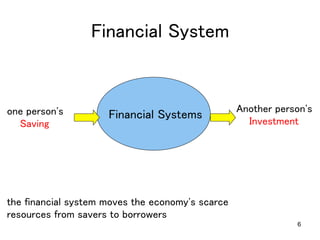
Financial System	
	
Financial Systems	
	
one person's 	
Saving	
Another person's	
Investment	
the financial system moves the economy's scarce 	
resources from savers to borrowers
7
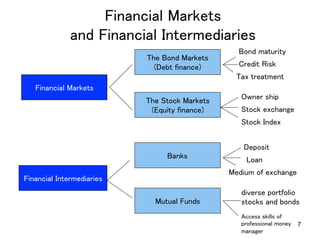
Financial Markets 

and Financial Intermediaries	
Financial Markets	
Financial Intermediaries	
The Bond Markets	
(Debt finance)	
The Stock Markets	
(Equity finance)	
Banks	
Mutual Funds	
Bond maturity	
Credit Risk	
Tax treatment	
Owner ship	
Stock exchange	
Stock Index	
Deposit	
Loan	
Medium of exchange	
Access skills of 	
professional money 	
manager	
diverse portfolio 	
stocks and bonds
8
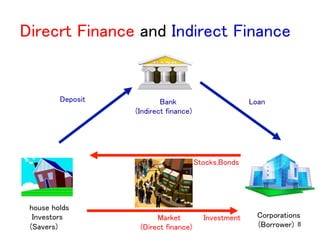
Direcrt Finance and Indirect Finance	
   Corporations	
(Borrower)	
Bank	
(Indirect finance)	
house holds	
Investors	
 (Savers)	
Deposit	
 Loan	
Market	
(Direct finance)	
Investment	
Stocks,Bonds
9
Chapter26 Index	
1. Financial Institution	
2. Saving and Investment in the National Income
Accounts	
3. The Market for loanable funds	
(building a model of financial markets)
10
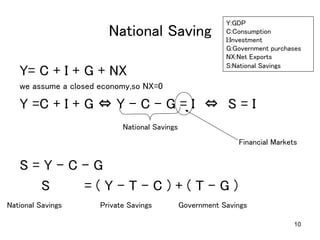
National Saving 	
Y= C + I + G + NX	
we assume a closed economy,so NX=0	
Y =C + I + G ⇔ Y - C - G = I ⇔ S = I	
	
	
S = Y - C - G	
S = ( Y - T - C ) + ( T - G )         
	
	
National Savings	
National Savings	
 Private Savings	
 Government Savings	
Y:GDP	
C:Consumption	
I:Investment	
G:Government purchases	
NX:Net Exports	
S:National Savings	
Financial Markets
11
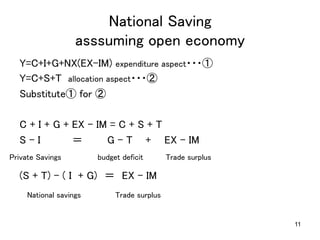
National Saving 

asssuming open economy	
Y=C+I+G+NX(EX-IM) expenditure aspect・・・①	
Y=C+S+T allocation aspect・・・②	
Substitute① for ②	
	
C + I + G + EX - IM = C + S + T	
S - I     =    G - T +  EX - IM	
	
(S + T) - ( I + G) = EX - IM	
	
Private Savings	
 budget deficit	
National savings	
 Trade surplus	
Trade surplus
12
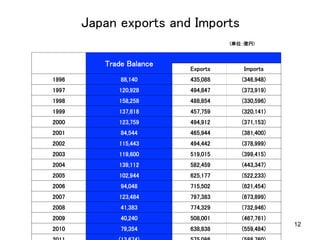
Japan exports and Imports	
(単位:億円)
Trade Balance	
Exports 	
 Imports	
1996	
 88,140 	
 435,088 	
 (346,948)	
1997	
 120,928 	
 494,847 	
 (373,919)	
1998	
 158,258 	
 488,854 	
 (330,596)	
1999	
 137,618 	
 457,759 	
 (320,141)	
2000	
 123,759 	
 494,912 	
 (371,153)	
2001	
 84,544 	
 465,944 	
 (381,400)	
2002	
 115,443 	
 494,442 	
 (378,999)	
2003	
 119,600 	
 519,015 	
 (399,415)	
2004	
 139,112 	
 582,459 	
 (443,347)	
2005	
 102,944 	
 625,177 	
 (522,233)	
2006	
 94,048 	
 715,502 	
 (621,454)	
2007	
 123,484 	
 797,383 	
 (673,899)	
2008	
 41,383 	
 774,329 	
 (732,946)	
2009	
 40,240 	
 508,001 	
 (467,761)	
2010	
 79,354 	
 638,838 	
 (559,484)
13
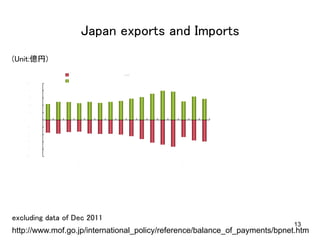
Japan exports and Imports	
(Unit:億円)	
	
excluding data of Dec 2011	
http://www.mof.go.jp/international_policy/reference/balance_of_payments/bpnet.htm
14
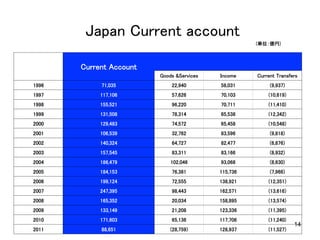
(単位:億円)
Current Account 	
Goods &Services	
 Income	
 Current Transfers	
1996	
 71,035 	
 22,940 	
 58,031 	
 (9,937)	
1997	
 117,106 	
 57,626 	
 70,103 	
 (10,619)	
1998	
 155,521 	
 96,220 	
 70,711 	
 (11,410)	
1999	
 131,508 	
 78,314 	
 65,538 	
 (12,342)	
2000	
 129,483 	
 74,572 	
 65,458 	
 (10,548)	
2001	
 106,539 	
 32,762 	
 83,596 	
 (9,818)	
2002	
 140,324 	
 64,727 	
 82,477 	
 (6,876)	
2003	
 157,545 	
 83,311 	
 83,166 	
 (8,932)	
2004	
 186,479 	
 102,046 	
 93,068 	
 (8,630)	
2005	
 184,153 	
 76,381 	
 115,736 	
 (7,966)	
2006	
 199,124 	
 72,555 	
 138,921 	
 (12,351)	
2007	
 247,395 	
 98,443 	
 162,571 	
 (13,616)	
2008	
 165,352 	
 20,034 	
 158,895 	
 (13,574)	
2009	
 133,149 	
 21,208 	
 123,336 	
 (11,395)	
2010	
 171,603 	
 65,136 	
 117,706 	
 (11,240)	
2011	
 88,651 	
 (28,759)	
 128,937 	
 (11,527)	
Japan Current account
15
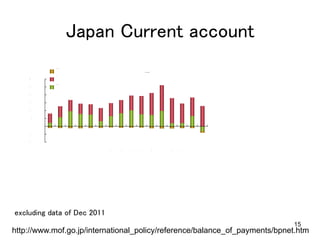
Japan Current account 	
excluding data of Dec 2011	
http://www.mof.go.jp/international_policy/reference/balance_of_payments/bpnet.htm
16
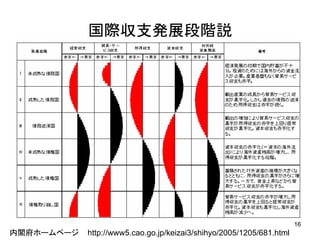
国際収支発展段階説	
内閣府ホームページ	
 http://www5.cao.go.jp/keizai3/shihyo/2005/1205/681.html
17
The meaning of 

saving and investment	
In a language of macroeconomics,	
	
q Investment:	
the purchase of new capital,such as
equipment or building.	
	
q Buying stocks or bonds:	
savings rather than investment.
18
Chapter26 Index	
1. Financial Institution	
2. Saving and Investment in the National Income
Accounts	
3. The Market for loanable funds	
(building a model of financial markets)
19
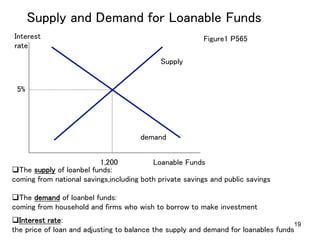
Supply and Demand for Loanable Funds	
5%	
1,200	
Interest 	
rate	
Loanable Funds	
Supply	
demand	
q The supply of loanbel funds:	
coming from national savings,including both private savings and public savings	
q The demand of loanbel funds:	
coming from household and firms who wish to borrow to make investment	
Figure1 P565	
q Interest rate:	
the price of loan and adjusting to balance the supply and demand for loanables funds
20
Three steps to analyzing changes in

equilibrimu from Chapter4	
1.  Decide wether the event shifts the supply or demand
curve(or perhaps both)	
2.  Decide in which direction the curve shifts	
3.  Use the supply-and-supply diagram to see how the shifts
changes the equilibrium price and quantity.
21
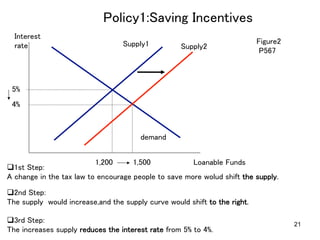
Policy1:Saving Incentives	
5%	
1,200	
Interest 	
rate	
Loanable Funds	
Supply1	
demand	
q 1st Step:	
A change in the tax law to encourage people to save more wolud shift the supply.	
q 2nd Step:	
The supply would increase,and the supply curve would shift to the right.	
Figure2	
P567	
q 3rd Step:	
The increases supply reduces the interest rate from 5% to 4%.	
4%	
Supply2	
1,500
22
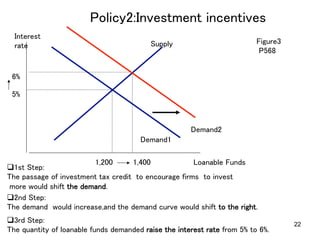
Policy2:Investment incentives	
6%	
1,200	
Interest 	
rate	
Loanable Funds	
Supply	
Demand1	
q 1st Step:	
The passage of investment tax credit to encourage firms to invest 	
more would shift the demand.	
q 2nd Step:	
The demand would increase,and the demand curve would shift to the right.	
Figure3	
P568	
q 3rd Step:	
The quantity of loanable funds demanded raise the interest rate from 5% to 6%.	
5%	
1,400	
Demand2
23
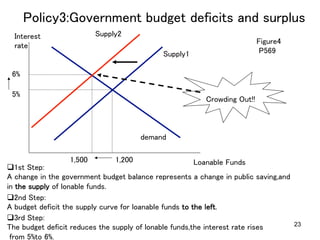
Policy3:Government budget deficits and surplus	
6%	
1,200	
Interest 	
rate	
Loanable Funds	
Supply1	
demand	
q 1st Step:	
A change in the government budget balance represents a change in public saving,and 	
in the supply of lonable funds. 	
q 2nd Step:	
A budget deficit the supply curve for loanable funds to the left.	
Figure4	
P569	
q 3rd Step:	
The budget deficit reduces the supply of lonable funds,the interest rate rises	
from 5%to 6%.	
5%	
Supply2	
1,500	
Crowding Out!!
24
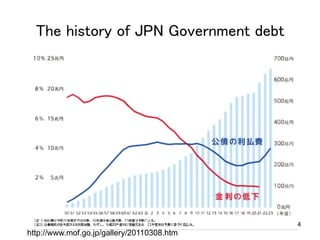
The history of JPN Government debt	
http://www.mof.go.jp/gallery/20110308.htm
25
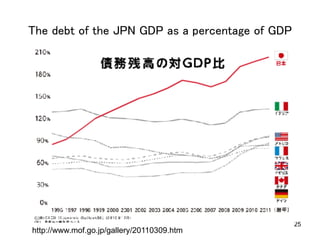
The debt of the JPN GDP as a percentage of GDP	
http://www.mof.go.jp/gallery/20110309.htm
26
Conclusion	
•  Financial markets serve the important role of linking the
present and the future	
•  Those who supply loanable funds do so because they want
to convert some of their current income into future
purchasing power.	
•  Well-functioning financial markets are important not only for
current generations but also for future generations.

20120129 mankiw economics chapter26

  • 1.
  • 2.
    2 What we learned
 from previous chapter •  Chapter23 :Components of GDP •  Chapter24 :Inflation rate CPI •  Chapter25 :A country's standard living depends on its ability to produce goods and service and and productivity depends on –  physical capital –  human capital –  natural resources –  technological knowledge
  • 3.
    3 How do wematch one person's saving with another person's investment?
  • 4.
    4 Chapter26 Index 1. Financial Institution 2. Savingand Investment in the National Income Accounts 3. The Market for loanable funds (building a model of financial markets)
  • 5.
    5 Ten Principles ofEconomics Ⅰ.How People Make Decisions. 1:People Face Trade-offs. 2:The Cost of Something Is What You Give Up to Get It. 3:Rational People Think at the Margin. 4:People Respond to Incentives. Ⅱ.How People Interact. 5:Trade Can Make Everyone Better Off. 6:Markets Are Usually a Goodway to Organize Economic Activity. 7:Governments Can Sometimes Improve Market Outcomes. Ⅲ.How the Economy as a Whole Works 8:A Country's Standard of Living Depends on its Ability to Produce Goods and Services. 9:Prices Rise When the Government Prints Too Much Money. 10:Society Faces a Short-Run Trade-off between Inflation and Umemployment.
  • 6.
    6 Financial System Financial Systems oneperson's Saving Another person's Investment the financial system moves the economy's scarce resources from savers to borrowers
  • 7.
    7 Financial Markets 
 andFinancial Intermediaries Financial Markets Financial Intermediaries The Bond Markets (Debt finance) The Stock Markets (Equity finance) Banks Mutual Funds Bond maturity Credit Risk Tax treatment Owner ship Stock exchange Stock Index Deposit Loan Medium of exchange Access skills of professional money manager diverse portfolio stocks and bonds
  • 8.
    8 Direcrt Finance andIndirect Finance    Corporations (Borrower) Bank (Indirect finance) house holds Investors  (Savers) Deposit Loan Market (Direct finance) Investment Stocks,Bonds
  • 9.
    9 Chapter26 Index 1. Financial Institution 2. Savingand Investment in the National Income Accounts 3. The Market for loanable funds (building a model of financial markets)
  • 10.
    10 National Saving Y=C + I + G + NX we assume a closed economy,so NX=0 Y =C + I + G ⇔ Y - C - G = I ⇔ S = I S = Y - C - G S = ( Y - T - C ) + ( T - G )          National Savings National Savings Private Savings Government Savings Y:GDP C:Consumption I:Investment G:Government purchases NX:Net Exports S:National Savings Financial Markets
  • 11.
    11 National Saving 
 asssumingopen economy Y=C+I+G+NX(EX-IM) expenditure aspect・・・① Y=C+S+T allocation aspect・・・② Substitute① for ② C + I + G + EX - IM = C + S + T S - I     =    G - T +  EX - IM (S + T) - ( I + G) = EX - IM Private Savings budget deficit National savings Trade surplus Trade surplus
  • 12.
    12 Japan exports andImports (単位:億円) Trade Balance Exports Imports 1996 88,140 435,088 (346,948) 1997 120,928 494,847 (373,919) 1998 158,258 488,854 (330,596) 1999 137,618 457,759 (320,141) 2000 123,759 494,912 (371,153) 2001 84,544 465,944 (381,400) 2002 115,443 494,442 (378,999) 2003 119,600 519,015 (399,415) 2004 139,112 582,459 (443,347) 2005 102,944 625,177 (522,233) 2006 94,048 715,502 (621,454) 2007 123,484 797,383 (673,899) 2008 41,383 774,329 (732,946) 2009 40,240 508,001 (467,761) 2010 79,354 638,838 (559,484)
  • 13.
    13 Japan exports andImports (Unit:億円) excluding data of Dec 2011 http://www.mof.go.jp/international_policy/reference/balance_of_payments/bpnet.htm
  • 14.
    14 (単位:億円) Current Account Goods&Services Income Current Transfers 1996 71,035 22,940 58,031 (9,937) 1997 117,106 57,626 70,103 (10,619) 1998 155,521 96,220 70,711 (11,410) 1999 131,508 78,314 65,538 (12,342) 2000 129,483 74,572 65,458 (10,548) 2001 106,539 32,762 83,596 (9,818) 2002 140,324 64,727 82,477 (6,876) 2003 157,545 83,311 83,166 (8,932) 2004 186,479 102,046 93,068 (8,630) 2005 184,153 76,381 115,736 (7,966) 2006 199,124 72,555 138,921 (12,351) 2007 247,395 98,443 162,571 (13,616) 2008 165,352 20,034 158,895 (13,574) 2009 133,149 21,208 123,336 (11,395) 2010 171,603 65,136 117,706 (11,240) 2011 88,651 (28,759) 128,937 (11,527) Japan Current account
  • 15.
    15 Japan Current account excluding data of Dec 2011 http://www.mof.go.jp/international_policy/reference/balance_of_payments/bpnet.htm
  • 16.
  • 17.
    17 The meaning of
 saving and investment In a language of macroeconomics, q Investment: the purchase of new capital,such as equipment or building. q Buying stocks or bonds: savings rather than investment.
  • 18.
    18 Chapter26 Index 1. Financial Institution 2. Savingand Investment in the National Income Accounts 3. The Market for loanable funds (building a model of financial markets)
  • 19.
    19 Supply and Demandfor Loanable Funds 5% 1,200 Interest rate Loanable Funds Supply demand q The supply of loanbel funds: coming from national savings,including both private savings and public savings q The demand of loanbel funds: coming from household and firms who wish to borrow to make investment Figure1 P565 q Interest rate: the price of loan and adjusting to balance the supply and demand for loanables funds
  • 20.
    20 Three steps toanalyzing changes in
 equilibrimu from Chapter4 1.  Decide wether the event shifts the supply or demand curve(or perhaps both) 2.  Decide in which direction the curve shifts 3.  Use the supply-and-supply diagram to see how the shifts changes the equilibrium price and quantity.
  • 21.
    21 Policy1:Saving Incentives 5% 1,200 Interest rate LoanableFunds Supply1 demand q 1st Step: A change in the tax law to encourage people to save more wolud shift the supply. q 2nd Step: The supply would increase,and the supply curve would shift to the right. Figure2 P567 q 3rd Step: The increases supply reduces the interest rate from 5% to 4%. 4% Supply2 1,500
  • 22.
    22 Policy2:Investment incentives 6% 1,200 Interest rate LoanableFunds Supply Demand1 q 1st Step: The passage of investment tax credit to encourage firms to invest more would shift the demand. q 2nd Step: The demand would increase,and the demand curve would shift to the right. Figure3 P568 q 3rd Step: The quantity of loanable funds demanded raise the interest rate from 5% to 6%. 5% 1,400 Demand2
  • 23.
    23 Policy3:Government budget deficitsand surplus 6% 1,200 Interest rate Loanable Funds Supply1 demand q 1st Step: A change in the government budget balance represents a change in public saving,and in the supply of lonable funds. q 2nd Step: A budget deficit the supply curve for loanable funds to the left. Figure4 P569 q 3rd Step: The budget deficit reduces the supply of lonable funds,the interest rate rises from 5%to 6%. 5% Supply2 1,500 Crowding Out!!
  • 24.
    24 The history ofJPN Government debt http://www.mof.go.jp/gallery/20110308.htm
  • 25.
    25 The debt ofthe JPN GDP as a percentage of GDP http://www.mof.go.jp/gallery/20110309.htm
  • 26.
    26 Conclusion •  Financial marketsserve the important role of linking the present and the future •  Those who supply loanable funds do so because they want to convert some of their current income into future purchasing power. •  Well-functioning financial markets are important not only for current generations but also for future generations.