RtB
Internaionalization
Creative Commons License
Quantum Integration
International BusinessStephan Langdon, MBA, M.ED
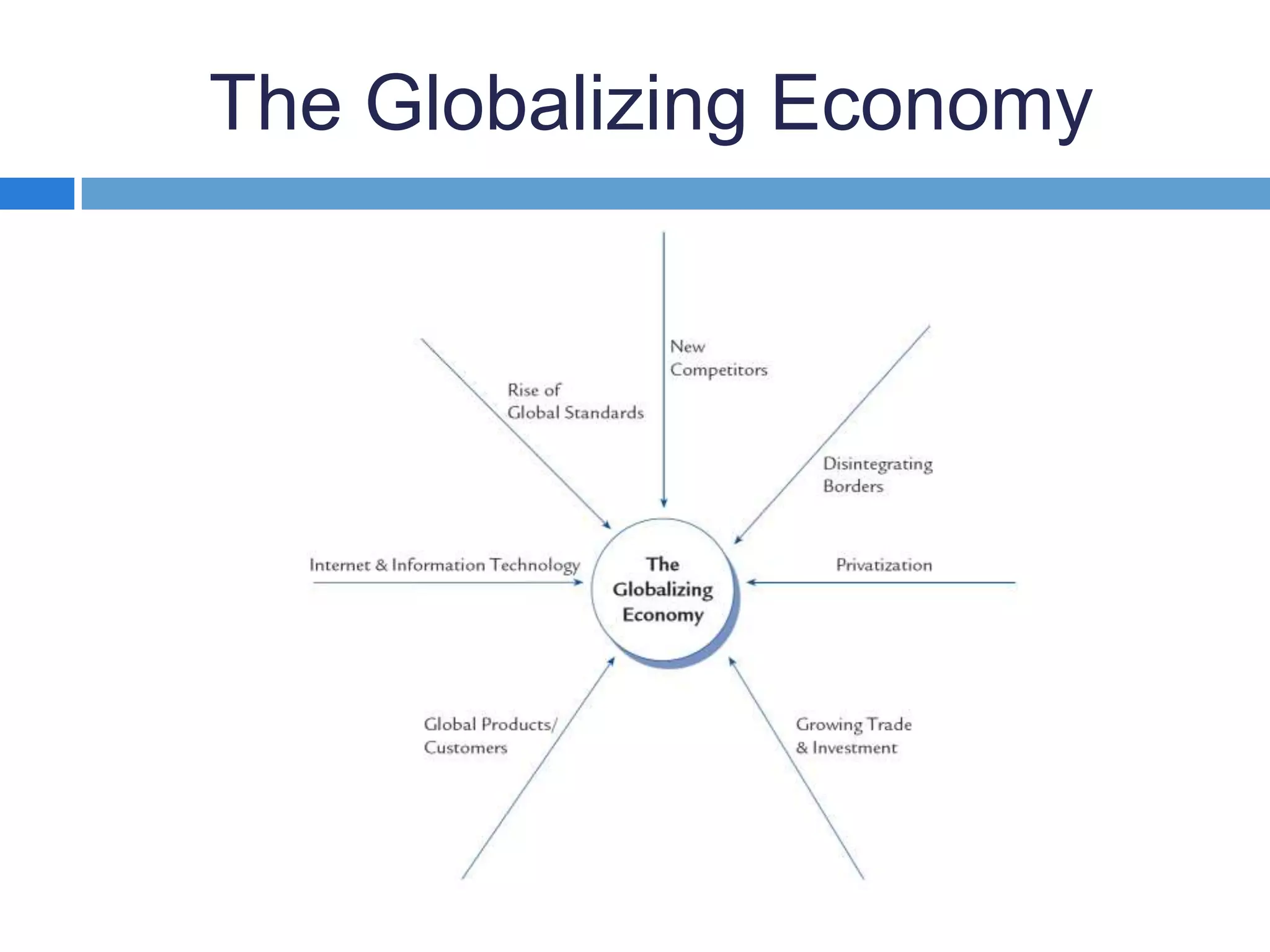
The Globalizing Economy
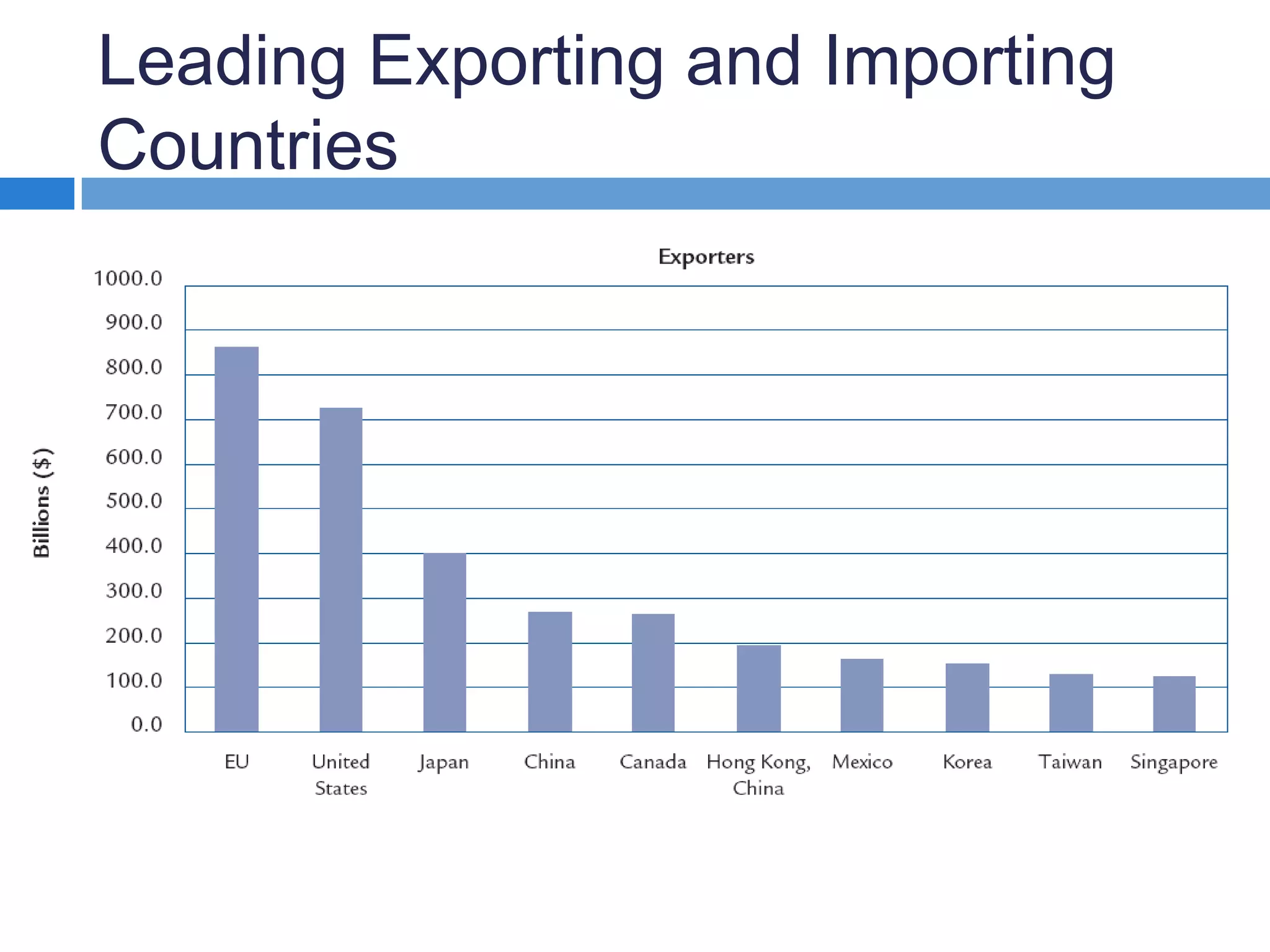
Leading Exporting and Importing Countries
Leading Exporting and Importing Countries, continued
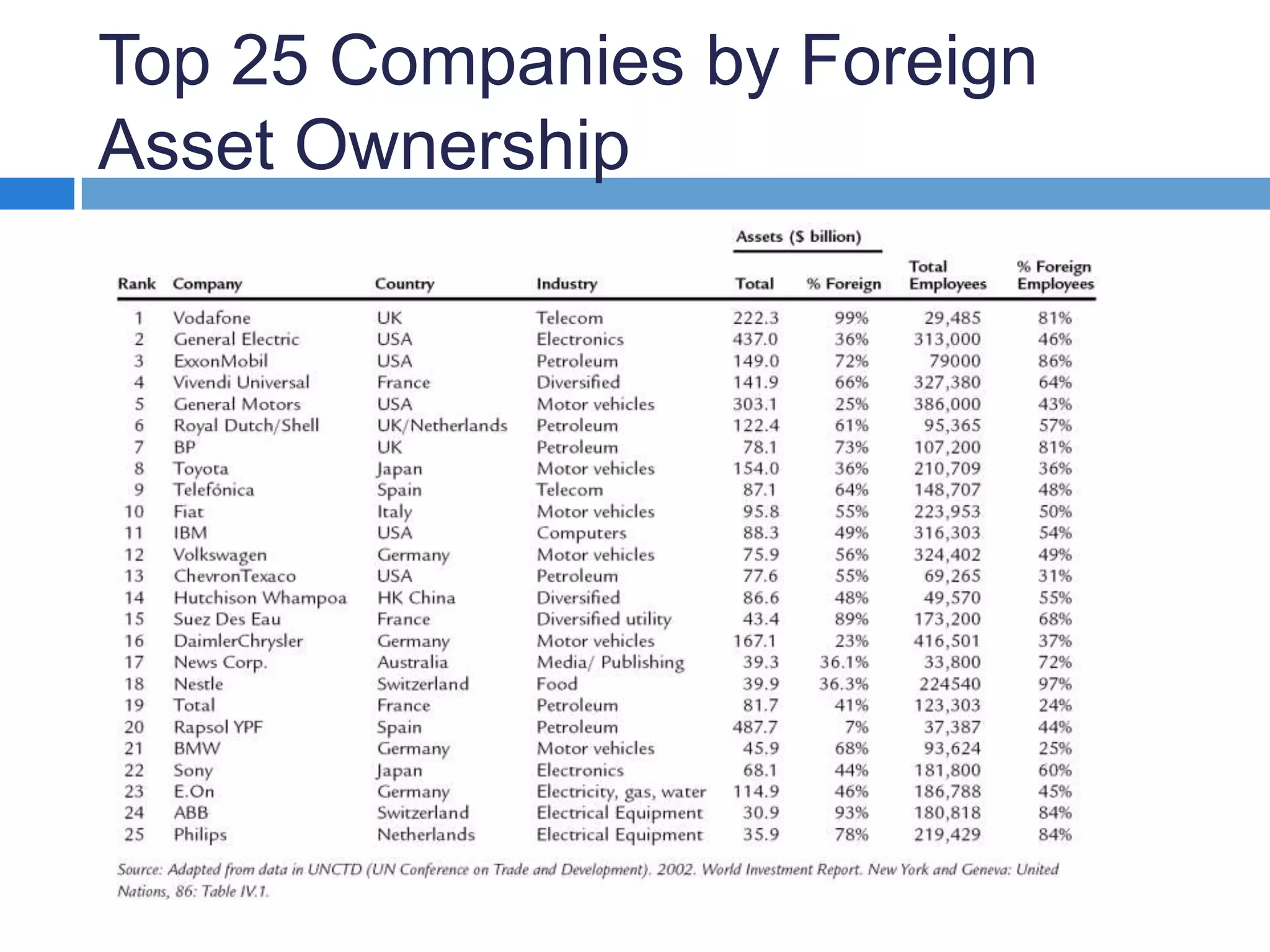
Top 25 Companies by Foreign Asset Ownership
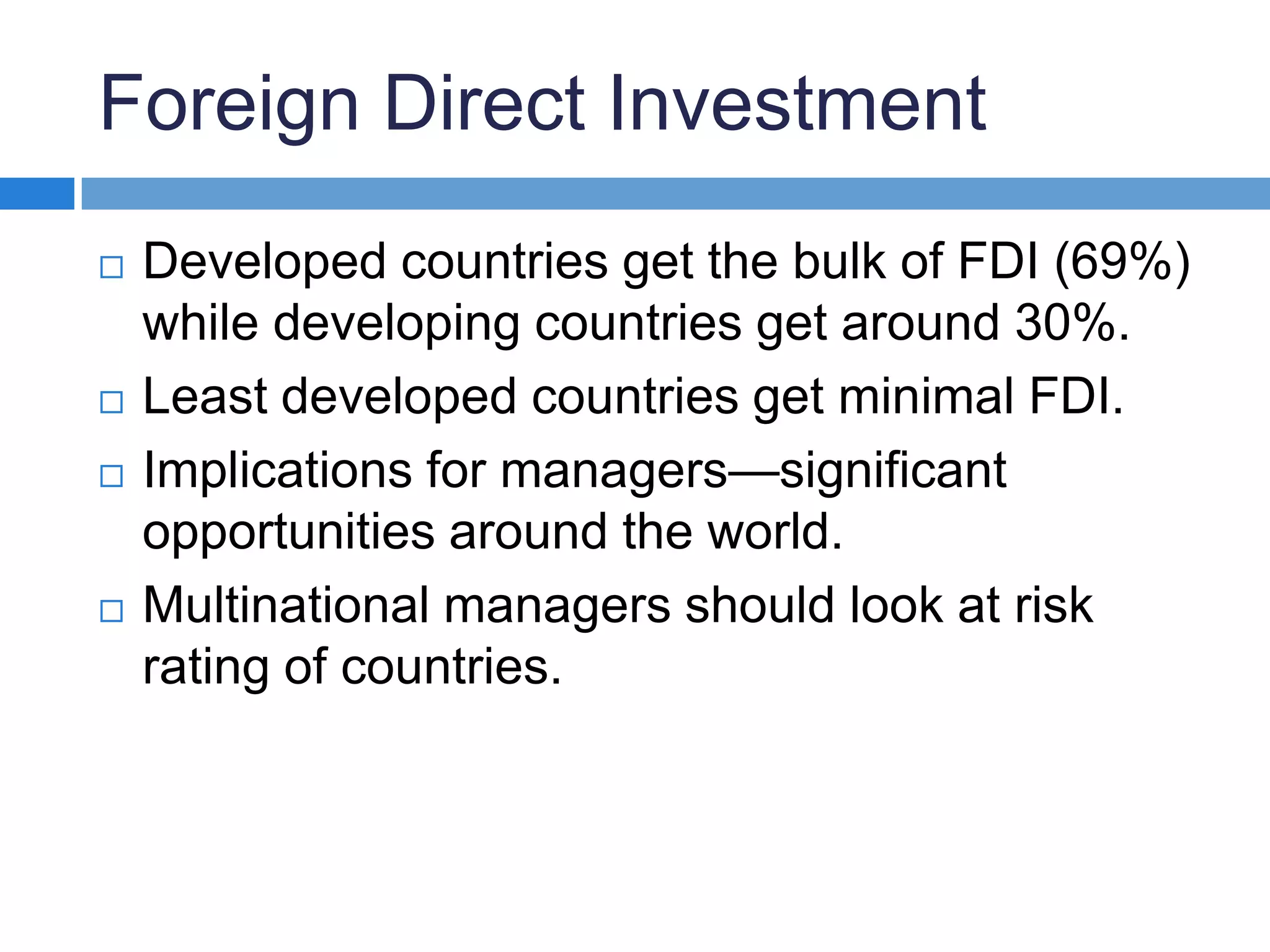
Foreign Direct InvestmentDeveloped countries get the bulk of FDI (69%) while developing countries get around 30%.Least developed countries get minimal FDI.Implications for managers—significant opportunities around the world.Multinational managers should look at risk rating of countries.
The Internet and Information TechnologyElectronic Communication — E-mail, World Wide Web, etc. Allows multinationals to communicate with company locations throughout the world.Multinationals can also monitor worldwide operations. Information technology is spurring a borderless financial market.
The Rise of Global Products and Global CustomersThe needs of customers for many products and services are growing more similar,   e.g., McDonald’s, Boeing, Toyota.Global customers search the world for their supplies without regard for national boundaries.
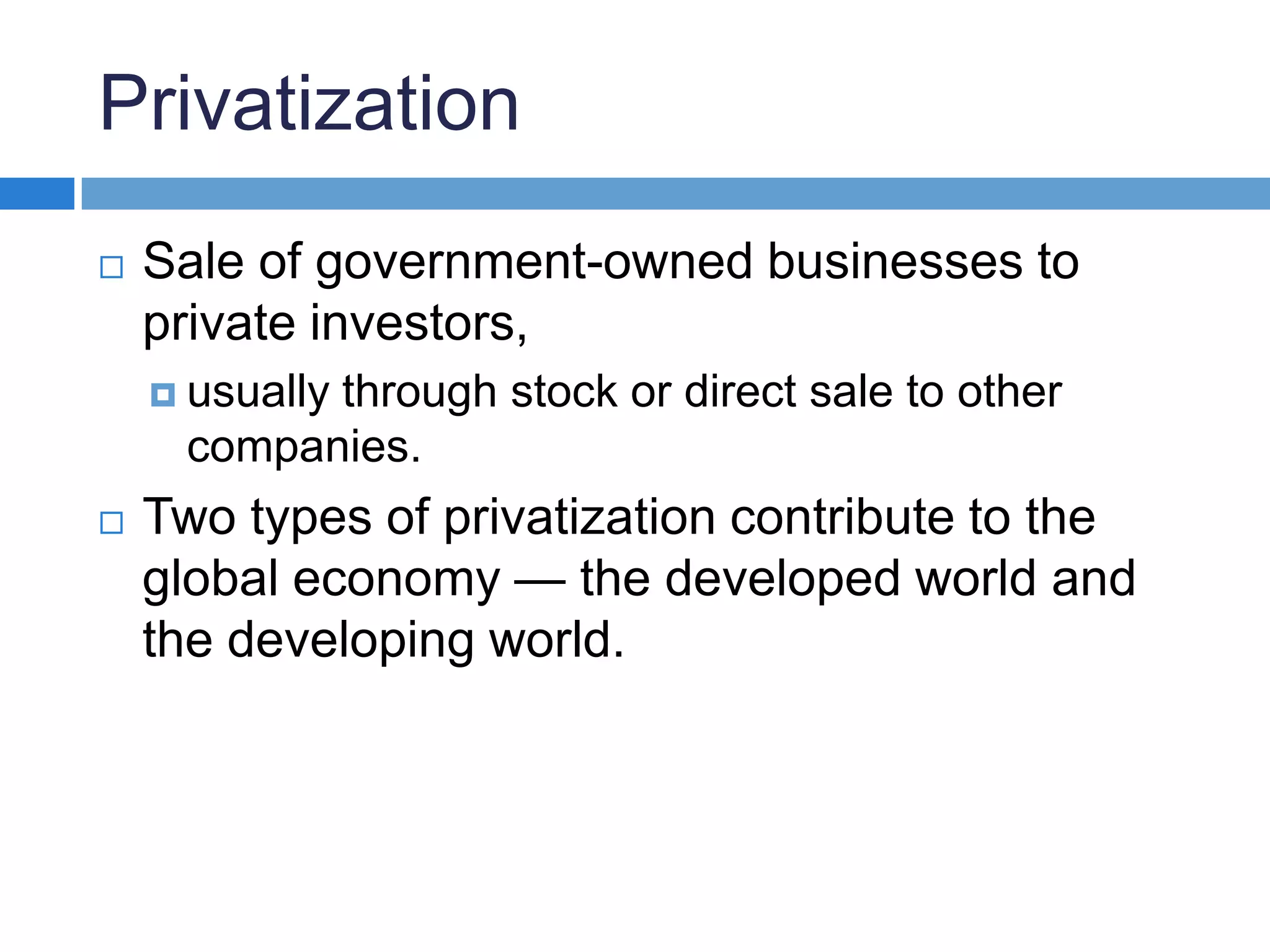
PrivatizationSale of government-owned businesses to private investors, usually through stock or direct sale to other companies.Two types of privatization contribute to the global economy — the developed world and the developing world.
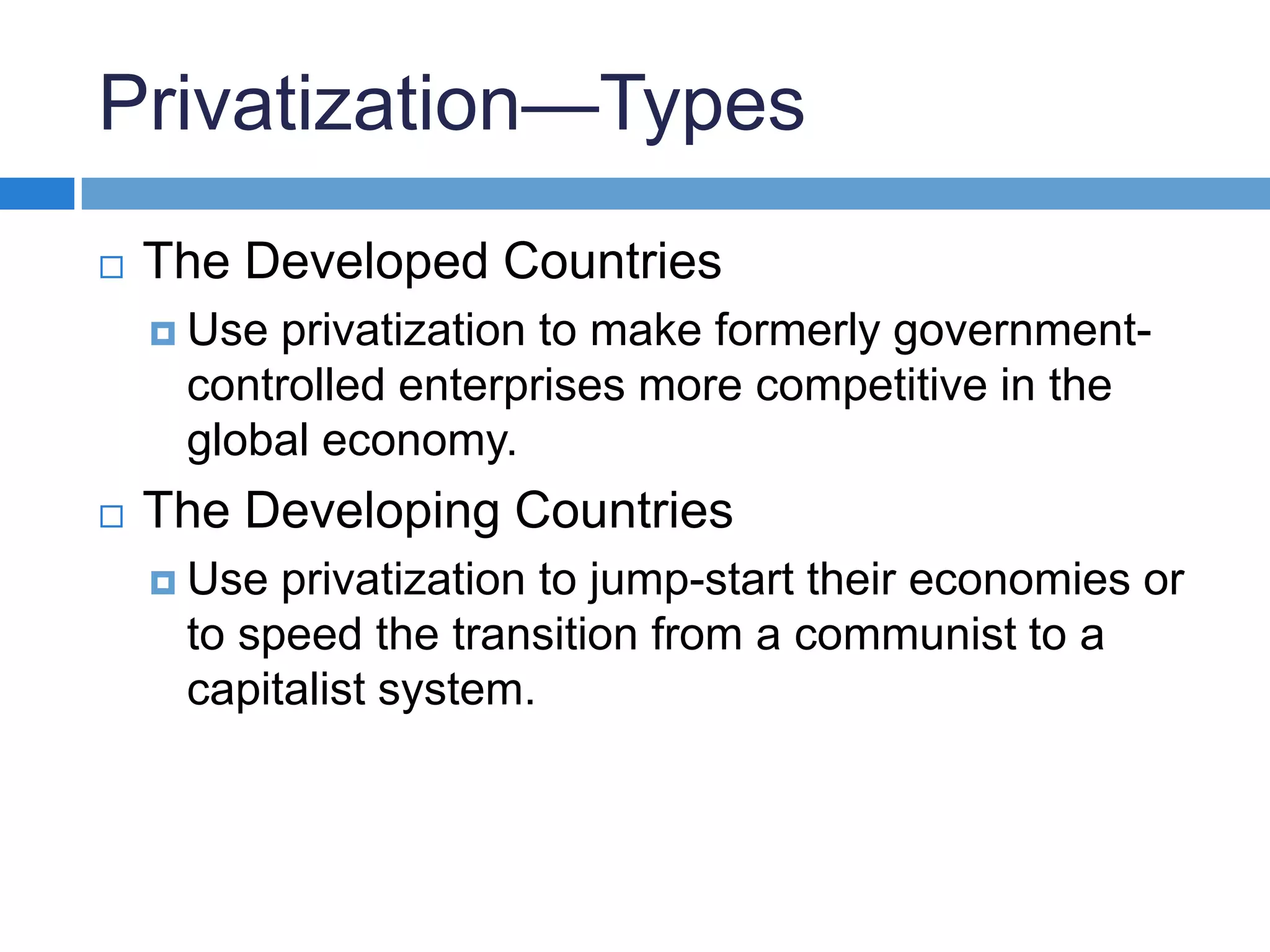
Privatization—TypesThe Developed Countries Use privatization to make formerly government-controlled enterprises more competitive in the global economy.The Developing Countries Use privatization to jump-start their economies or to speed the transition from a communist to a capitalist system.
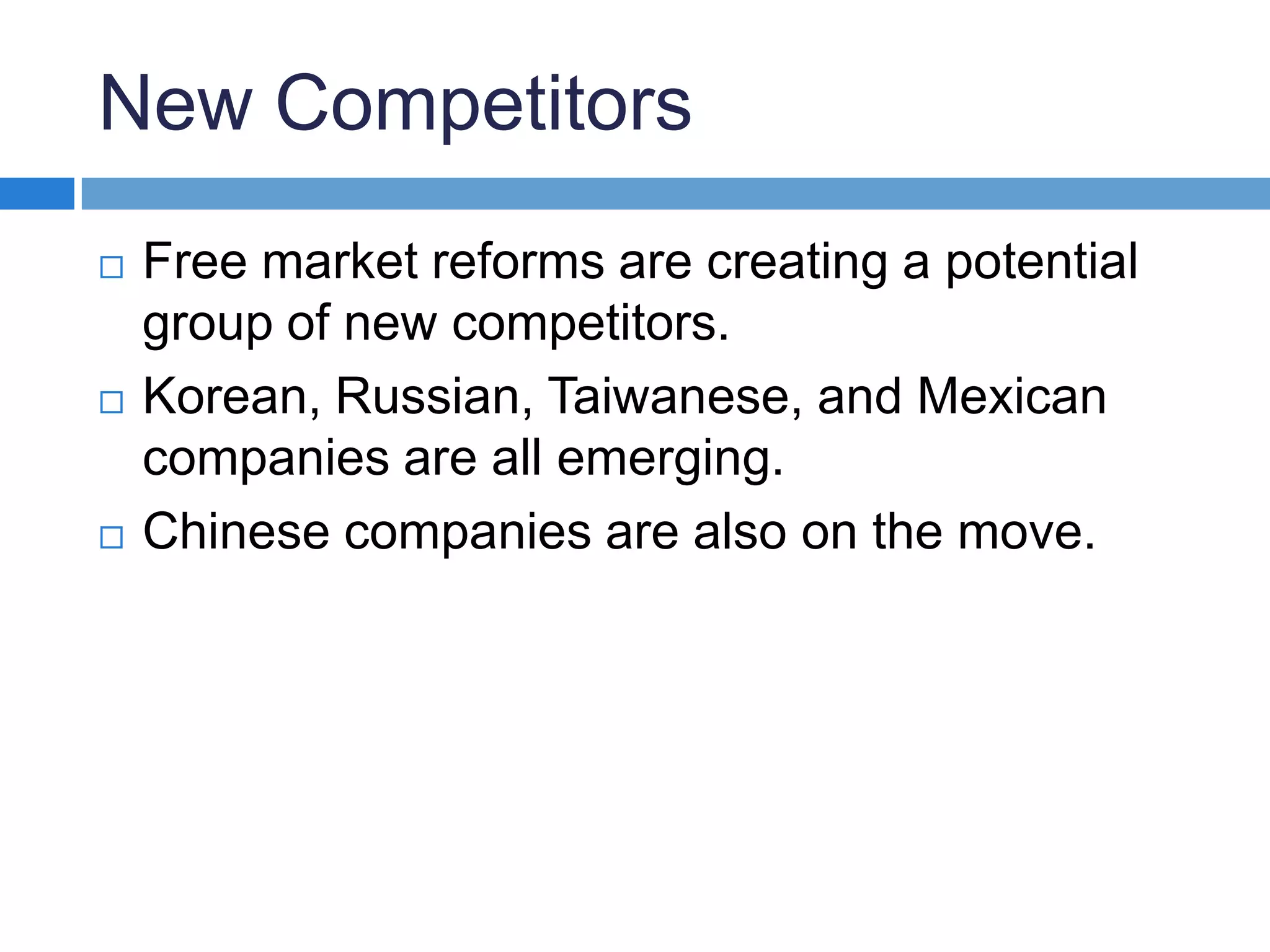
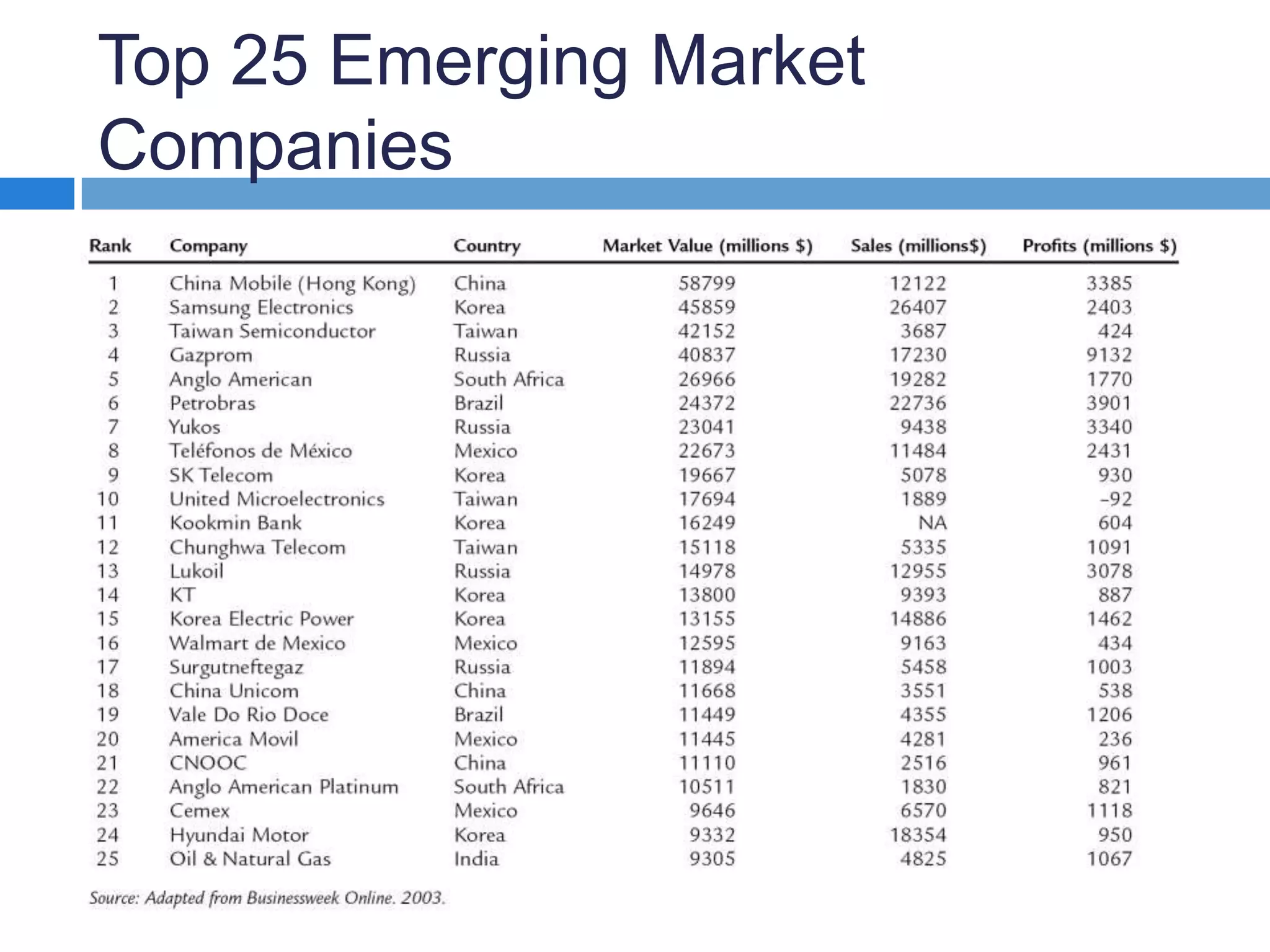
New CompetitorsFree market reforms are creating a potential group of new competitors.Korean, Russian, Taiwanese, and Mexican companies are all emerging. Chinese companies are also on the move.
Top 25 Emerging Market Companies
New Competitors are EmergingGlobal trade has two important effects in developing new competitors:When developing countries are used as low-wage platforms for high-tech assembly, multinationals facilitate the transfer of technology.Aggressive multinationals are also expanding beyond their own borders.
The Rise of Global StandardsCompanies can make one or only a few versions of product for the world market.This is cheaper than making different versions for different countries.Drive to develop common standards to save money.
Global StandardsConsistency in quality also an important requirement of doing business in many countries.International organization for standardization (ISO) in Geneva, Switzerland Developed a set of technical standards (ISO 9001:2000 series).
InternationalizationInternationalization is the process by which Firms increase their awareness of the influence of international activities on their futureEstablish and conduct transactions with firms from other countries.
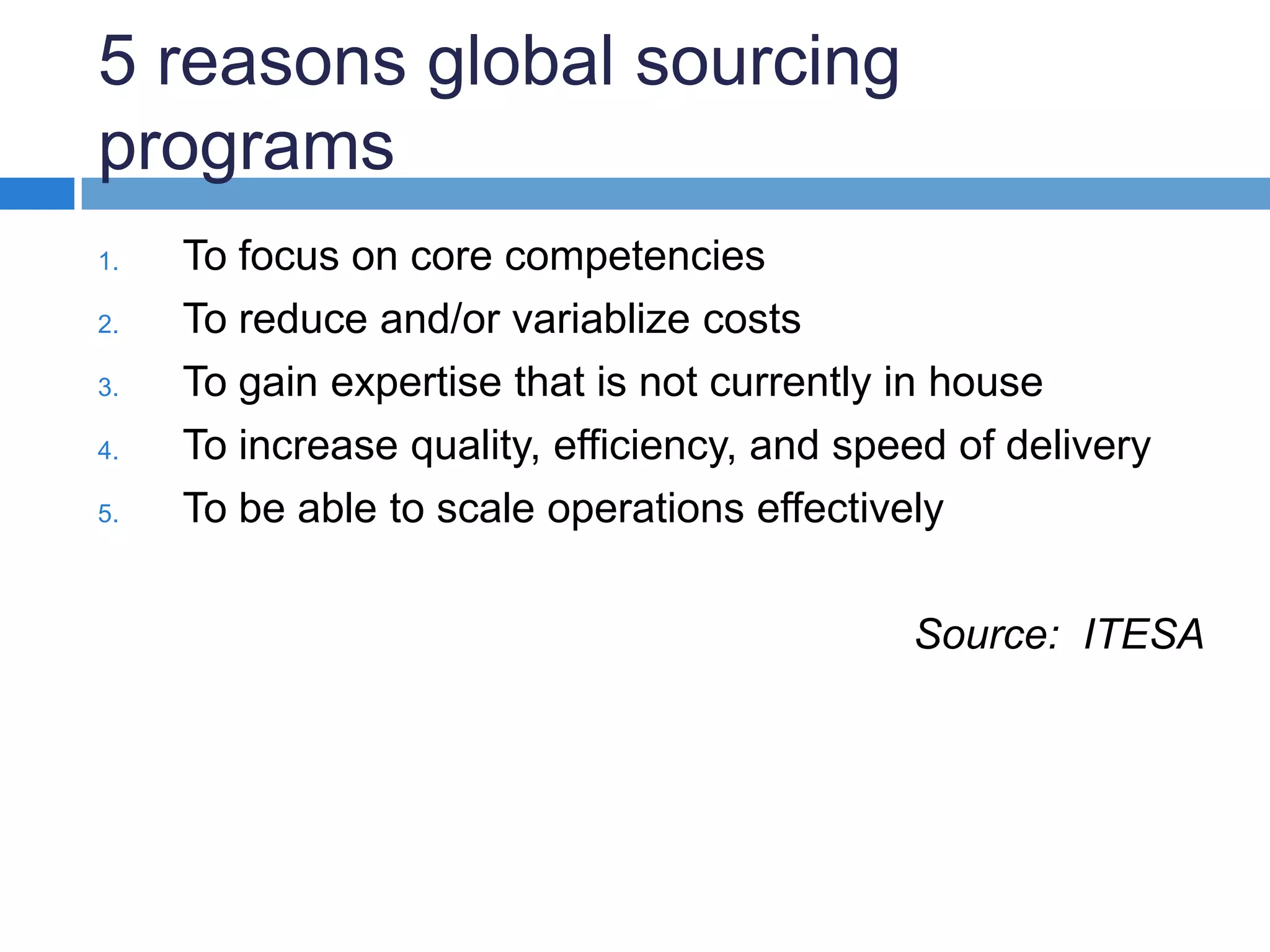
5 reasons global sourcing programsTo focus on core competenciesTo reduce and/or variablize costs To gain expertise that is not currently in houseTo increase quality, efficiency, and speed of deliveryTo be able to scale operations effectivelySource: ITESA
Reznor Case
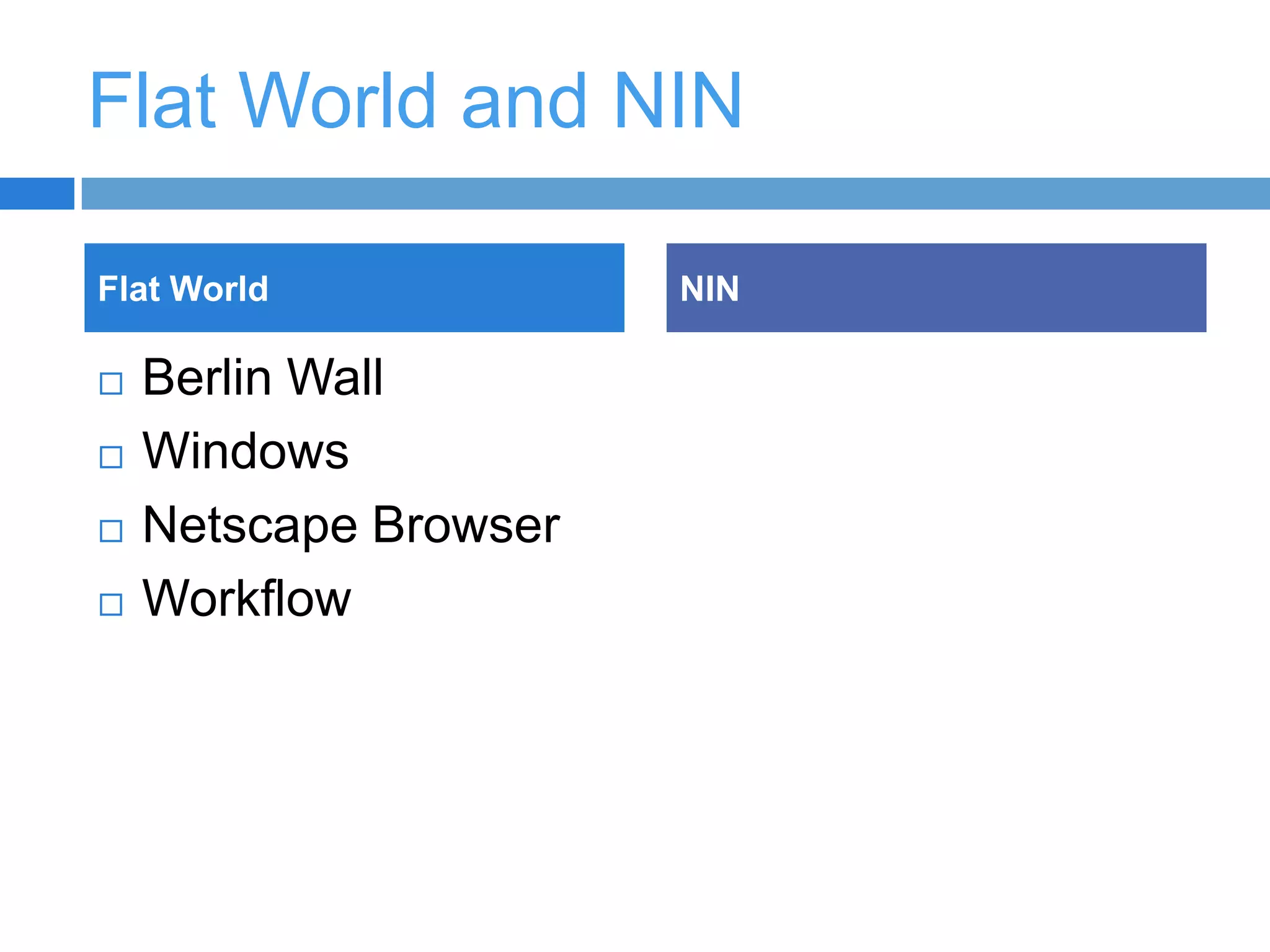
Flat World and NINBerlin WallWindowsNetscape BrowserWorkflowFlat WorldNIN
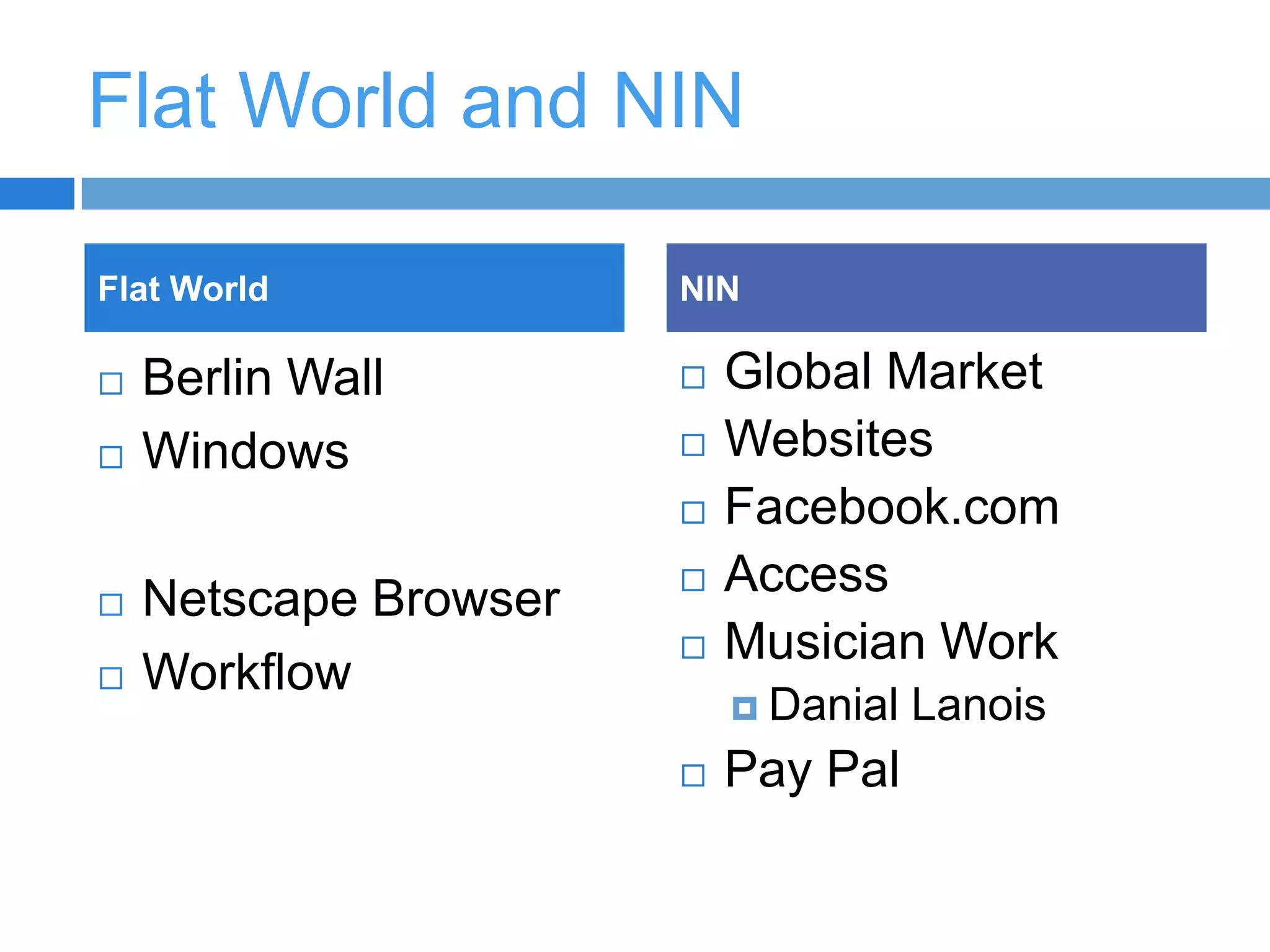
Flat World and NINBerlin WallWindowsNetscape BrowserWorkflowGlobal Market
Websites
Facebook.com
Access
Musician Work
Danial Lanois
Pay PalFlat WorldNIN
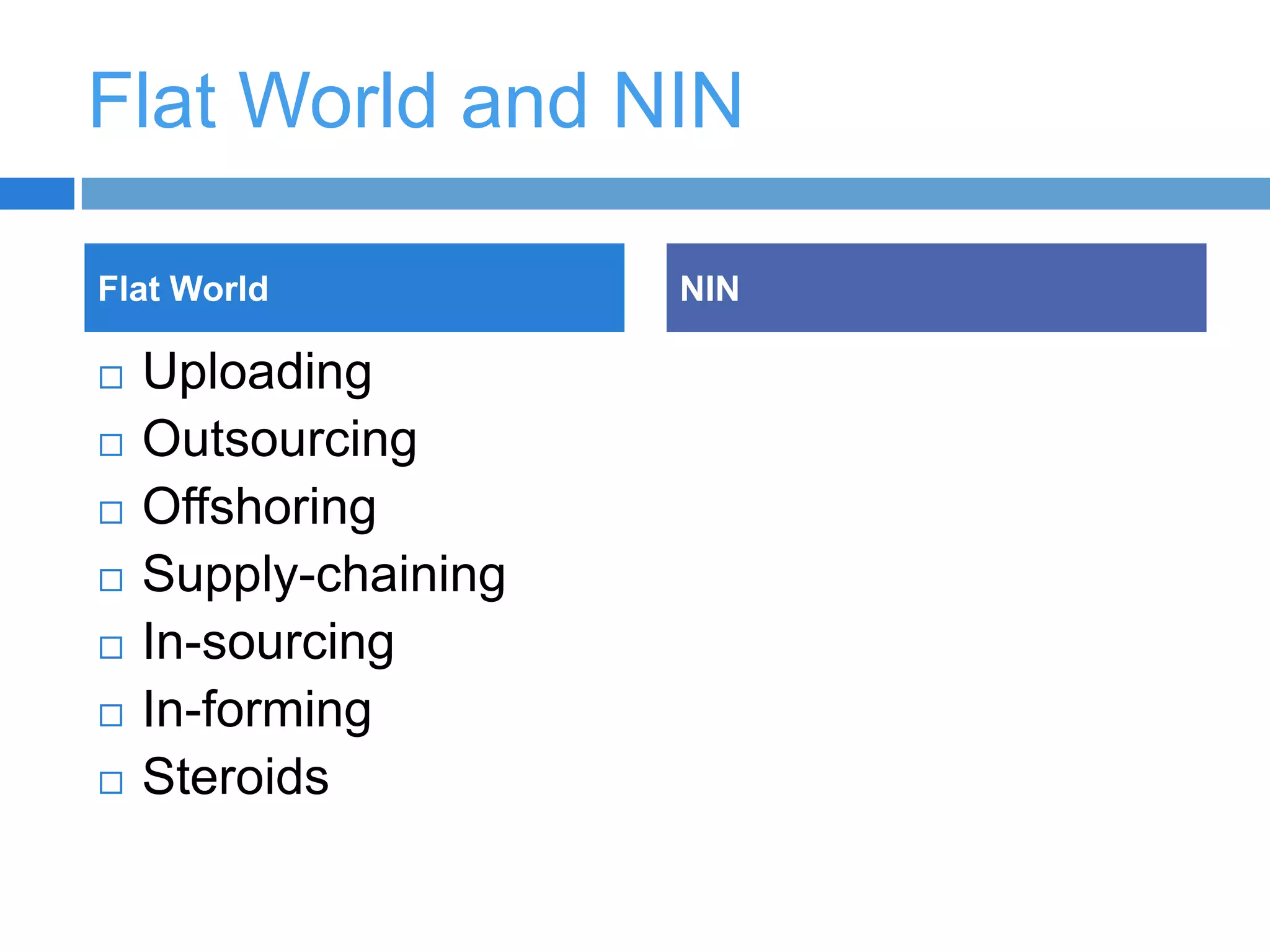
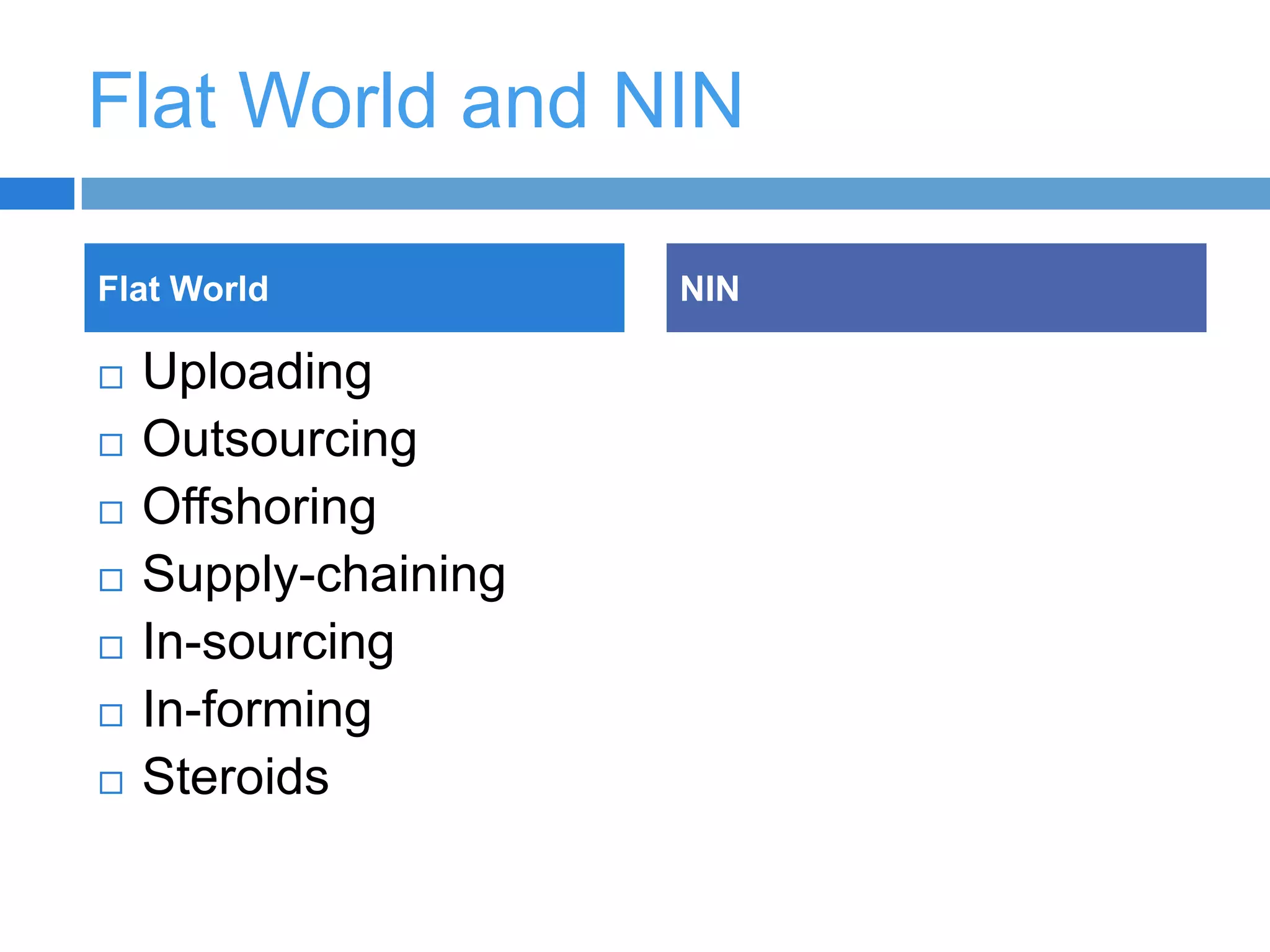
Flat World and NINUploadingOutsourcingOffshoringSupply-chainingIn-sourcingIn-formingSteroidsFlat WorldNIN
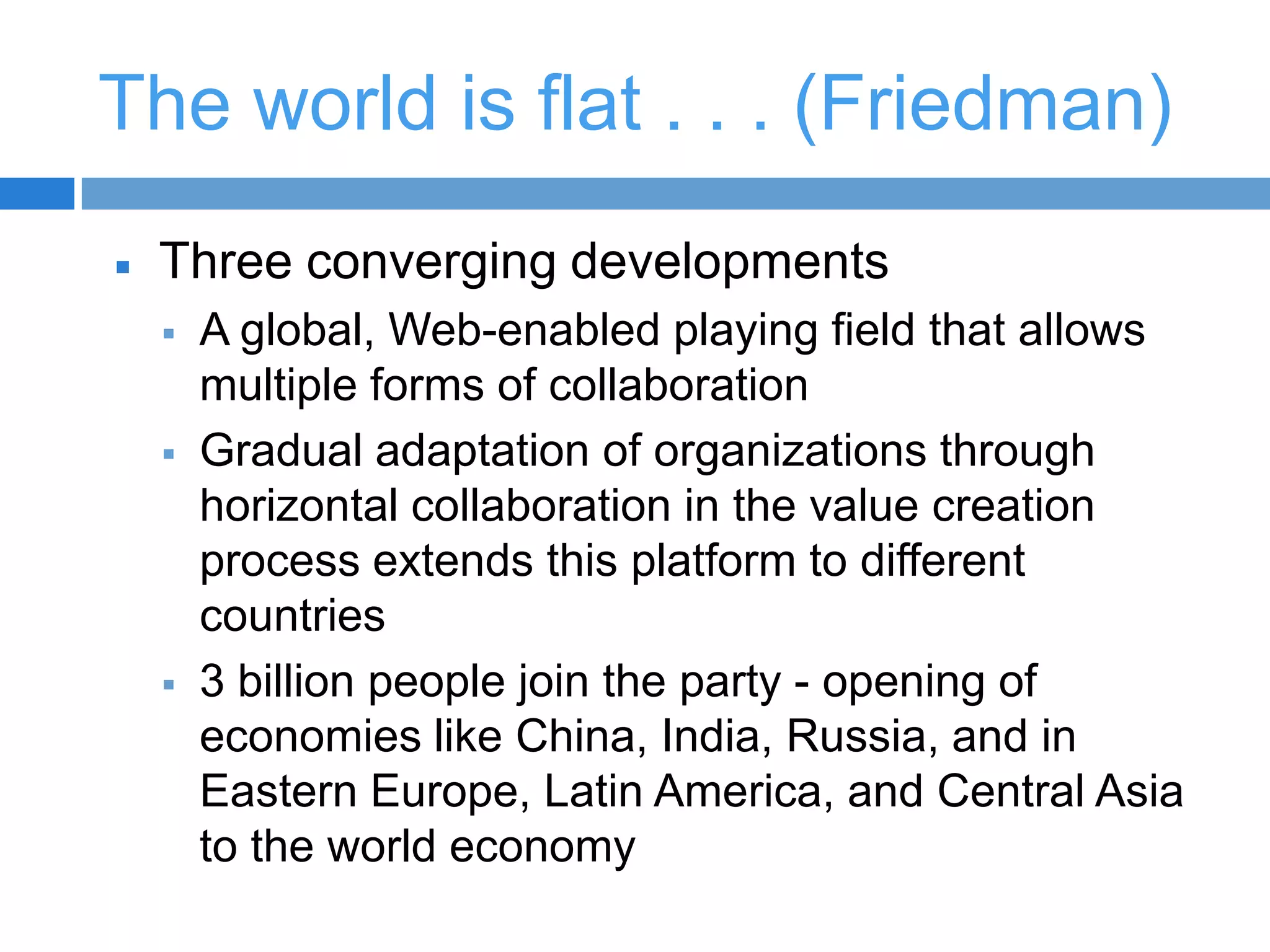
The world is flat . . . (Friedman)Three converging developments
A global, Web-enabled playing field that allows multiple forms of collaboration
Gradual adaptation of organizations through horizontal collaboration in the value creation process extends this platform to different countries
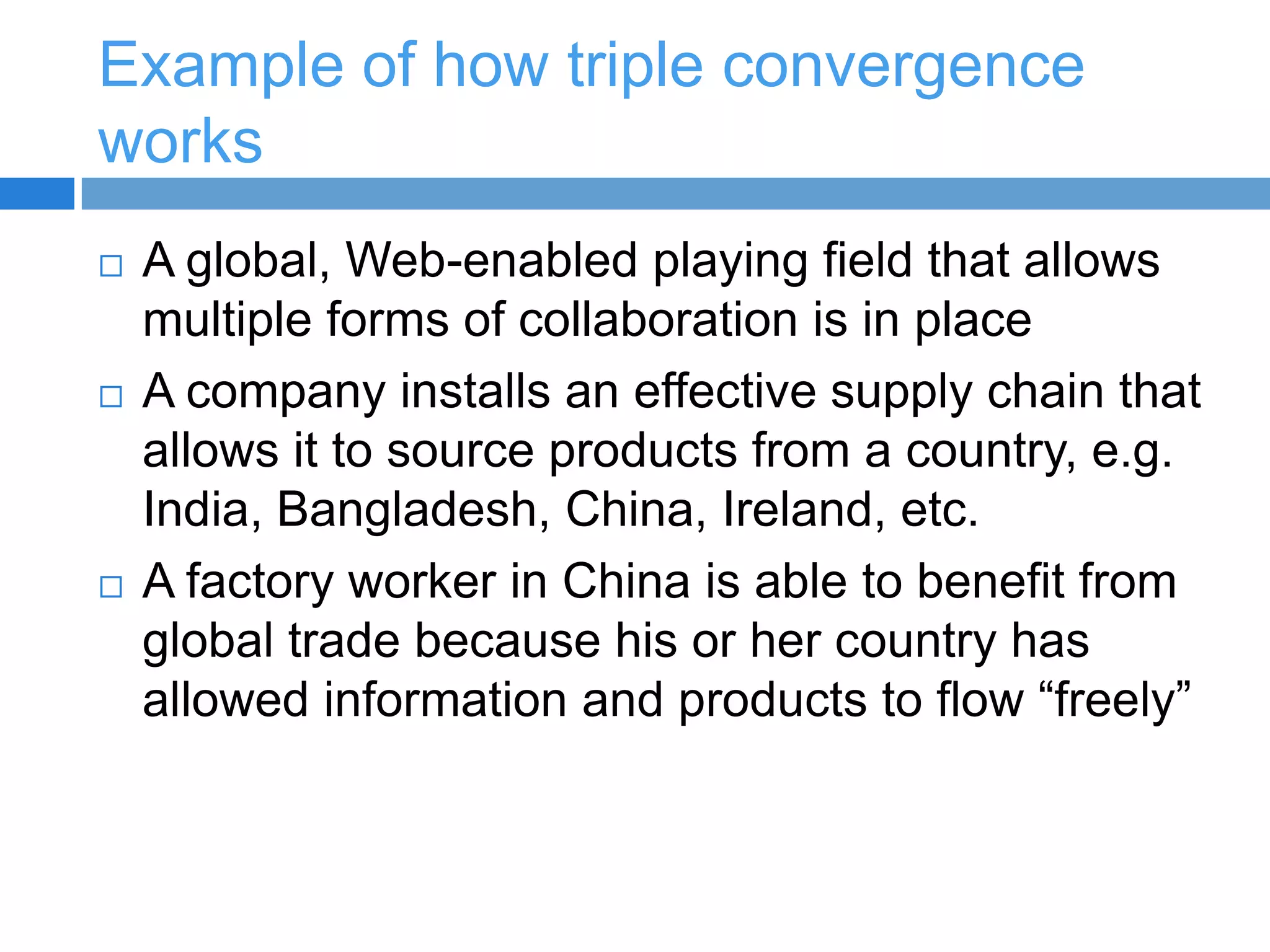
3 billion people join the party - opening of economies like China, India, Russia, and in Eastern Europe, Latin America, and Central Asia to the world economyExample of how triple convergence worksA global, Web-enabled playing field that allows multiple forms of collaboration is in placeA company installs an effective supply chain that allows it to source products from a country, e.g. India, Bangladesh, China, Ireland, etc.A factory worker in China is able to benefit from global trade because his or her country has allowed information and products to flow “freely”
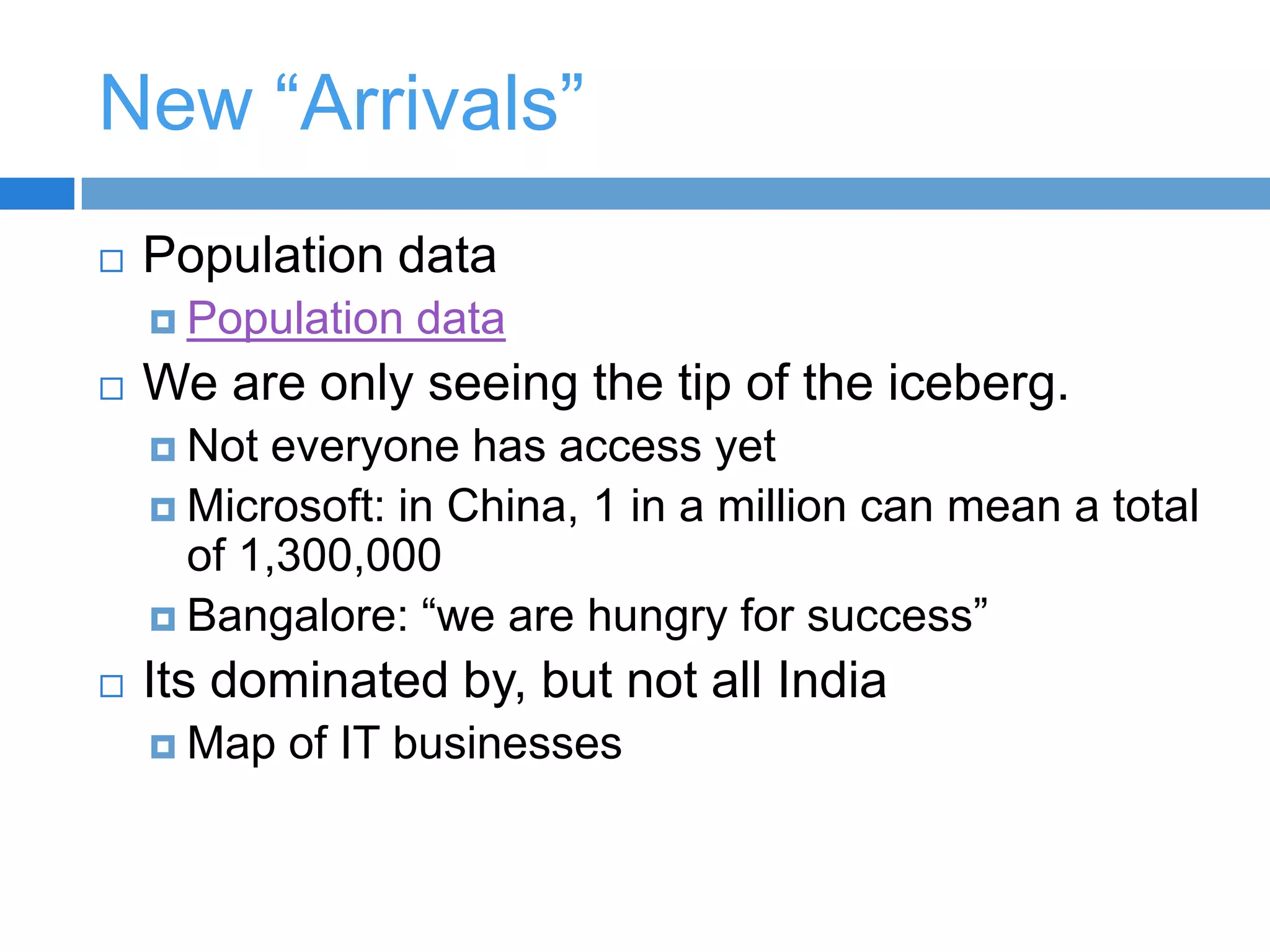
New “Arrivals”Population dataPopulation dataWe are only seeing the tip of the iceberg.Not everyone has access yetMicrosoft: in China, 1 in a million can mean a total of 1,300,000Bangalore: “we are hungry for success”Its dominated by, but not all IndiaMap of IT businesses
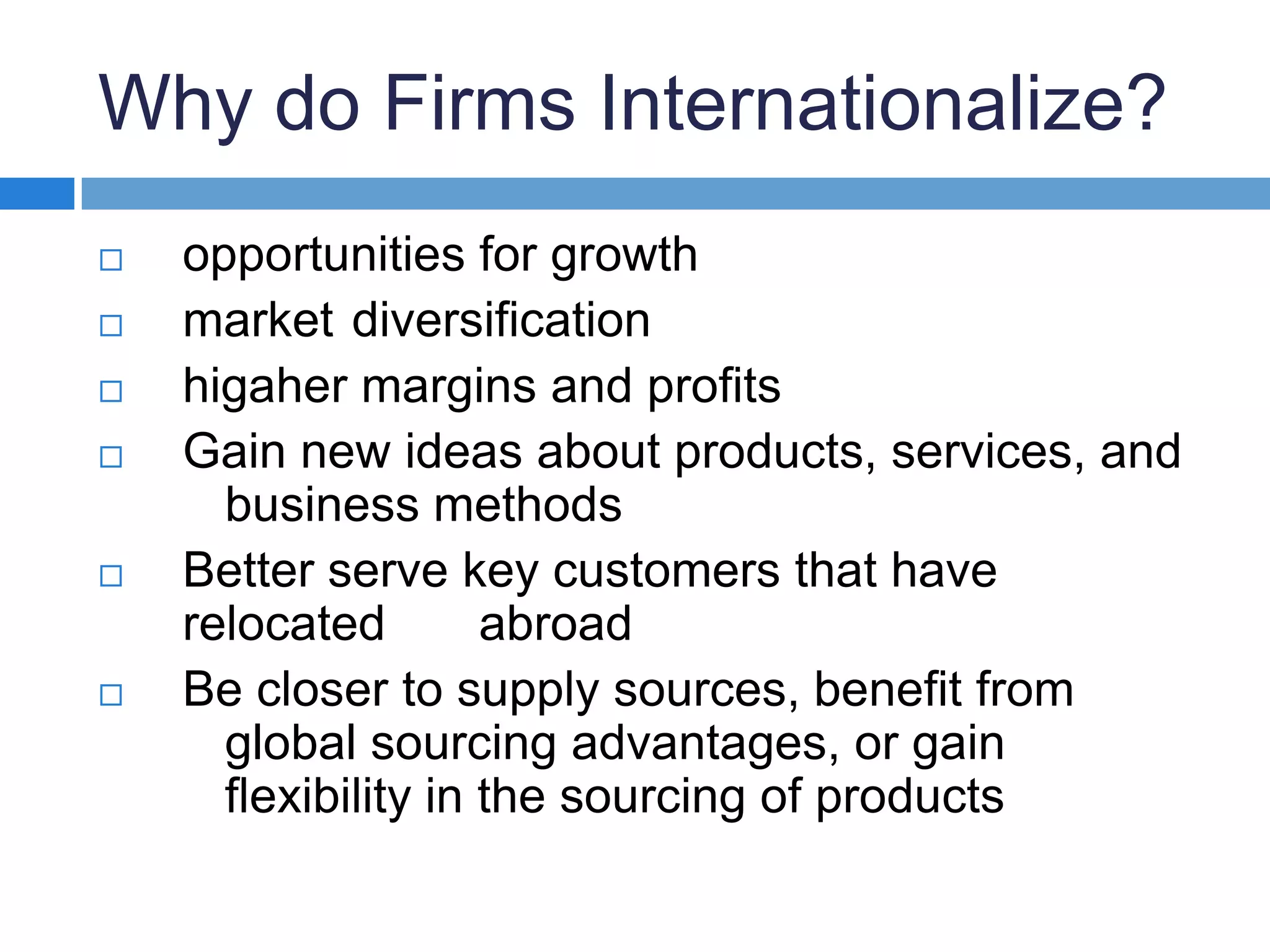
Why do Firms Internationalize?opportunities for growthmarket 	diversificationhigaher margins and profitsGain new ideas about products, services, and 	business methodsBetter serve key customers that have relocated 	abroadBe closer to supply sources, benefit from 	global sourcing advantages, or gain 	flexibility in the sourcing of products
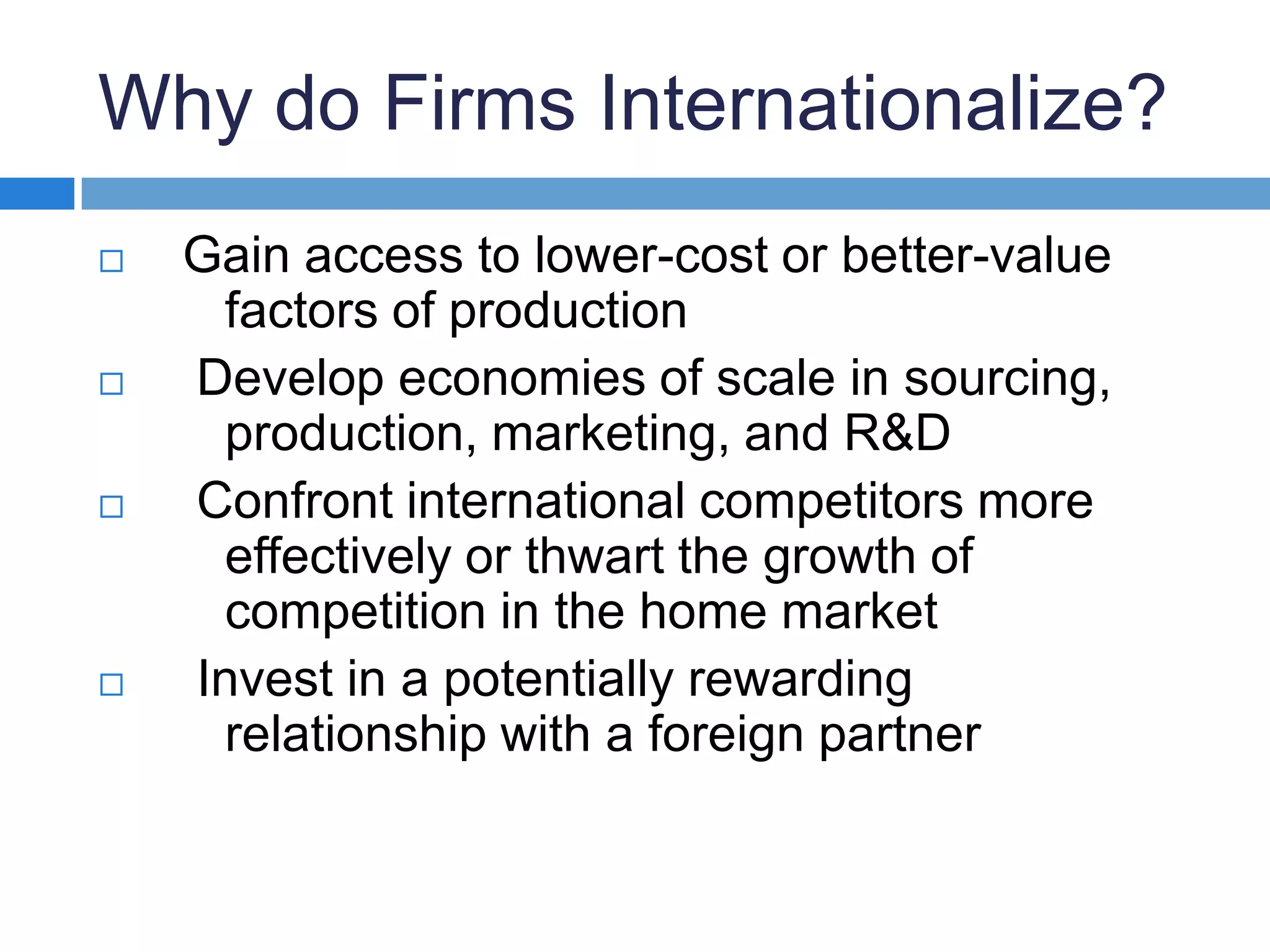
Why do Firms Internationalize?Gain access to lower-cost or better-value 	factors of production Develop economies of scale in sourcing, 	production, marketing, and R&D Confront international competitors more 	effectively or thwart the growth of 	competition in the home market Invest in a potentially rewarding 	relationship with a foreign partner
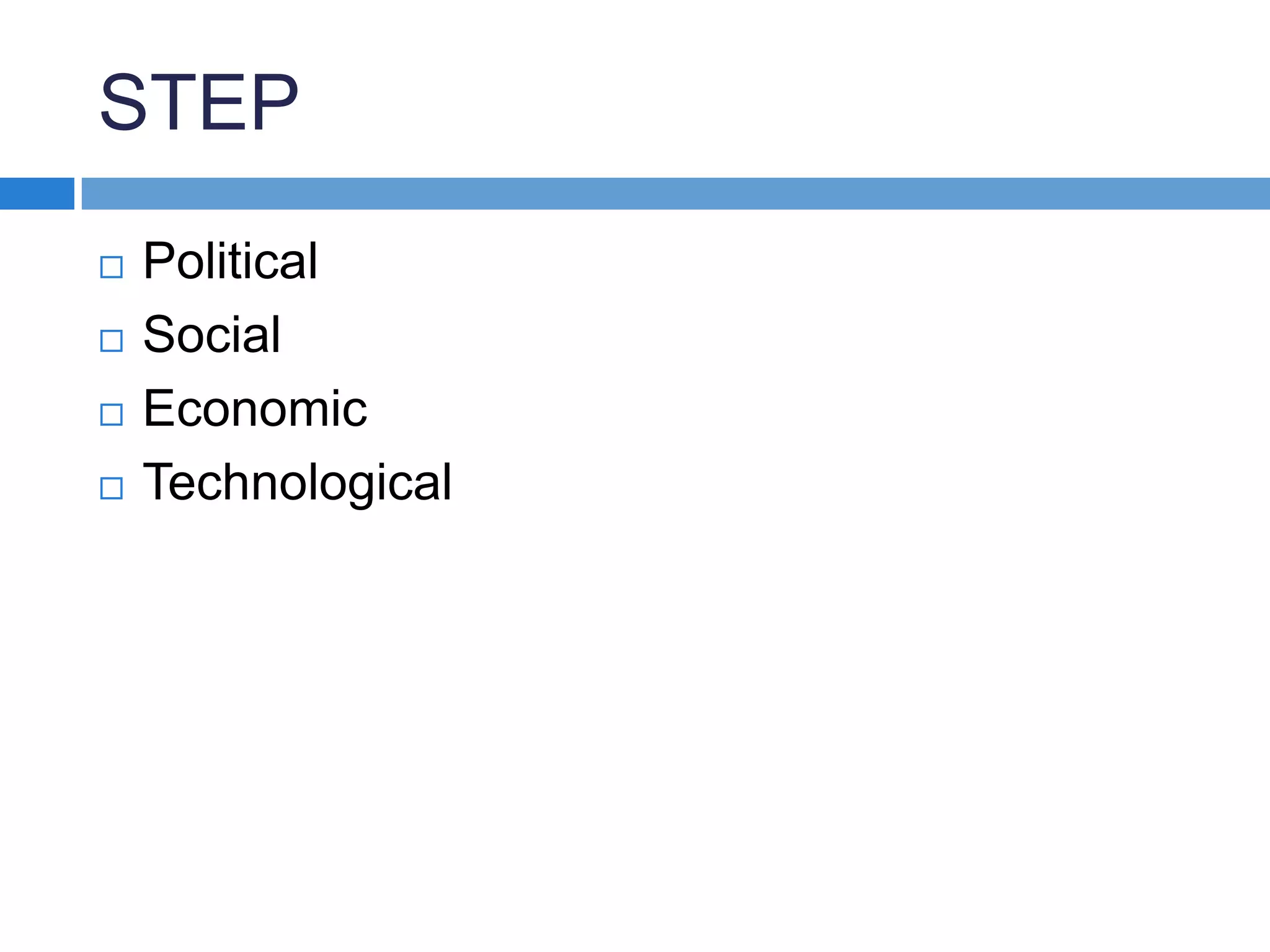
STEPPolitical SocialEconomic Technological
Dimensions of InternalizationInternationalization has both inward-looking and outward-looking dimensions. The outward-looking perspective incorporates an awareness of the nature of competition in foreign markets
Dimensions of Internalization (cont.)Includes the following modes of activities:Exporting.Acting as licensor to a foreign company.Establishing joint ventures outside the home country with foreign companies.Establishing or acquiring wholly owned businesses outside the home country.
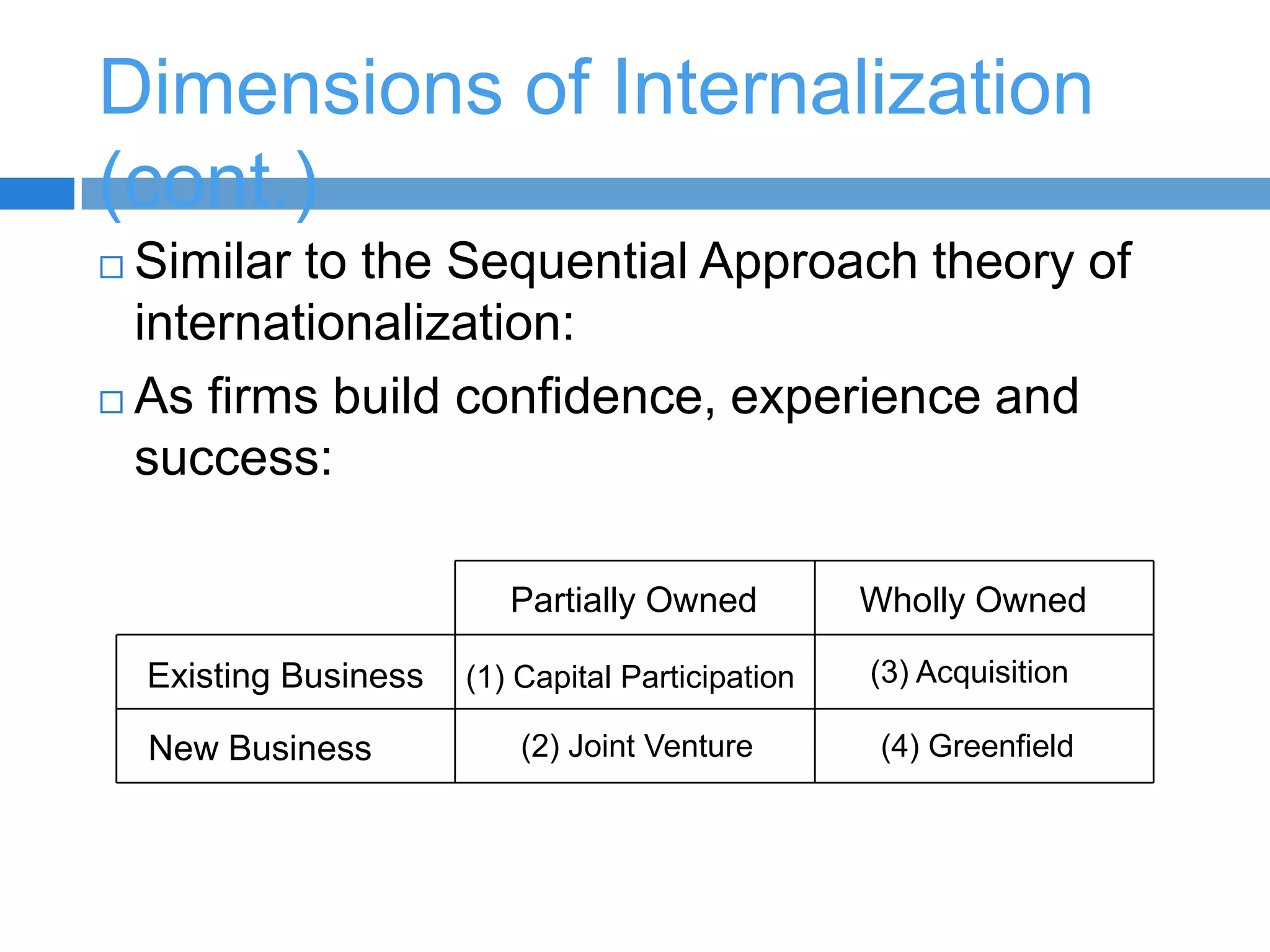
Dimensions of Internalization (cont.)Similar to the Sequential Approach theory of internationalization:As firms build confidence, experience and success:Partially OwnedWholly Owned(3) Acquisition Existing Business(1) Capital ParticipationNew Business(2) Joint Venture(4) Greenfield
Dimensions of Internalization (cont.)Not all firms do or can follow the sequential process of internationalization:Dependent upon industrial and environmental conditionsNeed to coordinate operations in many countries and many value chain activities
Dimensions of Internalization (cont.)Internationalization affects firms in equally important ways from an inward perspective.
The related modes of activity include:
Importing/sourcing.
Acting as licensee from a foreign company.
Establishing joint ventures (JVs) inside the home country with foreign companies.
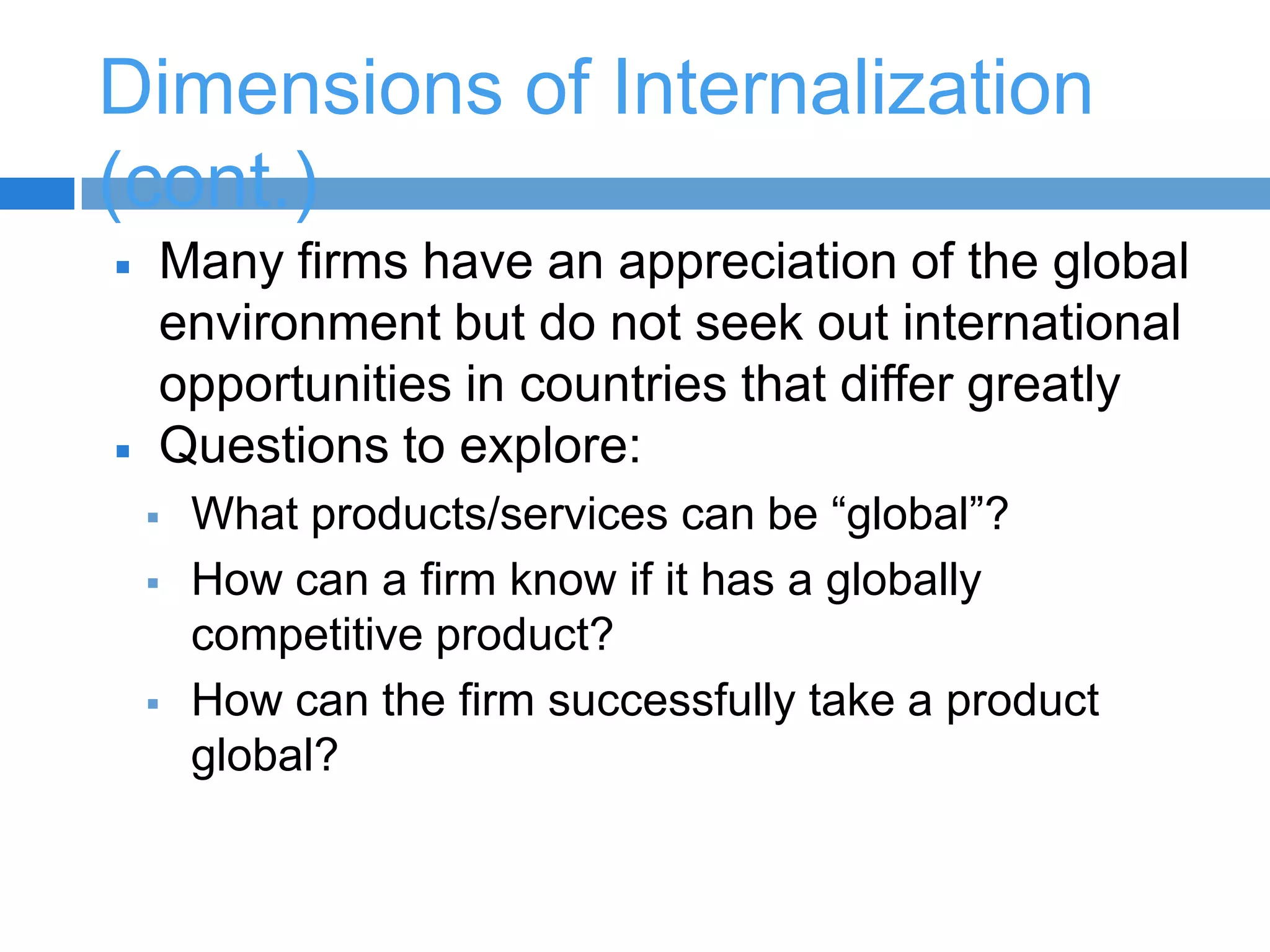
Managing as the wholly owned subsidiary of a foreign firmDimensions of Internalization (cont.)Many firms have an appreciation of the global environment but do not seek out international opportunities in countries that differ greatly
Questions to explore:
What products/services can be “global”?
How can a firm know if it has a globally competitive product?
How can the firm successfully take a product global?	Internationalization       Theory
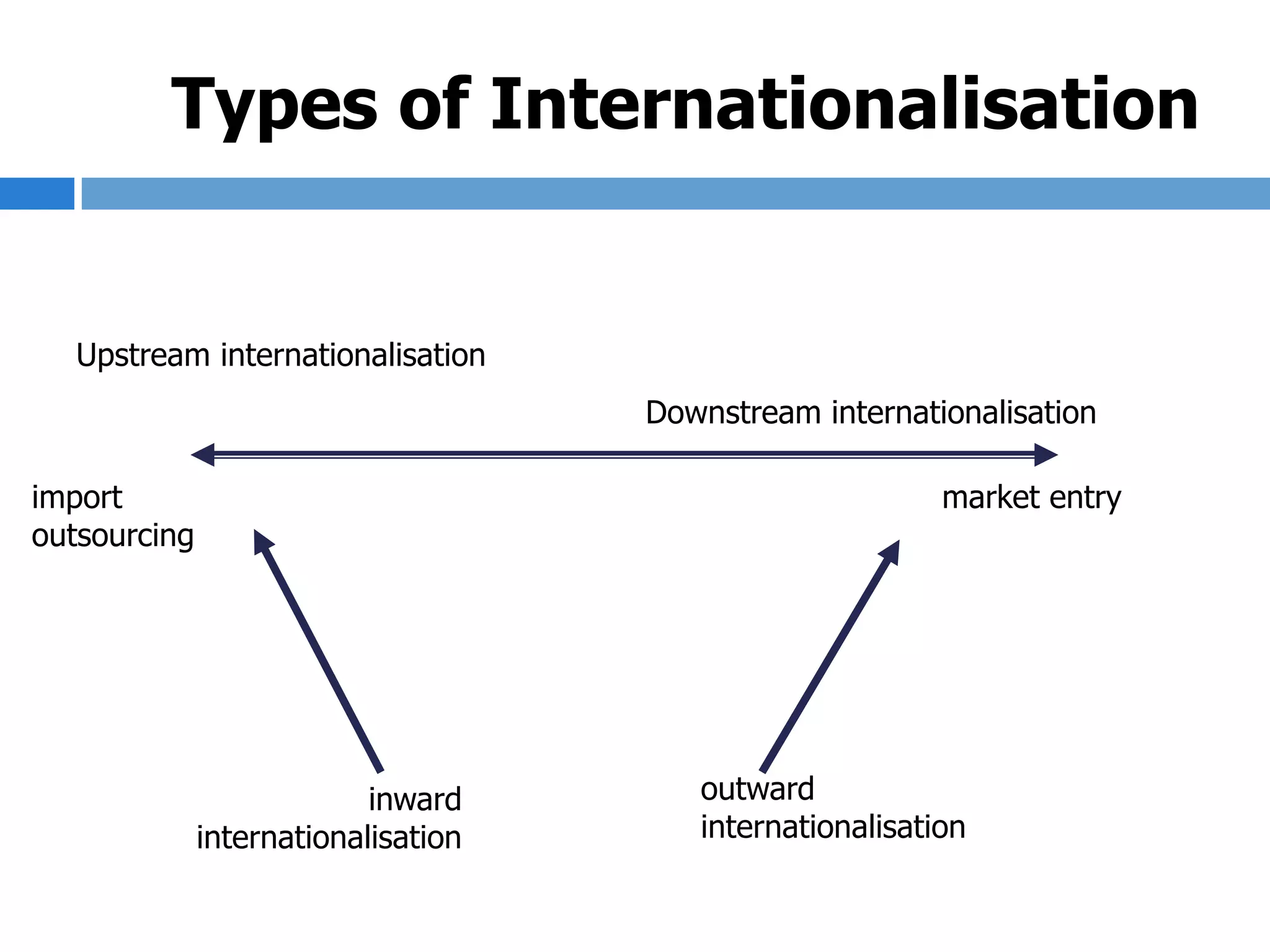
Types of InternationalisationUpstream internationalisation Downstream internationalisation importoutsourcingmarket entryoutwardinternationalisationinwardinternationalisation
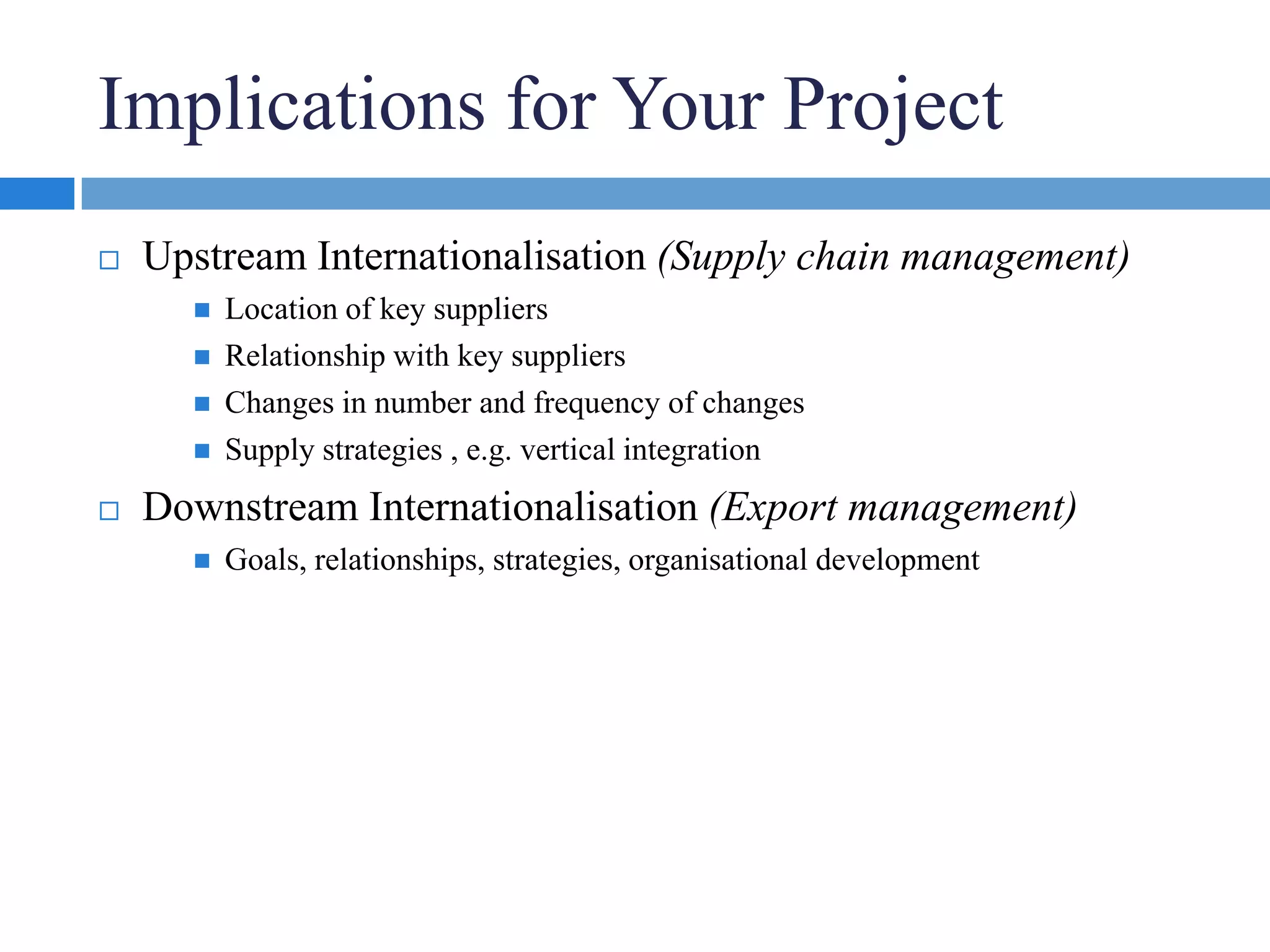
Implications for Your Project Upstream Internationalisation (Supply chain management)Location of key suppliersRelationship with key suppliersChanges in number and frequency of changesSupply strategies , e.g. vertical integrationDownstream Internationalisation (Export management)Goals, relationships, strategies, organisational development
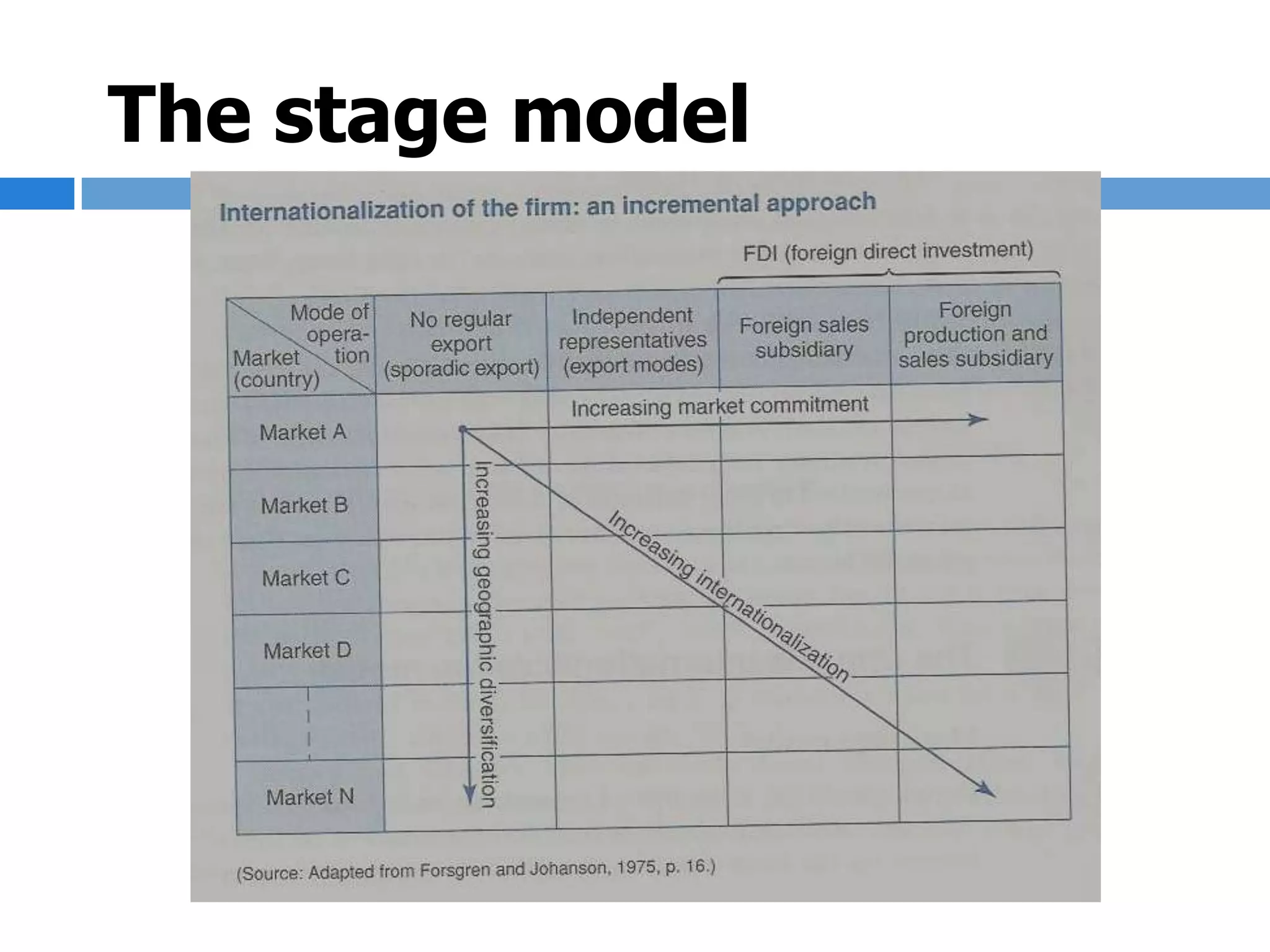
Degrees of InternationalisationDegree of commitment/level of involvement (structure)Degree of change within the firm (process)
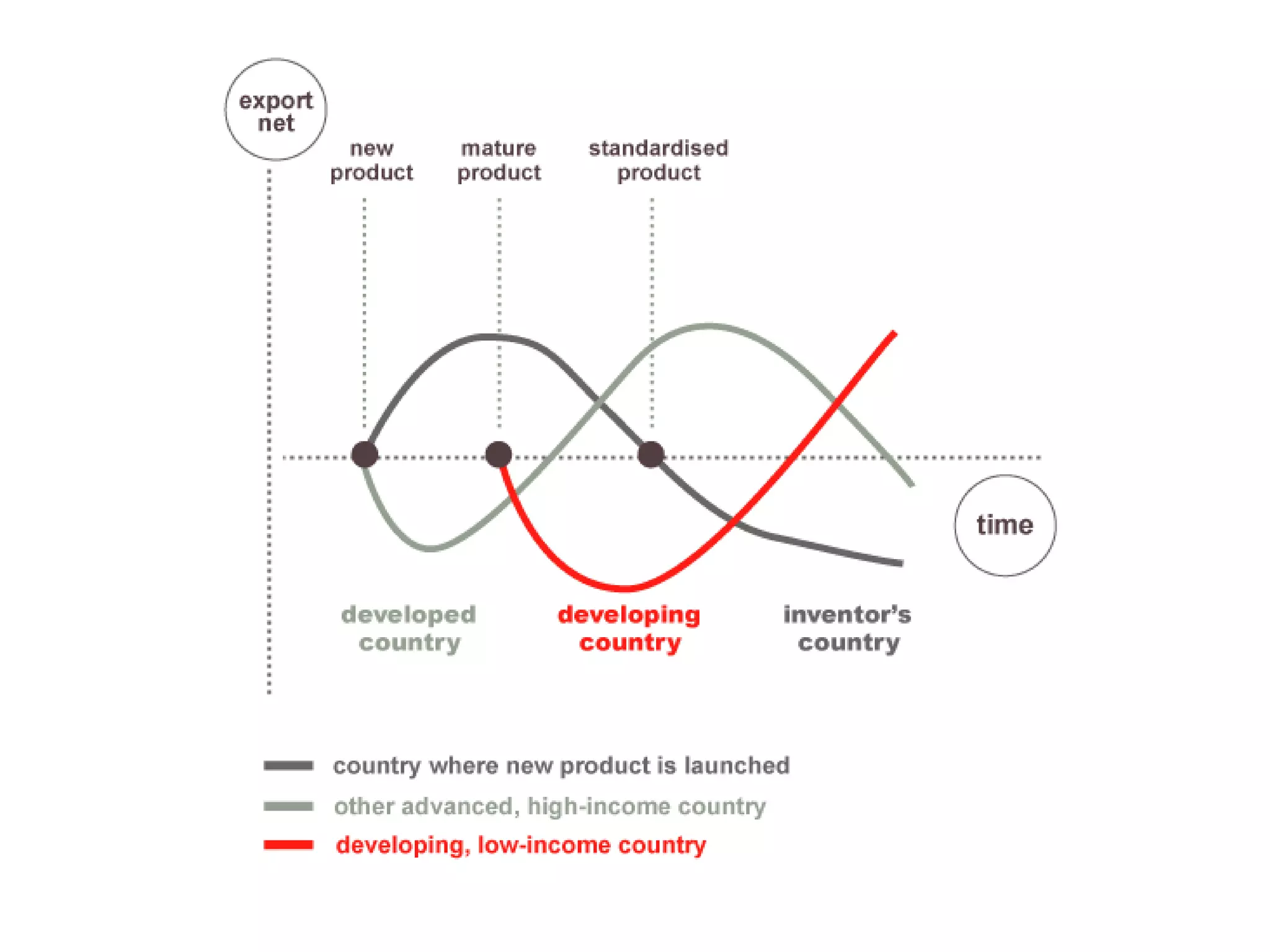
International Product Life CycleBasic AssumptionsThe relative weight of changes in factors of production at various stages of a product’s life cycleChanges in a product’s degree of market attractivenessImplications for InternationalisationExtension of the life cycle of productsReduction in unit costs of productionOther useful conceptsProduct vs. Market lagClient-followers vs. Market searchers
The Network Approach to InternationalisationFirms within an industrial market are inter-dependentThey share resourcesTheir relationships are both stable and changingThey are mutually vulnerableMarkets are networks of relationships
Some Characteristics of a NetworkIntensityPower sharingReciprocityCohesion, throughDomain consensusPositive evaluationWork co-ordination
FACTOR ENDOWMENTS (HECKSCHER – OHLIN) Introduces concept of ‘factors of production’.A country will have a comparative advantage in producing goods which make intensive use of factors of production which it has in abundance A country exportsproducts which use intensively its relatively abundant factors and imports products which use intensively its relatively scarce factorsLeontief paradox
Industrial Clusters A concentration of suppliers and supporting firms from the same industry located within the same geographic areaExamples include: the Silicon Valley, fashion cluster in northern Italy, pharma cluster in Switzerland, footwear industry in Pusan, South Korea, and the IT industry in Bangalore, IndiaIndustrial clusters can serve as an export platform for individual nations
National Industrial PolicyProactive economic development plan implemented by the public sector to nurture or support promising industry sectors with potential for regional or global dominance.  Public sector initiatives can include:Tax incentivesMonetary and fiscal policiesRigorous educational systemsInvestment in national infrastructureStrong legal and regulatory systems
National Industrial Policy:Ireland as an ExampleBeginning in the 1980s, the Irish government implemented a series of pro-business policies to build strong economic sectors.  The “Irish Miracle” resulted from:Fiscal, monetary, and tax consolidationPartnership with the industry and unionsEmphasis on high-value adding industries such as pharma, biotechnology, and ITMembership in the European Union; subsidies and investment received from the EUInvestment in education
FDI Based Explanations: Dunning’s Eclectic ParadigmThree conditions determine whether or not a company will internalize via FDI:Ownership-specific advantages – knowledge, skills, capabilities, relationships, or physical assets that form the basis for the firm’s competitive advantageLocation-specific advantages – advantages associated with the country in which the MNE is invested, including natural resources, skilled or low cost labor, and inexpensive capitalInternalization advantages – control derived from internalizing foreign-based manufacturing, distribution, or other value chain activities
The background - UppsalaThe firm is assumed to strive for growth and long term profitThe firm is assumed to avoid uncertainty and keep risk taking at a low levelThe behavioral theory of the firm bounded rationality – perfect decisons are infeasable limited search satisficing behavior - meet criteria for adequacy, rather than to identify an optimal solution conflicting goals, Incremental adjustments to changing conditions of the firm and its environmentDynamic model (present state important for future changes and subsequent states)
State AspectsMarket knowledgeInformation stored and retrievable in minds of individuals, computer memories or in written formObjective or experiential – latter most crusialMarket commitmentAmount and specificity of resources committed to a market (experiential knowledge may be one type)
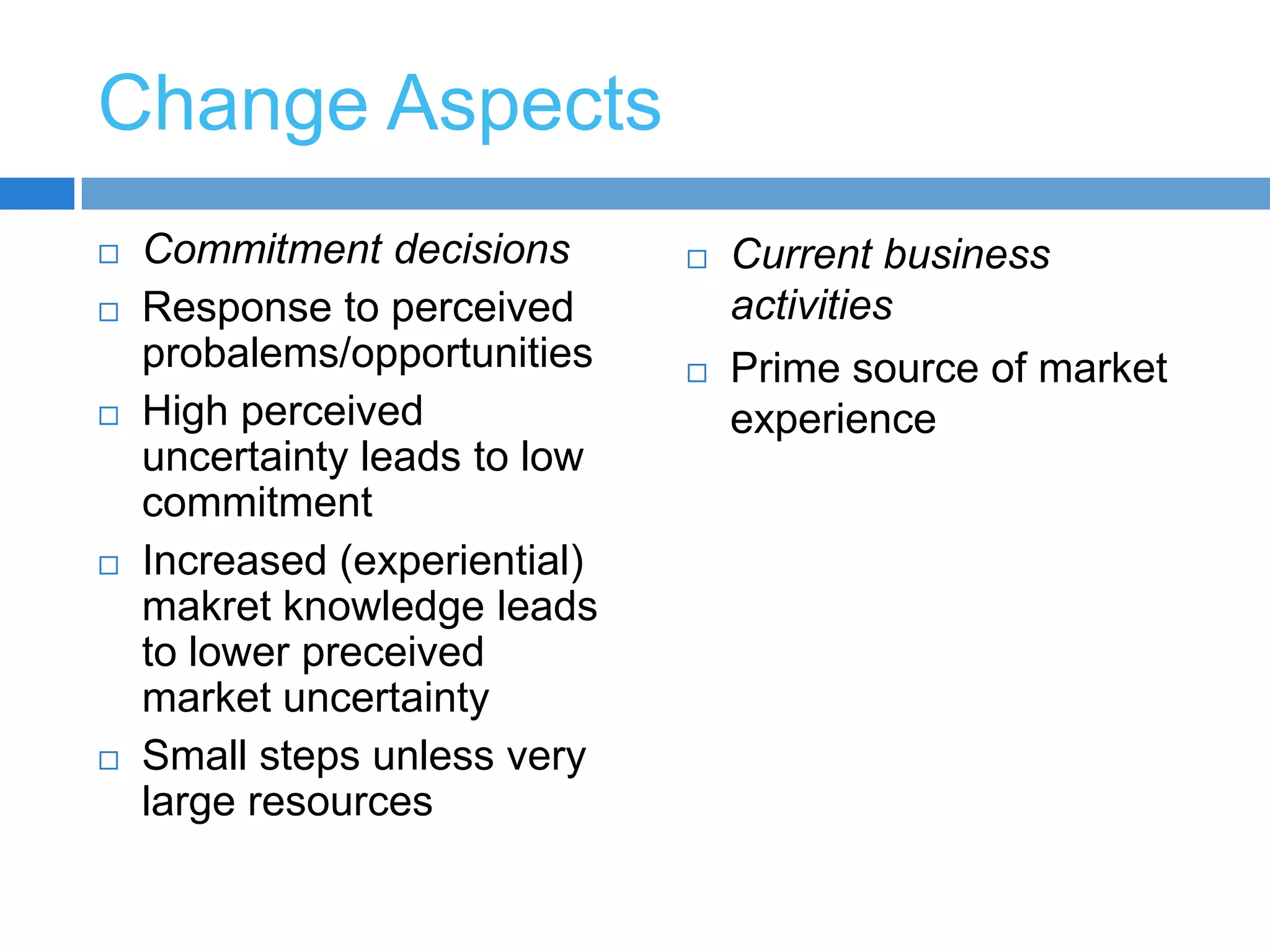
Change AspectsCommitment decisionsResponse to perceived probalems/opportunitiesHigh perceived uncertainty leads to low commitmentIncreased (experiential) makret knowledge leads to lower preceived market uncertaintySmall steps unless very large resourcesCurrent business activitiesPrime source of market experience
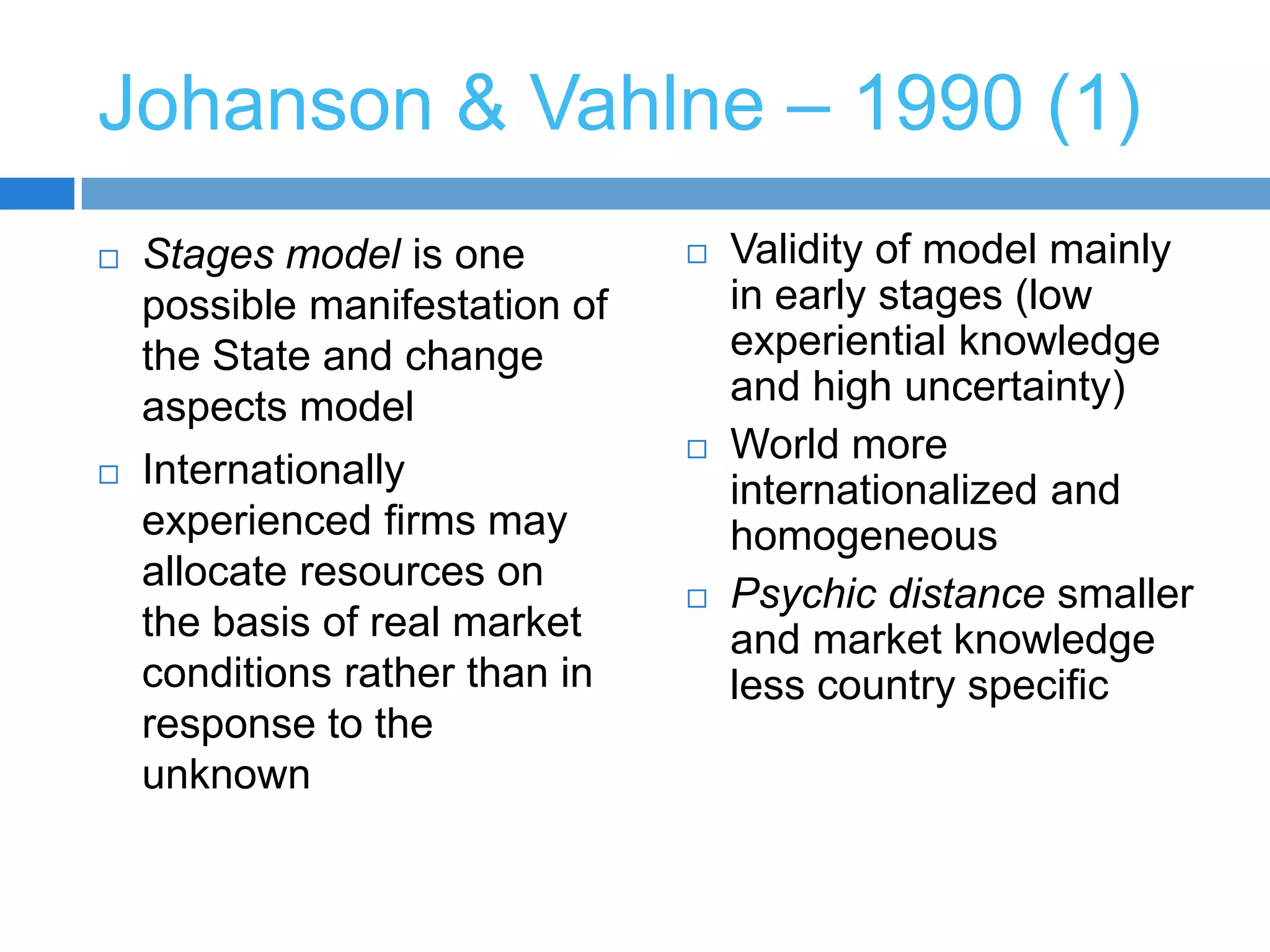
Johanson & Vahlne – 1990 (1)Stages model is one possible manifestation of the State and change aspects modelInternationally experienced firms may allocate resources on the basis of real market conditions rather than in response to the unknownValidity of model mainly in early stages (low experiential knowledge and high uncertainty)World more internationalized and homogeneousPsychic distance smaller and market knowledge less country specific
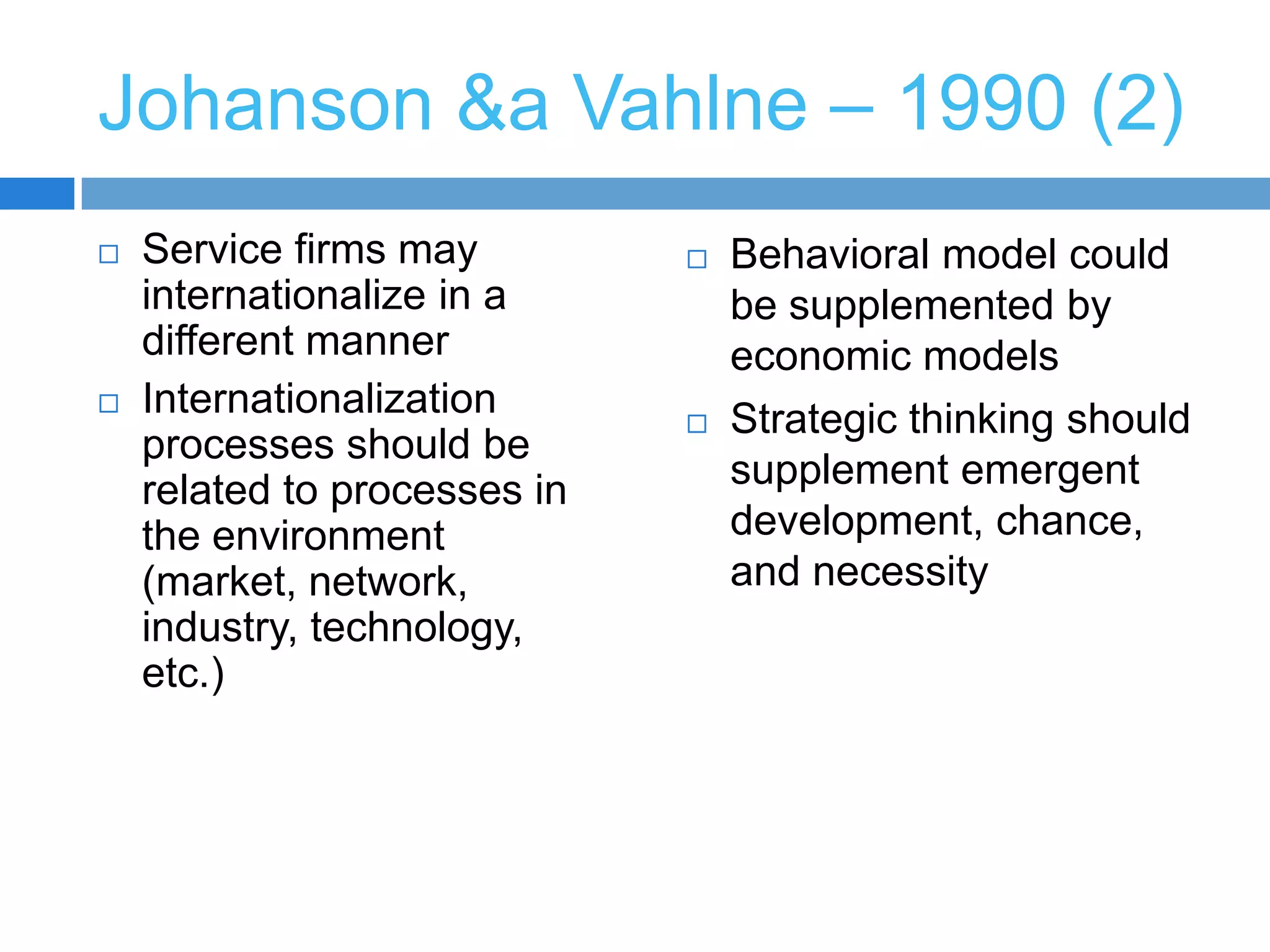
Johanson &a Vahlne – 1990 (2)Service firms may internationalize in a different mannerInternationalization processes should be related to processes in the environment (market, network, industry, technology, etc.)Behavioral model could be supplemented by economic modelsStrategic thinking should supplement emergent development, chance, and necessity
The stage model
Two
Moving ForwardFriedman’s view of a “flat world”“Flatteners” or developments that helped create this flat worldSummarize these flatteners into his notion of a “triple convergence”
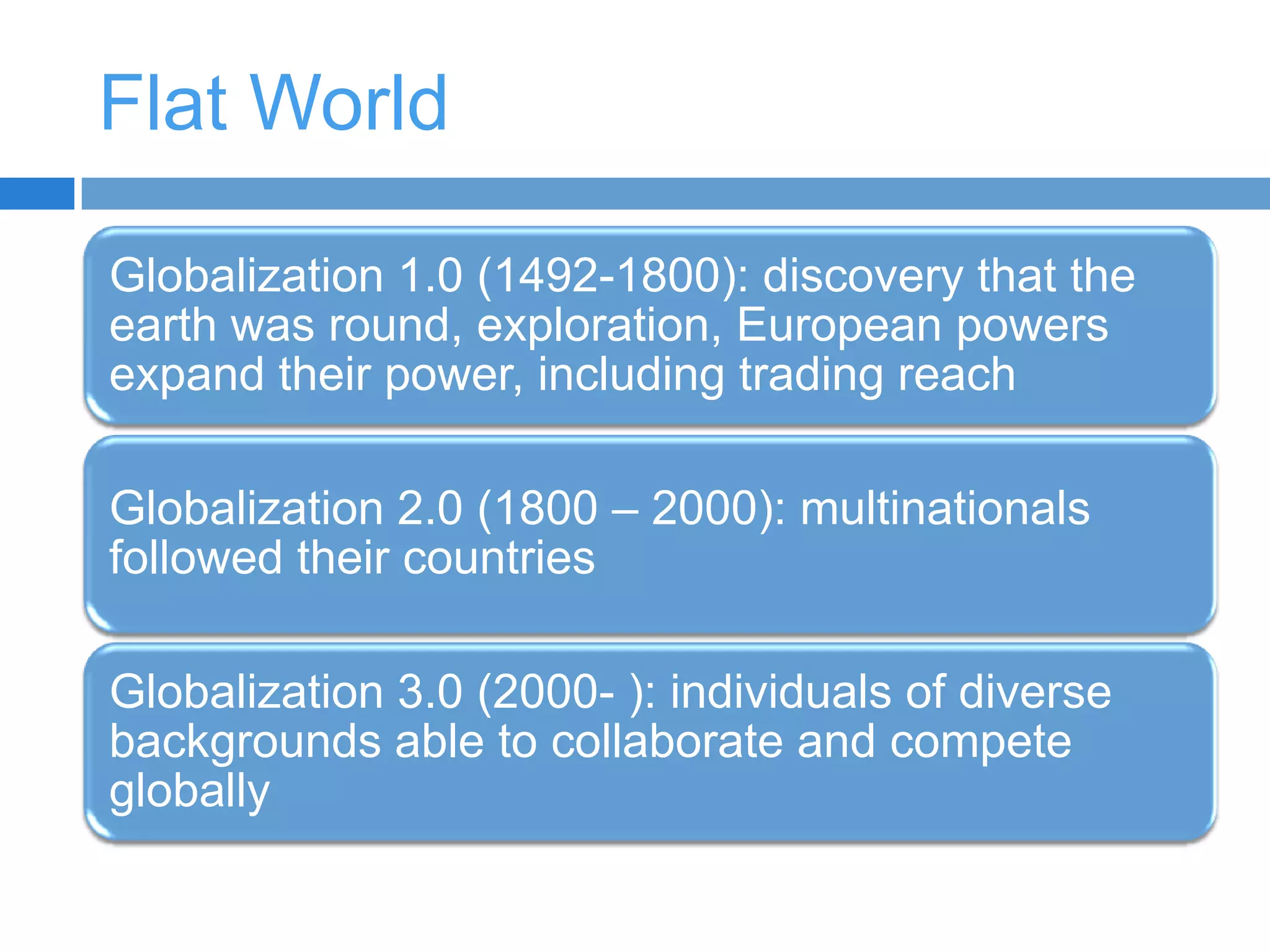
Flat World
Flat WorldPlaying field has been flattened traditional advantages accruing to one country or a large multinational are being challengedCoefficient of globalizationCompletion for global knowledge workIntellectual work, intellectual capital, can be delivered, distributed, produced, and put back together again . . .  with relative freedom in the way we do work
What is the significance of all this?
Significance of Flat WorldLevel playing fieldTraditional, comparative advantages held by those with access to information and/or technology can now be challengedIndividuals from non-traditional backgrounds can now engage in economic activity, at times in ways not seen before
Flattenersfirst three are platforms    contributing to collaboration
Flatteners: first three are platforms contributing to collaboration11/9: the fall of the Berlin Wall opening WindowsFall of the “Wall” between East and West BerlinPolitical systems that were once closed opened upWindows8/9: Netscape goes publicEmergence of an internet browserWork flow software: Development of software which when installed in different computers and in different places allows them to work with each other
11/9 as a platform for collaboration11/9: the fall of the Berlin Wall which separated East and West Berlin and GermanyThe fall of the “wall” resulted in the eventual collapse of countries that were part of the Council for Mutual Economic Assistance or COMECON, sometimes referred to as the “Eastern bloc”, or the Soviet empireIncluded in this “bloc” were countries like the Czech Republic, Bulgaria, Romania, East Germany, Poland, etc.
Friedman’s claimthis event tipped balance of power across the world towards more democratic, free-market oriented governments
11/9 as a platform for collaboration (Continued)Centrally planned countries “opened up”In 1991, India abolished trade controlsChina accelerated reforms (although some of china’s economic reforms started in the 70s)Global exchange of digital information now possible as political restrictions eased upHuge personal empowerment
8/9 as a platform for collaboration8/9: Netscape goes publicThe initial browser was Mosaic which was designed to allow researchers/scientists in remote locations to access each other’s workMosaic was transformed into the first browser to be made available to the public (for free)Coupled with introduction of Windows 95, including GUI capability, these made accessing the internet much easierEarly access to the internet were text based
8/9 as a platform for collaboration (Continued)Browsers as gateway to Internet From internal systems to systems of systemsDot com bubble allowed massive investments in the internet highway; by the time the bubble burst, an initial physical infrastructure – fiber optic cables, switches, etc. – was in placeFrom resistance to email and cell phones (early 90s) to emergence of terms like B2B and B2C.
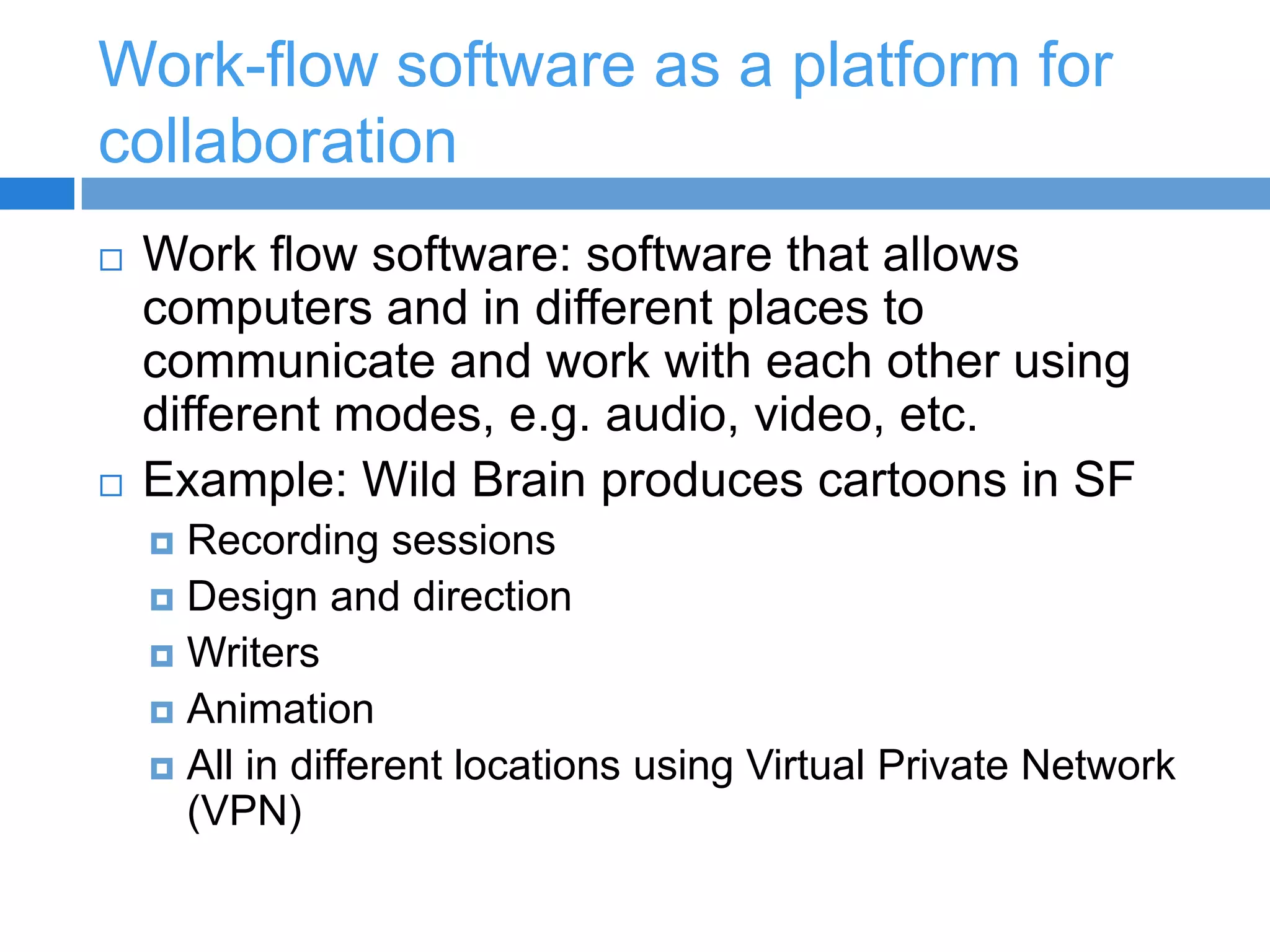
Work-flow software as a platform for collaborationWork flow software: software that allows computers and in different places to communicate and work with each other using different modes, e.g. audio, video, etc.Example: Wild Brain produces cartoons in SFRecording sessionsDesign and directionWritersAnimationAll in different locations using Virtual Private Network (VPN)
Work-flow software as a platform for collaboration (Continued)Example 2: Pay PalEmergence of protocols and standards to facilitate communication among systems
Flatteners: the next seven are new forms of collaboration
Flatteners: the next seven are new forms of collaborationUploadingOutsourcingOffshoringSupply-chainingIn-sourcingIn-formingSteroids
Flattener 4: UploadingPower or capability of individuals to send up, out, and around their own products and ideasApache – a web server that  allow web browsers (in different computers) to interact with different web servers.  Web servers allow a user to use his or her home or office to host a web site.
Flattener 4: Uploading (Continued)Open source communities“community rules”Examples:Linux operating system - offers a family of operating systems; can be adapted to run on the smallest desk top computer, laptop, palm pilot, etc.Firefox (Mozilla)Blogging, Wikis, etc.
Flattener 5: Outsourcing India as an example of how outsourcing beganEducational infrastructure in India7 Indian Institute of Technology 6 Institute of ManagementAs a result, Indian nationals would go to the US or developed countries to find workDot-com boom created “physical highway” to allow for India to get “connected”Reform of telecommunications system in India
Flattener 5: Outsourcing (Continued)US companies start looking for opportunities to utilize labor pool in IndiaLate in the 1990s, the Y2K issue emergedIndian “expats” return to India after “dot.com bubble” burstFriedman sees the massive amount of programming to prevent a “Y2K” disaster and return of expats catalysts India’s emergence as an outsourcing destination
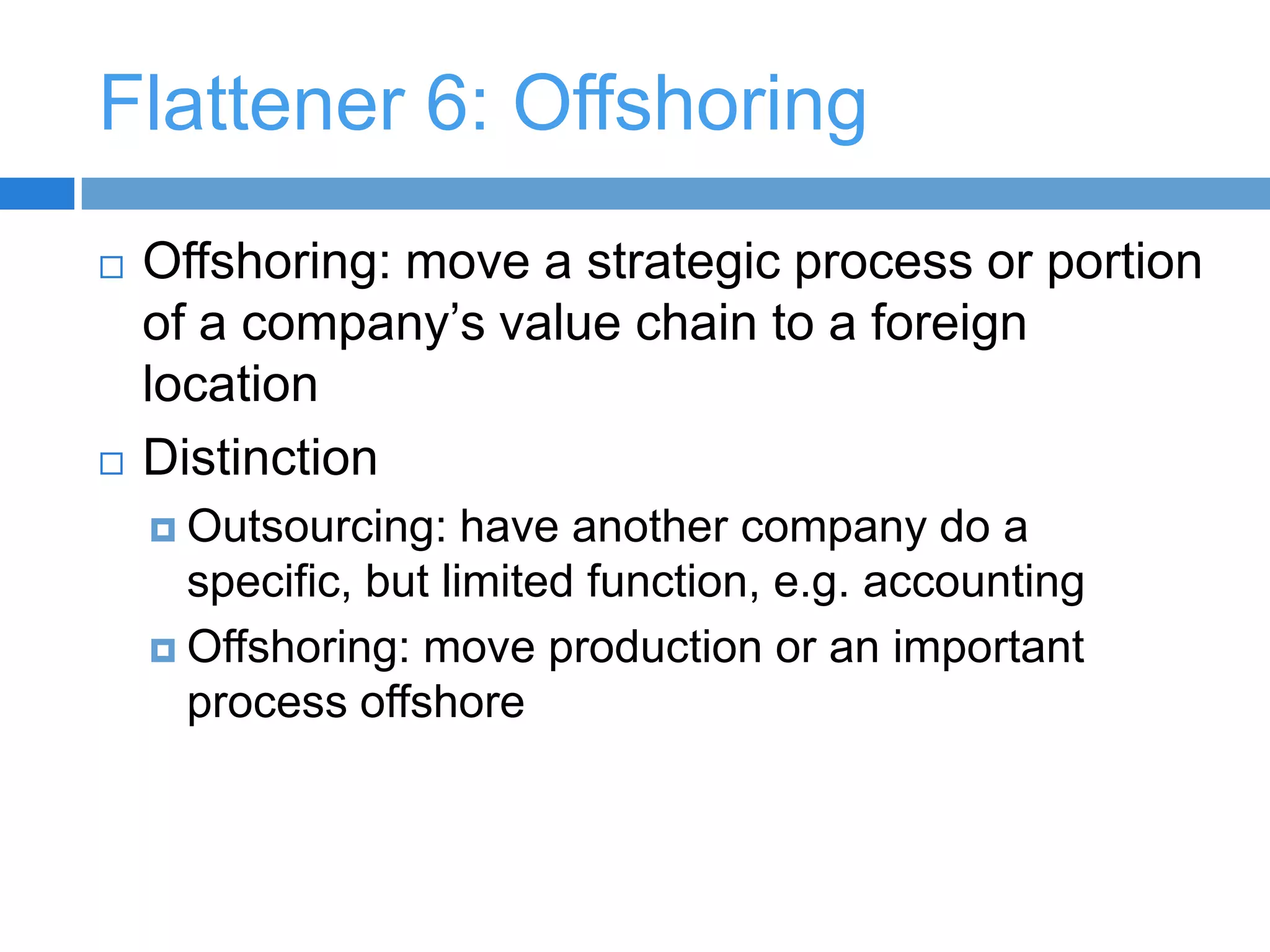
Flattener 6: OffshoringOffshoring: move a strategic process or portion of a company’s value chain to a foreign locationDistinction Outsourcing: have another company do a specific, but limited function, e.g. accountingOffshoring: move production or an important process offshore

2011.02.cesa ib 02

  • 2.
  • 3.
  • 4.
  • 5.
  • 7.
  • 8.
  • 9.
    Leading Exporting andImporting Countries
  • 10.
    Leading Exporting andImporting Countries, continued
  • 11.
    Top 25 Companiesby Foreign Asset Ownership
  • 12.
    Foreign Direct InvestmentDevelopedcountries get the bulk of FDI (69%) while developing countries get around 30%.Least developed countries get minimal FDI.Implications for managers—significant opportunities around the world.Multinational managers should look at risk rating of countries.
  • 13.
    The Internet andInformation TechnologyElectronic Communication — E-mail, World Wide Web, etc. Allows multinationals to communicate with company locations throughout the world.Multinationals can also monitor worldwide operations. Information technology is spurring a borderless financial market.
  • 14.
    The Rise ofGlobal Products and Global CustomersThe needs of customers for many products and services are growing more similar, e.g., McDonald’s, Boeing, Toyota.Global customers search the world for their supplies without regard for national boundaries.
  • 15.
    PrivatizationSale of government-ownedbusinesses to private investors, usually through stock or direct sale to other companies.Two types of privatization contribute to the global economy — the developed world and the developing world.
  • 16.
    Privatization—TypesThe Developed CountriesUse privatization to make formerly government-controlled enterprises more competitive in the global economy.The Developing Countries Use privatization to jump-start their economies or to speed the transition from a communist to a capitalist system.
  • 17.
    New CompetitorsFree marketreforms are creating a potential group of new competitors.Korean, Russian, Taiwanese, and Mexican companies are all emerging. Chinese companies are also on the move.
  • 18.
    Top 25 EmergingMarket Companies
  • 19.
    New Competitors areEmergingGlobal trade has two important effects in developing new competitors:When developing countries are used as low-wage platforms for high-tech assembly, multinationals facilitate the transfer of technology.Aggressive multinationals are also expanding beyond their own borders.
  • 20.
    The Rise ofGlobal StandardsCompanies can make one or only a few versions of product for the world market.This is cheaper than making different versions for different countries.Drive to develop common standards to save money.
  • 21.
    Global StandardsConsistency inquality also an important requirement of doing business in many countries.International organization for standardization (ISO) in Geneva, Switzerland Developed a set of technical standards (ISO 9001:2000 series).
  • 22.
    InternationalizationInternationalization is theprocess by which Firms increase their awareness of the influence of international activities on their futureEstablish and conduct transactions with firms from other countries.
  • 23.
    5 reasons globalsourcing programsTo focus on core competenciesTo reduce and/or variablize costs To gain expertise that is not currently in houseTo increase quality, efficiency, and speed of deliveryTo be able to scale operations effectivelySource: ITESA
  • 24.
  • 25.
    Flat World andNINBerlin WallWindowsNetscape BrowserWorkflowFlat WorldNIN
  • 26.
    Flat World andNINBerlin WallWindowsNetscape BrowserWorkflowGlobal Market
  • 27.
  • 28.
  • 29.
  • 30.
  • 31.
  • 32.
  • 33.
    Flat World andNINUploadingOutsourcingOffshoringSupply-chainingIn-sourcingIn-formingSteroidsFlat WorldNIN
  • 34.
    Flat World andNINUploadingOutsourcingOffshoringSupply-chainingIn-sourcingIn-formingSteroidsFlat WorldNIN
  • 35.
    The world isflat . . . (Friedman)Three converging developments
  • 36.
    A global, Web-enabledplaying field that allows multiple forms of collaboration
  • 37.
    Gradual adaptation oforganizations through horizontal collaboration in the value creation process extends this platform to different countries
  • 38.
    3 billion peoplejoin the party - opening of economies like China, India, Russia, and in Eastern Europe, Latin America, and Central Asia to the world economyExample of how triple convergence worksA global, Web-enabled playing field that allows multiple forms of collaboration is in placeA company installs an effective supply chain that allows it to source products from a country, e.g. India, Bangladesh, China, Ireland, etc.A factory worker in China is able to benefit from global trade because his or her country has allowed information and products to flow “freely”
  • 39.
    New “Arrivals”Population dataPopulationdataWe are only seeing the tip of the iceberg.Not everyone has access yetMicrosoft: in China, 1 in a million can mean a total of 1,300,000Bangalore: “we are hungry for success”Its dominated by, but not all IndiaMap of IT businesses
  • 40.
    Why do FirmsInternationalize?opportunities for growthmarket diversificationhigaher margins and profitsGain new ideas about products, services, and business methodsBetter serve key customers that have relocated abroadBe closer to supply sources, benefit from global sourcing advantages, or gain flexibility in the sourcing of products
  • 41.
    Why do FirmsInternationalize?Gain access to lower-cost or better-value factors of production Develop economies of scale in sourcing, production, marketing, and R&D Confront international competitors more effectively or thwart the growth of competition in the home market Invest in a potentially rewarding relationship with a foreign partner
  • 42.
  • 43.
    Dimensions of InternalizationInternationalizationhas both inward-looking and outward-looking dimensions. The outward-looking perspective incorporates an awareness of the nature of competition in foreign markets
  • 44.
    Dimensions of Internalization(cont.)Includes the following modes of activities:Exporting.Acting as licensor to a foreign company.Establishing joint ventures outside the home country with foreign companies.Establishing or acquiring wholly owned businesses outside the home country.
  • 45.
    Dimensions of Internalization(cont.)Similar to the Sequential Approach theory of internationalization:As firms build confidence, experience and success:Partially OwnedWholly Owned(3) Acquisition Existing Business(1) Capital ParticipationNew Business(2) Joint Venture(4) Greenfield
  • 46.
    Dimensions of Internalization(cont.)Not all firms do or can follow the sequential process of internationalization:Dependent upon industrial and environmental conditionsNeed to coordinate operations in many countries and many value chain activities
  • 47.
    Dimensions of Internalization(cont.)Internationalization affects firms in equally important ways from an inward perspective.
  • 48.
    The related modesof activity include:
  • 49.
  • 50.
    Acting as licenseefrom a foreign company.
  • 51.
    Establishing joint ventures(JVs) inside the home country with foreign companies.
  • 52.
    Managing as thewholly owned subsidiary of a foreign firmDimensions of Internalization (cont.)Many firms have an appreciation of the global environment but do not seek out international opportunities in countries that differ greatly
  • 53.
  • 54.
  • 55.
    How can afirm know if it has a globally competitive product?
  • 56.
    How can thefirm successfully take a product global? Internationalization Theory
  • 57.
    Types of InternationalisationUpstreaminternationalisation Downstream internationalisation importoutsourcingmarket entryoutwardinternationalisationinwardinternationalisation
  • 58.
    Implications for YourProject Upstream Internationalisation (Supply chain management)Location of key suppliersRelationship with key suppliersChanges in number and frequency of changesSupply strategies , e.g. vertical integrationDownstream Internationalisation (Export management)Goals, relationships, strategies, organisational development
  • 59.
    Degrees of InternationalisationDegreeof commitment/level of involvement (structure)Degree of change within the firm (process)
  • 60.
    International Product LifeCycleBasic AssumptionsThe relative weight of changes in factors of production at various stages of a product’s life cycleChanges in a product’s degree of market attractivenessImplications for InternationalisationExtension of the life cycle of productsReduction in unit costs of productionOther useful conceptsProduct vs. Market lagClient-followers vs. Market searchers
  • 62.
    The Network Approachto InternationalisationFirms within an industrial market are inter-dependentThey share resourcesTheir relationships are both stable and changingThey are mutually vulnerableMarkets are networks of relationships
  • 63.
    Some Characteristics ofa NetworkIntensityPower sharingReciprocityCohesion, throughDomain consensusPositive evaluationWork co-ordination
  • 64.
    FACTOR ENDOWMENTS (HECKSCHER– OHLIN) Introduces concept of ‘factors of production’.A country will have a comparative advantage in producing goods which make intensive use of factors of production which it has in abundance A country exportsproducts which use intensively its relatively abundant factors and imports products which use intensively its relatively scarce factorsLeontief paradox
  • 65.
    Industrial Clusters Aconcentration of suppliers and supporting firms from the same industry located within the same geographic areaExamples include: the Silicon Valley, fashion cluster in northern Italy, pharma cluster in Switzerland, footwear industry in Pusan, South Korea, and the IT industry in Bangalore, IndiaIndustrial clusters can serve as an export platform for individual nations
  • 66.
    National Industrial PolicyProactiveeconomic development plan implemented by the public sector to nurture or support promising industry sectors with potential for regional or global dominance. Public sector initiatives can include:Tax incentivesMonetary and fiscal policiesRigorous educational systemsInvestment in national infrastructureStrong legal and regulatory systems
  • 67.
    National Industrial Policy:Irelandas an ExampleBeginning in the 1980s, the Irish government implemented a series of pro-business policies to build strong economic sectors. The “Irish Miracle” resulted from:Fiscal, monetary, and tax consolidationPartnership with the industry and unionsEmphasis on high-value adding industries such as pharma, biotechnology, and ITMembership in the European Union; subsidies and investment received from the EUInvestment in education
  • 68.
    FDI Based Explanations:Dunning’s Eclectic ParadigmThree conditions determine whether or not a company will internalize via FDI:Ownership-specific advantages – knowledge, skills, capabilities, relationships, or physical assets that form the basis for the firm’s competitive advantageLocation-specific advantages – advantages associated with the country in which the MNE is invested, including natural resources, skilled or low cost labor, and inexpensive capitalInternalization advantages – control derived from internalizing foreign-based manufacturing, distribution, or other value chain activities
  • 69.
    The background -UppsalaThe firm is assumed to strive for growth and long term profitThe firm is assumed to avoid uncertainty and keep risk taking at a low levelThe behavioral theory of the firm bounded rationality – perfect decisons are infeasable limited search satisficing behavior - meet criteria for adequacy, rather than to identify an optimal solution conflicting goals, Incremental adjustments to changing conditions of the firm and its environmentDynamic model (present state important for future changes and subsequent states)
  • 70.
    State AspectsMarket knowledgeInformationstored and retrievable in minds of individuals, computer memories or in written formObjective or experiential – latter most crusialMarket commitmentAmount and specificity of resources committed to a market (experiential knowledge may be one type)
  • 71.
    Change AspectsCommitment decisionsResponseto perceived probalems/opportunitiesHigh perceived uncertainty leads to low commitmentIncreased (experiential) makret knowledge leads to lower preceived market uncertaintySmall steps unless very large resourcesCurrent business activitiesPrime source of market experience
  • 72.
    Johanson & Vahlne– 1990 (1)Stages model is one possible manifestation of the State and change aspects modelInternationally experienced firms may allocate resources on the basis of real market conditions rather than in response to the unknownValidity of model mainly in early stages (low experiential knowledge and high uncertainty)World more internationalized and homogeneousPsychic distance smaller and market knowledge less country specific
  • 73.
    Johanson &a Vahlne– 1990 (2)Service firms may internationalize in a different mannerInternationalization processes should be related to processes in the environment (market, network, industry, technology, etc.)Behavioral model could be supplemented by economic modelsStrategic thinking should supplement emergent development, chance, and necessity
  • 74.
  • 76.
  • 77.
    Moving ForwardFriedman’s viewof a “flat world”“Flatteners” or developments that helped create this flat worldSummarize these flatteners into his notion of a “triple convergence”
  • 78.
  • 79.
    Flat WorldPlaying fieldhas been flattened traditional advantages accruing to one country or a large multinational are being challengedCoefficient of globalizationCompletion for global knowledge workIntellectual work, intellectual capital, can be delivered, distributed, produced, and put back together again . . . with relative freedom in the way we do work
  • 80.
    What is thesignificance of all this?
  • 81.
    Significance of FlatWorldLevel playing fieldTraditional, comparative advantages held by those with access to information and/or technology can now be challengedIndividuals from non-traditional backgrounds can now engage in economic activity, at times in ways not seen before
  • 82.
    Flattenersfirst three areplatforms contributing to collaboration
  • 83.
    Flatteners: first threeare platforms contributing to collaboration11/9: the fall of the Berlin Wall opening WindowsFall of the “Wall” between East and West BerlinPolitical systems that were once closed opened upWindows8/9: Netscape goes publicEmergence of an internet browserWork flow software: Development of software which when installed in different computers and in different places allows them to work with each other
  • 84.
    11/9 as aplatform for collaboration11/9: the fall of the Berlin Wall which separated East and West Berlin and GermanyThe fall of the “wall” resulted in the eventual collapse of countries that were part of the Council for Mutual Economic Assistance or COMECON, sometimes referred to as the “Eastern bloc”, or the Soviet empireIncluded in this “bloc” were countries like the Czech Republic, Bulgaria, Romania, East Germany, Poland, etc.
  • 85.
    Friedman’s claimthis eventtipped balance of power across the world towards more democratic, free-market oriented governments
  • 86.
    11/9 as aplatform for collaboration (Continued)Centrally planned countries “opened up”In 1991, India abolished trade controlsChina accelerated reforms (although some of china’s economic reforms started in the 70s)Global exchange of digital information now possible as political restrictions eased upHuge personal empowerment
  • 87.
    8/9 as aplatform for collaboration8/9: Netscape goes publicThe initial browser was Mosaic which was designed to allow researchers/scientists in remote locations to access each other’s workMosaic was transformed into the first browser to be made available to the public (for free)Coupled with introduction of Windows 95, including GUI capability, these made accessing the internet much easierEarly access to the internet were text based
  • 88.
    8/9 as aplatform for collaboration (Continued)Browsers as gateway to Internet From internal systems to systems of systemsDot com bubble allowed massive investments in the internet highway; by the time the bubble burst, an initial physical infrastructure – fiber optic cables, switches, etc. – was in placeFrom resistance to email and cell phones (early 90s) to emergence of terms like B2B and B2C.
  • 89.
    Work-flow software asa platform for collaborationWork flow software: software that allows computers and in different places to communicate and work with each other using different modes, e.g. audio, video, etc.Example: Wild Brain produces cartoons in SFRecording sessionsDesign and directionWritersAnimationAll in different locations using Virtual Private Network (VPN)
  • 90.
    Work-flow software asa platform for collaboration (Continued)Example 2: Pay PalEmergence of protocols and standards to facilitate communication among systems
  • 91.
    Flatteners: the nextseven are new forms of collaboration
  • 92.
    Flatteners: the nextseven are new forms of collaborationUploadingOutsourcingOffshoringSupply-chainingIn-sourcingIn-formingSteroids
  • 93.
    Flattener 4: UploadingPoweror capability of individuals to send up, out, and around their own products and ideasApache – a web server that allow web browsers (in different computers) to interact with different web servers. Web servers allow a user to use his or her home or office to host a web site.
  • 94.
    Flattener 4: Uploading(Continued)Open source communities“community rules”Examples:Linux operating system - offers a family of operating systems; can be adapted to run on the smallest desk top computer, laptop, palm pilot, etc.Firefox (Mozilla)Blogging, Wikis, etc.
  • 95.
    Flattener 5: OutsourcingIndia as an example of how outsourcing beganEducational infrastructure in India7 Indian Institute of Technology 6 Institute of ManagementAs a result, Indian nationals would go to the US or developed countries to find workDot-com boom created “physical highway” to allow for India to get “connected”Reform of telecommunications system in India
  • 96.
    Flattener 5: Outsourcing(Continued)US companies start looking for opportunities to utilize labor pool in IndiaLate in the 1990s, the Y2K issue emergedIndian “expats” return to India after “dot.com bubble” burstFriedman sees the massive amount of programming to prevent a “Y2K” disaster and return of expats catalysts India’s emergence as an outsourcing destination
  • 97.
    Flattener 6: OffshoringOffshoring:move a strategic process or portion of a company’s value chain to a foreign locationDistinction Outsourcing: have another company do a specific, but limited function, e.g. accountingOffshoring: move production or an important process offshore
  • 98.
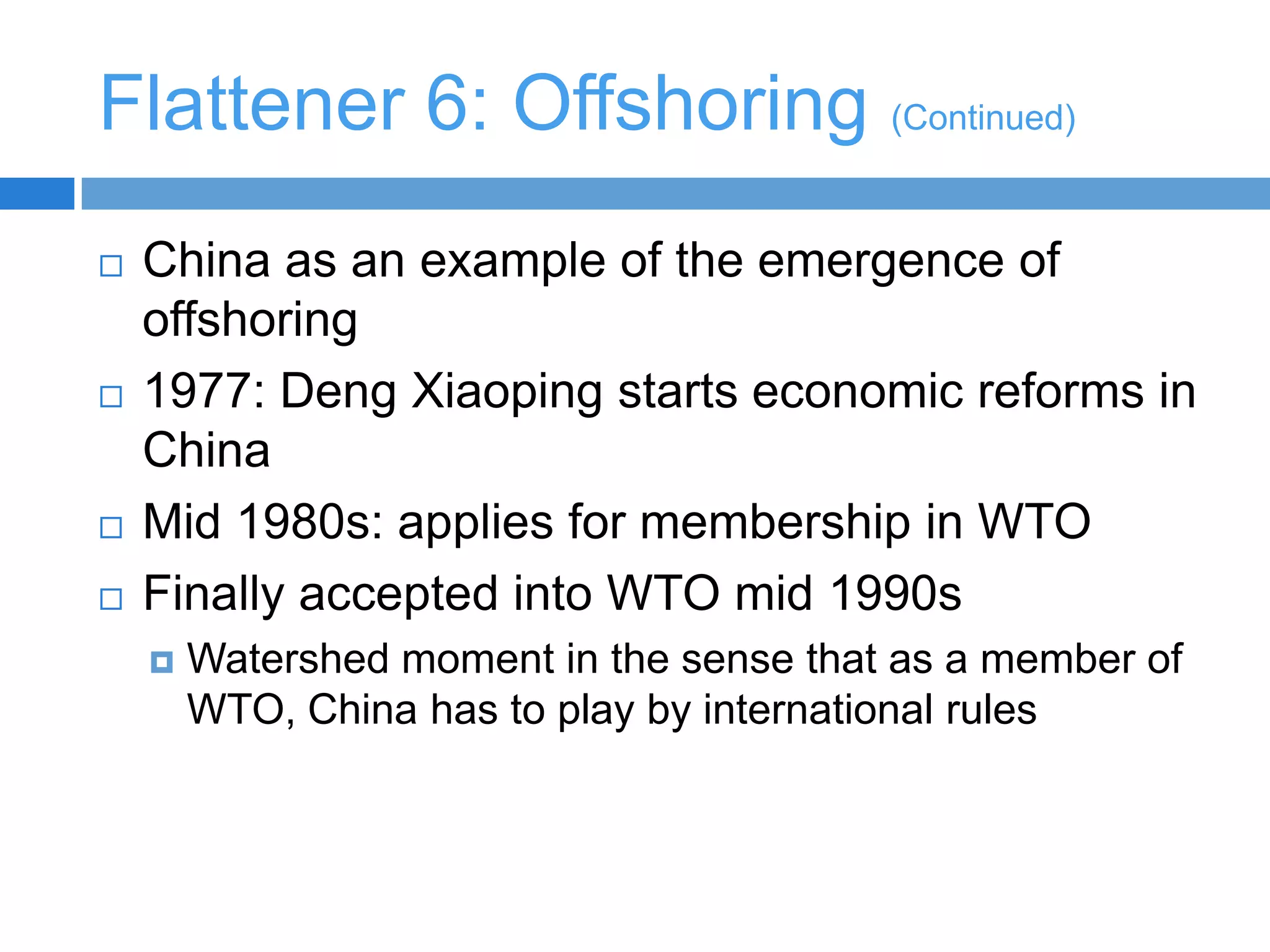
    Flattener 6: Offshoring(Continued)China as an example of the emergence of offshoring1977: Deng Xiaoping starts economic reforms in ChinaMid 1980s: applies for membership in WTOFinally accepted into WTO mid 1990sWatershed moment in the sense that as a member of WTO, China has to play by international rules
  • 99.
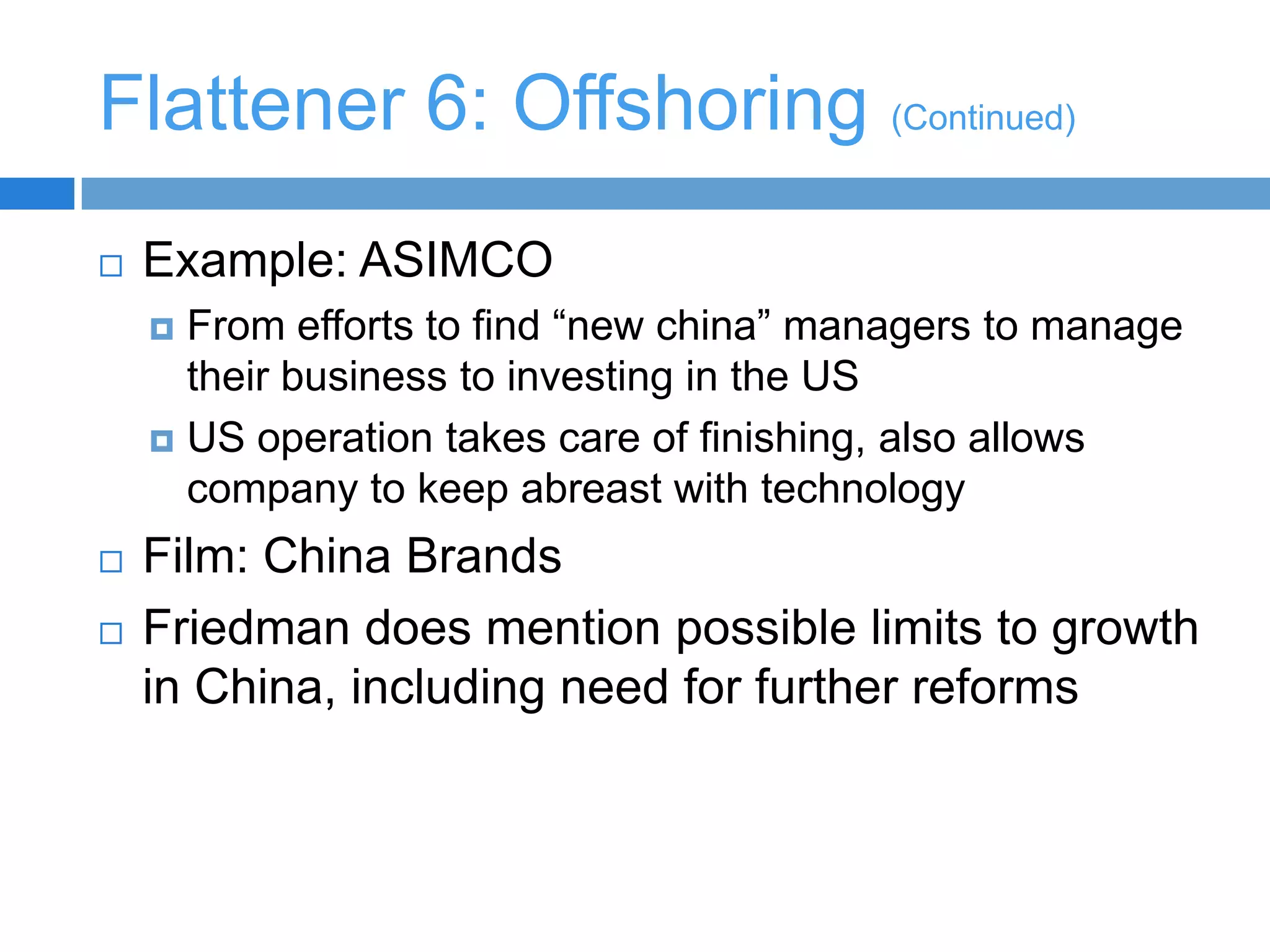
    Flattener 6: Offshoring(Continued)Example: ASIMCOFrom efforts to find “new china” managers to manage their business to investing in the US US operation takes care of finishing, also allows company to keep abreast with technologyFilm: China BrandsFriedman does mention possible limits to growth in China, including need for further reforms
  • 100.
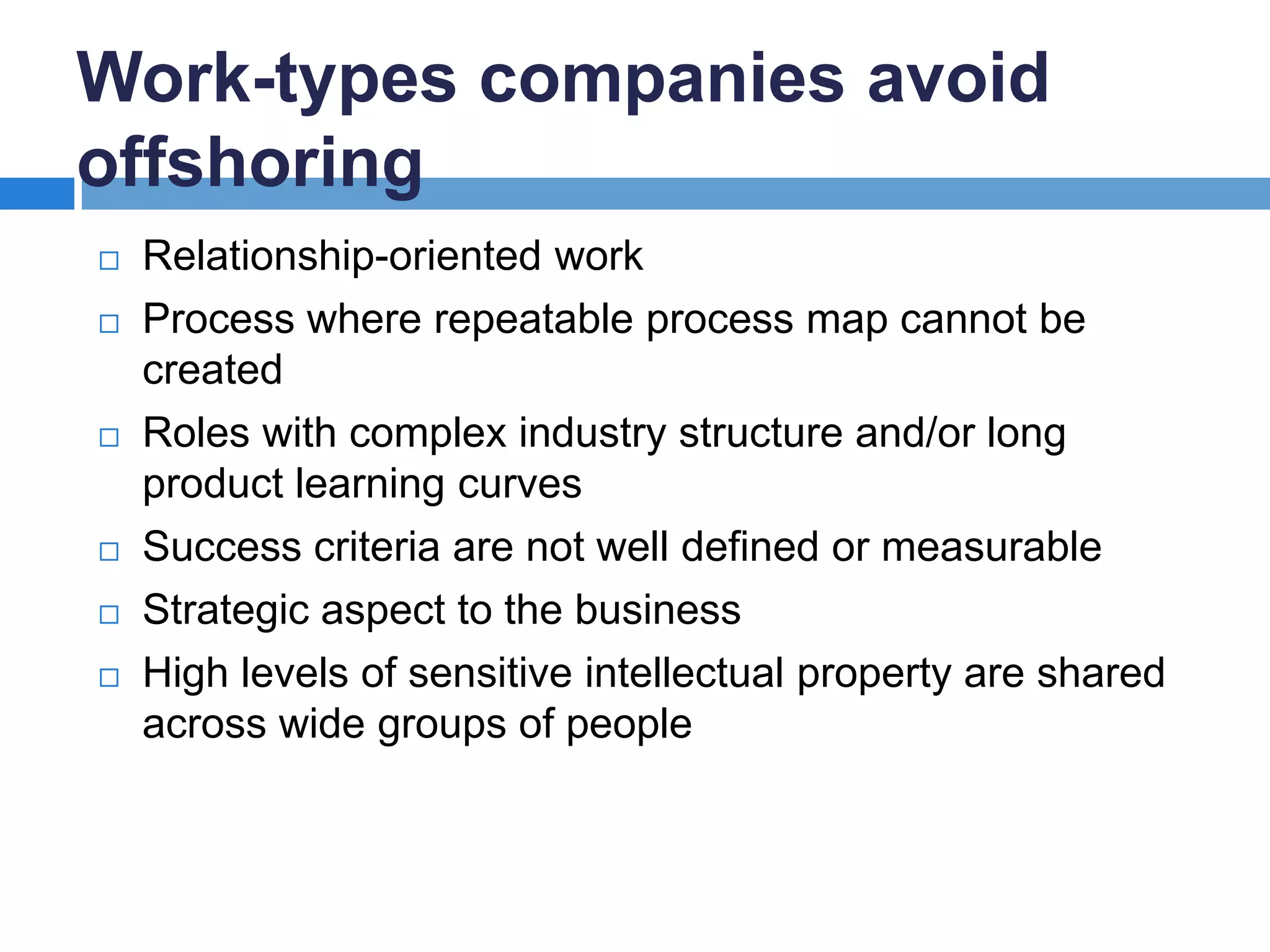
    Work-types companies avoidoffshoringRelationship-oriented work Process where repeatable process map cannot be createdRoles with complex industry structure and/or long product learning curvesSuccess criteria are not well defined or measurableStrategic aspect to the businessHigh levels of sensitive intellectual property are shared across wide groups of people
  • 101.
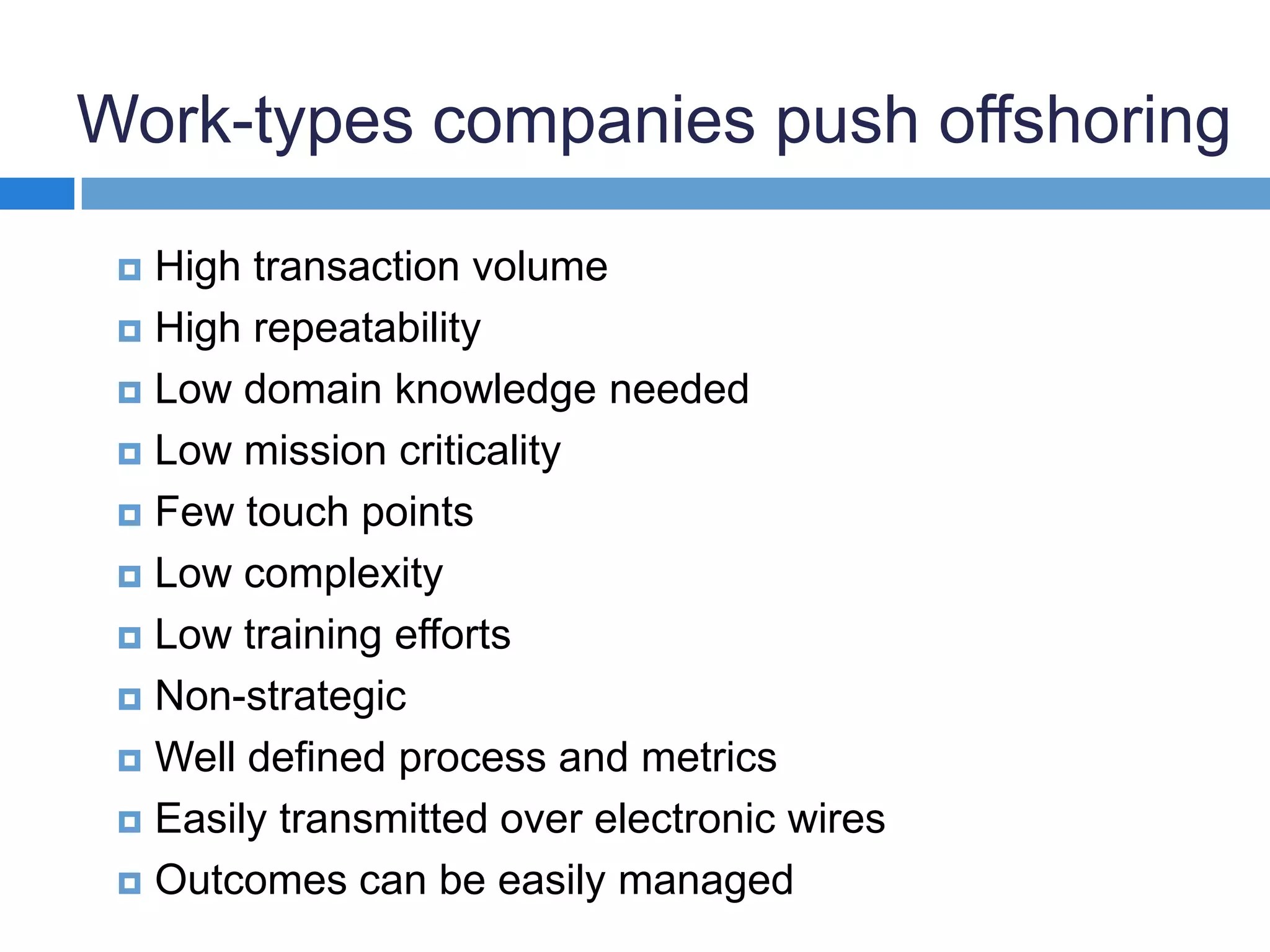
    Work-types companies pushoffshoringHigh transaction volumeHigh repeatabilityLow domain knowledge neededLow mission criticalityFew touch pointsLow complexityLow training effortsNon-strategicWell defined process and metricsEasily transmitted over electronic wiresOutcomes can be easily managed
  • 103.
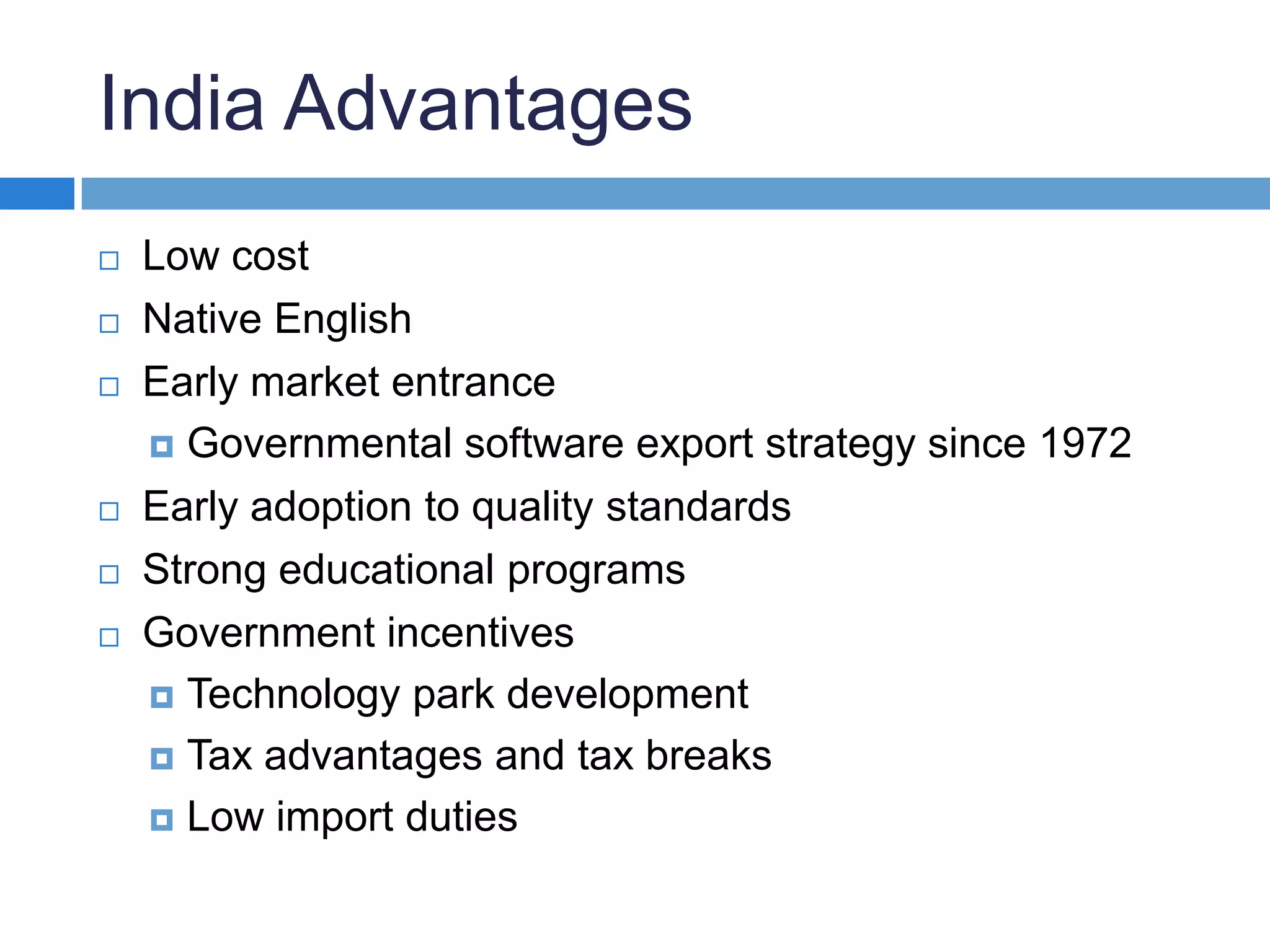
    India AdvantagesLow costNativeEnglishEarly market entranceGovernmental software export strategy since 1972 Early adoption to quality standardsStrong educational programsGovernment incentives Technology park developmentTax advantages and tax breaksLow import duties
  • 104.
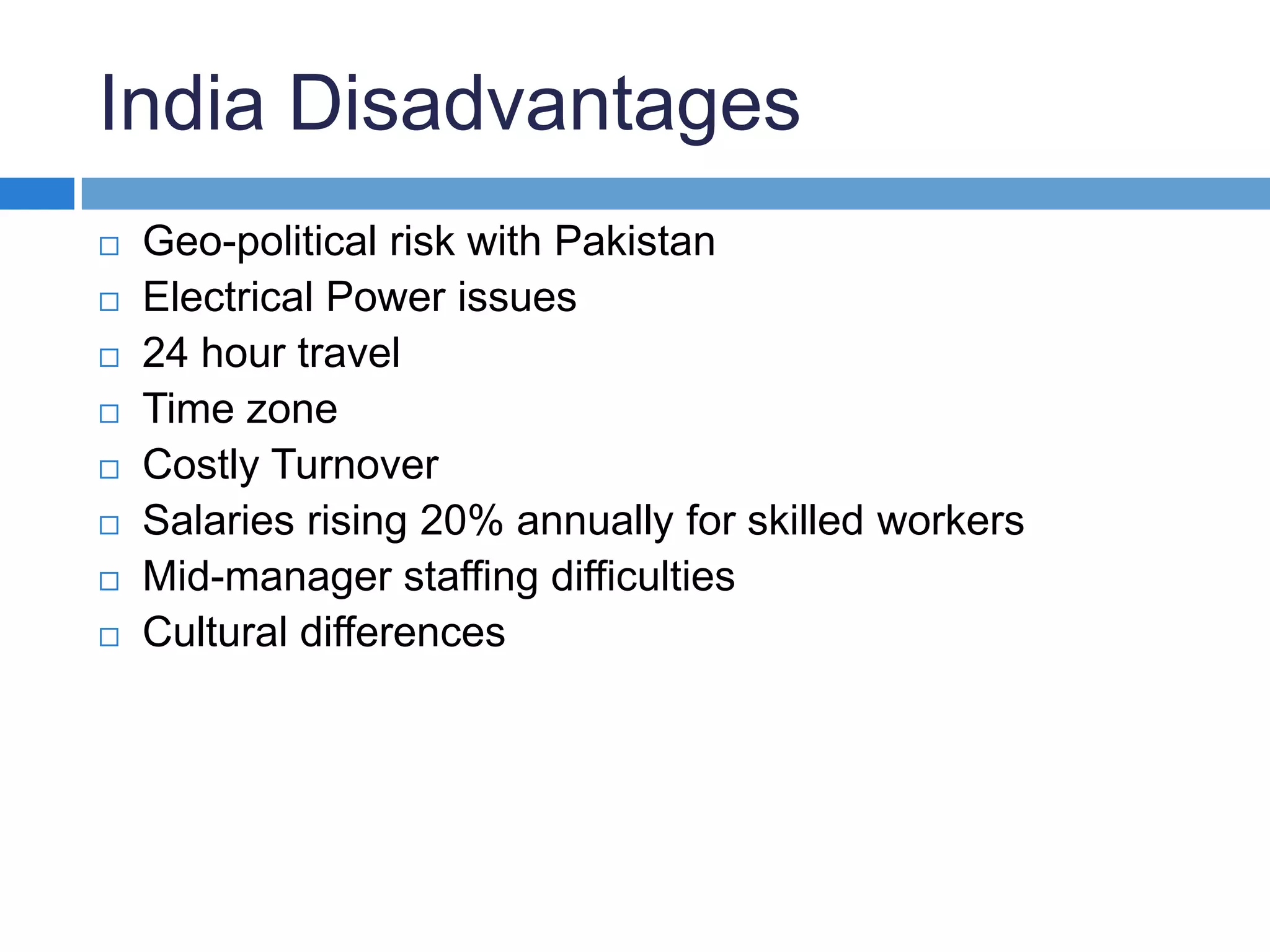
    India DisadvantagesGeo-political riskwith PakistanElectrical Power issues 24 hour travelTime zoneCostly Turnover Salaries rising 20% annually for skilled workersMid-manager staffing difficultiesCultural differences
  • 105.
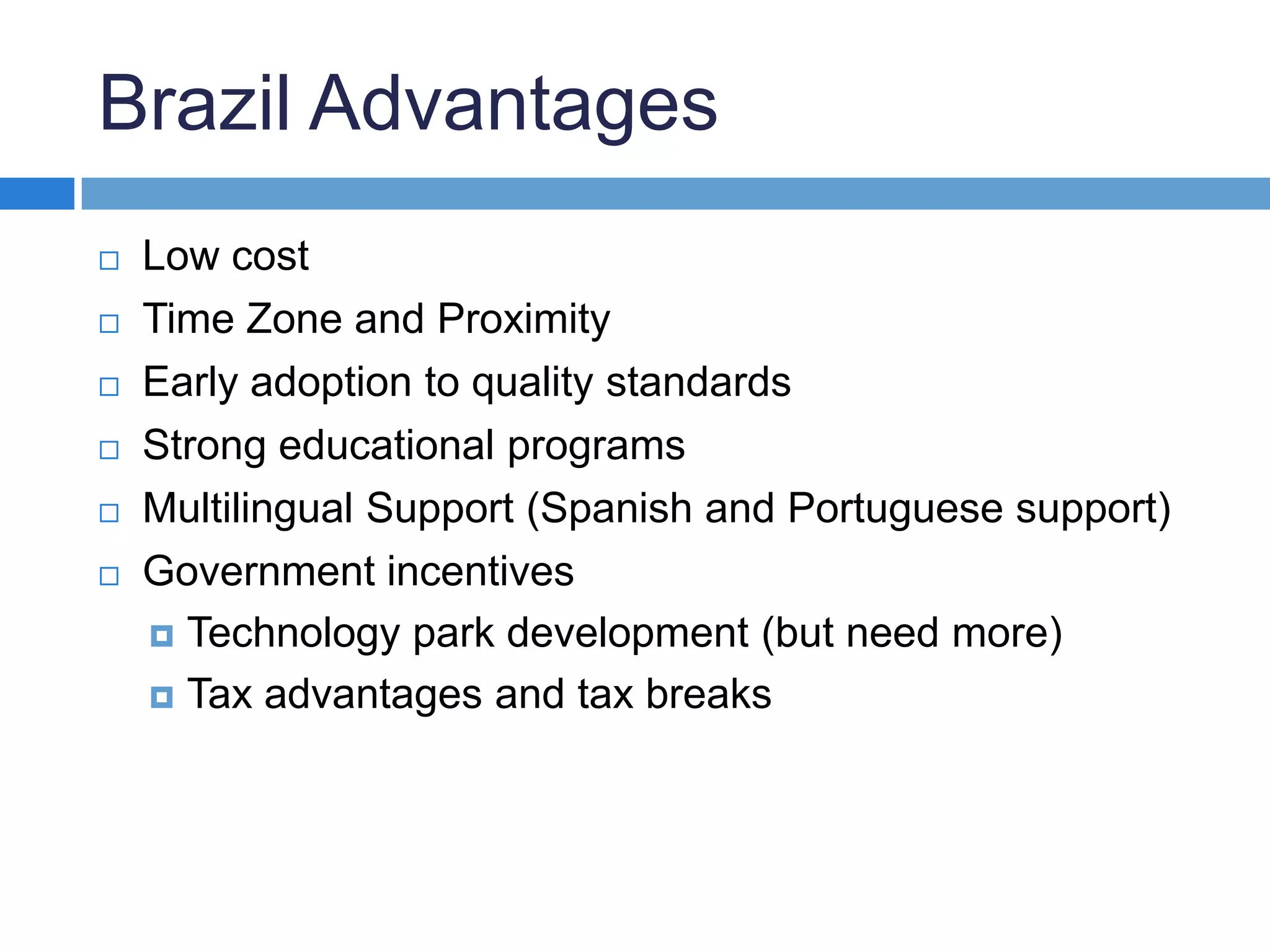
    Brazil AdvantagesLow costTimeZone and ProximityEarly adoption to quality standardsStrong educational programsMultilingual Support (Spanish and Portuguese support)Government incentives Technology park development (but need more)Tax advantages and tax breaks
  • 106.
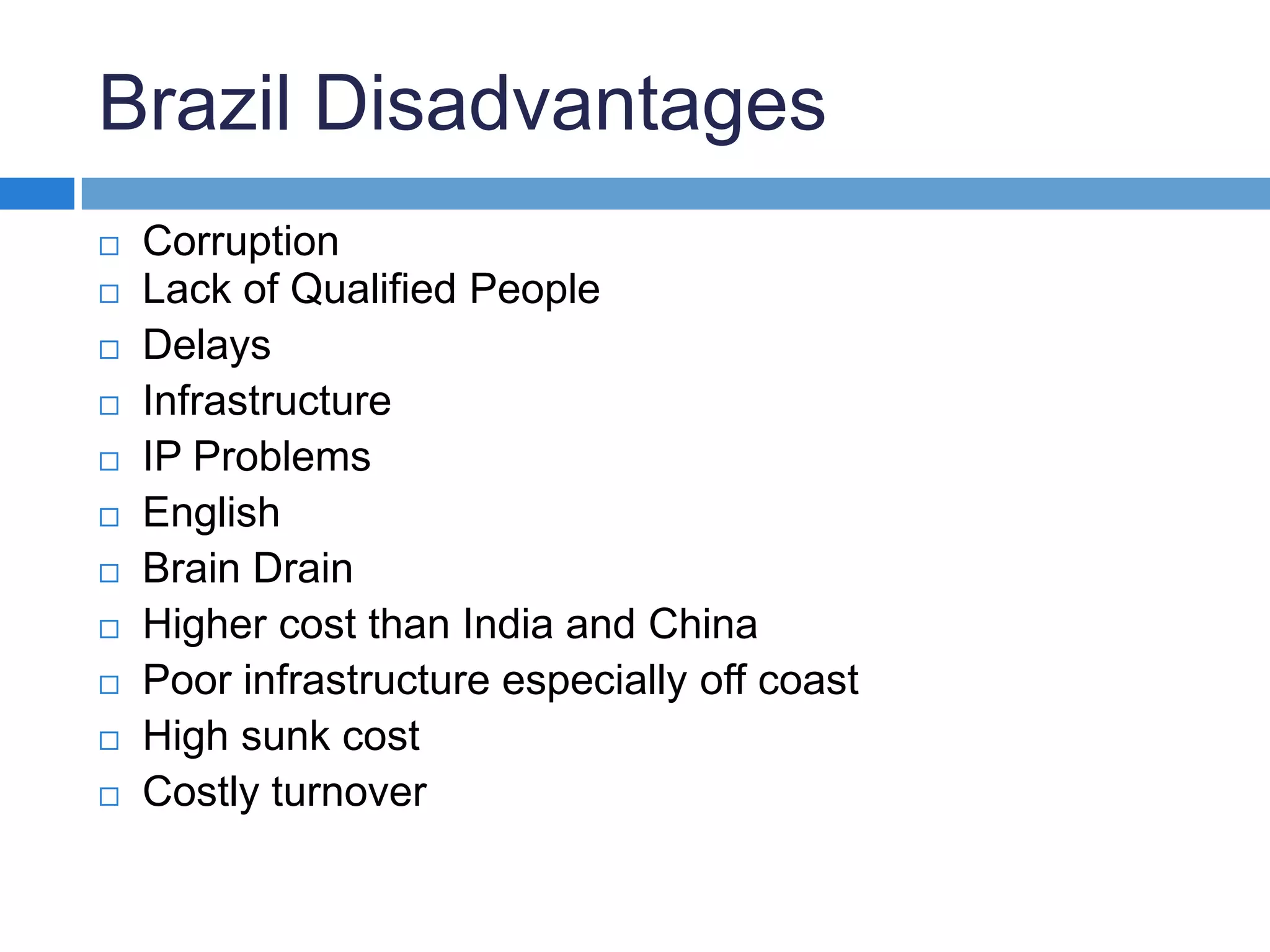
    Brazil DisadvantagesCorruptionLack ofQualified PeopleDelaysInfrastructureIP ProblemsEnglishBrain DrainHigher cost than India and ChinaPoor infrastructure especially off coastHigh sunk costCostly turnover
  • 107.
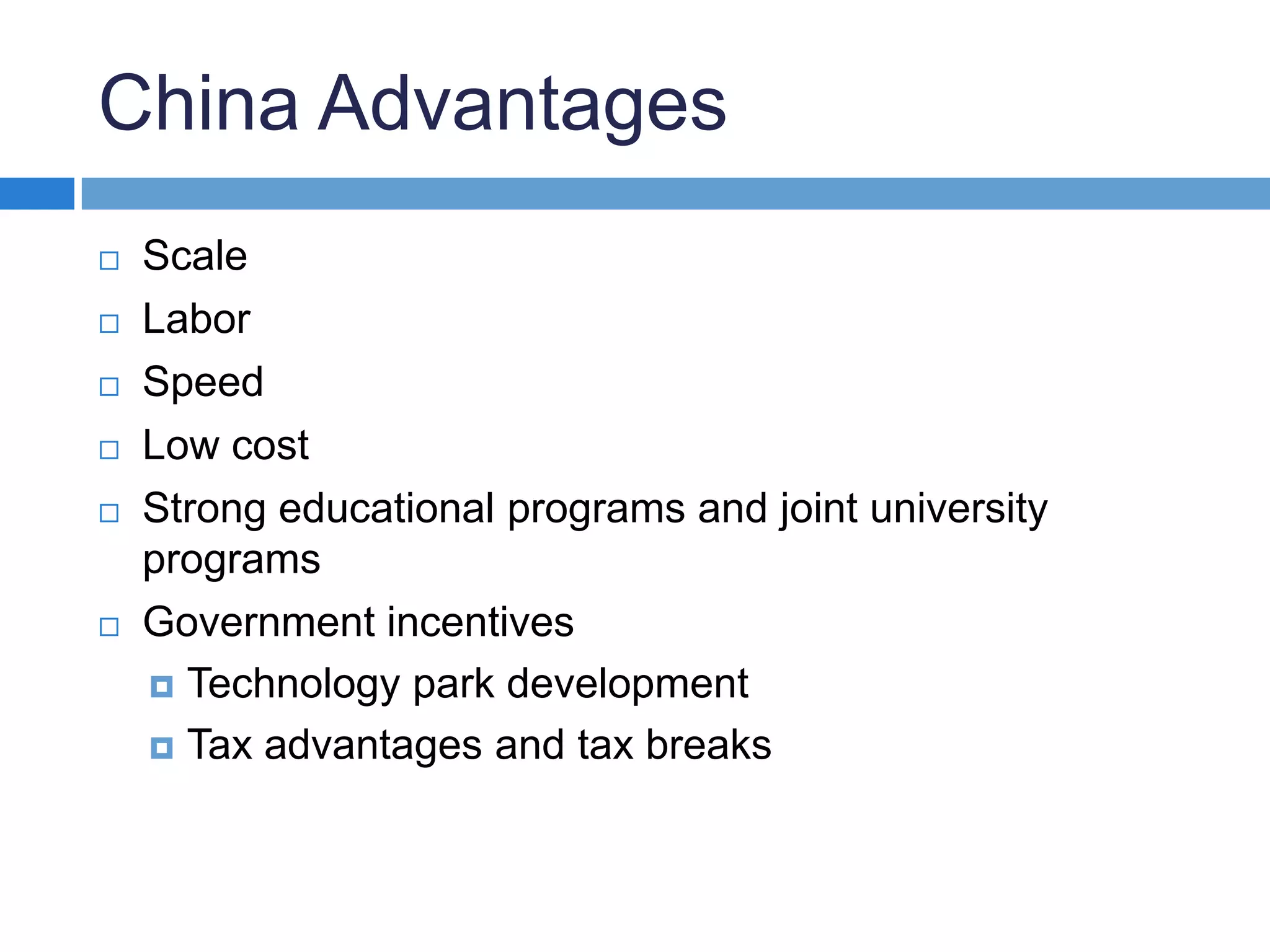
    China AdvantagesScaleLaborSpeedLow costStrongeducational programs and joint university programsGovernment incentives Technology park developmentTax advantages and tax breaks
  • 108.
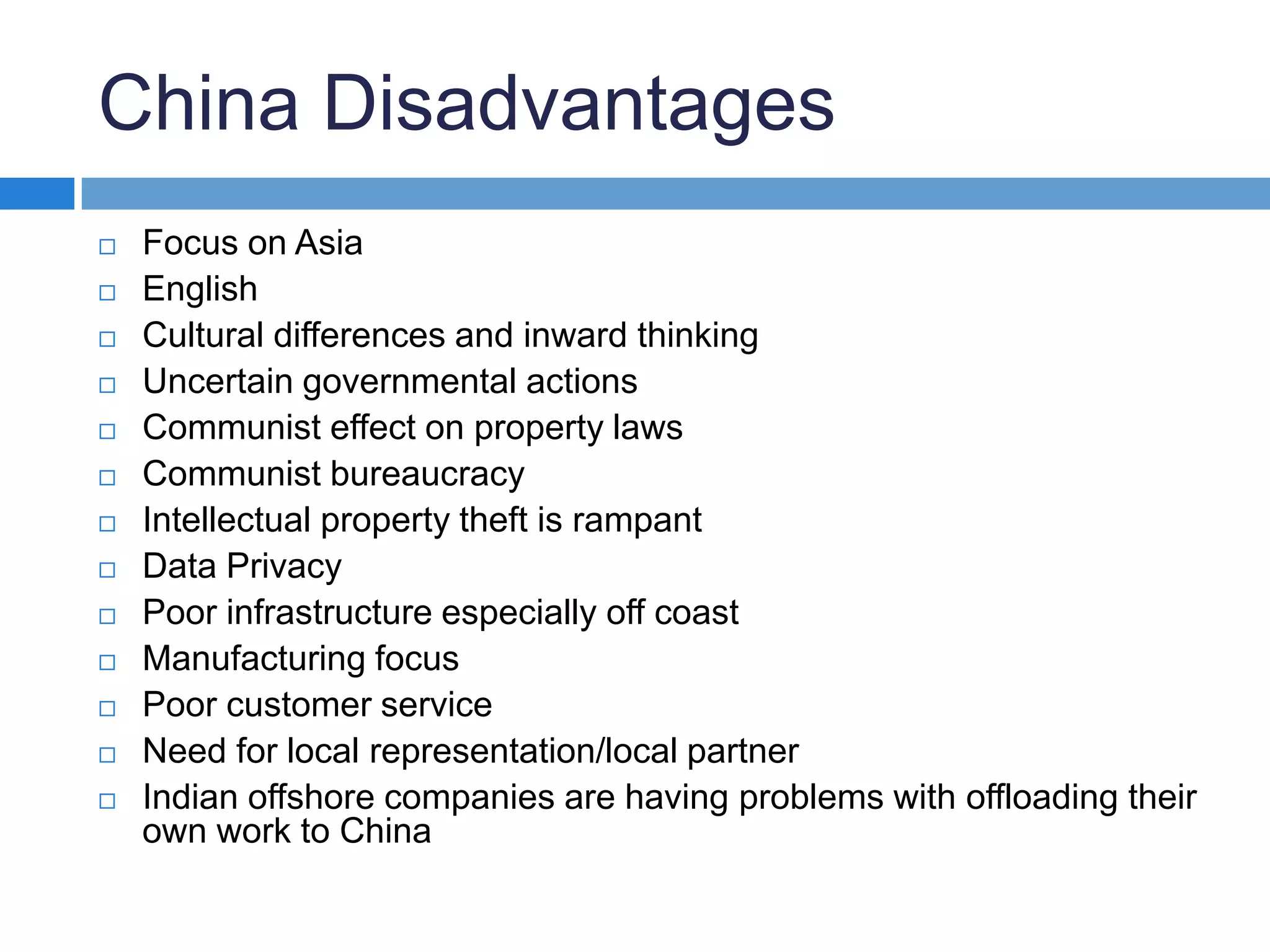
    China DisadvantagesFocus onAsiaEnglish Cultural differences and inward thinking Uncertain governmental actionsCommunist effect on property laws Communist bureaucracy Intellectual property theft is rampantData PrivacyPoor infrastructure especially off coastManufacturing focus Poor customer service Need for local representation/local partner Indian offshore companies are having problems with offloading their own work to China
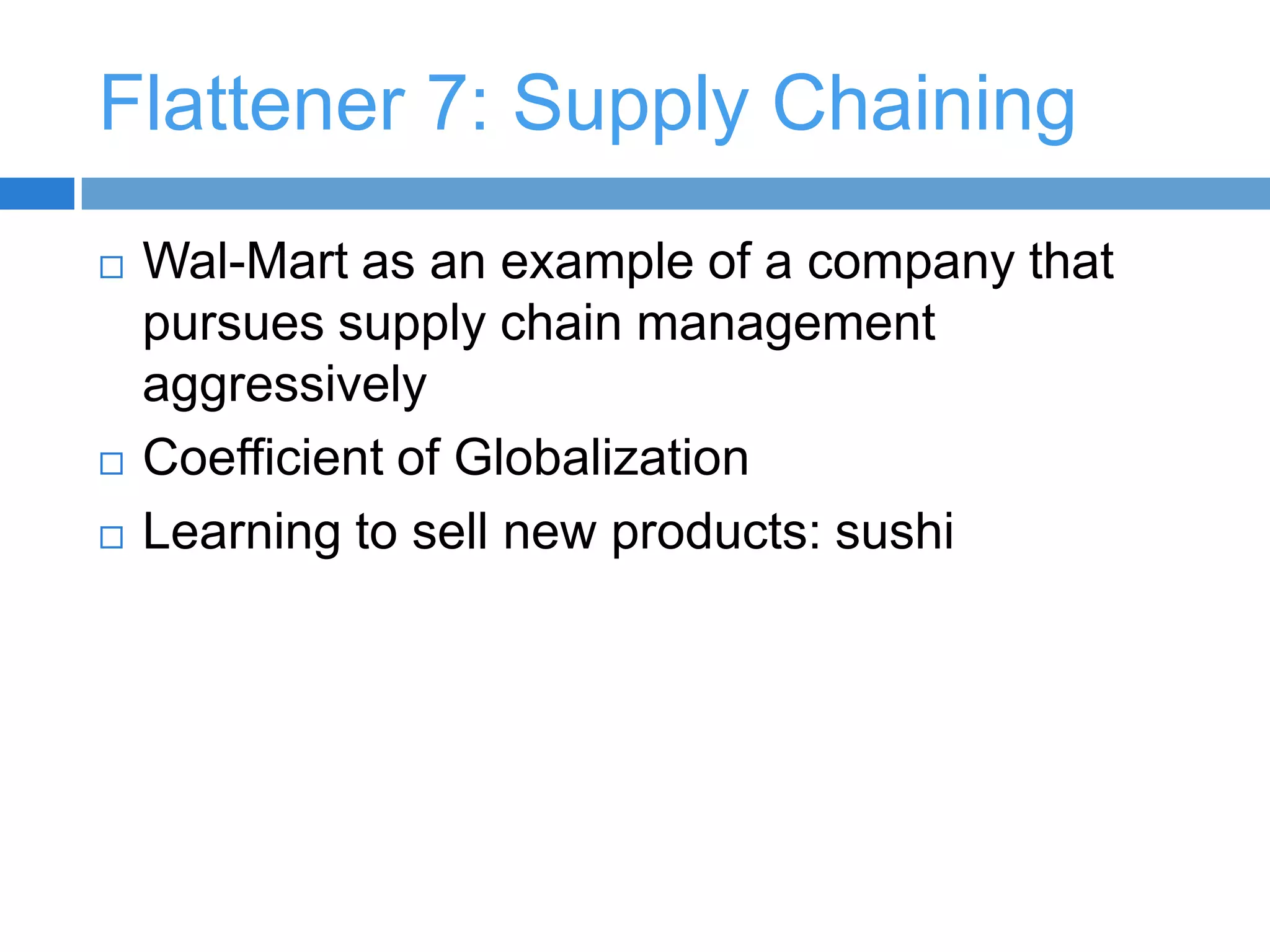
  • 109.
    Flattener 7: SupplyChainingWal-Mart as an example of a company that pursues supply chain management aggressivelyCoefficient of GlobalizationLearning to sell new products: sushi
  • 110.
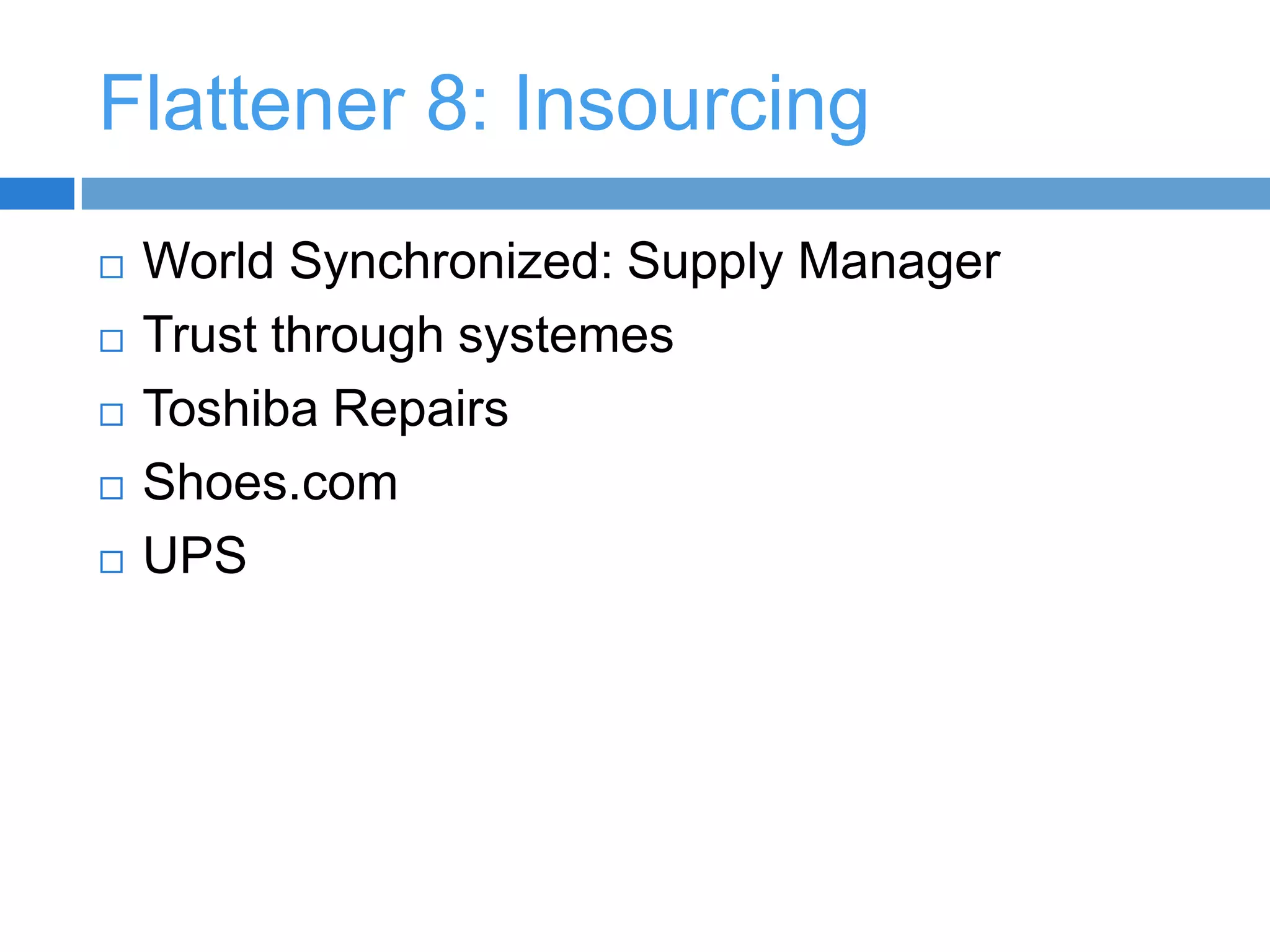
    Flattener 8: InsourcingWorldSynchronized: Supply ManagerTrust through systemesToshiba RepairsShoes.comUPS
  • 111.
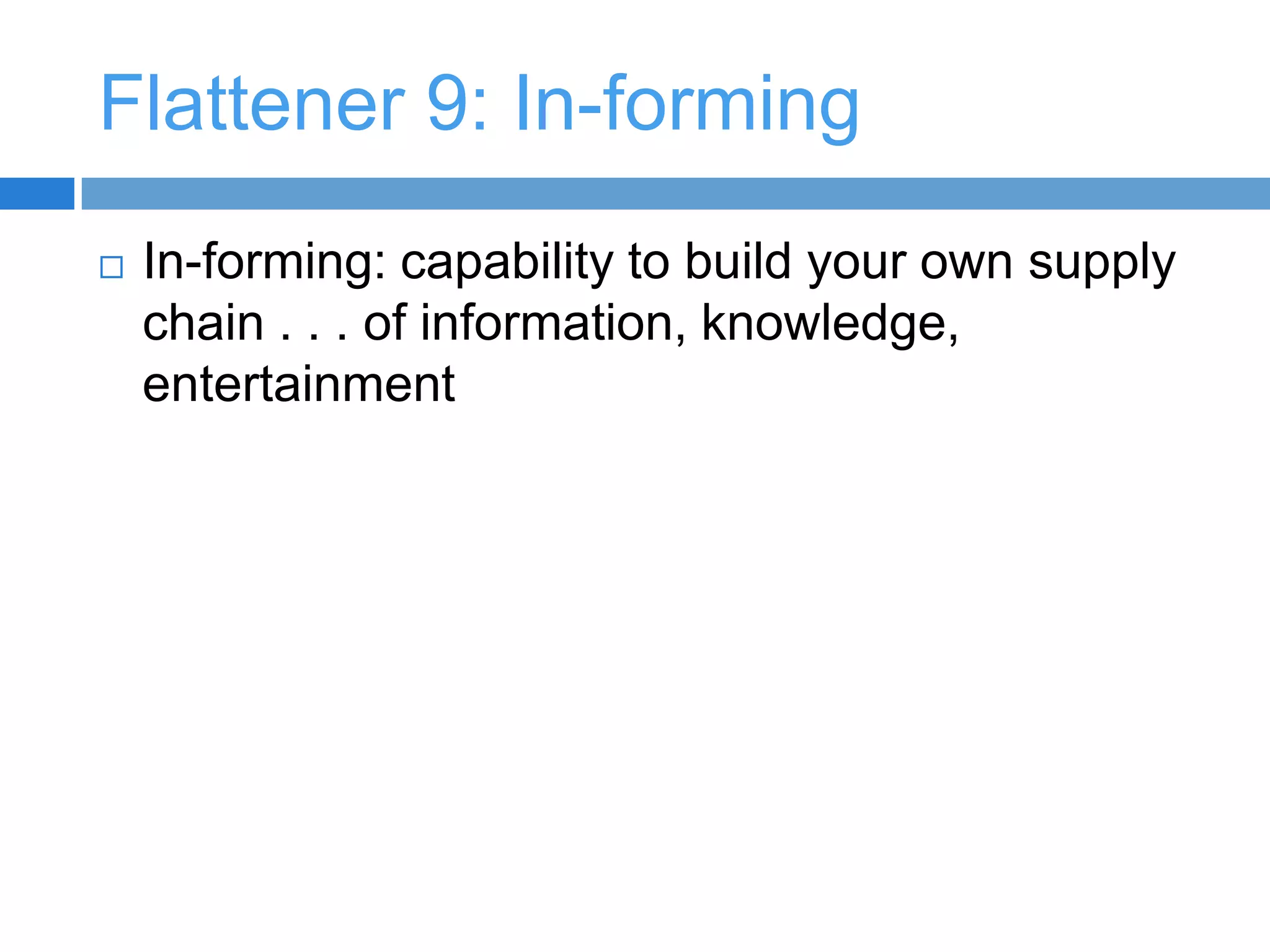
    Flattener 9: In-formingIn-forming:capability to build your own supply chain . . . of information, knowledge, entertainment
  • 112.
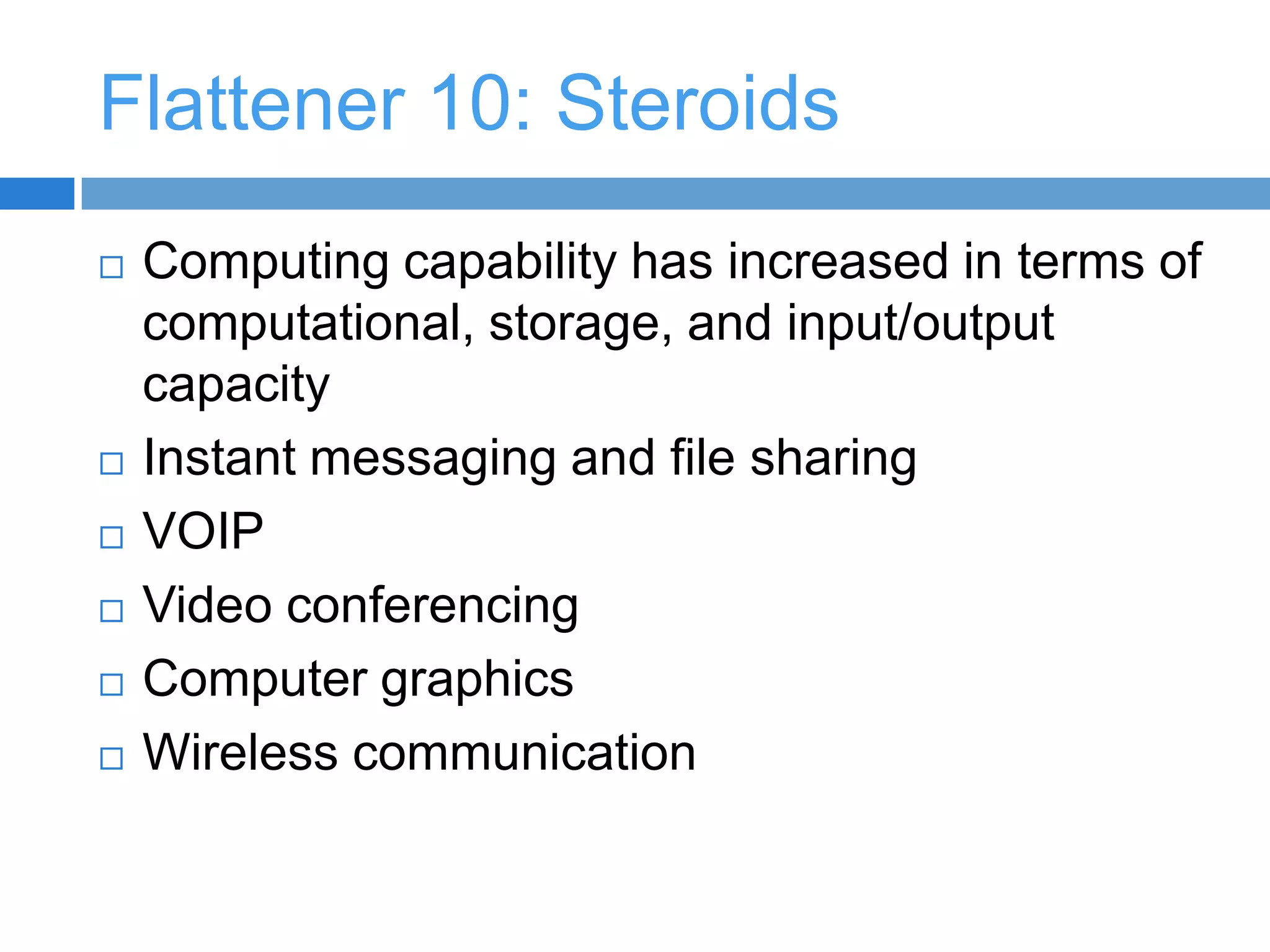
    Flattener 10: SteroidsComputingcapability has increased in terms of computational, storage, and input/output capacityInstant messaging and file sharingVOIPVideo conferencingComputer graphicsWireless communication