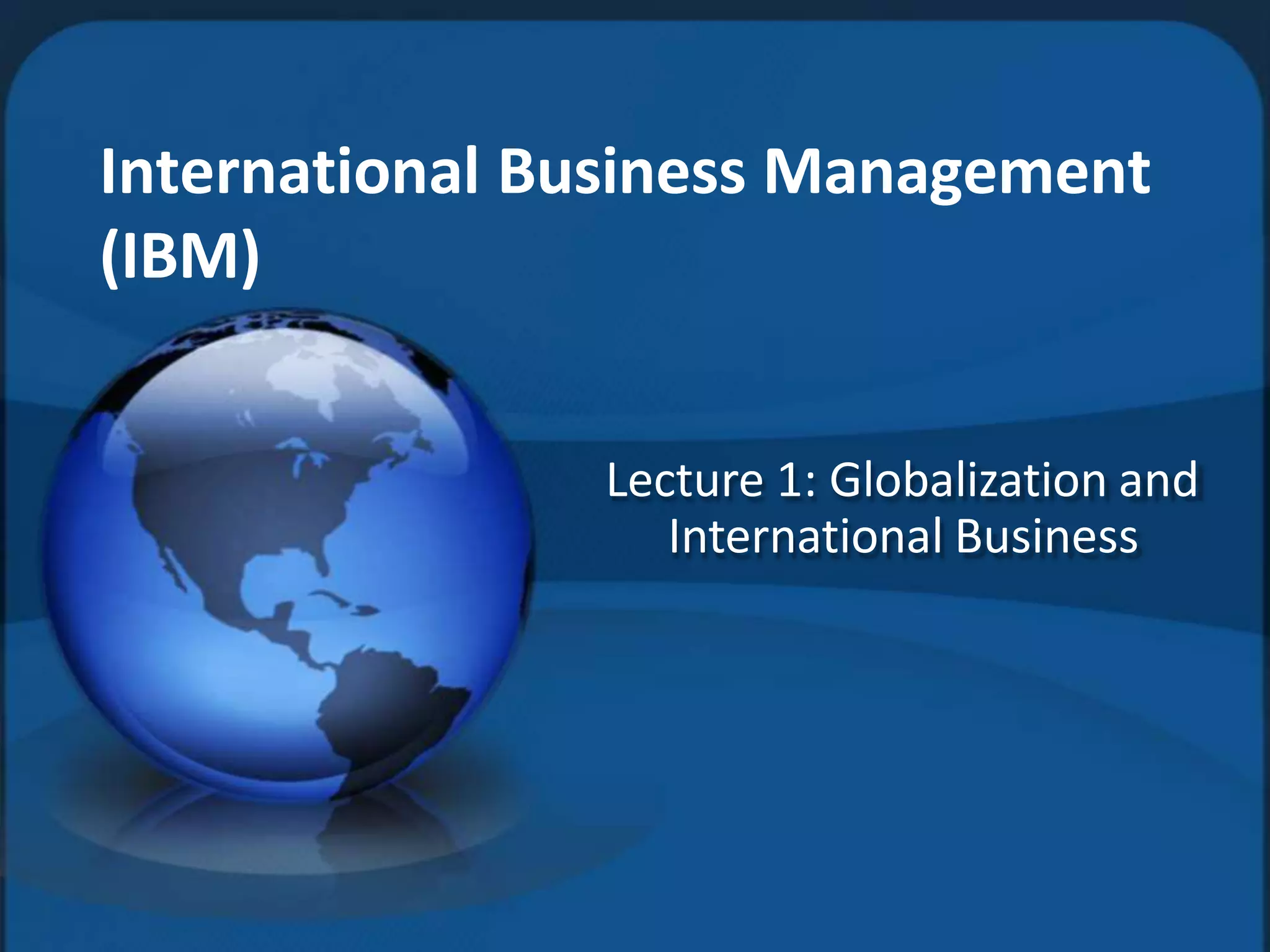


International Business Management
(IBM)
Lecture 1: Globalization and
International Business
Unit Expectations - Attendance
• Exception – is extreme weather
• Lectures start on the hour
• Lectures finish at 10 mins to the hour
• Doors shut across all years at 15 mins past the
hour.
• Scanning – you come back at the end of the
session to be scanned in i.e. 10 mins to the
hour
My expectations
• Work together, mutual respect, mutual
responsibility
• Room etiquette – phones, food, arrival – maintaining a
good learning environment for your colleagues.
• Participation – Getting the best from us,
Preparation
• Review the lecture / seminar material on BREO
after the sessions
• Read the recommended readings
• Be alert to the issues in news and read
Today we will…
• Introduce the Unit Essential text
• And the Assessments!
• And start thinking about why we include the study of
international business management in your course
• Looking at Globalization and International Business Management (IBM)
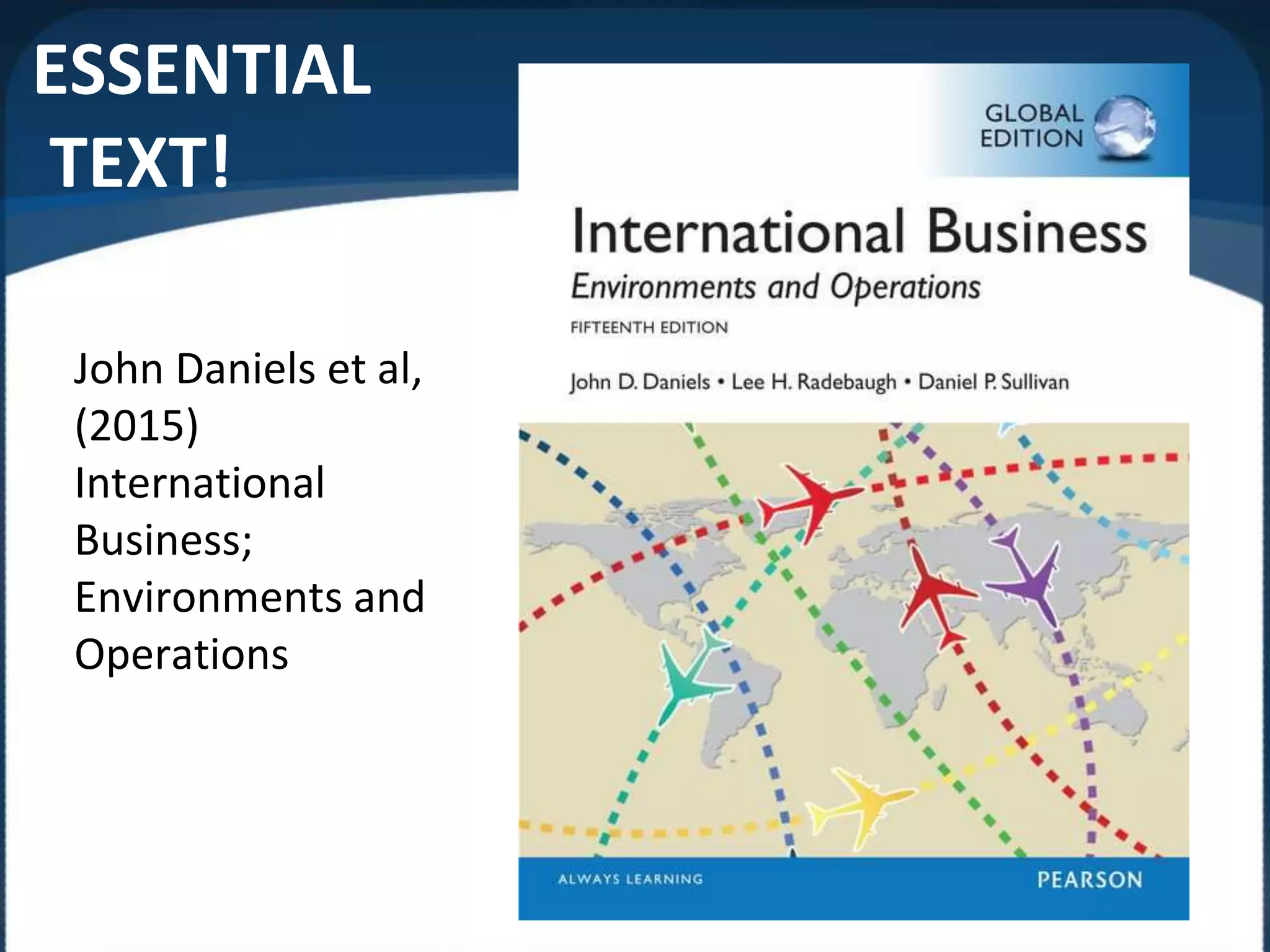
ESSENTIAL
TEXT!
John Daniels et al,
(2015)
International
Business;
Environments and
Operations
Assessments
Assignment 1 (50%)
• Individual assignment, Max 2,000.
• You will be looking at doing business in other countries –
especially risks and entry modes
• Deadline in week commencing 9th of May
• Late submission accepted only with mitigation circumstances.
Otherwise…. Repeat the unit nextyear!
Assessment 2 – Exam (50%)
• 2 hour exam
International Business Management
Learning Objectives
• Todefine international business and globalization and show
how they affect each other
• Tounderstand why companies engage in international
business and why international business growth has
accelerated
• Todiscuss globalization’s future and the major criticisms of
globalization
• Tobecome familiar with different ways in which a company
can accomplish its global objectives
International business
1-9
• International business includes all
commercial transactions—including sales,
investments, and transportation—that take
place between two or more countries
– including private companies trading for profit
And national Governments undertaking transactions
for profit or other reasons
Why study international business?
1-10
• Because:
– Most companies are either international or compete
with international companies
– Modes (ways) of operations may differ from those
used domestically
– The best way of conducting business may differ by
country
– An understanding helps you make better career
decisions
– An understanding helps you decide what government
policies to support
Globalization
1-11
• Globalization is
– the ongoing process that deepens and broadens
the relationships and interdependence among
people from different parts of the world that
happens to be divided into nations
– the integration of world economies through the
reduction of barriers to the movement of trade,
capital, technology and people (Daniels et al.
2015, P.47).
Forces Driving Globalization
1-12
1. Increase in and application of technology
2. Liberalization of cross-border trade and
resource movements
3. Development of services that support
international business
4. Growing consumer pressures
5. Increased global competition
6. Changing political situations
7. Expanded cross-national cooperation
Forces Driving Globalization (Cont..)
Increase in and Application of Technology : Vast
improvements in transportation and communications
technology including the development of the Internet
Liberalization of Cross-Border Trade and Resource
Movement: Over time most governments have lowered
restrictions on trade and foreign investment in response to
the expressed desires of their citizens and producers.
Forces Driving Globalization (Cont..)
Development of Services that Support International
Business: Services provided by government, banks,
transportation companies, and other businesses greatly
facilitate the conduct and reduce the risks of doing business
internationally.
Growing Consumer Pressures: Now consumers are well-
informed about and often able to access foreign products.
Thus competitors the world over have been forced to
respond to consumers’ demand for increasingly higher
quality, more cost-competitive offerings.
Increased Global Competition The pressures of increased
foreign competition persuade firms to expand
internationally to gain access to foreign opportunities and
to improve their competitiveness.
Changing Political Situations The transformation of the
political and economic policies of Eastern Europe,
Vietnam, and China has led to increases in trade between
those countries and the rest of the world
Forces Driving Globalization (Cont..)
Expanded Cross-National Cooperation: Governments
have increasingly entered into cross-national treaties and
agreements in order to gain reciprocal advantages for
their own firms, to jointly attack problems and to deal
with areas of concern that lie outside the territory of all
countries.
Forces Driving Globalization (Cont..)
Costs of Globalization
1-17
• Threats to national sovereignty
– lose freedom to “act locally”
• Economic growth and environmental stress
It has both positive and negative consequences, including
damage to society and the environment. While it can support
the sustenance of natural resources.
• Growing income inequality
It may speeds up the process of altering the relative economic
differences between the two countries involved.
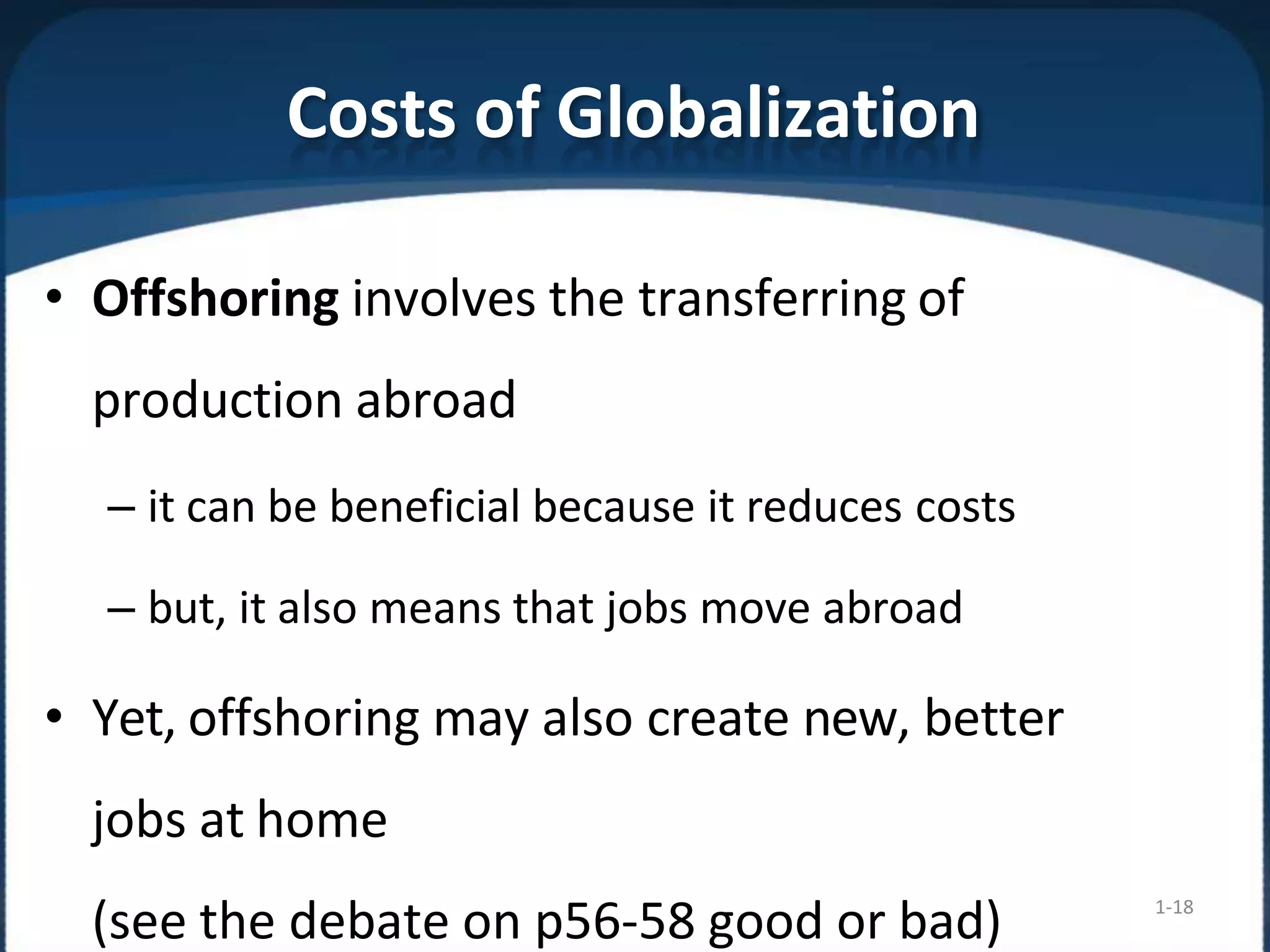
Costs of Globalization
1-18
• Offshoring involves the transferring of
production abroad
– it can be beneficial because it reduces costs
– but, it also means that jobs move abroad
• Yet, offshoring may also create new, better
jobs at home
(see the debate on p56-58 good or bad)
Factors in International Business
Operations
1-29
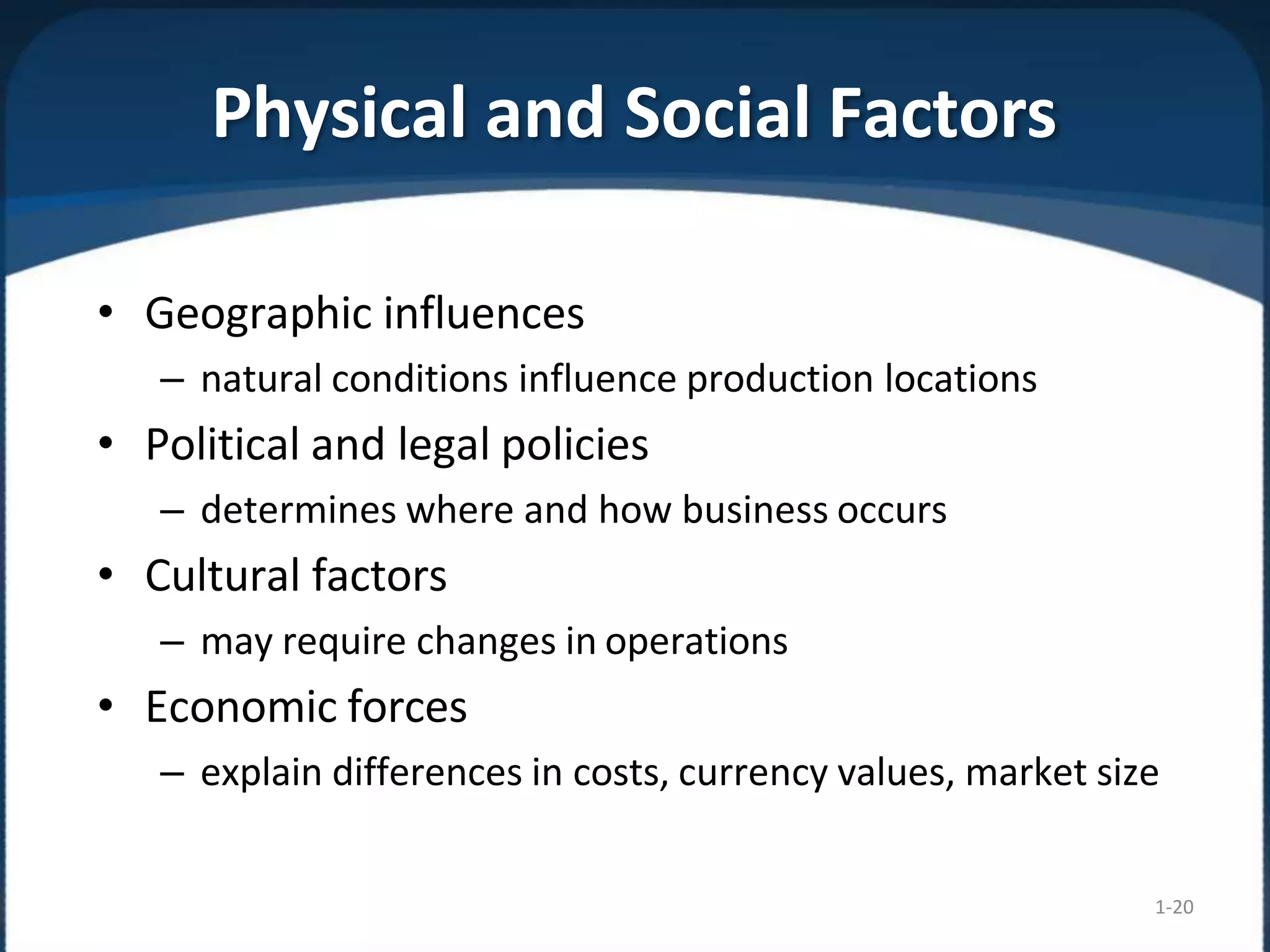
Physical and Social Factors
1-20
• Geographic influences
– natural conditions influence production locations
• Political and legal policies
– determines where and how business occurs
• Cultural factors
– may require changes in operations
• Economic forces
– explain differences in costs, currency values, market size
The Competitive Environment
1-21
• Competitive strategy for products
– Cost strategy
– Differentiation strategy
– Focus strategy
• Company resources and experience
– market leaders have more resources for
international operations
• Competitors faced in each market
– local or international
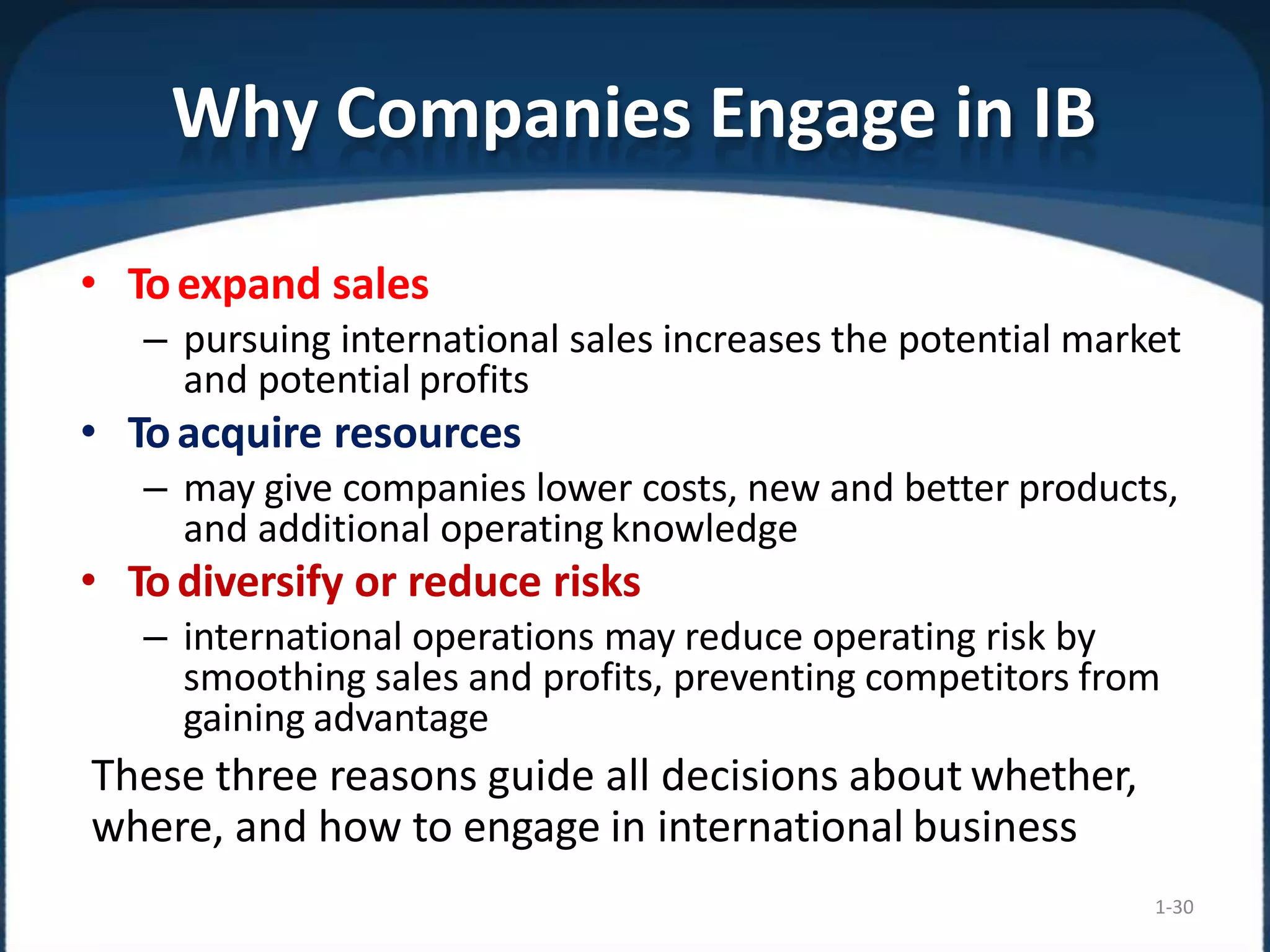
Why Companies Engage in IB
1-30
• Toexpand sales
– pursuing international sales increases the potential market
and potential profits
• Toacquire resources
– may give companies lower costs, new and better products,
and additional operating knowledge
• Todiversify or reduce risks
– international operations may reduce operating risk by
smoothing sales and profits, preventing competitors from
gaining advantage
These three reasons guide all decisions about whether,
where, and how to engage in international business
Modes of Operations in IB
1-23
• Exports and imports of both goods and services
• Investments
– Foreign Direct Investment (FDI)
• investor takes a controlling interest in a foreign company
– joint venture
– Portfolio Investment
• a non-controlling financial interest in another entity
• Collaborative arrangements
– Joint ventures
– Licensing and franchising arrangements
– Management contracts
– Strategic alliance
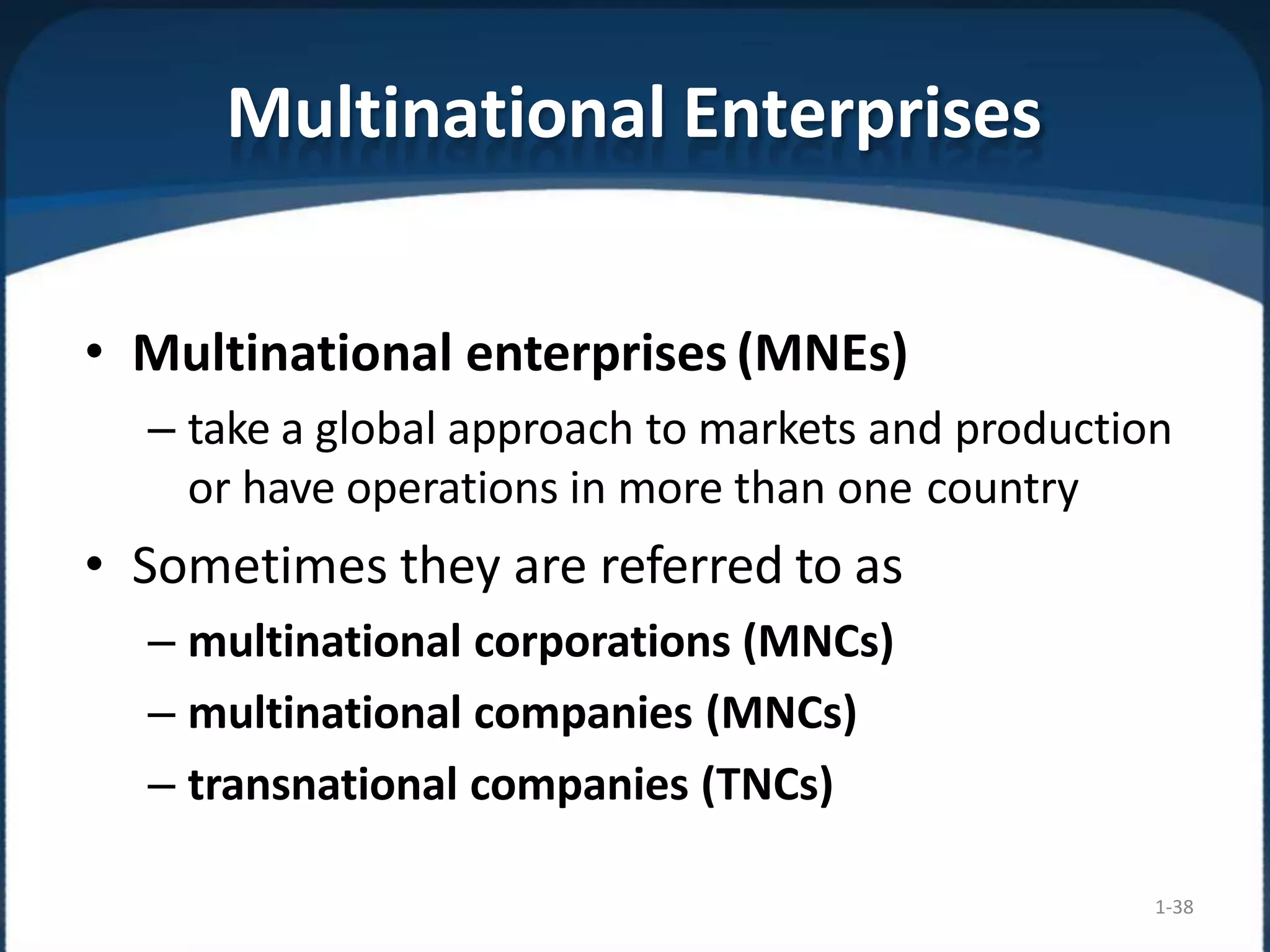
Multinational Enterprises
1-38
• Multinational enterprises (MNEs)
– take a global approach to markets and production
or have operations in more than one country
• Sometimes they are referred to as
– multinational corporations (MNCs)
– multinational companies (MNCs)
– transnational companies (TNCs)
Looking to the Future
1-40
• Three major perspectives on the future of
international business and globalization
– Further globalization is inevitable
– International business will grow primarily along
regional rather than global lines
– Forces working against further globalization and
international business will slow down both trends
Further reading
• Daniels et al. (2015). Chapter 1.

Lecture 1 globalisation & international business (3)

  • 1.
    International Business Management (IBM) Lecture1: Globalization and International Business
  • 2.
    Unit Expectations -Attendance • Exception – is extreme weather • Lectures start on the hour • Lectures finish at 10 mins to the hour • Doors shut across all years at 15 mins past the hour. • Scanning – you come back at the end of the session to be scanned in i.e. 10 mins to the hour
  • 3.
    My expectations • Worktogether, mutual respect, mutual responsibility • Room etiquette – phones, food, arrival – maintaining a good learning environment for your colleagues. • Participation – Getting the best from us, Preparation • Review the lecture / seminar material on BREO after the sessions • Read the recommended readings • Be alert to the issues in news and read
  • 4.
    Today we will… •Introduce the Unit Essential text • And the Assessments! • And start thinking about why we include the study of international business management in your course • Looking at Globalization and International Business Management (IBM)
  • 5.
    ESSENTIAL TEXT! John Daniels etal, (2015) International Business; Environments and Operations
  • 6.
    Assessments Assignment 1 (50%) •Individual assignment, Max 2,000. • You will be looking at doing business in other countries – especially risks and entry modes • Deadline in week commencing 9th of May • Late submission accepted only with mitigation circumstances. Otherwise…. Repeat the unit nextyear! Assessment 2 – Exam (50%) • 2 hour exam
  • 7.
  • 8.
    Learning Objectives • Todefineinternational business and globalization and show how they affect each other • Tounderstand why companies engage in international business and why international business growth has accelerated • Todiscuss globalization’s future and the major criticisms of globalization • Tobecome familiar with different ways in which a company can accomplish its global objectives
  • 9.
    International business 1-9 • Internationalbusiness includes all commercial transactions—including sales, investments, and transportation—that take place between two or more countries – including private companies trading for profit And national Governments undertaking transactions for profit or other reasons
  • 10.
    Why study internationalbusiness? 1-10 • Because: – Most companies are either international or compete with international companies – Modes (ways) of operations may differ from those used domestically – The best way of conducting business may differ by country – An understanding helps you make better career decisions – An understanding helps you decide what government policies to support
  • 11.
    Globalization 1-11 • Globalization is –the ongoing process that deepens and broadens the relationships and interdependence among people from different parts of the world that happens to be divided into nations – the integration of world economies through the reduction of barriers to the movement of trade, capital, technology and people (Daniels et al. 2015, P.47).
  • 12.
    Forces Driving Globalization 1-12 1.Increase in and application of technology 2. Liberalization of cross-border trade and resource movements 3. Development of services that support international business 4. Growing consumer pressures 5. Increased global competition 6. Changing political situations 7. Expanded cross-national cooperation
  • 13.
    Forces Driving Globalization(Cont..) Increase in and Application of Technology : Vast improvements in transportation and communications technology including the development of the Internet Liberalization of Cross-Border Trade and Resource Movement: Over time most governments have lowered restrictions on trade and foreign investment in response to the expressed desires of their citizens and producers.
  • 14.
    Forces Driving Globalization(Cont..) Development of Services that Support International Business: Services provided by government, banks, transportation companies, and other businesses greatly facilitate the conduct and reduce the risks of doing business internationally. Growing Consumer Pressures: Now consumers are well- informed about and often able to access foreign products. Thus competitors the world over have been forced to respond to consumers’ demand for increasingly higher quality, more cost-competitive offerings.
  • 15.
    Increased Global CompetitionThe pressures of increased foreign competition persuade firms to expand internationally to gain access to foreign opportunities and to improve their competitiveness. Changing Political Situations The transformation of the political and economic policies of Eastern Europe, Vietnam, and China has led to increases in trade between those countries and the rest of the world Forces Driving Globalization (Cont..)
  • 16.
    Expanded Cross-National Cooperation:Governments have increasingly entered into cross-national treaties and agreements in order to gain reciprocal advantages for their own firms, to jointly attack problems and to deal with areas of concern that lie outside the territory of all countries. Forces Driving Globalization (Cont..)
  • 17.
    Costs of Globalization 1-17 •Threats to national sovereignty – lose freedom to “act locally” • Economic growth and environmental stress It has both positive and negative consequences, including damage to society and the environment. While it can support the sustenance of natural resources. • Growing income inequality It may speeds up the process of altering the relative economic differences between the two countries involved.
  • 18.
    Costs of Globalization 1-18 •Offshoring involves the transferring of production abroad – it can be beneficial because it reduces costs – but, it also means that jobs move abroad • Yet, offshoring may also create new, better jobs at home (see the debate on p56-58 good or bad)
  • 19.
    Factors in InternationalBusiness Operations 1-29
  • 20.
    Physical and SocialFactors 1-20 • Geographic influences – natural conditions influence production locations • Political and legal policies – determines where and how business occurs • Cultural factors – may require changes in operations • Economic forces – explain differences in costs, currency values, market size
  • 21.
    The Competitive Environment 1-21 •Competitive strategy for products – Cost strategy – Differentiation strategy – Focus strategy • Company resources and experience – market leaders have more resources for international operations • Competitors faced in each market – local or international
  • 22.
    Why Companies Engagein IB 1-30 • Toexpand sales – pursuing international sales increases the potential market and potential profits • Toacquire resources – may give companies lower costs, new and better products, and additional operating knowledge • Todiversify or reduce risks – international operations may reduce operating risk by smoothing sales and profits, preventing competitors from gaining advantage These three reasons guide all decisions about whether, where, and how to engage in international business
  • 23.
    Modes of Operationsin IB 1-23 • Exports and imports of both goods and services • Investments – Foreign Direct Investment (FDI) • investor takes a controlling interest in a foreign company – joint venture – Portfolio Investment • a non-controlling financial interest in another entity • Collaborative arrangements – Joint ventures – Licensing and franchising arrangements – Management contracts – Strategic alliance
  • 24.
    Multinational Enterprises 1-38 • Multinationalenterprises (MNEs) – take a global approach to markets and production or have operations in more than one country • Sometimes they are referred to as – multinational corporations (MNCs) – multinational companies (MNCs) – transnational companies (TNCs)
  • 25.
    Looking to theFuture 1-40 • Three major perspectives on the future of international business and globalization – Further globalization is inevitable – International business will grow primarily along regional rather than global lines – Forces working against further globalization and international business will slow down both trends
  • 26.
    Further reading • Danielset al. (2015). Chapter 1.