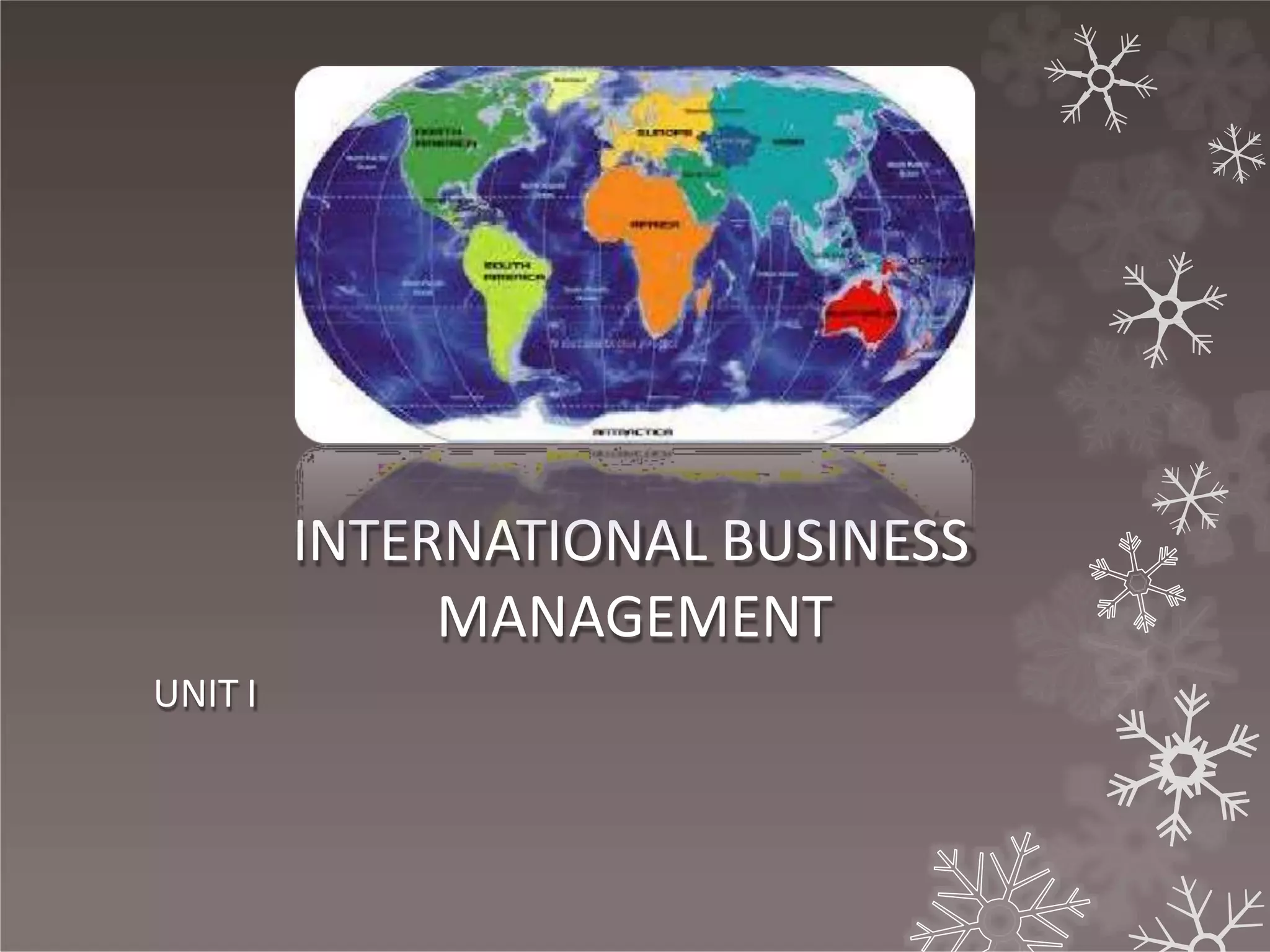
INTERNATIONAL BUSINESS
MANAGEMENT
UNIT I
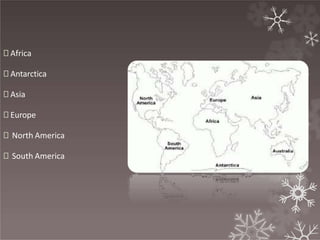
🞇 Africa
🞇 Antarctica
🞇 Asia
🞇 Europe
🞇 North America
🞇 South America
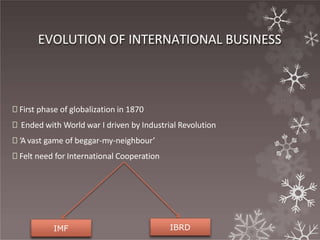
EVOLUTION OF INTERNATIONAL BUSINESS
🞇 First phase of globalization in 1870
🞇 Ended with World war I driven by Industrial Revolution
🞇 ‘A vast game of beggar-my-neighbour’
🞇 Felt need for International Cooperation
IMF IBRD
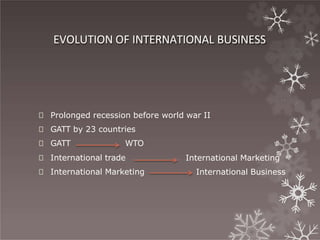
EVOLUTION OF INTERNATIONAL BUSINESS
🞇 Prolonged recession before world war II
🞇 GATT by 23 countries
🞇 GATT WTO
🞇 International trade
🞇 International Marketing
International Marketing
International Business
CHARACTERISTICS/FEATURES OF INTERNATIONAL
BUSINESS
🞇 Regional Integration
🞇 Declining Trade Barriers
🞇 Declining Investment Barriers
🞇 Growth in FDI
🞇 Strides in Technology
🞇 Growth of MNCs
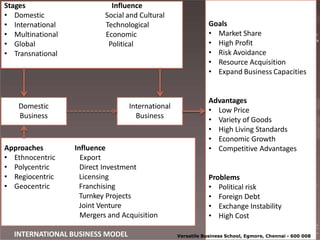
Stages Influence
Social and Cultural
Technological
Economic
Political
• Domestic
• International
• Multinational
• Global
• Transnational
Domestic
Business
International
Business
Approaches
• Ethnocentric
• Polycentric
• Regiocentric
• Geocentric
Influence
Export
Direct Investment
Licensing
Franchising
Turnkey Projects
Joint Venture
Mergers and Acquisition
Goals
• Market Share
• High Profit
• Risk Avoidance
• Resource Acquisition
• Expand Business Capacities
Advantages
• Low Price
• Variety of Goods
• High Living Standards
• Economic Growth
• Competitive Advantages
Problems
• Political risk
• Foreign Debt
• Exchange Instability
• High Cost
INTERNATIONAL BUSINESS MODEL Versatile Business School, Egmore, Chennai - 600 008
INFLUENCES
🞇 Accurate Information e.g. Bata
🞇 Timely Information e.g. Coca Cola
🞇 Size of the Business
🞇 Market Segmentation
🞇 Potentiality of Markets
🞇 Inter-Country comparative study
🞇 Host Country’s Monetary System
🞇 National Security Policies e.g.: USA
🞇 Cultural Factors e.g. : Fiji
🞇 Language
🞇 Nationalism and Business Policy e.g.: USA ‘s Be American, Buy
American Made
STAGES OF INTERNATIONALIZATION
🞇 Domestic Company
🞇Limits operation, Vision, Mission to National political boundaries
🞇 International Company
🞇Focus on domestic practices but extend wings to foreign countries (Mere
export-import)
🞇 Multinational Company
🞇Different strategy for different market
🞇 Global Company
🞇Either produce in one country and market globally or produce globally and
market domestically
🞇 Transnational Company
🞇Produces, markets, invests and operates across the world
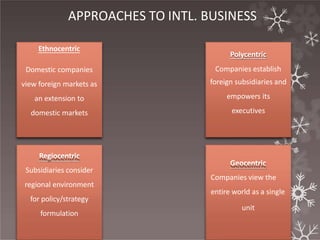
APPROACHES TO INTL. BUSINESS
Ethnocentric
Domestic companies
view foreign markets as
an extension to
domestic markets
Polycentric
Companies establish
foreign subsidiaries and
empowers its
executives
Regiocentric
Subsidiaries consider
regional environment
for policy/strategy
formulation
Geocentric
Companies view the
entire world as a single
unit
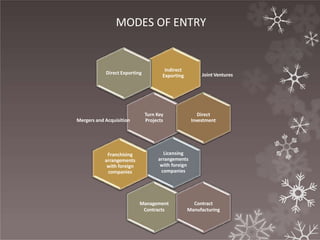
MODES OF ENTRY
Indirect
Exporting Joint Ventures
Direct Exporting
Turn Key
Projects
Mergers and Acquisition
Direct
Investment
Licensing
arrangements
with foreign
companies
Franchising
arrangements
with foreign
companies
Management
Contracts
Contract
Manufacturing
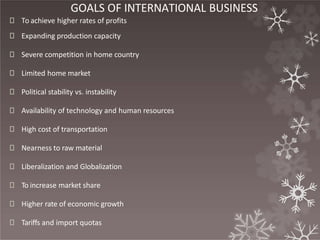
GOALS OF INTERNATIONAL BUSINESS
🞇 To achieve higher rates of profits
🞇 Expanding production capacity
🞇 Severe competition in home country
🞇 Limited home market
🞇 Political stability vs. instability
🞇 Availability of technology and human resources
🞇 High cost of transportation
🞇 Nearness to raw material
🞇 Liberalization and Globalization
🞇 To increase market share
🞇 Higher rate of economic growth
🞇 Tariffs and import quotas
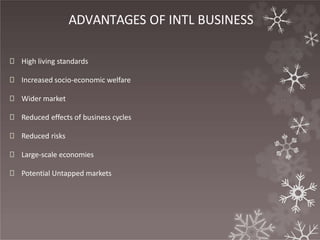
ADVANTAGES OF INTL BUSINESS
🞇 High living standards
🞇 Increased socio-economic welfare
🞇 Wider market
🞇 Reduced effects of business cycles
🞇 Reduced risks
🞇 Large-scale economies
🞇 Potential Untapped markets
ADVANTAGES OF INTL BUSINESS
🞇 Opportunity for challenge to domestic business
🞇 Division of labour and specialization
🞇 Economic growth of the world
🞇 Optimum and proper utilization of world resources
🞇 Cultural transformation
🞇 Knitting the world into a traditional village
PROBLEMS OF INTL BUSINESS
🞇 Political factors
🞇 Huge foreign indebtedness
🞇 Exchange instability
🞇 Entry requirements
🞇 Tariffs, quotas and trade barriers
🞇 Corruption
🞇 Bureaucratic practices of Govt
🞇 Technological pirating
🞇 Quality Maintenance
GLOBALIZATION
interdependence of countries worldwide
🞇IMF defines globalization as, “the growing
through
economic
increasing
volume and variety of cross border transactions in goods and
services and of international capital flows and also through the
more rapid and widespread diffusion of technology”
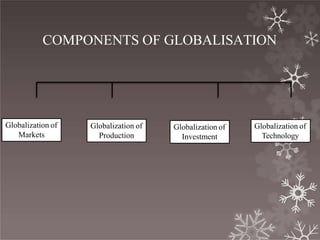
COMPONENTS OF GLOBALISATION
Globalization of
Markets
Globalization of
Technology
Globalization of
Production
Globalization of
Investment
GLOBALIZATION OF MARKETS
🞇 Globalization of markets refers to the process of integrating and
merging of the distinct world markets into a single market
🞇 EXAMPLE: Coca-Cola, Pepsi, McDonald’s burgers, Levis Jeans etc.,
FEATURES:
🞇 Size of the company need not be too large
🞇 Distinction of national markets still prevail
🞇 Most of the foreign markets are markets for non-consumer goods
REASONS FOR GLOBALIZATION OF
MARKETS
🞇 Large scale industrialization enabled mass production
🞇 Risk reduction by diversification
🞇 Increase profits and achieve goals
🞇 Adverse business environment in home country
🞇 Demand for their products in foreign markets
🞇 Failure of domestic companies to cater the needs of customers
GLOBALIZATION OF PRODUCTION
🞇 Globalization of production is locating the manufacturing facilities in a number of
locations around the globe. EXAMPLE: Jet airlines Boeing 777 and Swan opticals
REASONS:
🞇 Impositions of imports by the foreign country
🞇 Availability of high quality raw materials and components
🞇 Availability of inputs at low cost
🞇 Skilled human resource at low cost
🞇 Liberal labour laws
🞇 To reduce cost of transport
🞇 To cater to varying tastes of customers
GLOBALIZATION OF PRODUCTION
🞇 Globalization of investment refers to investment of capital by a global company
in any part of the world.
REASONS:
🞇 Increase in volume of global trade
🞇 Limitations of exporting and importing
🞇 Liberalization
🞇 Avoid restrictions
MODES OF GLOBALIZATION OF
PRODUCTION
🞇 Acquisition
🞇 Joint ventures
🞇 Long term loans
🞇 Issuing equity, shares, debentures, bonds’
🞇 Global deposit receipt
GLOBALIZATION OF TECHNOLOGY
🞇 Latest technology and distinctive competencies
🞇 Technological collaboration
🞇 Usage of technology by paying royalty
GLOBALIZATION
ADVANTAGES
🞇 Free flow of capital, technology
🞇 Industrialization
🞇 Production facilities throughout the
world
🞇 Increase in production and
consumption
🞇 Lower prices and high quality
🞇 Jobs and Incomes
🞇 Higher standard of living
🞇 Balanced Human development
🞇 Welfare and prosperity
DISADVANTAGES
🞇 Kills domestic business
🞇 Exploits human resource
🞇 Unemployment and
underemployment
🞇 Widening gap between rich and poor
🞇 Transfer of natural resources
🞇 National sovereignty at stake
🞇 Commercial and political
colonialism
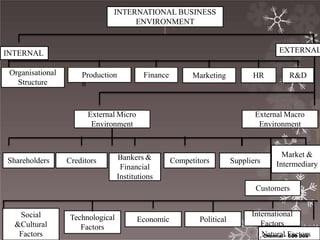
INTERNATIONAL BUSINESS
ENVIRONMENT
INTERNAL EXTERNAL
Organisational
Structure
R&D
HR
Marketing
Productio
n
Finance
External Micro
Environment
External Macro
Environment
Shareholders Creditors Bankers &
Financial
Institutions
Competitors Suppliers
Customers
Social
&Cultural
Factors
Technological
Factors
Economic Political
International
Factors
Organisational
Structure
R&D
HR
Marketing
Production Finance
External Micro
Environment
External Macro
Environment
Market &
Intermediary
,N
Ch
ae
tn
un
ra
ail-F
60
a0
ct
0
o
0r
8s
SOCIALAND CULTURAL
ENVIRONMENT
CULTURE
🞇 Prescriptive
🞇 Socially Shared
🞇 Learned
🞇 Subjective
🞇 Cumulative
🞇 Dynamic
SOCIALAND CULTURAL
ENVIRONMENT
🞇 Food habits and International business
🞇 Dressing habits and International business
🞇 Cross-Cultural communication process and Negotiations
🞇Low-context cultures
🞇High-context culture
🞇Monochromic
🞇Polychromic
SOCIALAND CULTURAL
ENVIRONMENT
🞇 Cultural Universals
🞇 Communication
🞇 Time and Culture
🞇 Space and Culture
🞇 Culture and agreement
🞇 Culture of friendship
🞇 Culture and negotiation
🞇 Culture and superstition
🞇 Culture and gifts
ECONOMIC SYSTEM
🞇 Economic system: It is an organization of institution to satisfy
human needs/wants
🞇 Economic systems are based on resource allocation
🞇 There are three types of economic system
🞇 Capitalism: under this system, customer allocates resources
🞇This economic system provides for economic democracy, thus giving the
customer, his choice for products
🞇Communism: In this, economic system, private property and property
rights to income are abolished
🞇Mixed: Under this system, major factor of production and distribution are
owned, managed and controlled by the state
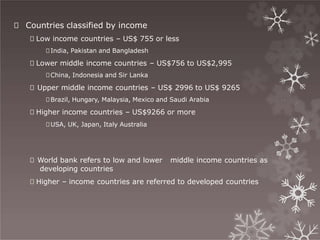
🞇 Countries classified by income
🞇 Low income countries – US$ 755 or less
🞇India, Pakistan and Bangladesh
🞇 Lower middle income countries – US$756 to US$2,995
🞇China, Indonesia and Sir Lanka
🞇 Upper middle income countries – US$ 2996 to US$ 9265
🞇Brazil, Hungary, Malaysia, Mexico and Saudi Arabia
🞇 Higher income countries – US$9266 or more
🞇USA, UK, Japan, Italy Australia
🞇 World bank refers to low and lower middle income countries as
developing countries
🞇 Higher – income countries are referred to developed countries
POLITICAL ENVIRONMENT
🞇 Political ideology is the body of complex ideas, theories and
objectives
🞇 Political ideology of the people in the same country vary widely due
to the variation in culture, ethnic group, tribal, community, religious
and economic groups
🞇 Democracy : Pure democracy aims that all citizens should be equal
politically and legally and should enjoy freedom
🞇 Totalitarianism is extreme to democracy
🞇 Types of political systems
🞇 Appraisal of political systems helps us in having and idea of political
systems and their impact on international business
🞇 Government may be parliamentary or absolutist
🞇 Parliamentary is open
🞇 Absolutist is closed
🞇 Government may be classified into
🞇Two party system
🞇Multi party system
🞇Single party system
🞇One party dominated system
GLOBALIZATION OF BUSINESS
🞇 Globalization is the shift towards a more integrated and
interdependent world economy
🞇 Globalization implies integration of the economy of the country with
the rest of the world economy and opening up of the economy for
foreign direct investment by liberalizing the rules and regulation and
by creating favorable socio-economic and political climate for global
business
FEATURES OF GLOBALIZATION
⚫ Operating and planning to expand business throughout the world
⚫ Erasing the difference between domestic and foreign markets
⚫ Buying and selling goods and services from any country to any country in the world
⚫ Establishing manufacturing and distribution facilities in any part of the world based
on the feasibility and viability rather than national consideration
⚫ product planning and development are based on market consideration of the
entire world
⚫ Sourcing the factors of production and inputs like raw materials, machinery,
finance, human resources , technology and managerial skills from entire world
⚫ Global orientation in strategies, organizational structure, organizational culture and
managerial expertise
⚫ Setting the mind and attitude to view the entire globe as a single market
PROCESS OF GLOBALIZATION
⚫ Domestic company export to foreign countries through the dealers or
distributors of the home country
⚫ The domestic company exports to foreign countries directly on its
own
⚫ The domestic company becomes an international company by
establishing production and marketing operations in various key
foreign countires
⚫ The company replicates a foreign company in the foregin country by
having all the facilities including r&d, full fledged human resource
⚫ The company becomes a true foreign company by serving the needs
of foreign customer just like the home country company serves
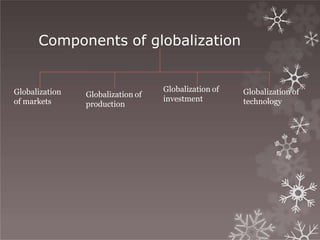
Components of globalization
Globalization
of markets
Globalization of
production
Globalization of
investment
Globalization of
technology
GLOBALIZATION OF MARKETS
🞇 Globalization of markets refers to the process of integrating and
merging of the distinct world markets into a single market
🞇 This process involves the identification of some common norms,
values, taste, preference and convenience and slowly enables the
cultural shift towards the use of a common products or services
🞇 A number of consumer products have global acceptance. Eg coca-
cola, pepsi, sony and kfc
FEATURES OF GLOBALIZATION
OF MARKETS
⚫ The size of the company should be large to create a global market
⚫ The difference require the companies to formulate different
employ separate strategies for each
strategies for each market
Eg coca cola, levis jeans
country
⚫ Most of the foreign markets are the marketers for non-consumer
goods like industrial products, machinery, computers, software,
financial products
⚫ The global business firms compete with each other frequently in
different national markets including their home markets
REASONS FOR GLOBALIZATION
OF MARKETS
🞇 Large scale industries enable mass production
🞇 Companies in order to reduce the risk
🞇 Companies globalize markets in order to increase their profits and
achieve company goals
🞇 To cater the demand for their products in the foreign markets
🞇 The failure of the domestic companies in catering the needs of their
customer pulled the foreign countries to market their product
GLOBALIZATION OF
PRODUCTION
🞇 Factors influencing the location of manufacturing facilities vary from
one country to another
🞇 They may be more favorable in foreign countries rather than in the
home country
🞇 Eg cheap lab our in developing countries, availability of high quality and
cheap raw materials in other countries enable the companies to produce
the products of high quality and low cost in various foreign markets
REASONS FOR GLOBALIZATION
OF PRODUCTION
🞇 Availability of high quality raw materials and components in other
countries
🞇 Availability of skilled human resources at low cost
🞇 Availability of inputs at low cost in foreign countries
🞇 Liberal lab our laws in the foreign countries
🞇 To reduce the cost of transportation and easy logistics management
🞇 T
o design and produce the product as per the varying tastes of
customers in foreign countries
GLOBALIZATION OF INVESTMENT
🞇 Globalization of investment refers to investment of capital by a
global company in any part of the world
🞇 Before 1930 many countries created barriers relating to export and
imports. After GATT the reduction in trade was implemented
in Indian
🞇 After WTO the eliminated the investment barriers
🞇 India has allowed 51% foreign direct investment
companies
REASONS FOR GLOBALIZATION
OF INVESTMENT
⚫ Many countries provided more congenial environment for attracting
direct investment
⚫ Significant amount of FDI is directed to the developing countries in
Asia and Eastern Europe
⚫ Small and medium companies have started investing in foreign
countries
⚫ Limitation of exporting and licensing force the domestic companies to
enter foreign countries
Indian
 Sourcing funds globally: The Indian government has allowed
companies to procured investment from foreign companies
🞇Eg reliance, Dr. reddy lab and sat yam computers
GLOBALIZATION OF
TECHNOLOGY
⚫ Technological changes is improved after 1950
⚫ The revolution in telecommunication, IT and transportation have
made many company go into globalization
 Methods of globalization technology
🞇Companies with latest technology acquire distinctive competencies and gain the
advantages of producing high quality products at low cost
🞇Companies may have technological collaboration with foreign companies through
which technology spreads from country to country
🞇The foreign companies allow the companies of various other countries adopt their
technologies on royally payment basis
ADVANTAGES AND DISADVANTAGES OF
GLOBALIZATION
⚫ Free flow of capital
⚫ Free flow of technology
⚫ Increase industrialization
⚫ Balanced development of world
economics
⚫ Increase in production and
consumption
⚫ Commodities at lower prices with
high quality
⚫ Increase in jobs and income
⚫ Higher standards of living
⚫ Balanced human development
⚫ Increase in welfare and prosperity
⚫ Globalization kills domestic
business
⚫ Exploits human resources
⚫ Leads to unemployment and
underemployment
⚫ Decline in demand for domestic
products
⚫ Decline in income
⚫ Widening gap between rich and
poor
⚫ Transfer of natural resources
MODE OF GLOBALIZATION
🞇 Acquisition of foreign companies
🞇 Joint ventures
🞇 Long term loans
🞇 Issuing equity shares, debentures and bonds
🞇 Global deposits receipts
DRIVERS OF GLOBALIZATION
🞇 Establishment of the world trade organization:
🞇 Government of the member countries of general agreement on trade and
tariff(GATT) concluded the Uruguay round negotiation on the 15th
December 1994. according to uruguay meeting they came with a political
support “ strengthen the world economy and lead to more trade,
investment, employment and income growth throughout the world” WTO
was established on 1st Jan 1995. This is to facilitate the implementation,
administration and operation and further the objectives of this agreement
and on the multinational trade agreement
🞇 Declining trade barriers:
🞇 International trade occurs when the goods flow across the countries.
Government used to impose trade barriers like quotas and tariffs in order
to protect domestic business from the competition of international
business. Advanced countries after world war 2 agreed to reduce tariffs
in order to encourage free flow of goods. Thus reduction of tariffs and
other trade barriers contributed for the growth of global trade
🞇 Declining investment barriers:
🞇 Global business firm invest in order to establish manufacturing and other
facilities in foreign country. Foreign government impose barriers on
foreign investment in order to protect domestic industry.
🞇 Various countries have been removing these barriers on foreign direct
investment
🞇 Growth in foreign direct investment:
🞇 There are number of reasons for the growth of FDI. Which is also a
drivers of globalization
🞇 Strides in technology:
🞇Technological changes has dramatically diverged global company to
globalization
🞇Microprocessors and telecommunications
🞇The internet and world wide web
🞇On-line globalization
🞇Transportation technology
🞇 Growth of multinational companies
🞇Growth of multinational and transactional company are spreading their
operation in manufacturing, finance and other functional areas. Which
are been the drivers of globalization
TRADE LIBERALIZATION
🞇 Integration of the economy of a country with the rest of the world
economy is called globalization.
🞇 Indian government globalised economy by announcing economic
liberalization in 1991.
🞇 Integrated global economy were sown as early as 1940’s when steps
were taken to establish
🞇 International Monetary Fund
🞇 International Bank for Reconstruction and Development
🞇 General Agreement on Tariffs and Trade

ibm.pptx

  • 1.
  • 2.
    🞇 Africa 🞇 Antarctica 🞇Asia 🞇 Europe 🞇 North America 🞇 South America
  • 3.
    EVOLUTION OF INTERNATIONALBUSINESS 🞇 First phase of globalization in 1870 🞇 Ended with World war I driven by Industrial Revolution 🞇 ‘A vast game of beggar-my-neighbour’ 🞇 Felt need for International Cooperation IMF IBRD
  • 4.
    EVOLUTION OF INTERNATIONALBUSINESS 🞇 Prolonged recession before world war II 🞇 GATT by 23 countries 🞇 GATT WTO 🞇 International trade 🞇 International Marketing International Marketing International Business
  • 5.
    CHARACTERISTICS/FEATURES OF INTERNATIONAL BUSINESS 🞇Regional Integration 🞇 Declining Trade Barriers 🞇 Declining Investment Barriers 🞇 Growth in FDI 🞇 Strides in Technology 🞇 Growth of MNCs
  • 6.
    Stages Influence Social andCultural Technological Economic Political • Domestic • International • Multinational • Global • Transnational Domestic Business International Business Approaches • Ethnocentric • Polycentric • Regiocentric • Geocentric Influence Export Direct Investment Licensing Franchising Turnkey Projects Joint Venture Mergers and Acquisition Goals • Market Share • High Profit • Risk Avoidance • Resource Acquisition • Expand Business Capacities Advantages • Low Price • Variety of Goods • High Living Standards • Economic Growth • Competitive Advantages Problems • Political risk • Foreign Debt • Exchange Instability • High Cost INTERNATIONAL BUSINESS MODEL Versatile Business School, Egmore, Chennai - 600 008
  • 7.
    INFLUENCES 🞇 Accurate Informatione.g. Bata 🞇 Timely Information e.g. Coca Cola 🞇 Size of the Business 🞇 Market Segmentation 🞇 Potentiality of Markets 🞇 Inter-Country comparative study 🞇 Host Country’s Monetary System 🞇 National Security Policies e.g.: USA 🞇 Cultural Factors e.g. : Fiji 🞇 Language 🞇 Nationalism and Business Policy e.g.: USA ‘s Be American, Buy American Made
  • 8.
    STAGES OF INTERNATIONALIZATION 🞇Domestic Company 🞇Limits operation, Vision, Mission to National political boundaries 🞇 International Company 🞇Focus on domestic practices but extend wings to foreign countries (Mere export-import) 🞇 Multinational Company 🞇Different strategy for different market 🞇 Global Company 🞇Either produce in one country and market globally or produce globally and market domestically 🞇 Transnational Company 🞇Produces, markets, invests and operates across the world
  • 9.
    APPROACHES TO INTL.BUSINESS Ethnocentric Domestic companies view foreign markets as an extension to domestic markets Polycentric Companies establish foreign subsidiaries and empowers its executives Regiocentric Subsidiaries consider regional environment for policy/strategy formulation Geocentric Companies view the entire world as a single unit
  • 10.
    MODES OF ENTRY Indirect ExportingJoint Ventures Direct Exporting Turn Key Projects Mergers and Acquisition Direct Investment Licensing arrangements with foreign companies Franchising arrangements with foreign companies Management Contracts Contract Manufacturing
  • 11.
    GOALS OF INTERNATIONALBUSINESS 🞇 To achieve higher rates of profits 🞇 Expanding production capacity 🞇 Severe competition in home country 🞇 Limited home market 🞇 Political stability vs. instability 🞇 Availability of technology and human resources 🞇 High cost of transportation 🞇 Nearness to raw material 🞇 Liberalization and Globalization 🞇 To increase market share 🞇 Higher rate of economic growth 🞇 Tariffs and import quotas
  • 12.
    ADVANTAGES OF INTLBUSINESS 🞇 High living standards 🞇 Increased socio-economic welfare 🞇 Wider market 🞇 Reduced effects of business cycles 🞇 Reduced risks 🞇 Large-scale economies 🞇 Potential Untapped markets
  • 13.
    ADVANTAGES OF INTLBUSINESS 🞇 Opportunity for challenge to domestic business 🞇 Division of labour and specialization 🞇 Economic growth of the world 🞇 Optimum and proper utilization of world resources 🞇 Cultural transformation 🞇 Knitting the world into a traditional village
  • 14.
    PROBLEMS OF INTLBUSINESS 🞇 Political factors 🞇 Huge foreign indebtedness 🞇 Exchange instability 🞇 Entry requirements 🞇 Tariffs, quotas and trade barriers 🞇 Corruption 🞇 Bureaucratic practices of Govt 🞇 Technological pirating 🞇 Quality Maintenance
  • 15.
    GLOBALIZATION interdependence of countriesworldwide 🞇IMF defines globalization as, “the growing through economic increasing volume and variety of cross border transactions in goods and services and of international capital flows and also through the more rapid and widespread diffusion of technology”
  • 16.
    COMPONENTS OF GLOBALISATION Globalizationof Markets Globalization of Technology Globalization of Production Globalization of Investment
  • 17.
    GLOBALIZATION OF MARKETS 🞇Globalization of markets refers to the process of integrating and merging of the distinct world markets into a single market 🞇 EXAMPLE: Coca-Cola, Pepsi, McDonald’s burgers, Levis Jeans etc., FEATURES: 🞇 Size of the company need not be too large 🞇 Distinction of national markets still prevail 🞇 Most of the foreign markets are markets for non-consumer goods
  • 18.
    REASONS FOR GLOBALIZATIONOF MARKETS 🞇 Large scale industrialization enabled mass production 🞇 Risk reduction by diversification 🞇 Increase profits and achieve goals 🞇 Adverse business environment in home country 🞇 Demand for their products in foreign markets 🞇 Failure of domestic companies to cater the needs of customers
  • 19.
    GLOBALIZATION OF PRODUCTION 🞇Globalization of production is locating the manufacturing facilities in a number of locations around the globe. EXAMPLE: Jet airlines Boeing 777 and Swan opticals REASONS: 🞇 Impositions of imports by the foreign country 🞇 Availability of high quality raw materials and components 🞇 Availability of inputs at low cost 🞇 Skilled human resource at low cost 🞇 Liberal labour laws 🞇 To reduce cost of transport 🞇 To cater to varying tastes of customers
  • 20.
    GLOBALIZATION OF PRODUCTION 🞇Globalization of investment refers to investment of capital by a global company in any part of the world. REASONS: 🞇 Increase in volume of global trade 🞇 Limitations of exporting and importing 🞇 Liberalization 🞇 Avoid restrictions
  • 21.
    MODES OF GLOBALIZATIONOF PRODUCTION 🞇 Acquisition 🞇 Joint ventures 🞇 Long term loans 🞇 Issuing equity, shares, debentures, bonds’ 🞇 Global deposit receipt
  • 22.
    GLOBALIZATION OF TECHNOLOGY 🞇Latest technology and distinctive competencies 🞇 Technological collaboration 🞇 Usage of technology by paying royalty
  • 23.
    GLOBALIZATION ADVANTAGES 🞇 Free flowof capital, technology 🞇 Industrialization 🞇 Production facilities throughout the world 🞇 Increase in production and consumption 🞇 Lower prices and high quality 🞇 Jobs and Incomes 🞇 Higher standard of living 🞇 Balanced Human development 🞇 Welfare and prosperity DISADVANTAGES 🞇 Kills domestic business 🞇 Exploits human resource 🞇 Unemployment and underemployment 🞇 Widening gap between rich and poor 🞇 Transfer of natural resources 🞇 National sovereignty at stake 🞇 Commercial and political colonialism
  • 24.
    INTERNATIONAL BUSINESS ENVIRONMENT INTERNAL EXTERNAL Organisational Structure R&D HR Marketing Productio n Finance ExternalMicro Environment External Macro Environment Shareholders Creditors Bankers & Financial Institutions Competitors Suppliers Customers Social &Cultural Factors Technological Factors Economic Political International Factors Organisational Structure R&D HR Marketing Production Finance External Micro Environment External Macro Environment Market & Intermediary ,N Ch ae tn un ra ail-F 60 a0 ct 0 o 0r 8s
  • 25.
    SOCIALAND CULTURAL ENVIRONMENT CULTURE 🞇 Prescriptive 🞇Socially Shared 🞇 Learned 🞇 Subjective 🞇 Cumulative 🞇 Dynamic
  • 26.
    SOCIALAND CULTURAL ENVIRONMENT 🞇 Foodhabits and International business 🞇 Dressing habits and International business 🞇 Cross-Cultural communication process and Negotiations 🞇Low-context cultures 🞇High-context culture 🞇Monochromic 🞇Polychromic
  • 27.
    SOCIALAND CULTURAL ENVIRONMENT 🞇 CulturalUniversals 🞇 Communication 🞇 Time and Culture 🞇 Space and Culture 🞇 Culture and agreement 🞇 Culture of friendship 🞇 Culture and negotiation 🞇 Culture and superstition 🞇 Culture and gifts
  • 28.
    ECONOMIC SYSTEM 🞇 Economicsystem: It is an organization of institution to satisfy human needs/wants 🞇 Economic systems are based on resource allocation 🞇 There are three types of economic system 🞇 Capitalism: under this system, customer allocates resources 🞇This economic system provides for economic democracy, thus giving the customer, his choice for products 🞇Communism: In this, economic system, private property and property rights to income are abolished 🞇Mixed: Under this system, major factor of production and distribution are owned, managed and controlled by the state
  • 29.
    🞇 Countries classifiedby income 🞇 Low income countries – US$ 755 or less 🞇India, Pakistan and Bangladesh 🞇 Lower middle income countries – US$756 to US$2,995 🞇China, Indonesia and Sir Lanka 🞇 Upper middle income countries – US$ 2996 to US$ 9265 🞇Brazil, Hungary, Malaysia, Mexico and Saudi Arabia 🞇 Higher income countries – US$9266 or more 🞇USA, UK, Japan, Italy Australia 🞇 World bank refers to low and lower middle income countries as developing countries 🞇 Higher – income countries are referred to developed countries
  • 30.
    POLITICAL ENVIRONMENT 🞇 Politicalideology is the body of complex ideas, theories and objectives 🞇 Political ideology of the people in the same country vary widely due to the variation in culture, ethnic group, tribal, community, religious and economic groups 🞇 Democracy : Pure democracy aims that all citizens should be equal politically and legally and should enjoy freedom 🞇 Totalitarianism is extreme to democracy
  • 31.
    🞇 Types ofpolitical systems 🞇 Appraisal of political systems helps us in having and idea of political systems and their impact on international business 🞇 Government may be parliamentary or absolutist 🞇 Parliamentary is open 🞇 Absolutist is closed 🞇 Government may be classified into 🞇Two party system 🞇Multi party system 🞇Single party system 🞇One party dominated system
  • 32.
    GLOBALIZATION OF BUSINESS 🞇Globalization is the shift towards a more integrated and interdependent world economy 🞇 Globalization implies integration of the economy of the country with the rest of the world economy and opening up of the economy for foreign direct investment by liberalizing the rules and regulation and by creating favorable socio-economic and political climate for global business
  • 33.
    FEATURES OF GLOBALIZATION ⚫Operating and planning to expand business throughout the world ⚫ Erasing the difference between domestic and foreign markets ⚫ Buying and selling goods and services from any country to any country in the world ⚫ Establishing manufacturing and distribution facilities in any part of the world based on the feasibility and viability rather than national consideration ⚫ product planning and development are based on market consideration of the entire world ⚫ Sourcing the factors of production and inputs like raw materials, machinery, finance, human resources , technology and managerial skills from entire world ⚫ Global orientation in strategies, organizational structure, organizational culture and managerial expertise ⚫ Setting the mind and attitude to view the entire globe as a single market
  • 34.
    PROCESS OF GLOBALIZATION ⚫Domestic company export to foreign countries through the dealers or distributors of the home country ⚫ The domestic company exports to foreign countries directly on its own ⚫ The domestic company becomes an international company by establishing production and marketing operations in various key foreign countires ⚫ The company replicates a foreign company in the foregin country by having all the facilities including r&d, full fledged human resource ⚫ The company becomes a true foreign company by serving the needs of foreign customer just like the home country company serves
  • 35.
    Components of globalization Globalization ofmarkets Globalization of production Globalization of investment Globalization of technology
  • 36.
    GLOBALIZATION OF MARKETS 🞇Globalization of markets refers to the process of integrating and merging of the distinct world markets into a single market 🞇 This process involves the identification of some common norms, values, taste, preference and convenience and slowly enables the cultural shift towards the use of a common products or services 🞇 A number of consumer products have global acceptance. Eg coca- cola, pepsi, sony and kfc
  • 37.
    FEATURES OF GLOBALIZATION OFMARKETS ⚫ The size of the company should be large to create a global market ⚫ The difference require the companies to formulate different employ separate strategies for each strategies for each market Eg coca cola, levis jeans country ⚫ Most of the foreign markets are the marketers for non-consumer goods like industrial products, machinery, computers, software, financial products ⚫ The global business firms compete with each other frequently in different national markets including their home markets
  • 38.
    REASONS FOR GLOBALIZATION OFMARKETS 🞇 Large scale industries enable mass production 🞇 Companies in order to reduce the risk 🞇 Companies globalize markets in order to increase their profits and achieve company goals 🞇 To cater the demand for their products in the foreign markets 🞇 The failure of the domestic companies in catering the needs of their customer pulled the foreign countries to market their product
  • 39.
    GLOBALIZATION OF PRODUCTION 🞇 Factorsinfluencing the location of manufacturing facilities vary from one country to another 🞇 They may be more favorable in foreign countries rather than in the home country 🞇 Eg cheap lab our in developing countries, availability of high quality and cheap raw materials in other countries enable the companies to produce the products of high quality and low cost in various foreign markets
  • 40.
    REASONS FOR GLOBALIZATION OFPRODUCTION 🞇 Availability of high quality raw materials and components in other countries 🞇 Availability of skilled human resources at low cost 🞇 Availability of inputs at low cost in foreign countries 🞇 Liberal lab our laws in the foreign countries 🞇 To reduce the cost of transportation and easy logistics management 🞇 T o design and produce the product as per the varying tastes of customers in foreign countries
  • 41.
    GLOBALIZATION OF INVESTMENT 🞇Globalization of investment refers to investment of capital by a global company in any part of the world 🞇 Before 1930 many countries created barriers relating to export and imports. After GATT the reduction in trade was implemented in Indian 🞇 After WTO the eliminated the investment barriers 🞇 India has allowed 51% foreign direct investment companies
  • 42.
    REASONS FOR GLOBALIZATION OFINVESTMENT ⚫ Many countries provided more congenial environment for attracting direct investment ⚫ Significant amount of FDI is directed to the developing countries in Asia and Eastern Europe ⚫ Small and medium companies have started investing in foreign countries ⚫ Limitation of exporting and licensing force the domestic companies to enter foreign countries Indian  Sourcing funds globally: The Indian government has allowed companies to procured investment from foreign companies 🞇Eg reliance, Dr. reddy lab and sat yam computers
  • 43.
    GLOBALIZATION OF TECHNOLOGY ⚫ Technologicalchanges is improved after 1950 ⚫ The revolution in telecommunication, IT and transportation have made many company go into globalization  Methods of globalization technology 🞇Companies with latest technology acquire distinctive competencies and gain the advantages of producing high quality products at low cost 🞇Companies may have technological collaboration with foreign companies through which technology spreads from country to country 🞇The foreign companies allow the companies of various other countries adopt their technologies on royally payment basis
  • 44.
    ADVANTAGES AND DISADVANTAGESOF GLOBALIZATION ⚫ Free flow of capital ⚫ Free flow of technology ⚫ Increase industrialization ⚫ Balanced development of world economics ⚫ Increase in production and consumption ⚫ Commodities at lower prices with high quality ⚫ Increase in jobs and income ⚫ Higher standards of living ⚫ Balanced human development ⚫ Increase in welfare and prosperity ⚫ Globalization kills domestic business ⚫ Exploits human resources ⚫ Leads to unemployment and underemployment ⚫ Decline in demand for domestic products ⚫ Decline in income ⚫ Widening gap between rich and poor ⚫ Transfer of natural resources
  • 45.
    MODE OF GLOBALIZATION 🞇Acquisition of foreign companies 🞇 Joint ventures 🞇 Long term loans 🞇 Issuing equity shares, debentures and bonds 🞇 Global deposits receipts
  • 46.
    DRIVERS OF GLOBALIZATION 🞇Establishment of the world trade organization: 🞇 Government of the member countries of general agreement on trade and tariff(GATT) concluded the Uruguay round negotiation on the 15th December 1994. according to uruguay meeting they came with a political support “ strengthen the world economy and lead to more trade, investment, employment and income growth throughout the world” WTO was established on 1st Jan 1995. This is to facilitate the implementation, administration and operation and further the objectives of this agreement and on the multinational trade agreement
  • 47.
    🞇 Declining tradebarriers: 🞇 International trade occurs when the goods flow across the countries. Government used to impose trade barriers like quotas and tariffs in order to protect domestic business from the competition of international business. Advanced countries after world war 2 agreed to reduce tariffs in order to encourage free flow of goods. Thus reduction of tariffs and other trade barriers contributed for the growth of global trade 🞇 Declining investment barriers: 🞇 Global business firm invest in order to establish manufacturing and other facilities in foreign country. Foreign government impose barriers on foreign investment in order to protect domestic industry. 🞇 Various countries have been removing these barriers on foreign direct investment
  • 48.
    🞇 Growth inforeign direct investment: 🞇 There are number of reasons for the growth of FDI. Which is also a drivers of globalization 🞇 Strides in technology: 🞇Technological changes has dramatically diverged global company to globalization 🞇Microprocessors and telecommunications 🞇The internet and world wide web 🞇On-line globalization 🞇Transportation technology 🞇 Growth of multinational companies 🞇Growth of multinational and transactional company are spreading their operation in manufacturing, finance and other functional areas. Which are been the drivers of globalization
  • 49.
    TRADE LIBERALIZATION 🞇 Integrationof the economy of a country with the rest of the world economy is called globalization. 🞇 Indian government globalised economy by announcing economic liberalization in 1991. 🞇 Integrated global economy were sown as early as 1940’s when steps were taken to establish 🞇 International Monetary Fund 🞇 International Bank for Reconstruction and Development 🞇 General Agreement on Tariffs and Trade