Week 3
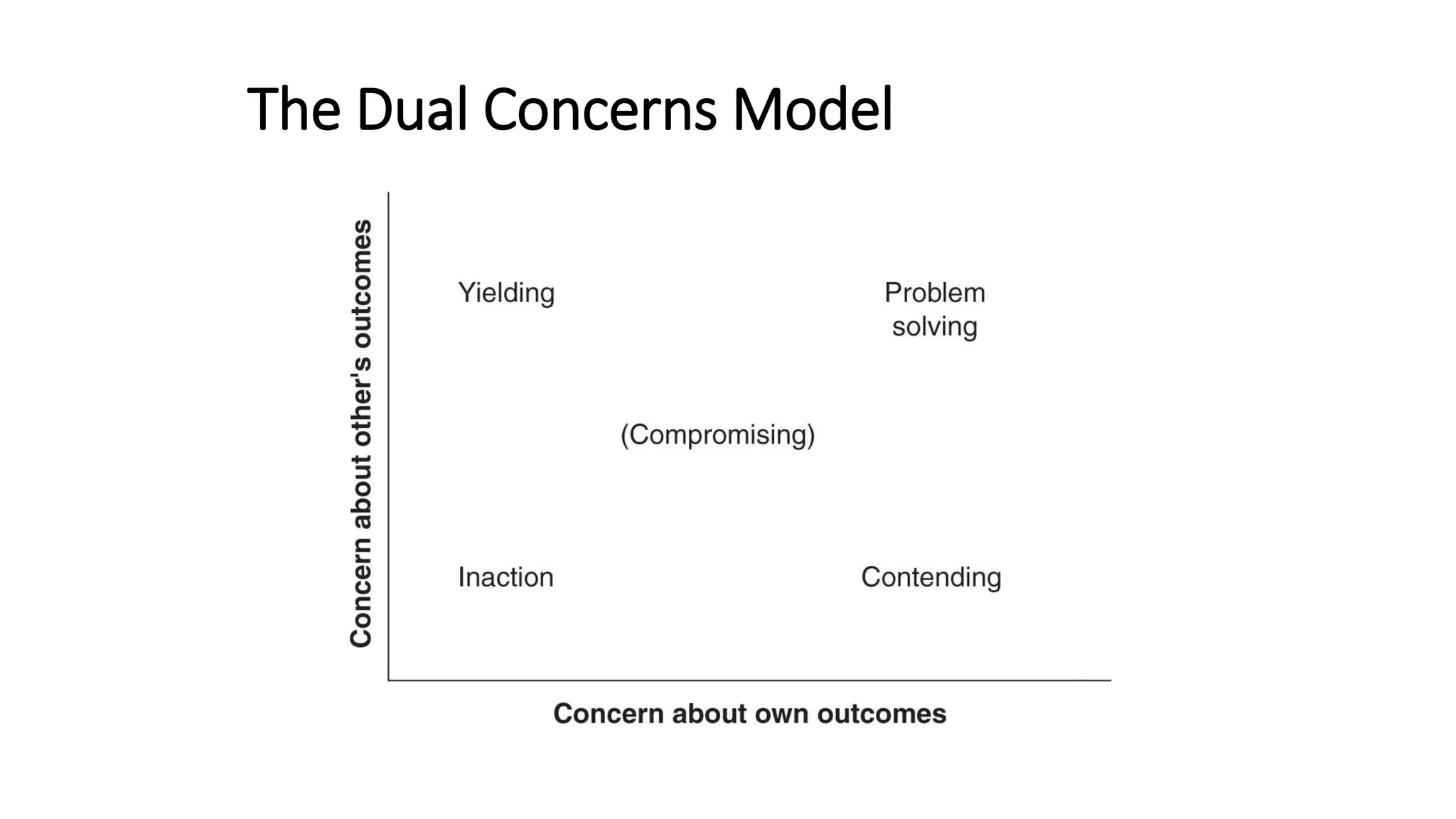
The Dual
Concerns
Model
Collabora
te
AccommodateAvoid
Compromise
Compete
Value of
Relationship
Importance Placed on
Mercy
Response to Other’s
Interests
ValueofIssue
Needfor
Justice
AchievementofOwn
Interests
The Dual Concerns Model
Collaborate
AccommodateAvoid
Compromise
Compete
Value of Relationship
Importance Placed on Mercy
Response to Other’s Interests
ValueofIssue
NeedforJustice
AchievementofOwnInterests
Ting Toomy
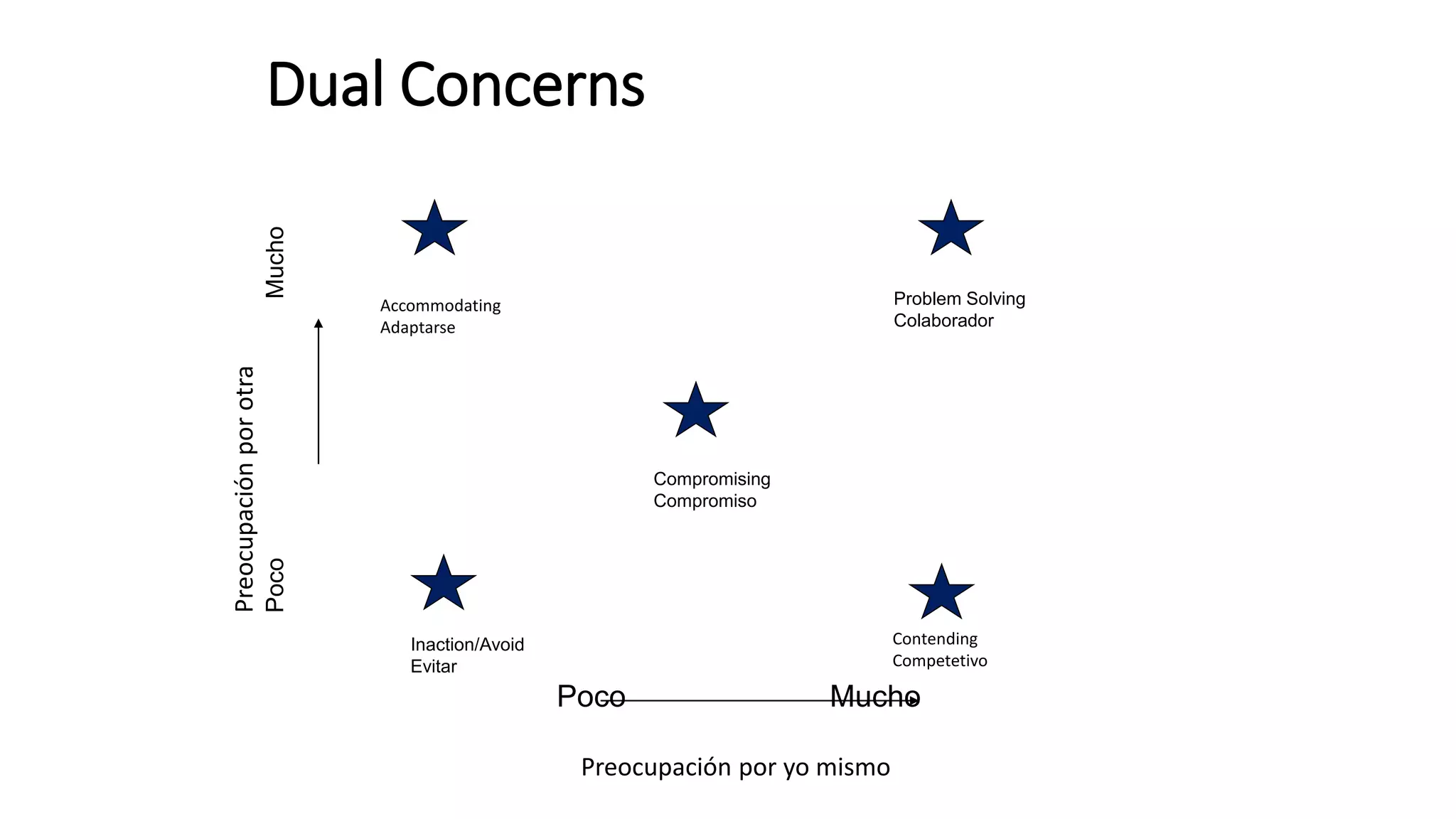
Dual Concerns
Poco Mucho
Preocupación por yo mismo
Preocupaciónporotra
PocoMucho
Accommodating
Adaptarse
Problem Solving
Colaborador
Contending
Competetivo
Compromising
Compromiso
Inaction/Avoid
Evitar
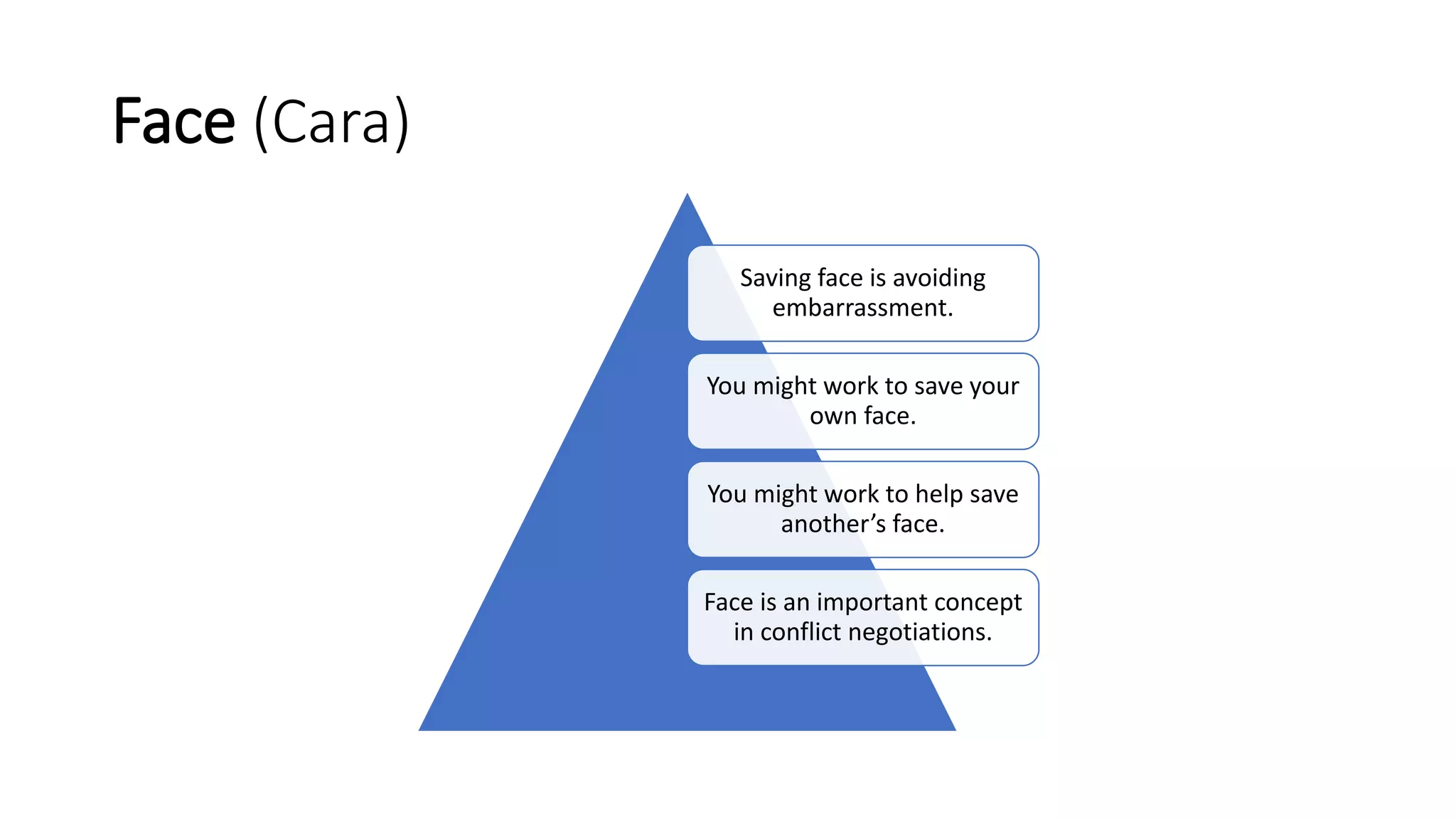
Face (Cara)
Saving face is avoiding
embarrassment.
You might work to save your
own face.
You might work to help save
another’s face.
Face is an important concept
in conflict negotiations.
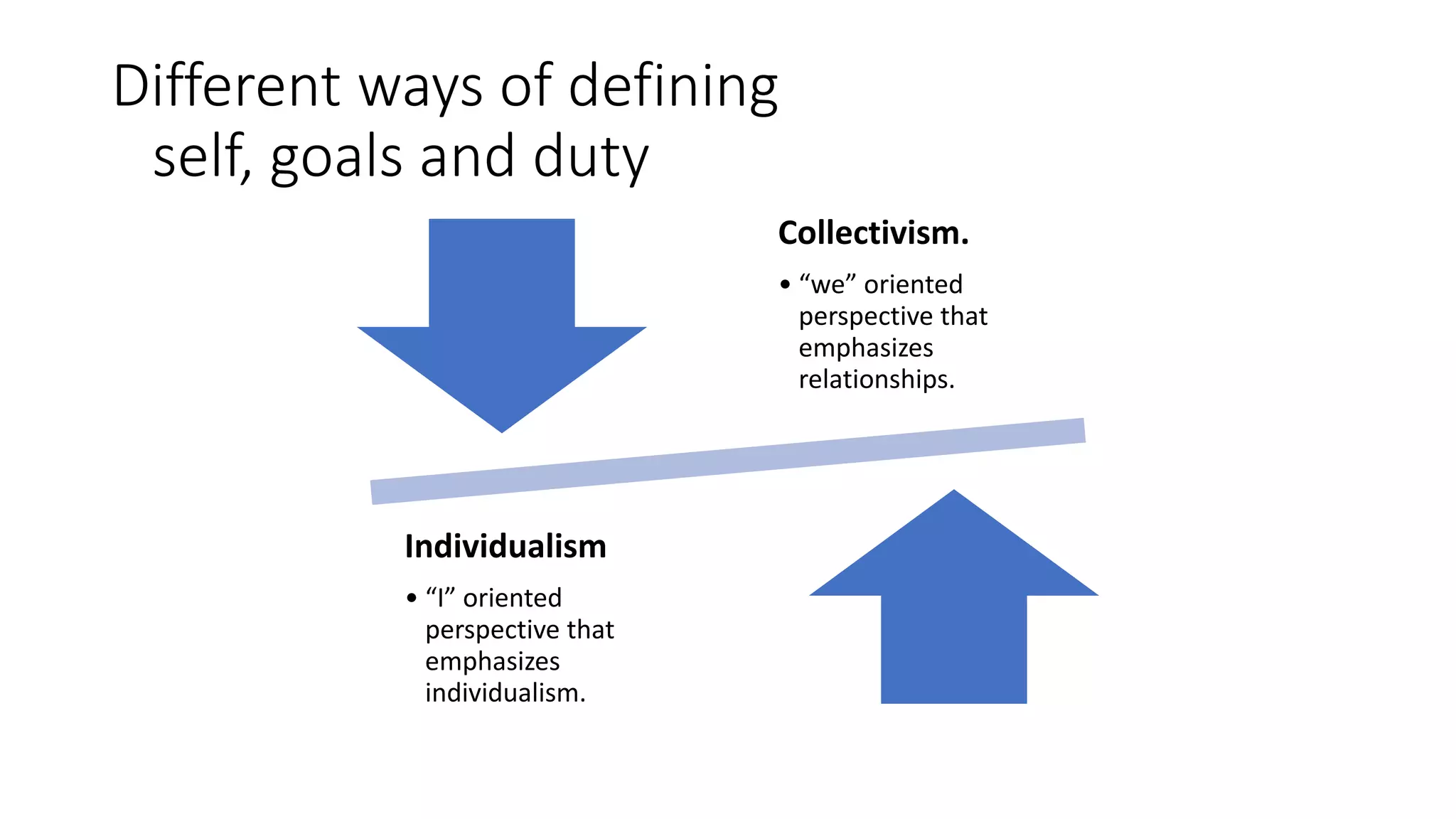
Different ways of defining
self, goals and duty
Collectivism.
• “we” oriented
perspective that
emphasizes
relationships.
Individualism
• “I” oriented
perspective that
emphasizes
individualism.
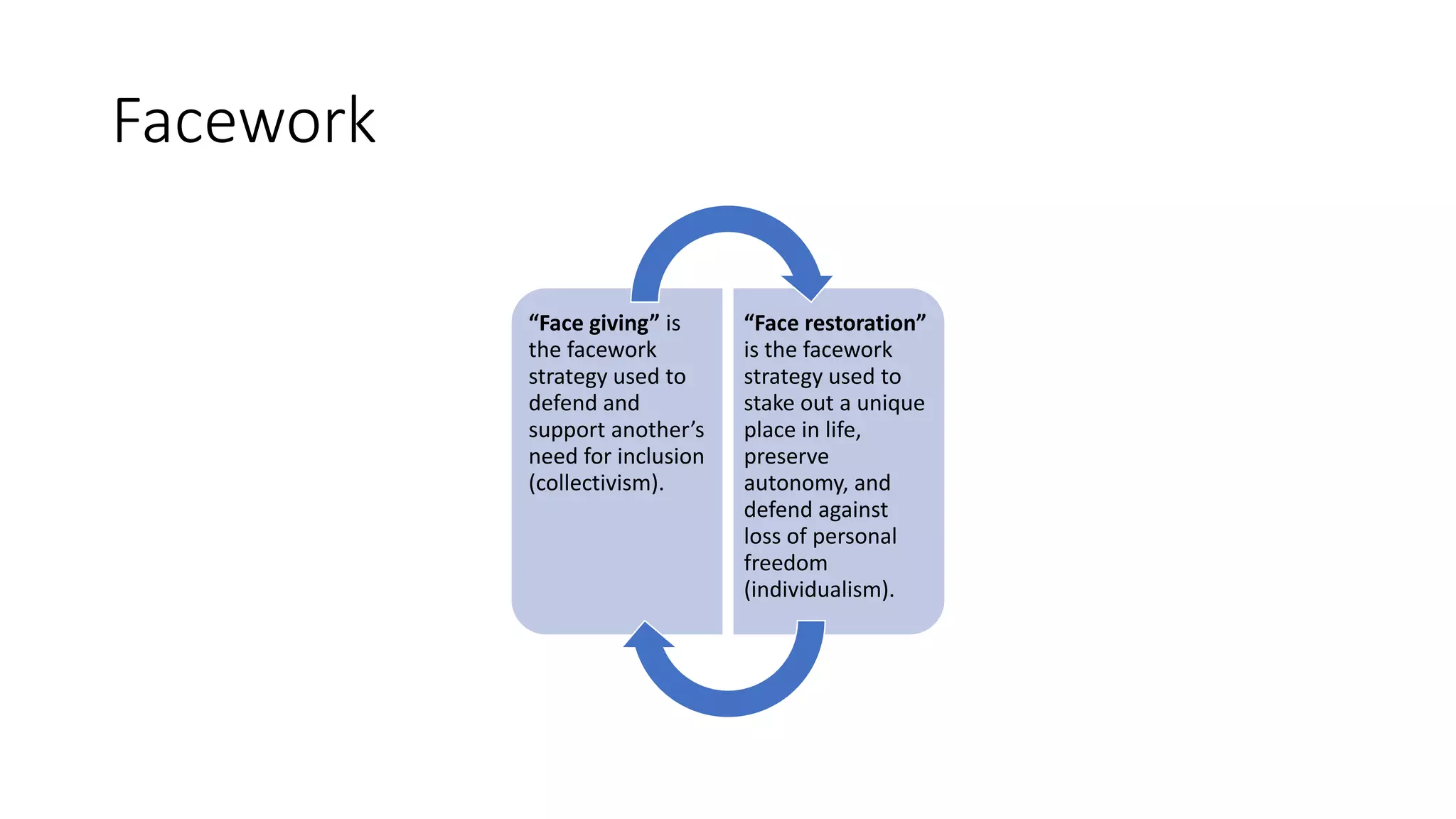
Facework
“Face giving” is
the facework
strategy used to
defend and
support another’s
need for inclusion
(collectivism).
“Face restoration”
is the facework
strategy used to
stake out a unique
place in life,
preserve
autonomy, and
defend against
loss of personal
freedom
(individualism).
Revised Conflict Map
11
Negotiation
Preparation
Role of
Perception
Subjective. Always check your
views, opinions and analysis of
your position!!
One’s view of fairness. (Barry
Bond’s homerun).
Be very careful of your client's (and
your own) perception of fairness.
13
Framing
Frames can be transformative.
Change frame, change
conversation.
Frames can be shifted.
When people hold to their frames, conflict can
occur.
Frames persist as long as they are useful.
Language
Ohio negotiation.
• Environmentalist.
• Developers.
1
Environmentalists.
• Called polluters
developers.
2
Conflict.
• Result of nonverbal
looks and glances.
• Polarizing language.
3
Trust/Distrust Frame
• Trust distrust different frames.
• Main role of negotiator / mediator.
• Decide which you are doing:
• Building trust.
• Managing distrust.
Trust/Distrust
Frame
• Little step by step process.
• Reliability.
• Competence.
Trust Frame.
• Risk averion
Distrust Frame.
Managing
Trust
Creating positive expectations.
Confident expectations about the other.
Shape
them
by:
Language.
Clear
exceptions.
Manage
expectation.
Managing
distrust
• Boarders.
• Boundaries.
• Processes.
• Not trust building.
Tools.
• Distrust binding.
• Prenuptial agreement.
Manages downside risk.
10 Frames
INTERESTS RIGHTS POWER
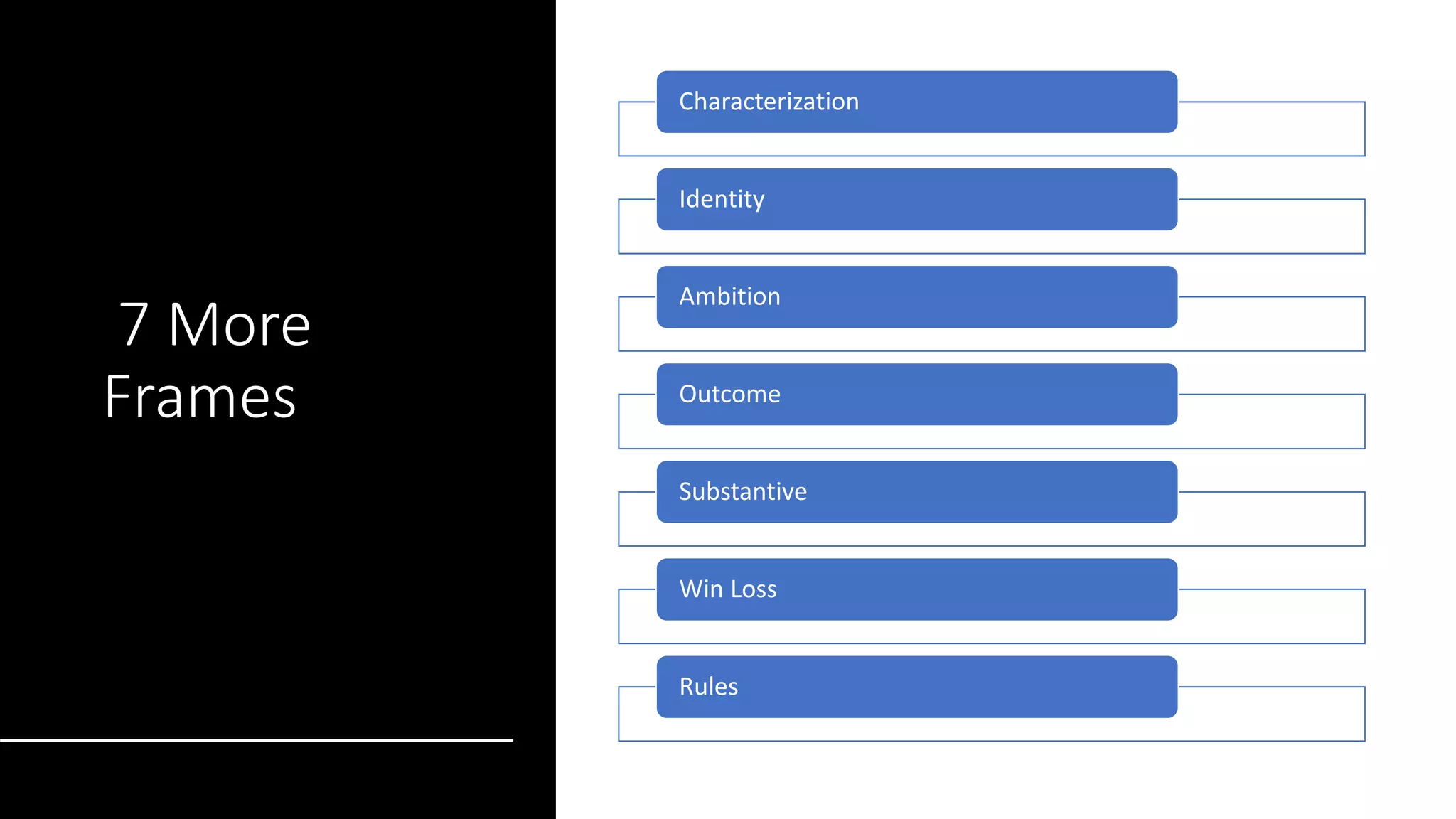
7 More
Frames
Characterization
Identity
Ambition
Outcome
Substantive
Win Loss
Rules
Reframing
Listen to Frame.
•Disputants.
•Third parties.
Reframe.
THE NEGOTIATOR’S DILEMMA
23
Create value Claim value
Learn Truthfully share
information about
interests in order to
identify opportunities
to create value
Gather accurate
information about
walk-always; then
use anchoring and
commitment tactics
to claim value
Shape perceptions Reframe the
negotiations to
emphasize integrative
possibilities
Mislead counterparts
about priorities in
order to claim value
when making trades
Cooperative
Negotiation
Stress Stress looking for a long term relationship
Build Build trust: integrity
Listen Sensitive to the other’s needs: listen
Search
Search for a “Win-Win” solution
•*Find best deal for both parties
•*Find ways to make a bigger pie to divide
•*Invent options for mutual gain
Competitive
Negotiation.
Win
little information as possibleDiscloses
little concern for youShows
youManipulates
Uses variety of negotiating tactics to winTactics
A Few Terms
BATNA
Best Alternative to a
Negotiated
Settlement
Tactic:
A Specific Negotiation
Behavior or Action the
Lawyer uses initially
or as a response to
the other side.
Strategy
The execution of a
plan through a series
of tactics or actions
that a lawyer uses to
negotiate a favorable
outcome.
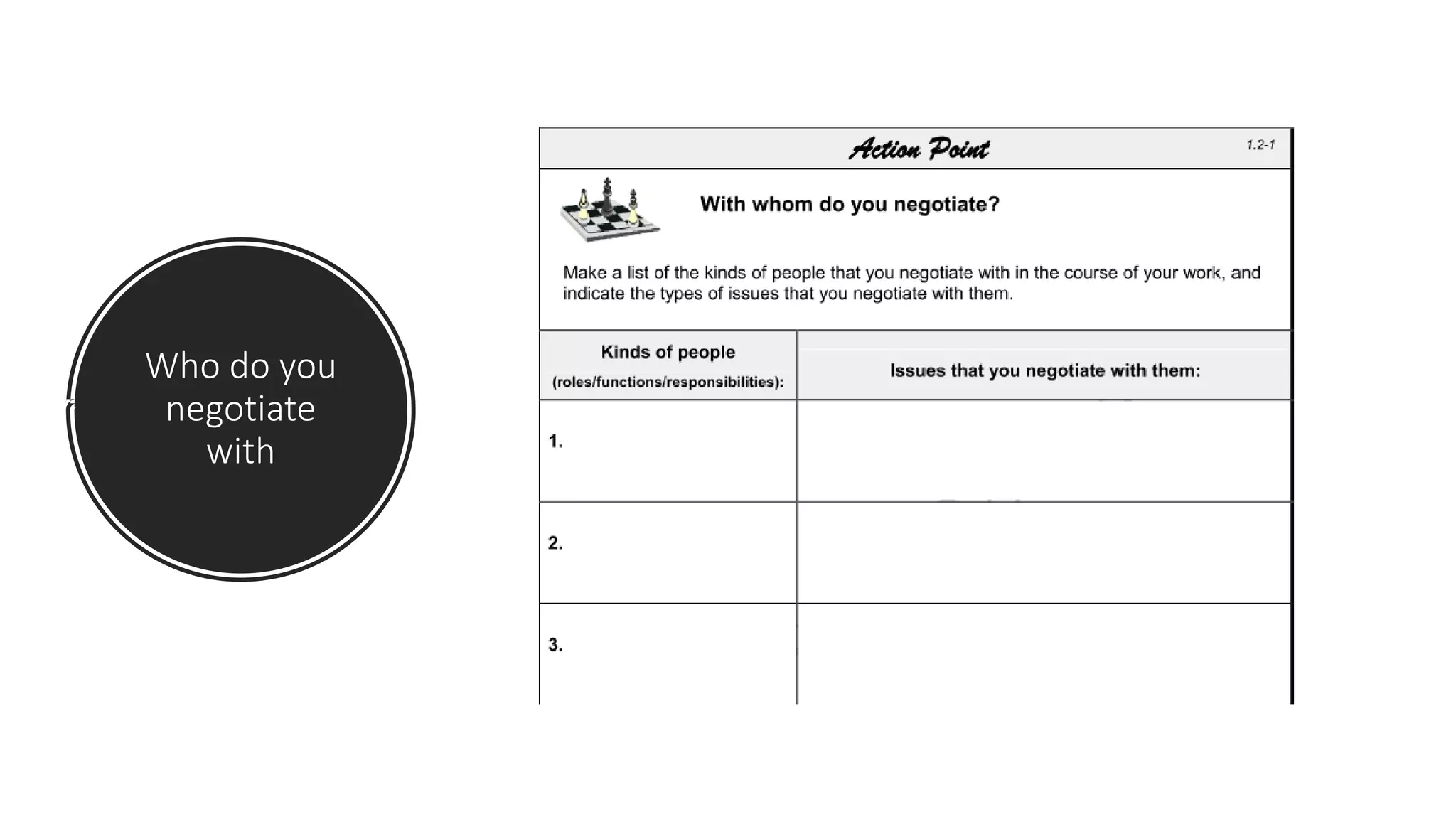
Who do you
negotiate
with
Negotation
and Maslow
Definitions
• A situation where for one person to gain something
the other must lose something. A fixed quantity of
resources. Zero sum gain.
Distributive Negotiation:
• A negotiation where the parties interests are not
directly in conflict and agreements are possible in
which the level of satisfaction of one party is not
necessarily inversely related to that of another.
Integrative Negotiation:
From
Distributive
to
Intregrative
Definition of
Distributive
Bargaining
Limited & fixed amount of resources
Goal conflict
Each maximizes getting
share of resources
available to oneself
No focus on relationship
Informational context
Each provides very little
information while trying
to extract the most from
the other
When to use
Distributive
Bargaining?
Single issue
•e.g., this session’s
exercise
Relationship is not
important
When to use Distributive Bargaining?
• Target point
• Resistance point
• Initial offer
• Bargaining range
• Zone of potential agreement (ZOPA) or settlement range
• Implications of Positive & negative bargaining range
• Best Alternative to Negotiated Agreement
• WATNA
• Settlement point
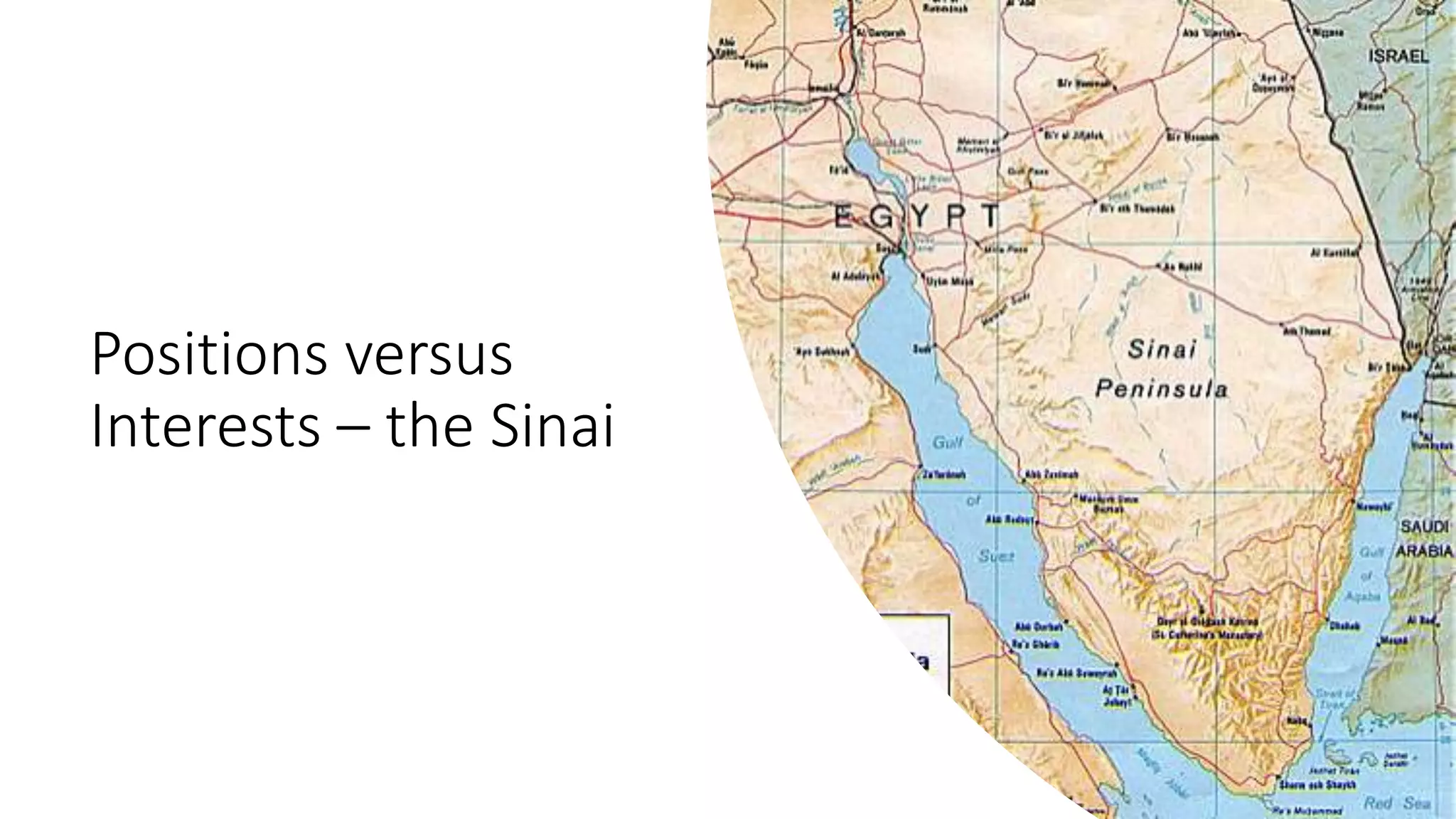
Positions versus
Interests – the Sinai
Negotiations
the Sinai --
1978
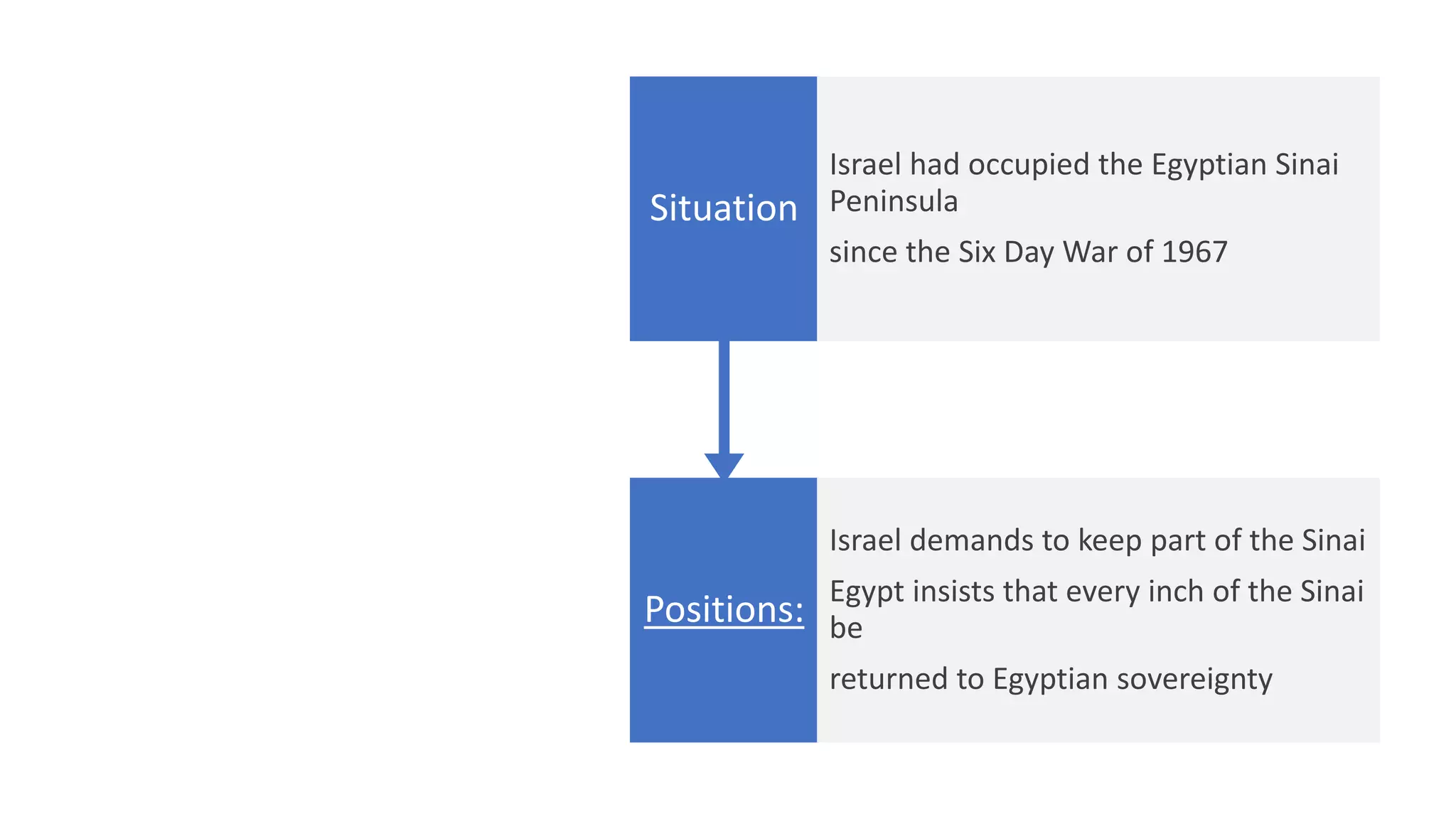
Positions:
Israel demands to keep part of the Sinai
Egypt insists that every inch of the Sinai
be
returned to Egyptian sovereignty
Situation
Israel had occupied the Egyptian Sinai
Peninsula
since the Six Day War of 1967
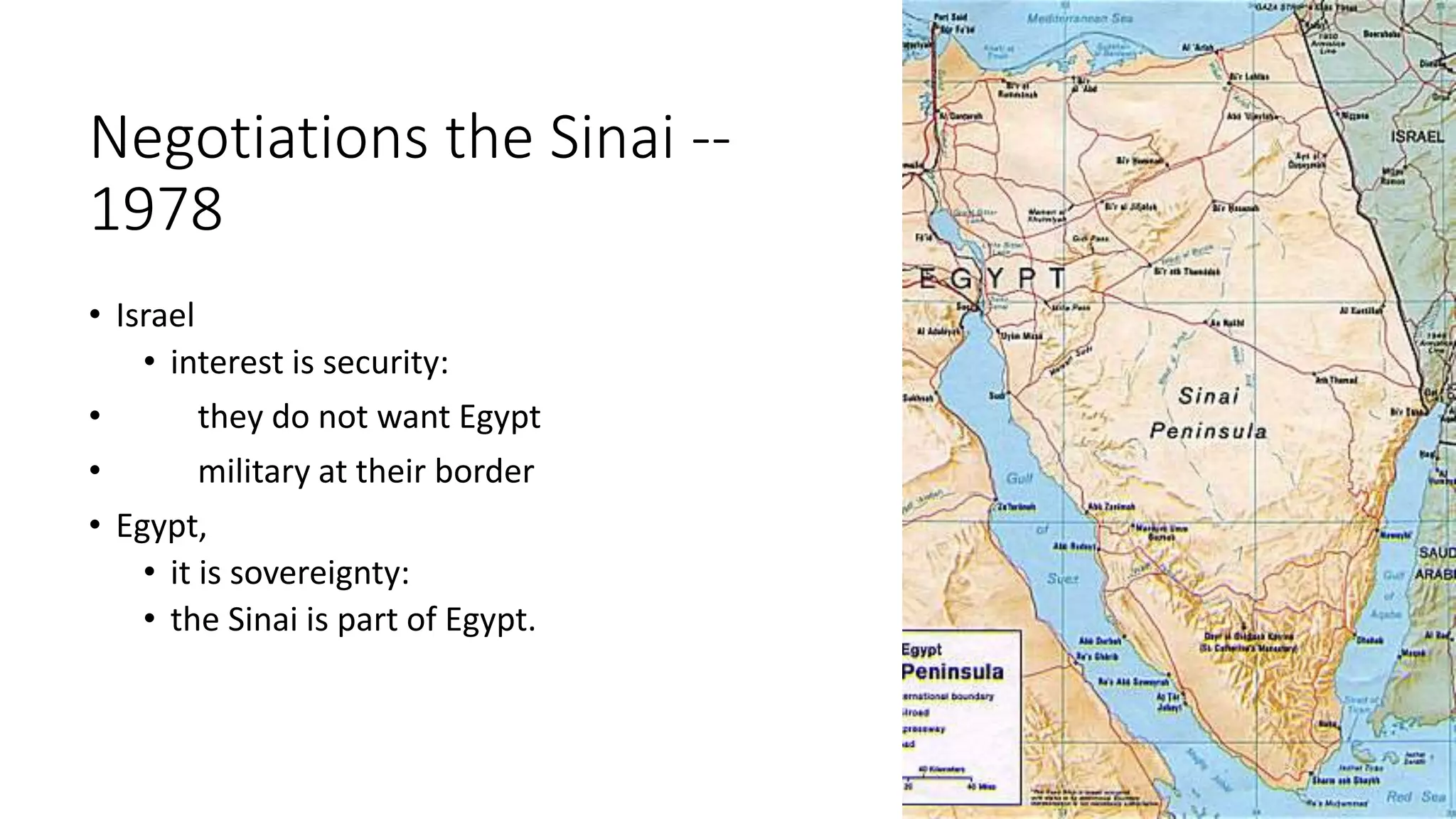
Negotiations the Sinai --
1978
• Israel
• interest is security:
• they do not want Egypt
• military at their border
• Egypt,
• it is sovereignty:
• the Sinai is part of Egypt.
Strategy, Malhotra
• Step 1: Assess your BATNA
• Step 2: Calculate your reservation value.
• Step 3: Assess the other party’s BATNA.
• Step 4: Calculate the other party’s reservation value
• Step 5: Evaluate the ZOPA.”
Common Mistakes, Malhotra
• “1. You made the first offer when you were not in a strong position
to do so.
• 2. You made a first offer that was not sufficiently aggressive.
• 3. You talked but did not listen.
• 4. You tried to influence the other party but did not try to learn from
her.
• 5. You did not challenge your assumptions about the other party.
• 6. You miscalculated the ZOPA and did not reevaluate it during the
negotiation.
• 7. You made greater concessions than the other party did.”
Anchoring
How should you respond to their initial offer?
• Strategy 1: ignore the anchor”
• Strategy 2: separate information from influence”
• Strategy 3: avoid dwelling on their anchor”
• Strategy 4: make an anchored counteroffer, then propose
moderation”
• Strategy 5: give them time to moderate their offer without losing
face”
ILLUSTRATION OF OPENING MOVES
Defendan
t’s
Opening
Offer
Plaintiff’s
Reservati
on Figure
Defendant’
s
Reservatio
n Figure
Plaintiff’
s
Openin
g Offer
Zone of
Agreement
Insult
Zone
Credibl
e Zone
Reasonable
Zone
Credibl
e Zone
Insult
Zone
First Offer
IGNORE THE ANCHORIGNORE
SEPARATE INFORMATION FROM INFLUENCESEPARATE
AVOID DWELLING ON THEIR ANCHORAVOID
MAKE AN ANCHORED COUNTEROFFER, THEN PROPOSE MODERATIONMAKE
GIVE THEM TIME TO MODERATE THEIR OFFER WITHOUT LOSING FACEGIVE
• Set high, but realistic aspirations
• Consider the context and the relationship
HOW FAR
CAN I PUSH
THEM?
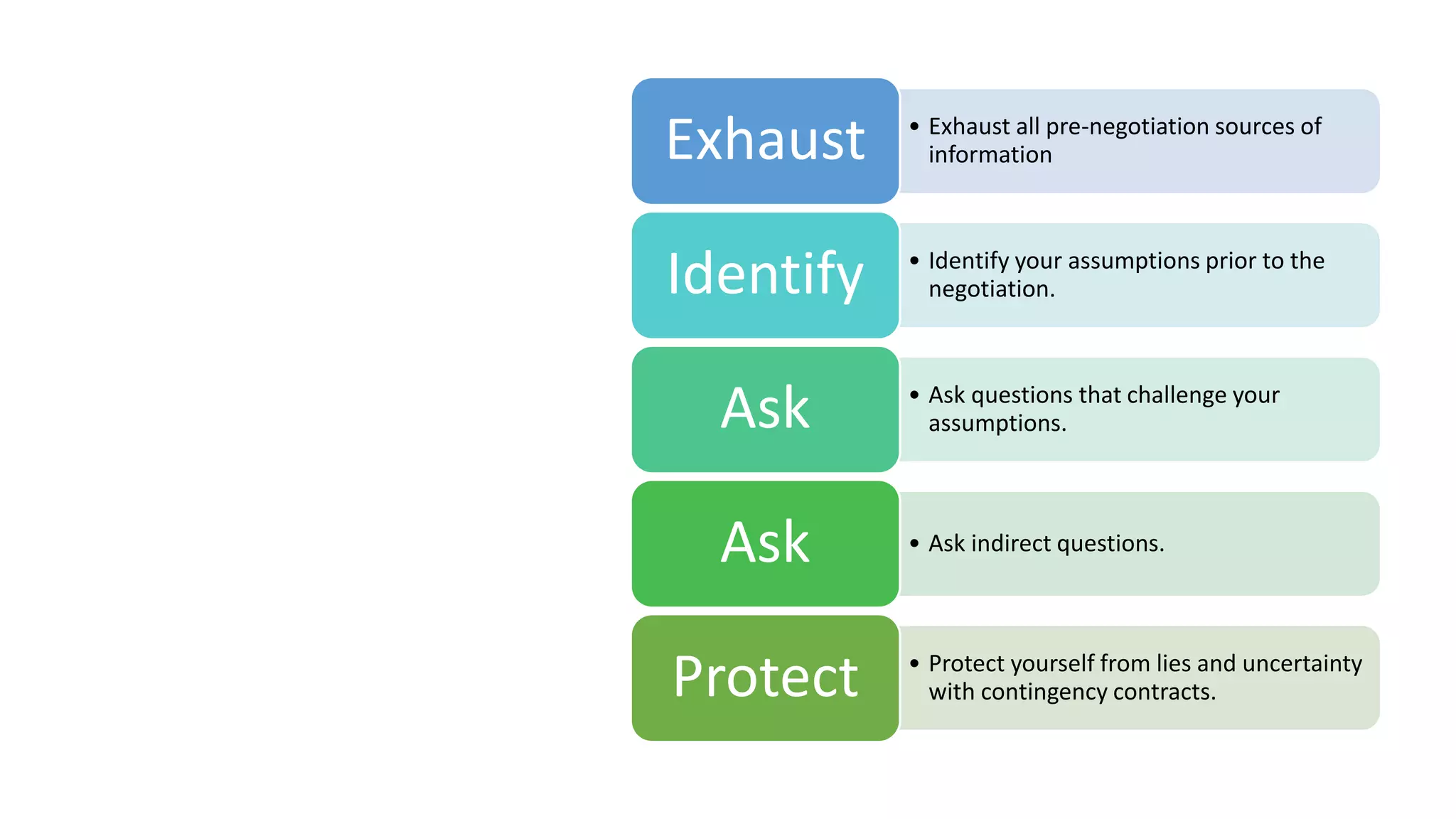
• Exhaust all pre-negotiation sources of
informationExhaust
• Identify your assumptions prior to the
negotiation.Identify
• Ask questions that challenge your
assumptions.Ask
• Ask indirect questions.Ask
• Protect yourself from lies and uncertainty
with contingency contracts.Protect

Neg 2019.2 week3

  • 1.
  • 2.
  • 3.
    Collabora te AccommodateAvoid Compromise Compete Value of Relationship Importance Placedon Mercy Response to Other’s Interests ValueofIssue Needfor Justice AchievementofOwn Interests
  • 4.
  • 5.
    Collaborate AccommodateAvoid Compromise Compete Value of Relationship ImportancePlaced on Mercy Response to Other’s Interests ValueofIssue NeedforJustice AchievementofOwnInterests
  • 6.
  • 7.
    Dual Concerns Poco Mucho Preocupaciónpor yo mismo Preocupaciónporotra PocoMucho Accommodating Adaptarse Problem Solving Colaborador Contending Competetivo Compromising Compromiso Inaction/Avoid Evitar
  • 8.
    Face (Cara) Saving faceis avoiding embarrassment. You might work to save your own face. You might work to help save another’s face. Face is an important concept in conflict negotiations.
  • 9.
    Different ways ofdefining self, goals and duty Collectivism. • “we” oriented perspective that emphasizes relationships. Individualism • “I” oriented perspective that emphasizes individualism.
  • 10.
    Facework “Face giving” is thefacework strategy used to defend and support another’s need for inclusion (collectivism). “Face restoration” is the facework strategy used to stake out a unique place in life, preserve autonomy, and defend against loss of personal freedom (individualism).
  • 11.
  • 12.
  • 13.
    Role of Perception Subjective. Alwayscheck your views, opinions and analysis of your position!! One’s view of fairness. (Barry Bond’s homerun). Be very careful of your client's (and your own) perception of fairness. 13
  • 14.
    Framing Frames can betransformative. Change frame, change conversation. Frames can be shifted. When people hold to their frames, conflict can occur. Frames persist as long as they are useful.
  • 15.
    Language Ohio negotiation. • Environmentalist. •Developers. 1 Environmentalists. • Called polluters developers. 2 Conflict. • Result of nonverbal looks and glances. • Polarizing language. 3
  • 16.
    Trust/Distrust Frame • Trustdistrust different frames. • Main role of negotiator / mediator. • Decide which you are doing: • Building trust. • Managing distrust.
  • 17.
    Trust/Distrust Frame • Little stepby step process. • Reliability. • Competence. Trust Frame. • Risk averion Distrust Frame.
  • 18.
    Managing Trust Creating positive expectations. Confidentexpectations about the other. Shape them by: Language. Clear exceptions. Manage expectation.
  • 19.
    Managing distrust • Boarders. • Boundaries. •Processes. • Not trust building. Tools. • Distrust binding. • Prenuptial agreement. Manages downside risk.
  • 20.
  • 21.
  • 22.
  • 23.
    THE NEGOTIATOR’S DILEMMA 23 Createvalue Claim value Learn Truthfully share information about interests in order to identify opportunities to create value Gather accurate information about walk-always; then use anchoring and commitment tactics to claim value Shape perceptions Reframe the negotiations to emphasize integrative possibilities Mislead counterparts about priorities in order to claim value when making trades
  • 24.
    Cooperative Negotiation Stress Stress lookingfor a long term relationship Build Build trust: integrity Listen Sensitive to the other’s needs: listen Search Search for a “Win-Win” solution •*Find best deal for both parties •*Find ways to make a bigger pie to divide •*Invent options for mutual gain
  • 25.
    Competitive Negotiation. Win little information aspossibleDiscloses little concern for youShows youManipulates Uses variety of negotiating tactics to winTactics
  • 26.
    A Few Terms BATNA BestAlternative to a Negotiated Settlement Tactic: A Specific Negotiation Behavior or Action the Lawyer uses initially or as a response to the other side. Strategy The execution of a plan through a series of tactics or actions that a lawyer uses to negotiate a favorable outcome.
  • 27.
  • 28.
  • 30.
    Definitions • A situationwhere for one person to gain something the other must lose something. A fixed quantity of resources. Zero sum gain. Distributive Negotiation: • A negotiation where the parties interests are not directly in conflict and agreements are possible in which the level of satisfaction of one party is not necessarily inversely related to that of another. Integrative Negotiation:
  • 31.
  • 32.
    Definition of Distributive Bargaining Limited &fixed amount of resources Goal conflict Each maximizes getting share of resources available to oneself No focus on relationship Informational context Each provides very little information while trying to extract the most from the other
  • 33.
    When to use Distributive Bargaining? Singleissue •e.g., this session’s exercise Relationship is not important
  • 34.
    When to useDistributive Bargaining? • Target point • Resistance point • Initial offer • Bargaining range • Zone of potential agreement (ZOPA) or settlement range • Implications of Positive & negative bargaining range • Best Alternative to Negotiated Agreement • WATNA • Settlement point
  • 35.
  • 36.
    Negotiations the Sinai -- 1978 Positions: Israeldemands to keep part of the Sinai Egypt insists that every inch of the Sinai be returned to Egyptian sovereignty Situation Israel had occupied the Egyptian Sinai Peninsula since the Six Day War of 1967
  • 37.
    Negotiations the Sinai-- 1978 • Israel • interest is security: • they do not want Egypt • military at their border • Egypt, • it is sovereignty: • the Sinai is part of Egypt.
  • 38.
    Strategy, Malhotra • Step1: Assess your BATNA • Step 2: Calculate your reservation value. • Step 3: Assess the other party’s BATNA. • Step 4: Calculate the other party’s reservation value • Step 5: Evaluate the ZOPA.”
  • 39.
    Common Mistakes, Malhotra •“1. You made the first offer when you were not in a strong position to do so. • 2. You made a first offer that was not sufficiently aggressive. • 3. You talked but did not listen. • 4. You tried to influence the other party but did not try to learn from her. • 5. You did not challenge your assumptions about the other party. • 6. You miscalculated the ZOPA and did not reevaluate it during the negotiation. • 7. You made greater concessions than the other party did.”
  • 40.
  • 41.
    How should yourespond to their initial offer? • Strategy 1: ignore the anchor” • Strategy 2: separate information from influence” • Strategy 3: avoid dwelling on their anchor” • Strategy 4: make an anchored counteroffer, then propose moderation” • Strategy 5: give them time to moderate their offer without losing face”
  • 42.
    ILLUSTRATION OF OPENINGMOVES Defendan t’s Opening Offer Plaintiff’s Reservati on Figure Defendant’ s Reservatio n Figure Plaintiff’ s Openin g Offer Zone of Agreement Insult Zone Credibl e Zone Reasonable Zone Credibl e Zone Insult Zone
  • 43.
    First Offer IGNORE THEANCHORIGNORE SEPARATE INFORMATION FROM INFLUENCESEPARATE AVOID DWELLING ON THEIR ANCHORAVOID MAKE AN ANCHORED COUNTEROFFER, THEN PROPOSE MODERATIONMAKE GIVE THEM TIME TO MODERATE THEIR OFFER WITHOUT LOSING FACEGIVE
  • 44.
    • Set high,but realistic aspirations • Consider the context and the relationship
  • 45.
    HOW FAR CAN IPUSH THEM? • Exhaust all pre-negotiation sources of informationExhaust • Identify your assumptions prior to the negotiation.Identify • Ask questions that challenge your assumptions.Ask • Ask indirect questions.Ask • Protect yourself from lies and uncertainty with contingency contracts.Protect