PART THREE
  THEORIES AND INSTITUTIONS:
    TRADE AND INVESTMENT


International Business

         Chapter Six
  International Trade and
   Factor Mobility Theory
Chapter Objectives

• To understand theories of why countries should trade
• To comprehend how global efficiency can be increased
    through free trade
•   To become familiar with factors affecting countries’ trade
    patterns
•   To realize why countries’ export capabilities are dynamic
•   To discern why the production factors of labor and
    capital move internationally
•   To grasp the relationship between foreign trade and
    international factor mobility


                                               6-2
The Importance of Trade Theory

Trade theory helps managers and govern-
  ment policymakers focus on three critical
  questions:
• What products should be imported and exported?
• How much should be traded?
• With whom should they trade?
      While descriptive theories suggest a laissez-faire
    treatment of trade, prescriptive theories suggest that
       governments should influence trade patterns.

                                             6-3
Trade and Investment Policies

• import substitution: a policy of developing
  domestic industries to manufacture goods
  and provide services that would otherwise
  be imported
• strategic trade policy: the identification
  and development of targeted domestic
  industries in order to improve their
  competitiveness at home and abroad
                                  6-4
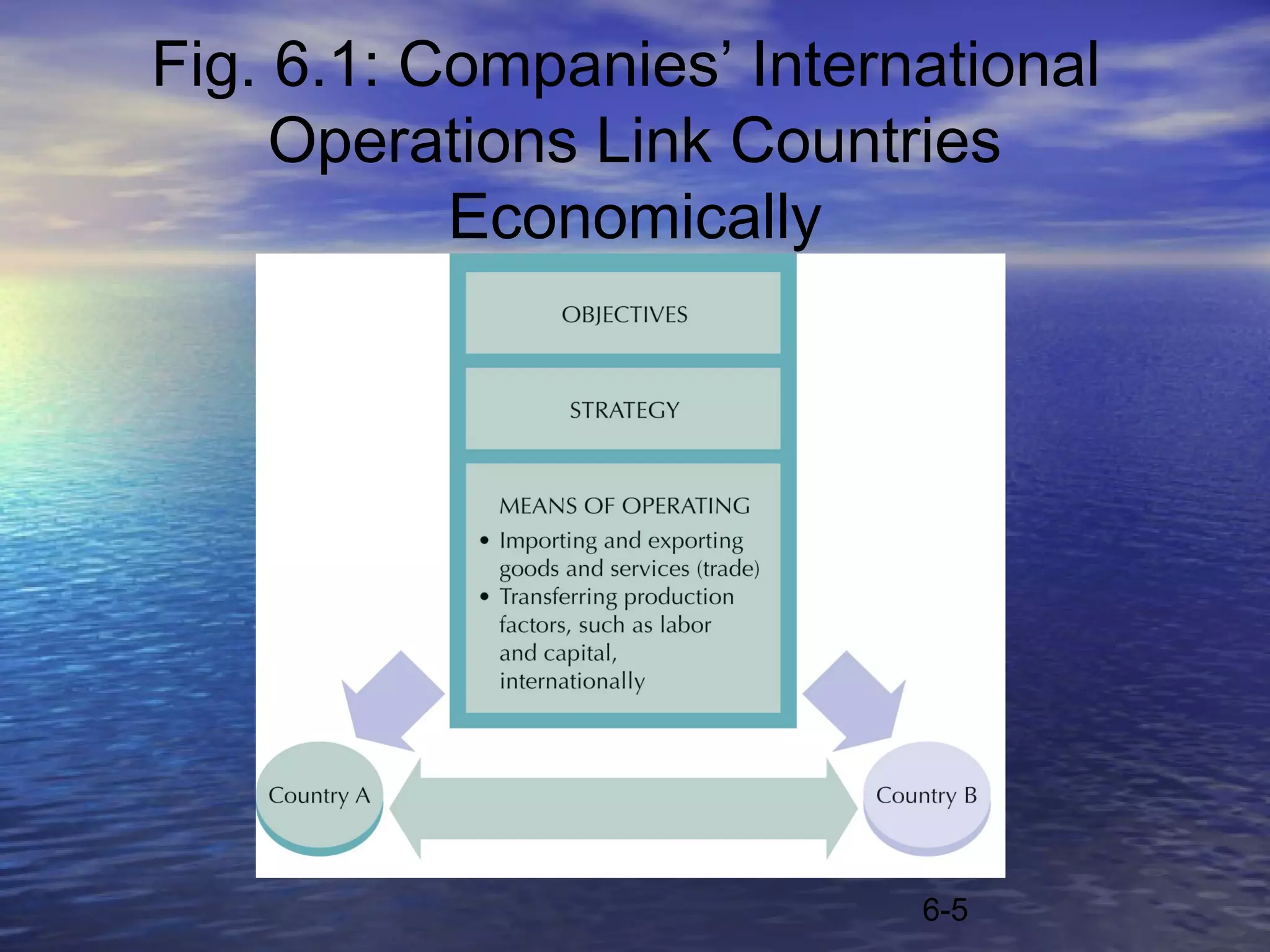
Fig. 6.1: Companies’ International
     Operations Link Countries
           Economically


                           6-5
Interventionist Trade Theories
Interventionist trade theories prescribe govern-
  ment action with respect to the international
  trade process.
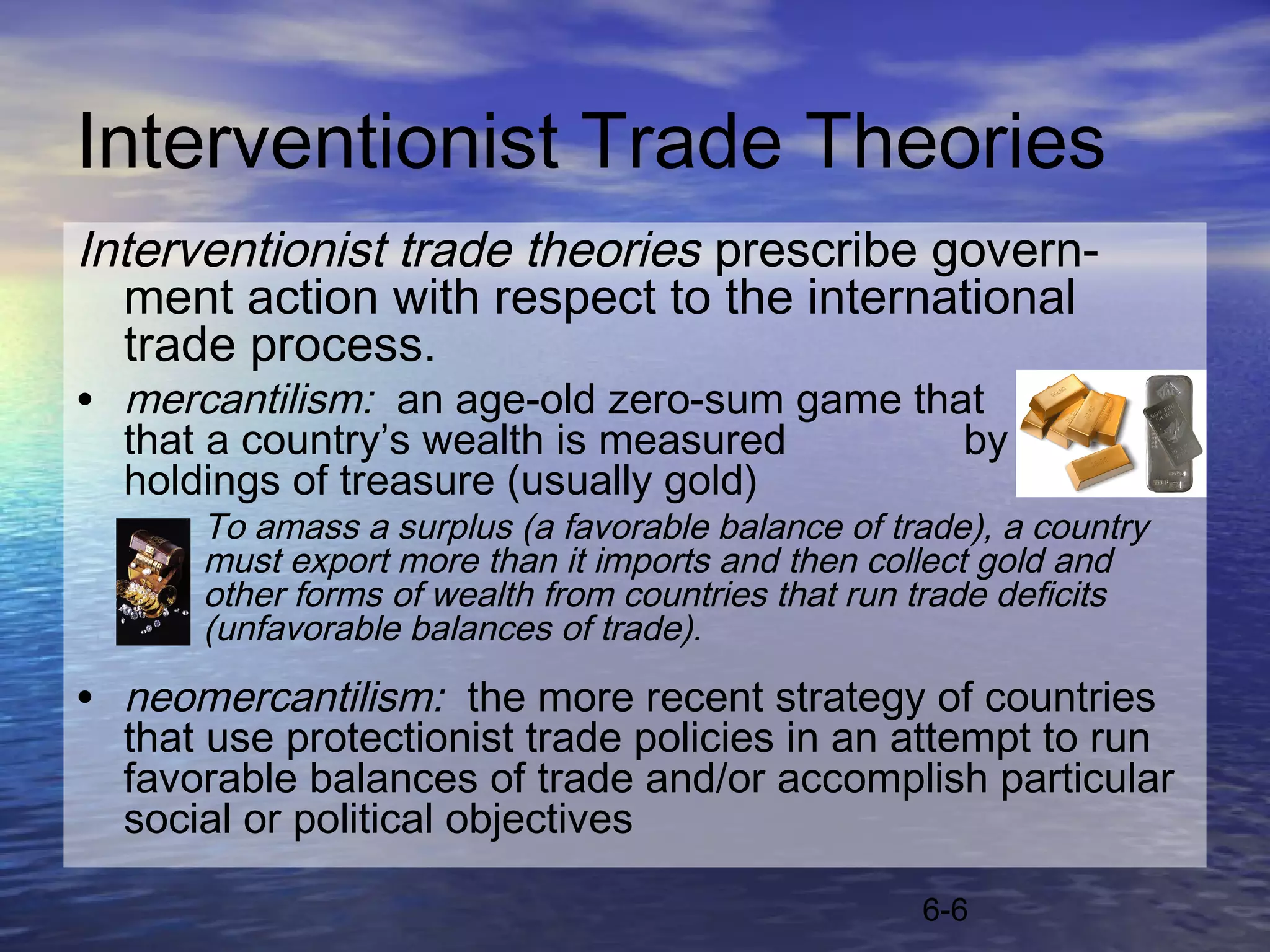
• mercantilism: an age-old zero-sum game that purports
  that a country’s wealth is measured                 by its
  holdings of treasure (usually gold)
      To amass a surplus (a favorable balance of trade), a country
      must export more than it imports and then collect gold and
      other forms of wealth from countries that run trade deficits
      (unfavorable balances of trade).

• neomercantilism: the more recent strategy of countries
  that use protectionist trade policies in an attempt to run
  favorable balances of trade and/or accomplish particular
  social or political objectives

                                                   6-6
Free Trade Theories:
Absolute & Comparative Advantage
• The theories of absolute and comparative
  advantage demonstrate how economic growth can
  occur via specialization and trade.
• Free trade (a positive-sum game) implies speciali-
  zation and requires that nations neither artificially
  limit imports nor artificially promote exports.
• The invisible hand of the market determines
  which competitors survive, as customers buy
  those products that best serve their needs.
      Nations specialize in the production of certain products, some
      of which may be exported; export earnings can in turn be used
      to pay for imported goods and services.


                                                         6-7
Theory of Absolute Advantage
Absolute advantage [Adam Smith, 1776]:                A
  country can (i) maximize its own economic well
  being by specializing in the production of those
  goods and services that it produces more efficiently
  than any other nation and (ii) enhance global
  efficiency through its participation in free trade.
  Smith reasoned that:
      • workers become more skilled by repeating the
         same tasks
      • workers do not lose time in switching from the
         production of one kind of product to another
      • longer production runs provide greater incentives
         for the development of more effective working
         methods
                                            6-8
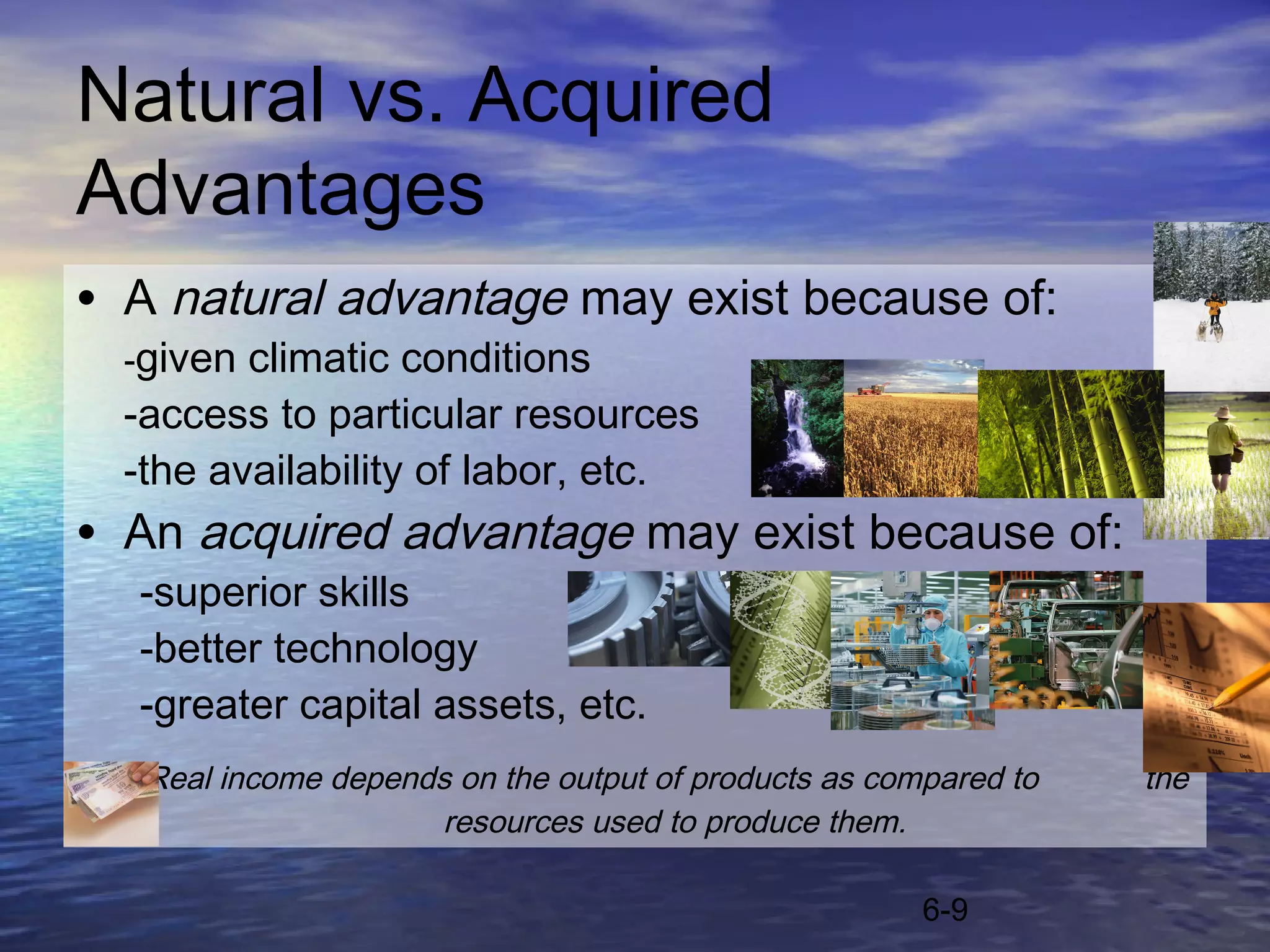
Natural vs. Acquired
Advantages
• A natural advantage may exist because of:
  -given climatic conditions
  -access to particular resources
  -the availability of labor, etc.
• An acquired advantage may exist because of:
  -superior skills
  -better technology
  -greater capital assets, etc.
   Real income depends on the output of products as compared to   the
                     resources used to produce them.

                                                       6-9
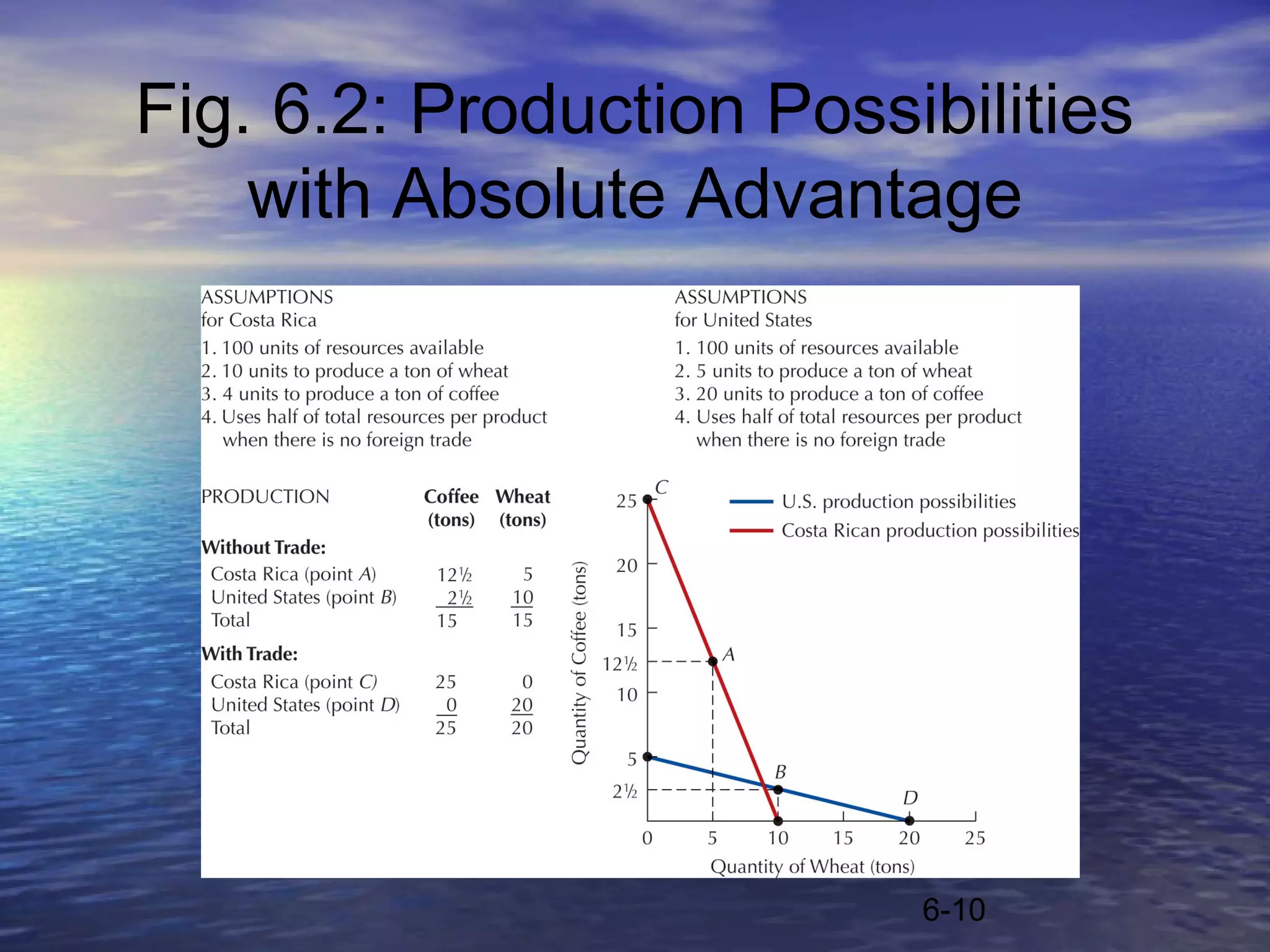
Fig. 6.2: Production Possibilities
    with Absolute Advantage


                          6-10
Theory of Comparative Advantage
Comparative advantage [David Ricardo, 1817]:
  A country can (i) maximize its own economic well-
  being by specializing in the production of those
  goods and services it can produce relatively
  efficiently and (ii) enhance global efficiency via its
  participation in free trade.
  Ricardo also reasoned that:
      • a country can simultaneously have an absolute
        and a comparative advantage in the production
        of a given product
      • by concentrating on the production of the product
        in which it has the greater advantage, a country
        can further enhance both global output and its
        own economic well-being
                                            6-11
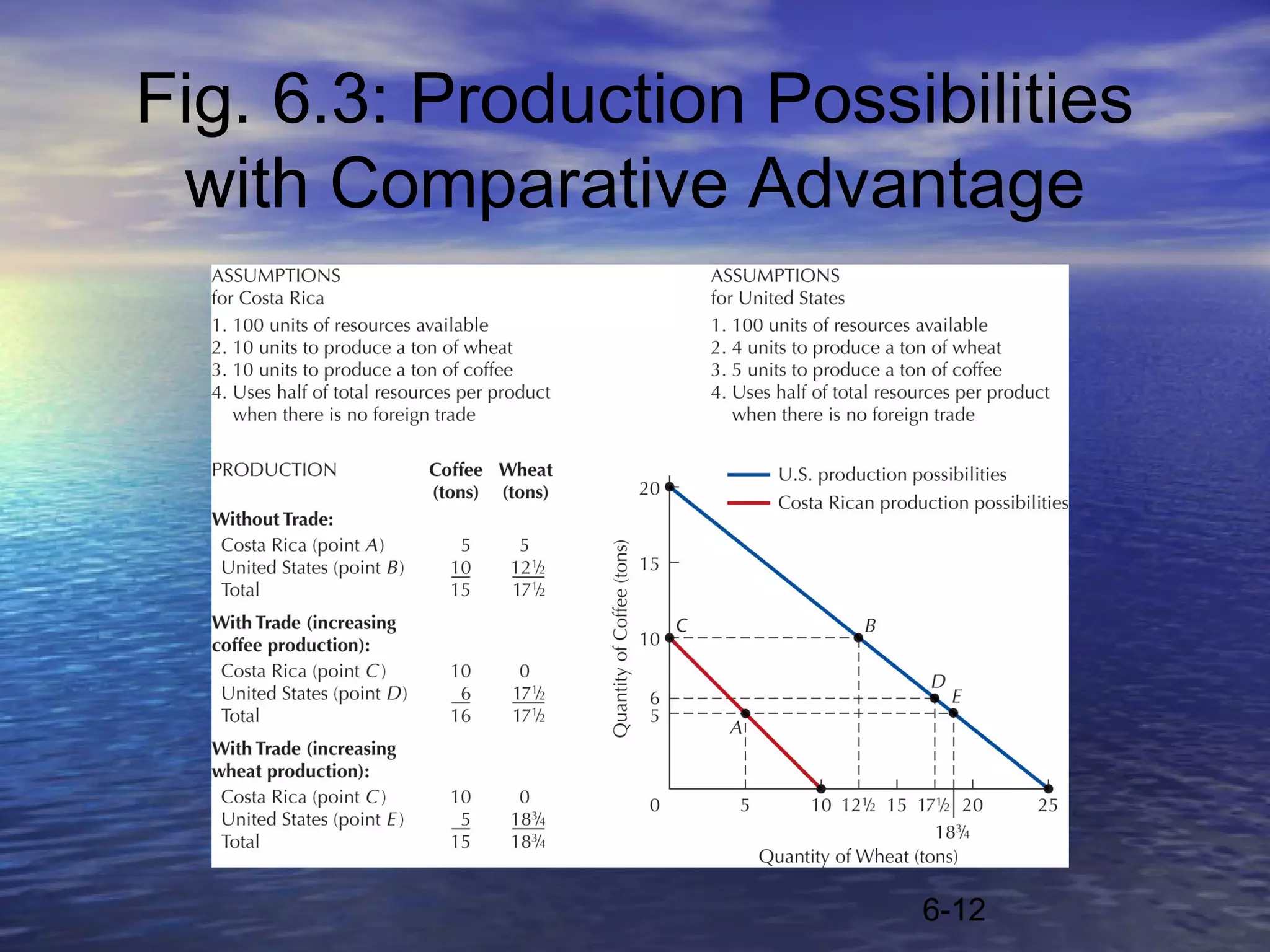
Fig. 6.3: Production Possibilities
 with Comparative Advantage


                          6-12
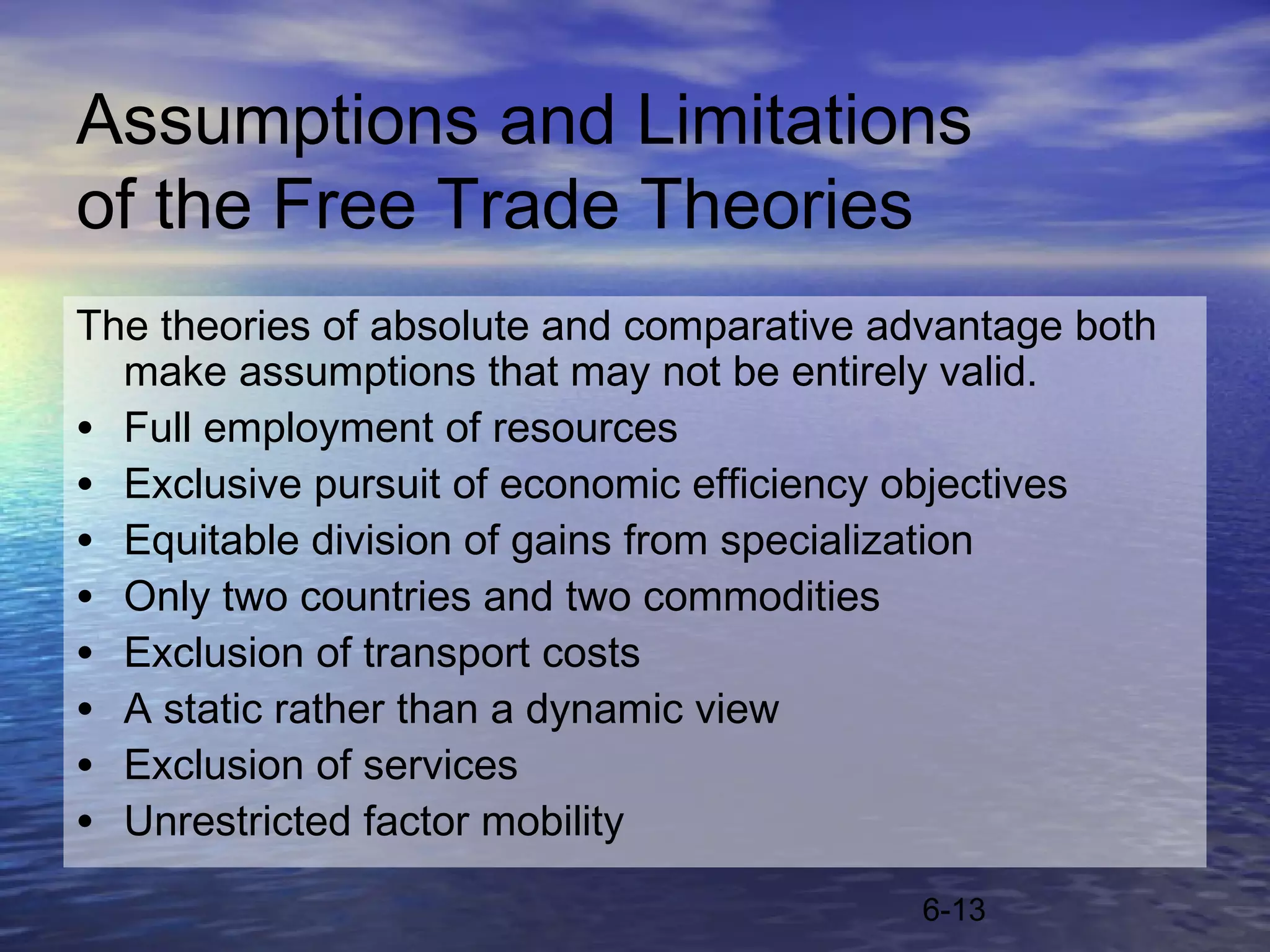
Assumptions and Limitations
of the Free Trade Theories
The theories of absolute and comparative advantage both
  make assumptions that may not be entirely valid.
• Full employment of resources
• Exclusive pursuit of economic efficiency objectives
• Equitable division of gains from specialization
• Only two countries and two commodities
• Exclusion of transport costs
• A static rather than a dynamic view
• Exclusion of services
• Unrestricted factor mobility
                                           6-13
Theories Explaining Patterns of Trade:
Country Size, Factor Proportions,
Country Similarity
The theories of country size, factor
  proportions, and country similarity all
  contribute to the explanations of:
• what types of products are traded
• with which partner nations countries will
  primarily trade
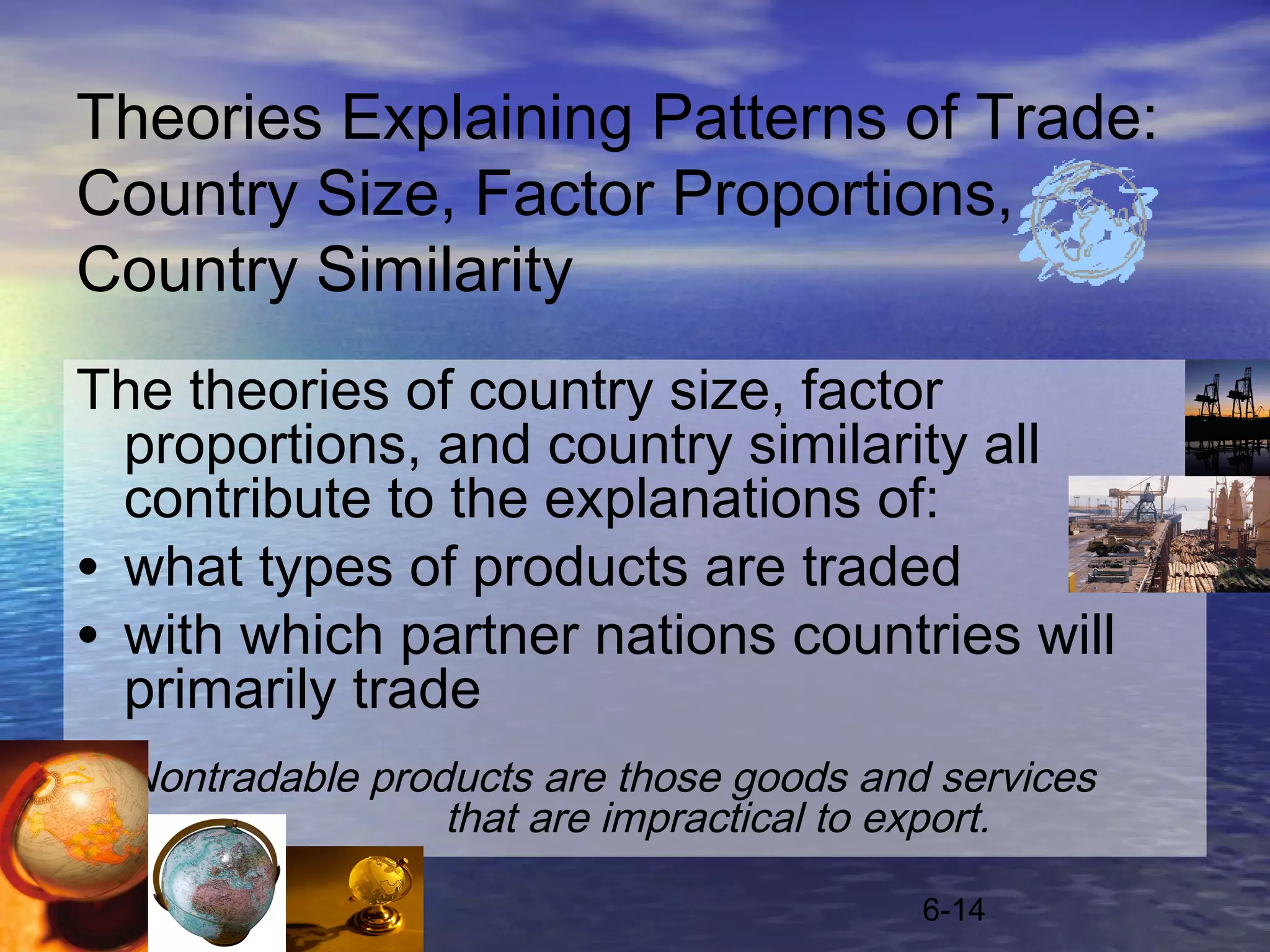
  Nontradable products are those goods and services
                  that are impractical to export.

                                          6-14
Theory of Country Size
Large countries differ from small countries in at least
  two critical ways:
• Large countries tend to export a smaller portion of their
  output and import a small portion of their consumption.
       Large countries are more apt to have varied climates and a greater
       assortment of natural resources than smaller countries, thus making
       large countries more self-sufficient.
• Large countries tend to have higher transportation costs
  for exported and imported products.
       Given the same types of terrain and modes of transportation, the
       greater the distance, the higher the associated transport costs.
       Thus, firms in large countries often face higher transport costs in
       terms of sourcing inputs from and delivering outputs to distant foreign
  markets than do their closer foreign competitors.


                                                           6-15
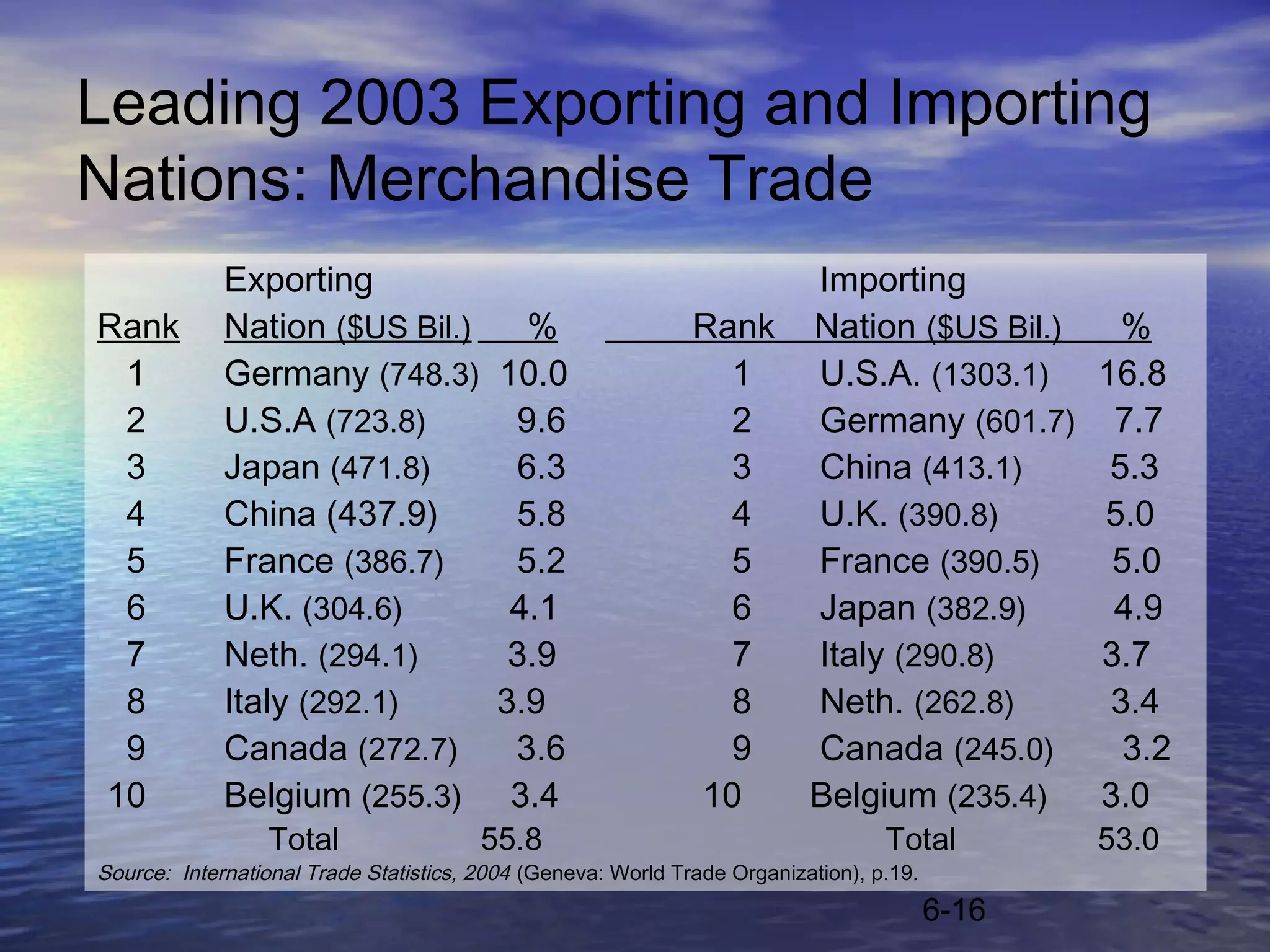
Leading 2003 Exporting and Importing
Nations: Merchandise Trade
             Exporting                                             Importing
Rank         Nation ($US Bil.)             %                  Rank Nation ($US Bil.)              %
 1           Germany (748.3)             10.0                   1  U.S.A. (1303.1)              16.8
 2           U.S.A (723.8)                9.6                   2  Germany (601.7)               7.7
 3           Japan (471.8)                6.3                   3  China (413.1)                 5.3
 4           China (437.9)                5.8                   4  U.K. (390.8)                 5.0
 5           France (386.7)               5.2                   5  France (390.5)                5.0
 6           U.K. (304.6)                 4.1                   6  Japan (382.9)                 4.9
 7           Neth. (294.1)                3.9                   7  Italy (290.8)                3.7
 8           Italy (292.1)               3.9                    8  Neth. (262.8)                 3.4
 9           Canada (272.7)               3.6                   9  Canada (245.0)                 3.2
10           Belgium (255.3)              3.4                 10   Belgium (235.4)              3.0
                 Total                  55.8                                      Total         53.0
Source: International Trade Statistics, 2004 (Geneva: World Trade Organization), p.19.
                                                                                         6-16
Factor Proportions Theory
Factor proportions [Eli Heckscher, 1919;
  Bertil Ohlin, 1933]:
• Differences in a country’s relative endowments
  of land, labor, and capital explain differences in
  the cost of production factors.
• A country will tend to export products that utilize
  relatively abundant production factors because
  they are relatively cheaper than scarce factors.
 The composition of a country’s trade depends on both its natural and
    acquired advantages. With respect to the latter, both production
            and product technology can be very important.


                                                     6-17
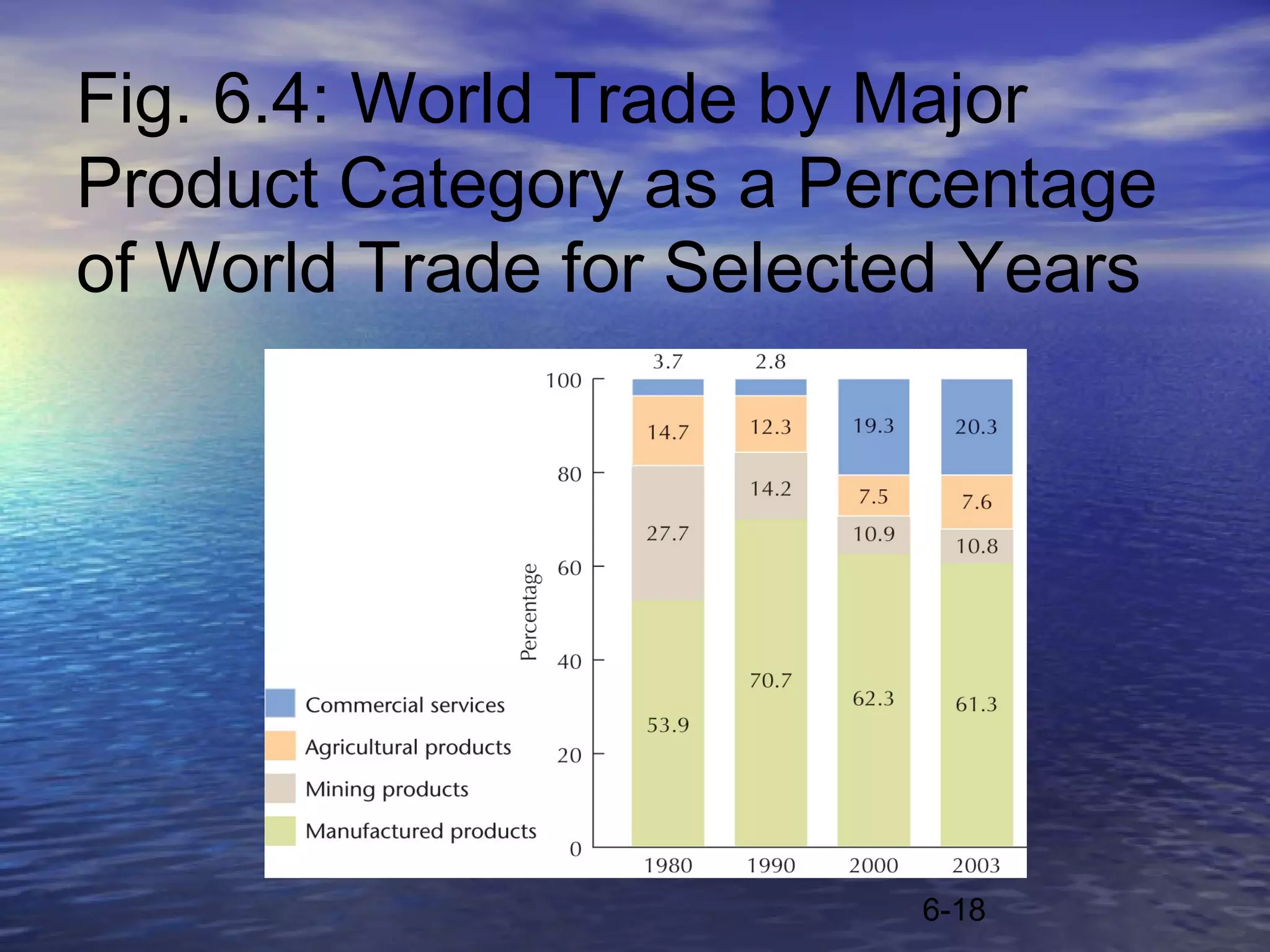
Fig. 6.4: World Trade by Major
Product Category as a Percentage
of World Trade for Selected Years


                         6-18
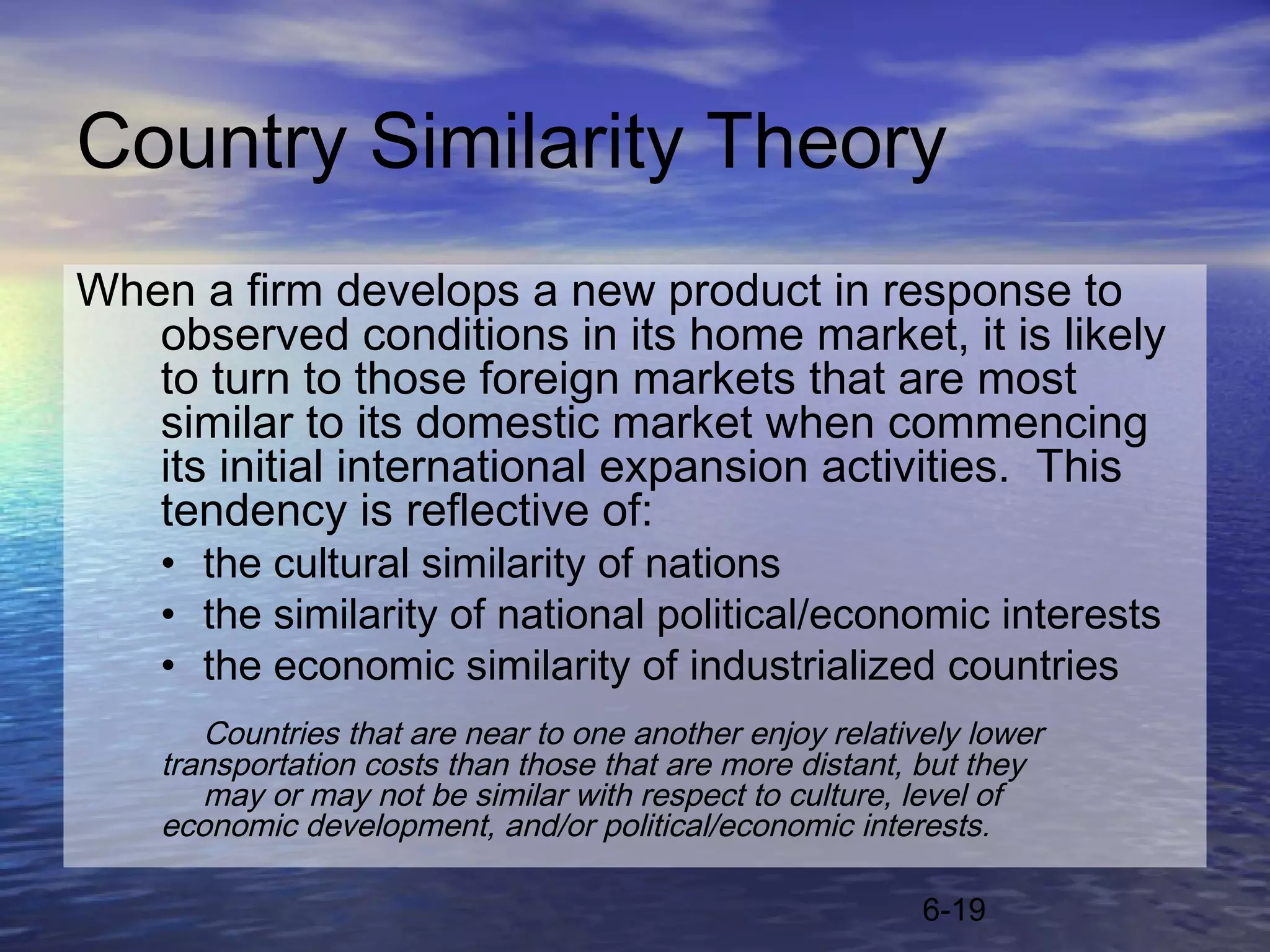
Country Similarity Theory
When a firm develops a new product in response to
   observed conditions in its home market, it is likely
   to turn to those foreign markets that are most
   similar to its domestic market when commencing
   its initial international expansion activities. This
   tendency is reflective of:
    • the cultural similarity of nations
    • the similarity of national political/economic interests
    • the economic similarity of industrialized countries
       Countries that are near to one another enjoy relatively lower
    transportation costs than those that are more distant, but they
       may or may not be similar with respect to culture, level of
    economic development, and/or political/economic interests.

                                                           6-19
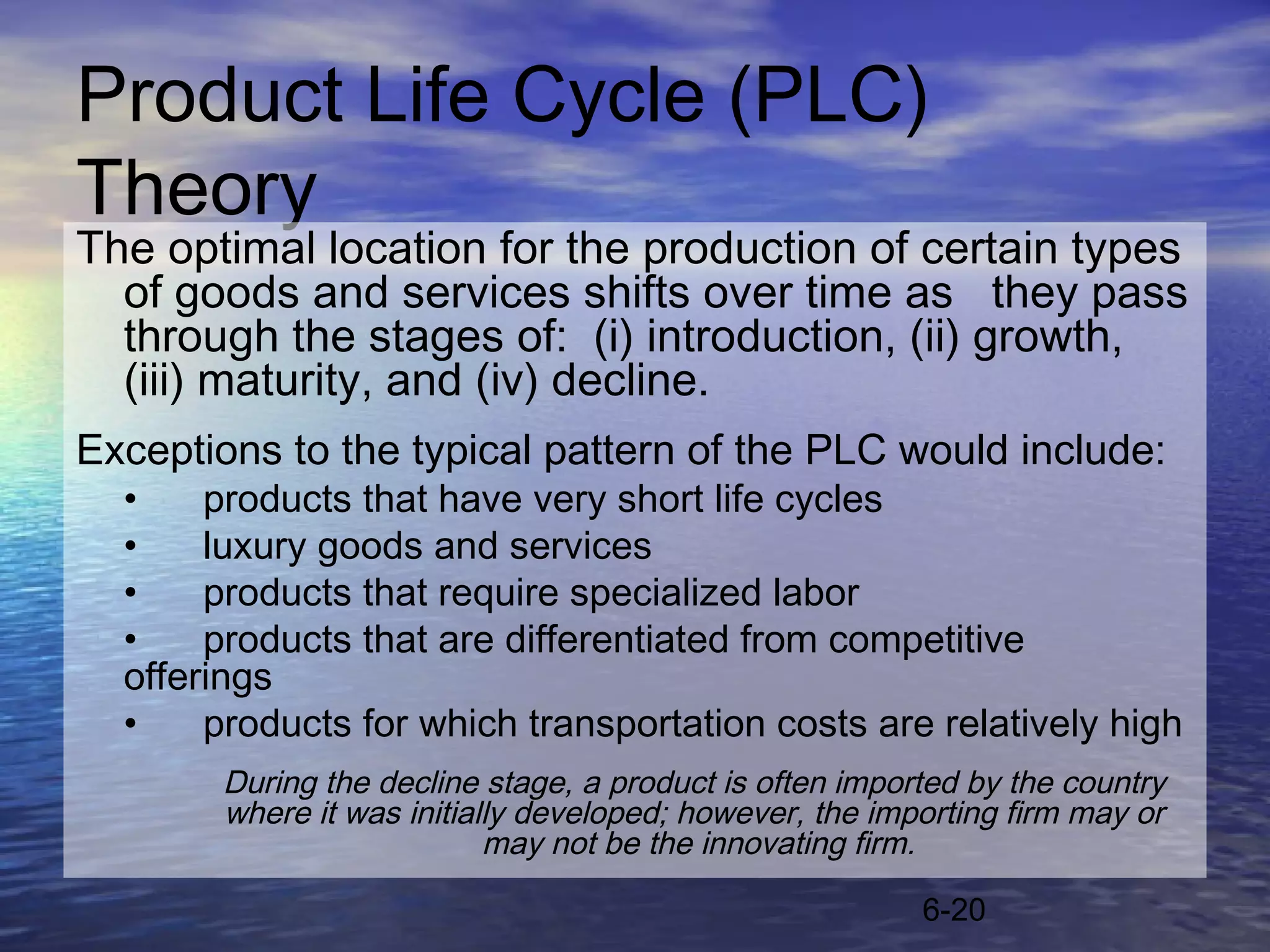
Product Life Cycle (PLC)
Theory
The optimal location for the production of certain types
  of goods and services shifts over time as they pass
  through the stages of: (i) introduction, (ii) growth,
  (iii) maturity, and (iv) decline.
Exceptions to the typical pattern of the PLC would include:
  •    products that have very short life cycles
  •    luxury goods and services
  •    products that require specialized labor
  •    products that are differentiated from competitive
  offerings
  •    products for which transportation costs are relatively high
       During the decline stage, a product is often imported by the country
       where it was initially developed; however, the importing firm may or
                           may not be the innovating firm.

                                                         6-20
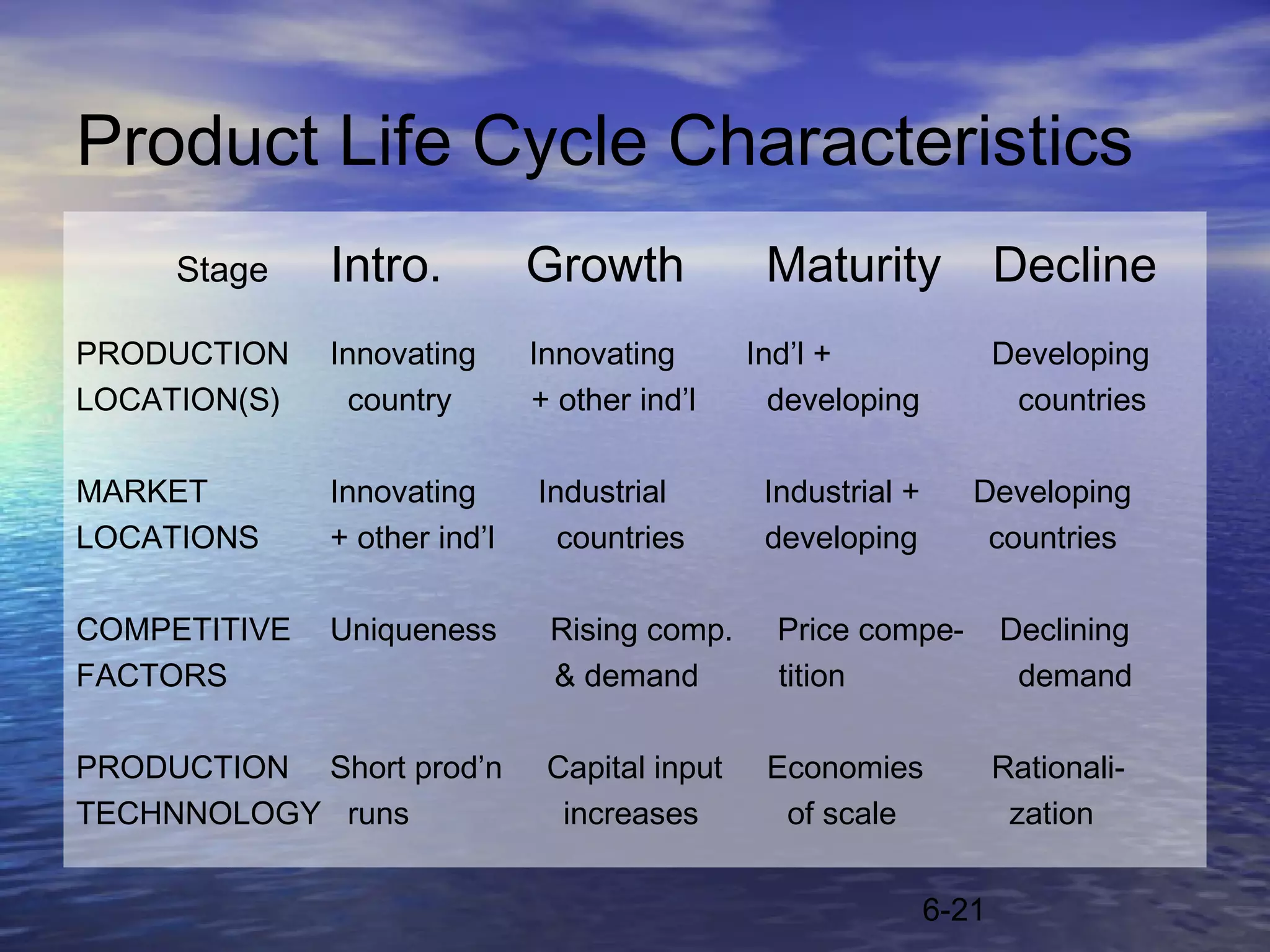
Product Life Cycle Characteristics
     Stage    Intro.          Growth            Maturity              Decline
PRODUCTION    Innovating      Innovating       Ind’l +                Developing
LOCATION(S)    country        + other ind’l      developing            countries

MARKET        Innovating      Industrial        Industrial +      Developing
LOCATIONS     + other ind’l     countries       developing         countries

COMPETITIVE   Uniqueness       Rising comp.      Price compe-         Declining
FACTORS                        & demand          tition                demand

PRODUCTION Short prod’n        Capital input    Economies             Rationali-
TECHNNOLOGY runs                increases        of scale              zation


                                                               6-21
Porter’s Diamond of National
Competitive Advantage [1990]
The Porter Diamond theorizes that national
  competitive advantage is embedded in four
  determinants:
  •    factor endowments
  •    demand conditions
  •    related and supporting industries
  •    firm strategy, structure, and rivalry
      All four determinants are interlinked and
  generally must be favorable for a given national
  industry to attain global competitiveness.
 At times, determinants can be affected by                     the
                      roles of chance and government.

                                                        6-22
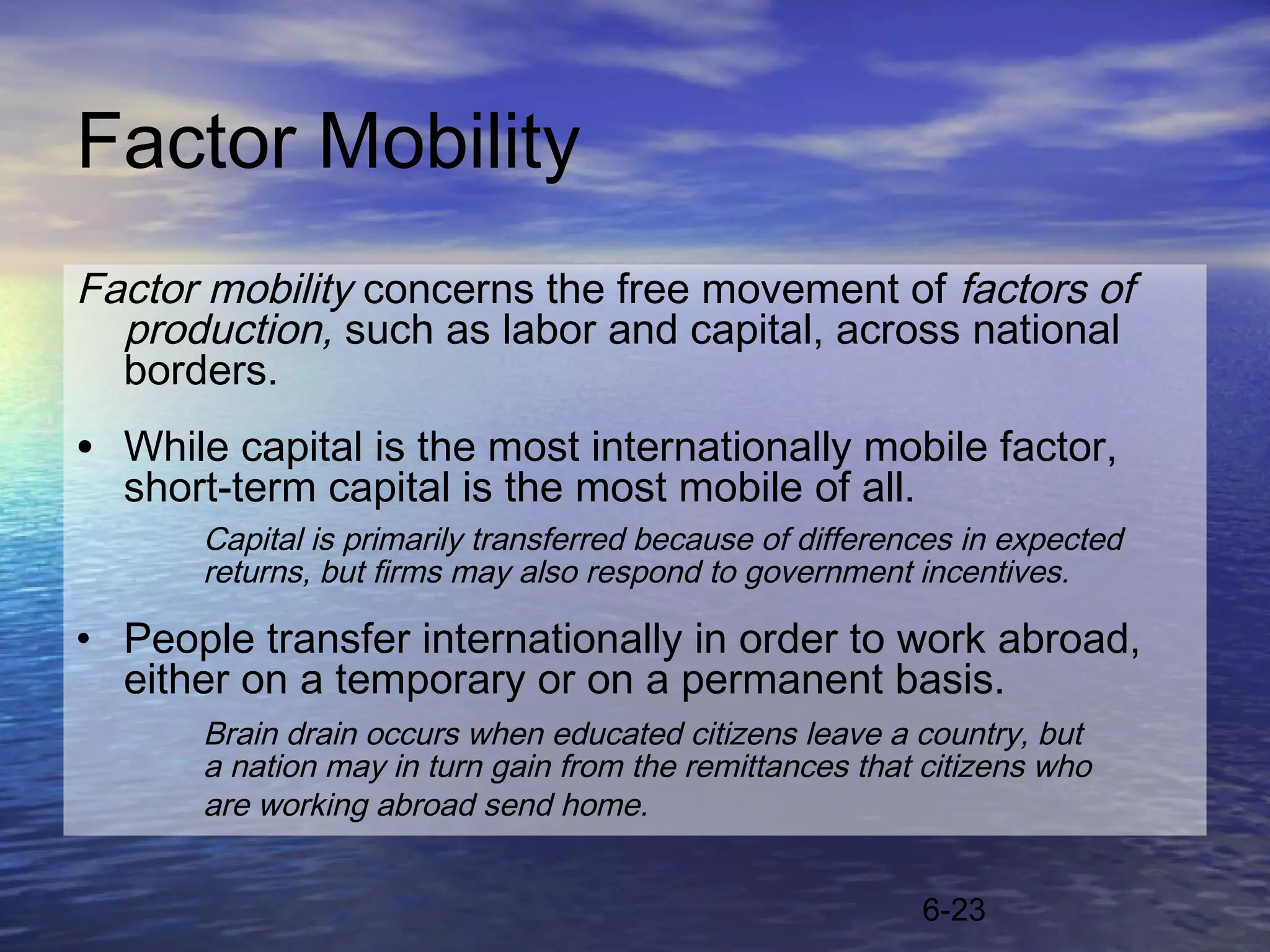
Factor Mobility
Factor mobility concerns the free movement of factors of
  production, such as labor and capital, across national
  borders.
• While capital is the most internationally mobile factor,
  short-term capital is the most mobile of all.
       Capital is primarily transferred because of differences in expected
       returns, but firms may also respond to government incentives.

• People transfer internationally in order to work abroad,
  either on a temporary or on a permanent basis.
       Brain drain occurs when educated citizens leave a country, but
       a nation may in turn gain from the remittances that citizens who
       are working abroad send home.


                                                           6-23
International Trade and Factor
Mobility—Potential Effects
• Substitution: the inability to gain sufficient access to
  foreign production factors may stimulate efficient
  methods of domestic substitution, such as the develop-
  ment of alternatives for traditional production methods
• Complementarity: factor mobility via foreign direct
  investment may stimulate foreign trade because of the
  need for equipment, components, and/or complementary
  products in the destination country
      While immigrants add to the base of a country’s skills, thus enabling
      competition in new areas, inflows of capital can be used to develop
      infrastructure and natural and other acquired advantages, thus
     enabling increased participation in the international trade arena.


                                                           6-24
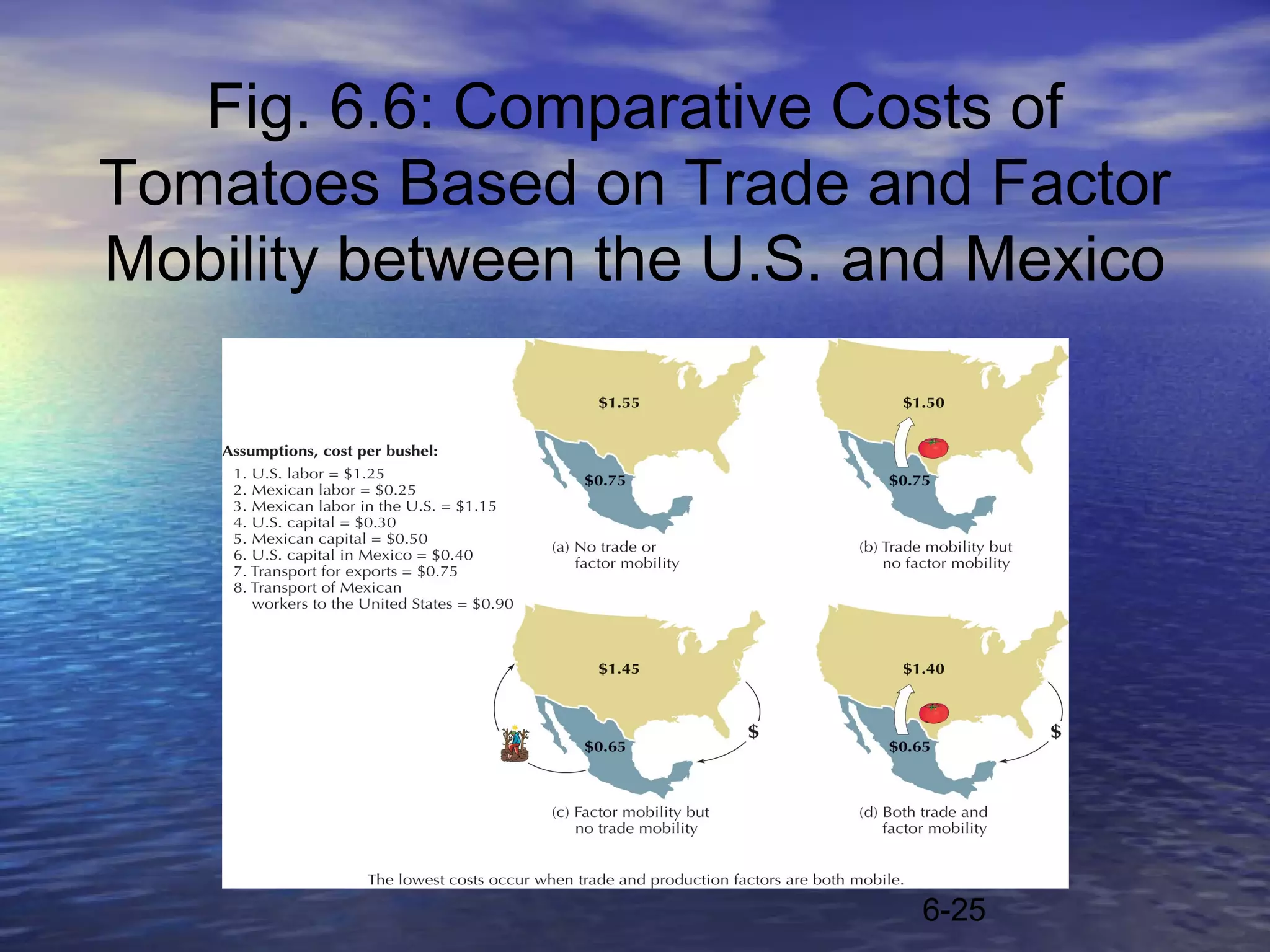
Fig. 6.6: Comparative Costs of
Tomatoes Based on Trade and Factor
Mobility between the U.S. and Mexico


                           6-25
Implications/Conclusions


• Production factors are neither as mobile nor
  as immobile as theories assume.
• While the free trade theories of absolute and
  comparative advantage are descriptive in
  nature, the interventionist theories of
  mercantilism and neomercantilism are
  prescriptive in nature.

                                    6-26
• The theories of country size, factor propor-
  tions, and country similarity help explain
  patterns of trade; the product life cycle and
  Porter’s Diamond help explain the dynamics
  of trade.
• Although the international mobility of
  production factors may be a substitute       for
  trade, that same mobility may stimulate trade
  because of the need for equipment,
  components, and/or complementary
  products in the destination country.
                                      6-27

Daniels06rev pp.doc

  • 1.
    PART THREE THEORIES AND INSTITUTIONS: TRADE AND INVESTMENT International Business Chapter Six International Trade and Factor Mobility Theory
  • 2.
    Chapter Objectives • Tounderstand theories of why countries should trade • To comprehend how global efficiency can be increased through free trade • To become familiar with factors affecting countries’ trade patterns • To realize why countries’ export capabilities are dynamic • To discern why the production factors of labor and capital move internationally • To grasp the relationship between foreign trade and international factor mobility 6-2
  • 3.
    The Importance ofTrade Theory Trade theory helps managers and govern- ment policymakers focus on three critical questions: • What products should be imported and exported? • How much should be traded? • With whom should they trade? While descriptive theories suggest a laissez-faire treatment of trade, prescriptive theories suggest that governments should influence trade patterns. 6-3
  • 4.
    Trade and InvestmentPolicies • import substitution: a policy of developing domestic industries to manufacture goods and provide services that would otherwise be imported • strategic trade policy: the identification and development of targeted domestic industries in order to improve their competitiveness at home and abroad 6-4
  • 5.
    Fig. 6.1: Companies’International Operations Link Countries Economically 6-5
  • 6.
    Interventionist Trade Theories Interventionisttrade theories prescribe govern- ment action with respect to the international trade process. • mercantilism: an age-old zero-sum game that purports that a country’s wealth is measured by its holdings of treasure (usually gold) To amass a surplus (a favorable balance of trade), a country must export more than it imports and then collect gold and other forms of wealth from countries that run trade deficits (unfavorable balances of trade). • neomercantilism: the more recent strategy of countries that use protectionist trade policies in an attempt to run favorable balances of trade and/or accomplish particular social or political objectives 6-6
  • 7.
    Free Trade Theories: Absolute& Comparative Advantage • The theories of absolute and comparative advantage demonstrate how economic growth can occur via specialization and trade. • Free trade (a positive-sum game) implies speciali- zation and requires that nations neither artificially limit imports nor artificially promote exports. • The invisible hand of the market determines which competitors survive, as customers buy those products that best serve their needs. Nations specialize in the production of certain products, some of which may be exported; export earnings can in turn be used to pay for imported goods and services. 6-7
  • 8.
    Theory of AbsoluteAdvantage Absolute advantage [Adam Smith, 1776]: A country can (i) maximize its own economic well being by specializing in the production of those goods and services that it produces more efficiently than any other nation and (ii) enhance global efficiency through its participation in free trade. Smith reasoned that: • workers become more skilled by repeating the same tasks • workers do not lose time in switching from the production of one kind of product to another • longer production runs provide greater incentives for the development of more effective working methods 6-8
  • 9.
    Natural vs. Acquired Advantages •A natural advantage may exist because of: -given climatic conditions -access to particular resources -the availability of labor, etc. • An acquired advantage may exist because of: -superior skills -better technology -greater capital assets, etc. Real income depends on the output of products as compared to the resources used to produce them. 6-9
  • 10.
    Fig. 6.2: ProductionPossibilities with Absolute Advantage 6-10
  • 11.
    Theory of ComparativeAdvantage Comparative advantage [David Ricardo, 1817]: A country can (i) maximize its own economic well- being by specializing in the production of those goods and services it can produce relatively efficiently and (ii) enhance global efficiency via its participation in free trade. Ricardo also reasoned that: • a country can simultaneously have an absolute and a comparative advantage in the production of a given product • by concentrating on the production of the product in which it has the greater advantage, a country can further enhance both global output and its own economic well-being 6-11
  • 12.
    Fig. 6.3: ProductionPossibilities with Comparative Advantage 6-12
  • 13.
    Assumptions and Limitations ofthe Free Trade Theories The theories of absolute and comparative advantage both make assumptions that may not be entirely valid. • Full employment of resources • Exclusive pursuit of economic efficiency objectives • Equitable division of gains from specialization • Only two countries and two commodities • Exclusion of transport costs • A static rather than a dynamic view • Exclusion of services • Unrestricted factor mobility 6-13
  • 14.
    Theories Explaining Patternsof Trade: Country Size, Factor Proportions, Country Similarity The theories of country size, factor proportions, and country similarity all contribute to the explanations of: • what types of products are traded • with which partner nations countries will primarily trade Nontradable products are those goods and services that are impractical to export. 6-14
  • 15.
    Theory of CountrySize Large countries differ from small countries in at least two critical ways: • Large countries tend to export a smaller portion of their output and import a small portion of their consumption. Large countries are more apt to have varied climates and a greater assortment of natural resources than smaller countries, thus making large countries more self-sufficient. • Large countries tend to have higher transportation costs for exported and imported products. Given the same types of terrain and modes of transportation, the greater the distance, the higher the associated transport costs. Thus, firms in large countries often face higher transport costs in terms of sourcing inputs from and delivering outputs to distant foreign markets than do their closer foreign competitors. 6-15
  • 16.
    Leading 2003 Exportingand Importing Nations: Merchandise Trade Exporting Importing Rank Nation ($US Bil.) % Rank Nation ($US Bil.) % 1 Germany (748.3) 10.0 1 U.S.A. (1303.1) 16.8 2 U.S.A (723.8) 9.6 2 Germany (601.7) 7.7 3 Japan (471.8) 6.3 3 China (413.1) 5.3 4 China (437.9) 5.8 4 U.K. (390.8) 5.0 5 France (386.7) 5.2 5 France (390.5) 5.0 6 U.K. (304.6) 4.1 6 Japan (382.9) 4.9 7 Neth. (294.1) 3.9 7 Italy (290.8) 3.7 8 Italy (292.1) 3.9 8 Neth. (262.8) 3.4 9 Canada (272.7) 3.6 9 Canada (245.0) 3.2 10 Belgium (255.3) 3.4 10 Belgium (235.4) 3.0 Total 55.8 Total 53.0 Source: International Trade Statistics, 2004 (Geneva: World Trade Organization), p.19. 6-16
  • 17.
    Factor Proportions Theory Factorproportions [Eli Heckscher, 1919; Bertil Ohlin, 1933]: • Differences in a country’s relative endowments of land, labor, and capital explain differences in the cost of production factors. • A country will tend to export products that utilize relatively abundant production factors because they are relatively cheaper than scarce factors. The composition of a country’s trade depends on both its natural and acquired advantages. With respect to the latter, both production and product technology can be very important. 6-17
  • 18.
    Fig. 6.4: WorldTrade by Major Product Category as a Percentage of World Trade for Selected Years 6-18
  • 19.
    Country Similarity Theory Whena firm develops a new product in response to observed conditions in its home market, it is likely to turn to those foreign markets that are most similar to its domestic market when commencing its initial international expansion activities. This tendency is reflective of: • the cultural similarity of nations • the similarity of national political/economic interests • the economic similarity of industrialized countries Countries that are near to one another enjoy relatively lower transportation costs than those that are more distant, but they may or may not be similar with respect to culture, level of economic development, and/or political/economic interests. 6-19
  • 20.
    Product Life Cycle(PLC) Theory The optimal location for the production of certain types of goods and services shifts over time as they pass through the stages of: (i) introduction, (ii) growth, (iii) maturity, and (iv) decline. Exceptions to the typical pattern of the PLC would include: • products that have very short life cycles • luxury goods and services • products that require specialized labor • products that are differentiated from competitive offerings • products for which transportation costs are relatively high During the decline stage, a product is often imported by the country where it was initially developed; however, the importing firm may or may not be the innovating firm. 6-20
  • 21.
    Product Life CycleCharacteristics Stage Intro. Growth Maturity Decline PRODUCTION Innovating Innovating Ind’l + Developing LOCATION(S) country + other ind’l developing countries MARKET Innovating Industrial Industrial + Developing LOCATIONS + other ind’l countries developing countries COMPETITIVE Uniqueness Rising comp. Price compe- Declining FACTORS & demand tition demand PRODUCTION Short prod’n Capital input Economies Rationali- TECHNNOLOGY runs increases of scale zation 6-21
  • 22.
    Porter’s Diamond ofNational Competitive Advantage [1990] The Porter Diamond theorizes that national competitive advantage is embedded in four determinants: • factor endowments • demand conditions • related and supporting industries • firm strategy, structure, and rivalry All four determinants are interlinked and generally must be favorable for a given national industry to attain global competitiveness. At times, determinants can be affected by the roles of chance and government. 6-22
  • 23.
    Factor Mobility Factor mobilityconcerns the free movement of factors of production, such as labor and capital, across national borders. • While capital is the most internationally mobile factor, short-term capital is the most mobile of all. Capital is primarily transferred because of differences in expected returns, but firms may also respond to government incentives. • People transfer internationally in order to work abroad, either on a temporary or on a permanent basis. Brain drain occurs when educated citizens leave a country, but a nation may in turn gain from the remittances that citizens who are working abroad send home. 6-23
  • 24.
    International Trade andFactor Mobility—Potential Effects • Substitution: the inability to gain sufficient access to foreign production factors may stimulate efficient methods of domestic substitution, such as the develop- ment of alternatives for traditional production methods • Complementarity: factor mobility via foreign direct investment may stimulate foreign trade because of the need for equipment, components, and/or complementary products in the destination country While immigrants add to the base of a country’s skills, thus enabling competition in new areas, inflows of capital can be used to develop infrastructure and natural and other acquired advantages, thus enabling increased participation in the international trade arena. 6-24
  • 25.
    Fig. 6.6: ComparativeCosts of Tomatoes Based on Trade and Factor Mobility between the U.S. and Mexico 6-25
  • 26.
    Implications/Conclusions • Production factorsare neither as mobile nor as immobile as theories assume. • While the free trade theories of absolute and comparative advantage are descriptive in nature, the interventionist theories of mercantilism and neomercantilism are prescriptive in nature. 6-26
  • 27.
    • The theoriesof country size, factor propor- tions, and country similarity help explain patterns of trade; the product life cycle and Porter’s Diamond help explain the dynamics of trade. • Although the international mobility of production factors may be a substitute for trade, that same mobility may stimulate trade because of the need for equipment, components, and/or complementary products in the destination country. 6-27