MIMICKING HUMAN BRAIN
PROCESS
OUTLINE
 INTRODUCTION
 Mind Model
 LITERATURE REVIEW
 PROBLEM STATEMENT
 CONCLUSION
 REFERENCES
2
INTRODUCTION
3
 After more than 60 years of development, the operation speed
of computer is up to several hundred thousand billion times,
but its intelligence level is extremely low.
 Studying machine which combines high performance and the
people's high intelligence together becomes the effective way
with high capacity and efficiency of exploring information
processing. In general, this kind of intelligent machine is
called brain-like computer.
INTRODUCTION
4
 Basic TOI is important for the development of brain-like
computer.
 Intelligence science is an interdisciplinary subject that
dedicates to joint research on basic theory and technology of
intelligence by brain science, cognitive science, artificial
intelligence and others.
 Cognitive science focuses on how human brain works and its
activities, such as perception, learning, memory, thinking,
consciousness etc.
INTRODUCTION
5
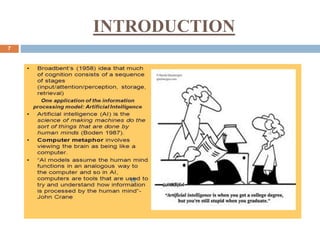
 Mind model is software for artificial brain.
 The mind is defined as thinks, reasons, perceives, wills, and
feels.
 From the AI perspective, the mind modeling is to construct
computational artifacts which combine many cognitive abilities
in one integrated system and make the artifacts have the same
intellectual capacity as humans.
 Thus, in IS, a mind model is intended to be an explanation on
the problem of how to use a set of primitive computational
process to implement some aspects of cognitive behaviors.
INTRODUCTION
6
Fig a: Subjects that relate Brains, Minds, and Computers [8]
Here the direction of the arrows indicates how one area of study influences
another:
INTRODUCTION
7
LITERATURE REVIEW
8
LITERATURE REVIEW(1/5)
9
 Title: ”A Mind Model For Brain-Like Computer”,
IEEE-2010
Author: Zhongzhi Shi1, Xiaofeng Wang1,2, Zhiping Shi1 ˈLimin
Chen1,2, Zhuxiao Wang1,2
 Objective: To discuss the computational model of memory and
consciousness in the mind model named Consciousness And
Memory model(CAM).
Cont..
10
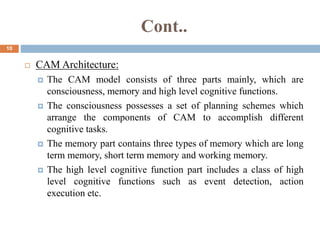
 CAM Architecture:
 The CAM model consists of three parts mainly, which are
consciousness, memory and high level cognitive functions.
 The consciousness possesses a set of planning schemes which
arrange the components of CAM to accomplish different
cognitive tasks.
 The memory part contains three types of memory which are long
term memory, short term memory and working memory.
 The high level cognitive function part includes a class of high
level cognitive functions such as event detection, action
execution etc.
Cont..
11
[Fig b: Architecture of CAM [1]] [Fig c: Memory System
[1]]
Cont..
12
 The key issue in IS, is to construct the mind model of the brain
system, which is the OS of brain-like computer. The
computational model of memory and consciousness in the mind
model has been discussed in the paper.
 In the future, work on the mechanism of memory and
consciousness in CAM, containing episodic memory, working
memory, planning schemes and so on, will provide the
foundational theory for development of brain-like computer.
LITERATURE REVIEW(2/5)
13
 Title: “Introducing the Human Brain Project”,
2011[2].
Author: Henry Markram, Karlheinz Meier, Thomas Lippert, Sten
Grillner, Richard Frackowiak, Stanislas Dehaene, Alois Saria
 Objective: Development of supercomputers for high
performance computing, generate new neuro-scientific data as
a benchmark for modeling, develop radically new tools for
informatics, modeling and simulation, and build virtual
laboratories for collaborative basic and clinical studies, virtual
prototyping of robotic devices, etc.
Cont..
14
 The HBP proposes a new approach that uses supercomputer
technology to integrate everything we know in multilevel brain
models.
 Brain Simulation As Integration Strategy:
 The brain has many different levels of organization, each with its
own characteristic elements, interactions, emergent properties, and
time scales. Integrating the data from these different levels poses a
massive challenge. The strategy proposed by the Human Brain
Project is grounded in two major trends.
Cont..
15
 Modern supercomputers will soon be powerful enough to support
multilevel computer models of the human brain. Exascale computers,
predicted for the end of the decade, could allow cellular level simulations
of the complete human brain with dynamic switching to molecular-level
simulation of parts of the brain when required.
 New informatics and modeling approaches are making it possible to
reverse engineer the detailed structure of the human brain without resort to
invasive methods of data collection. This Predictive Reverse Engineering
will allow us to predict how different patterns of gene expression produce
neurons with different morphologies expressing different molecules, and
different synaptic connections. This kind of Multiomic Model Integration
will enable ever more accurate models of the human brain, providing a
focus for the projects integration strategy.
Cont..
16
Fig. d: Components of AI[7]
Cont..
17
 Summary:
The HBP sets academia and industry on a new road to
understanding the human brain. On the way, it will unify existing
biological knowledge, generate new approaches and methods, for
the brain sciences, and develop new intelligent technologies.
Finally, the HBP will provide a new tool for investigations of the
brains diseases and for easier, faster, and cheaper development of
new treatments. Necessarily, the project will dedicate a significant
effort to educating young scientists in its new integrated approach
to science, medicine and technology, etc.
LITERATURE REVIEW(3/5)
18
 Title: “Computational Modeling of Visual Selective
Attention”, 2011[3].
Author: Kleanthis C. Neokleous, Christos N. Schizas
 Objective: To develop a plausible and biological realistic
computational model of visual selective attention using tools
from the field of computational intelligence and use it in
engineering and other applications.
Cont..
19
 Visual Selective Attention:
 Visual selective attention is a fundamental function of human
cognition and a highly important brain mechanism, essential for
the functioning of the human brain as a system.
 A comprehensive example of the role of human attention can be
seen by noting that each instant of conscious life, each person
receives millions of external stimulations from his/her sensory
systems, while only a limited amount is selected by attention for
further processing that leads to conscious perception. If every
stimulus was allowed to pass into perception, one would have
been soon overflowed. Adding to external stimulation all internal
stimuli (e.g., thoughts), a person would end up in a totally
unstable state. Selective attention is necessary for keeping the
brain system in stability.
Cont..
20
 Studying the brain from the computer scientists perspective
has always being a great challenge, and is usually divided
under two main paths within the computational intelligence
(CI) field.
 On one, to understand and mimic in a sense the functionality of
the human brain has triggered the design and implementation of
AI systems such as robotics, etc.
 On the other, the understanding of certain brain functions can be
facilitated with the implementation of relevant cognitive
computational models.
Cont..
21
 The model has two stages of processing implemented with spiking
neural networks (SNN).
 The first stage simulates the initial bottom-up competitive neural
interactions among visual stimuli, while the second stage involves
modulations of neural activity based on the semantics of the stimulus.
 During the progression of the neural activity in the two stages of
processing, the encoded stimuli will compete for access to WM through
forward, backward and lateral inhibitory interactions which influence
the strength of their neural response.
 For instance if the top-down signals contain information regarding the
spatial location of a brief visual stimulus (i.e. spatial cues), they will
influence the first stage of processing, while if perceptual cues contain
information about the semantics of a stimulus, they will manipulate the
processing in the second stage.
Cont..
22
 Summary:
 The basic functionality of the model relies on the assumption that
an incoming visual stimulus will be processed by the model
based on the rate and temporal coding of its associated neural
activity.
 The developed model was used for simulating the findings from
several behavioral experiments that are well-known in the
scientific literature of visual selective attention.
LITERATURE REVIEW(4/5)
23
 Title: “Generic Cognitive Computing for Cognition”,
IEEE 2015[4].
Author: Ozer Ciftcioglu, Michael S. Bittermann
 Objective: Establish a generic computational model for
computational cognition and comprehension.
Cont..
24
 GCM:
 Simple GCM is devised to gain insight into cognition.
 In order to comprehend the working mechanism of brain by
comprehending the implications of the computations step by
step through the computation process, where comprehension
is essential concept relevant to human mind activity.
 Generic in sense, model is valid for any particularly
industrial process i.e. spanning aviation and power plant.
Cont..
25
 Definition Of Cognition:
 In terms of theoretical constructs such as ‘information’ or
‘recognition’ and ‘operations’ on those constructs such as
‘Brain Information Processing’.
 From Computational Counterpart view-point , Cognition is to
process the knowledge of relations among entities in any
context and manifesting it by a best action in same context.
Cont..
26
 Conclusion:
 This approach can also yield enhancement in diverse
applications, such as robotics where optimal response is to
guarantee.
 The work is exciting not only because it sheds some light on
cognitive computation for mimicking the complex brain
processes as computational cognition and comprehension but it
also provides a one to one liaison between neuro-science and
computational neuro-science.
LITERATURE REVIEW(5/5)
27
 Title: “Generative models of the human connectome”,
2015[5].
Author: Richard F. B., Andrea Avena Koenigsberger, Ye He, Olaf Sporns
 Objective: The aim of this study was not to model the growth and
development of the human connectome. Doing so would have
required a more complicated model that included more system-
specific detail. Instead, our models were designed to reduce a
network's description length.
Cont..
28
 Introduction:
 The human connectome represents a network map of the brain
in which regions and inter-regional connections are rendered
into the nodes and edges of a graph.
 Connectome networks strike a balance wherein the formation of
costly features like hubs and rich clubs trades off with a drive to
reduce the total cost of wiring.
 In the context of complex networks, generative modeling refers
to a set of approaches for creating synthetic networks with
properties similar to those of real-world networks.
Cont..
29
 The models we investigate combine two distinct mechanisms
for network growth:
 Geometric wiring rules: Influence connection formation by
favoring either shorter or longer connections.
 Non-geometric rules: Ignore the distance between two regions
and, instead, form connections on the basis of some shared
topological relationship.
 The failure of the pure geometric model to generate synthetic
networks that were as clustered and contained as many long-
distance connections as observed connectomes suggests that
additional factors are needed as part of a realistic generative
mechanism.
Cont..
30
 Summary:
 An application of n/w modeling to human lifespan data, revealed that
geometric constraints weakened while energy and the mismatch of
clustering and edge length distributions all increased with age.
Possible explanation is that connectome patterns become increasingly
random with age, making it impossible to model the connectome
precisely.
 Naively, we can reconstruct a n/w exactly from a list of its nodes and
edges. However, such a precise reconstruction may not be necessary
or even desirable.
 Oftentimes we are more interested in a n/w's high-level properties
(e.g. degree distribution), than the exact configuration of its
connections. In such a case, a mechanism that generates synthetic n/w
with the approximately the same set of properties represents a much
more economical (compressed) description of the n/w.
PROBLEM STATEMENT
31
 Issues to be considered by this study:
 Among many different levels of organization of brain,
Integrating the data from those different levels poses a massive
challenge.
 In network modeling of human lifespan data, revealed that
geometric constraints weakened with age. As connectome
patterns become increasingly random with age, making it
impossible to model the connectome precisely.
CONCLUSION
32
 Future Scope:
 Work on the mechanism of memory and consciousness in CAM,
will provide the foundational theory for development of brain-
like computer.
 The Human Brain Project is accelerating progress toward a
multi-level understanding of the human brain, better diagnosis
and treatment of brain diseases, and brain-inspired Information
and Communications Technologies (ICT). The potential impacts
of these advancements on science, medicine, industry and society
are profound.
REFERENCES
33
1. “A Mind Model For Brain-Like Computer”, Proc. 9th IEEE Int. Conf. on Cognitive
Informatics (ICCI’10) F. Sun, Y. Wang, J. Lu, B. Zhang, W. Kinsner & L.A. Zadeh
(Eds.) 978-1-4244-8040-1/10 ©2010 IEEE
2. “Introducing the Human Brain Project”, ©Selection and peer-review under
responsibility of FET11 conference organizers and published by Elsevier B.V.
doi:10.1016/j.procs.2011.12.015
3. “Computational Modeling of Visual Selective Attention”, ©Selection and peer-review
under responsibility of FET11 conference organizers and published by Elsevier B.V.
doi:10.1016/j.procs.2011.09.030
4. “Generic Cognitive Computing for Cognition”, 1053-8119/ 978-1-4799-7492-4/15 ©
2015 IEEE
5. “Generative models of the human connectome”, ©2015 The Authors. Published by
Elsevier Inc. This is an open access article under the CC BY license
6. https://www.humanbrainproject.eu/discover/the-project/overview
7. http://emberify.com/blog/context-artificial-intelligence/
8. http://ecee.colorado.edu/~ecen4831/cnsweb/cns0.html

Mimicking Human Brain Process

  • 1.
  • 2.
    OUTLINE  INTRODUCTION  MindModel  LITERATURE REVIEW  PROBLEM STATEMENT  CONCLUSION  REFERENCES 2
  • 3.
    INTRODUCTION 3  After morethan 60 years of development, the operation speed of computer is up to several hundred thousand billion times, but its intelligence level is extremely low.  Studying machine which combines high performance and the people's high intelligence together becomes the effective way with high capacity and efficiency of exploring information processing. In general, this kind of intelligent machine is called brain-like computer.
  • 4.
    INTRODUCTION 4  Basic TOIis important for the development of brain-like computer.  Intelligence science is an interdisciplinary subject that dedicates to joint research on basic theory and technology of intelligence by brain science, cognitive science, artificial intelligence and others.  Cognitive science focuses on how human brain works and its activities, such as perception, learning, memory, thinking, consciousness etc.
  • 5.
    INTRODUCTION 5  Mind modelis software for artificial brain.  The mind is defined as thinks, reasons, perceives, wills, and feels.  From the AI perspective, the mind modeling is to construct computational artifacts which combine many cognitive abilities in one integrated system and make the artifacts have the same intellectual capacity as humans.  Thus, in IS, a mind model is intended to be an explanation on the problem of how to use a set of primitive computational process to implement some aspects of cognitive behaviors.
  • 6.
    INTRODUCTION 6 Fig a: Subjectsthat relate Brains, Minds, and Computers [8] Here the direction of the arrows indicates how one area of study influences another:
  • 7.
  • 8.
  • 9.
    LITERATURE REVIEW(1/5) 9  Title:”A Mind Model For Brain-Like Computer”, IEEE-2010 Author: Zhongzhi Shi1, Xiaofeng Wang1,2, Zhiping Shi1 ˈLimin Chen1,2, Zhuxiao Wang1,2  Objective: To discuss the computational model of memory and consciousness in the mind model named Consciousness And Memory model(CAM).
  • 10.
    Cont.. 10  CAM Architecture: The CAM model consists of three parts mainly, which are consciousness, memory and high level cognitive functions.  The consciousness possesses a set of planning schemes which arrange the components of CAM to accomplish different cognitive tasks.  The memory part contains three types of memory which are long term memory, short term memory and working memory.  The high level cognitive function part includes a class of high level cognitive functions such as event detection, action execution etc.
  • 11.
    Cont.. 11 [Fig b: Architectureof CAM [1]] [Fig c: Memory System [1]]
  • 12.
    Cont.. 12  The keyissue in IS, is to construct the mind model of the brain system, which is the OS of brain-like computer. The computational model of memory and consciousness in the mind model has been discussed in the paper.  In the future, work on the mechanism of memory and consciousness in CAM, containing episodic memory, working memory, planning schemes and so on, will provide the foundational theory for development of brain-like computer.
  • 13.
    LITERATURE REVIEW(2/5) 13  Title:“Introducing the Human Brain Project”, 2011[2]. Author: Henry Markram, Karlheinz Meier, Thomas Lippert, Sten Grillner, Richard Frackowiak, Stanislas Dehaene, Alois Saria  Objective: Development of supercomputers for high performance computing, generate new neuro-scientific data as a benchmark for modeling, develop radically new tools for informatics, modeling and simulation, and build virtual laboratories for collaborative basic and clinical studies, virtual prototyping of robotic devices, etc.
  • 14.
    Cont.. 14  The HBPproposes a new approach that uses supercomputer technology to integrate everything we know in multilevel brain models.  Brain Simulation As Integration Strategy:  The brain has many different levels of organization, each with its own characteristic elements, interactions, emergent properties, and time scales. Integrating the data from these different levels poses a massive challenge. The strategy proposed by the Human Brain Project is grounded in two major trends.
  • 15.
    Cont.. 15  Modern supercomputerswill soon be powerful enough to support multilevel computer models of the human brain. Exascale computers, predicted for the end of the decade, could allow cellular level simulations of the complete human brain with dynamic switching to molecular-level simulation of parts of the brain when required.  New informatics and modeling approaches are making it possible to reverse engineer the detailed structure of the human brain without resort to invasive methods of data collection. This Predictive Reverse Engineering will allow us to predict how different patterns of gene expression produce neurons with different morphologies expressing different molecules, and different synaptic connections. This kind of Multiomic Model Integration will enable ever more accurate models of the human brain, providing a focus for the projects integration strategy.
  • 16.
  • 17.
    Cont.. 17  Summary: The HBPsets academia and industry on a new road to understanding the human brain. On the way, it will unify existing biological knowledge, generate new approaches and methods, for the brain sciences, and develop new intelligent technologies. Finally, the HBP will provide a new tool for investigations of the brains diseases and for easier, faster, and cheaper development of new treatments. Necessarily, the project will dedicate a significant effort to educating young scientists in its new integrated approach to science, medicine and technology, etc.
  • 18.
    LITERATURE REVIEW(3/5) 18  Title:“Computational Modeling of Visual Selective Attention”, 2011[3]. Author: Kleanthis C. Neokleous, Christos N. Schizas  Objective: To develop a plausible and biological realistic computational model of visual selective attention using tools from the field of computational intelligence and use it in engineering and other applications.
  • 19.
    Cont.. 19  Visual SelectiveAttention:  Visual selective attention is a fundamental function of human cognition and a highly important brain mechanism, essential for the functioning of the human brain as a system.  A comprehensive example of the role of human attention can be seen by noting that each instant of conscious life, each person receives millions of external stimulations from his/her sensory systems, while only a limited amount is selected by attention for further processing that leads to conscious perception. If every stimulus was allowed to pass into perception, one would have been soon overflowed. Adding to external stimulation all internal stimuli (e.g., thoughts), a person would end up in a totally unstable state. Selective attention is necessary for keeping the brain system in stability.
  • 20.
    Cont.. 20  Studying thebrain from the computer scientists perspective has always being a great challenge, and is usually divided under two main paths within the computational intelligence (CI) field.  On one, to understand and mimic in a sense the functionality of the human brain has triggered the design and implementation of AI systems such as robotics, etc.  On the other, the understanding of certain brain functions can be facilitated with the implementation of relevant cognitive computational models.
  • 21.
    Cont.. 21  The modelhas two stages of processing implemented with spiking neural networks (SNN).  The first stage simulates the initial bottom-up competitive neural interactions among visual stimuli, while the second stage involves modulations of neural activity based on the semantics of the stimulus.  During the progression of the neural activity in the two stages of processing, the encoded stimuli will compete for access to WM through forward, backward and lateral inhibitory interactions which influence the strength of their neural response.  For instance if the top-down signals contain information regarding the spatial location of a brief visual stimulus (i.e. spatial cues), they will influence the first stage of processing, while if perceptual cues contain information about the semantics of a stimulus, they will manipulate the processing in the second stage.
  • 22.
    Cont.. 22  Summary:  Thebasic functionality of the model relies on the assumption that an incoming visual stimulus will be processed by the model based on the rate and temporal coding of its associated neural activity.  The developed model was used for simulating the findings from several behavioral experiments that are well-known in the scientific literature of visual selective attention.
  • 23.
    LITERATURE REVIEW(4/5) 23  Title:“Generic Cognitive Computing for Cognition”, IEEE 2015[4]. Author: Ozer Ciftcioglu, Michael S. Bittermann  Objective: Establish a generic computational model for computational cognition and comprehension.
  • 24.
    Cont.. 24  GCM:  SimpleGCM is devised to gain insight into cognition.  In order to comprehend the working mechanism of brain by comprehending the implications of the computations step by step through the computation process, where comprehension is essential concept relevant to human mind activity.  Generic in sense, model is valid for any particularly industrial process i.e. spanning aviation and power plant.
  • 25.
    Cont.. 25  Definition OfCognition:  In terms of theoretical constructs such as ‘information’ or ‘recognition’ and ‘operations’ on those constructs such as ‘Brain Information Processing’.  From Computational Counterpart view-point , Cognition is to process the knowledge of relations among entities in any context and manifesting it by a best action in same context.
  • 26.
    Cont.. 26  Conclusion:  Thisapproach can also yield enhancement in diverse applications, such as robotics where optimal response is to guarantee.  The work is exciting not only because it sheds some light on cognitive computation for mimicking the complex brain processes as computational cognition and comprehension but it also provides a one to one liaison between neuro-science and computational neuro-science.
  • 27.
    LITERATURE REVIEW(5/5) 27  Title:“Generative models of the human connectome”, 2015[5]. Author: Richard F. B., Andrea Avena Koenigsberger, Ye He, Olaf Sporns  Objective: The aim of this study was not to model the growth and development of the human connectome. Doing so would have required a more complicated model that included more system- specific detail. Instead, our models were designed to reduce a network's description length.
  • 28.
    Cont.. 28  Introduction:  Thehuman connectome represents a network map of the brain in which regions and inter-regional connections are rendered into the nodes and edges of a graph.  Connectome networks strike a balance wherein the formation of costly features like hubs and rich clubs trades off with a drive to reduce the total cost of wiring.  In the context of complex networks, generative modeling refers to a set of approaches for creating synthetic networks with properties similar to those of real-world networks.
  • 29.
    Cont.. 29  The modelswe investigate combine two distinct mechanisms for network growth:  Geometric wiring rules: Influence connection formation by favoring either shorter or longer connections.  Non-geometric rules: Ignore the distance between two regions and, instead, form connections on the basis of some shared topological relationship.  The failure of the pure geometric model to generate synthetic networks that were as clustered and contained as many long- distance connections as observed connectomes suggests that additional factors are needed as part of a realistic generative mechanism.
  • 30.
    Cont.. 30  Summary:  Anapplication of n/w modeling to human lifespan data, revealed that geometric constraints weakened while energy and the mismatch of clustering and edge length distributions all increased with age. Possible explanation is that connectome patterns become increasingly random with age, making it impossible to model the connectome precisely.  Naively, we can reconstruct a n/w exactly from a list of its nodes and edges. However, such a precise reconstruction may not be necessary or even desirable.  Oftentimes we are more interested in a n/w's high-level properties (e.g. degree distribution), than the exact configuration of its connections. In such a case, a mechanism that generates synthetic n/w with the approximately the same set of properties represents a much more economical (compressed) description of the n/w.
  • 31.
    PROBLEM STATEMENT 31  Issuesto be considered by this study:  Among many different levels of organization of brain, Integrating the data from those different levels poses a massive challenge.  In network modeling of human lifespan data, revealed that geometric constraints weakened with age. As connectome patterns become increasingly random with age, making it impossible to model the connectome precisely.
  • 32.
    CONCLUSION 32  Future Scope: Work on the mechanism of memory and consciousness in CAM, will provide the foundational theory for development of brain- like computer.  The Human Brain Project is accelerating progress toward a multi-level understanding of the human brain, better diagnosis and treatment of brain diseases, and brain-inspired Information and Communications Technologies (ICT). The potential impacts of these advancements on science, medicine, industry and society are profound.
  • 33.
    REFERENCES 33 1. “A MindModel For Brain-Like Computer”, Proc. 9th IEEE Int. Conf. on Cognitive Informatics (ICCI’10) F. Sun, Y. Wang, J. Lu, B. Zhang, W. Kinsner & L.A. Zadeh (Eds.) 978-1-4244-8040-1/10 ©2010 IEEE 2. “Introducing the Human Brain Project”, ©Selection and peer-review under responsibility of FET11 conference organizers and published by Elsevier B.V. doi:10.1016/j.procs.2011.12.015 3. “Computational Modeling of Visual Selective Attention”, ©Selection and peer-review under responsibility of FET11 conference organizers and published by Elsevier B.V. doi:10.1016/j.procs.2011.09.030 4. “Generic Cognitive Computing for Cognition”, 1053-8119/ 978-1-4799-7492-4/15 © 2015 IEEE 5. “Generative models of the human connectome”, ©2015 The Authors. Published by Elsevier Inc. This is an open access article under the CC BY license 6. https://www.humanbrainproject.eu/discover/the-project/overview 7. http://emberify.com/blog/context-artificial-intelligence/ 8. http://ecee.colorado.edu/~ecen4831/cnsweb/cns0.html