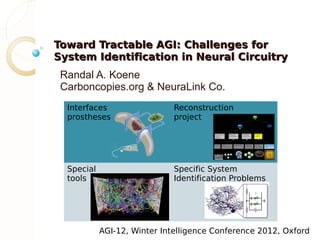
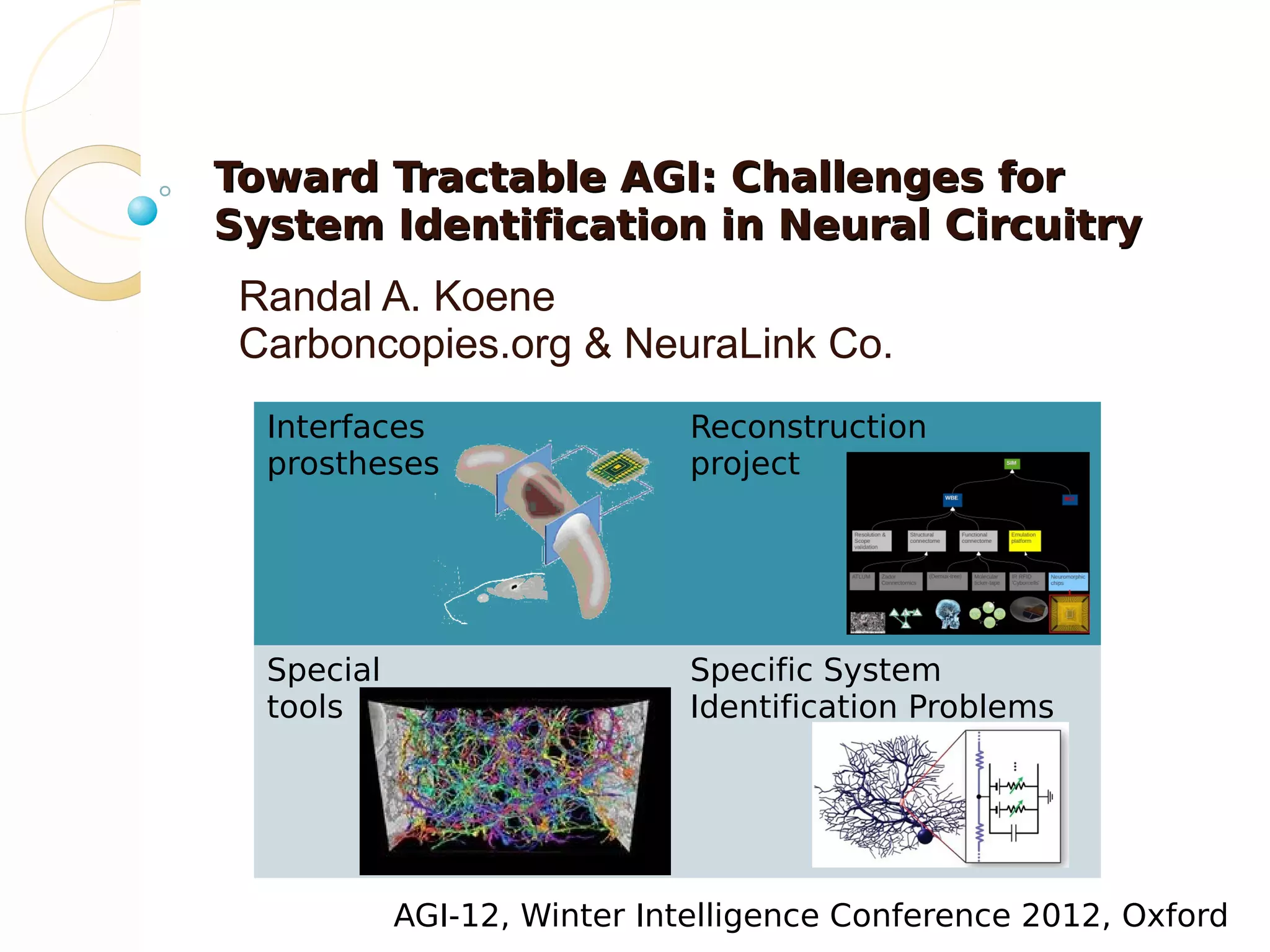
Toward Tractable AGI: Challenges for
System Identification in Neural Circuitry
 Randal A. Koene
 Carboncopies.org & NeuraLink Co.
  Interfaces                  Reconstruction
  prostheses                  project


  Special                     Specific System
  tools                       Identification Problems


            AGI-12, Winter Intelligence Conference 2012, Oxford
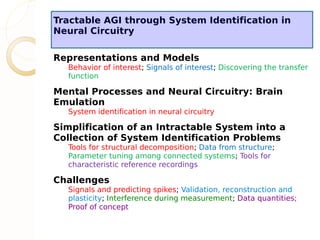
Tractable AGI through System Identification in
Neural Circuitry

Representations and Models
  Behavior of interest; Signals of interest; Discovering the transfer
  function

Mental Processes and Neural Circuitry: Brain
Emulation
  System identification in neural circuitry

Simplification of an Intractable System into a
Collection of System Identification Problems
  Tools for structural decomposition; Data from structure;
  Parameter tuning among connected systems; Tools for
  characteristic reference recordings

Challenges
  Signals and predicting spikes; Validation, reconstruction and
  plasticity; Interference during measurement; Data quantities;
  Proof of concept
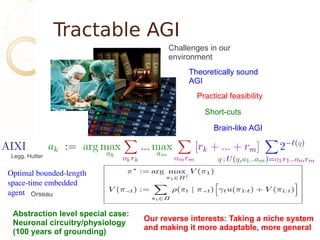
Tractable AGI
                                         Challenges in our
                                         environment
                                              Theoretically sound
                                              AGI
                                                Practical feasibility

                                                  Short-cuts

                                                     Brain-like AGI


Legg, Hutter


Optimal bounded­length
space­time embedded
agent Orseau

 Abstraction level special case:
                                   Our reverse interests: Taking a niche system
 Neuronal circuitry/physiology
                                   and making it more adaptable, more general
 (100 years of grounding)
Tractable AGI through System Identification in
Neural Circuitry

Representations and Models
  Behavior of interest; Signals of interest; Discovering the transfer
  function

Mental Processes and Neural Circuitry: Brain
Emulation
  System identification in neural circuitry

Simplification of an Intractable System into a
Collection of System Identification Problems
  Tools for structural decomposition; Data from structure;
  Parameter tuning among connected systems; Tools for
  characteristic reference recordings

Challenges
  Signals and predicting spikes; Validation, reconstruction and
  plasticity; Interference during measurement; Data quantities;
  Proof of concept
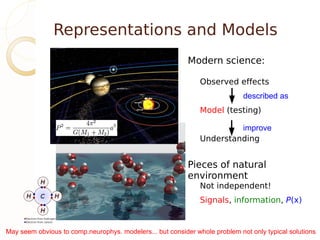
Representations and Models
                                                           Modern science:

                                                               Observed effects
                                                                             described as
                                                               Model (testing)

                                                                        improve
                                                               Understanding


                                                           Pieces of natural
                                                           environment
                                                               Not independent!
                                                               Signals, information, P(x)


May seem obvious to comp.neurophys. modelers... but consider whole problem not only typical solutions
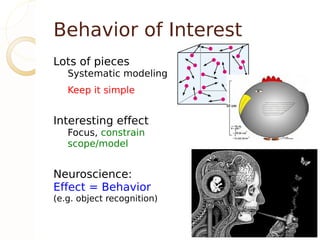
Behavior of Interest
Lots of pieces
   Systematic modeling
   Keep it simple


Interesting effect
   Focus, constrain
   scope/model


Neuroscience:
Effect = Behavior
(e.g. object recognition)
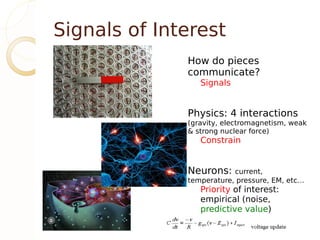
Signals of Interest
              How do pieces
              communicate?
                 Signals


              Physics: 4 interactions
              (gravity, electromagnetism, weak
              & strong nuclear force)
                 Constrain


              Neurons:    current,
              temperature, pressure, EM, etc…
                 Priority of interest:
                 empirical (noise,
                 predictive value)
Discovering the Transfer
Function
SI in Control Theory:
Black/gray box
  State, input, output
  Find: Transfer
  Function


Formal methods
  E.g. Volterra series
  expansion

                         kernels & history of input
Tractable AGI through System Identification in
Neural Circuitry

Representations and Models
  Behavior of interest; Signals of interest; Discovering the transfer
  function

Mental Processes and Neural Circuitry: Brain
Emulation
  System identification in neural circuitry

Simplification of an Intractable System into a
Collection of System Identification Problems
  Tools for structural decomposition; Data from structure;
  Parameter tuning among connected systems; Tools for
  characteristic reference recordings

Challenges
  Signals and predicting spikes; Validation, reconstruction and
  plasticity; Interference during measurement; Data quantities;
  Proof of concept
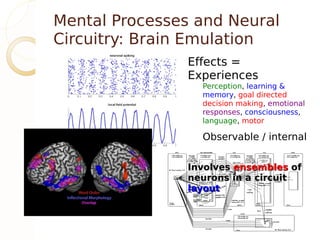
Mental Processes and Neural
Circuitry: Brain Emulation
                Effects =
                Experiences
                  Perception, learning &
                  memory, goal directed
                  decision making, emotional
                  responses, consciousness,
                  language, motor

                  Observable / internal


                Involves ensembles of
                neurons in a circuit
                layout
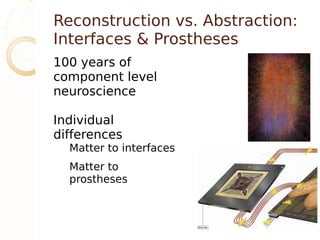
Reconstruction vs. Abstraction:
Interfaces & Prostheses
100 years of
component level
neuroscience

Individual
differences
  Matter to interfaces
  Matter to
  prostheses
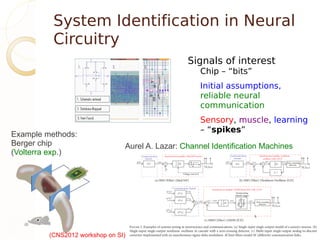
System Identification in Neural
          Circuitry
                                                 Signals of interest
                                                     Chip – “bits”
                                                     Initial assumptions,
                                                     reliable neural
                                                     communication
                                                     Sensory, muscle, learning
                                                     – “spikes”
Example methods:
Berger chip                     Aurel A. Lazar: Channel Identification Machines
(Volterra exp.)


         (CNS2012 workshop on SI)
Tractable AGI through System Identification in
Neural Circuitry

Representations and Models
  Behavior of interest; Signals of interest; Discovering the transfer
  function

Mental Processes and Neural Circuitry: Brain
Emulation
  System identification in neural circuitry

Simplification of an Intractable System into a
Collection of System Identification Problems
  Tools for structural decomposition; Data from structure;
  Parameter tuning among connected systems; Tools for
  characteristic reference recordings

Challenges
  Signals and predicting spikes; Validation, reconstruction and
  plasticity; Interference during measurement; Data quantities;
  Proof of concept
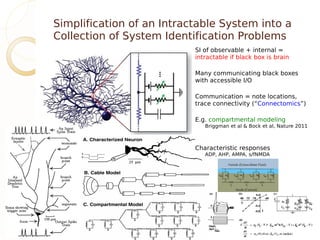
Simplification of an Intractable System into a
Collection of System Identification Problems
                           SI of observable + internal =
                           intractable if black box is brain

                           Many communicating black boxes
                           with accessible I/O

                           Communication = note locations,
                           trace connectivity (“Connectomics”)

                           E.g. compartmental modeling
                              Briggman et al & Bock et al, Nature 2011


                           Characteristic responses
                              ADP, AHP, AMPA, s/fNMDA
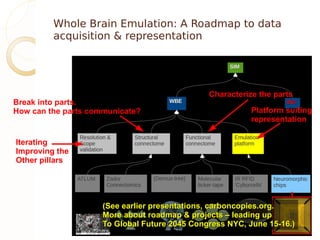
Whole Brain Emulation: A Roadmap to data
         acquisition & representation


                                               Characterize the parts
Break into parts.
How can the parts communicate?                            Platform suiting
                                                          representation

Iterating
Improving the
Other pillars


                     (See earlier presentations, carboncopies.org.
                     More about roadmap & projects – leading up
                     To Global Future 2045 Congress NYC, June 15-16.)
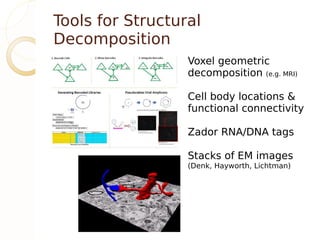
Tools for Structural
Decomposition
                  Voxel geometric
                  decomposition (e.g. MRI)

                  Cell body locations &
                  functional connectivity

                  Zador RNA/DNA tags

                  Stacks of EM images
                  (Denk, Hayworth, Lichtman)
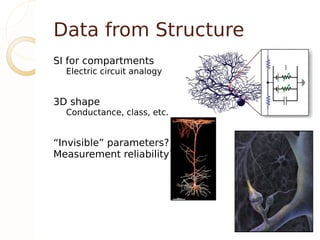
Data from Structure
SI for compartments
  Electric circuit analogy


3D shape
  Conductance, class, etc.


“Invisible” parameters?
Measurement reliability?
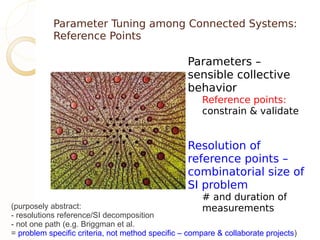
Parameter Tuning among Connected Systems:
            Reference Points

                                                  Parameters –
                                                  sensible collective
                                                  behavior
                                                      Reference points:
                                                      constrain & validate


                                                  Resolution of
                                                  reference points –
                                                  combinatorial size of
                                                  SI problem
                                                      # and duration of
(purposely abstract:                                  measurements
- resolutions reference/SI decomposition
- not one path (e.g. Briggman et al.
= problem specific criteria, not method specific – compare & collaborate projects)
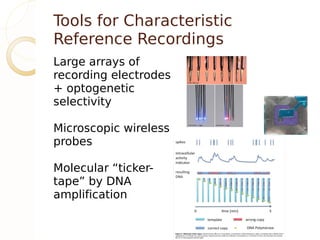
Tools for Characteristic
Reference Recordings
Large arrays of
recording electrodes
+ optogenetic
selectivity

Microscopic wireless
probes

Molecular “ticker-
tape” by DNA
amplification
Tractable AGI through System Identification in
Neural Circuitry

Representations and Models
  Behavior of interest; Signals of interest; Discovering the transfer
  function

Mental Processes and Neural Circuitry: Brain
Emulation
  System identification in neural circuitry

Simplification of an Intractable System into a
Collection of System Identification Problems
  Tools for structural decomposition; Data from structure;
  Parameter tuning among connected systems; Tools for
  characteristic reference recordings

Challenges
  Signals and predicting spikes; Validation, reconstruction and
  plasticity; Interference during measurement; Data quantities;
  Proof of concept
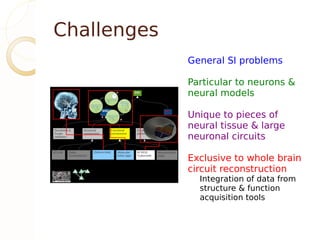
Challenges
             General SI problems

             Particular to neurons &
             neural models

             Unique to pieces of
             neural tissue & large
             neuronal circuits

             Exclusive to whole brain
             circuit reconstruction
               Integration of data from
               structure & function
               acquisition tools
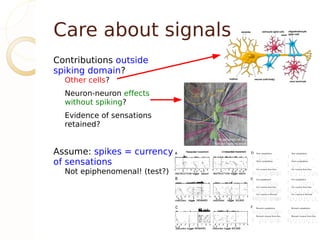
Care about signals
Contributions outside
spiking domain?
  Other cells?
  Neuron-neuron effects
  without spiking?
  Evidence of sensations
  retained?


Assume: spikes = currency
of sensations
  Not epiphenomenal! (test?)
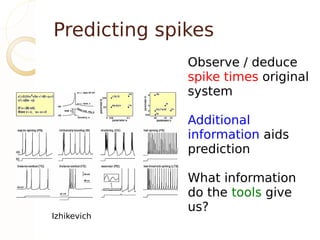
Predicting spikes
              Observe / deduce
              spike times original
              system

              Additional
              information aids
              prediction

              What information
              do the tools give
              us?
Izhikevich
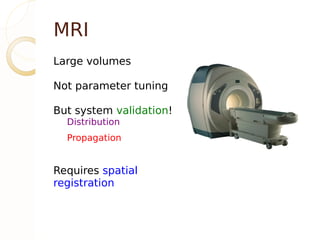
MRI
Large volumes

Not parameter tuning

But system validation!
  Distribution
  Propagation


Requires spatial
registration
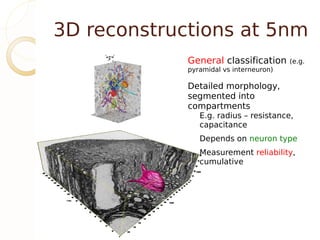
3D reconstructions at 5nm
             General classification      (e.g.
             pyramidal vs interneuron)

             Detailed morphology,
             segmented into
             compartments
                E.g. radius – resistance,
                capacitance
                Depends on neuron type
                Measurement reliability,
                cumulative
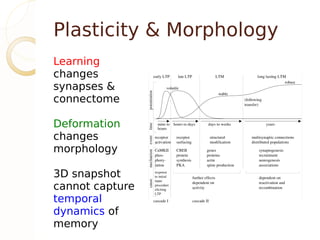
Plasticity & Morphology
Learning
changes
synapses &
connectome

Deformation
changes
morphology

3D snapshot
cannot capture
temporal
dynamics of
memory
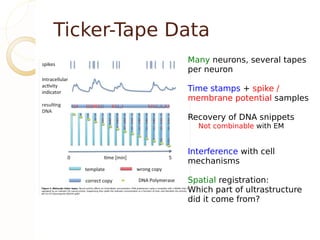
Ticker-Tape Data
             Many neurons, several tapes
             per neuron

             Time stamps + spike /
             membrane potential samples

             Recovery of DNA snippets
               Not combinable with EM


             Interference with cell
             mechanisms

             Spatial registration:
             Which part of ultrastructure
             did it come from?
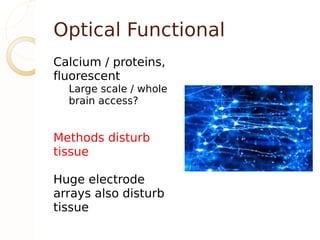
Optical Functional
Calcium / proteins,
fluorescent
  Large scale / whole
  brain access?


Methods disturb
tissue

Huge electrode
arrays also disturb
tissue
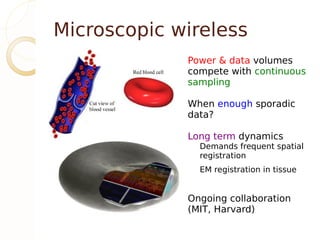
Microscopic wireless
             Power & data volumes
             compete with continuous
             sampling

             When enough sporadic
             data?

             Long term dynamics
               Demands frequent spatial
               registration
               EM registration in tissue


             Ongoing collaboration
             (MIT, Harvard)
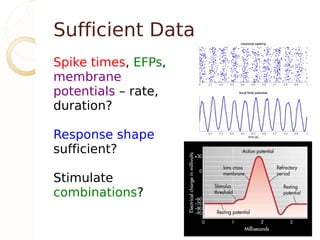
Sufficient Data
Spike times, EFPs,
membrane
potentials – rate,
duration?

Response shape
sufficient?

Stimulate
combinations?
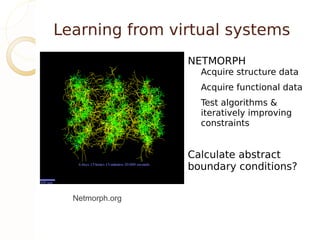
Learning from virtual systems
                 NETMORPH
                   Acquire structure data
                   Acquire functional data
                   Test algorithms &
                   iteratively improving
                   constraints


                 Calculate abstract
                 boundary conditions?


  Netmorph.org
Proof of Concept: Starting Small
Test process in small system

  C.Elegans (Dalrymple)


  Retina (Briggman)


  Hippocampal neuroprosthetic
  (Berger)


  Cerebellar neuroprosthetic
  (Bamford)


  Memory from piece of neural
  tissue (Seung)
Discussion
Good gage of          Tools = problem 1,
problems – proof of   turning data into
concept!              model = problem 2

SI is not new!        True effort
Many fields can       underway –
contribute            seeking input from
                      SI experts!
Thanks
Ed Boyden (MIT)
Yael Maguire (MIT)
Konrad Kording
(NW)
Ken Hayworth (JF)
Many others in the
WBE group!           Carboncopies.org
                     2045.com

Toward Tractable AGI: Challenges for System Identification in Neural Circuitry

  • 1.
    Toward Tractable AGI:Challenges for System Identification in Neural Circuitry Randal A. Koene Carboncopies.org & NeuraLink Co. Interfaces Reconstruction prostheses project Special Specific System tools Identification Problems AGI-12, Winter Intelligence Conference 2012, Oxford
  • 2.
    Tractable AGI throughSystem Identification in Neural Circuitry Representations and Models Behavior of interest; Signals of interest; Discovering the transfer function Mental Processes and Neural Circuitry: Brain Emulation System identification in neural circuitry Simplification of an Intractable System into a Collection of System Identification Problems Tools for structural decomposition; Data from structure; Parameter tuning among connected systems; Tools for characteristic reference recordings Challenges Signals and predicting spikes; Validation, reconstruction and plasticity; Interference during measurement; Data quantities; Proof of concept
  • 3.
    Tractable AGI Challenges in our environment Theoretically sound AGI Practical feasibility Short-cuts Brain-like AGI Legg, Hutter Optimal bounded­length space­time embedded agent Orseau Abstraction level special case: Our reverse interests: Taking a niche system Neuronal circuitry/physiology and making it more adaptable, more general (100 years of grounding)
  • 4.
    Tractable AGI throughSystem Identification in Neural Circuitry Representations and Models Behavior of interest; Signals of interest; Discovering the transfer function Mental Processes and Neural Circuitry: Brain Emulation System identification in neural circuitry Simplification of an Intractable System into a Collection of System Identification Problems Tools for structural decomposition; Data from structure; Parameter tuning among connected systems; Tools for characteristic reference recordings Challenges Signals and predicting spikes; Validation, reconstruction and plasticity; Interference during measurement; Data quantities; Proof of concept
  • 5.
    Representations and Models Modern science: Observed effects described as Model (testing) improve Understanding Pieces of natural environment Not independent! Signals, information, P(x) May seem obvious to comp.neurophys. modelers... but consider whole problem not only typical solutions
  • 6.
    Behavior of Interest Lotsof pieces Systematic modeling Keep it simple Interesting effect Focus, constrain scope/model Neuroscience: Effect = Behavior (e.g. object recognition)
  • 7.
    Signals of Interest How do pieces communicate? Signals Physics: 4 interactions (gravity, electromagnetism, weak & strong nuclear force) Constrain Neurons: current, temperature, pressure, EM, etc… Priority of interest: empirical (noise, predictive value)
  • 8.
    Discovering the Transfer Function SIin Control Theory: Black/gray box State, input, output Find: Transfer Function Formal methods E.g. Volterra series expansion kernels & history of input
  • 9.
    Tractable AGI throughSystem Identification in Neural Circuitry Representations and Models Behavior of interest; Signals of interest; Discovering the transfer function Mental Processes and Neural Circuitry: Brain Emulation System identification in neural circuitry Simplification of an Intractable System into a Collection of System Identification Problems Tools for structural decomposition; Data from structure; Parameter tuning among connected systems; Tools for characteristic reference recordings Challenges Signals and predicting spikes; Validation, reconstruction and plasticity; Interference during measurement; Data quantities; Proof of concept
  • 10.
    Mental Processes andNeural Circuitry: Brain Emulation Effects = Experiences Perception, learning & memory, goal directed decision making, emotional responses, consciousness, language, motor Observable / internal Involves ensembles of neurons in a circuit layout
  • 11.
    Reconstruction vs. Abstraction: Interfaces& Prostheses 100 years of component level neuroscience Individual differences Matter to interfaces Matter to prostheses
  • 12.
    System Identification inNeural Circuitry Signals of interest Chip – “bits” Initial assumptions, reliable neural communication Sensory, muscle, learning – “spikes” Example methods: Berger chip Aurel A. Lazar: Channel Identification Machines (Volterra exp.) (CNS2012 workshop on SI)
  • 13.
    Tractable AGI throughSystem Identification in Neural Circuitry Representations and Models Behavior of interest; Signals of interest; Discovering the transfer function Mental Processes and Neural Circuitry: Brain Emulation System identification in neural circuitry Simplification of an Intractable System into a Collection of System Identification Problems Tools for structural decomposition; Data from structure; Parameter tuning among connected systems; Tools for characteristic reference recordings Challenges Signals and predicting spikes; Validation, reconstruction and plasticity; Interference during measurement; Data quantities; Proof of concept
  • 14.
    Simplification of anIntractable System into a Collection of System Identification Problems SI of observable + internal = intractable if black box is brain Many communicating black boxes with accessible I/O Communication = note locations, trace connectivity (“Connectomics”) E.g. compartmental modeling Briggman et al & Bock et al, Nature 2011 Characteristic responses ADP, AHP, AMPA, s/fNMDA
  • 15.
    Whole Brain Emulation:A Roadmap to data acquisition & representation Characterize the parts Break into parts. How can the parts communicate? Platform suiting representation Iterating Improving the Other pillars (See earlier presentations, carboncopies.org. More about roadmap & projects – leading up To Global Future 2045 Congress NYC, June 15-16.)
  • 16.
    Tools for Structural Decomposition Voxel geometric decomposition (e.g. MRI) Cell body locations & functional connectivity Zador RNA/DNA tags Stacks of EM images (Denk, Hayworth, Lichtman)
  • 17.
    Data from Structure SIfor compartments Electric circuit analogy 3D shape Conductance, class, etc. “Invisible” parameters? Measurement reliability?
  • 18.
    Parameter Tuning amongConnected Systems: Reference Points Parameters – sensible collective behavior Reference points: constrain & validate Resolution of reference points – combinatorial size of SI problem # and duration of (purposely abstract: measurements - resolutions reference/SI decomposition - not one path (e.g. Briggman et al. = problem specific criteria, not method specific – compare & collaborate projects)
  • 19.
    Tools for Characteristic ReferenceRecordings Large arrays of recording electrodes + optogenetic selectivity Microscopic wireless probes Molecular “ticker- tape” by DNA amplification
  • 20.
    Tractable AGI throughSystem Identification in Neural Circuitry Representations and Models Behavior of interest; Signals of interest; Discovering the transfer function Mental Processes and Neural Circuitry: Brain Emulation System identification in neural circuitry Simplification of an Intractable System into a Collection of System Identification Problems Tools for structural decomposition; Data from structure; Parameter tuning among connected systems; Tools for characteristic reference recordings Challenges Signals and predicting spikes; Validation, reconstruction and plasticity; Interference during measurement; Data quantities; Proof of concept
  • 21.
    Challenges General SI problems Particular to neurons & neural models Unique to pieces of neural tissue & large neuronal circuits Exclusive to whole brain circuit reconstruction Integration of data from structure & function acquisition tools
  • 22.
    Care about signals Contributionsoutside spiking domain? Other cells? Neuron-neuron effects without spiking? Evidence of sensations retained? Assume: spikes = currency of sensations Not epiphenomenal! (test?)
  • 23.
    Predicting spikes Observe / deduce spike times original system Additional information aids prediction What information do the tools give us? Izhikevich
  • 24.
    MRI Large volumes Not parametertuning But system validation! Distribution Propagation Requires spatial registration
  • 25.
    3D reconstructions at5nm General classification (e.g. pyramidal vs interneuron) Detailed morphology, segmented into compartments E.g. radius – resistance, capacitance Depends on neuron type Measurement reliability, cumulative
  • 26.
    Plasticity & Morphology Learning changes synapses& connectome Deformation changes morphology 3D snapshot cannot capture temporal dynamics of memory
  • 27.
    Ticker-Tape Data Many neurons, several tapes per neuron Time stamps + spike / membrane potential samples Recovery of DNA snippets Not combinable with EM Interference with cell mechanisms Spatial registration: Which part of ultrastructure did it come from?
  • 28.
    Optical Functional Calcium /proteins, fluorescent Large scale / whole brain access? Methods disturb tissue Huge electrode arrays also disturb tissue
  • 29.
    Microscopic wireless Power & data volumes compete with continuous sampling When enough sporadic data? Long term dynamics Demands frequent spatial registration EM registration in tissue Ongoing collaboration (MIT, Harvard)
  • 30.
    Sufficient Data Spike times,EFPs, membrane potentials – rate, duration? Response shape sufficient? Stimulate combinations?
  • 31.
    Learning from virtualsystems NETMORPH Acquire structure data Acquire functional data Test algorithms & iteratively improving constraints Calculate abstract boundary conditions? Netmorph.org
  • 32.
    Proof of Concept:Starting Small Test process in small system C.Elegans (Dalrymple) Retina (Briggman) Hippocampal neuroprosthetic (Berger) Cerebellar neuroprosthetic (Bamford) Memory from piece of neural tissue (Seung)
  • 33.
    Discussion Good gage of Tools = problem 1, problems – proof of turning data into concept! model = problem 2 SI is not new! True effort Many fields can underway – contribute seeking input from SI experts!
  • 34.
    Thanks Ed Boyden (MIT) YaelMaguire (MIT) Konrad Kording (NW) Ken Hayworth (JF) Many others in the WBE group! Carboncopies.org 2045.com