Introducing Scala


Developing a new Scala DSL
     for Apache Camel
Goals
●
    Goals
    –   Introduce a few basic concepts/syntax of Scala
    –   How to use these Scala techniques for building a
        Scala DSL (using Apache Camel as an example)
Planning
●
    Introduction
●
    Scala for DSL building
    –   Implicit conversion
    –   Passing functions as parameters
    –   By-name parameters and currying
    –   Caveats
●
    Scala tooling
    –   Maven plugin
    –   Eclipse plugin
Planning
●
    Introduction
●
    Scala for DSL building
    –   Implicit conversion
    –   Passing functions as parameters
    –   By-name parameters and currying
    –   Caveats
●
    Scala tooling
    –   Maven plugin
    –   Eclipse plugin
Introduction
●
    Who am I?
    –   Gert Vanthienen (gert@anova.be)
    –   Independent consultant
         ●
             Open-source (Java/J2EE) technology
         ●
             Legacy integration (System i aka AS/400)
    –   Open-source
         ●
             Apache ServiceMix committer / PMC member
         ●
             Contributor to Apache Camel
Introduction
●
    What is Apache Camel?
    –   Spring-based Integration Framework
    –   Implements enterprise integration patterns
    –   Configured through
         ●
             Java DSL (fluent API)
         ●
             Spring XML configuration file
    –   URIs to work with other transports/protocols
    –   Routing/mediation for ServiceMix, ActiveMQ, CXF, ...
    –   Check out Bruce Snyder's presentation on Friday!!
Introduction
●
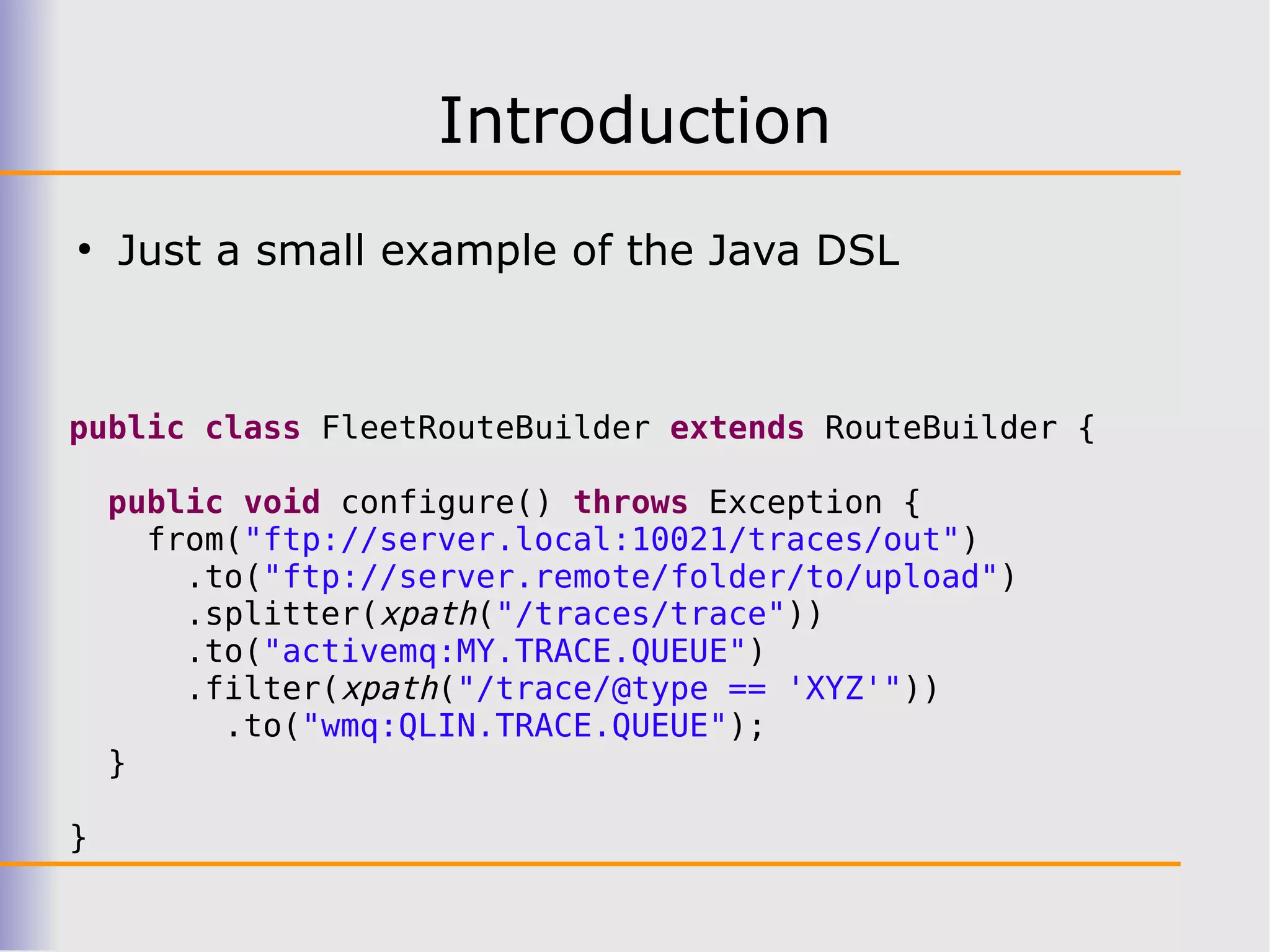
    Just a small example of the Java DSL


public class FleetRouteBuilder extends RouteBuilder {

    public void configure() throws Exception {
      from("ftp://server.local:10021/traces/out")
        .to("ftp://server.remote/folder/to/upload")
        .splitter(xpath("/traces/trace"))
        .to("activemq:MY.TRACE.QUEUE")
        .filter(xpath("/trace/@type == 'XYZ'"))
          .to("wmq:QLIN.TRACE.QUEUE");
    }

}
Introduction
●
    What is Scala?
    –   Sca(lable) la(nguage)
    –   Multi-paradigm:
         ●
             Object-oriented: classes, polymorphism, inheritance, ..
         ●
             Functional: function = value, pattern matching, ...
    –   Static typing, using type inference
    –   Interoperates with JRE (and .NET CLR)
         ●
             Scala code compiles into Java bytecode
         ●
             You can call Java code from Scala (and vica versa)
Introduction
●
    A simple Scala class example

    class Person(name: String, age: Int) {

        def eat(food: String) {
          println("Eating " + food + " now")
        }

        def isToddler = age > 0 && age < 3

        override def toString() = "Person[" + name + "]"

    }
Planning
●
    Introduction
●
    Scala language
    –   Implicit conversion
    –   Passing functions as parameters
    –   By-name parameters and currying
    –   Caveats
●
    Scala tooling
    –   Maven plugin
    –   Eclipse plugin
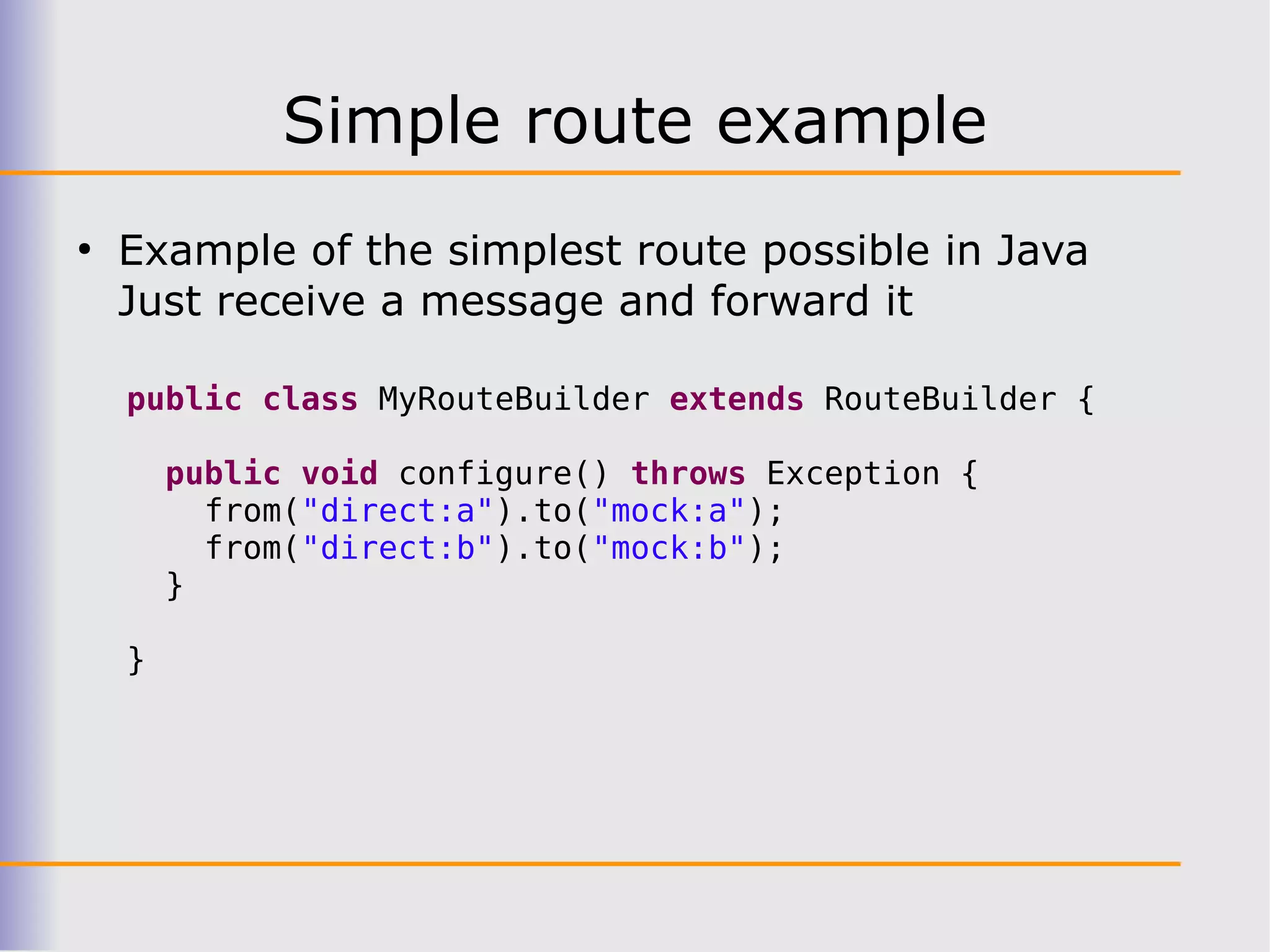
Simple route example
●
    Example of the simplest route possible in Java
    Just receive a message and forward it

    public class MyRouteBuilder extends RouteBuilder {

        public void configure() throws Exception {
          from("direct:a").to("mock:a");
          from("direct:b").to("mock:b");
        }

    }
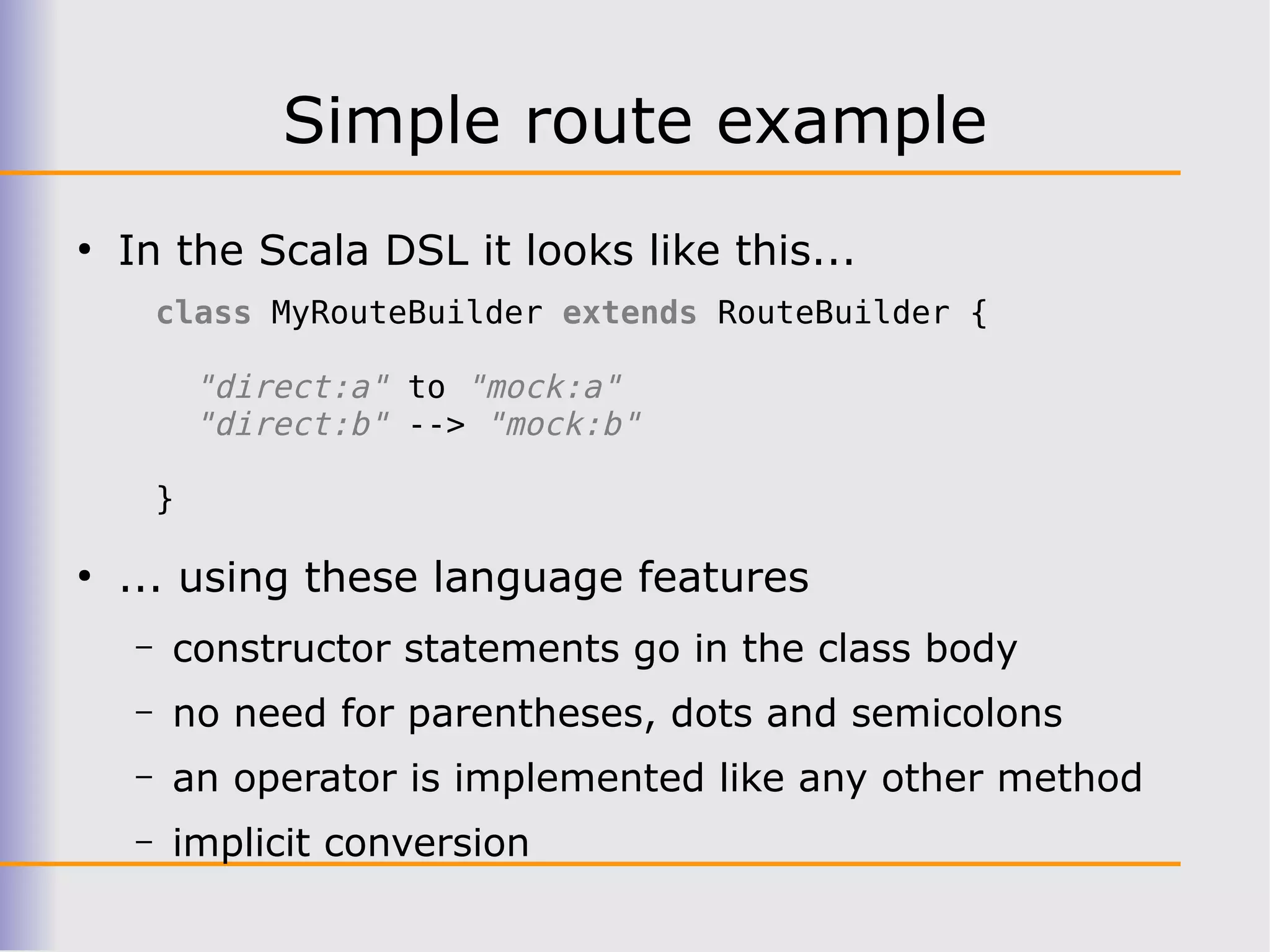
Simple route example
●
    In the Scala DSL it looks like this...
        class MyRouteBuilder extends RouteBuilder {

            "direct:a" to "mock:a"
            "direct:b" --> "mock:b"

        }

●
    ... using these language features
    –   constructor statements go in the class body
    –   no need for parentheses, dots and semicolons
    –   an operator is implemented like any other method
    –   implicit conversion
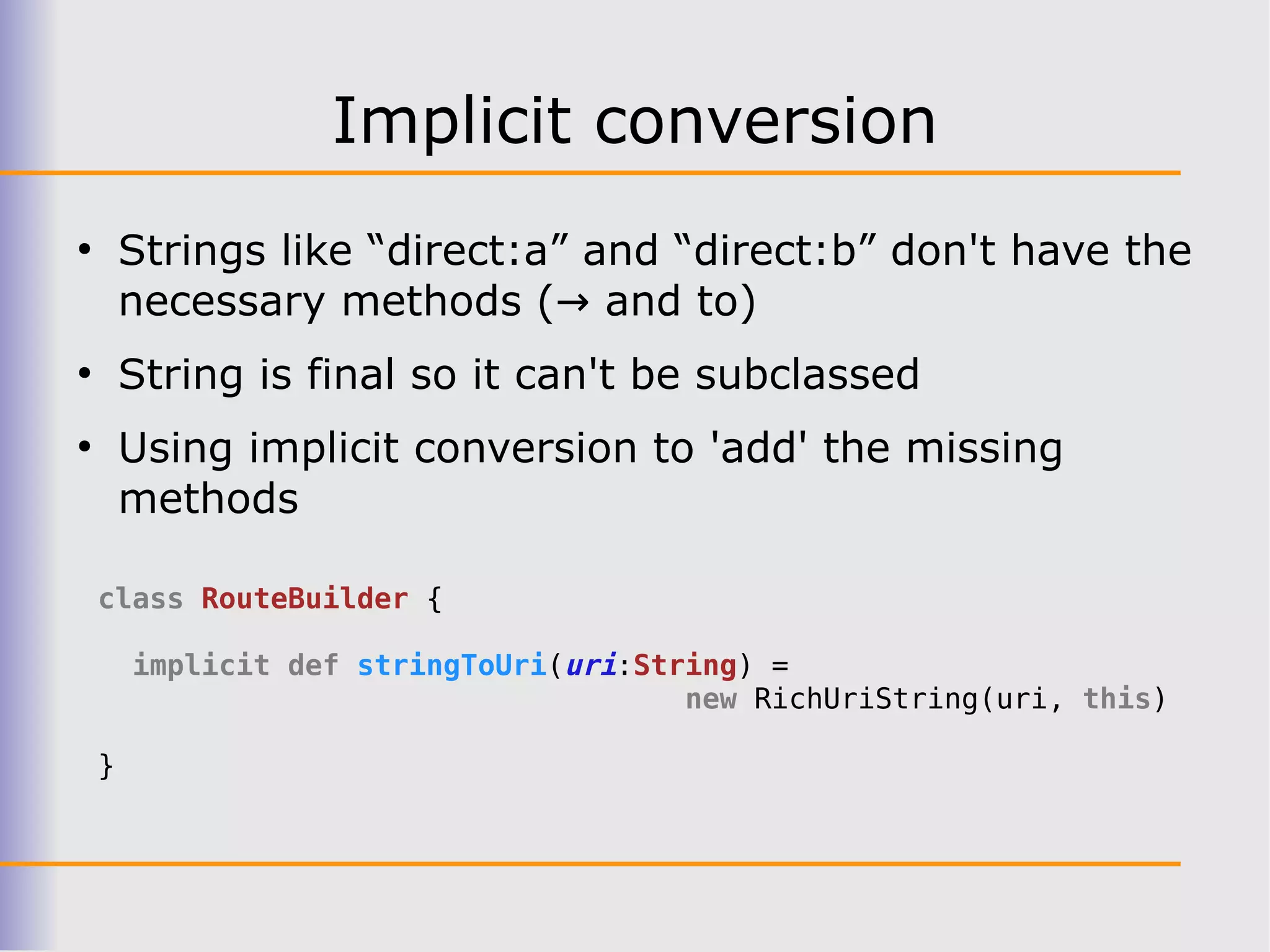
Implicit conversion
●
        Strings like “direct:a” and “direct:b” don't have the
        necessary methods (→ and to)
●
        String is final so it can't be subclassed
●
        Using implicit conversion to 'add' the missing
        methods

    class RouteBuilder {

        implicit def stringToUri(uri:String) =
                                        new RichUriString(uri, this)

    }
Implicit conversion
●
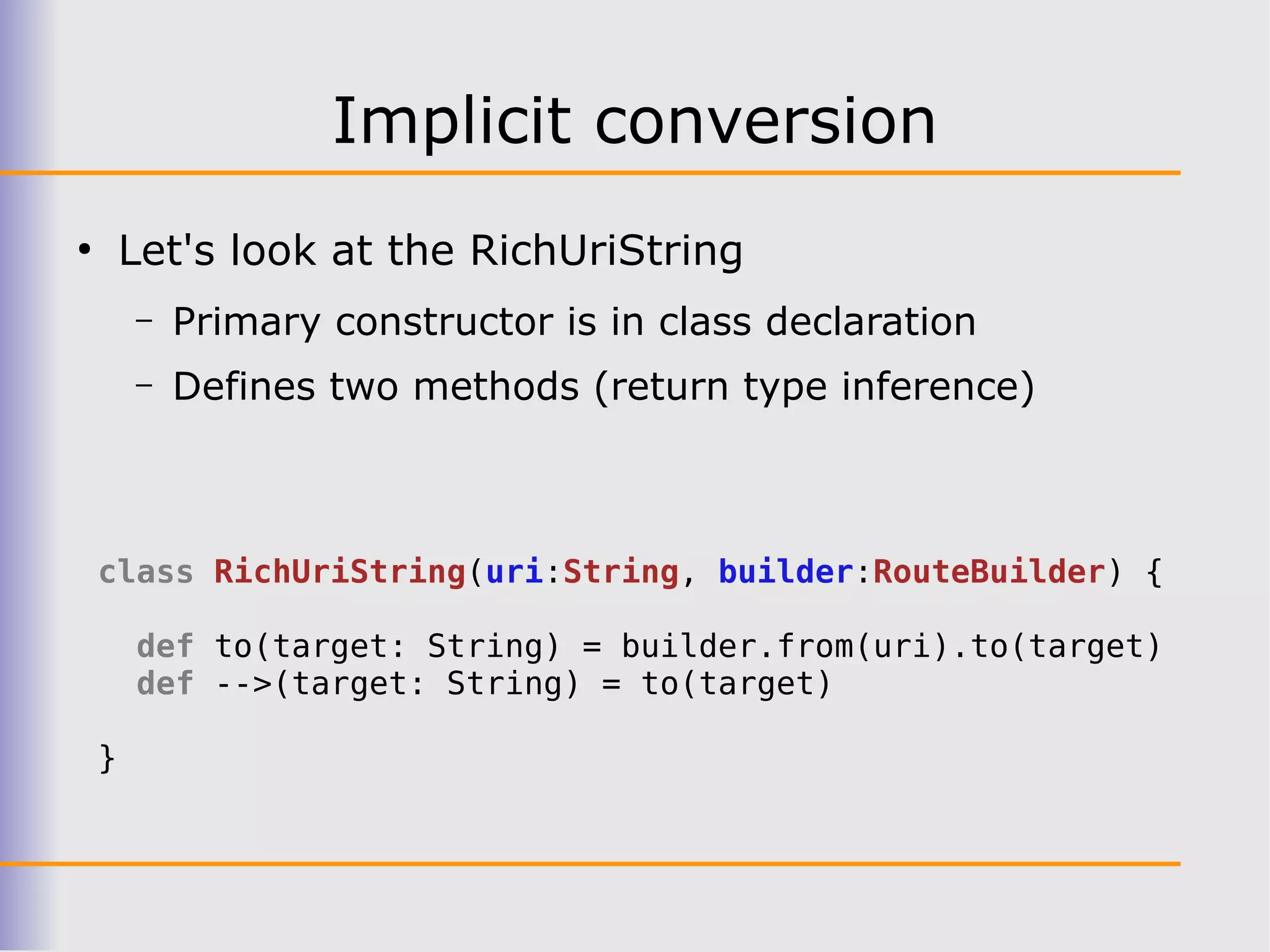
        Let's look at the RichUriString
        –   Primary constructor is in class declaration
        –   Defines two methods (return type inference)


    class RichUriString(uri:String, builder:RouteBuilder) {

        def to(target: String) = builder.from(uri).to(target)
        def -->(target: String) = to(target)

    }
Implicit conversion
●
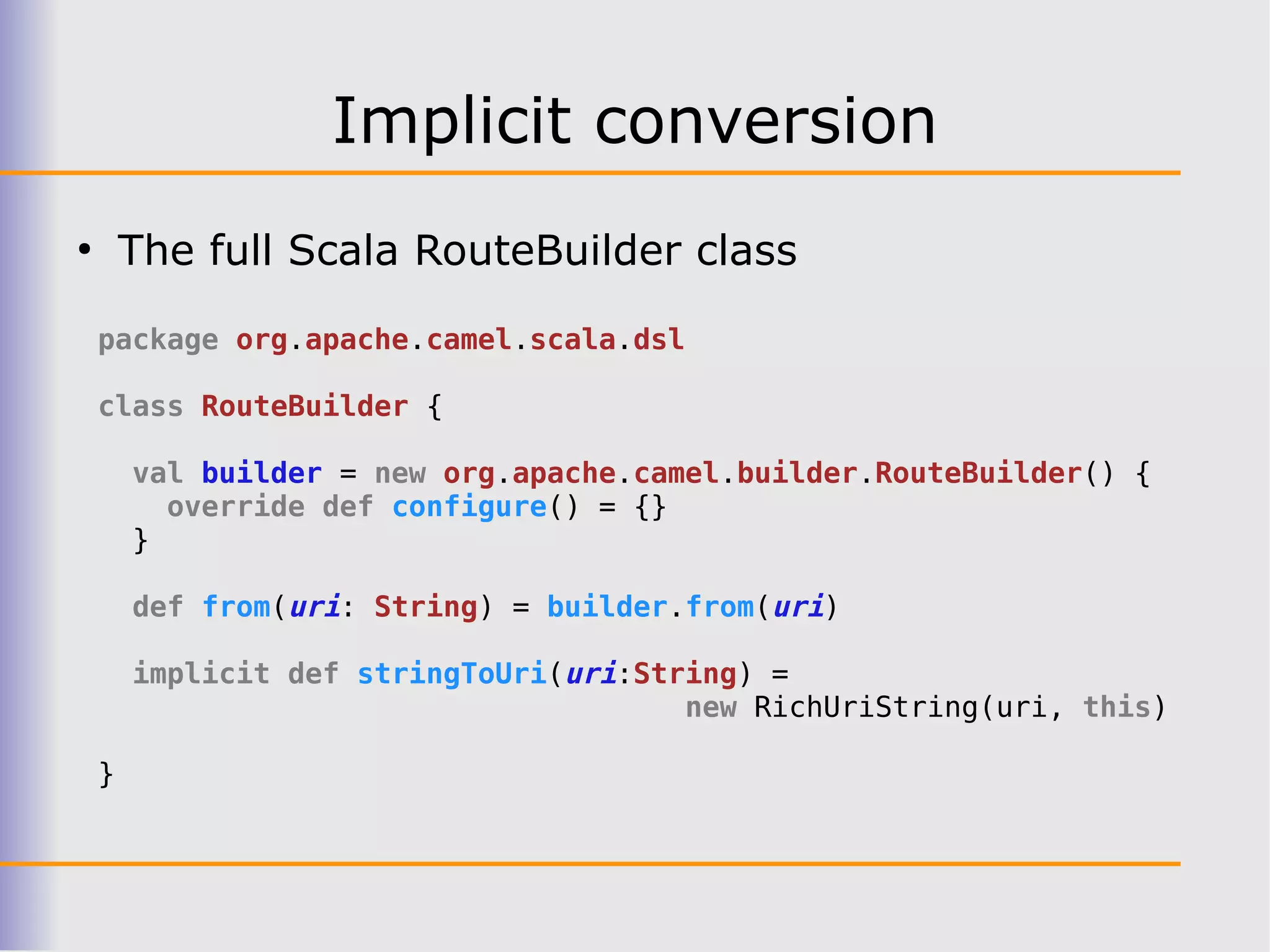
        The full Scala RouteBuilder class

    package org.apache.camel.scala.dsl

    class RouteBuilder {

        val builder = new org.apache.camel.builder.RouteBuilder() {
          override def configure() = {}
        }

        def from(uri: String) = builder.from(uri)

        implicit def stringToUri(uri:String) =
                                        new RichUriString(uri, this)

    }
Implicit conversion
●
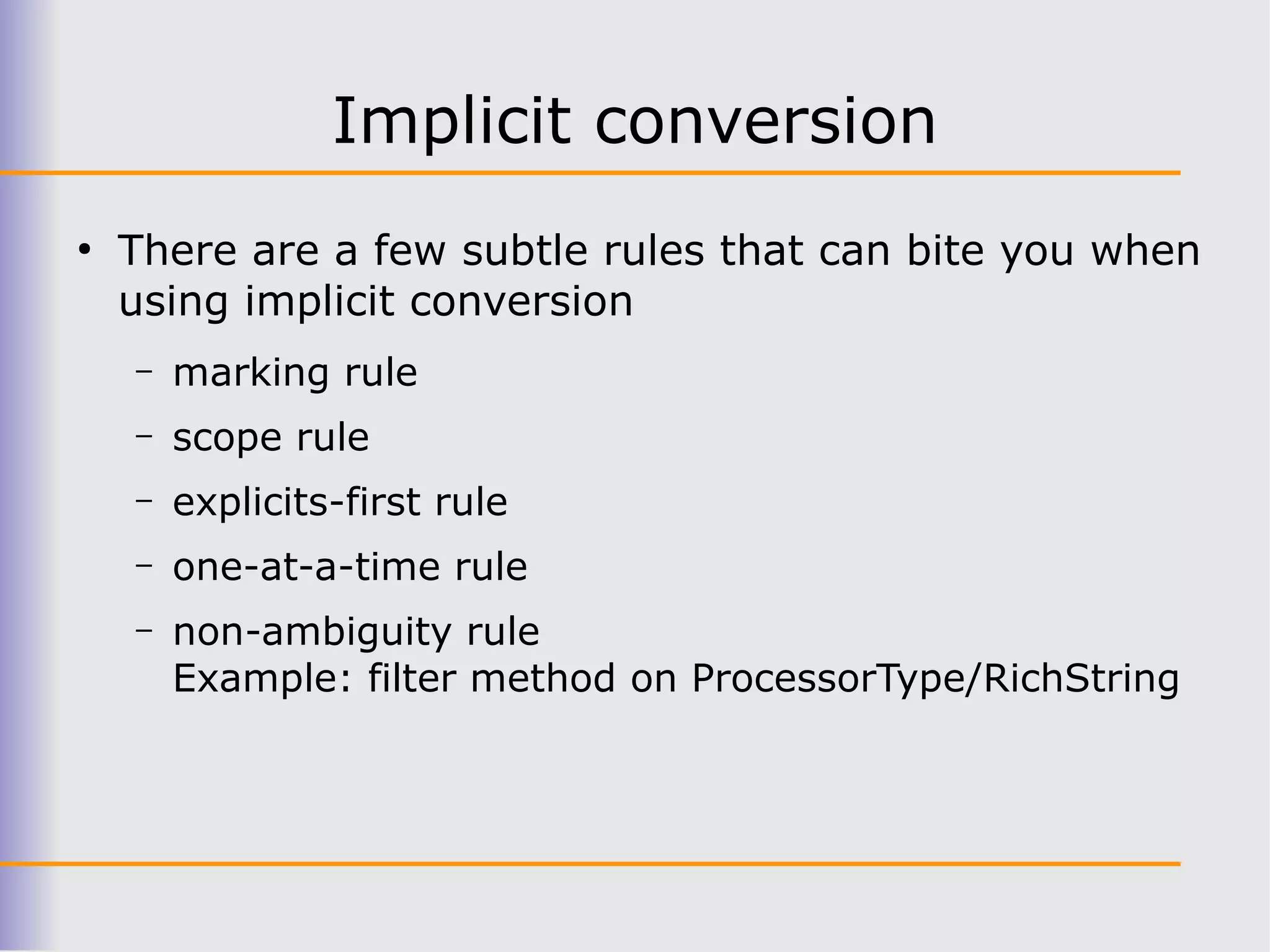
    There are a few subtle rules that can bite you when
    using implicit conversion
    –   marking rule
    –   scope rule
    –   explicits-first rule
    –   one-at-a-time rule
    –   non-ambiguity rule
        Example: filter method on ProcessorType/RichString
Filter route example
●
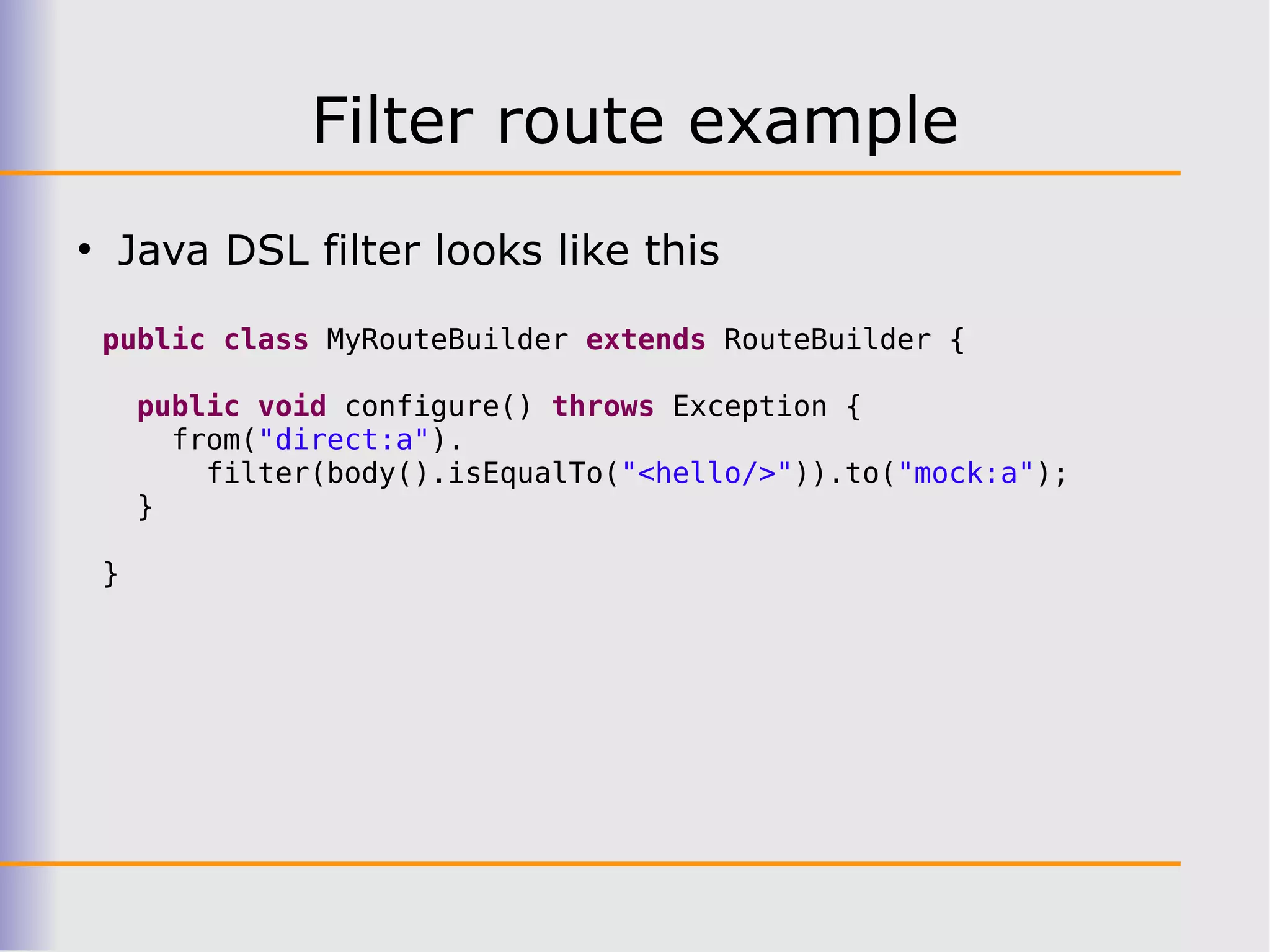
    Java DSL filter looks like this

    public class MyRouteBuilder extends RouteBuilder {

        public void configure() throws Exception {
          from("direct:a").
            filter(body().isEqualTo("<hello/>")).to("mock:a");
        }

    }
Filter route example
●
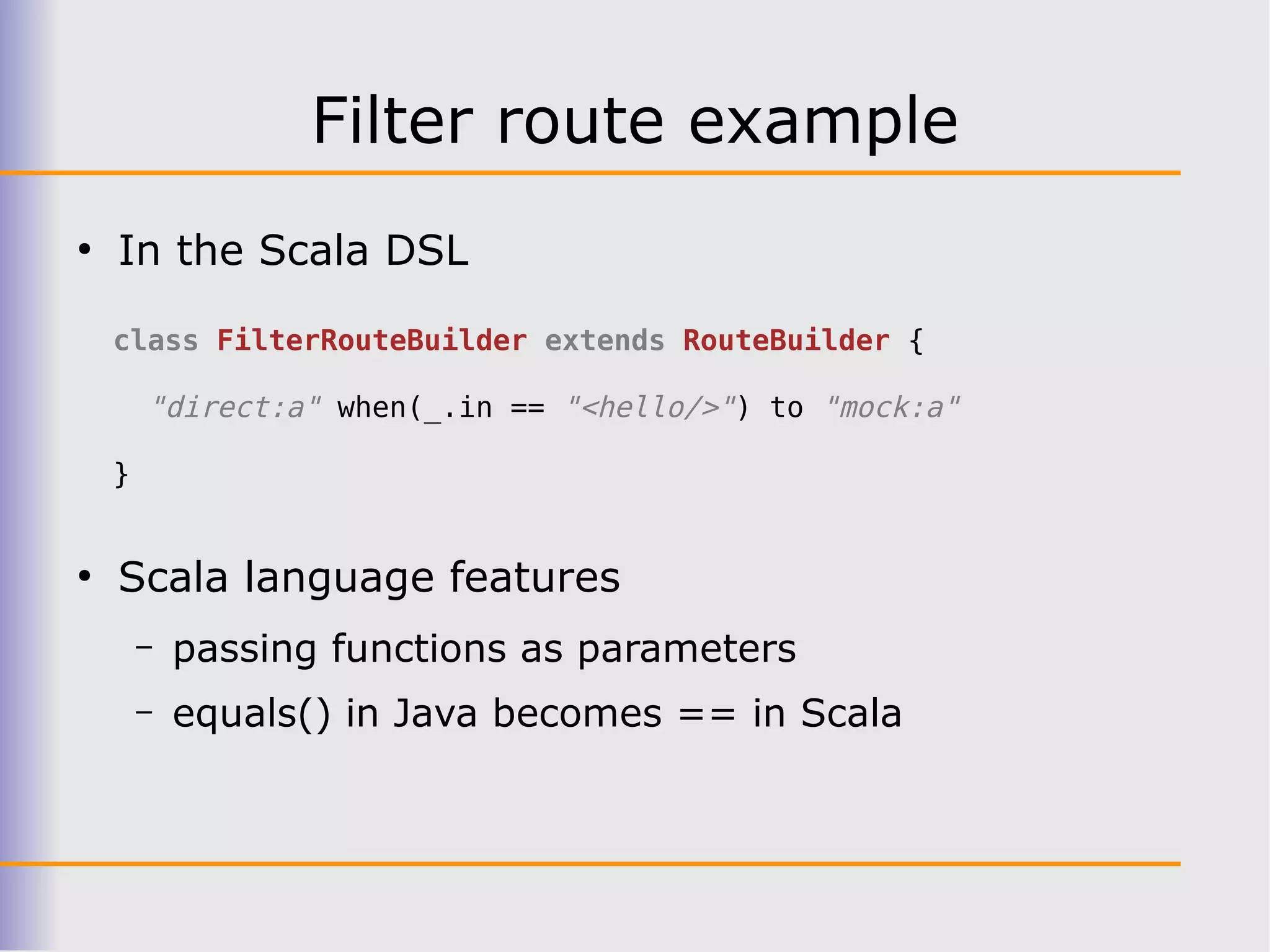
    In the Scala DSL

    class FilterRouteBuilder extends RouteBuilder {

        "direct:a" when(_.in == "<hello/>") to "mock:a"

    }


●
    Scala language features
        –   passing functions as parameters
        –   equals() in Java becomes == in Scala
Passing functions as parameters
●
        Scala is a functional language
        –   functions are variables
        –   you can pass functions as method parameters
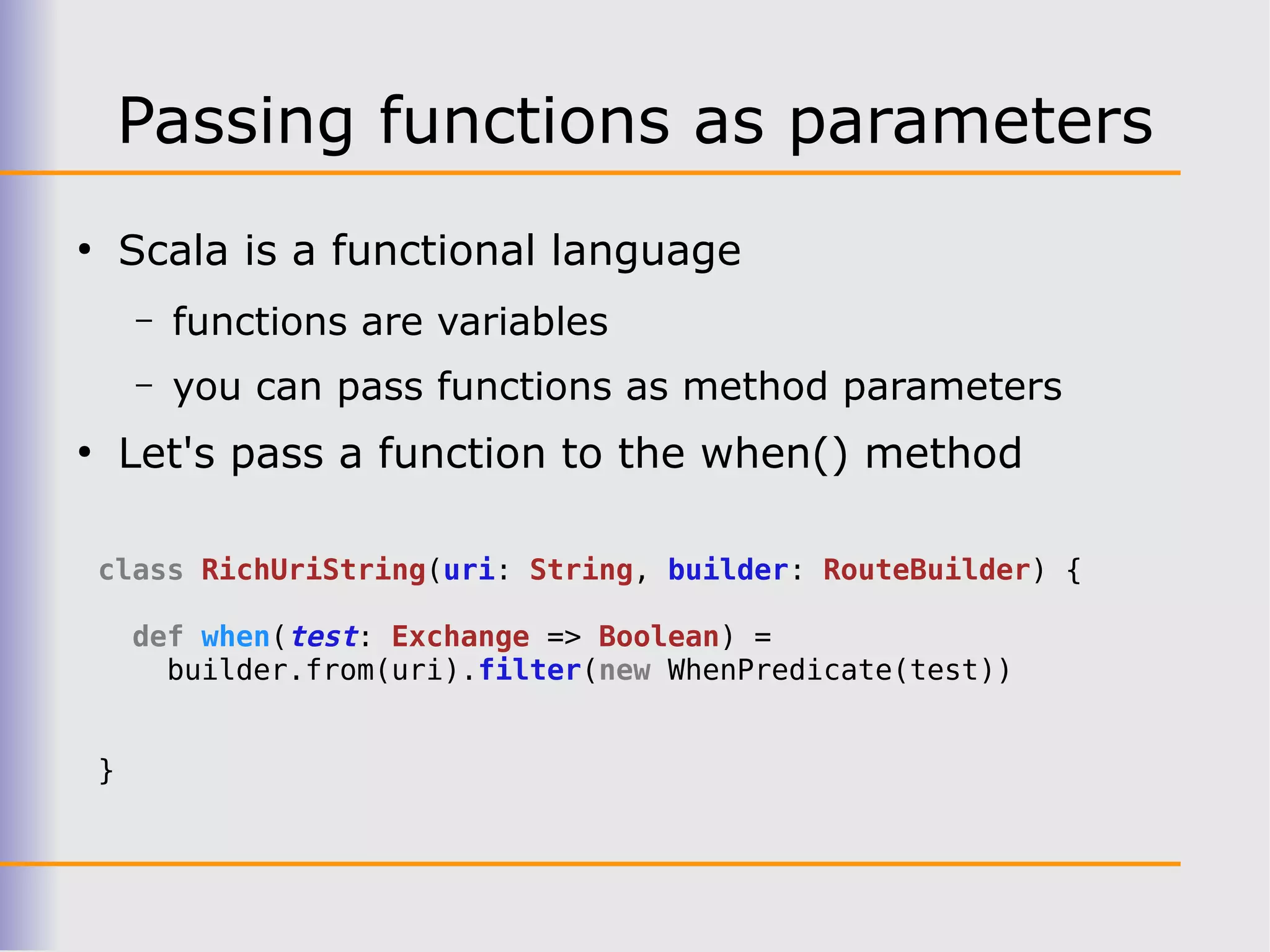
●
        Let's pass a function to the when() method

    class RichUriString(uri: String, builder: RouteBuilder) {

        def when(test: Exchange => Boolean) =
          builder.from(uri).filter(new WhenPredicate(test))


    }
Passing functions as parameters
●
        Predicate<E> is an interface in the Camel API
        –   WhenPredicate is a Scala class that implements it
        –   Use the function with an Exchange to evaluate


    package org.apache.camel.scala.dsl

    class WhenPredicate(function: Exchange => Boolean)
                                       extends Predicate[Exchange]{

        override def matches(exchange: Exchange) = function(exchange)

        //assertMatches is also here

    }
Passing functions as parameters
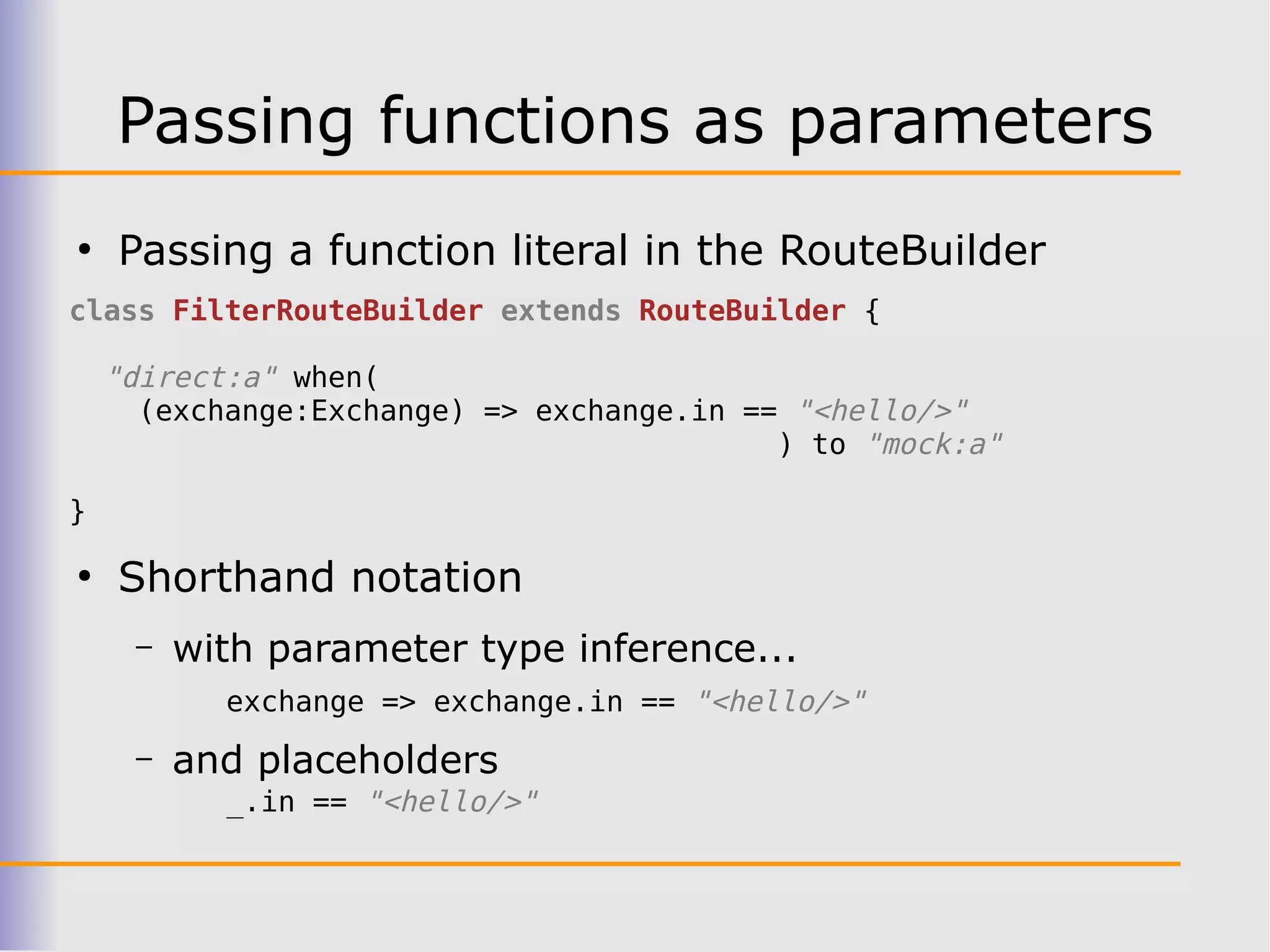
●
    Passing a function literal in the RouteBuilder
class FilterRouteBuilder extends RouteBuilder {

    "direct:a" when(
      (exchange:Exchange) => exchange.in == "<hello/>"
                                           ) to "mock:a"

}

●
    Shorthand notation
     –   with parameter type inference...
           exchange => exchange.in == "<hello/>"
     –   and placeholders
           _.in == "<hello/>"
CBR example
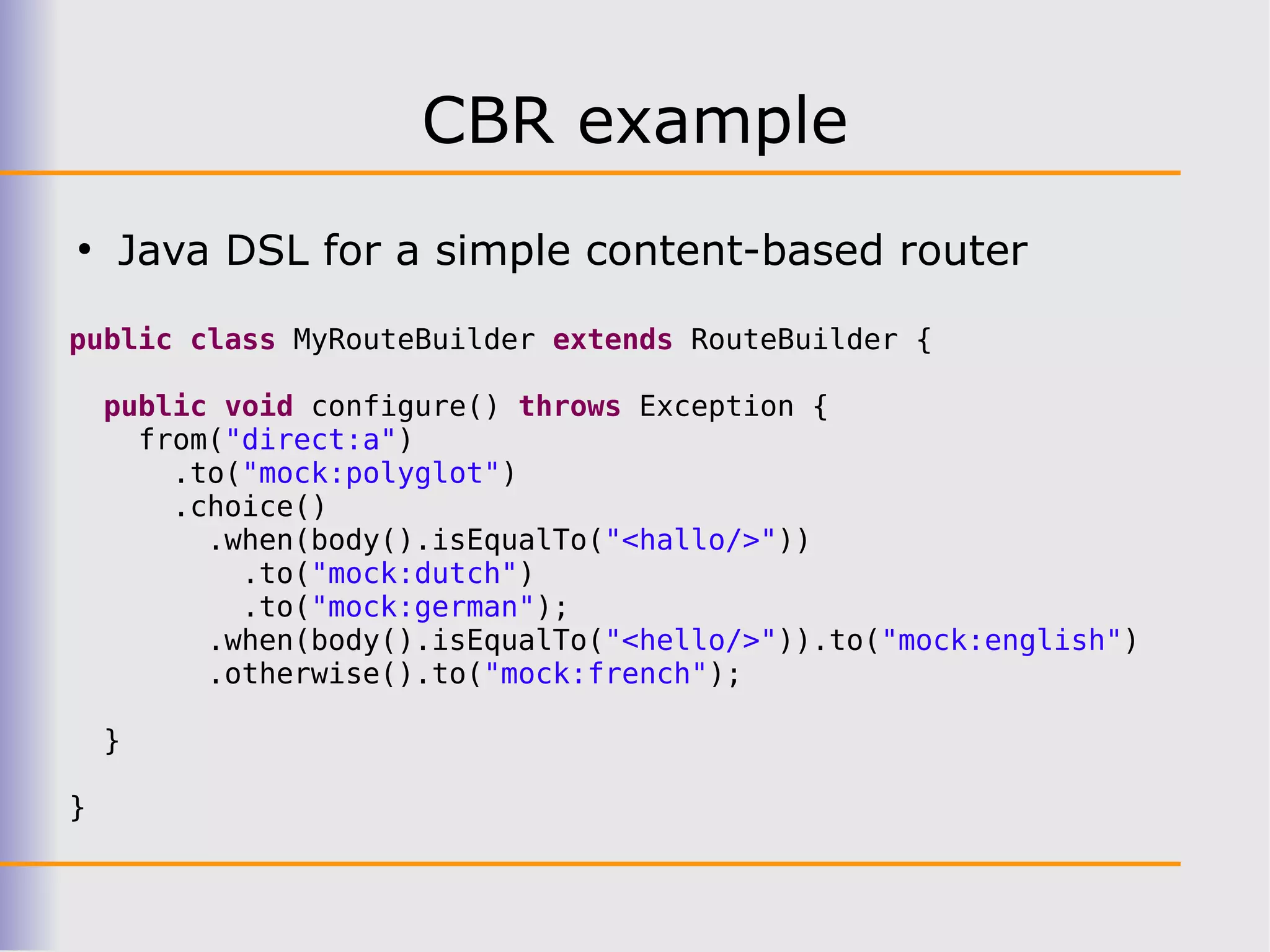
●
    Java DSL for a simple content-based router

public class MyRouteBuilder extends RouteBuilder {

    public void configure() throws Exception {
      from("direct:a")
        .to("mock:polyglot")
        .choice()
          .when(body().isEqualTo("<hallo/>"))
            .to("mock:dutch")
            .to("mock:german");
          .when(body().isEqualTo("<hello/>")).to("mock:english")
          .otherwise().to("mock:french");

    }

}
CBR example
●
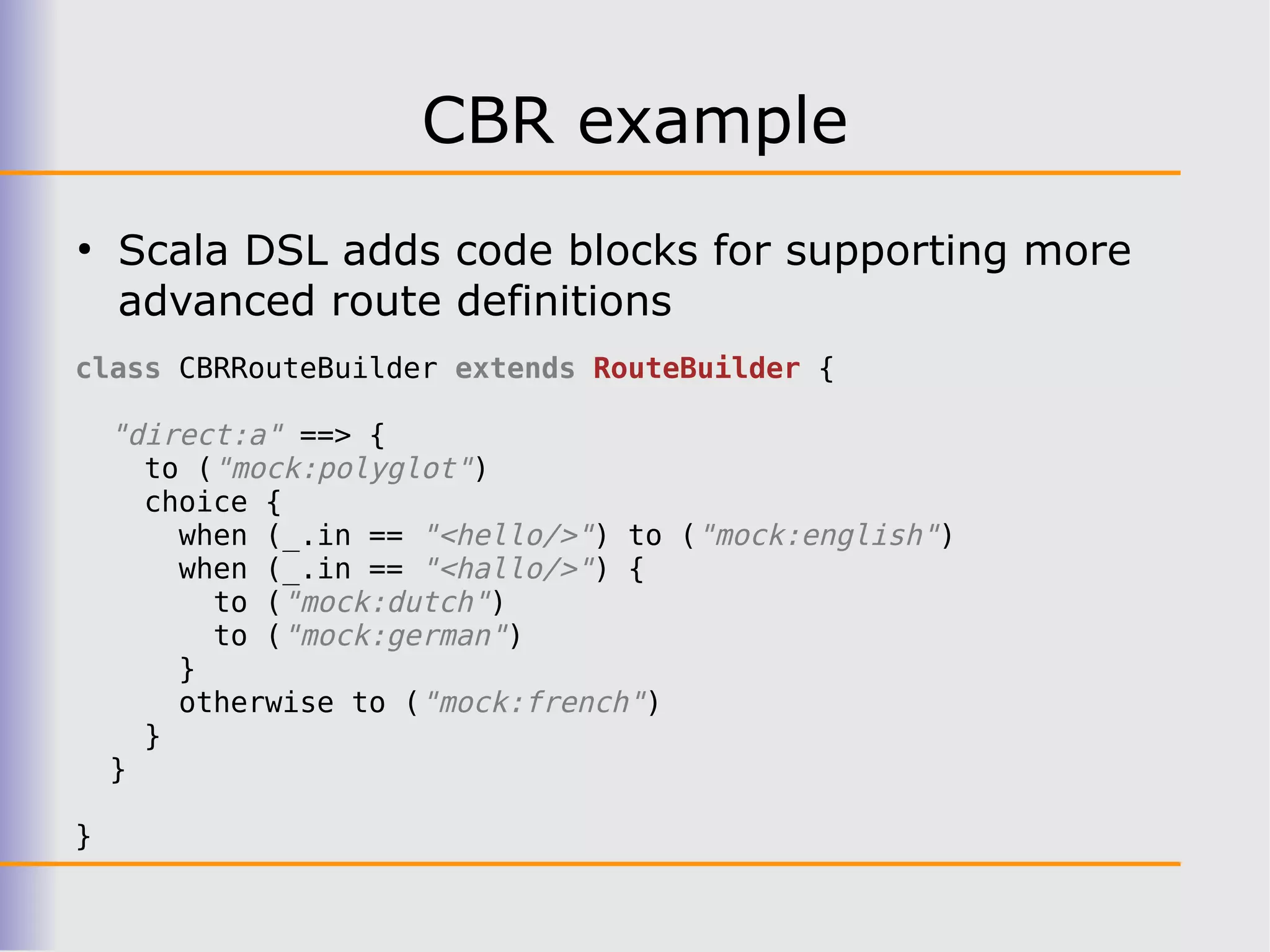
    Scala DSL adds code blocks for supporting more
    advanced route definitions
class CBRRouteBuilder extends RouteBuilder {

    "direct:a" ==> {
      to ("mock:polyglot")
      choice {
        when (_.in == "<hello/>") to ("mock:english")
        when (_.in == "<hallo/>") {
          to ("mock:dutch")
          to ("mock:german")
        }
        otherwise to ("mock:french")
      }
    }

}
By-name parameters and currying
●
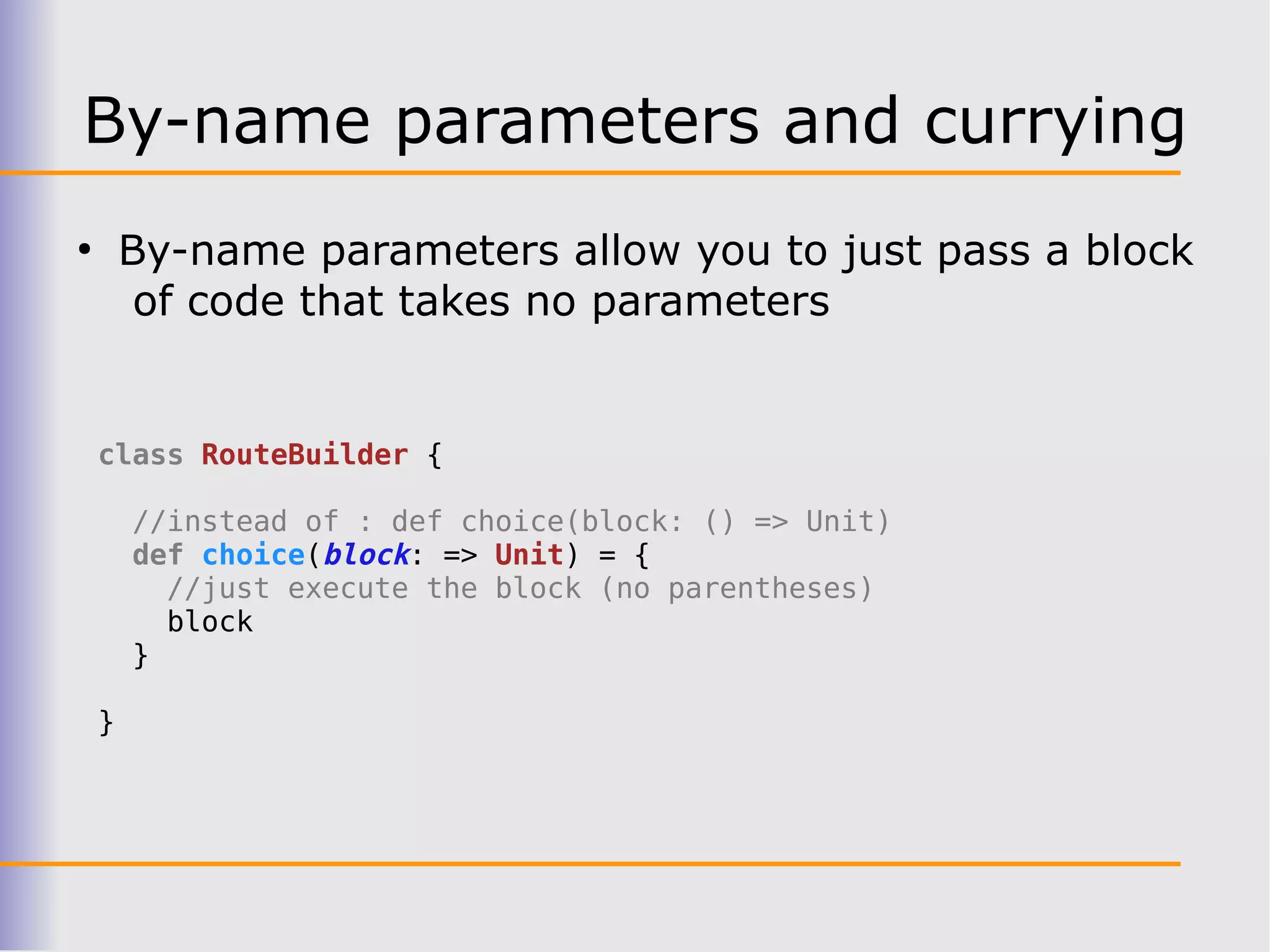
        By-name parameters allow you to just pass a block
         of code that takes no parameters


    class RouteBuilder {

        //instead of : def choice(block: () => Unit)
        def choice(block: => Unit) = {
          //just execute the block (no parentheses)
          block
        }

    }
By-name parameters and currying
●
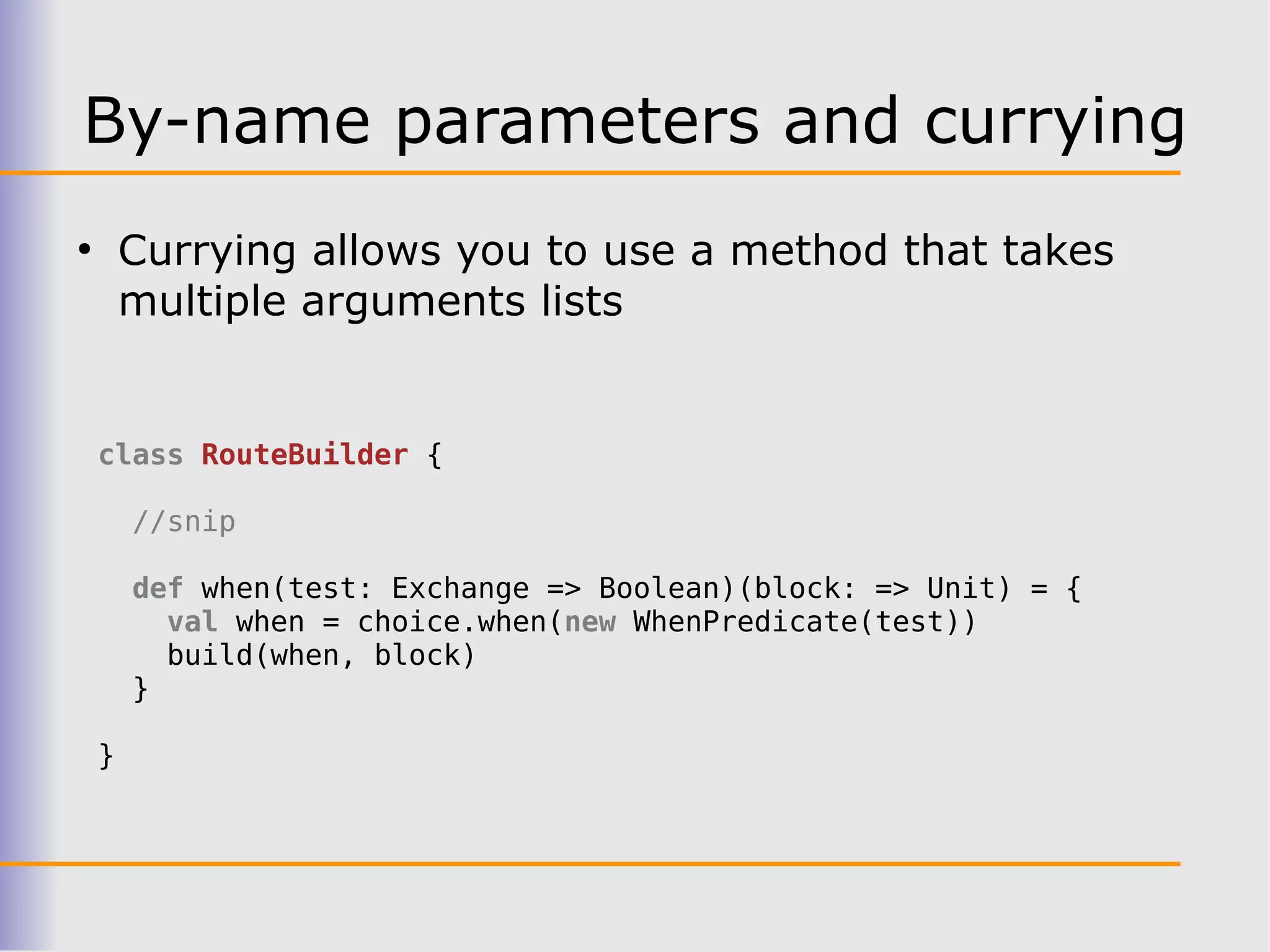
        Currying allows you to use a method that takes
        multiple arguments lists


    class RouteBuilder {

        //snip

        def when(test: Exchange => Boolean)(block: => Unit) = {
          val when = choice.when(new WhenPredicate(test))
          build(when, block)
        }

    }
Caveats
●
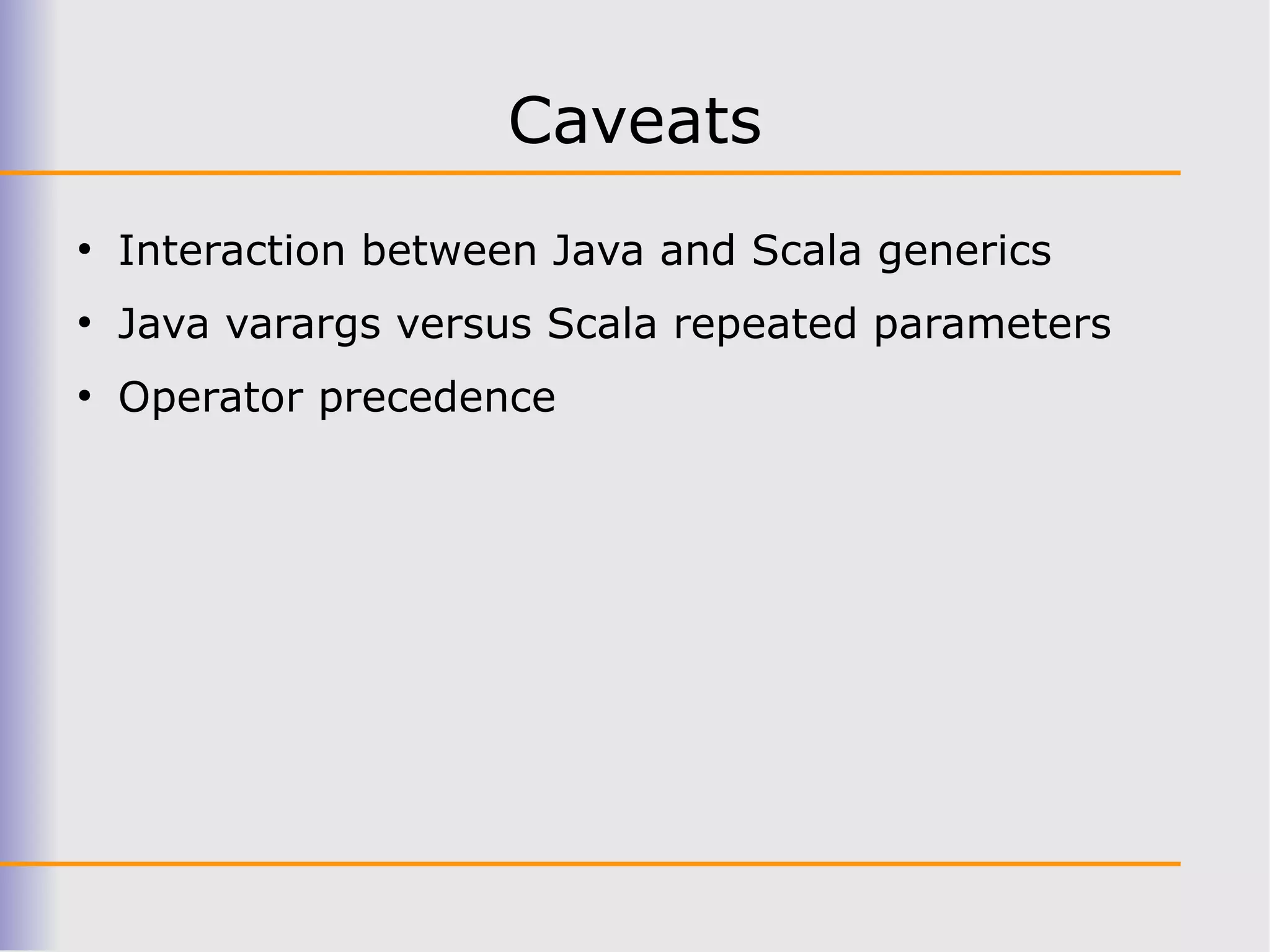
    Interaction between Java and Scala generics
●
    Java varargs versus Scala repeated parameters
●
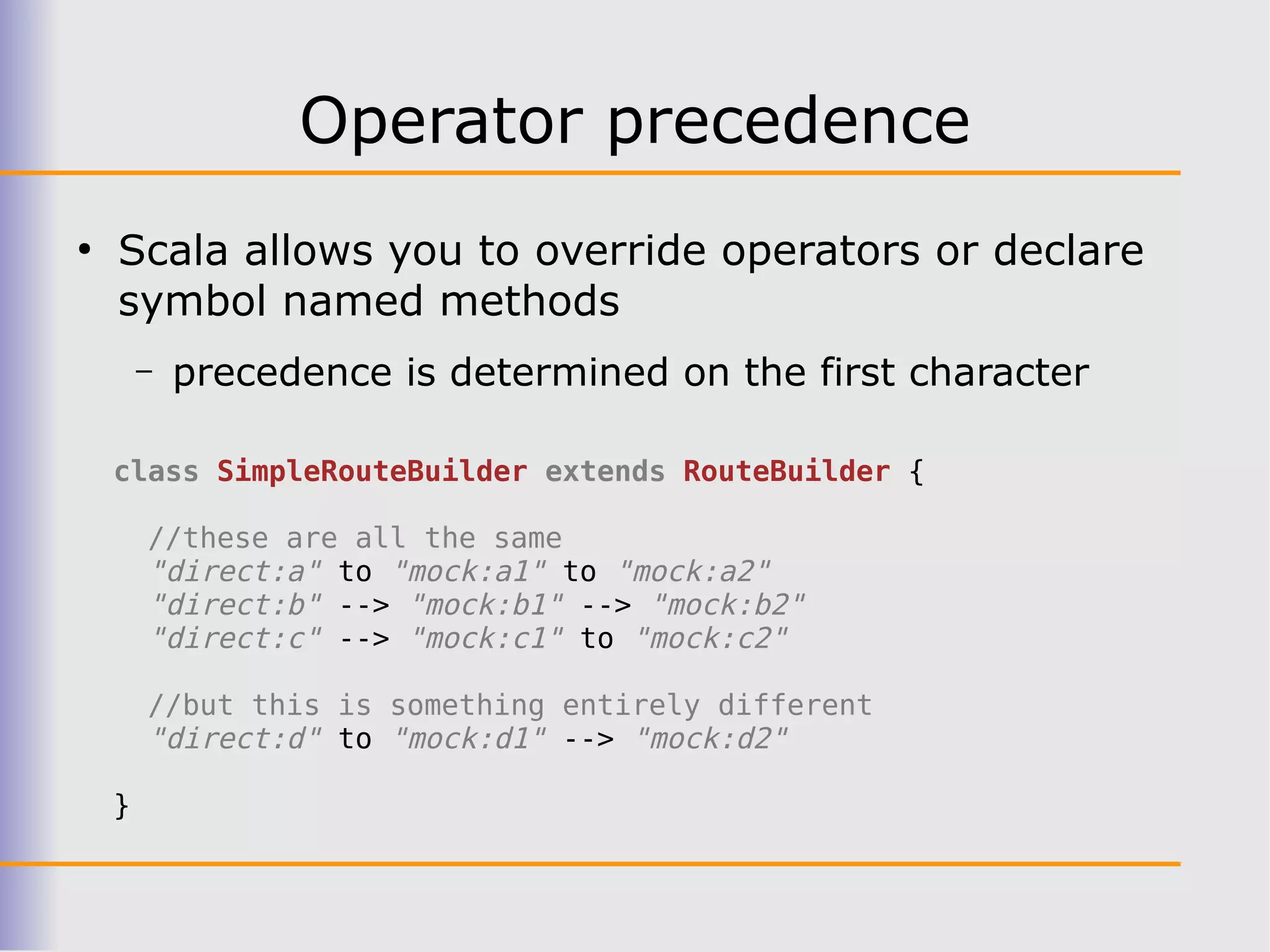
    Operator precedence
Operator precedence
●
    Scala allows you to override operators or declare
    symbol named methods
        –   precedence is determined on the first character

    class SimpleRouteBuilder extends RouteBuilder {

        //these are all the same
        "direct:a" to "mock:a1" to "mock:a2"
        "direct:b" --> "mock:b1" --> "mock:b2"
        "direct:c" --> "mock:c1" to "mock:c2"

        //but this is something entirely different
        "direct:d" to "mock:d1" --> "mock:d2"

    }
Java/Scala generics
●
     Most of the times, you can simply replace <> by []
●
     A Java type defined as...
    public class ProcessorType<Type extends ProcessorType> {}


●
     In Java, you can also declare the raw type ...
     (you'll only get compiler warnings)
●
     ... but in Scala this doesn't work. The solution is
     this (ugly-looking) syntax (existential type).
    implicit def processorWrapper(
                 processor: ProcessorType[T] forSome {type T}) =
                                      new RichProcessor(processor)
Varargs/repeated parameters
●
    Java varargs...
     public Type to(String... uri) {
        //does some work
     }
●
    ... are like Scala repeated parameters
     def to(uris: String*) = //implementation goes here


●
    Caveats:
     def to(uris: String*) = {
       val processor = builder.from(uri)
       processor.to(uris.toArray[String])
     }

     def -->(uris: String*) = to(uris:_*)
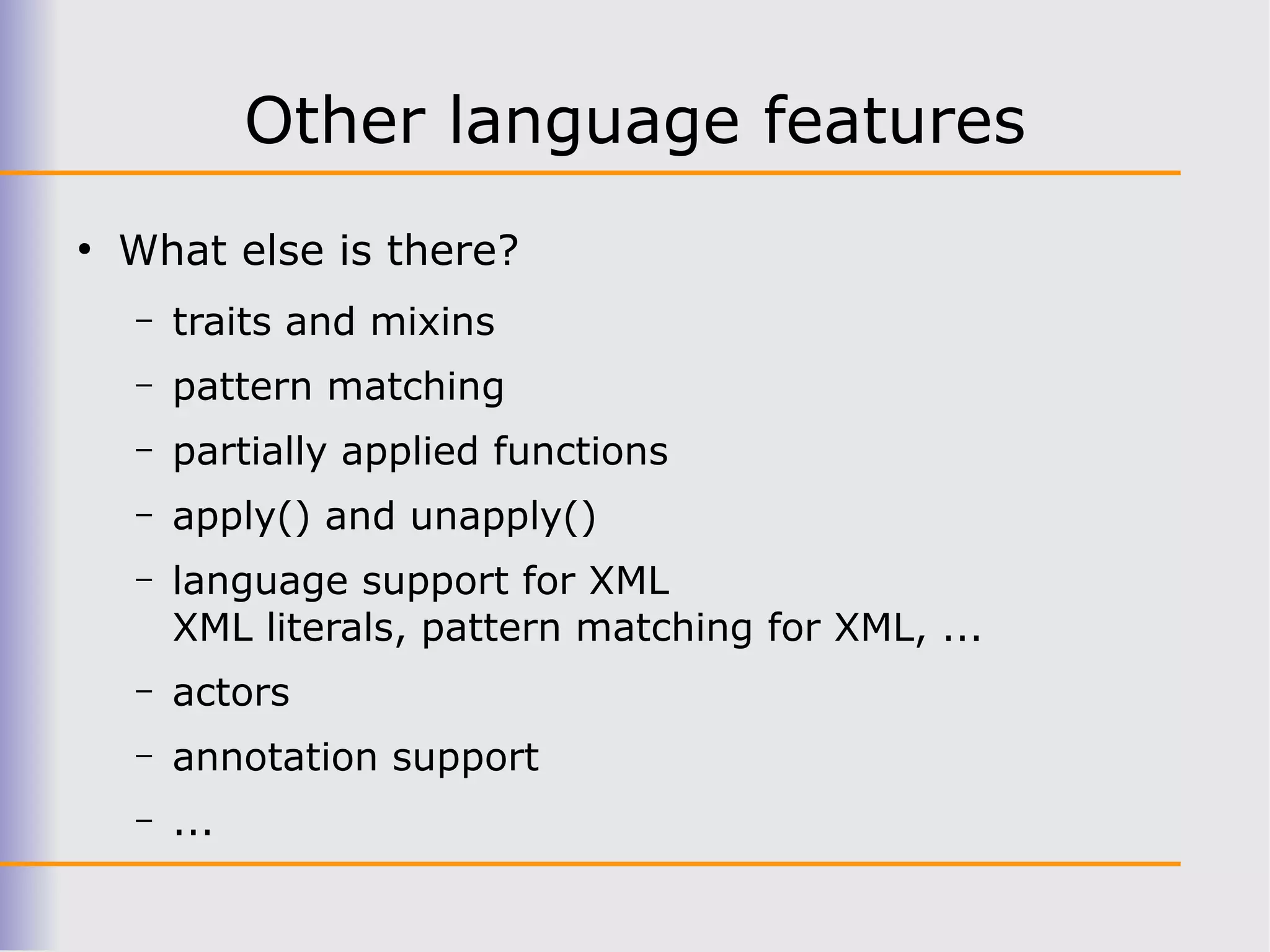
Other language features
●
    What else is there?
    –   traits and mixins
    –   pattern matching
    –   partially applied functions
    –   apply() and unapply()
    –   language support for XML
        XML literals, pattern matching for XML, ...
    –   actors
    –   annotation support
    –   ...
Planning
●
    Introduction
●
    Scala for DSL building
    –   Implicit conversion
    –   Passing functions as parameters
    –   By-name parameters and currying
    –   Caveats
●
    Scala tooling
    –   Maven plugin
    –   Eclipse plugin
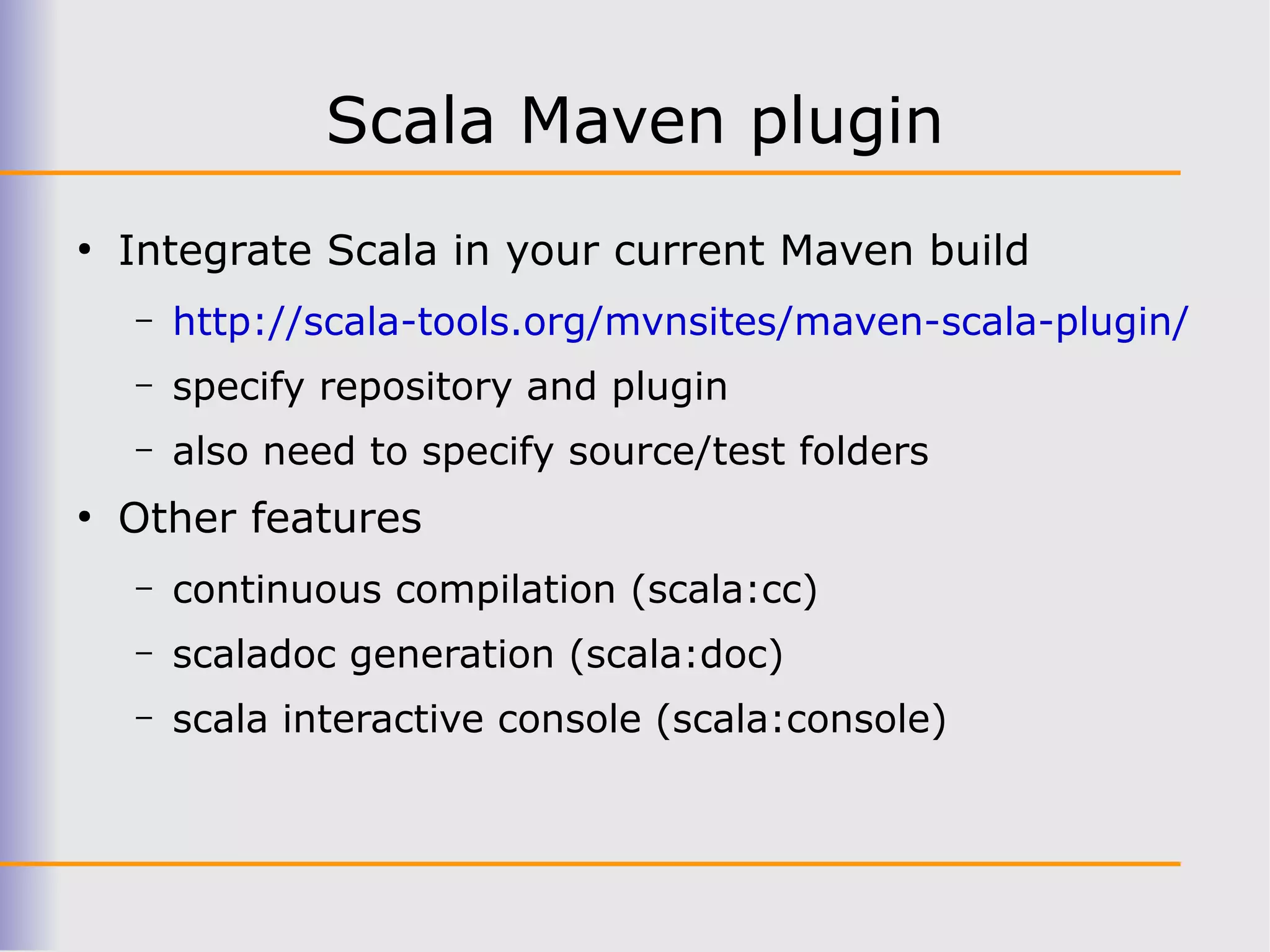
Scala Maven plugin
●
    Integrate Scala in your current Maven build
    –   http://scala-tools.org/mvnsites/maven-scala-plugin/
    –   specify repository and plugin
    –   also need to specify source/test folders
●
    Other features
    –   continuous compilation (scala:cc)
    –   scaladoc generation (scala:doc)
    –   scala interactive console (scala:console)
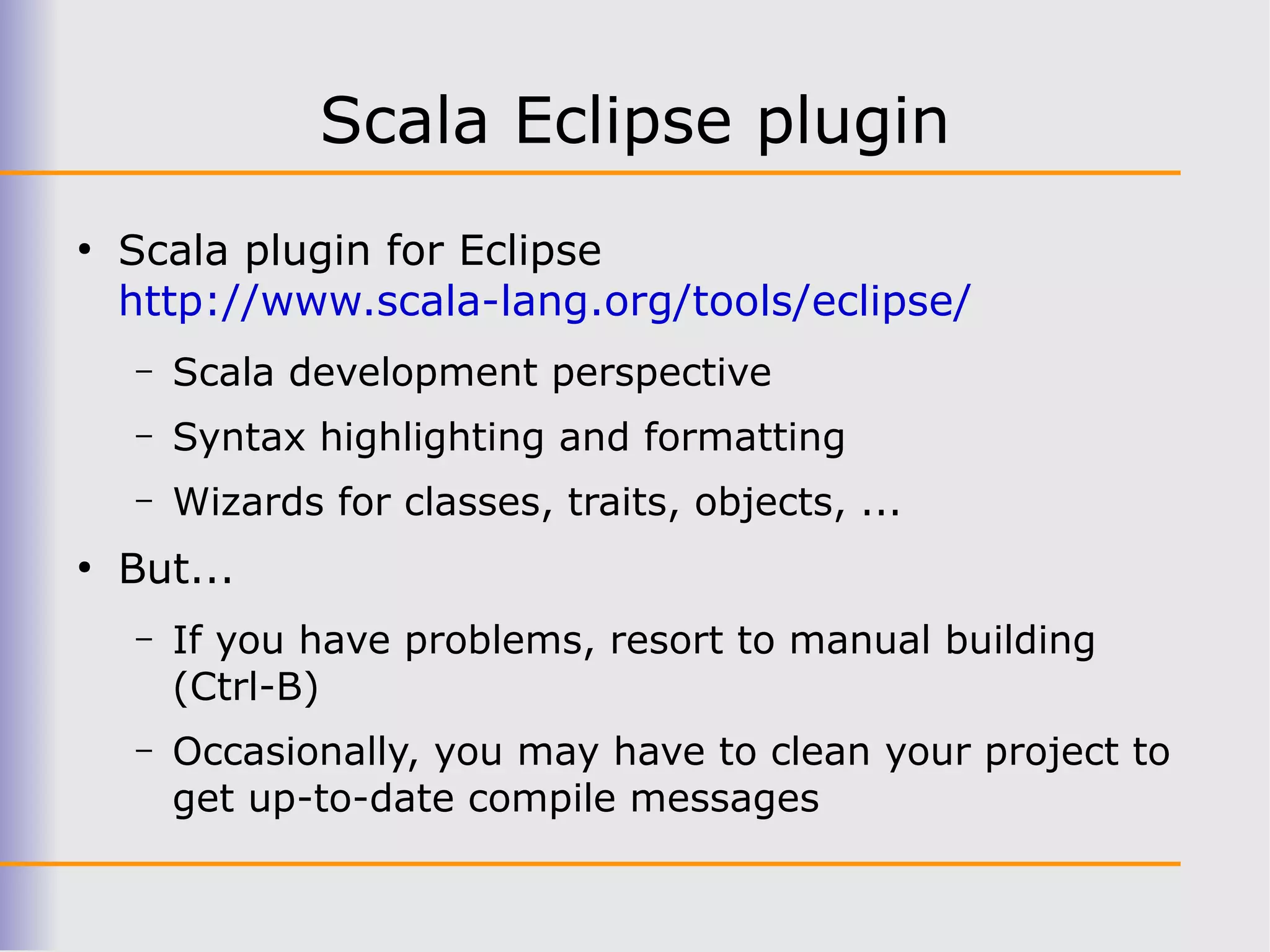
Scala Eclipse plugin
●
    Scala plugin for Eclipse
    http://www.scala-lang.org/tools/eclipse/
    –   Scala development perspective
    –   Syntax highlighting and formatting
    –   Wizards for classes, traits, objects, ...
●
    But...
    –   If you have problems, resort to manual building
        (Ctrl-B)
    –   Occasionally, you may have to clean your project to
        get up-to-date compile messages
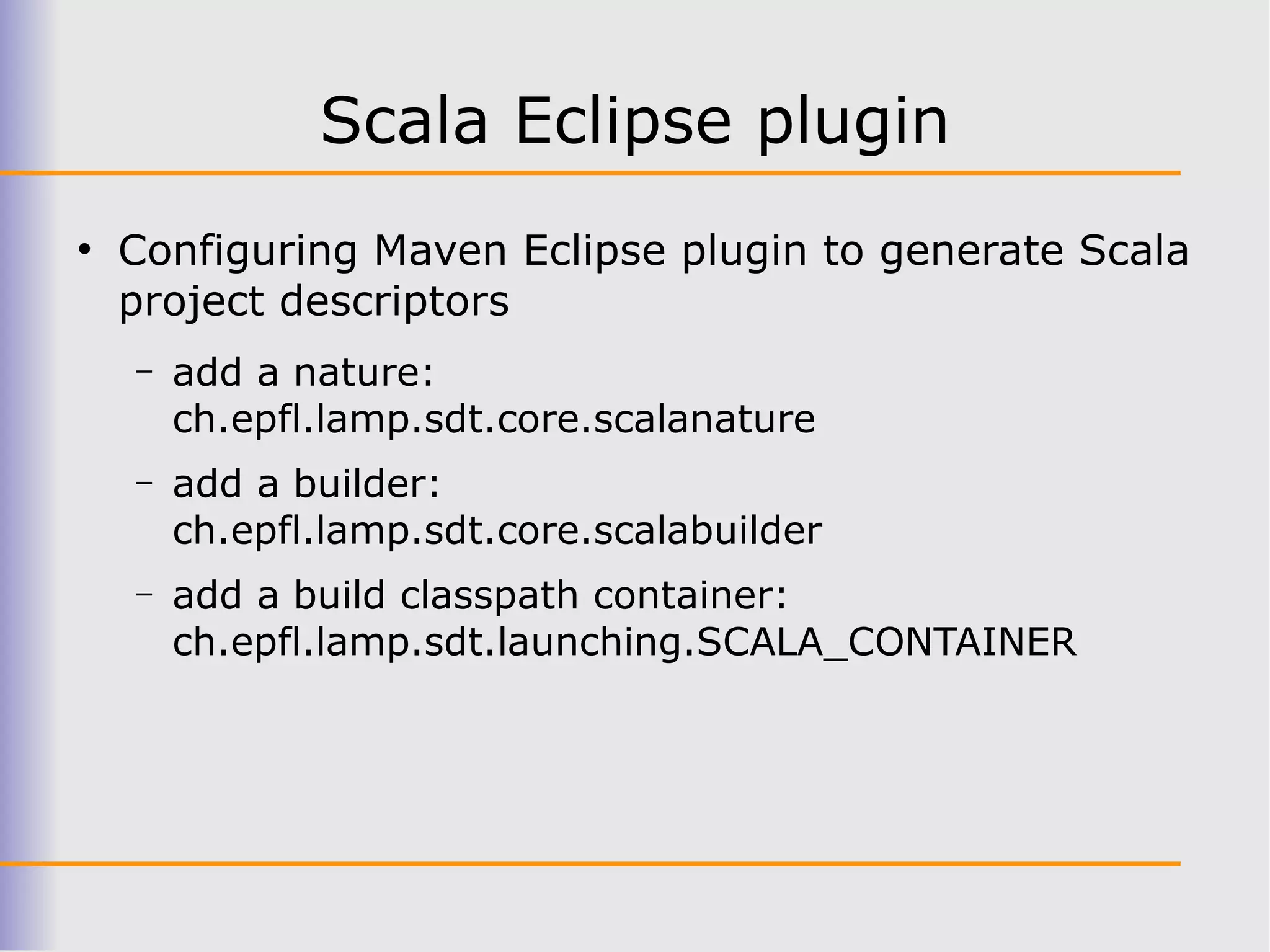
Scala Eclipse plugin
●
    Configuring Maven Eclipse plugin to generate Scala
    project descriptors
    –   add a nature:
        ch.epfl.lamp.sdt.core.scalanature
    –   add a builder:
        ch.epfl.lamp.sdt.core.scalabuilder
    –   add a build classpath container:
        ch.epfl.lamp.sdt.launching.SCALA_CONTAINER
Thanks for attending...


   Questions? Remarks?

camel-scala.pdf

  • 1.
    Introducing Scala Developing anew Scala DSL for Apache Camel
  • 2.
    Goals ● Goals – Introduce a few basic concepts/syntax of Scala – How to use these Scala techniques for building a Scala DSL (using Apache Camel as an example)
  • 3.
    Planning ● Introduction ● Scala for DSL building – Implicit conversion – Passing functions as parameters – By-name parameters and currying – Caveats ● Scala tooling – Maven plugin – Eclipse plugin
  • 4.
    Planning ● Introduction ● Scala for DSL building – Implicit conversion – Passing functions as parameters – By-name parameters and currying – Caveats ● Scala tooling – Maven plugin – Eclipse plugin
  • 5.
    Introduction ● Who am I? – Gert Vanthienen (gert@anova.be) – Independent consultant ● Open-source (Java/J2EE) technology ● Legacy integration (System i aka AS/400) – Open-source ● Apache ServiceMix committer / PMC member ● Contributor to Apache Camel
  • 6.
    Introduction ● What is Apache Camel? – Spring-based Integration Framework – Implements enterprise integration patterns – Configured through ● Java DSL (fluent API) ● Spring XML configuration file – URIs to work with other transports/protocols – Routing/mediation for ServiceMix, ActiveMQ, CXF, ... – Check out Bruce Snyder's presentation on Friday!!
  • 7.
    Introduction ● Just a small example of the Java DSL public class FleetRouteBuilder extends RouteBuilder { public void configure() throws Exception { from("ftp://server.local:10021/traces/out") .to("ftp://server.remote/folder/to/upload") .splitter(xpath("/traces/trace")) .to("activemq:MY.TRACE.QUEUE") .filter(xpath("/trace/@type == 'XYZ'")) .to("wmq:QLIN.TRACE.QUEUE"); } }
  • 8.
    Introduction ● What is Scala? – Sca(lable) la(nguage) – Multi-paradigm: ● Object-oriented: classes, polymorphism, inheritance, .. ● Functional: function = value, pattern matching, ... – Static typing, using type inference – Interoperates with JRE (and .NET CLR) ● Scala code compiles into Java bytecode ● You can call Java code from Scala (and vica versa)
  • 9.
    Introduction ● A simple Scala class example class Person(name: String, age: Int) { def eat(food: String) { println("Eating " + food + " now") } def isToddler = age > 0 && age < 3 override def toString() = "Person[" + name + "]" }
  • 10.
    Planning ● Introduction ● Scala language – Implicit conversion – Passing functions as parameters – By-name parameters and currying – Caveats ● Scala tooling – Maven plugin – Eclipse plugin
  • 11.
    Simple route example ● Example of the simplest route possible in Java Just receive a message and forward it public class MyRouteBuilder extends RouteBuilder { public void configure() throws Exception { from("direct:a").to("mock:a"); from("direct:b").to("mock:b"); } }
  • 12.
    Simple route example ● In the Scala DSL it looks like this... class MyRouteBuilder extends RouteBuilder { "direct:a" to "mock:a" "direct:b" --> "mock:b" } ● ... using these language features – constructor statements go in the class body – no need for parentheses, dots and semicolons – an operator is implemented like any other method – implicit conversion
  • 13.
    Implicit conversion ● Strings like “direct:a” and “direct:b” don't have the necessary methods (→ and to) ● String is final so it can't be subclassed ● Using implicit conversion to 'add' the missing methods class RouteBuilder { implicit def stringToUri(uri:String) = new RichUriString(uri, this) }
  • 14.
    Implicit conversion ● Let's look at the RichUriString – Primary constructor is in class declaration – Defines two methods (return type inference) class RichUriString(uri:String, builder:RouteBuilder) { def to(target: String) = builder.from(uri).to(target) def -->(target: String) = to(target) }
  • 15.
    Implicit conversion ● The full Scala RouteBuilder class package org.apache.camel.scala.dsl class RouteBuilder { val builder = new org.apache.camel.builder.RouteBuilder() { override def configure() = {} } def from(uri: String) = builder.from(uri) implicit def stringToUri(uri:String) = new RichUriString(uri, this) }
  • 16.
    Implicit conversion ● There are a few subtle rules that can bite you when using implicit conversion – marking rule – scope rule – explicits-first rule – one-at-a-time rule – non-ambiguity rule Example: filter method on ProcessorType/RichString
  • 17.
    Filter route example ● Java DSL filter looks like this public class MyRouteBuilder extends RouteBuilder { public void configure() throws Exception { from("direct:a"). filter(body().isEqualTo("<hello/>")).to("mock:a"); } }
  • 18.
    Filter route example ● In the Scala DSL class FilterRouteBuilder extends RouteBuilder { "direct:a" when(_.in == "<hello/>") to "mock:a" } ● Scala language features – passing functions as parameters – equals() in Java becomes == in Scala
  • 19.
    Passing functions asparameters ● Scala is a functional language – functions are variables – you can pass functions as method parameters ● Let's pass a function to the when() method class RichUriString(uri: String, builder: RouteBuilder) { def when(test: Exchange => Boolean) = builder.from(uri).filter(new WhenPredicate(test)) }
  • 20.
    Passing functions asparameters ● Predicate<E> is an interface in the Camel API – WhenPredicate is a Scala class that implements it – Use the function with an Exchange to evaluate package org.apache.camel.scala.dsl class WhenPredicate(function: Exchange => Boolean) extends Predicate[Exchange]{ override def matches(exchange: Exchange) = function(exchange) //assertMatches is also here }
  • 21.
    Passing functions asparameters ● Passing a function literal in the RouteBuilder class FilterRouteBuilder extends RouteBuilder { "direct:a" when( (exchange:Exchange) => exchange.in == "<hello/>" ) to "mock:a" } ● Shorthand notation – with parameter type inference... exchange => exchange.in == "<hello/>" – and placeholders _.in == "<hello/>"
  • 22.
    CBR example ● Java DSL for a simple content-based router public class MyRouteBuilder extends RouteBuilder { public void configure() throws Exception { from("direct:a") .to("mock:polyglot") .choice() .when(body().isEqualTo("<hallo/>")) .to("mock:dutch") .to("mock:german"); .when(body().isEqualTo("<hello/>")).to("mock:english") .otherwise().to("mock:french"); } }
  • 23.
    CBR example ● Scala DSL adds code blocks for supporting more advanced route definitions class CBRRouteBuilder extends RouteBuilder { "direct:a" ==> { to ("mock:polyglot") choice { when (_.in == "<hello/>") to ("mock:english") when (_.in == "<hallo/>") { to ("mock:dutch") to ("mock:german") } otherwise to ("mock:french") } } }
  • 24.
    By-name parameters andcurrying ● By-name parameters allow you to just pass a block of code that takes no parameters class RouteBuilder { //instead of : def choice(block: () => Unit) def choice(block: => Unit) = { //just execute the block (no parentheses) block } }
  • 25.
    By-name parameters andcurrying ● Currying allows you to use a method that takes multiple arguments lists class RouteBuilder { //snip def when(test: Exchange => Boolean)(block: => Unit) = { val when = choice.when(new WhenPredicate(test)) build(when, block) } }
  • 26.
    Caveats ● Interaction between Java and Scala generics ● Java varargs versus Scala repeated parameters ● Operator precedence
  • 27.
    Operator precedence ● Scala allows you to override operators or declare symbol named methods – precedence is determined on the first character class SimpleRouteBuilder extends RouteBuilder { //these are all the same "direct:a" to "mock:a1" to "mock:a2" "direct:b" --> "mock:b1" --> "mock:b2" "direct:c" --> "mock:c1" to "mock:c2" //but this is something entirely different "direct:d" to "mock:d1" --> "mock:d2" }
  • 28.
    Java/Scala generics ● Most of the times, you can simply replace <> by [] ● A Java type defined as... public class ProcessorType<Type extends ProcessorType> {} ● In Java, you can also declare the raw type ... (you'll only get compiler warnings) ● ... but in Scala this doesn't work. The solution is this (ugly-looking) syntax (existential type). implicit def processorWrapper( processor: ProcessorType[T] forSome {type T}) = new RichProcessor(processor)
  • 29.
    Varargs/repeated parameters ● Java varargs... public Type to(String... uri) { //does some work } ● ... are like Scala repeated parameters def to(uris: String*) = //implementation goes here ● Caveats: def to(uris: String*) = { val processor = builder.from(uri) processor.to(uris.toArray[String]) } def -->(uris: String*) = to(uris:_*)
  • 30.
    Other language features ● What else is there? – traits and mixins – pattern matching – partially applied functions – apply() and unapply() – language support for XML XML literals, pattern matching for XML, ... – actors – annotation support – ...
  • 31.
    Planning ● Introduction ● Scala for DSL building – Implicit conversion – Passing functions as parameters – By-name parameters and currying – Caveats ● Scala tooling – Maven plugin – Eclipse plugin
  • 32.
    Scala Maven plugin ● Integrate Scala in your current Maven build – http://scala-tools.org/mvnsites/maven-scala-plugin/ – specify repository and plugin – also need to specify source/test folders ● Other features – continuous compilation (scala:cc) – scaladoc generation (scala:doc) – scala interactive console (scala:console)
  • 33.
    Scala Eclipse plugin ● Scala plugin for Eclipse http://www.scala-lang.org/tools/eclipse/ – Scala development perspective – Syntax highlighting and formatting – Wizards for classes, traits, objects, ... ● But... – If you have problems, resort to manual building (Ctrl-B) – Occasionally, you may have to clean your project to get up-to-date compile messages
  • 34.
    Scala Eclipse plugin ● Configuring Maven Eclipse plugin to generate Scala project descriptors – add a nature: ch.epfl.lamp.sdt.core.scalanature – add a builder: ch.epfl.lamp.sdt.core.scalabuilder – add a build classpath container: ch.epfl.lamp.sdt.launching.SCALA_CONTAINER
  • 35.
    Thanks for attending... Questions? Remarks?