10 reasons why Java developers
are jealous of Scala developers
 Or 10 things which are not in Java but are in modern
languages

 Inspired by Graham Lea, thanks to him
Matthew Farwell
 Senior developer @ Nexthink SA in Lausanne
 > 20 years development experience

 Project lead on Scalastyle, the style checker for Scala
 Contributor to various open source projects, Junit
 Co-author of "sbt in Action" with Josh Suereth
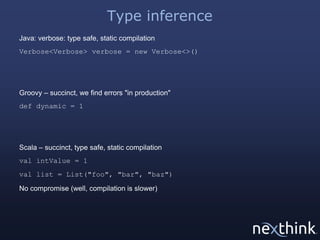
Type inference
Java: verbose: type safe, static compilation
Verbose<Verbose> verbose = new Verbose<>()

Groovy – succinct, we find errors "in production"
def dynamic = 1

Scala – succinct, type safe, static compilation
val intValue = 1
val list = List("foo", "bar", "baz")
No compromise (well, compilation is slower)
Less syntax - Java
final BigDecimal principle = new BigDecimal("100000");
final BigDecimal interestRate = new BigDecimal("0.065");
final int depositTerm = 10;
final BigDecimal interestEarned =
principle.multiply(interestRate.add(ONE).pow(depositTerm))
.subtract(principle).setScale(2, ROUND_HALF_UP);
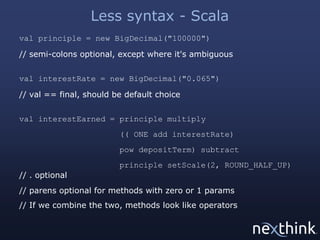
Less syntax - Scala
val principle = new BigDecimal("100000")
// semi-colons optional, except where it's ambiguous
val interestRate = new BigDecimal("0.065")
// val == final, should be default choice
val interestEarned = principle multiply
(( ONE add interestRate)
pow depositTerm) subtract
principle setScale(2, ROUND_HALF_UP)
// . optional
// parens optional for methods with zero or 1 params
// If we combine the two, methods look like operators
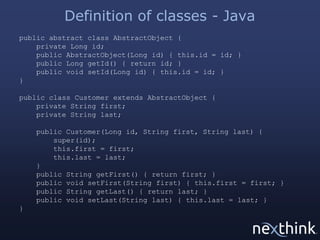
Definition of classes - Java
public abstract class AbstractObject {
private Long id;
public AbstractObject(Long id) { this.id = id; }
public Long getId() { return id; }
public void setId(Long id) { this.id = id; }
}
public class Customer extends AbstractObject {
private String first;
private String last;
public Customer(Long id, String first, String last) {
super(id);
this.first = first;
this.last = last;
}
public String getFirst() { return first; }
public void setFirst(String first) { this.first = first; }
public String getLast() { return last; }
public void setLast(String last) { this.last = last; }
}
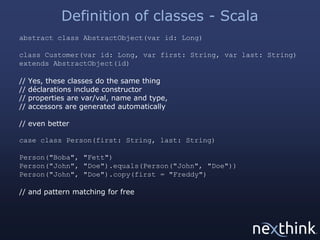
Definition of classes - Scala
abstract class AbstractObject(var id: Long)
class Customer(var id: Long, var first: String, var last: String)
extends AbstractObject(id)

//
//
//
//

Yes, these classes do the same thing
déclarations include constructor
properties are var/val, name and type,
accessors are generated automatically

// even better
case class Person(first: String, last: String)
Person("Boba", "Fett")
Person("John", "Doe").equals(Person("John", "Doe"))
Person("John", "Doe").copy(first = "Freddy")

// and pattern matching for free
Closures – Java7
public interface FunctionInt {
int evaluate(int parameter);
}
private static List<Integer> doLoop(List<Integer> inputs, FunctionInt f) {
ArrayList<Integer> result = new ArrayList<>(inputs.size());
for (int input : inputs) {
result.add(f.evaluate(input));
}
return result;
}
public static void main(String[] args) {
List<Integer> primes = Arrays.asList(1, 2, 3, 5, 7, 11, 13, 17);
List<Integer> possiblePrimes = doLoop(primes, new FunctionInt() {
public int evaluate(int n) {
return n * 2 - 1;
}
});
System.out.println("possiblePrimes=" + possiblePrimes);
}
Closures – Java8
public interface FunctionInt {
int evaluate(int parameter);
}
private static List<Integer> doLoop(List<Integer> inputs, FunctionInt f) {
ArrayList<Integer> result = new ArrayList<>(inputs.size());
for (int input : inputs) {
result.add(f.evaluate(input));
}
return result;
}
public static void main(String[] args) {
List<Integer> primes = Arrays.asList(1, 2, 3, 5, 7, 11, 13, 17);
List<Integer> possiblePrimes = doLoop(primes, (n -> n * 2 - 1 ));
System.out.println("possiblePrimes=" + possiblePrimes);
}
Closures - Scala
private def doLoop(inputs: Seq[Int], fn: (Int) => Int): Seq[Int] = {
val result = ListBuffer[Int]()
for (input <- inputs) {
result += fn(input) // not the best, use map instead
}
result
}
def main(args: Array[String]) {
val primes = List(1, 2, 3, 5, 7, 11, 13, 17, 19, 23)
val possiblePrimes = doLoop(primes, {n => n * 2 - 1})
println("possiblePrimes=" + possiblePrimes)
}
// (Int) => Int is how we declare a function
// { n => n * 2 - 1 } is effectively:
new Function1[Int, Int] {
def apply(n: Int): Int = {
n * 2 - 1
}
}
Collections – Java7
List<Integer> numbers = Arrays.asList(1, 2, 3);
// static imports make our lives easier
// but there are always things which aren't easy
Map<String, Integer> map = new HashMap<>();
map.put("one", 1);
map.put("two", 2);
map.put("three", 3);
// We can add our own methods, but we need to write them
map(entry("one", 1), entry("two", 2), entry("three", 3));
// filter
List<Integer> list = Arrays.asList(1, 2, 3, 4, 5, 6);
ArrayList<Integer> oddNumbers = new ArrayList<>(inputs.size());
for (int input : list) {
if (input % 2 != 0) {
oddNumbers.add(input);
}
}
Collections - Scala
// simple things are simple
val numbers = List(1, 2, 3)
val moreNumbers = numbers ::: List(4, 5, 6) // concatenation
val map = Map("one" -> 1, "two" -> 2, "three" -> 3)

// filter
val numbers = List(1, 2, 3, 4, 5, 6)
val oddNumbers = numbers.filter(_ % 2 != 0)
// map (transform a list of X into a list of Y)
val numbers = List(1, 2, 3, 4, 5, 6)
def oddOrEven(i: Int) = n + " is " + (if (n % 2 != 0) "odd" else "even")
val statements = numbers.map(oddOrEven)
// N.B. statements = List[String]
// sum
val numbers = List(1, 2, 3, 4, 5, 6)
val sum = numbers.sum
Collections – Java 8 vs Scala
// Java 8
List<Integer> primes = Arrays.asList(1, 2, 3, 5, 7, 11, 13, 17);
List<Integer> possiblePrimes = primes.stream()
.map(n -> n * 2 - 1)
.collect(Collectors.toList());
// Scala
val primes = List(1, 2, 3, 5, 7, 11, 13, 17)
val possiblePrimes = primes.map(n => n * 2 - 1)
// or
val possiblePrimes = primes.map(_ * 2 – 1)
// possiblePrimes is a List[Int]

// can't do the following in Java:
val primes = Array(1, 2, 3, 5, 7, 11, 13, 17)
val possiblePrimes = primes.map(n => n * 2 – 1)
// possiblePrimes is an Array[Int]
// same performance as Java
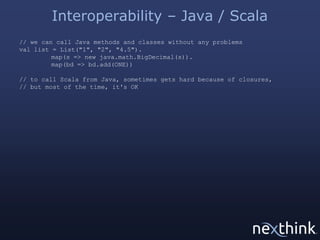
Interoperability – Java / Scala
// we can call Java methods and classes without any problems
val list = List("1", "2", "4.5").
map(s => new java.math.BigDecimal(s)).
map(bd => bd.add(ONE))
// to call Scala from Java, sometimes gets hard because of closures,
// but most of the time, it's OK
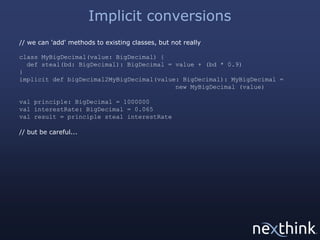
Implicit conversions
// we can 'add' methods to existing classes, but not really
class MyBigDecimal(value: BigDecimal) {
def steal(bd: BigDecimal): BigDecimal = value + (bd * 0.9)
}
implicit def bigDecimal2MyBigDecimal(value: BigDecimal): MyBigDecimal =
new MyBigDecimal (value)
val principle: BigDecimal = 1000000
val interestRate: BigDecimal = 0.065
val result = principle steal interestRate
// but be careful...
DIY operators
// we can define methods with non-alphanumerique names, such as +
class BigDecimalWithOperators(val value: BigDecimal) {
def + (bd: BigDecimal): BigDecimal = value add bd
def - (bd: BigDecimal): BigDecimal = value subtract bd
def * (bd: BigDecimal): BigDecimal = value multiply bd
def ^ (bd: Int): BigDecimal = value pow bd
def to$: BigDecimal = value setScale(2, HALF_UP)
}
implicit def bigDecimal2BigDecimalWithOperators(value: BigDecimal):
BigDecimalWithOperators = new BigDecimalWithOperators(value)
val principle = new BigDecimal("1000000")
val interestRate = new BigDecimal("0.065")
val depositTerm = 10
val interestEarned = (principle * ((ONE + interestRate) ^ depositTerm) principle).to$
println("interestEarned=" + interestEarned)

// but again be careful ...
// note that this is NOT operator overloading
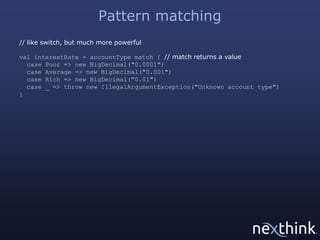
Pattern matching
// like switch, but much more powerful
val interestRate = accountType match { // match returns a value
case Poor => new BigDecimal("0.0001")
case Average => new BigDecimal("0.001")
case Rich => new BigDecimal("0.01")
case _ => throw new IllegalArgumentException("Unknown account type")
}
Pattern matching
// and even better
case class Name(names: List[String])
case class Languages(languages: List[String])
def interpret(strings: List[String]): Any = {
strings match {
case Nil => null
case "Name:" :: tail => Name(tail)
case "Languages:" :: tail => Languages(tail)
case List("Hello:", x, y) => List(x, y)
case label :: _ => throw new Exception("Unknown label: " + label)
}
}
interpret(List("Name:", "Matthew", "Farwell"))
interpret(List("Hello:", "All", "There"))
interpret(List("Hello:", "Too", "Many", "Items"))
interpret(List("Languages:", "Java", "Scala", "Javascript", "Groovy"))
interpret(List())
interpret(List("Unknown:", "Hello"))
Named parameters / default values
// JAVA
public class FunctionalException extends Exception {
// etc.
}
public class FunctionalExceptionBuilder {
public FunctionalExceptionBuilder(String message) {...}
public FunctionalExceptionBuilder setCause(Exception cause) {...}
public FunctionalExceptionBuilder setErrorCode(String errorCode) {...}
public FunctionalException build() { return new
FunctionalException(message, cause, errorCode); }
}
// we use like:
new FunctionalExceptionBuilder("message").setErrorCode("001").build());
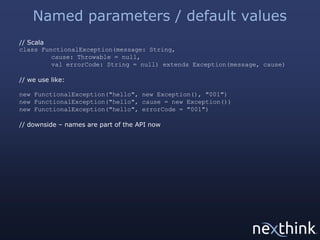
Named parameters / default values
// Scala
class FunctionalException(message: String,
cause: Throwable = null,
val errorCode: String = null) extends Exception(message, cause)
// we use like:
new FunctionalException("hello", new Exception(), "001")
new FunctionalException("hello", cause = new Exception())
new FunctionalException("hello", errorCode = "001")
// downside – names are part of the API now
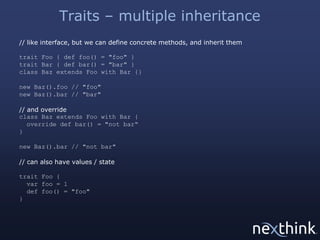
Traits – multiple inheritance
// like interface, but we can define concrete methods, and inherit them
trait Foo { def foo() = "foo" }
trait Bar { def bar() = "bar" }
class Baz extends Foo with Bar {}
new Baz().foo // "foo"
new Baz().bar // "bar"
// and override
class Baz extends Foo with Bar {
override def bar() = "not bar“
}
new Baz().bar // "not bar"
// can also have values / state
trait Foo {
var foo = 1
def foo() = "foo"
}
Simplified concurrency – one thread
List(1, 2, 3, 4).map(i => {
println("calculating " + i)
Thread.sleep(1000)
println("done " + i)
i * 2
})
calculating 1
done 1
calculating 2
done 2
calculating 3
done 3
calculating 4
done 4
res14: List[Int] = List(2, 4, 6, 8)
Simplified concurrency – >1 thread
List(1, 2, 3, 4).par.map(i => {
println("calculating " + i)
Thread.sleep(1000)
println("done " + i)
i * 2
})
calculating 1
calculating 4
calculating 2
calculating 3
done 1
done 4
done 3
done 2
res14: List[Int] = List(2, 4, 6, 8)
// and futures, promises, actors
And more…
For comprehensions
Lazy evaluation
Futures and promises
Currying
Value classes
String interpolation
Implicit classes
Actors / AKKA
Options
XML Literals
Parser combinators
Partial functions
Higher kinded types
Scala REPL / Scala IDE Worksheet
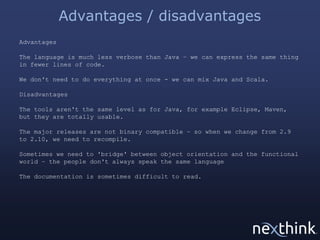
Advantages / disadvantages
Advantages
The language is much less verbose than Java – we can express the same thing
in fewer lines of code.
We don't need to do everything at once - we can mix Java and Scala.
Disadvantages
The tools aren't the same level as for Java, for example Eclipse, Maven,
but they are totally usable.
The major releases are not binary compatible – so when we change from 2.9
to 2.10, we need to recompile.
Sometimes we need to 'bridge' between object orientation and the functional
world – the people don't always speak the same language
The documentation is sometimes difficult to read.
Me again
Matthew Farwell
Twitter: @matthewfarwell
Blog: http://randomallsorts.blogspot.ch/
Scalastyle: http://www.scalastyle.org
sbt in Action: http://manning.com/suereth2

Softshake 2013: 10 reasons why java developers are jealous of Scala developers

  • 1.
    10 reasons whyJava developers are jealous of Scala developers
  • 2.
     Or 10things which are not in Java but are in modern languages  Inspired by Graham Lea, thanks to him
  • 3.
    Matthew Farwell  Seniordeveloper @ Nexthink SA in Lausanne  > 20 years development experience  Project lead on Scalastyle, the style checker for Scala  Contributor to various open source projects, Junit  Co-author of "sbt in Action" with Josh Suereth
  • 4.
    Type inference Java: verbose:type safe, static compilation Verbose<Verbose> verbose = new Verbose<>() Groovy – succinct, we find errors "in production" def dynamic = 1 Scala – succinct, type safe, static compilation val intValue = 1 val list = List("foo", "bar", "baz") No compromise (well, compilation is slower)
  • 5.
    Less syntax -Java final BigDecimal principle = new BigDecimal("100000"); final BigDecimal interestRate = new BigDecimal("0.065"); final int depositTerm = 10; final BigDecimal interestEarned = principle.multiply(interestRate.add(ONE).pow(depositTerm)) .subtract(principle).setScale(2, ROUND_HALF_UP);
  • 6.
    Less syntax -Scala val principle = new BigDecimal("100000") // semi-colons optional, except where it's ambiguous val interestRate = new BigDecimal("0.065") // val == final, should be default choice val interestEarned = principle multiply (( ONE add interestRate) pow depositTerm) subtract principle setScale(2, ROUND_HALF_UP) // . optional // parens optional for methods with zero or 1 params // If we combine the two, methods look like operators
  • 7.
    Definition of classes- Java public abstract class AbstractObject { private Long id; public AbstractObject(Long id) { this.id = id; } public Long getId() { return id; } public void setId(Long id) { this.id = id; } } public class Customer extends AbstractObject { private String first; private String last; public Customer(Long id, String first, String last) { super(id); this.first = first; this.last = last; } public String getFirst() { return first; } public void setFirst(String first) { this.first = first; } public String getLast() { return last; } public void setLast(String last) { this.last = last; } }
  • 8.
    Definition of classes- Scala abstract class AbstractObject(var id: Long) class Customer(var id: Long, var first: String, var last: String) extends AbstractObject(id) // // // // Yes, these classes do the same thing déclarations include constructor properties are var/val, name and type, accessors are generated automatically // even better case class Person(first: String, last: String) Person("Boba", "Fett") Person("John", "Doe").equals(Person("John", "Doe")) Person("John", "Doe").copy(first = "Freddy") // and pattern matching for free
  • 9.
    Closures – Java7 publicinterface FunctionInt { int evaluate(int parameter); } private static List<Integer> doLoop(List<Integer> inputs, FunctionInt f) { ArrayList<Integer> result = new ArrayList<>(inputs.size()); for (int input : inputs) { result.add(f.evaluate(input)); } return result; } public static void main(String[] args) { List<Integer> primes = Arrays.asList(1, 2, 3, 5, 7, 11, 13, 17); List<Integer> possiblePrimes = doLoop(primes, new FunctionInt() { public int evaluate(int n) { return n * 2 - 1; } }); System.out.println("possiblePrimes=" + possiblePrimes); }
  • 10.
    Closures – Java8 publicinterface FunctionInt { int evaluate(int parameter); } private static List<Integer> doLoop(List<Integer> inputs, FunctionInt f) { ArrayList<Integer> result = new ArrayList<>(inputs.size()); for (int input : inputs) { result.add(f.evaluate(input)); } return result; } public static void main(String[] args) { List<Integer> primes = Arrays.asList(1, 2, 3, 5, 7, 11, 13, 17); List<Integer> possiblePrimes = doLoop(primes, (n -> n * 2 - 1 )); System.out.println("possiblePrimes=" + possiblePrimes); }
  • 11.
    Closures - Scala privatedef doLoop(inputs: Seq[Int], fn: (Int) => Int): Seq[Int] = { val result = ListBuffer[Int]() for (input <- inputs) { result += fn(input) // not the best, use map instead } result } def main(args: Array[String]) { val primes = List(1, 2, 3, 5, 7, 11, 13, 17, 19, 23) val possiblePrimes = doLoop(primes, {n => n * 2 - 1}) println("possiblePrimes=" + possiblePrimes) } // (Int) => Int is how we declare a function // { n => n * 2 - 1 } is effectively: new Function1[Int, Int] { def apply(n: Int): Int = { n * 2 - 1 } }
  • 12.
    Collections – Java7 List<Integer>numbers = Arrays.asList(1, 2, 3); // static imports make our lives easier // but there are always things which aren't easy Map<String, Integer> map = new HashMap<>(); map.put("one", 1); map.put("two", 2); map.put("three", 3); // We can add our own methods, but we need to write them map(entry("one", 1), entry("two", 2), entry("three", 3)); // filter List<Integer> list = Arrays.asList(1, 2, 3, 4, 5, 6); ArrayList<Integer> oddNumbers = new ArrayList<>(inputs.size()); for (int input : list) { if (input % 2 != 0) { oddNumbers.add(input); } }
  • 13.
    Collections - Scala //simple things are simple val numbers = List(1, 2, 3) val moreNumbers = numbers ::: List(4, 5, 6) // concatenation val map = Map("one" -> 1, "two" -> 2, "three" -> 3) // filter val numbers = List(1, 2, 3, 4, 5, 6) val oddNumbers = numbers.filter(_ % 2 != 0) // map (transform a list of X into a list of Y) val numbers = List(1, 2, 3, 4, 5, 6) def oddOrEven(i: Int) = n + " is " + (if (n % 2 != 0) "odd" else "even") val statements = numbers.map(oddOrEven) // N.B. statements = List[String] // sum val numbers = List(1, 2, 3, 4, 5, 6) val sum = numbers.sum
  • 14.
    Collections – Java8 vs Scala // Java 8 List<Integer> primes = Arrays.asList(1, 2, 3, 5, 7, 11, 13, 17); List<Integer> possiblePrimes = primes.stream() .map(n -> n * 2 - 1) .collect(Collectors.toList()); // Scala val primes = List(1, 2, 3, 5, 7, 11, 13, 17) val possiblePrimes = primes.map(n => n * 2 - 1) // or val possiblePrimes = primes.map(_ * 2 – 1) // possiblePrimes is a List[Int] // can't do the following in Java: val primes = Array(1, 2, 3, 5, 7, 11, 13, 17) val possiblePrimes = primes.map(n => n * 2 – 1) // possiblePrimes is an Array[Int] // same performance as Java
  • 15.
    Interoperability – Java/ Scala // we can call Java methods and classes without any problems val list = List("1", "2", "4.5"). map(s => new java.math.BigDecimal(s)). map(bd => bd.add(ONE)) // to call Scala from Java, sometimes gets hard because of closures, // but most of the time, it's OK
  • 16.
    Implicit conversions // wecan 'add' methods to existing classes, but not really class MyBigDecimal(value: BigDecimal) { def steal(bd: BigDecimal): BigDecimal = value + (bd * 0.9) } implicit def bigDecimal2MyBigDecimal(value: BigDecimal): MyBigDecimal = new MyBigDecimal (value) val principle: BigDecimal = 1000000 val interestRate: BigDecimal = 0.065 val result = principle steal interestRate // but be careful...
  • 17.
    DIY operators // wecan define methods with non-alphanumerique names, such as + class BigDecimalWithOperators(val value: BigDecimal) { def + (bd: BigDecimal): BigDecimal = value add bd def - (bd: BigDecimal): BigDecimal = value subtract bd def * (bd: BigDecimal): BigDecimal = value multiply bd def ^ (bd: Int): BigDecimal = value pow bd def to$: BigDecimal = value setScale(2, HALF_UP) } implicit def bigDecimal2BigDecimalWithOperators(value: BigDecimal): BigDecimalWithOperators = new BigDecimalWithOperators(value) val principle = new BigDecimal("1000000") val interestRate = new BigDecimal("0.065") val depositTerm = 10 val interestEarned = (principle * ((ONE + interestRate) ^ depositTerm) principle).to$ println("interestEarned=" + interestEarned) // but again be careful ... // note that this is NOT operator overloading
  • 18.
    Pattern matching // likeswitch, but much more powerful val interestRate = accountType match { // match returns a value case Poor => new BigDecimal("0.0001") case Average => new BigDecimal("0.001") case Rich => new BigDecimal("0.01") case _ => throw new IllegalArgumentException("Unknown account type") }
  • 19.
    Pattern matching // andeven better case class Name(names: List[String]) case class Languages(languages: List[String]) def interpret(strings: List[String]): Any = { strings match { case Nil => null case "Name:" :: tail => Name(tail) case "Languages:" :: tail => Languages(tail) case List("Hello:", x, y) => List(x, y) case label :: _ => throw new Exception("Unknown label: " + label) } } interpret(List("Name:", "Matthew", "Farwell")) interpret(List("Hello:", "All", "There")) interpret(List("Hello:", "Too", "Many", "Items")) interpret(List("Languages:", "Java", "Scala", "Javascript", "Groovy")) interpret(List()) interpret(List("Unknown:", "Hello"))
  • 20.
    Named parameters /default values // JAVA public class FunctionalException extends Exception { // etc. } public class FunctionalExceptionBuilder { public FunctionalExceptionBuilder(String message) {...} public FunctionalExceptionBuilder setCause(Exception cause) {...} public FunctionalExceptionBuilder setErrorCode(String errorCode) {...} public FunctionalException build() { return new FunctionalException(message, cause, errorCode); } } // we use like: new FunctionalExceptionBuilder("message").setErrorCode("001").build());
  • 21.
    Named parameters /default values // Scala class FunctionalException(message: String, cause: Throwable = null, val errorCode: String = null) extends Exception(message, cause) // we use like: new FunctionalException("hello", new Exception(), "001") new FunctionalException("hello", cause = new Exception()) new FunctionalException("hello", errorCode = "001") // downside – names are part of the API now
  • 22.
    Traits – multipleinheritance // like interface, but we can define concrete methods, and inherit them trait Foo { def foo() = "foo" } trait Bar { def bar() = "bar" } class Baz extends Foo with Bar {} new Baz().foo // "foo" new Baz().bar // "bar" // and override class Baz extends Foo with Bar { override def bar() = "not bar“ } new Baz().bar // "not bar" // can also have values / state trait Foo { var foo = 1 def foo() = "foo" }
  • 23.
    Simplified concurrency –one thread List(1, 2, 3, 4).map(i => { println("calculating " + i) Thread.sleep(1000) println("done " + i) i * 2 }) calculating 1 done 1 calculating 2 done 2 calculating 3 done 3 calculating 4 done 4 res14: List[Int] = List(2, 4, 6, 8)
  • 24.
    Simplified concurrency –>1 thread List(1, 2, 3, 4).par.map(i => { println("calculating " + i) Thread.sleep(1000) println("done " + i) i * 2 }) calculating 1 calculating 4 calculating 2 calculating 3 done 1 done 4 done 3 done 2 res14: List[Int] = List(2, 4, 6, 8) // and futures, promises, actors
  • 25.
    And more… For comprehensions Lazyevaluation Futures and promises Currying Value classes String interpolation Implicit classes Actors / AKKA Options XML Literals Parser combinators Partial functions Higher kinded types Scala REPL / Scala IDE Worksheet
  • 26.
    Advantages / disadvantages Advantages Thelanguage is much less verbose than Java – we can express the same thing in fewer lines of code. We don't need to do everything at once - we can mix Java and Scala. Disadvantages The tools aren't the same level as for Java, for example Eclipse, Maven, but they are totally usable. The major releases are not binary compatible – so when we change from 2.9 to 2.10, we need to recompile. Sometimes we need to 'bridge' between object orientation and the functional world – the people don't always speak the same language The documentation is sometimes difficult to read.
  • 27.
    Me again Matthew Farwell Twitter:@matthewfarwell Blog: http://randomallsorts.blogspot.ch/ Scalastyle: http://www.scalastyle.org sbt in Action: http://manning.com/suereth2