RENEWING BELOVED COMMUNITY
UNDERSTANDING STRUCTURAL RACIALIZATION
AND OPPORTUNITY
                            john a. powell
    Executive Director, Kirwan Institute for the Study of Race and Ethnicity
    Williams Chair in Civil Rights & Civil Liberties, Moritz College of Law


               Presentation to Genesis
               First Unitarian Church of Oakland
               August 29, 2010
Overview
   My Opportunity Story: thinking through a structural
    racialization lens
   A Brief Snapshot of Opportunity in the San
    Francisco-Oakland-Fresno Area
   Renewing Our Communities
     Thinking,   talking, acting in new ways
   Activity: Telling your own Opportunity Story
My Opportunity Story
Thinking through a structural racialization lens
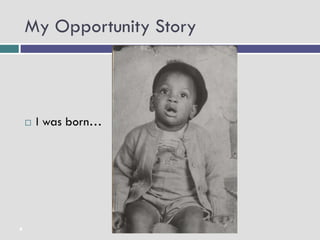
My Opportunity Story


       I was born…


4
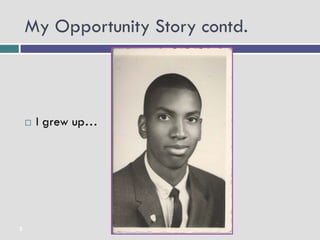
My Opportunity Story contd.


       I grew up…


5
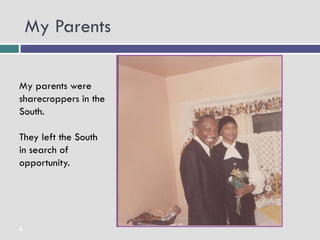
My Parents

My parents were
sharecroppers in the
South.

They left the South
in search of
opportunity.


6
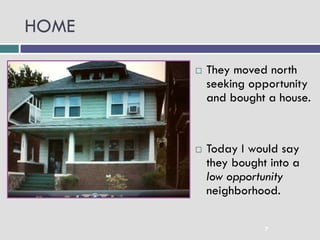
HOME

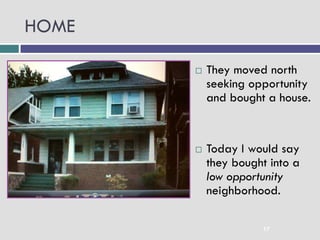
                                   They moved north
   They moved north seeking
    opportunity and bought a        seeking opportunity
    house.                          and bought a house.


   Today I would say they         Today I would say
    bought into a low
    opportunity neighborhood.       they bought into a
                                    low opportunity
                                    neighborhood.

                                               7
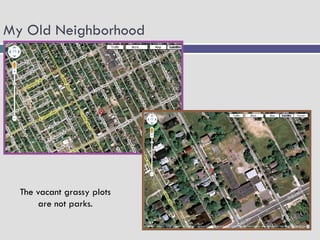
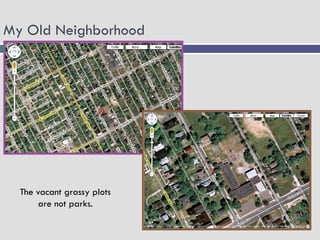
My Old Neighborhood
8


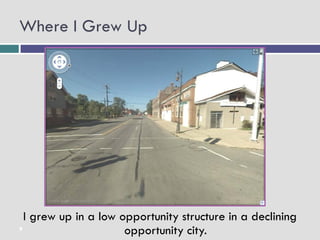
    The vacant grassy plots
         are not parks.
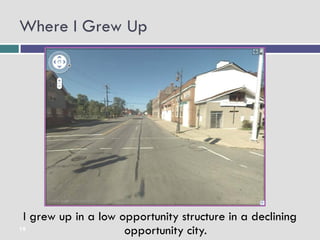
Where I Grew Up


  I grew up in a low opportunity structure in a declining
9
                      opportunity city.
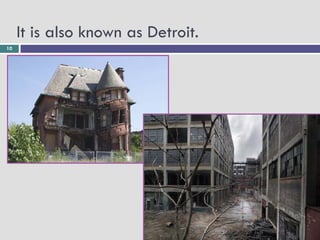
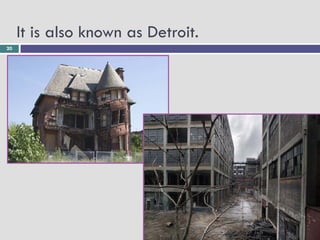
It is also known as Detroit.
10
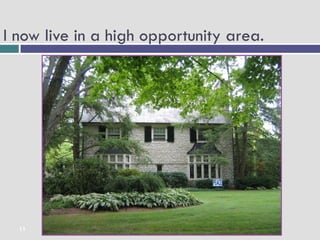
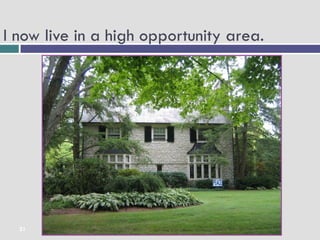
I now live in a high opportunity area.


  11
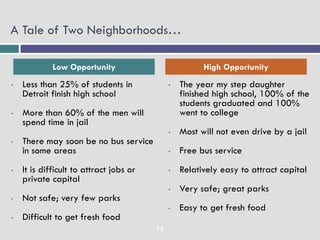
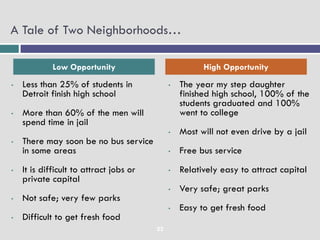
A Tale of Two Neighborhoods…

             Low Opportunity                            High Opportunity
•   Less than 25% of students in              •   The year my step daughter
    Detroit finish high school                    finished high school, 100% of the
                                                  students graduated and 100%
•   More than 60% of the men will                 went to college
    spend time in jail
                                              •   Most will not even drive by a jail
•   There may soon be no bus service
    in some areas                             •   Free bus service
•   It is difficult to attract jobs or        •   Relatively easy to attract capital
    private capital
                                              •   Very safe; great parks
•   Not safe; very few parks
                                              •   Easy to get fresh food
•   Difficult to get fresh food
                                         12
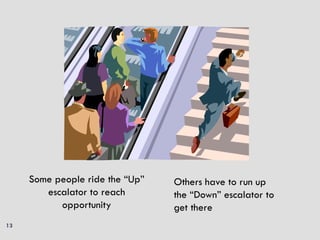
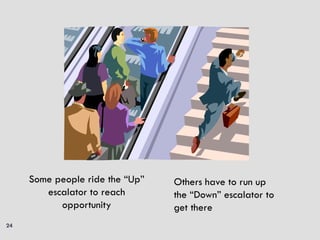
Some people ride the “Up”   Others have to run up
        escalator to reach       the “Down” escalator to
           opportunity           get there
13
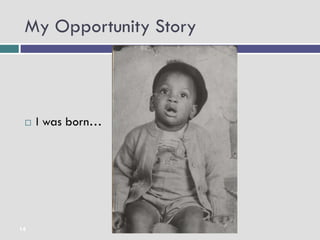
My Opportunity Story


    I was born…


14
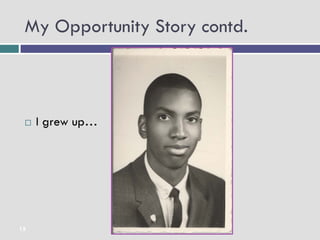
My Opportunity Story contd.


    I grew up…


15
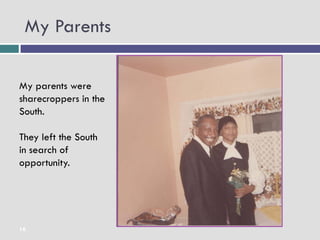
My Parents

My parents were
sharecroppers in the
South.

They left the South
in search of
opportunity.


16
HOME

                                   They moved north
   They moved north seeking
    opportunity and bought a        seeking opportunity
    house.                          and bought a house.


   Today I would say they         Today I would say
    bought into a low
    opportunity neighborhood.       they bought into a
                                    low opportunity
                                    neighborhood.

                                              17
My Old Neighborhood
18


     The vacant grassy plots
          are not parks.
Where I Grew Up


 I grew up in a low opportunity structure in a declining
19
                     opportunity city.
It is also known as Detroit.
20
I now live in a high opportunity area.


  21
A Tale of Two Neighborhoods…

             Low Opportunity                            High Opportunity
•   Less than 25% of students in              •   The year my step daughter
    Detroit finish high school                    finished high school, 100% of the
                                                  students graduated and 100%
•   More than 60% of the men will                 went to college
    spend time in jail
                                              •   Most will not even drive by a jail
•   There may soon be no bus service
    in some areas                             •   Free bus service
•   It is difficult to attract jobs or        •   Relatively easy to attract capital
    private capital
                                              •   Very safe; great parks
•   Not safe; very few parks
                                              •   Easy to get fresh food
•   Difficult to get fresh food
                                         22
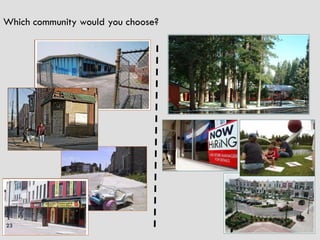
Which community would you choose?


23
Some people ride the “Up”   Others have to run up
        escalator to reach       the “Down” escalator to
           opportunity           get there
24
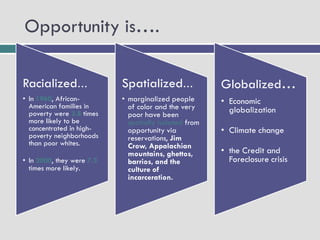
Opportunity is….

Racialized…                Spatialized…                Globalized…
• In 1960, African-        • marginalized people       • Economic
  American families in       of color and the very
  poverty were 3.8 times                                 globalization
                             poor have been
  more likely to be          spatially isolated from
  concentrated in high-      opportunity via           • Climate change
  poverty neighborhoods      reservations, Jim
  than poor whites.          Crow, Appalachian
                             mountains, ghettos,       • the Credit and
• In 2000, they were 7.3     barrios, and the            Foreclosure crisis
  times more likely.         culture of
                             incarceration.
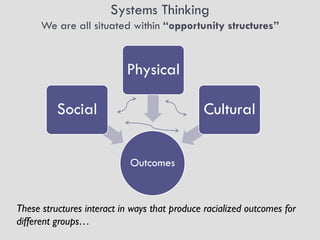
Systems Thinking
      We are all situated within “opportunity structures”


                           Physical

          Social                              Cultural


                            Outcomes


These structures interact in ways that produce racialized outcomes for
different groups…
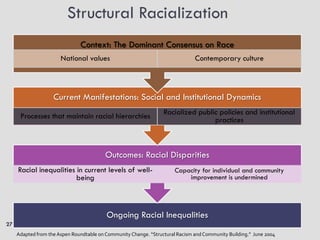
Structural Racialization
                               Context: The Dominant Consensus on Race
                       National values                                         Contemporary culture


                    Current Manifestations: Social and Institutional Dynamics
      Processes that maintain racial hierarchies                  Racialized public policies and institutional
                                                                                  practices


                                          Outcomes: Racial Disparities
     Racial inequalities in current levels of well-                    Capacity for individual and community
                         being                                             improvement is undermined


                                          Ongoing Racial Inequalities
27
     Adapted from the Aspen Roundtable on Community Change. “Structural Racism and Community Building.” June 2004
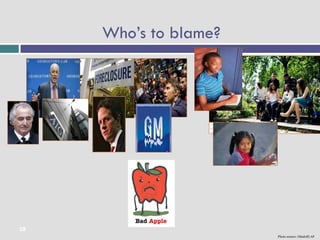
Who’s to blame?


28
                       Photo source: (Madoff) AP
Historic Government Role
29

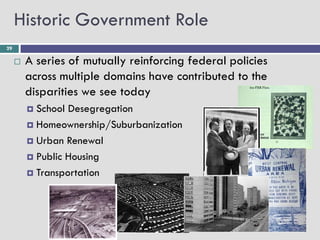
        A series of mutually reinforcing federal policies
         across multiple domains have contributed to the
         disparities we see today
          School Desegregation
          Homeownership/Suburbanization

          Urban Renewal

          Public Housing

          Transportation
Example
The Government and Homeownership Policies: Redlining

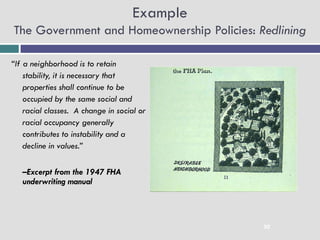
“If a neighborhood is to retain
    stability, it is necessary that
    properties shall continue to be
    occupied by the same social and
    racial classes. A change in social or
    racial occupancy generally
    contributes to instability and a
    decline in values.”

   –Excerpt from the 1947 FHA
   underwriting manual


                                               30
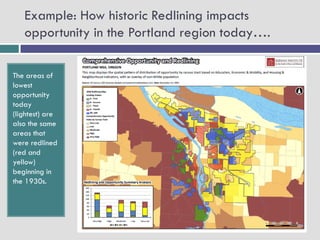
Example: How historic Redlining impacts
   opportunity in the Portland region today….

The areas of
lowest
opportunity
today
(lightest) are
also the same
areas that
were redlined
(red and
yellow)
beginning in
the 1930s.
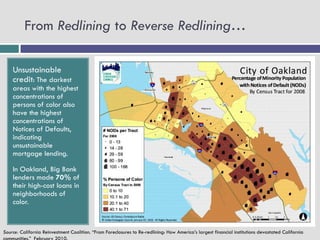
From Redlining to Reverse Redlining…

    Unsustainable
    credit: The darkest
    areas with the highest
    concentrations of
    persons of color also
    have the highest
    concentrations of
    Notices of Defaults,
    indicating
    unsustainable
    mortgage lending.

    In Oakland, Big Bank
    lenders made 70% of
    their high-cost loans in
    neighborhoods of
    color.


Source: California Reinvestment Coalition. “From Foreclosures to Re-redlining: How America’s largest financial institutions devastated California
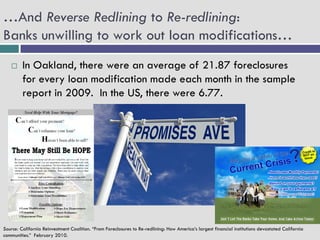
…And Reverse Redlining to Re-redlining:
Banks unwilling to work out loan modifications…
        In Oakland, there were an average of 21.87 foreclosures
         for every loan modification made each month in the sample
         report in 2009. In the US, there were 6.77.


Source: California Reinvestment Coalition. “From Foreclosures to Re-redlining: How America’s largest financial institutions devastated California
communities.” February 2010.
Re-redlining contd.:
                 And credit once again unavailable
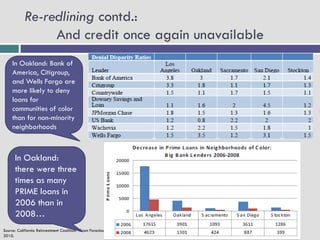
     In Oakland: Bank of
     America, Citigroup,
     and Wells Fargo are
     more likely to deny
     loans for
     communities of color
     than for non-minority
     neighborhoods


      In Oakland:
      there were three
      times as many
      PRIME loans in
      2006 than in
      2008…
Source: California Reinvestment Coalition. “From Foreclosures to Re-redlining: How America’s largest financial institutions devastated California communities.” February
2010.
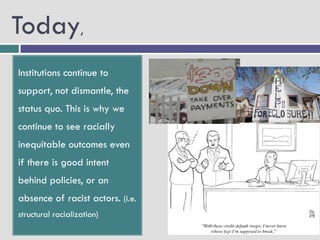
Today,
Institutions continue to
support, not dismantle, the
status quo. This is why we
continue to see racially
inequitable outcomes even
if there is good intent
behind policies, or an
absence of racist actors. (i.e.
structural racialization)
Lesson:
How we allocate our resources in
terms of People, Places, and
Linkages matters….
A Brief Snapshot of Opportunity for Children
in the San Francisco-Oakland-Fresno region
What are some key intervention points to
improve opportunity for children?
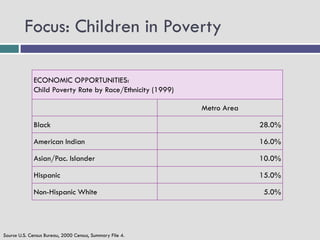
Focus: Children in Poverty

             ECONOMIC OPPORTUNITIES:
             Child Poverty Rate by Race/Ethnicity (1999)

                                                           Metro Area

             Black                                                      28.0%

             American Indian                                            16.0%

             Asian/Pac. Islander                                        10.0%

             Hispanic                                                   15.0%

             Non-Hispanic White                                          5.0%


Source U.S. Census Bureau, 2000 Census, Summary File 4.
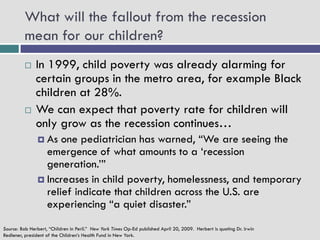
What will the fallout from the recession
          mean for our children?
              In 1999, child poverty was already alarming for
               certain groups in the metro area, for example Black
               children at 28%.
              We can expect that poverty rate for children will
               only grow as the recession continues…
                As  one pediatrician has warned, “We are seeing the
                 emergence of what amounts to a ‘recession
                 generation.’”
                Increases in child poverty, homelessness, and temporary
                 relief indicate that children across the U.S. are
                 experiencing “a quiet disaster.”
Source: Bob Herbert, “Children in Peril.” New York Times Op-Ed published April 20, 2009. Herbert is quoting Dr. Irwin
Redlener, president of the Children’s Health Fund in New York.
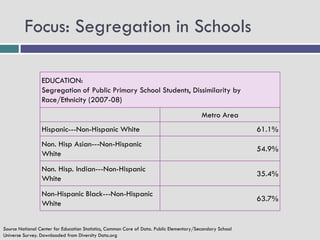
Focus: Segregation in Schools

                 EDUCATION:
                 Segregation of Public Primary School Students, Dissimilarity by
                 Race/Ethnicity (2007-08)
                                                                                          Metro Area
                 Hispanic---Non-Hispanic White                                                             61.1%
                 Non. Hisp Asian---Non-Hispanic
                                                                                                           54.9%
                 White
                 Non. Hisp. Indian---Non-Hispanic
                                                                                                           35.4%
                 White
                 Non-Hispanic Black---Non-Hispanic
                                                                                                           63.7%
                 White


Source National Center for Education Statistics, Common Core of Data. Public Elementary/Secondary School
Universe Survey. Downloaded from Diversity Data.org
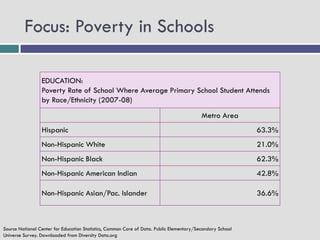
Focus: Poverty in Schools

                 EDUCATION:
                 Poverty Rate of School Where Average Primary School Student Attends
                 by Race/Ethnicity (2007-08)
                                                                                          Metro Area
                 Hispanic                                                                                  63.3%
                 Non-Hispanic White                                                                        21.0%
                 Non-Hispanic Black                                                                        62.3%
                 Non-Hispanic American Indian                                                              42.8%

                 Non-Hispanic Asian/Pac. Islander                                                          36.6%


Source National Center for Education Statistics, Common Core of Data. Public Elementary/Secondary School
Universe Survey. Downloaded from Diversity Data.org
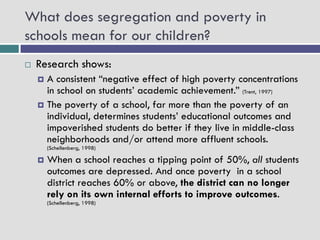
What does segregation and poverty in
schools mean for our children?
   Research shows:
     A consistent “negative effect of high poverty concentrations
      in school on students’ academic achievement.” (Trent, 1997)
     The poverty of a school, far more than the poverty of an
      individual, determines students’ educational outcomes and
      impoverished students do better if they live in middle-class
      neighborhoods and/or attend more affluent schools.
        (Schellenberg, 1998)

       When a school reaches a tipping point of 50%, all students
        outcomes are depressed. And once poverty in a school
        district reaches 60% or above, the district can no longer
        rely on its own internal efforts to improve outcomes.
        (Schellenberg, 1998)
Renewing our Communities
Growing opportunity for all
Strategies for Growing Together

 Think in new ways
 Talk in new ways

 Act in new ways
Transformative Thinking
   transformative thinking to combat structural
    racialization; we need to find new approaches.

   personal and social responsibility are important: we
    should maintain them in our advocacy and analysis

   approaches should consider the structures and
    systems that are creating and perpetuating these
    disparities and work to reform them for lasting
    change.
     Challenging   policies, processes, and assumptions   45
Talking in New Ways
I.    How do we talk about race?
II.   Targeted universalism—a new frame for dialogue
      (beyond disparities)
I. How to Talk about Race
47


        Focus on structures and systems rather than explicit
         individual action/reaction

        Focus on the subconscious—the implicit bias that is
         stored within the mind

        Focus on relationships—build collaborations and
         engage in real discussion
II. Targeted universalism as
          communication strategy
   Moves beyond the disparities frame

   Focuses on the universal goals shared by all the
    communities while being sensitive to the targeted
    strategies that are responsive to the situation of
    marginalized communities
Acting in New Ways
I.     Engagement and empowerment
II.    Targeted universalism as policy
III.   Strategies for connecting to opportunity
I. Engagement and Empowerment
   The less resourced a community is, the more critical
    organizing becomes
How Institutions can strengthen engagement

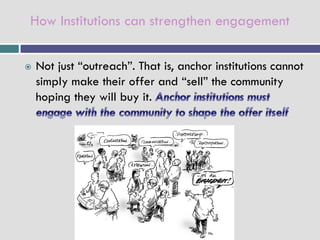
   Not just “outreach”. That is, anchor institutions cannot
    simply make their offer and “sell” the community
    hoping they will buy it.
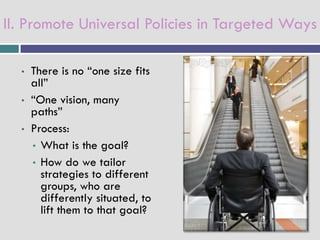
II. Promote Universal Policies in Targeted Ways

  •   There is no “one size fits
      all”
  •   “One vision, many
      paths”
  •   Process:
      • What is the goal?
      • How do we tailor
        strategies to different
        groups, who are
        differently situated, to
        lift them to that goal?
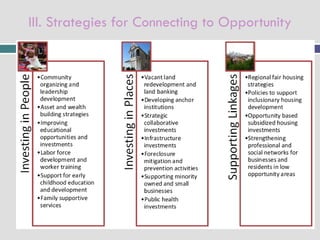
III. Strategies for Connecting to Opportunity
Activity: Telling your own Opportunity
Story
 Personal lens:
  What in my life and my parents’ life opened up and created opportunities for
    me?

    What in my life and my parents’ life has restricted opportunity for me?

    How has this impacted me? How has it shaped the story of my life?

    How does access to and restriction from opportunity impact my children’s lives?

 Community lens:
  Do opportunity structures exist in my community? What’s there, what’s missing,
   and for whom?
    Are they responsive to community needs?

    How do I impact these structures? How can the community?
www.KirwanInstitute.org

                          www.race-talk.org

                          KirwanInstitute
                          on:

Renewing Beloved Community Understanding Structural Racialization and Opportunity

  • 1.
    RENEWING BELOVED COMMUNITY UNDERSTANDINGSTRUCTURAL RACIALIZATION AND OPPORTUNITY john a. powell Executive Director, Kirwan Institute for the Study of Race and Ethnicity Williams Chair in Civil Rights & Civil Liberties, Moritz College of Law Presentation to Genesis First Unitarian Church of Oakland August 29, 2010
  • 2.
    Overview  My Opportunity Story: thinking through a structural racialization lens  A Brief Snapshot of Opportunity in the San Francisco-Oakland-Fresno Area  Renewing Our Communities  Thinking, talking, acting in new ways  Activity: Telling your own Opportunity Story
  • 3.
    My Opportunity Story Thinkingthrough a structural racialization lens
  • 4.
    My Opportunity Story  I was born… 4
  • 5.
    My Opportunity Storycontd.  I grew up… 5
  • 6.
    My Parents My parentswere sharecroppers in the South. They left the South in search of opportunity. 6
  • 7.
    HOME  They moved north  They moved north seeking opportunity and bought a seeking opportunity house. and bought a house.  Today I would say they  Today I would say bought into a low opportunity neighborhood. they bought into a low opportunity neighborhood. 7
  • 8.
    My Old Neighborhood 8 The vacant grassy plots are not parks.
  • 9.
    Where I GrewUp I grew up in a low opportunity structure in a declining 9 opportunity city.
  • 10.
    It is alsoknown as Detroit. 10
  • 11.
    I now livein a high opportunity area. 11
  • 12.
    A Tale ofTwo Neighborhoods… Low Opportunity High Opportunity • Less than 25% of students in • The year my step daughter Detroit finish high school finished high school, 100% of the students graduated and 100% • More than 60% of the men will went to college spend time in jail • Most will not even drive by a jail • There may soon be no bus service in some areas • Free bus service • It is difficult to attract jobs or • Relatively easy to attract capital private capital • Very safe; great parks • Not safe; very few parks • Easy to get fresh food • Difficult to get fresh food 12
  • 13.
    Some people ridethe “Up” Others have to run up escalator to reach the “Down” escalator to opportunity get there 13
  • 14.
    My Opportunity Story  I was born… 14
  • 15.
    My Opportunity Storycontd.  I grew up… 15
  • 16.
    My Parents My parentswere sharecroppers in the South. They left the South in search of opportunity. 16
  • 17.
    HOME  They moved north  They moved north seeking opportunity and bought a seeking opportunity house. and bought a house.  Today I would say they  Today I would say bought into a low opportunity neighborhood. they bought into a low opportunity neighborhood. 17
  • 18.
    My Old Neighborhood 18 The vacant grassy plots are not parks.
  • 19.
    Where I GrewUp I grew up in a low opportunity structure in a declining 19 opportunity city.
  • 20.
    It is alsoknown as Detroit. 20
  • 21.
    I now livein a high opportunity area. 21
  • 22.
    A Tale ofTwo Neighborhoods… Low Opportunity High Opportunity • Less than 25% of students in • The year my step daughter Detroit finish high school finished high school, 100% of the students graduated and 100% • More than 60% of the men will went to college spend time in jail • Most will not even drive by a jail • There may soon be no bus service in some areas • Free bus service • It is difficult to attract jobs or • Relatively easy to attract capital private capital • Very safe; great parks • Not safe; very few parks • Easy to get fresh food • Difficult to get fresh food 22
  • 23.
    Which community wouldyou choose? 23
  • 24.
    Some people ridethe “Up” Others have to run up escalator to reach the “Down” escalator to opportunity get there 24
  • 25.
    Opportunity is…. Racialized… Spatialized… Globalized… • In 1960, African- • marginalized people • Economic American families in of color and the very poverty were 3.8 times globalization poor have been more likely to be spatially isolated from concentrated in high- opportunity via • Climate change poverty neighborhoods reservations, Jim than poor whites. Crow, Appalachian mountains, ghettos, • the Credit and • In 2000, they were 7.3 barrios, and the Foreclosure crisis times more likely. culture of incarceration.
  • 26.
    Systems Thinking We are all situated within “opportunity structures” Physical Social Cultural Outcomes These structures interact in ways that produce racialized outcomes for different groups…
  • 27.
    Structural Racialization Context: The Dominant Consensus on Race National values Contemporary culture Current Manifestations: Social and Institutional Dynamics Processes that maintain racial hierarchies Racialized public policies and institutional practices Outcomes: Racial Disparities Racial inequalities in current levels of well- Capacity for individual and community being improvement is undermined Ongoing Racial Inequalities 27 Adapted from the Aspen Roundtable on Community Change. “Structural Racism and Community Building.” June 2004
  • 28.
    Who’s to blame? 28 Photo source: (Madoff) AP
  • 29.
    Historic Government Role 29  A series of mutually reinforcing federal policies across multiple domains have contributed to the disparities we see today  School Desegregation  Homeownership/Suburbanization  Urban Renewal  Public Housing  Transportation
  • 30.
    Example The Government andHomeownership Policies: Redlining “If a neighborhood is to retain stability, it is necessary that properties shall continue to be occupied by the same social and racial classes. A change in social or racial occupancy generally contributes to instability and a decline in values.” –Excerpt from the 1947 FHA underwriting manual 30
  • 31.
    Example: How historicRedlining impacts opportunity in the Portland region today…. The areas of lowest opportunity today (lightest) are also the same areas that were redlined (red and yellow) beginning in the 1930s.
  • 32.
    From Redlining toReverse Redlining… Unsustainable credit: The darkest areas with the highest concentrations of persons of color also have the highest concentrations of Notices of Defaults, indicating unsustainable mortgage lending. In Oakland, Big Bank lenders made 70% of their high-cost loans in neighborhoods of color. Source: California Reinvestment Coalition. “From Foreclosures to Re-redlining: How America’s largest financial institutions devastated California
  • 33.
    …And Reverse Redliningto Re-redlining: Banks unwilling to work out loan modifications…  In Oakland, there were an average of 21.87 foreclosures for every loan modification made each month in the sample report in 2009. In the US, there were 6.77. Source: California Reinvestment Coalition. “From Foreclosures to Re-redlining: How America’s largest financial institutions devastated California communities.” February 2010.
  • 34.
    Re-redlining contd.: And credit once again unavailable In Oakland: Bank of America, Citigroup, and Wells Fargo are more likely to deny loans for communities of color than for non-minority neighborhoods In Oakland: there were three times as many PRIME loans in 2006 than in 2008… Source: California Reinvestment Coalition. “From Foreclosures to Re-redlining: How America’s largest financial institutions devastated California communities.” February 2010.
  • 35.
    Today, Institutions continue to support,not dismantle, the status quo. This is why we continue to see racially inequitable outcomes even if there is good intent behind policies, or an absence of racist actors. (i.e. structural racialization)
  • 36.
    Lesson: How we allocateour resources in terms of People, Places, and Linkages matters….
  • 37.
    A Brief Snapshotof Opportunity for Children in the San Francisco-Oakland-Fresno region What are some key intervention points to improve opportunity for children?
  • 38.
    Focus: Children inPoverty ECONOMIC OPPORTUNITIES: Child Poverty Rate by Race/Ethnicity (1999) Metro Area Black 28.0% American Indian 16.0% Asian/Pac. Islander 10.0% Hispanic 15.0% Non-Hispanic White 5.0% Source U.S. Census Bureau, 2000 Census, Summary File 4.
  • 39.
    What will thefallout from the recession mean for our children?  In 1999, child poverty was already alarming for certain groups in the metro area, for example Black children at 28%.  We can expect that poverty rate for children will only grow as the recession continues…  As one pediatrician has warned, “We are seeing the emergence of what amounts to a ‘recession generation.’”  Increases in child poverty, homelessness, and temporary relief indicate that children across the U.S. are experiencing “a quiet disaster.” Source: Bob Herbert, “Children in Peril.” New York Times Op-Ed published April 20, 2009. Herbert is quoting Dr. Irwin Redlener, president of the Children’s Health Fund in New York.
  • 40.
    Focus: Segregation inSchools EDUCATION: Segregation of Public Primary School Students, Dissimilarity by Race/Ethnicity (2007-08) Metro Area Hispanic---Non-Hispanic White 61.1% Non. Hisp Asian---Non-Hispanic 54.9% White Non. Hisp. Indian---Non-Hispanic 35.4% White Non-Hispanic Black---Non-Hispanic 63.7% White Source National Center for Education Statistics, Common Core of Data. Public Elementary/Secondary School Universe Survey. Downloaded from Diversity Data.org
  • 41.
    Focus: Poverty inSchools EDUCATION: Poverty Rate of School Where Average Primary School Student Attends by Race/Ethnicity (2007-08) Metro Area Hispanic 63.3% Non-Hispanic White 21.0% Non-Hispanic Black 62.3% Non-Hispanic American Indian 42.8% Non-Hispanic Asian/Pac. Islander 36.6% Source National Center for Education Statistics, Common Core of Data. Public Elementary/Secondary School Universe Survey. Downloaded from Diversity Data.org
  • 42.
    What does segregationand poverty in schools mean for our children?  Research shows:  A consistent “negative effect of high poverty concentrations in school on students’ academic achievement.” (Trent, 1997)  The poverty of a school, far more than the poverty of an individual, determines students’ educational outcomes and impoverished students do better if they live in middle-class neighborhoods and/or attend more affluent schools. (Schellenberg, 1998)  When a school reaches a tipping point of 50%, all students outcomes are depressed. And once poverty in a school district reaches 60% or above, the district can no longer rely on its own internal efforts to improve outcomes. (Schellenberg, 1998)
  • 43.
  • 44.
    Strategies for GrowingTogether  Think in new ways  Talk in new ways  Act in new ways
  • 45.
    Transformative Thinking  transformative thinking to combat structural racialization; we need to find new approaches.  personal and social responsibility are important: we should maintain them in our advocacy and analysis  approaches should consider the structures and systems that are creating and perpetuating these disparities and work to reform them for lasting change.  Challenging policies, processes, and assumptions 45
  • 46.
    Talking in NewWays I. How do we talk about race? II. Targeted universalism—a new frame for dialogue (beyond disparities)
  • 47.
    I. How toTalk about Race 47  Focus on structures and systems rather than explicit individual action/reaction  Focus on the subconscious—the implicit bias that is stored within the mind  Focus on relationships—build collaborations and engage in real discussion
  • 48.
    II. Targeted universalismas communication strategy  Moves beyond the disparities frame  Focuses on the universal goals shared by all the communities while being sensitive to the targeted strategies that are responsive to the situation of marginalized communities
  • 49.
    Acting in NewWays I. Engagement and empowerment II. Targeted universalism as policy III. Strategies for connecting to opportunity
  • 50.
    I. Engagement andEmpowerment  The less resourced a community is, the more critical organizing becomes
  • 51.
    How Institutions canstrengthen engagement  Not just “outreach”. That is, anchor institutions cannot simply make their offer and “sell” the community hoping they will buy it.
  • 52.
    II. Promote UniversalPolicies in Targeted Ways • There is no “one size fits all” • “One vision, many paths” • Process: • What is the goal? • How do we tailor strategies to different groups, who are differently situated, to lift them to that goal?
  • 53.
    III. Strategies forConnecting to Opportunity
  • 54.
    Activity: Telling yourown Opportunity Story Personal lens:  What in my life and my parents’ life opened up and created opportunities for me?  What in my life and my parents’ life has restricted opportunity for me?  How has this impacted me? How has it shaped the story of my life?  How does access to and restriction from opportunity impact my children’s lives? Community lens:  Do opportunity structures exist in my community? What’s there, what’s missing, and for whom?  Are they responsive to community needs?  How do I impact these structures? How can the community?
  • 55.
    www.KirwanInstitute.org www.race-talk.org KirwanInstitute on: