Survive – Pivot/Adapt – Thrive Webinar
Where are the opportunities to Pivot/Adapt in your business and
role?
Facilitated by
Russell Cummings
www.shifft.com.au
9 June 2020
Adapting to the
new normal!
Webinars
instead of
workshops
• Regular online webinars – 1.5 hour in duration
• Thought leadership to support you through the current Coronavirus period
• Opportunity to hear insights from your peers and discuss strategies you are
embracing as leaders through this time
• Will cover topics to support leaders regardless of the scale (large or
minimal) of impact or type (more demand or much less demand) of impact
to the business
Today’s Agenda
1. Introductions
2. Roadmap through the crisis – Where are
we now?
3. Open discussion with peers: Update on
how are you dealing with the crisis
4. Where are your opportunities to
Pivot/Adapt your business and your
role? Competitor Analysis and Product
Offer Review
5. Open discussion with peers: How will
you pivot and adapt further in your
business?
6. Actions from the day and summary
7. FINISH
The Rules of Engagement
1. Participate and contribute and you will
reap the benefits
2. Contribute only what you are
comfortable sharing
3. Treat other people’s information with
the care and confidentiality that you
would expect of your own information –
100% confidential
4. Share your contact details in the chat
box – this is not an invitation to spam
each other
5. I encourage you to engage with other
outside of this forum if there are
synergies and opportunities
Roadmap through the
crisis Where are we now?
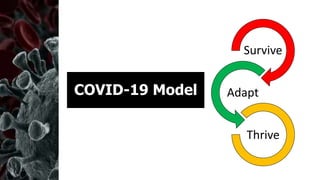
Survive
Adapt
Thrive
COVID-19 Model
Businesses and Leaders need to power out as restrictions lift
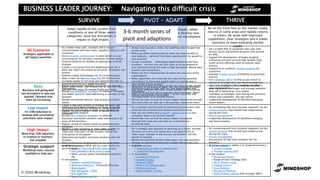
BUSINESS LEADER JOURNEY: Navigating this difficult crisis
SURVIVE THRIVEPIVOT - ADAPT
Adapt rapidly to the current market
conditions in one of three severity
categories: busy but disruption, low
impact or high impact.
Explore innovations, pivot strategies, adapt
delivery or business models and develop new
products or services for an evolved marketplace.
Be on the front foot as the market slowly
returns in some areas and rapidly returns
in others. Be ready with improved
capabilities, clear strategies and a stable
business to meet emerging market
needs.
Busy
Business still going well
but disruption to way you
operate. Demand may
even be increasing
Low Impact
10-20% reduction to
revenue with uncertainty
and short-term impact
High Impact
More than 50% reduction
in revenue or business
has stopped
• In online courses:
 Strategic Planning & Profit Improvement
 Self Confidence & Personal Growth
 Other courses where immediately needed In
the
• In the toolbox:
 Disaster Scenario Planning
 Workforce Planning / Continuity Planning
 Waste Audits
 Risk Mitigation - FMEA
 One Page Plan
 Rapid Problem Solving
Strategic support
Mindshop tools, courses
available to help you
• Review your business vision. Has anything now changed due
to the crisis?
• Where are there opportunities to pivot into new markets or
new products / services? Are there opportunities for growth in
new markets?
• Review innovation / technology opportunities around your
products / services you can fast-track or bring-forward in
your planning during this time or high disruption. Review best
practice and competitors.
• Where are there opportunities to evolve the structure of the
organisation?
• What capabilities and resources are required for potential
innovations? Is there new people talent or training that is
required for future success?
• Perfection is the enemy of good. Get new thinking 80% right
and move. Embrace Minimum Viable Solution (MVS) thinking.
Experiment and trial before making a big investment. Watch
making big decisions too quickly
• In online courses:
 Developing strategy in volatile times
 Leadership Development
• In the toolbox:
 Competitor Analysis
 Change Success
 Strategic SWOT
 Product Portfolio Analysis
 Product Surround
 Rapid Problem Solving
• In online courses:
 Growth Strategy
 Problem solving skills
• In the toolbox:
 Mindshop Process
 Range of Sales Strategy tools
 Must-Should-Could
 Change Success
 Issue Ranking
 Workforce Planning
 Rapid Problem Solving with strategic SWOT
All Scenarios
Strategies applicable to
all impact severities
• Review operational capability to ensure can demand
fluctuations
• Review risk mitigation strategies as demand fluctuates
and health concerns need addressing in all areas of the
business
• Review recruitment options. Stay strong on criteria /
values.
• Create a new daily rhythm to manage the team and
communicate priorities remotely or safely in person.
• Regular review of market trends to update disaster
scenarios
• As a leader keep calm, strategic and in regular
communication with your team, suppliers, advisors and
customers.
• Have a disaster scenario plan in place based on your
circumstances for business continuity. Receive quality
financial direction to develop an appropriate survival
strategy.
• Create a core group from the leadership team for a
daily ‘war room’ discussion on priorities, strategies and
actions.
• Embrace online technologies for all communication.
• Have a clear 30-day One Page Plan for the business
reviewed weekly (if not daily) and adapted monthly as
required with the core leadership team.
• Watch stress levels and mindset for all (you and team)
and take time away for mental health and fitness
• Determine how team members can be re-purposed
during this time to help in other areas OR work on
future planned projects
• Review risk mitigation strategies as demand
fluctuates and health concerns need addressing in all
areas of the business
• Regular review of market trends to update disaster
scenarios
• Where can you reduce costs and inefficiencies?• Develop a plan to reduce as many costs in order to
‘hibernate’ core parts of the business during this
brief period of disruption.
• Determine key leaders and team needed to plan for
recovery
• What professional development can be undertaken
while in hibernation? What will be a new rhythm for
the business?
• Do a strategic plan to explore using any excess funds gained
during this time to fund ‘wild cat’ new opportunities and
innovations.
• How can you evolve your product / service surround and
reimagine them in an evolved market?
• Review the team to look for future leaders discovered through
this crisis who can step up in the business. Accelerate them.
• Run rapid problem solving meetings to solve
pressing growth challenges and manage potential
drop off in demand as crisis abates.
• Capitalise on strengths built during this period to
attract new customers. Use war stories.
• Leadership development of identified emerging
future leaders.
• Do a strategic plan focused on recovering lost business and
evolving into potential new product and service areas.
• How can you evolve your product / service surround and
reimagine them in an evolved market?
• Review the team to look for future leaders discovered
through this crisis who can step up in the business.
Accelerate them.
• Do a strategic plan focused on returning as a leaner, evolved
business post the crisis where this is an opportunity to
make major changes to the way you do business and the
people if required.
• Review the potential market trends post crisis and prioritise
changes to operational structure, models the business can
embrace.
• Re-connecting with lost customer segments via the
contact program that should have stayed active
during the crisis.
• Priority management.
• Leadership development of identified emerging
and future leaders.
• Do a Growth Plan to accelerate new sales with
lessons learnt and evolved products and services
on offer.
• Support the development of highly targeted
marketing activities (around high growth, high
profit service offerings) with an evolved sales
process.
• Implement an authentic contact program for
customers.
• Evaluate change success probability to guarantee
success.
• Use a Strategic SWOT to help as you return to
normal to leverage what you learnt through the
crisis into strategies that should be included to
your strategic plan.
• Re-connecting with lost customer segments via the
contact program that should have stayed active
during the crisis.
• Priority management
• Recruitment of new team members for the
business.
• Workforce planning within a re-imagined business.
© 2020 Mindshop
3-6 month series of
pivot and adaptions
INTRODUCTIONS
Who are you? What do you do?
Update on how are you dealing with the
crisis?
How are you pivoting or adapting already?
Where are your
opportunities to
Pivot/Adapt your
business and your role
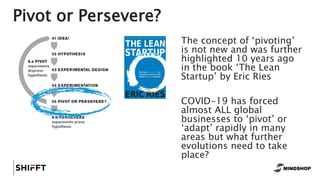
Pivot or Persevere?
The concept of ‘pivoting’
is not new and was further
highlighted 10 years ago
in the book ‘The Lean
Startup’ by Eric Ries
COVID-19 has forced
almost ALL global
businesses to ‘pivot’ or
‘adapt’ rapidly in many
areas but what further
evolutions need to take
place?
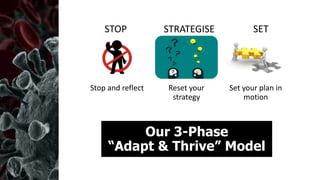
Stop and reflect Reset your
strategy
Set your plan in
motion
STOP STRATEGISE SET
Our 3-Phase
“Adapt & Thrive” Model
Competitor Analysis
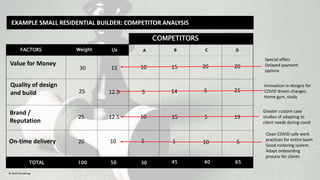
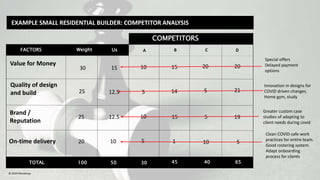
How does your business rate against the competition?
EXAMPLE SMALL RESIDENTIAL BUILDER: COMPETITOR ANALYSIS
COMPETITORS
© 2020 Mindshop
FACTORS Weight Us
TOTAL 100 50
A B C D
Value for Money
Quality of design
and build
Brand /
Reputation
On-time delivery
30
25
25
20
15
12.5
12.5
10
10
5
10
5
15
14
15
1
20
5
5
10
20
21
19
5
30 45 40 65
Special offers
Delayed payment
options
Innovation in designs for
COVID driven changes.
Home gym, study
Greater custom case
studies of adapting to
client needs during covid
Clean COVID-safe work
practices for entire team.
Good rostering system.
Adapt onboarding
process for clients
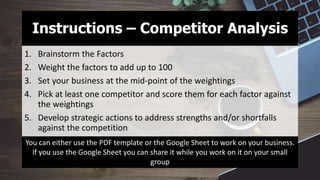
Instructions – Competitor Analysis
1. Brainstorm the Factors
2. Weight the factors to add up to 100
3. Set your business at the mid-point of the weightings
4. Pick at least one competitor and score them for each factor against
the weightings
5. Develop strategic actions to address strengths and/or shortfalls
against the competition
You can either use the PDF template or the Google Sheet to work on your business.
If you use the Google Sheet you can share it while you work on it on your small
group
EXERCISE:
Competitor Analysis
• Take 10 minutes to work on your Competitor
Analysis using the Google Sheet or template
then
• BREAKOUT GROUPS: In groups of 2 or 3 discuss each
Competitor Analysis - especially where you think
you have strengths or weaknesses and what you are
going to do about it
• Get feedback, insights and suggestions from your
team
• You will have about 3 minutes each so manage the
time well.
To the Breakout Rooms
EXAMPLE SMALL RESIDENTIAL BUILDER: COMPETITOR ANALYSIS
COMPETITORS
© 2020 Mindshop
FACTORS Weight Us
TOTAL 100 50
A B C D
Value for Money
Quality of design
and build
Brand /
Reputation
On-time delivery
30
25
25
20
15
12.5
12.5
10
10
5
10
5
15
14
15
1
20
5
5
10
20
21
19
5
30 45 40 65
Special offers
Delayed payment
options
Innovation in designs for
COVID driven changes.
Home gym, study
Greater custom case
studies of adapting to
client needs during covid
Clean COVID-safe work
practices for entire team.
Good rostering system.
Adapt onboarding
process for clients
Rework
your
Offer
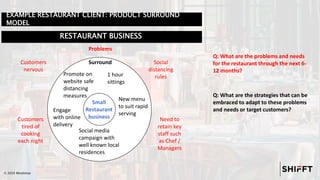
EXAMPLE RESTAURANT CLIENT: PRODUCT SURROUND
MODEL
RESTAURANT BUSINESS
© 2020 Mindshop
Small
Restaurant
business
Q: What are the problems and needs
for the restaurant through the next 6-
12 months?
Social
distancing
rules
Need to
retain key
staff such
as Chef /
Managers
Surround
Problems
Customers
nervous
Customers
tired of
cooking
each night
Promote on
website safe
distancing
measures
Engage
with online
delivery
Social media
campaign with
well known local
residences
New menu
to suit rapid
serving
1 hour
sittings
Q: What are the strategies that can be
embraced to adapt to these problems
and needs or target customers?
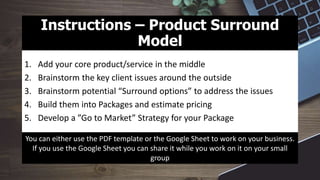
Instructions – Product Surround
Model
1. Add your core product/service in the middle
2. Brainstorm the key client issues around the outside
3. Brainstorm potential “Surround options” to address the issues
4. Build them into Packages and estimate pricing
5. Develop a ”Go to Market” Strategy for your Package
You can either use the PDF template or the Google Sheet to work on your business.
If you use the Google Sheet you can share it while you work on it on your small
group
EXERCISE:
Competitor Analysis
• Take 10 minutes to work on your Revised Offer
using the Google Sheet or template
then
• BREAKOUT GROUPS: In groups of 2 or 3 discuss
each Analysis - especially the additional
service/product offers that you can add
• Get feedback, insights and suggestions from your
team
• You will have about 5 minutes each so manage
the time well.
To the Breakout Rooms
Actions from the day
and summary
Top 3 strategies – share with me
Visit
www.shifft.com.au
for more resources
FREE Online Business Training
Courses for you and your team
Over 25 business topics –
$400 value
Limit 2 per person
https://www.shifft.com.au/free-online-business-
training-programs/
Share your plans and book a
call with me
https://calendly.com/russellcummings/30-minute-call
Next webinar is on
14 July 2020 at 3pm
BOOK IT IN NOW!
Thank you for attending
Any questions / comments?
Russell Cummings
Business Consultant
M: 0414 929 585
W: www.shifft.com.au
E: russell@shifft.com.au
What is your no #1 takeaway
from today’s session?

200609 SBLF Workshop - Thrive - Competitors - FINAL

  • 1.
    Survive – Pivot/Adapt– Thrive Webinar Where are the opportunities to Pivot/Adapt in your business and role? Facilitated by Russell Cummings www.shifft.com.au 9 June 2020
  • 2.
    Adapting to the newnormal! Webinars instead of workshops • Regular online webinars – 1.5 hour in duration • Thought leadership to support you through the current Coronavirus period • Opportunity to hear insights from your peers and discuss strategies you are embracing as leaders through this time • Will cover topics to support leaders regardless of the scale (large or minimal) of impact or type (more demand or much less demand) of impact to the business
  • 3.
    Today’s Agenda 1. Introductions 2.Roadmap through the crisis – Where are we now? 3. Open discussion with peers: Update on how are you dealing with the crisis 4. Where are your opportunities to Pivot/Adapt your business and your role? Competitor Analysis and Product Offer Review 5. Open discussion with peers: How will you pivot and adapt further in your business? 6. Actions from the day and summary 7. FINISH
  • 4.
    The Rules ofEngagement 1. Participate and contribute and you will reap the benefits 2. Contribute only what you are comfortable sharing 3. Treat other people’s information with the care and confidentiality that you would expect of your own information – 100% confidential 4. Share your contact details in the chat box – this is not an invitation to spam each other 5. I encourage you to engage with other outside of this forum if there are synergies and opportunities
  • 5.
    Roadmap through the crisisWhere are we now?
  • 6.
  • 7.
    Businesses and Leadersneed to power out as restrictions lift
  • 8.
    BUSINESS LEADER JOURNEY:Navigating this difficult crisis SURVIVE THRIVEPIVOT - ADAPT Adapt rapidly to the current market conditions in one of three severity categories: busy but disruption, low impact or high impact. Explore innovations, pivot strategies, adapt delivery or business models and develop new products or services for an evolved marketplace. Be on the front foot as the market slowly returns in some areas and rapidly returns in others. Be ready with improved capabilities, clear strategies and a stable business to meet emerging market needs. Busy Business still going well but disruption to way you operate. Demand may even be increasing Low Impact 10-20% reduction to revenue with uncertainty and short-term impact High Impact More than 50% reduction in revenue or business has stopped • In online courses:  Strategic Planning & Profit Improvement  Self Confidence & Personal Growth  Other courses where immediately needed In the • In the toolbox:  Disaster Scenario Planning  Workforce Planning / Continuity Planning  Waste Audits  Risk Mitigation - FMEA  One Page Plan  Rapid Problem Solving Strategic support Mindshop tools, courses available to help you • Review your business vision. Has anything now changed due to the crisis? • Where are there opportunities to pivot into new markets or new products / services? Are there opportunities for growth in new markets? • Review innovation / technology opportunities around your products / services you can fast-track or bring-forward in your planning during this time or high disruption. Review best practice and competitors. • Where are there opportunities to evolve the structure of the organisation? • What capabilities and resources are required for potential innovations? Is there new people talent or training that is required for future success? • Perfection is the enemy of good. Get new thinking 80% right and move. Embrace Minimum Viable Solution (MVS) thinking. Experiment and trial before making a big investment. Watch making big decisions too quickly • In online courses:  Developing strategy in volatile times  Leadership Development • In the toolbox:  Competitor Analysis  Change Success  Strategic SWOT  Product Portfolio Analysis  Product Surround  Rapid Problem Solving • In online courses:  Growth Strategy  Problem solving skills • In the toolbox:  Mindshop Process  Range of Sales Strategy tools  Must-Should-Could  Change Success  Issue Ranking  Workforce Planning  Rapid Problem Solving with strategic SWOT All Scenarios Strategies applicable to all impact severities • Review operational capability to ensure can demand fluctuations • Review risk mitigation strategies as demand fluctuates and health concerns need addressing in all areas of the business • Review recruitment options. Stay strong on criteria / values. • Create a new daily rhythm to manage the team and communicate priorities remotely or safely in person. • Regular review of market trends to update disaster scenarios • As a leader keep calm, strategic and in regular communication with your team, suppliers, advisors and customers. • Have a disaster scenario plan in place based on your circumstances for business continuity. Receive quality financial direction to develop an appropriate survival strategy. • Create a core group from the leadership team for a daily ‘war room’ discussion on priorities, strategies and actions. • Embrace online technologies for all communication. • Have a clear 30-day One Page Plan for the business reviewed weekly (if not daily) and adapted monthly as required with the core leadership team. • Watch stress levels and mindset for all (you and team) and take time away for mental health and fitness • Determine how team members can be re-purposed during this time to help in other areas OR work on future planned projects • Review risk mitigation strategies as demand fluctuates and health concerns need addressing in all areas of the business • Regular review of market trends to update disaster scenarios • Where can you reduce costs and inefficiencies?• Develop a plan to reduce as many costs in order to ‘hibernate’ core parts of the business during this brief period of disruption. • Determine key leaders and team needed to plan for recovery • What professional development can be undertaken while in hibernation? What will be a new rhythm for the business? • Do a strategic plan to explore using any excess funds gained during this time to fund ‘wild cat’ new opportunities and innovations. • How can you evolve your product / service surround and reimagine them in an evolved market? • Review the team to look for future leaders discovered through this crisis who can step up in the business. Accelerate them. • Run rapid problem solving meetings to solve pressing growth challenges and manage potential drop off in demand as crisis abates. • Capitalise on strengths built during this period to attract new customers. Use war stories. • Leadership development of identified emerging future leaders. • Do a strategic plan focused on recovering lost business and evolving into potential new product and service areas. • How can you evolve your product / service surround and reimagine them in an evolved market? • Review the team to look for future leaders discovered through this crisis who can step up in the business. Accelerate them. • Do a strategic plan focused on returning as a leaner, evolved business post the crisis where this is an opportunity to make major changes to the way you do business and the people if required. • Review the potential market trends post crisis and prioritise changes to operational structure, models the business can embrace. • Re-connecting with lost customer segments via the contact program that should have stayed active during the crisis. • Priority management. • Leadership development of identified emerging and future leaders. • Do a Growth Plan to accelerate new sales with lessons learnt and evolved products and services on offer. • Support the development of highly targeted marketing activities (around high growth, high profit service offerings) with an evolved sales process. • Implement an authentic contact program for customers. • Evaluate change success probability to guarantee success. • Use a Strategic SWOT to help as you return to normal to leverage what you learnt through the crisis into strategies that should be included to your strategic plan. • Re-connecting with lost customer segments via the contact program that should have stayed active during the crisis. • Priority management • Recruitment of new team members for the business. • Workforce planning within a re-imagined business. © 2020 Mindshop 3-6 month series of pivot and adaptions
  • 9.
    INTRODUCTIONS Who are you?What do you do? Update on how are you dealing with the crisis? How are you pivoting or adapting already?
  • 10.
    Where are your opportunitiesto Pivot/Adapt your business and your role
  • 11.
    Pivot or Persevere? Theconcept of ‘pivoting’ is not new and was further highlighted 10 years ago in the book ‘The Lean Startup’ by Eric Ries COVID-19 has forced almost ALL global businesses to ‘pivot’ or ‘adapt’ rapidly in many areas but what further evolutions need to take place?
  • 13.
    Stop and reflectReset your strategy Set your plan in motion STOP STRATEGISE SET Our 3-Phase “Adapt & Thrive” Model
  • 14.
    Competitor Analysis How doesyour business rate against the competition?
  • 15.
    EXAMPLE SMALL RESIDENTIALBUILDER: COMPETITOR ANALYSIS COMPETITORS © 2020 Mindshop FACTORS Weight Us TOTAL 100 50 A B C D Value for Money Quality of design and build Brand / Reputation On-time delivery 30 25 25 20 15 12.5 12.5 10 10 5 10 5 15 14 15 1 20 5 5 10 20 21 19 5 30 45 40 65 Special offers Delayed payment options Innovation in designs for COVID driven changes. Home gym, study Greater custom case studies of adapting to client needs during covid Clean COVID-safe work practices for entire team. Good rostering system. Adapt onboarding process for clients
  • 16.
    Instructions – CompetitorAnalysis 1. Brainstorm the Factors 2. Weight the factors to add up to 100 3. Set your business at the mid-point of the weightings 4. Pick at least one competitor and score them for each factor against the weightings 5. Develop strategic actions to address strengths and/or shortfalls against the competition You can either use the PDF template or the Google Sheet to work on your business. If you use the Google Sheet you can share it while you work on it on your small group
  • 17.
    EXERCISE: Competitor Analysis • Take10 minutes to work on your Competitor Analysis using the Google Sheet or template then • BREAKOUT GROUPS: In groups of 2 or 3 discuss each Competitor Analysis - especially where you think you have strengths or weaknesses and what you are going to do about it • Get feedback, insights and suggestions from your team • You will have about 3 minutes each so manage the time well.
  • 18.
  • 19.
    EXAMPLE SMALL RESIDENTIALBUILDER: COMPETITOR ANALYSIS COMPETITORS © 2020 Mindshop FACTORS Weight Us TOTAL 100 50 A B C D Value for Money Quality of design and build Brand / Reputation On-time delivery 30 25 25 20 15 12.5 12.5 10 10 5 10 5 15 14 15 1 20 5 5 10 20 21 19 5 30 45 40 65 Special offers Delayed payment options Innovation in designs for COVID driven changes. Home gym, study Greater custom case studies of adapting to client needs during covid Clean COVID-safe work practices for entire team. Good rostering system. Adapt onboarding process for clients
  • 20.
  • 22.
    EXAMPLE RESTAURANT CLIENT:PRODUCT SURROUND MODEL RESTAURANT BUSINESS © 2020 Mindshop Small Restaurant business Q: What are the problems and needs for the restaurant through the next 6- 12 months? Social distancing rules Need to retain key staff such as Chef / Managers Surround Problems Customers nervous Customers tired of cooking each night Promote on website safe distancing measures Engage with online delivery Social media campaign with well known local residences New menu to suit rapid serving 1 hour sittings Q: What are the strategies that can be embraced to adapt to these problems and needs or target customers?
  • 23.
    Instructions – ProductSurround Model 1. Add your core product/service in the middle 2. Brainstorm the key client issues around the outside 3. Brainstorm potential “Surround options” to address the issues 4. Build them into Packages and estimate pricing 5. Develop a ”Go to Market” Strategy for your Package You can either use the PDF template or the Google Sheet to work on your business. If you use the Google Sheet you can share it while you work on it on your small group
  • 24.
    EXERCISE: Competitor Analysis • Take10 minutes to work on your Revised Offer using the Google Sheet or template then • BREAKOUT GROUPS: In groups of 2 or 3 discuss each Analysis - especially the additional service/product offers that you can add • Get feedback, insights and suggestions from your team • You will have about 5 minutes each so manage the time well.
  • 25.
  • 27.
    Actions from theday and summary
  • 28.
    Top 3 strategies– share with me
  • 30.
  • 31.
    FREE Online BusinessTraining Courses for you and your team Over 25 business topics – $400 value Limit 2 per person https://www.shifft.com.au/free-online-business- training-programs/
  • 32.
    Share your plansand book a call with me https://calendly.com/russellcummings/30-minute-call
  • 33.
    Next webinar ison 14 July 2020 at 3pm BOOK IT IN NOW! Thank you for attending Any questions / comments? Russell Cummings Business Consultant M: 0414 929 585 W: www.shifft.com.au E: russell@shifft.com.au What is your no #1 takeaway from today’s session?

Editor's Notes

  • #2 1 min Welcome all attendees, guests and prospects this survive – pivot/adapt – thrive webinar series which has been adapted from the original face-to-face Growth Hub plan. State that this webinar will over the next hour cover where opportunities are to Pivot/Adapt in your business and role. State it will also broadly continue to discuss how to survive, pivot/adapt and thrive as leaders to navigate themselves, teams and businesses through this challenging period. State during this 1hr webinar (which you need to determine if you are recording to send them confidentially afterwards) there will be time to importantly hear from your peers to discuss their insights on navigating this crisis as a leader. IMPORTANT: If you are recording this webinar and seeking to distribute to members STRESS that it is not to be distributed widely if you are featuring attendees commenting (or that you will edit out the comments section OR re-record it with just your points and not their comments). You may in fact for confidentiality choose NOT to record so people are more comfortable to share their thoughts. This is a choice for each chairperson. Let’s get started. NOTE: All images used within the PowerPoint presentation are, to the best of our knowledge, images with no copyright and ‘labelled for reuse’. The intended use is within this private workshop, therefore the PowerPoint should not be re-published on your own website(s) without checking on applicable distribution copyright first. FURTHER NOTES Ensure you have tested your webinar platform, sound and video prior. See Mindshop’s webinar tips included with this online workshop.
  • #3 30 seconds State you are adapting to the new normal with a webinar format for the next 3 months while face-to-face workshops are not possible. If face-to-face is allowed to occur again then these workshops will revert to that format. Read the dot points on the slide.
  • #4 1 minute Read the agenda for today and provide clarity on timeframes and goal of 1hr duration. Note: If you would like to provide MORE time for discussion at each discussion stage please extend the webinar by the required duration (potentially 15 minutes overall) but ensure attendees are made aware when you are inviting them to attend the webinar
  • #5 1 minute Read the agenda for today and provide clarity on timeframes and goal of 1hr duration. Note: If you would like to provide MORE time for discussion at each discussion stage please extend the webinar by the required duration (potentially 15 minutes overall) but ensure attendees are made aware when you are inviting them to attend the webinar
  • #6 State let’s now look at the roadmap we looked at in the last webinar that you can use through this crisis as a leader
  • #8 30 sec Make the point that as restrictions lift businesses need to think about how they carefully power out of restrictions (as they lift) and return to a COVID-safe new normal environment. This will take strong leadership.
  • #9 4.5 minutes Use this slide to reinforce the 3 phases of this crisis being survive, pivot/adapt, thrive again as well as the different levels of impact the crisis is having on different businesses. If you have ‘fresh faces’ on the webinar explain the different stages and scenarios down the left hand side again. Explain (click on animation) you feel that many businesses have now commenced firmly into the pivot / adapt stage while still a slight ‘toe’ in the survive stage. Say it may be a long road out for some and a quicker road for others as business confidence comes back. Potentially tell a war story from your perspective as to why. Click again to make the point they may have to pivot/adapt multiple times during this COVID-crisis (over the next 3-6 months) as restrictions adapt / lift and business confidence returns slowly so its important they look at that are per the previous slide ‘power out’ with strong leadership to carefully be on the front foot steering back to a new normal.
  • #10 15 minutes Now use this opportunity to go to each of the leaders (you may do this via an open camera / microphone) to hear their updates on how they are dealing with the crisis and potentially how they are pivoting or adapting already?. Give each person a minute or two dependant on numbers. If you have a large number you might just pick 4-5 to hear their insights and if you cant get to all there will be time at the end for their context. Seek to un-mute (if muted) each person you want to speak and then mute again. After hearing from those you have time for summarise and move to the next section
  • #12 2 minutes Highlight these insights on the concept of ‘pivoting’ or ‘adapting’ their business models or way they go to market with their product / services(or their offering itself). Use to reinforce the need to look at continually pivoting and adapting a series of times as they learn / adapt through the crisis. State lets look at two tools that could be valuable for them in pivoting/ adapting in their business through this crisis.
  • #16 Rai, can you format this please.
  • #20 Rai, can you format this please.
  • #28 5 minutes Finally to wrap up this section state that as they progress with their pivot/adapt strategies and restrictions are lifting with a new normal resuming in markets they need to reflect on these four questions. Potentially give a war story from your own perspective for a couple of minutes around a business reflecting on other industries for best practice to drive their COVID adaptions?
  • #29 12 minutes Have an open discussion with participants by asking them how based on the tools just covered they will pivot and adapt further in their business? Xxxxx Add to that if anybody wants to share what’s working for them to date they are happy to share? Open the discussion again if limited with time and a big group to people that may not have spoken during the first breakout discussion. Summarise and move to last part of the day.
  • #30 State it’s now time to put rubber on the road and pull together their strategies for themselves and their area of the business.
  • #31 1 minute Recommend they note down their 3 key strategies from today’s session and share it with you (via MSOL if they are on the platform) for discussion, support and guidance over the coming 30 days.
  • #32 2 minutes Run through the summary points from today’s workshop and add in any specific further points that came up through discussions around today’s topic. Wrap after the summary and go to the next slide for a final Q&A
  • #37 Thank all for attending and say that you hope they have practical actions to take back into their businesses to navigate through the current crisis which you are here to help them with. State by the next webinar you want them to reflect on what they have implemented so stress for them to work with you between now and the next webinar (highlight the date) on each of them. Stress for them to lock in the next date into their diary now.