Business to Arts Strategy for Performance Improvement Alan Christie, University of Ulster
Strategy for Performance Improvement Managing strategy - course objectives introduction to strategy-purpose/value tools and techniques-practical formulation strategic thinking- vision and mission developing a strategy- setting objectives
Get a Competitive Position! On what basis will we compete? Which direction should we go? How do we get there? How will we stay there? Where next?
Successful Companies Understand their core competences and use them to develop in unexpected ways Re-write the rules so that only they can win Understand that CULTURE eats STRATEGY for breakfast … .the aim of today is for these lessons to be manifest in your strategy for development
I Will Use….. Everyday examples e.g. Nokia Tesco Ryanair!!!!! GOH to discover On what basis it competes? In which direction it is headed? How will it get there?
Defining the Path Where in the landscape are we? environmental analysis How is the landscape going to change? scenario possibilities
Defining the Path Where is it possible to go? Core competency analysis How do we get there? Strategic development
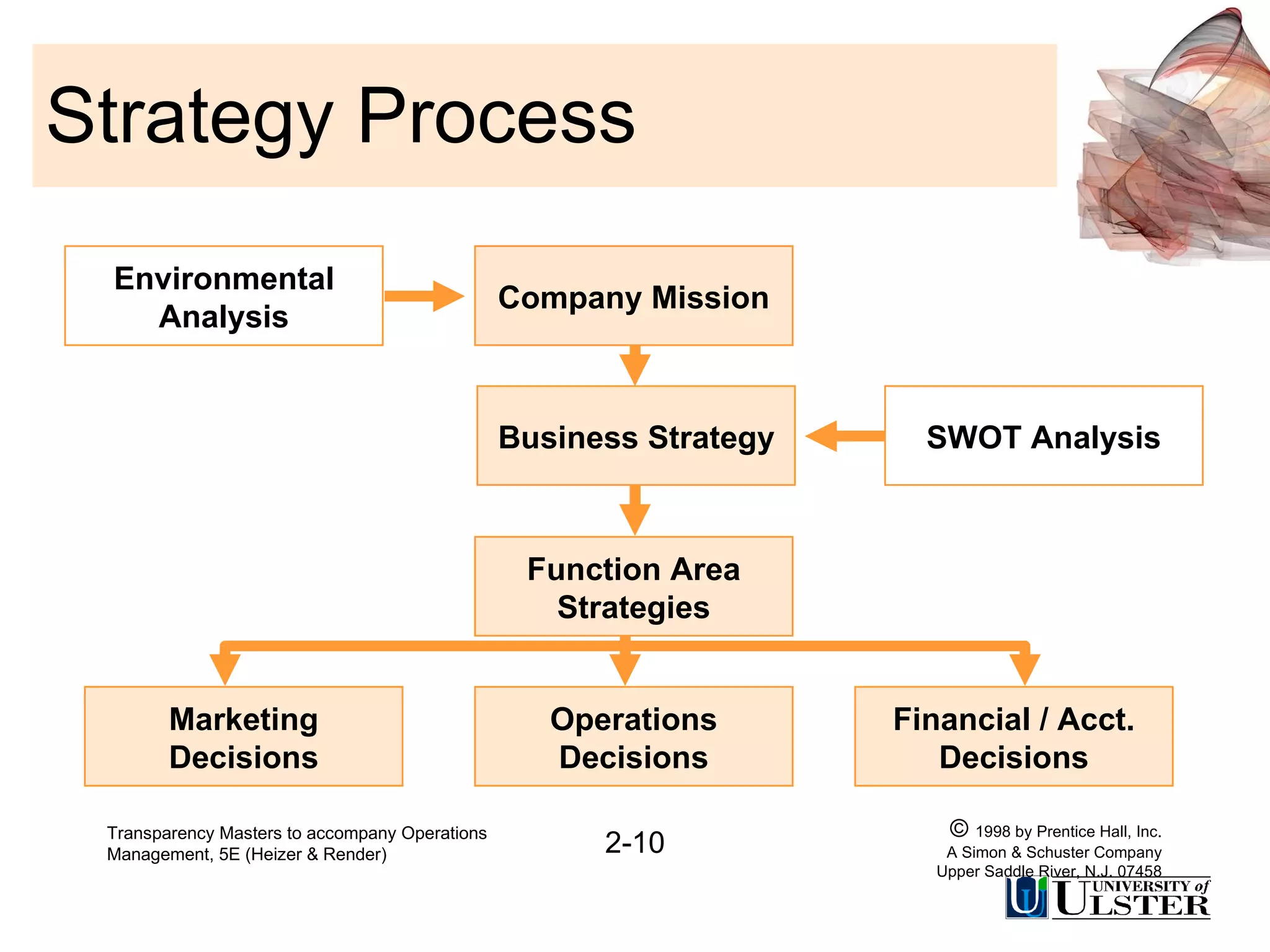
Strategy Process Transparency Masters to accompany Operations Management, 5E (Heizer & Render) 2-10 ©  1998 by Prentice Hall, Inc. A Simon & Schuster Company Upper Saddle River, N.J. 07458 Environmental Analysis Company Mission Business Strategy Function Area Strategies SWOT Analysis Operations Decisions Marketing Decisions Financial / Acct. Decisions
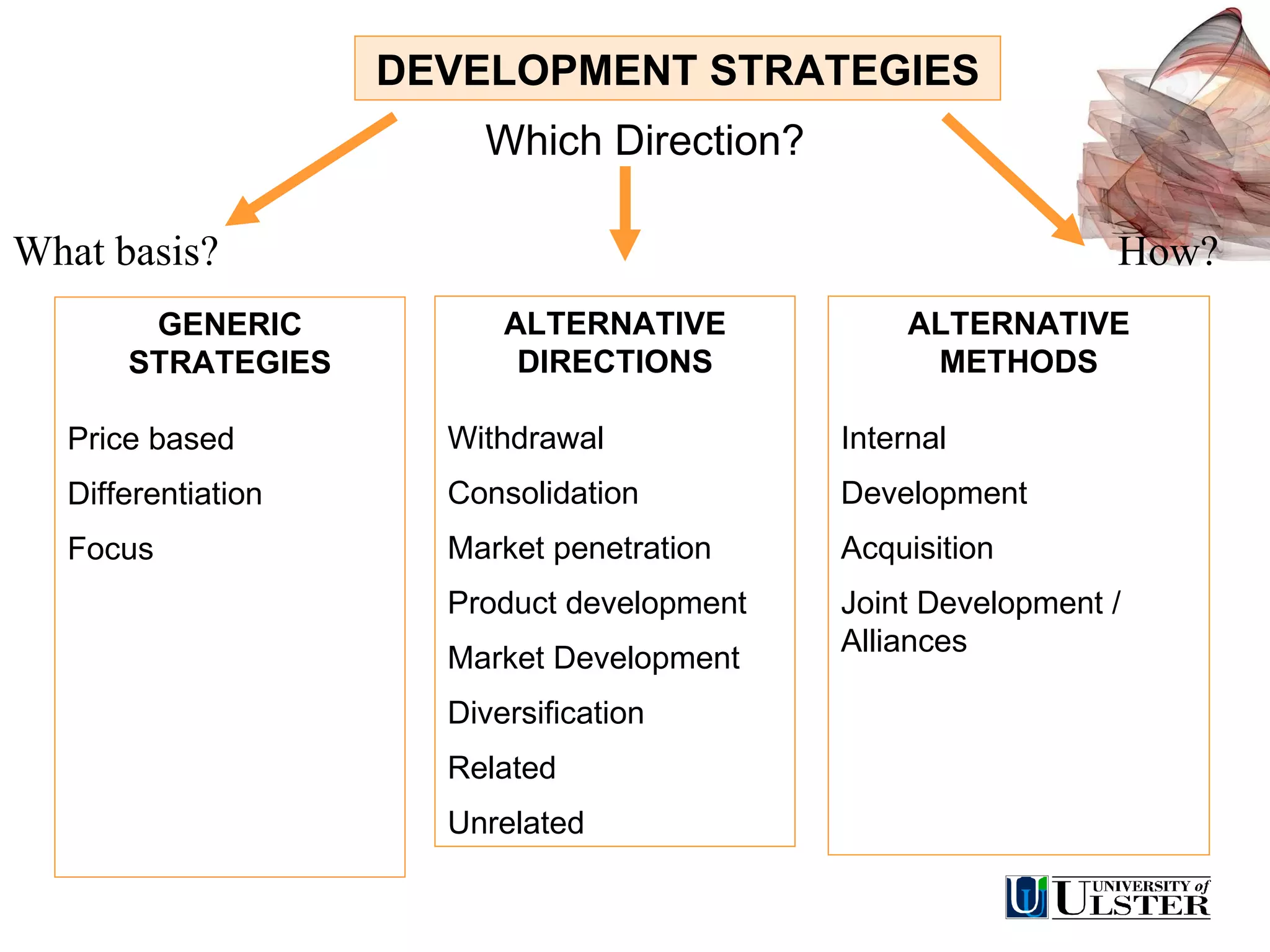
DEVELOPMENT STRATEGIES What basis? Which Direction? How? ALTERNATIVE DIRECTIONS Withdrawal Consolidation Market penetration Product development Market Development Diversification Related Unrelated ALTERNATIVE METHODS Internal Development Acquisition Joint Development / Alliances GENERIC STRATEGIES Price based Differentiation Focus
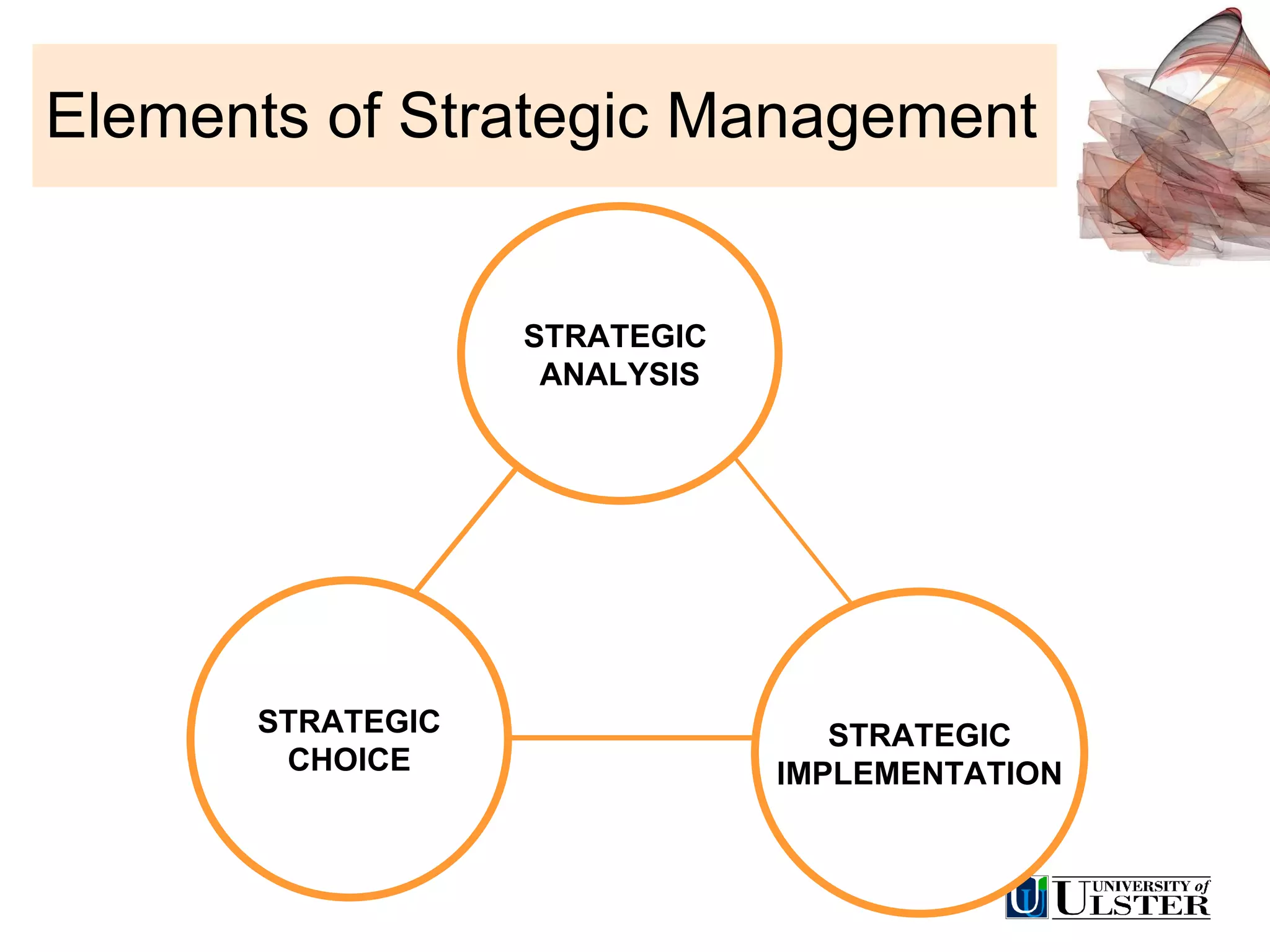
Elements of Strategic Management STRATEGIC CHOICE STRATEGIC IMPLEMENTATION STRATEGIC  ANALYSIS
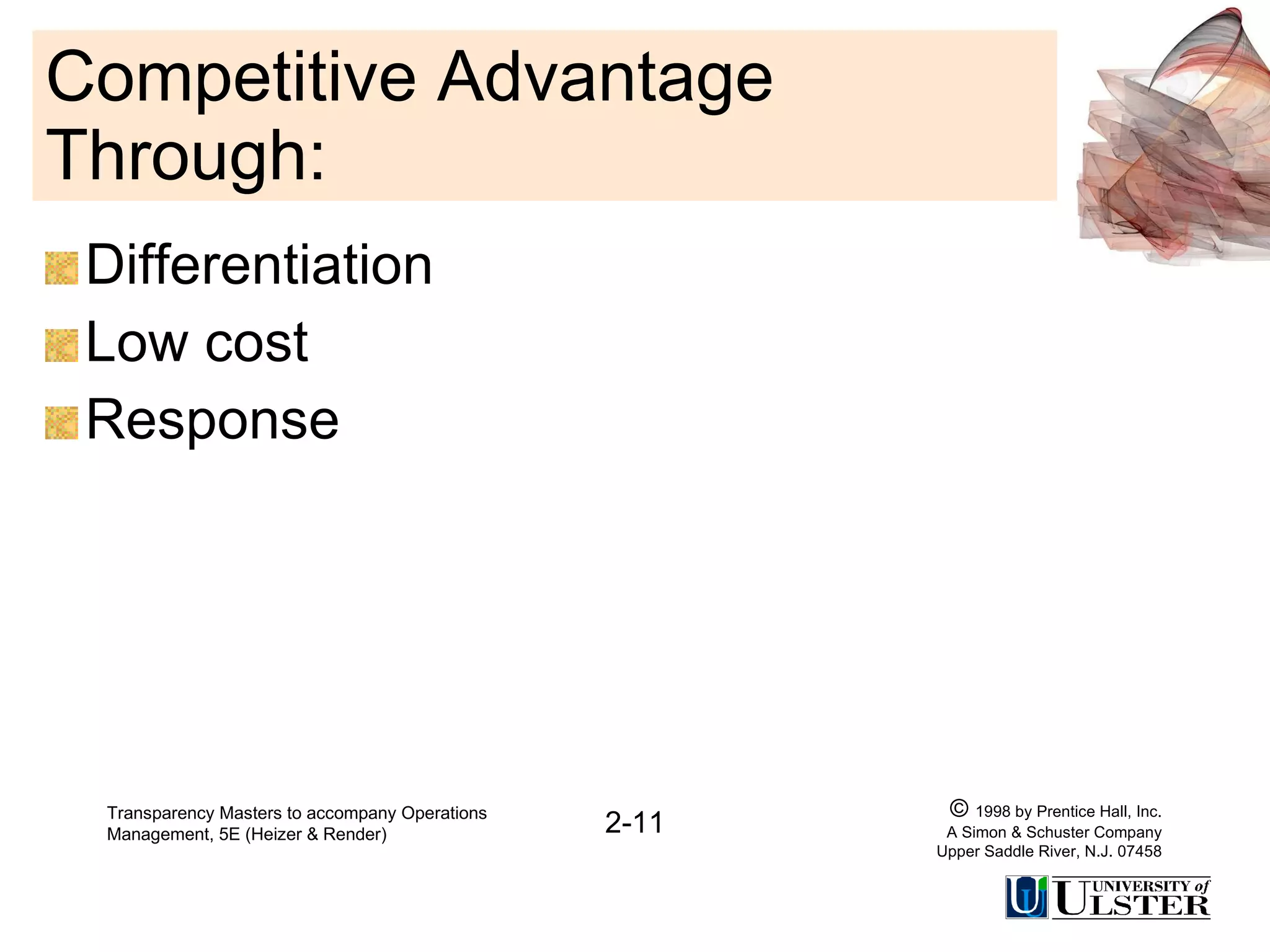
Competitive Advantage Through: Differentiation Low cost Response Transparency Masters to accompany Operations Management, 5E (Heizer & Render) 2-11 ©  1998 by Prentice Hall, Inc. A Simon & Schuster Company Upper Saddle River, N.J. 07458
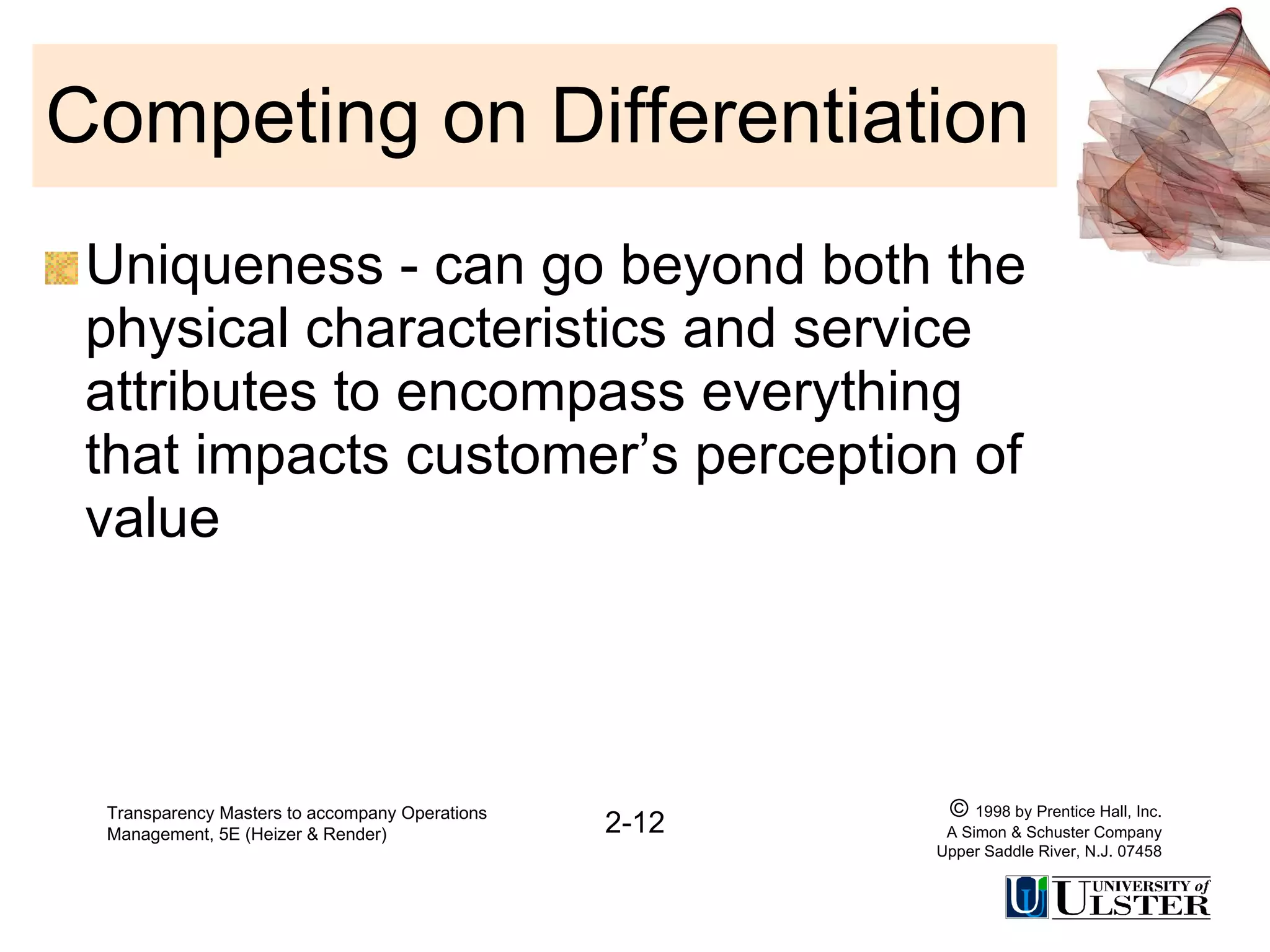
Competing on Differentiation Uniqueness - can go beyond both the physical characteristics and service attributes to encompass everything that impacts customer’s perception of value Transparency Masters to accompany Operations Management, 5E (Heizer & Render) 2-12 ©  1998 by Prentice Hall, Inc. A Simon & Schuster Company Upper Saddle River, N.J. 07458
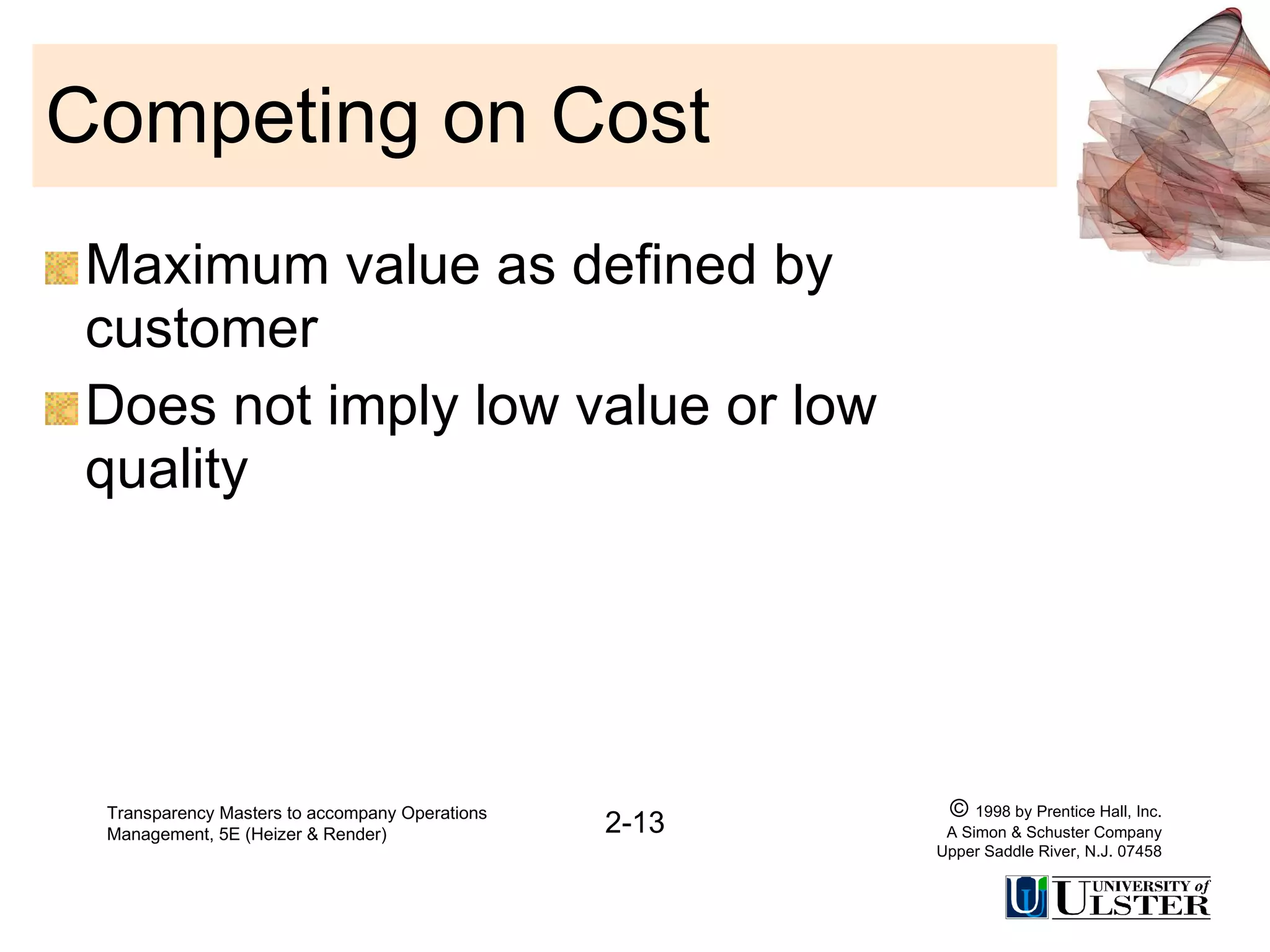
Competing on Cost Maximum value as defined by customer Does not imply low value or low quality Transparency Masters to accompany Operations Management, 5E (Heizer & Render) 2-13 ©  1998 by Prentice Hall, Inc. A Simon & Schuster Company Upper Saddle River, N.J. 07458
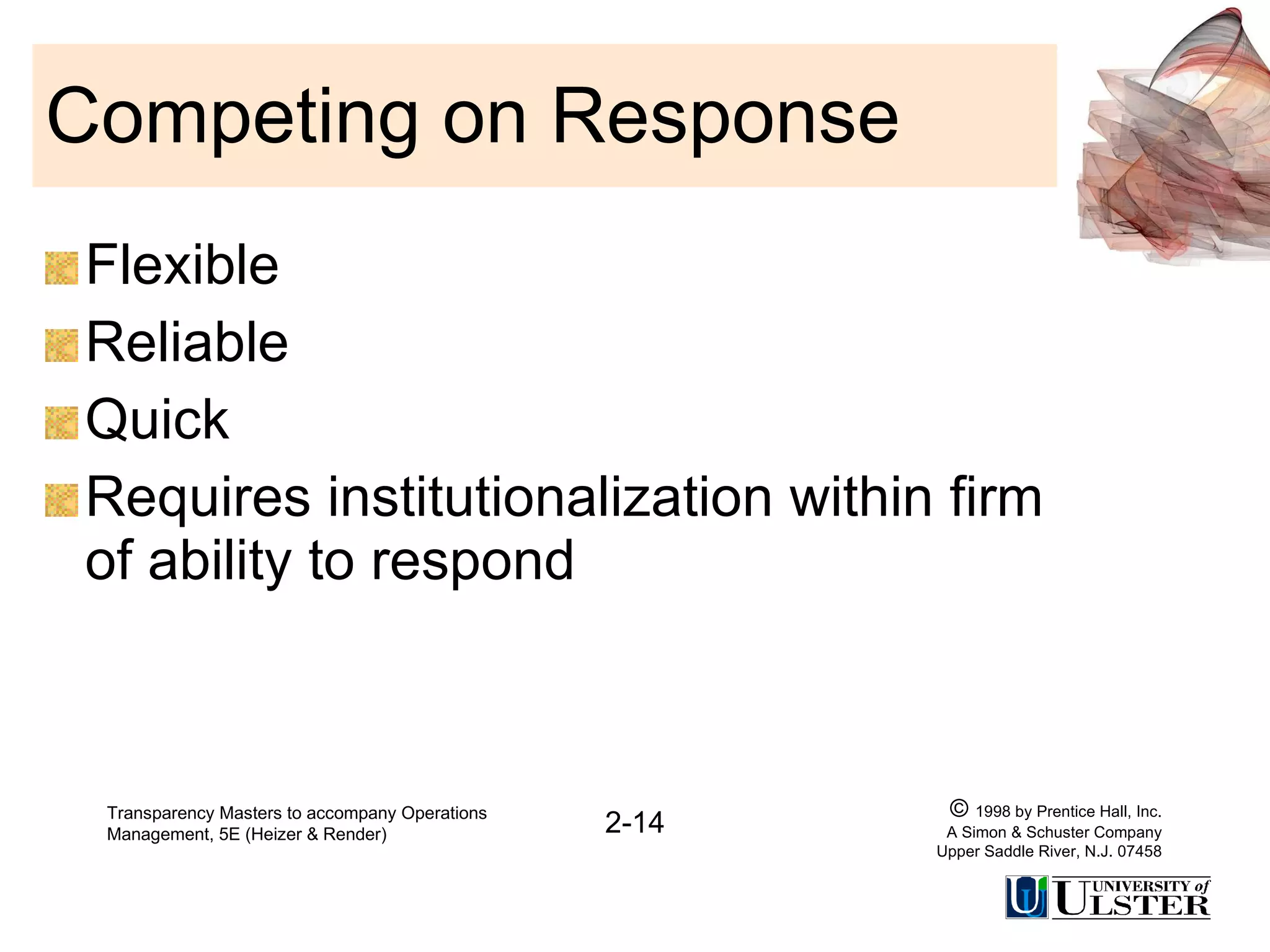
Competing on Response Flexible Reliable Quick Requires institutionalization within firm of ability to respond Transparency Masters to accompany Operations Management, 5E (Heizer & Render) 2-14 ©  1998 by Prentice Hall, Inc. A Simon & Schuster Company Upper Saddle River, N.J. 07458
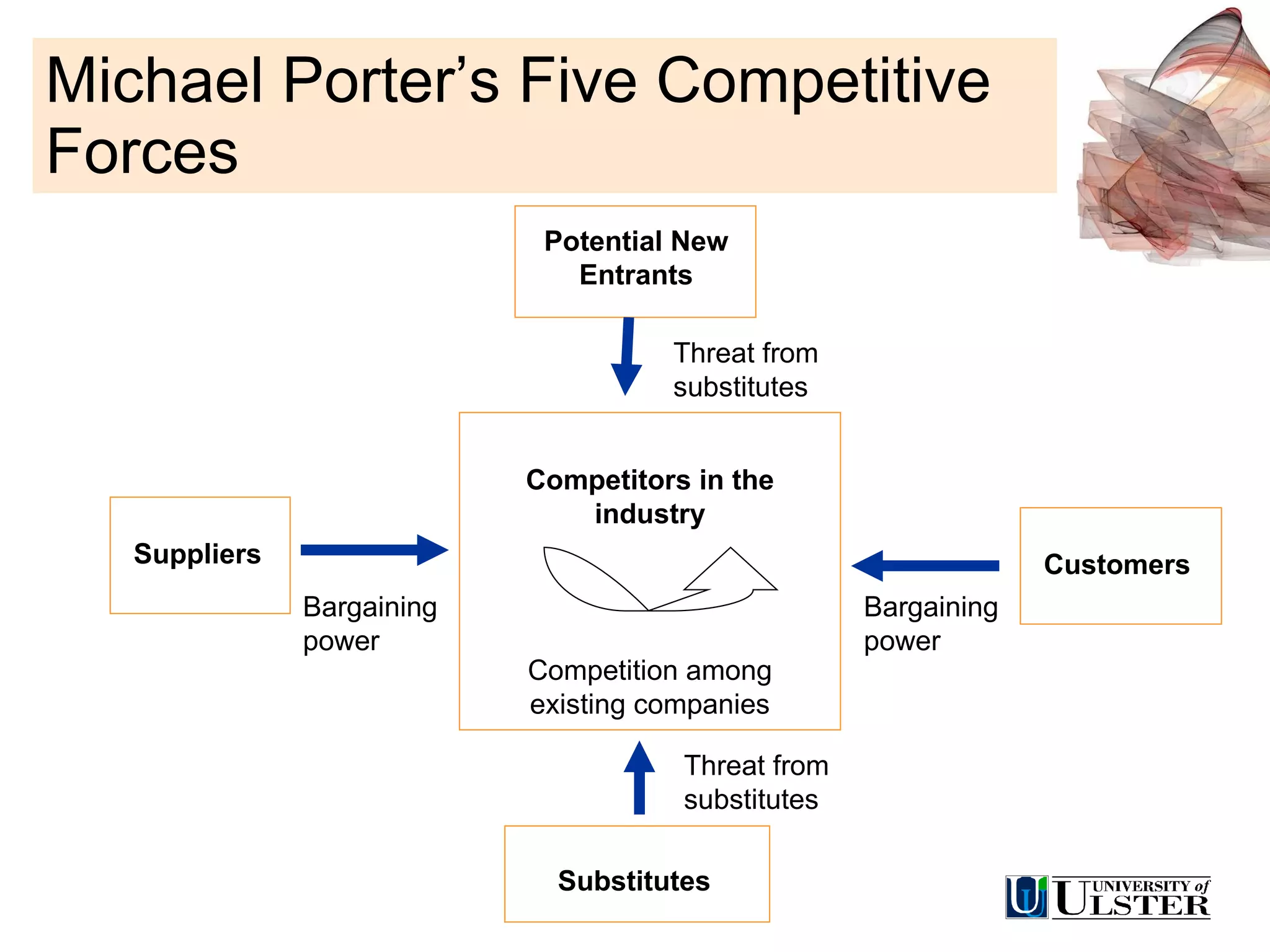
Michael Porter’s Five Competitive Forces Competitors in the industry Competition among existing companies Bargaining power Customers Substitutes Suppliers Threat from substitutes Potential New Entrants Bargaining power Threat from substitutes
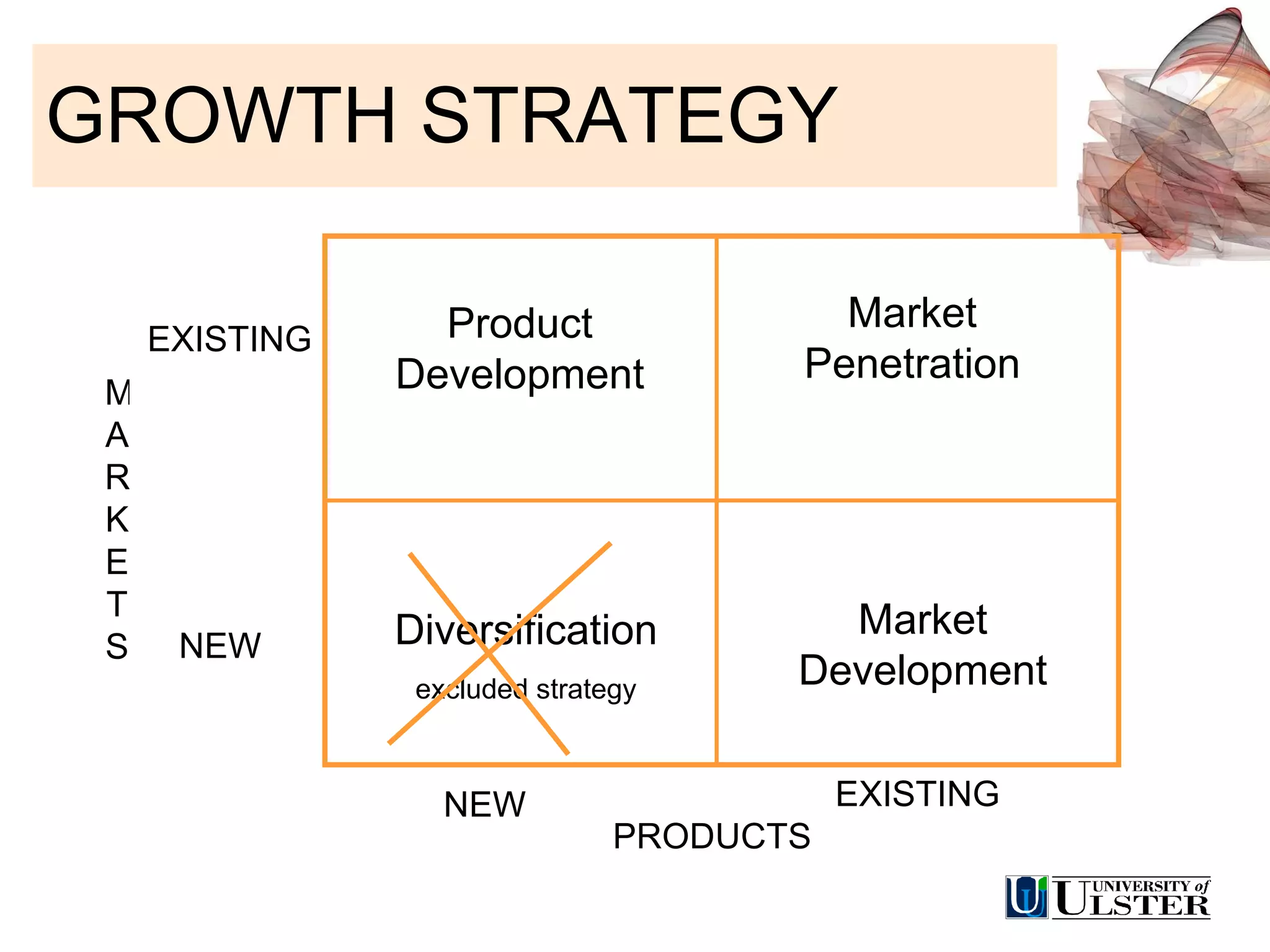
GROWTH STRATEGY NEW EXISTING PRODUCTS EXISTING NEW M A R K E T S Product Development Market Development Market Penetration Diversification excluded strategy
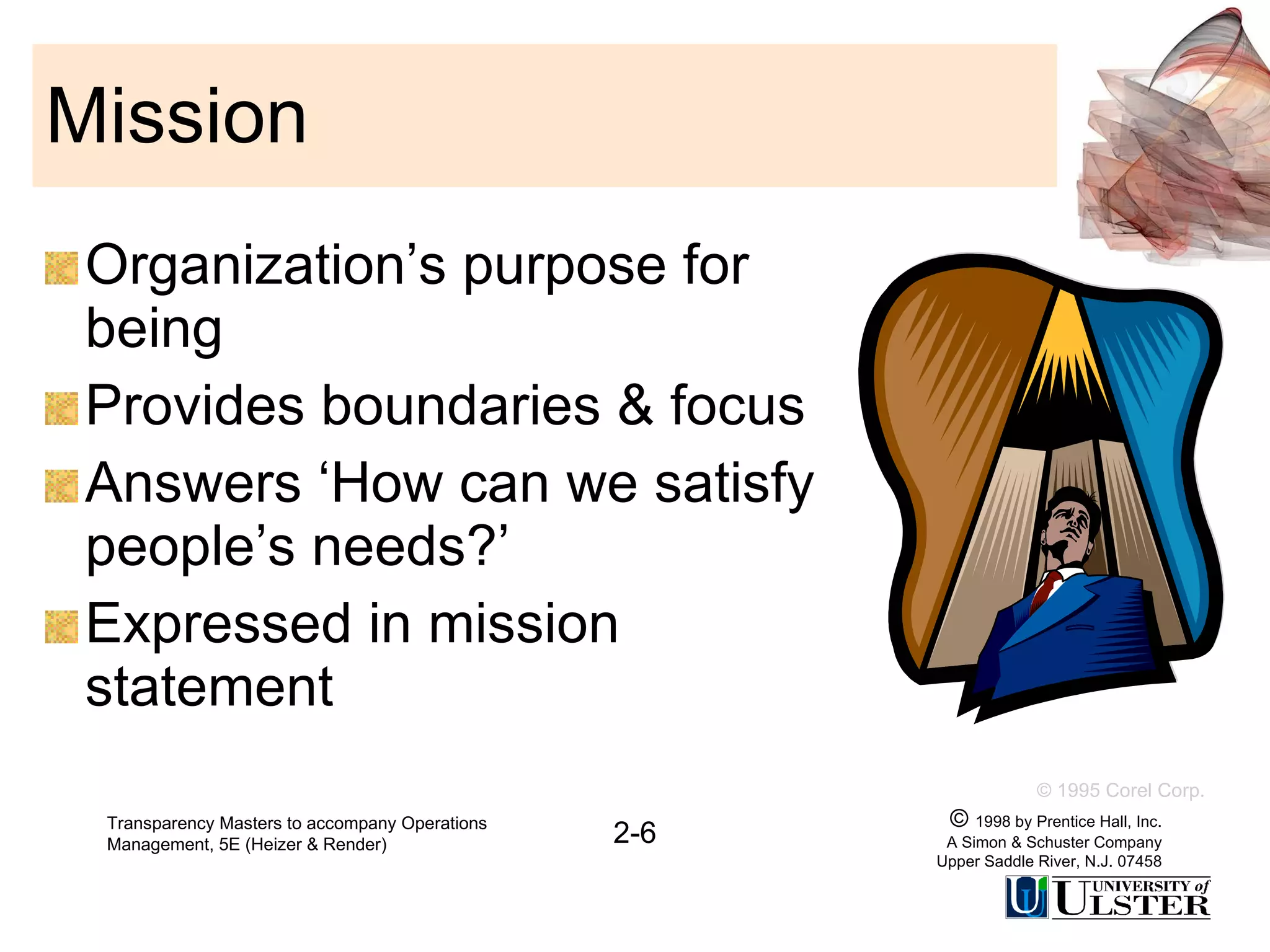
Mission Organization’s purpose for being Provides boundaries & focus Answers ‘How can we satisfy people’s needs?’ Expressed in mission statement Transparency Masters to accompany Operations Management, 5E (Heizer & Render) 2-6 ©  1998 by Prentice Hall, Inc. A Simon & Schuster Company Upper Saddle River, N.J. 07458 © 1995 Corel Corp.
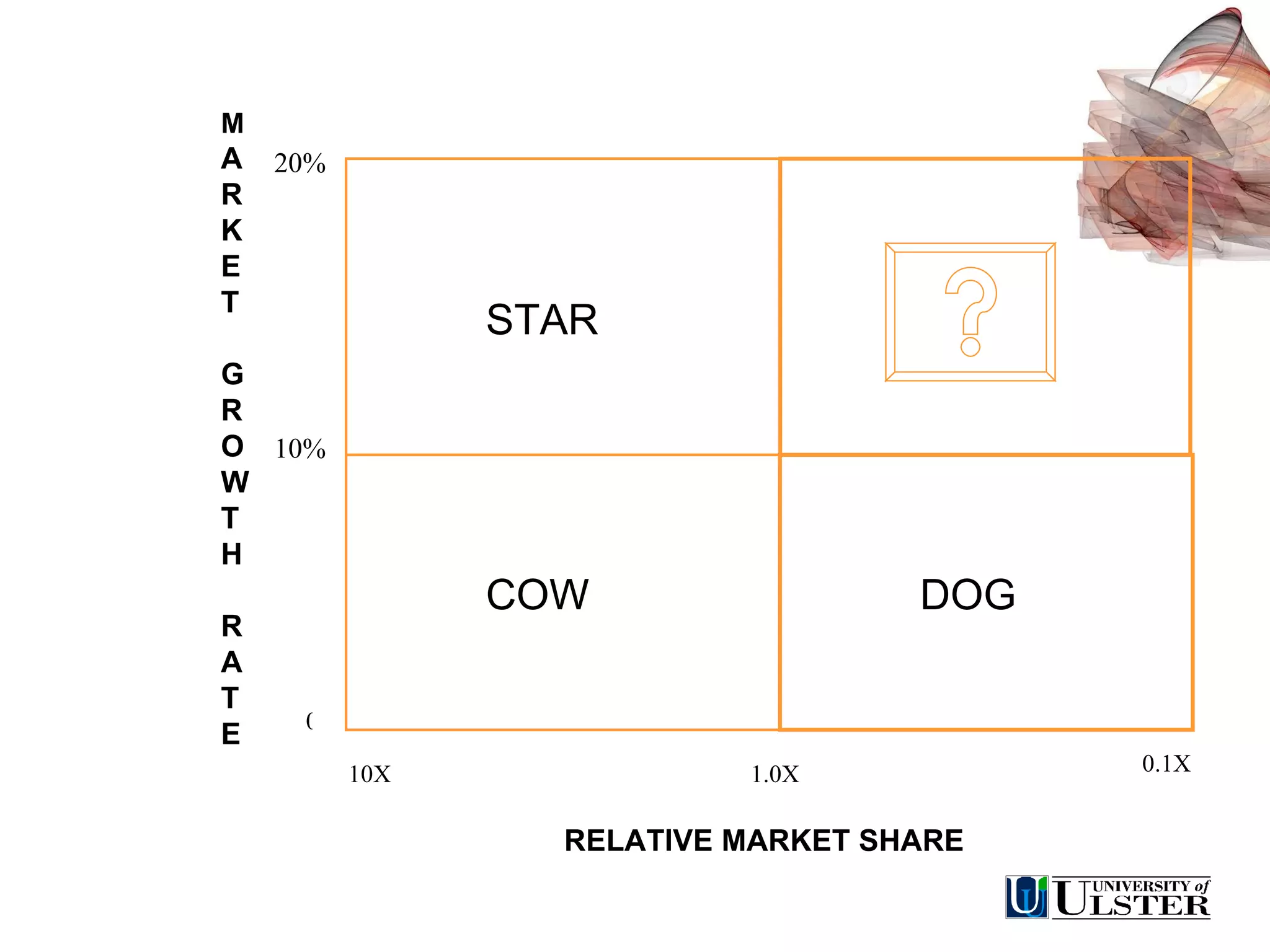
COW DOG STAR M A R K E T G R O W T H R A T E 10% 0 10X 1.0X 0.1X 20% RELATIVE MARKET SHARE
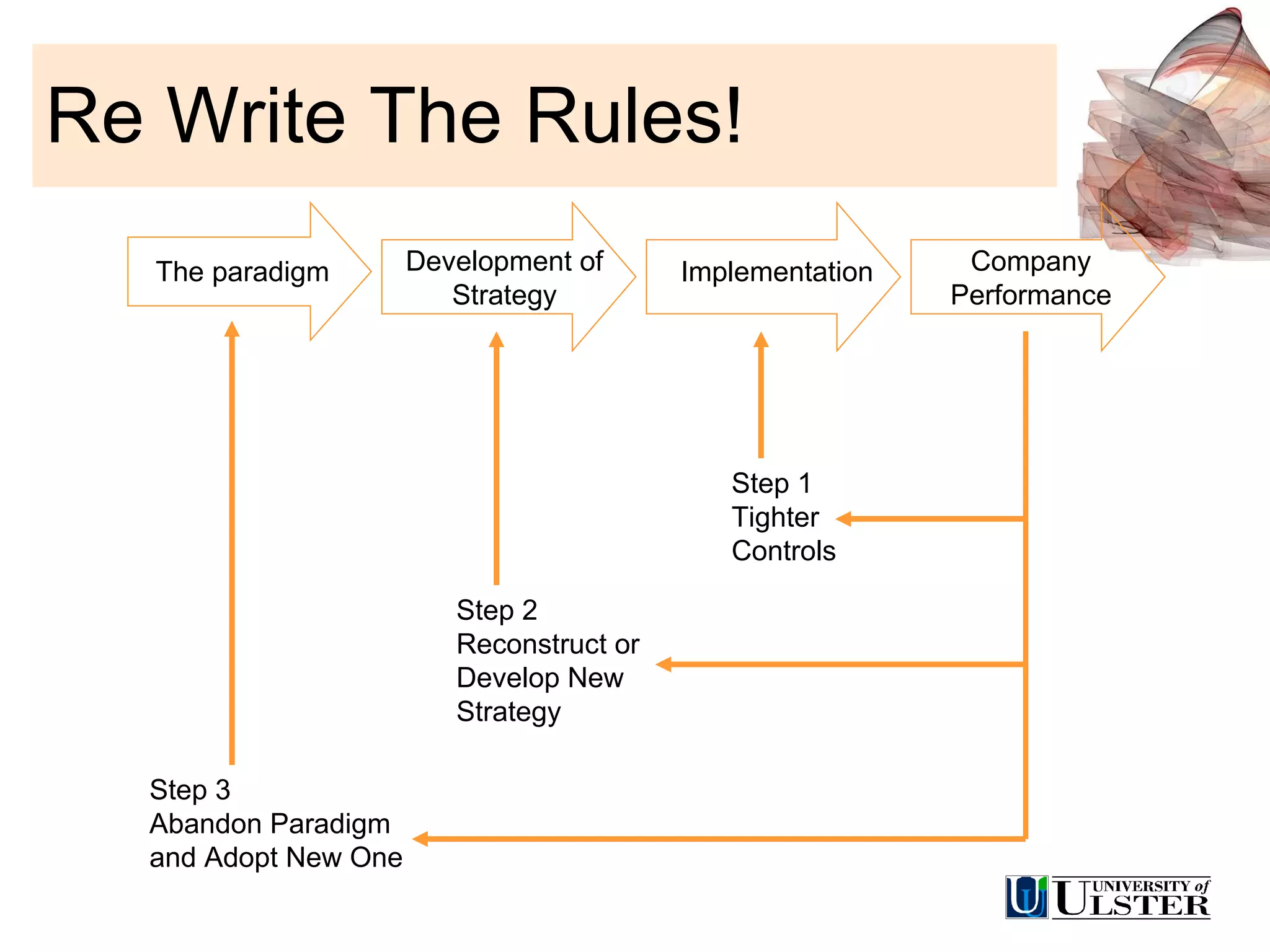
Re Write The Rules! The paradigm Development of Strategy Implementation Company Performance Step 1 Tighter Controls Step 2 Reconstruct or Develop New Strategy Step 3 Abandon Paradigm and Adopt New One
Performance Management Performance and Appraisal Steve Pollard,  Associate Lecturer
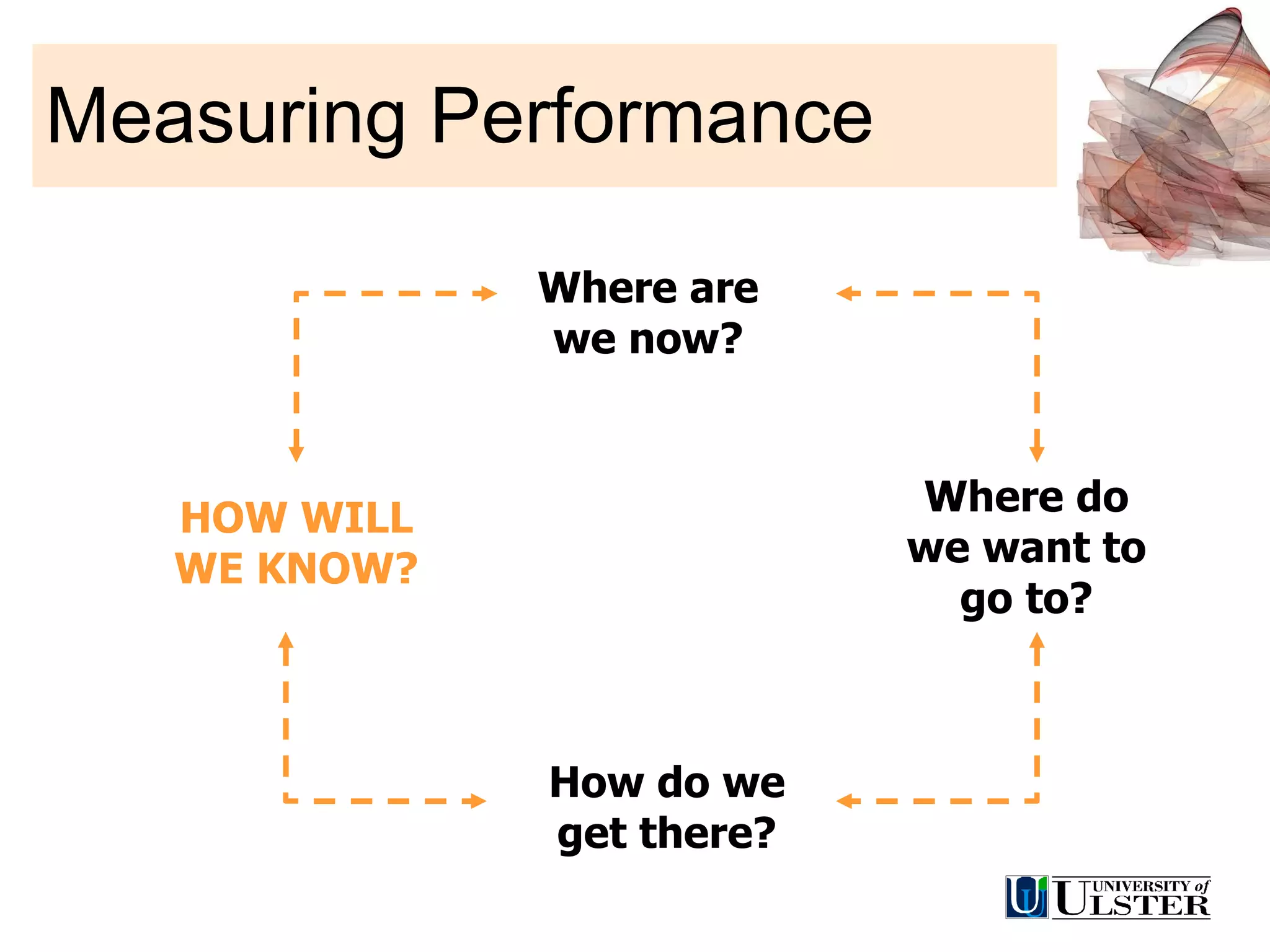
Measuring Performance Where are we now? Where do we want to go to? How do we get there? HOW WILL WE KNOW?
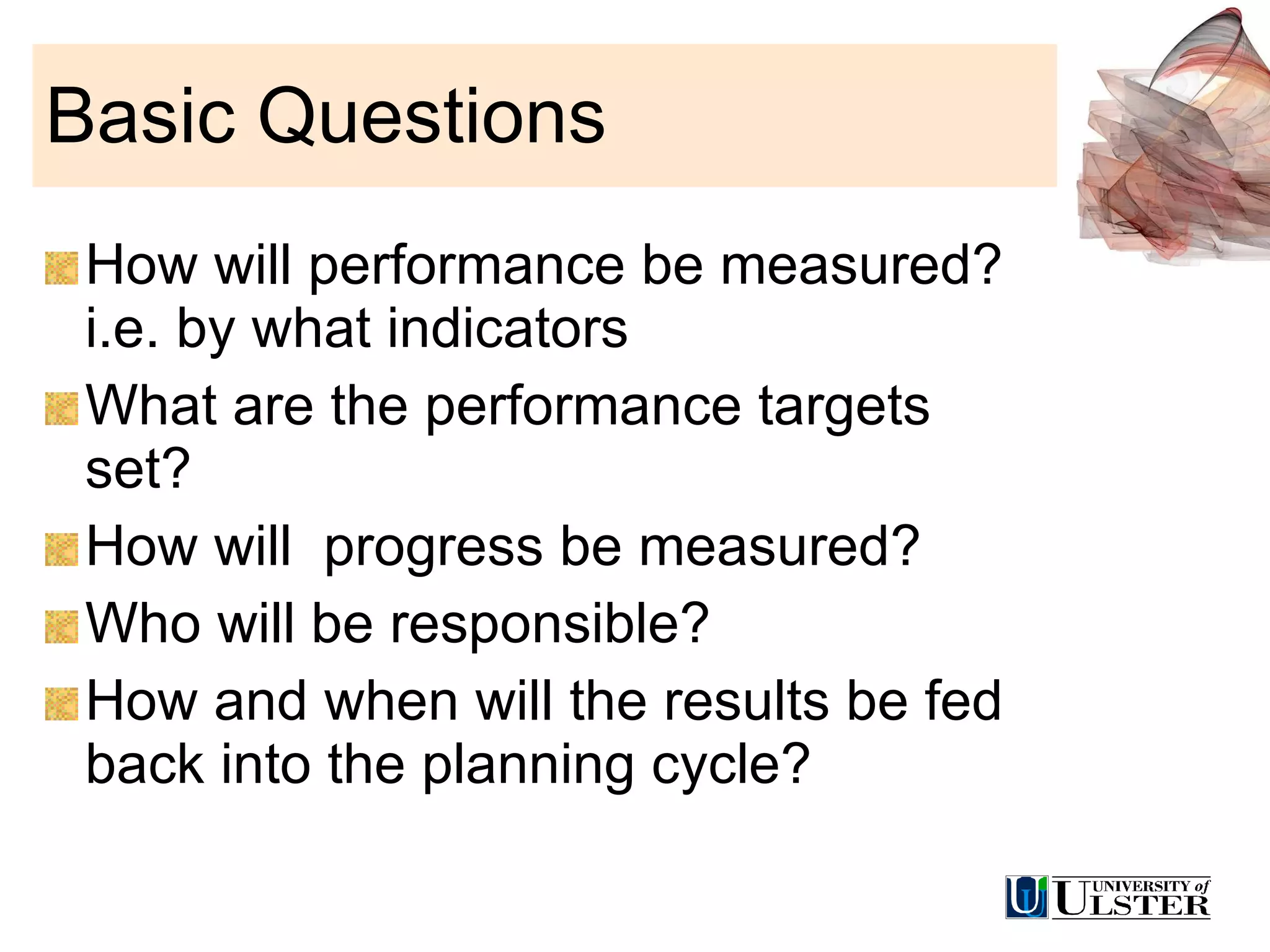
Basic Questions How will performance be measured?  i.e. by what indicators  What are the performance targets set? How will  progress be measured? Who will be responsible?  How and when will the results be fed back into the planning cycle?
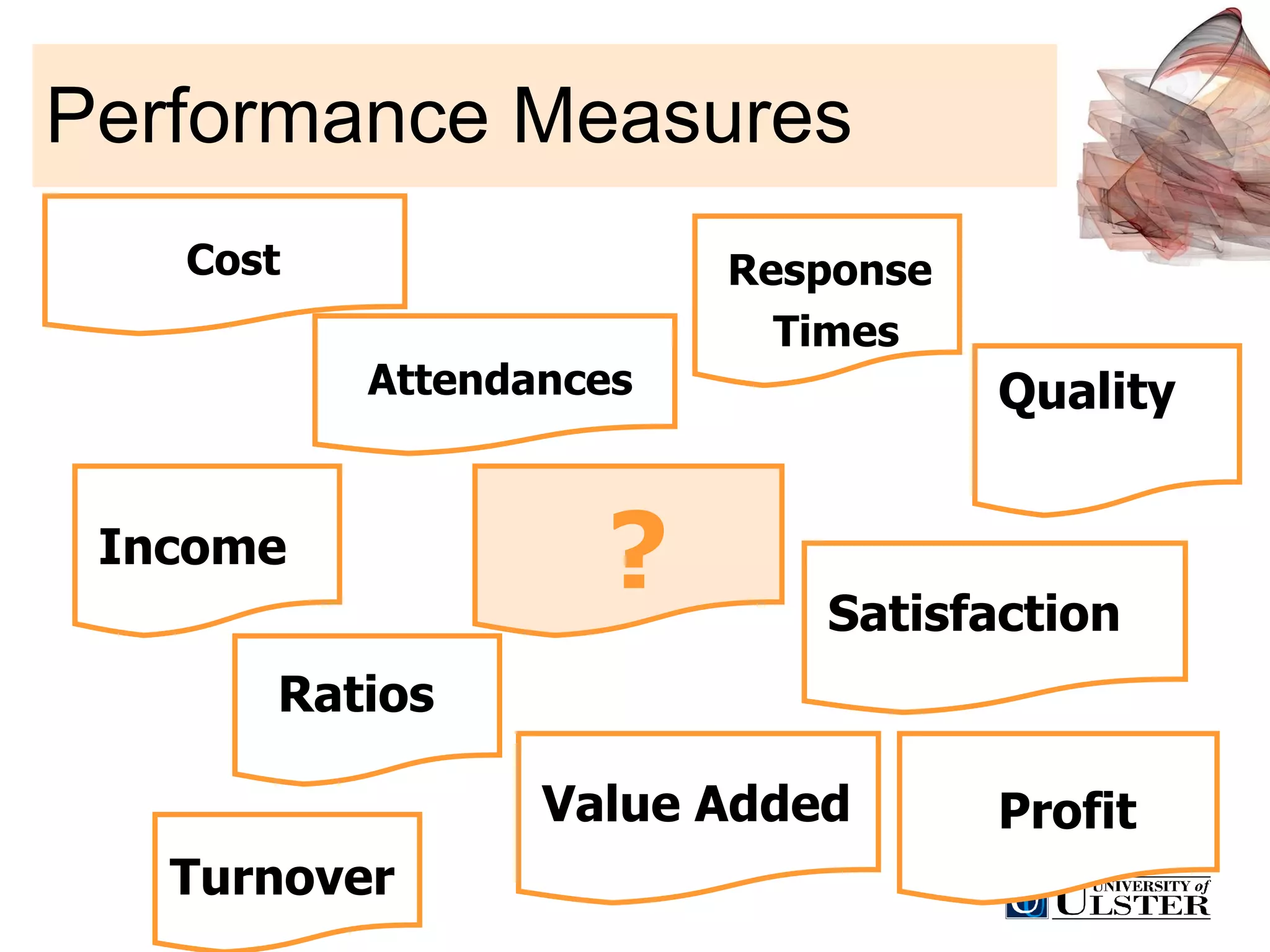
Performance Measures Income Response Times Satisfaction Value Added Turnover Ratios Quality Attendances Profit ? Cost
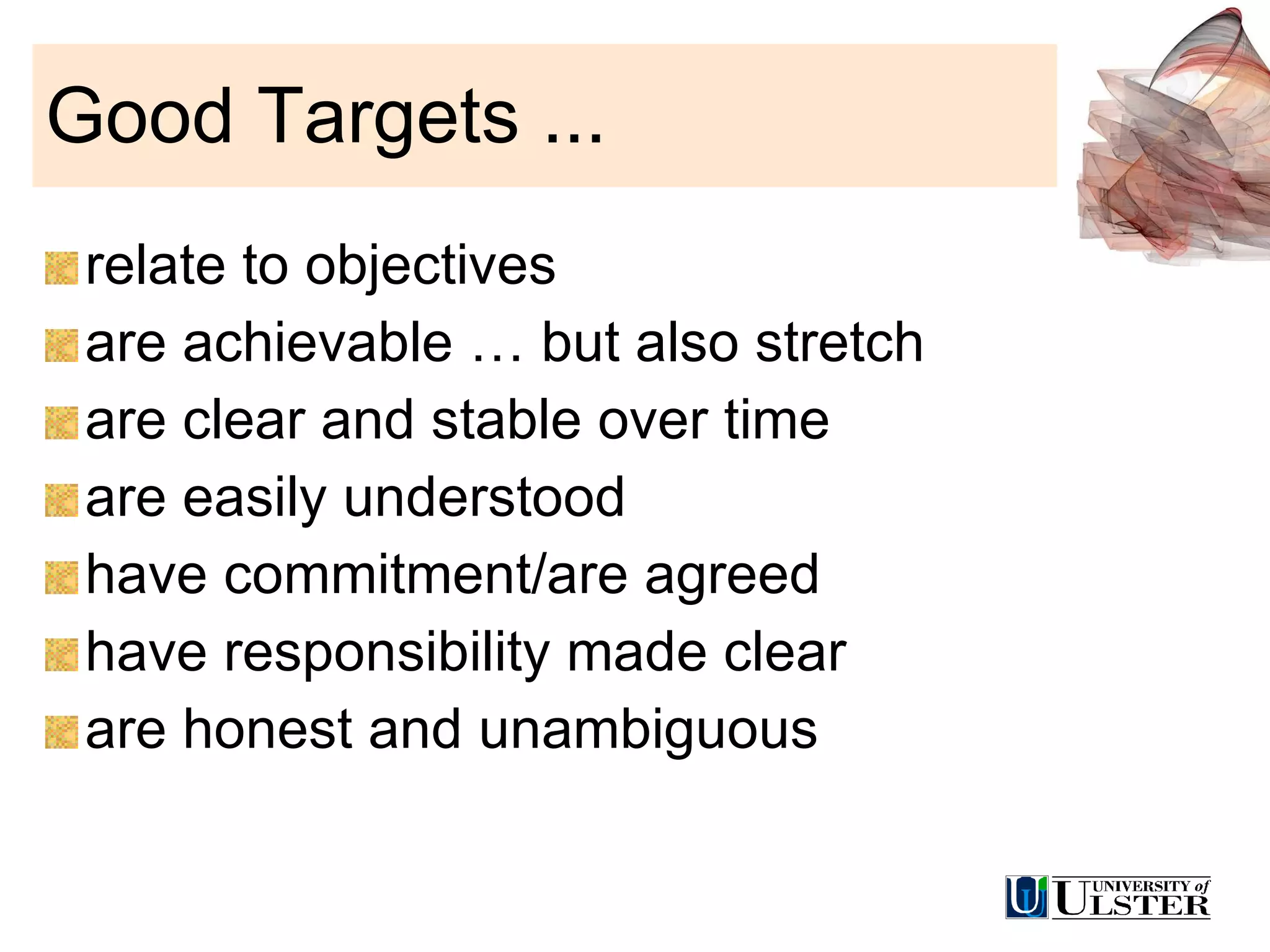
Good Targets ... relate to objectives are achievable … but also stretch are clear and stable over time are easily understood have commitment/are agreed have responsibility made clear are honest and unambiguous
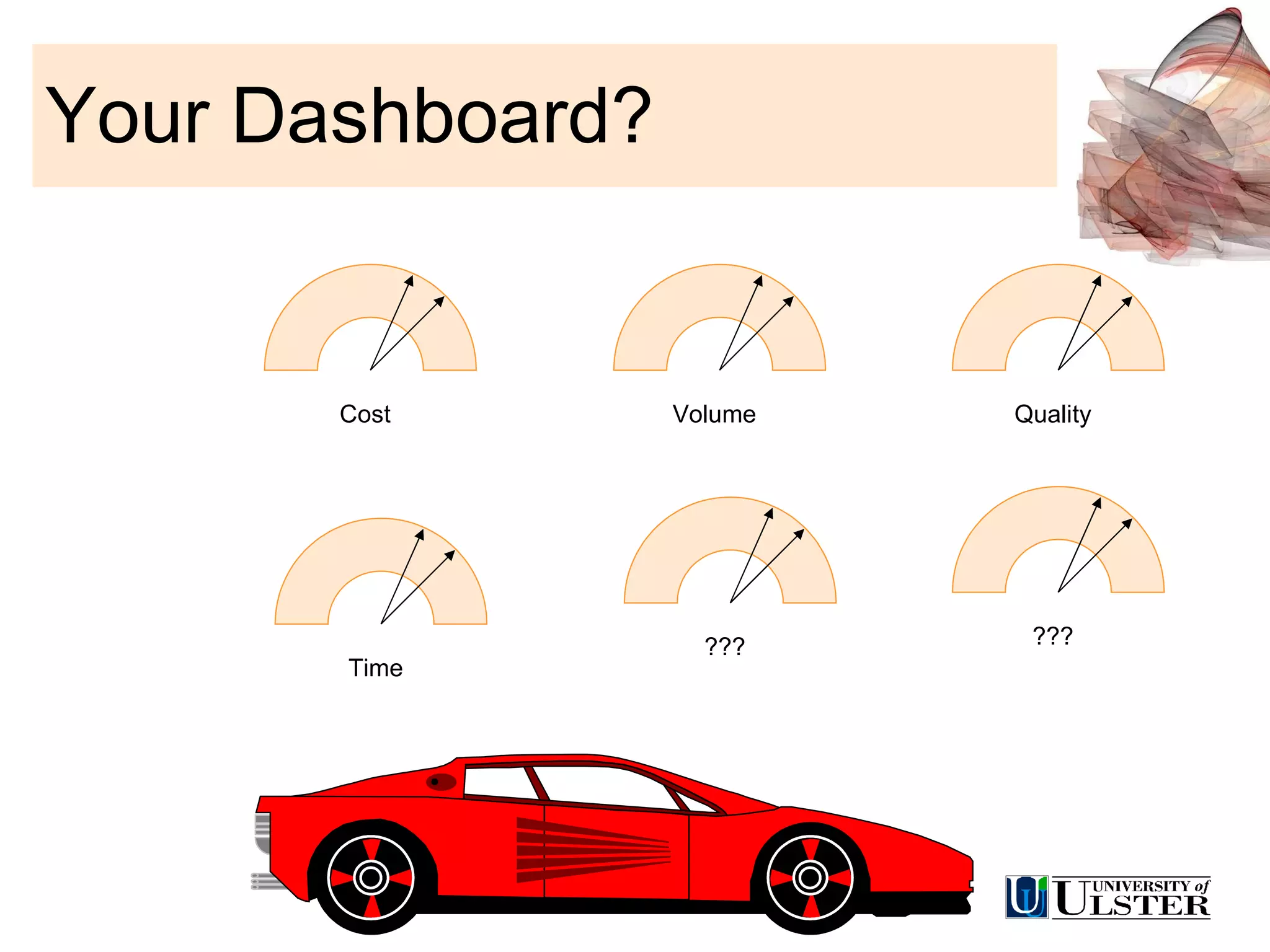
The Dashboard Approach More than one measure A few critical areas: fuel; speed; time etc Much more than the rear view mirror Guides … not automatic pilot!
Your Dashboard? Cost Time ??? Volume ??? Quality
Further Module Aims To: Consider how we can achieve high performance Discuss operational planning and apply certain planning tools Evaluate the problem solving/decision making process  Assess how we give feedback on performance
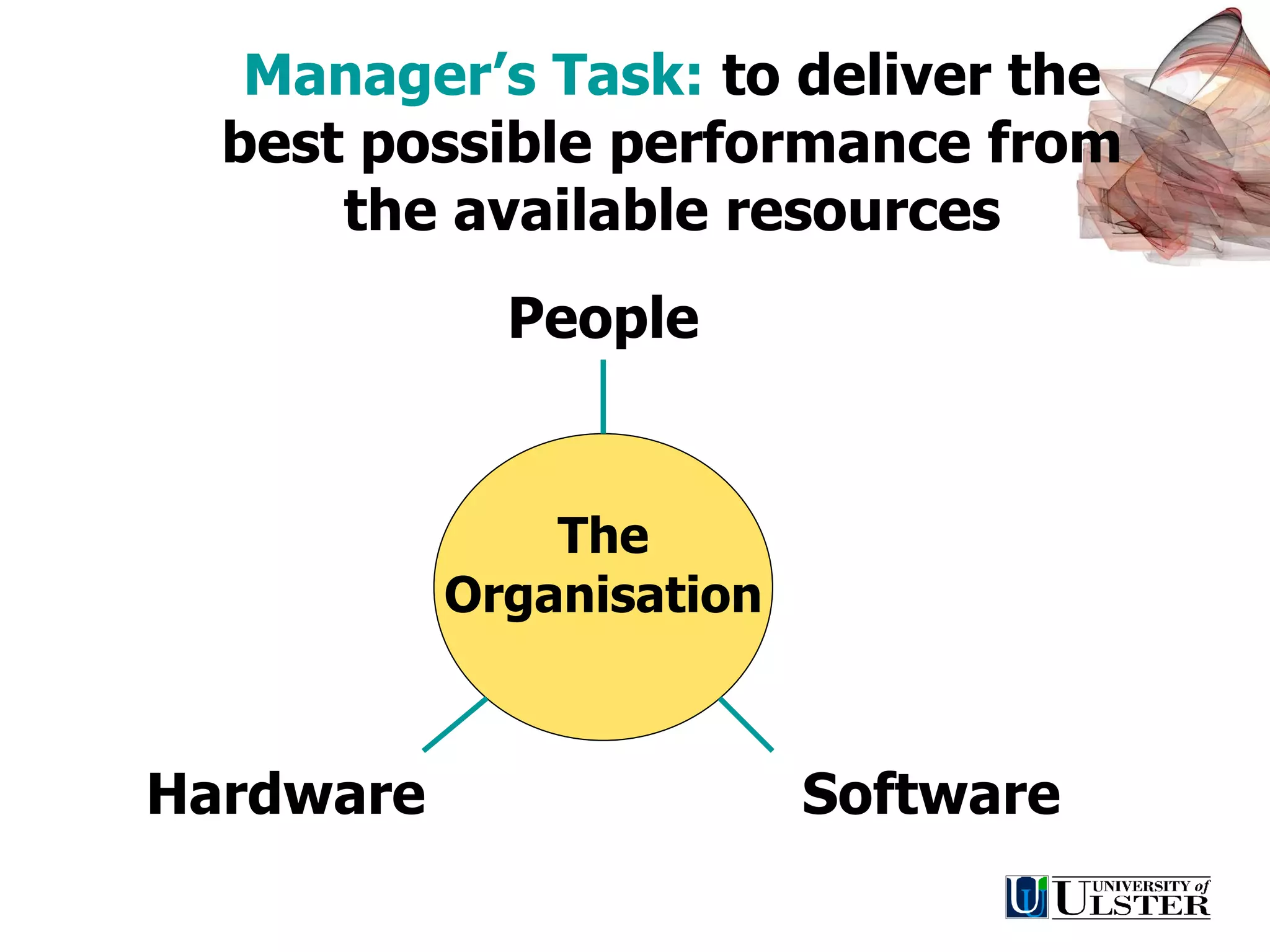
The Organisation People Hardware Software Manager’s Task:   to deliver the best possible performance from the available resources
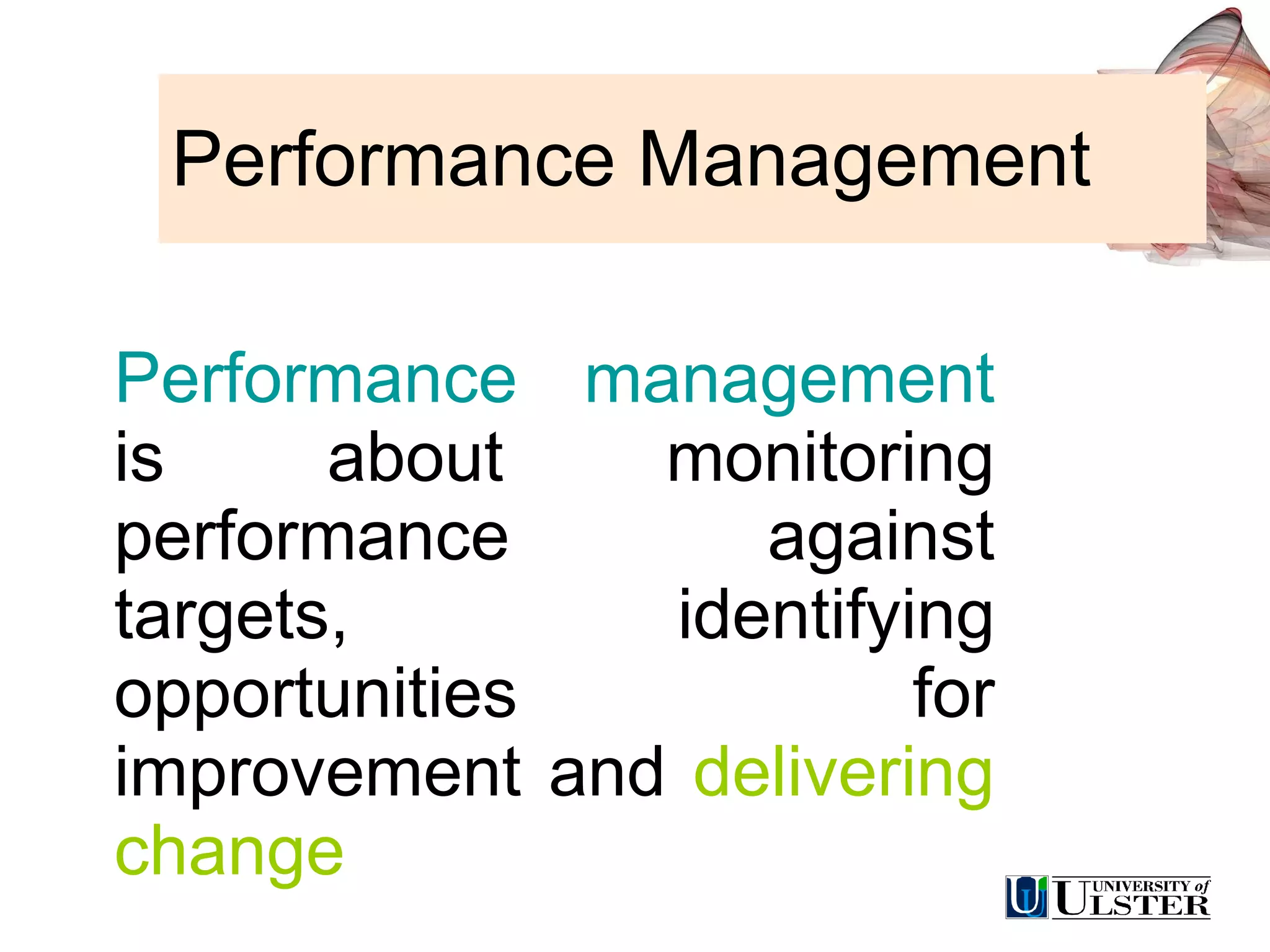
Performance Management Performance management  is about monitoring performance against targets, identifying opportunities for improvement and delivering change Lets come back to this..
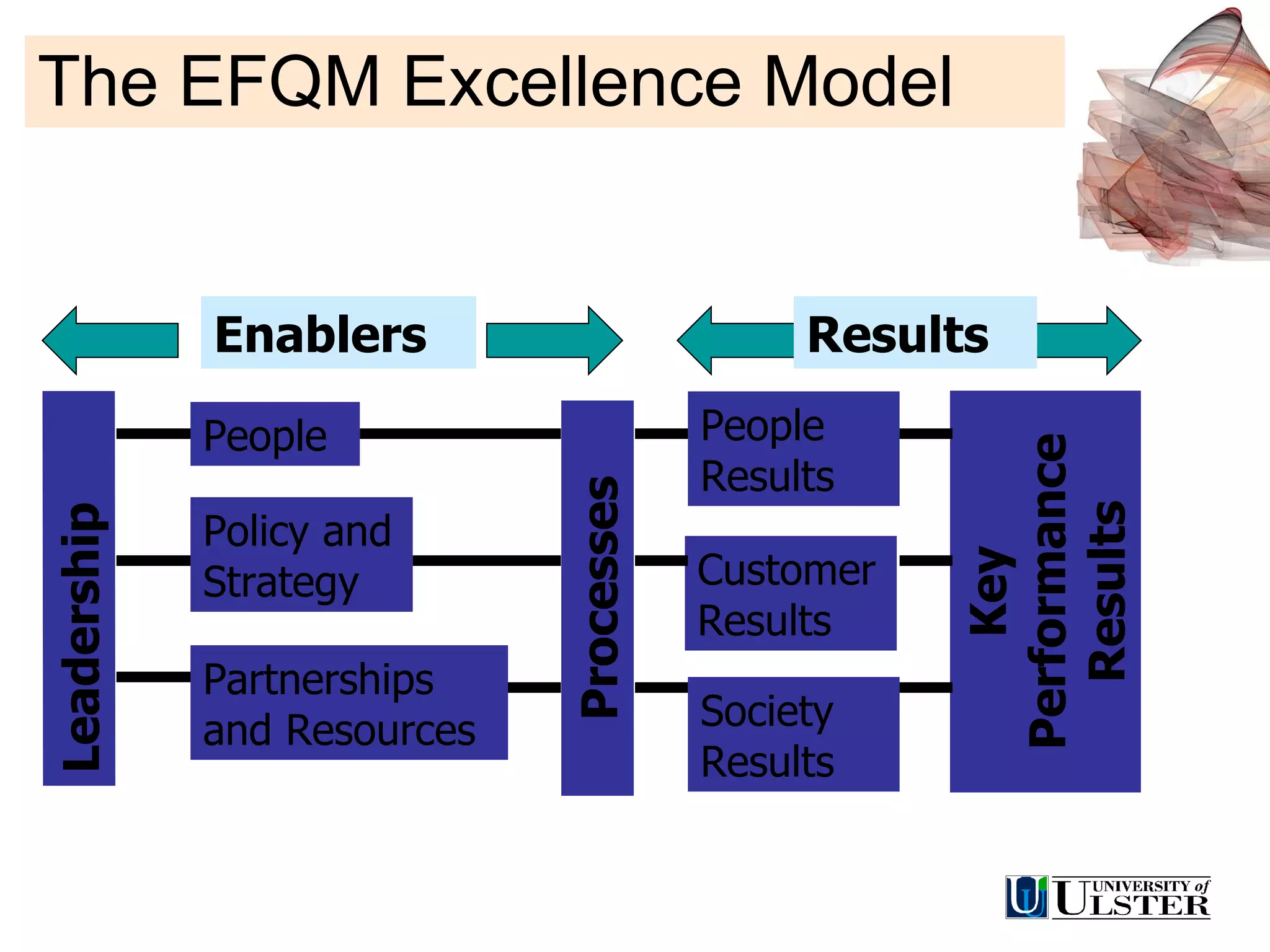
The EFQM Excellence Model Leadership People Policy and Strategy Partnerships and Resources Processes People Results Customer Results Society Results Key Performance Results Enablers Results
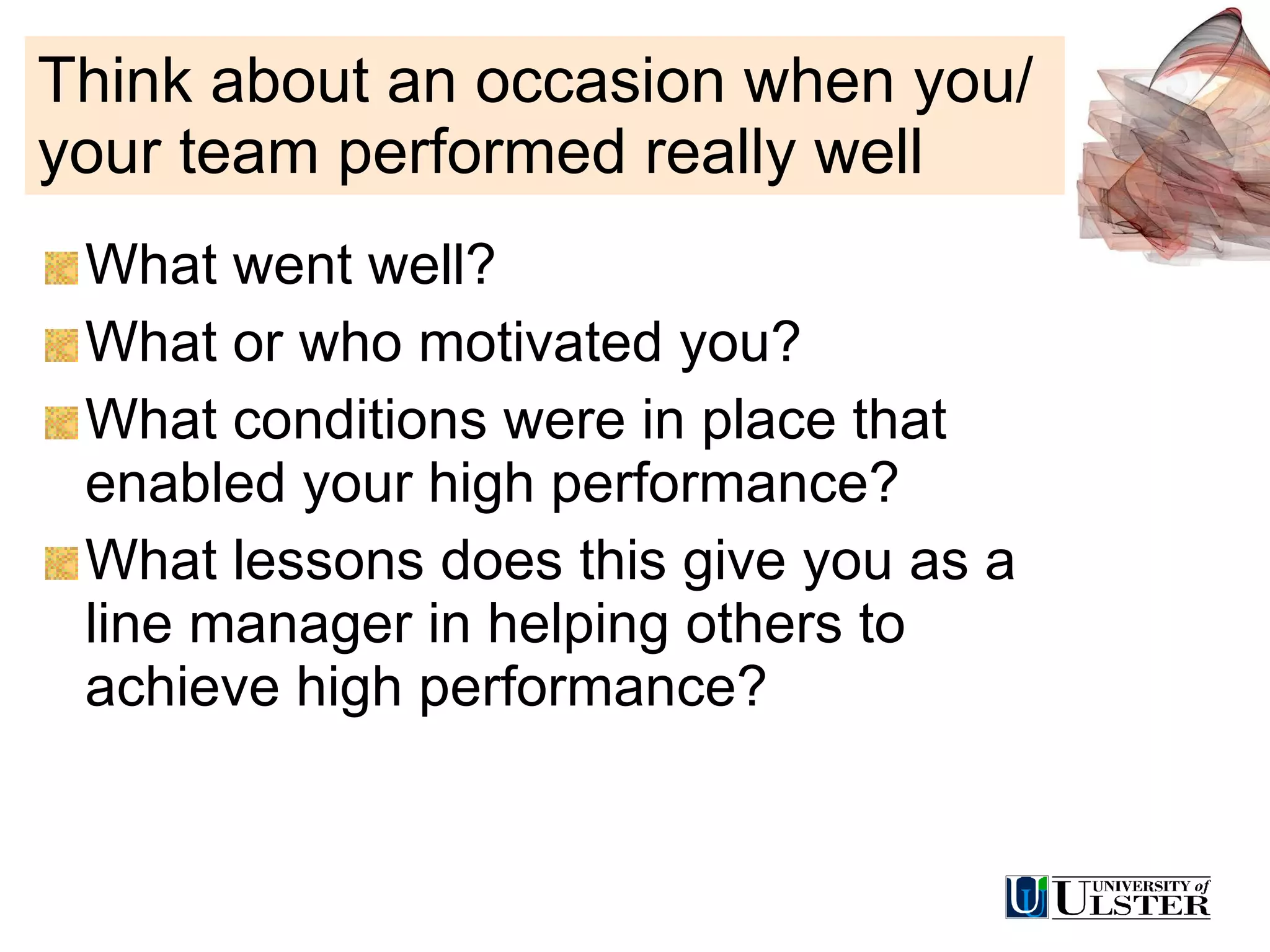
Think about an occasion when you/your team performed really well What went well? What or who motivated you? What conditions were in place that enabled your high performance? What lessons does this give you as a line manager in helping others to achieve high performance?
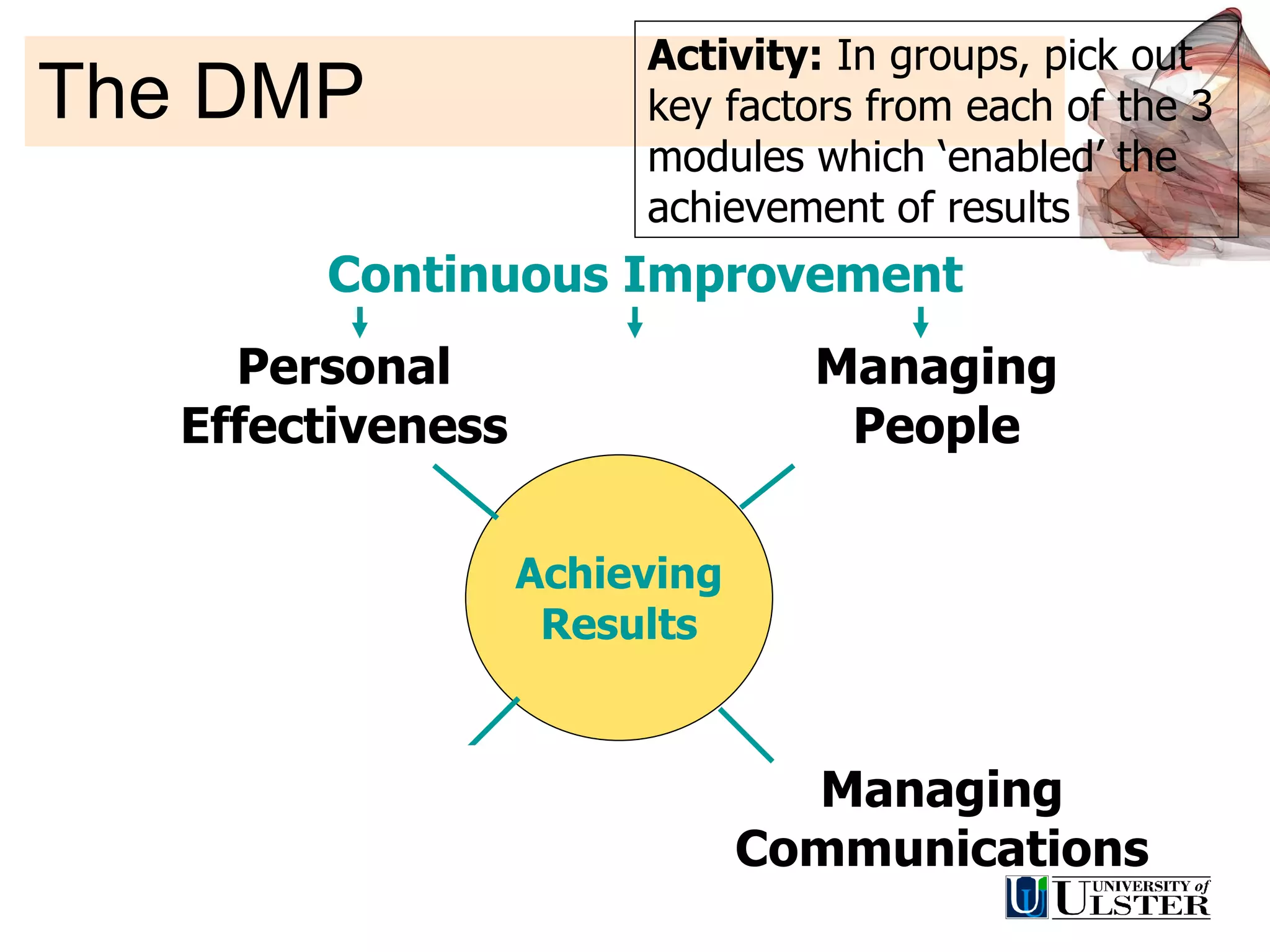
The DMP Achieving Results Personal Effectiveness Managing People Managing Communications Continuous Improvement Activity:  In groups, pick out key factors from each of the 3 modules which ‘enabled’ the achievement of results Managing Change
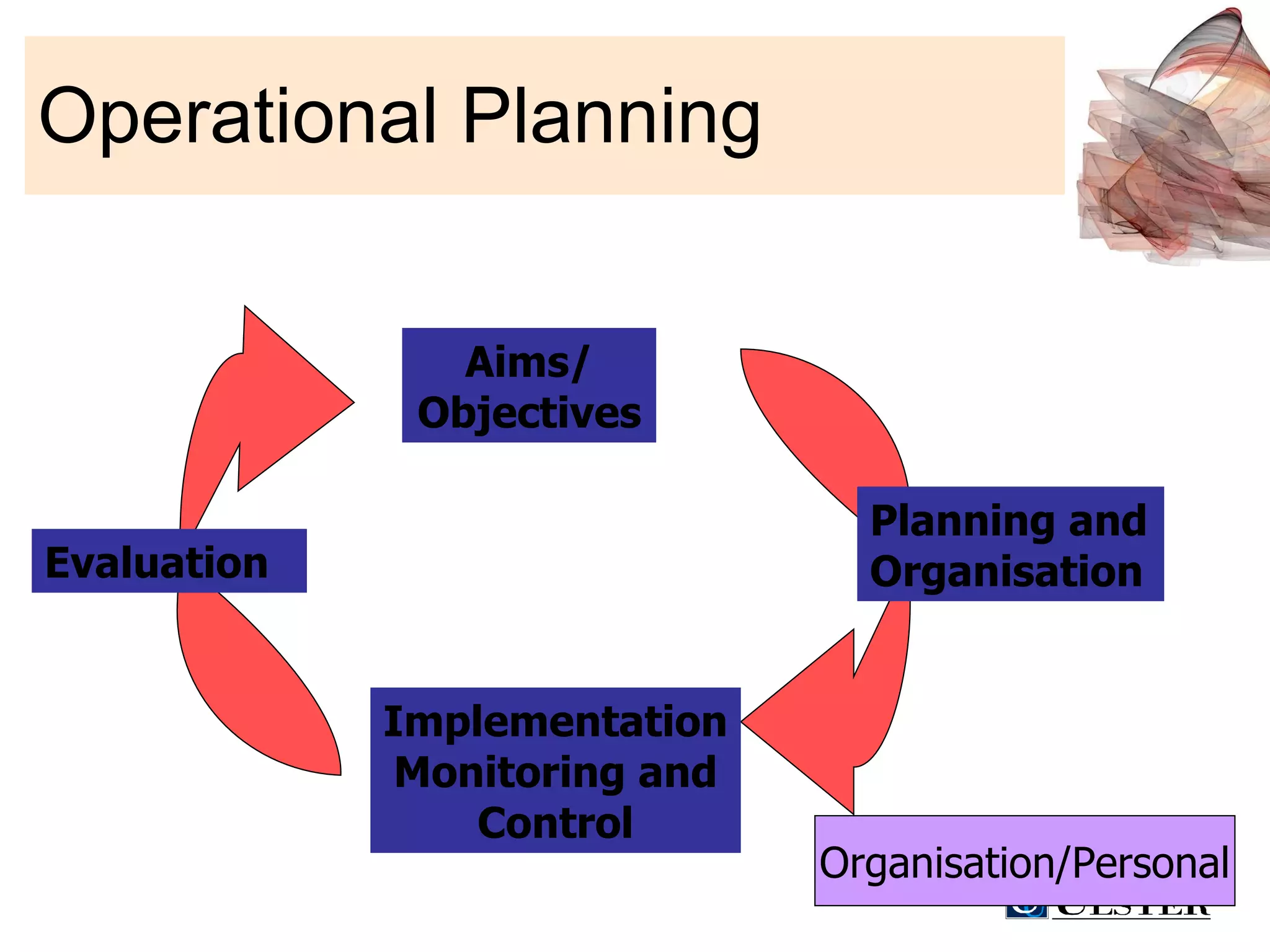
Operational Planning Organisation/Personal Aims/ Objectives Planning and Organisation Implementation Monitoring and Control Evaluation
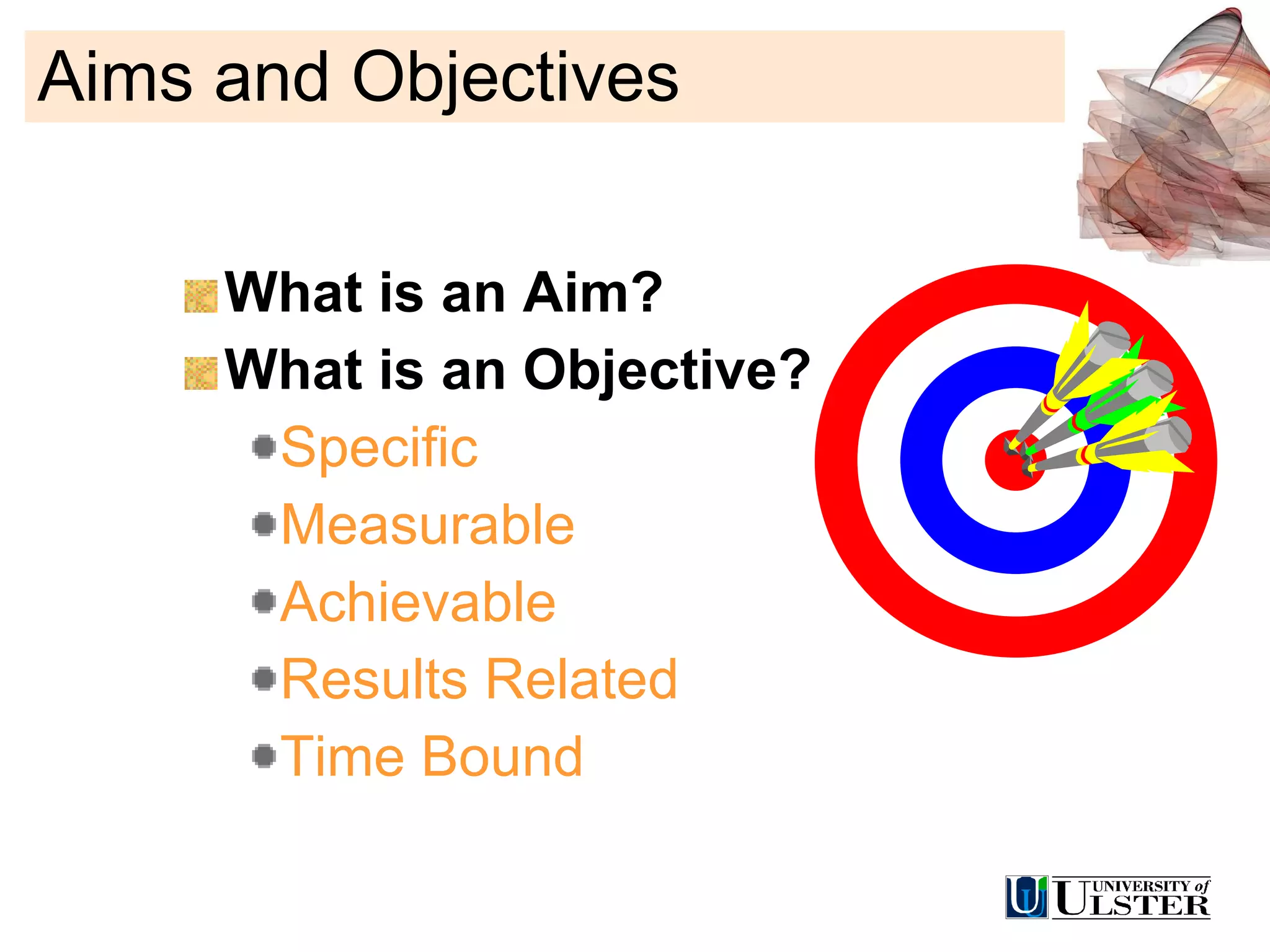
Aims and Objectives What is an Aim? What is an Objective? Specific Measurable Achievable Results Related Time Bound
Planning Mind Mapping
Aims and Objectives Activity:  In groups, you are going to plan redecorating a room in your house. This includes some electrical rewiring and a new carpet. For now, we need your aim, objectives (specifications), and milestones.
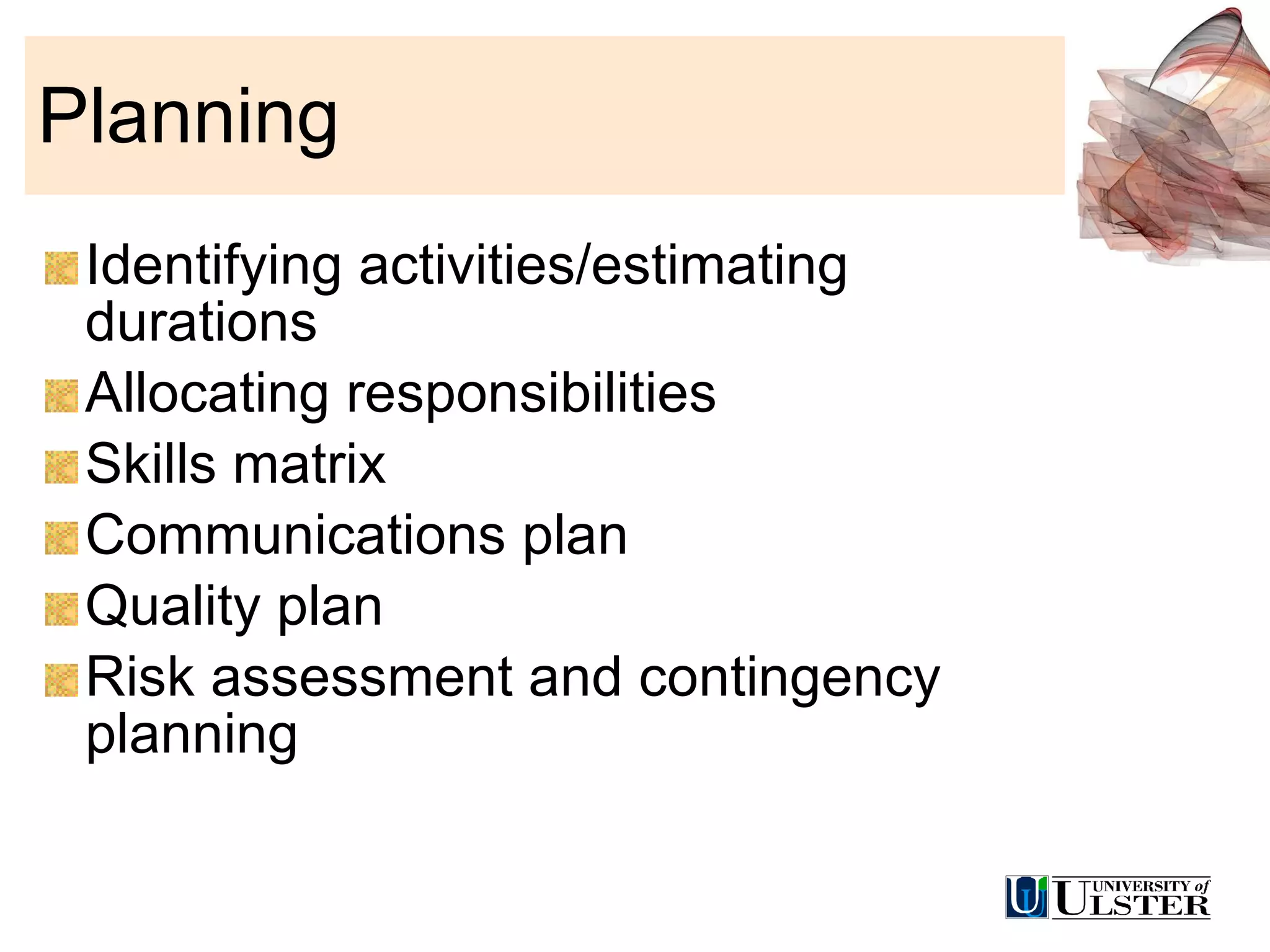
Planning Identifying activities/estimating durations Allocating responsibilities Skills matrix Communications plan Quality plan Risk assessment and contingency planning
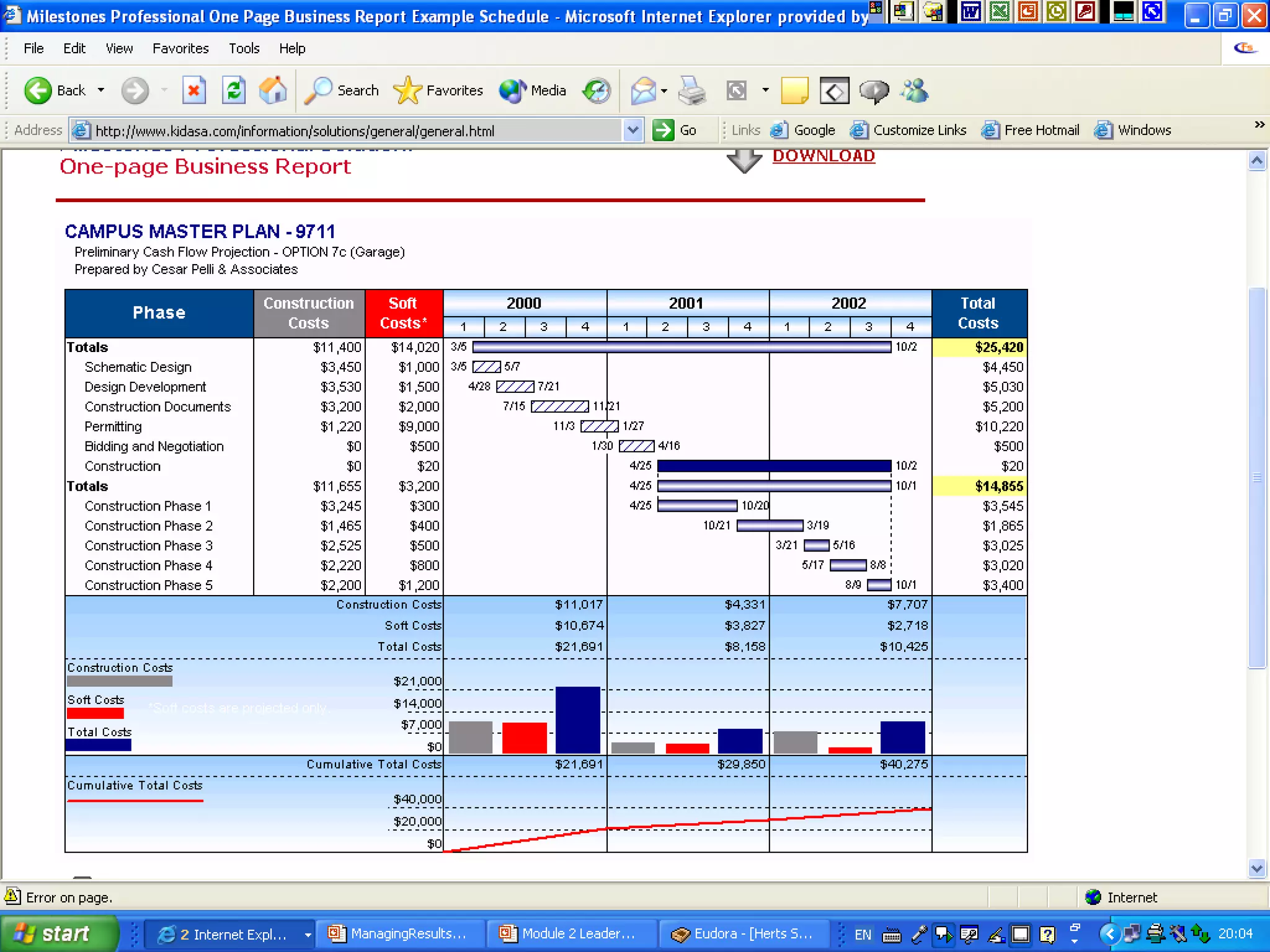
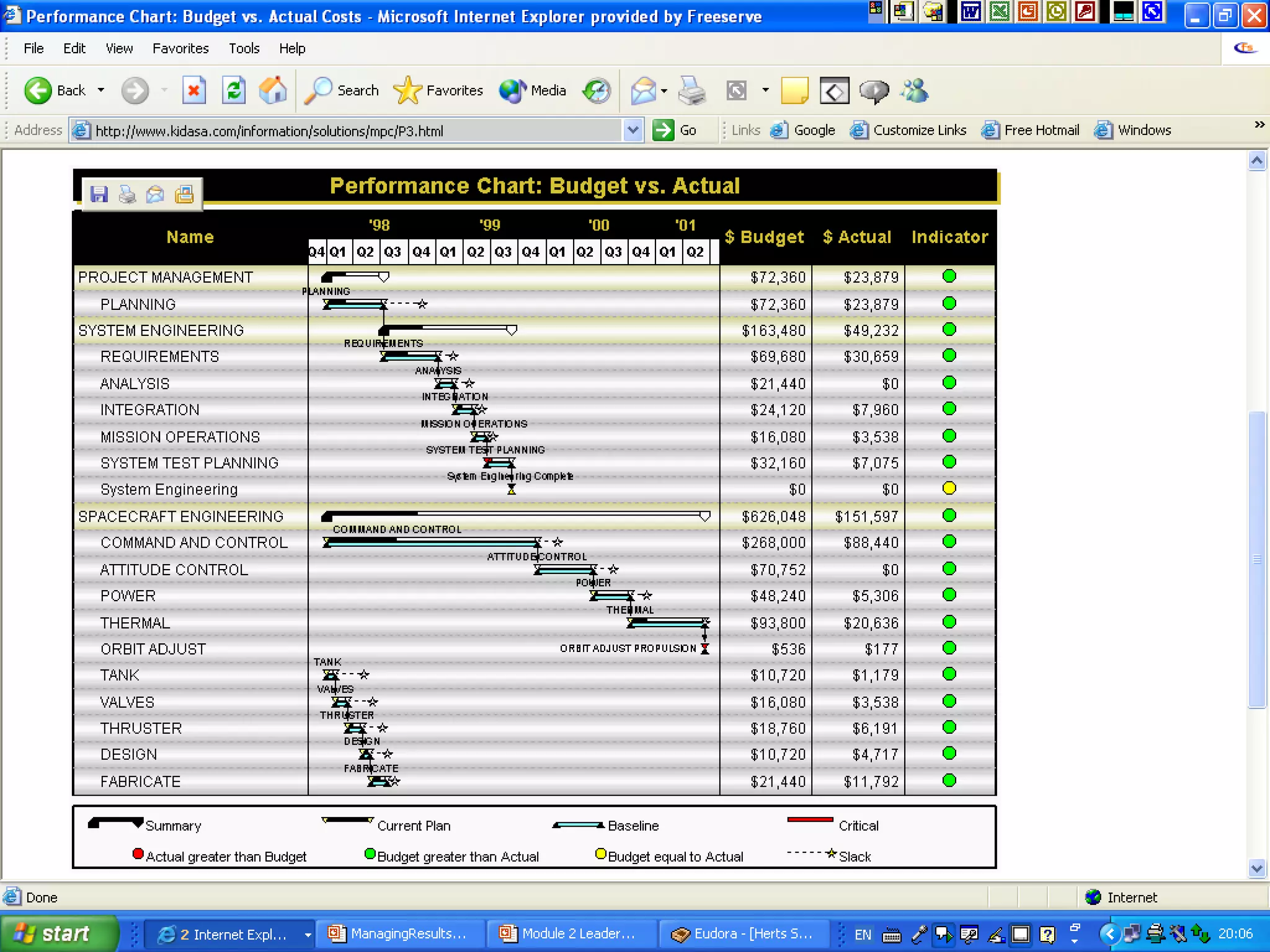
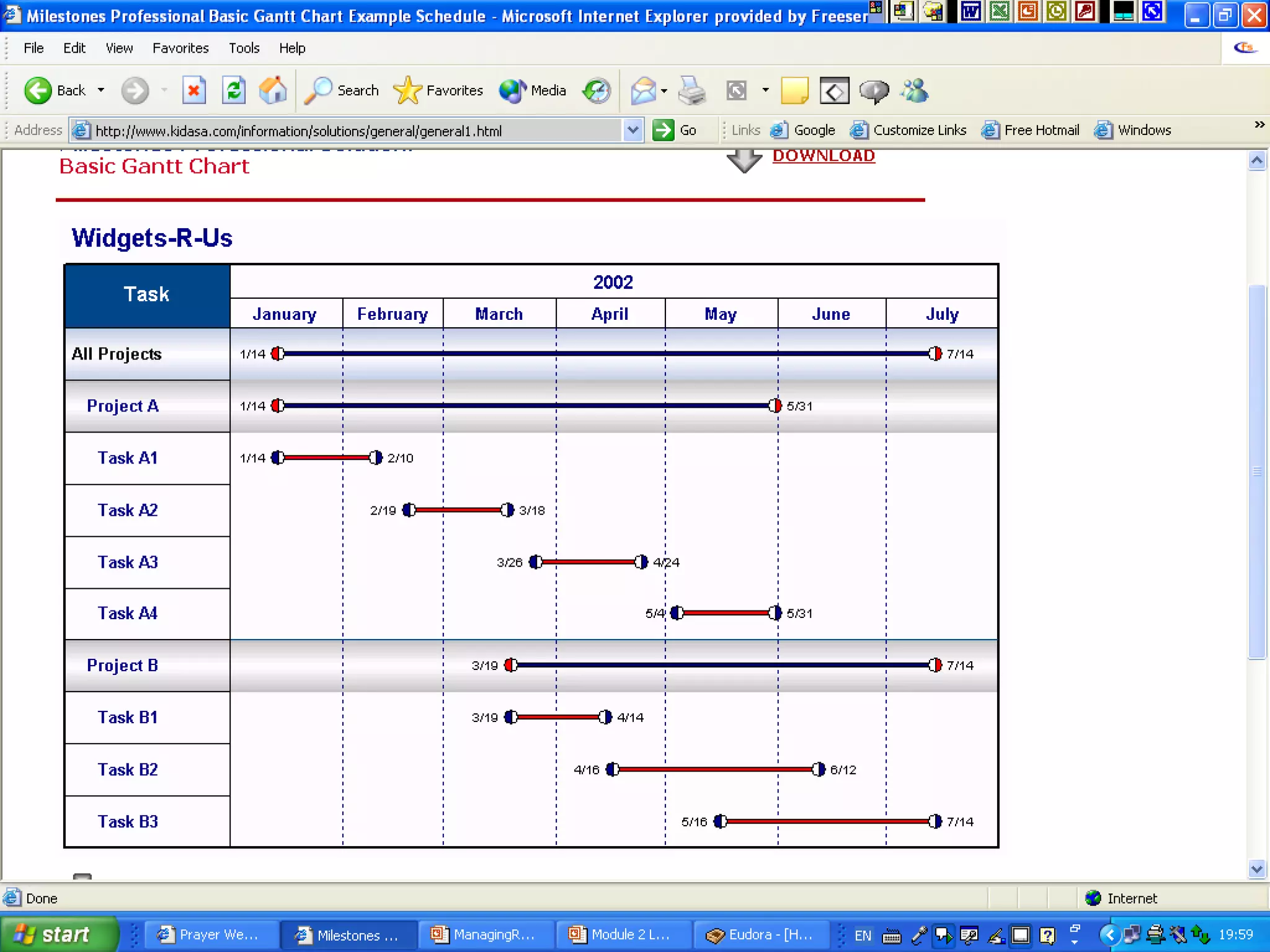
Planning, Implementation, Monitoring and Control The Gantt Chart


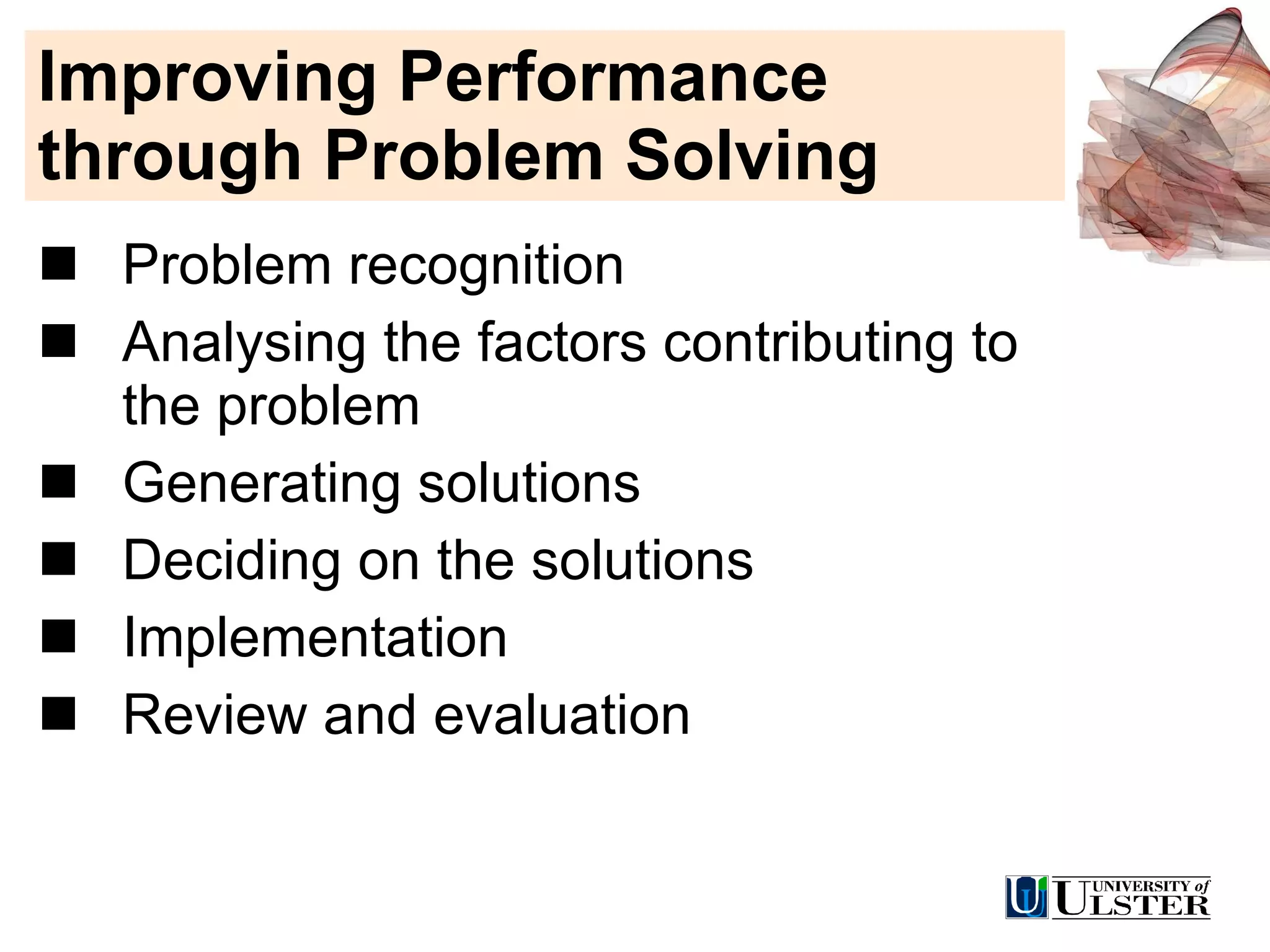
Improving Performance through Problem Solving Problem recognition Analysing the factors contributing to the problem  Generating solutions Deciding on the solutions Implementation Review and evaluation
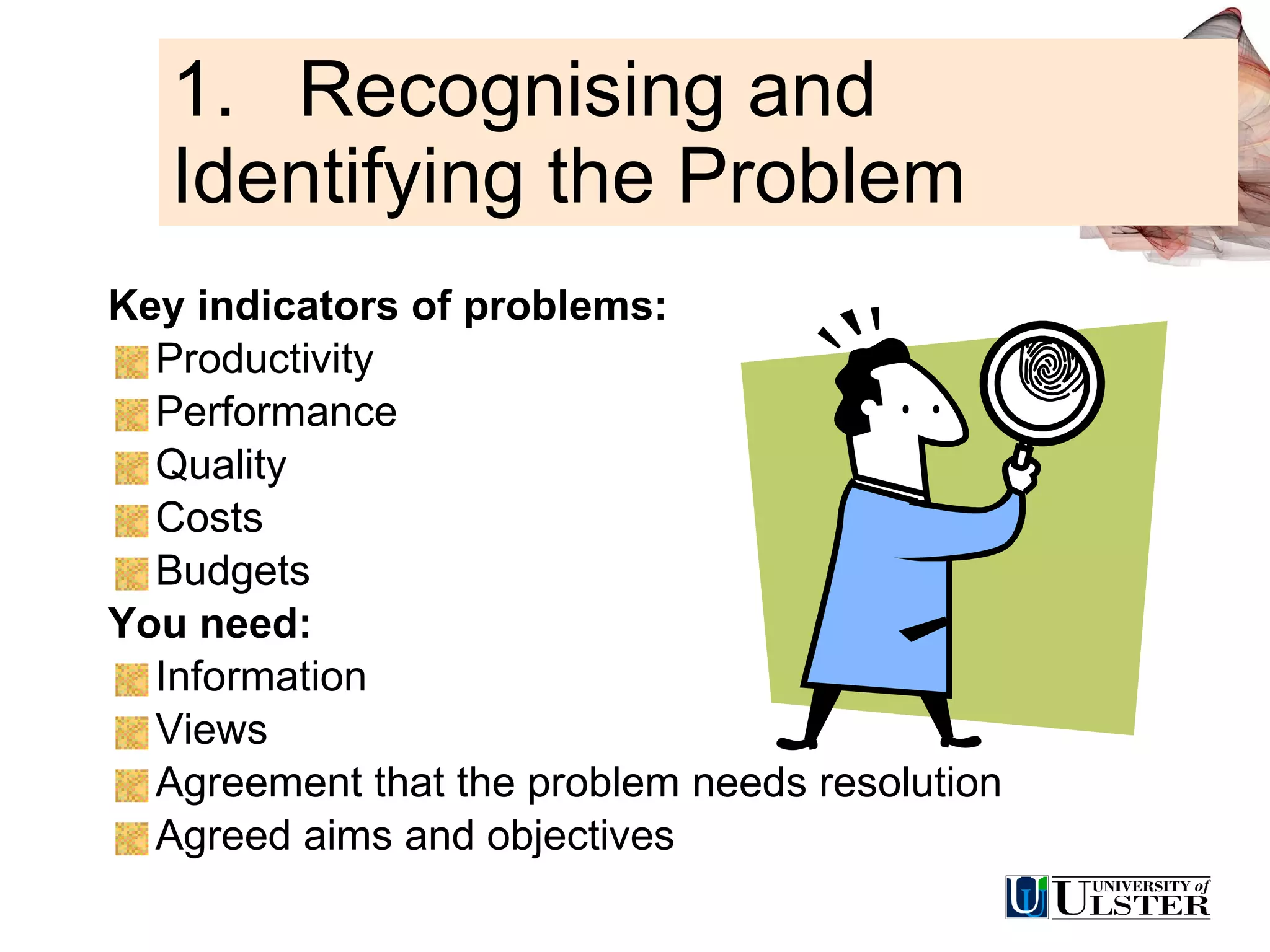
1.  Recognising and  Identifying the Problem Key indicators of problems: Productivity Performance Quality Costs Budgets  You need: Information Views Agreement that the problem needs resolution Agreed aims and objectives
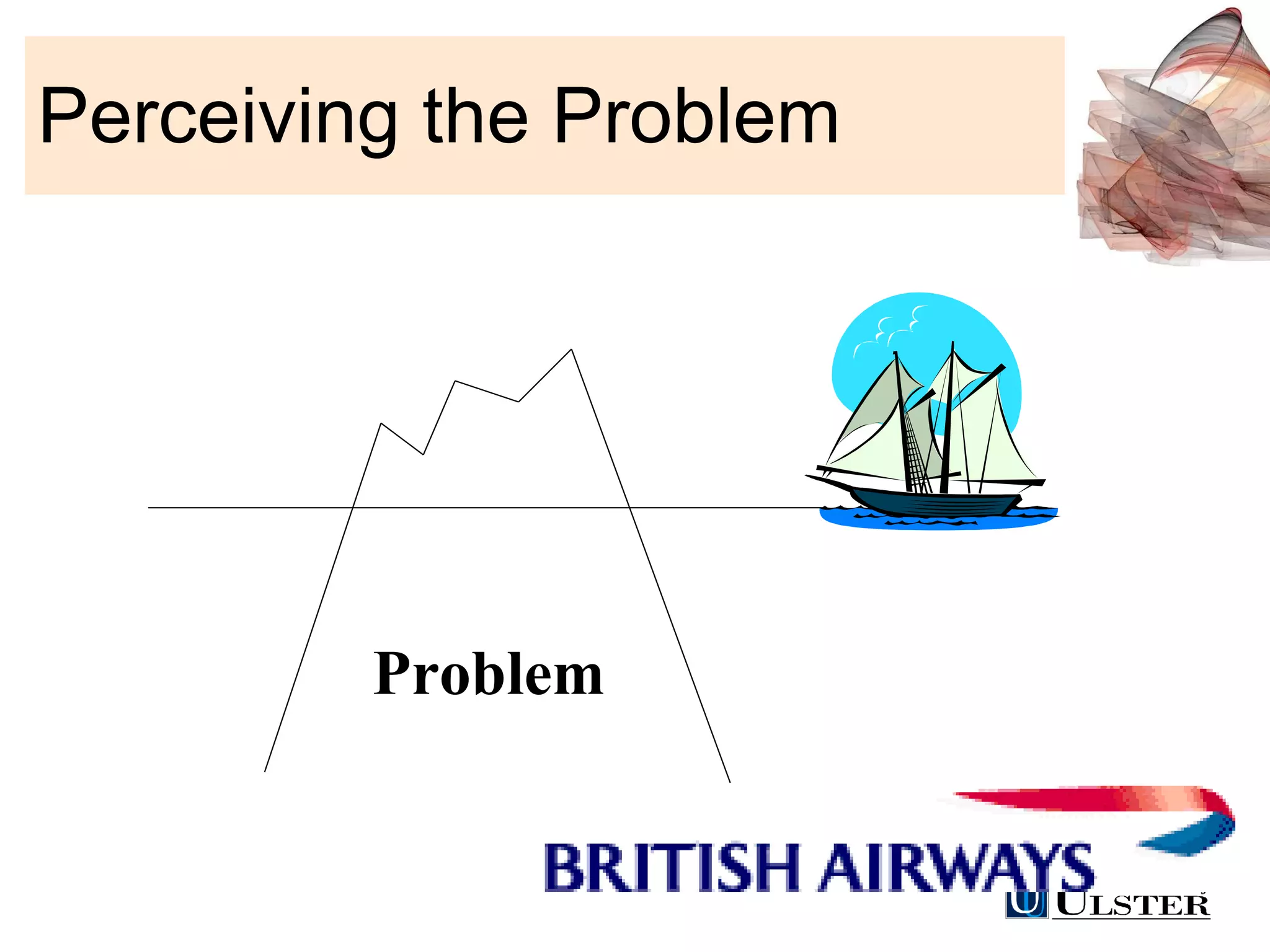
Perceiving the Problem Problem
2.  Analysing the Causes for  the Problem Problem-Solving Tools: Fishbone Diagram Ask Why 5 Times Method
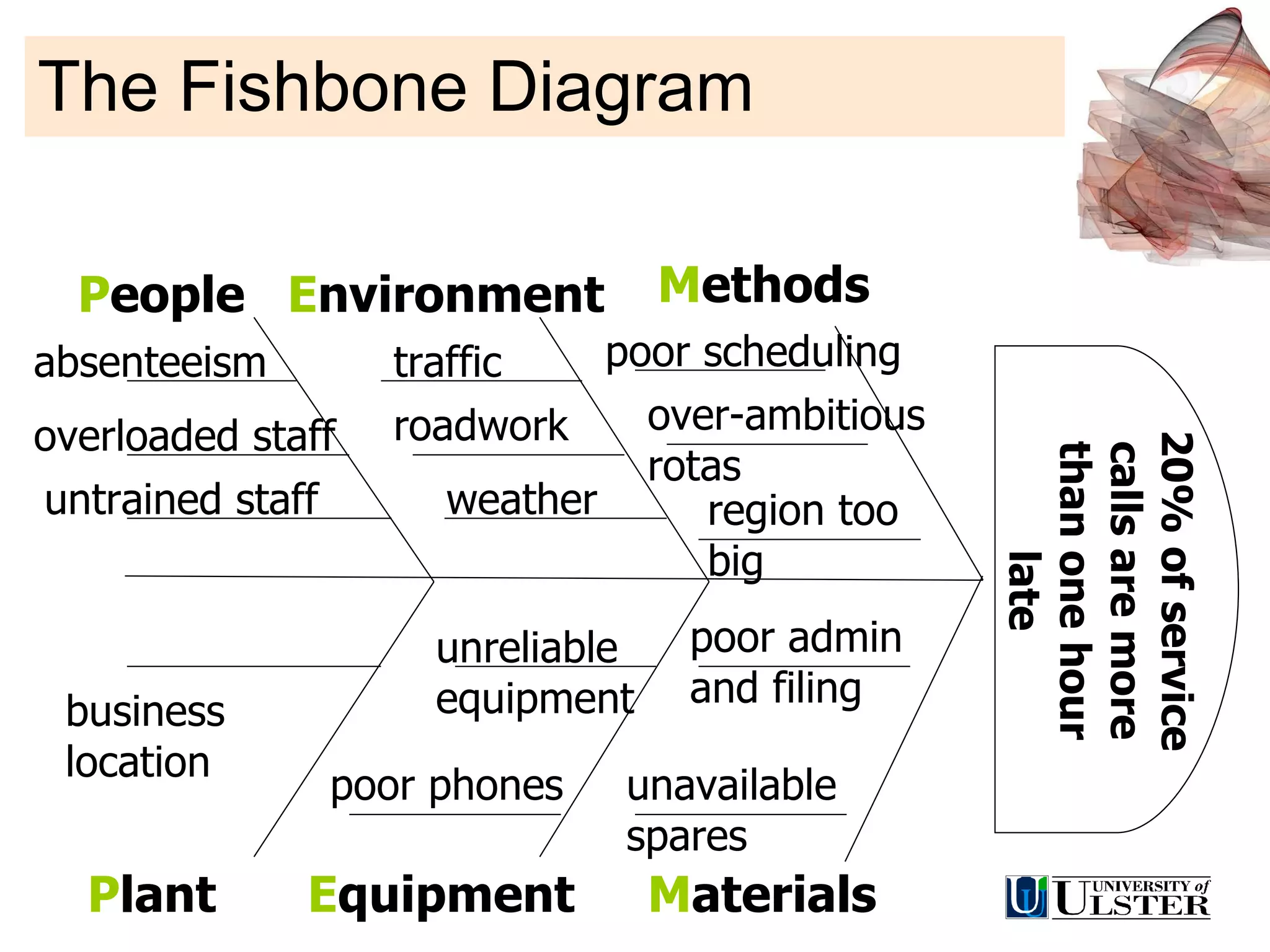
The Fishbone Diagram 20% of service calls are more than one hour late P eople absenteeism overloaded staff untrained staff P lant business location E nvironment traffic roadwork weather E quipment unreliable equipment poor phones M ethods poor scheduling over-ambitious rotas region too big poor admin and filing unavailable spares M aterials
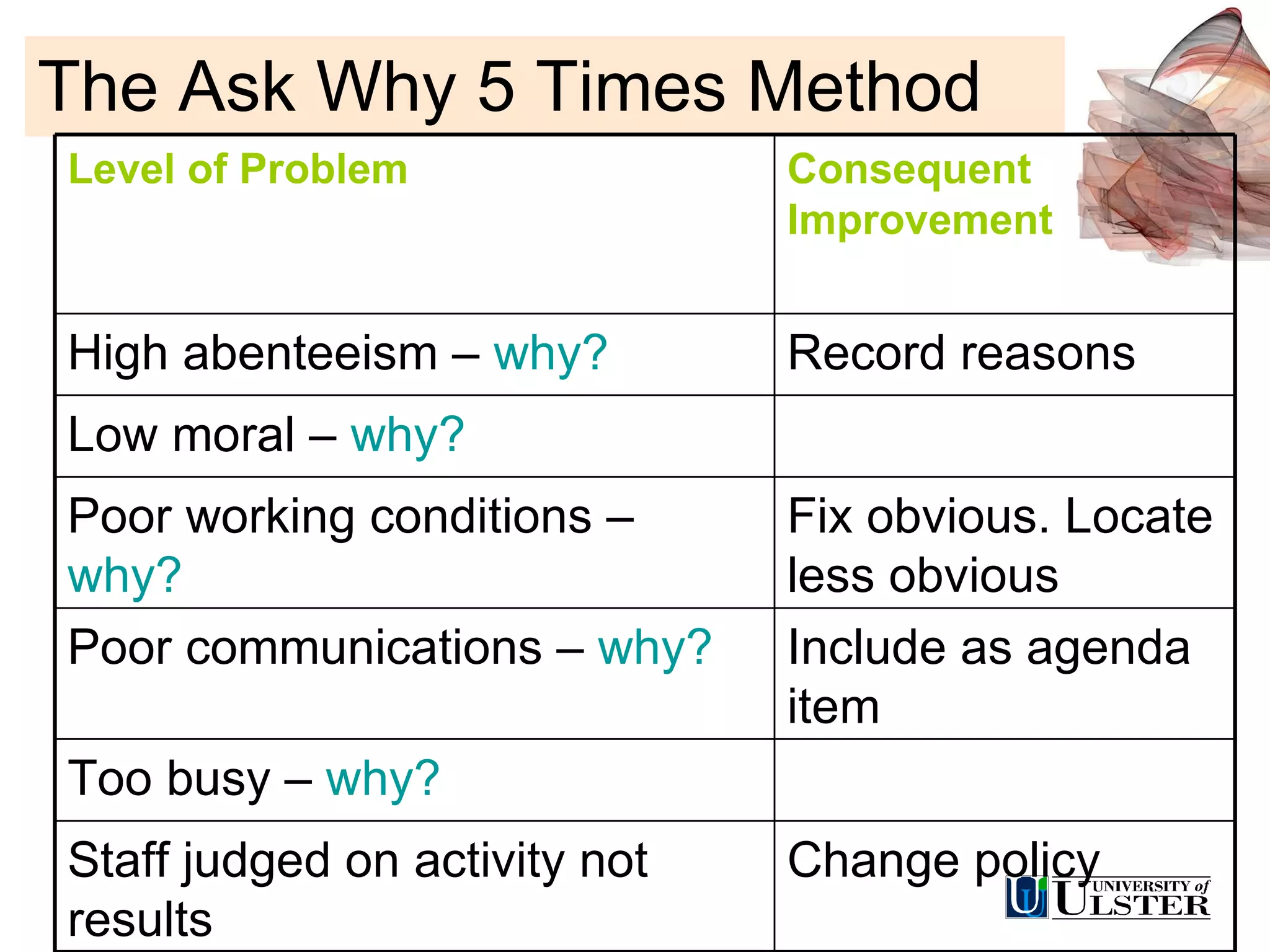
The Ask Why 5 Times Method Change policy Staff judged on activity not results Too busy –  why? Include as agenda item Poor communications –  why? Fix obvious. Locate less obvious Poor working conditions –  why? Low moral –  why? Record reasons High abenteeism –  why? Consequent Improvement Level of Problem
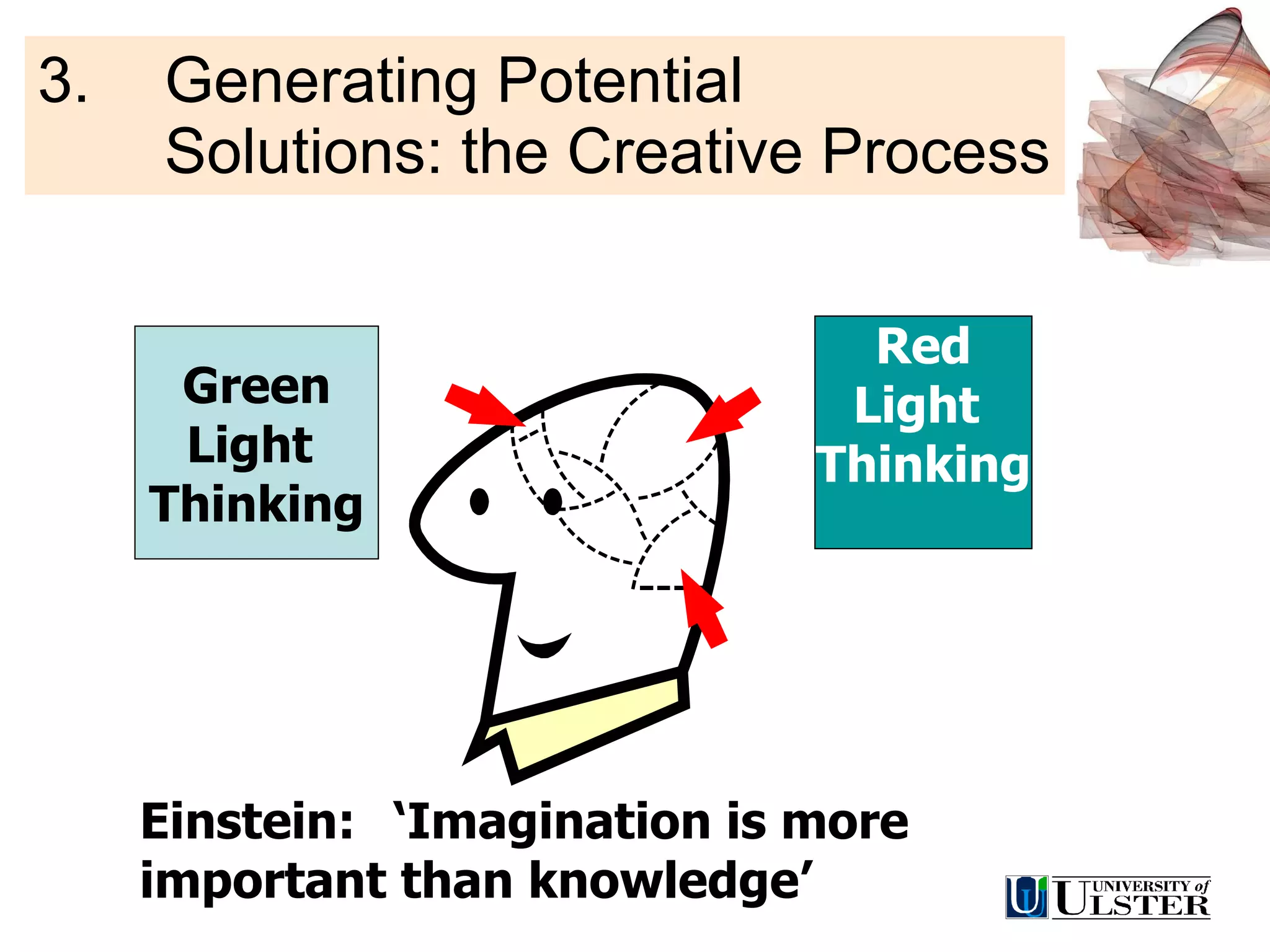
3.  Generating Potential  Solutions: the Creative Process Green Light   Thinking Red Light  Thinking Einstein:  ‘Imagination is more important than knowledge’
3.  Generating Potential  Solutions: the Creative Process
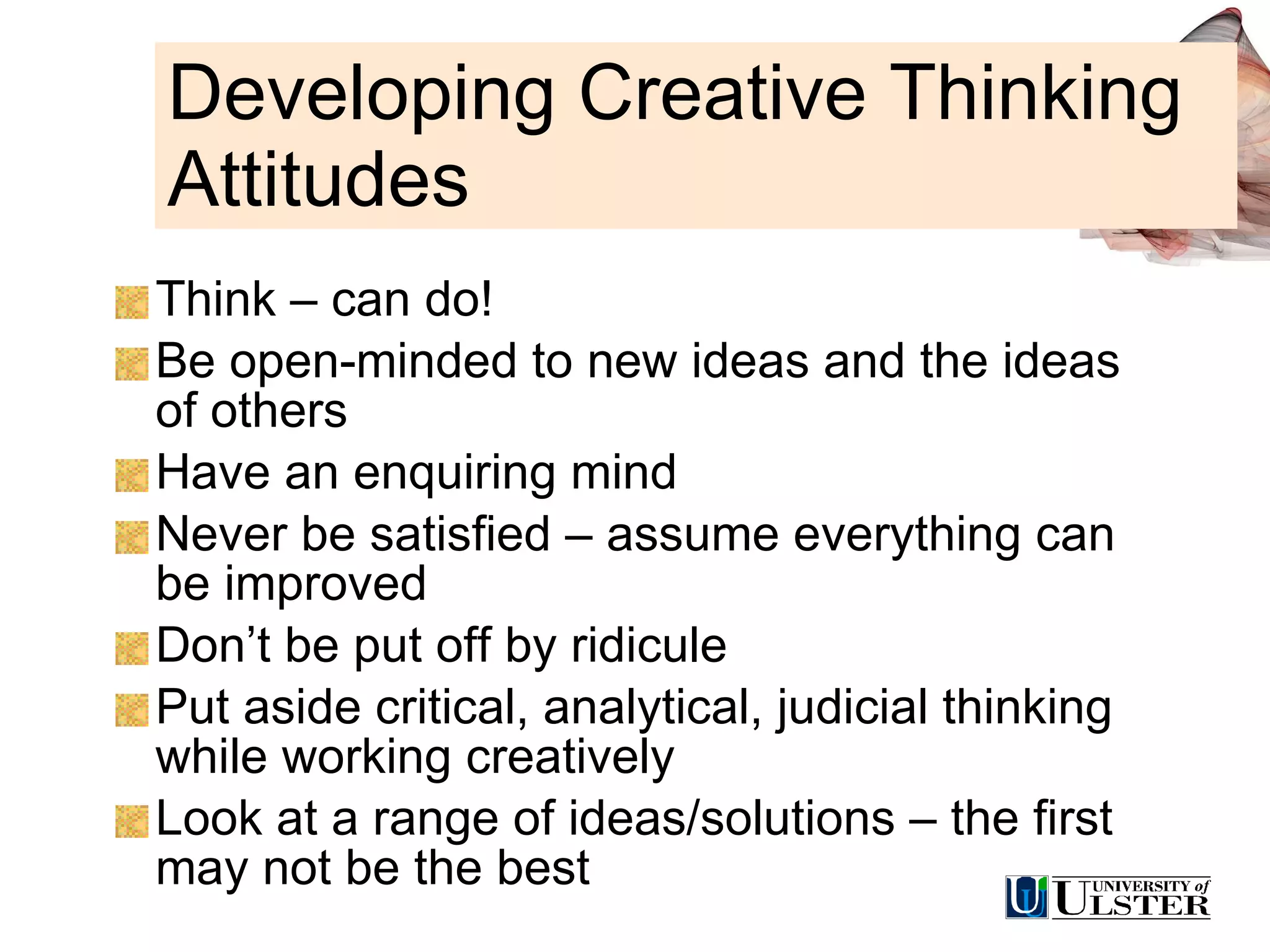
Developing Creative Thinking Attitudes Think – can do! Be open-minded to new ideas and the ideas of others Have an enquiring mind Never be satisfied – assume everything can be improved Don’t be put off by ridicule Put aside critical, analytical, judicial thinking while working creatively Look at a range of ideas/solutions – the first may not be the best
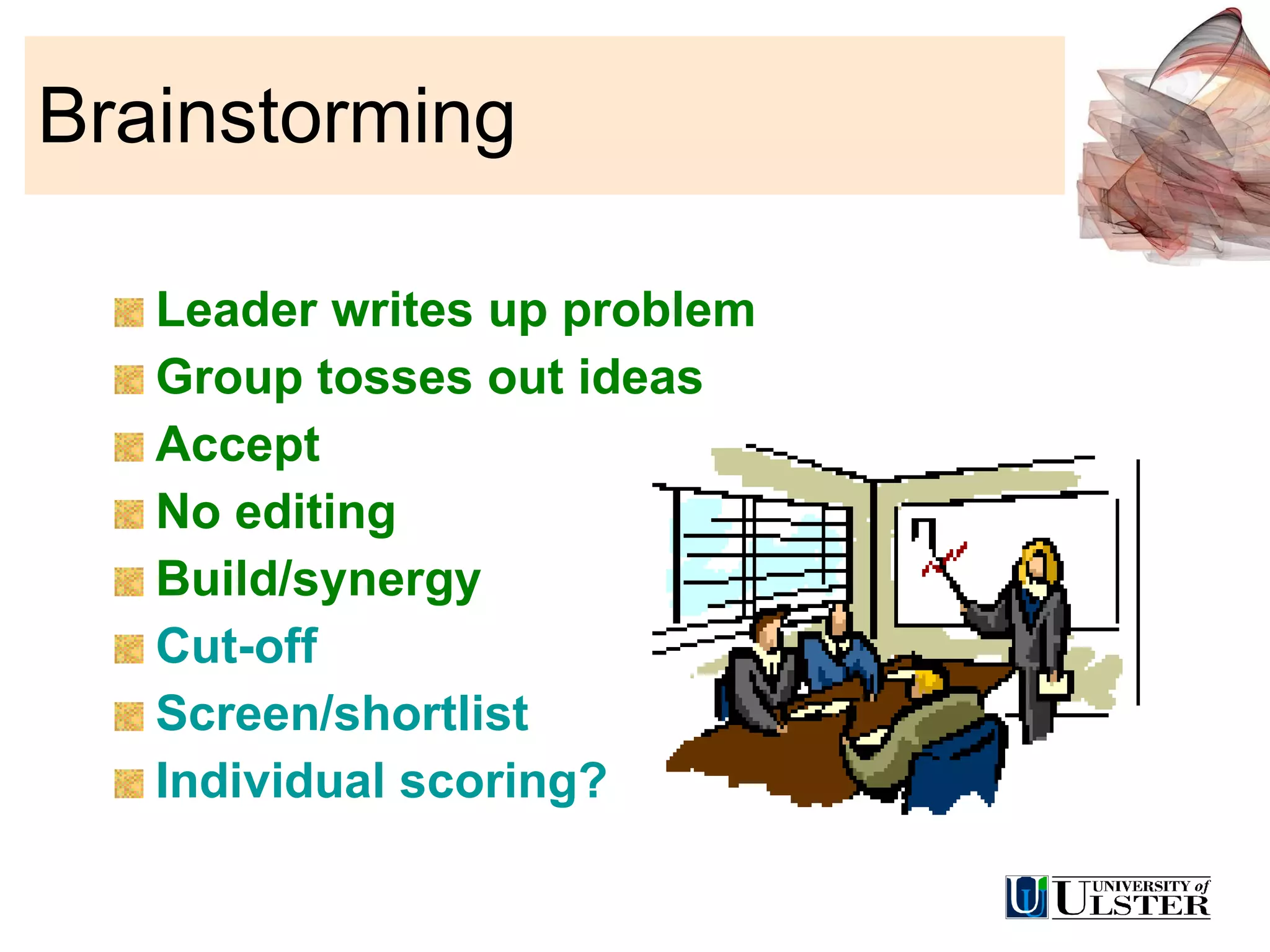
Brainstorming  Leader writes up problem Group tosses out ideas Accept No editing Build/synergy Cut-off Screen/shortlist Individual scoring?
Deciding Which Solution to Implement The Decision Matrix  Decision Tree Exercise Implementation Action plan
Review and Evaluation Have we achieved: our aims and objectives? targets? standards? An effective solution to the problem  The journey to excellence through continuous improvement
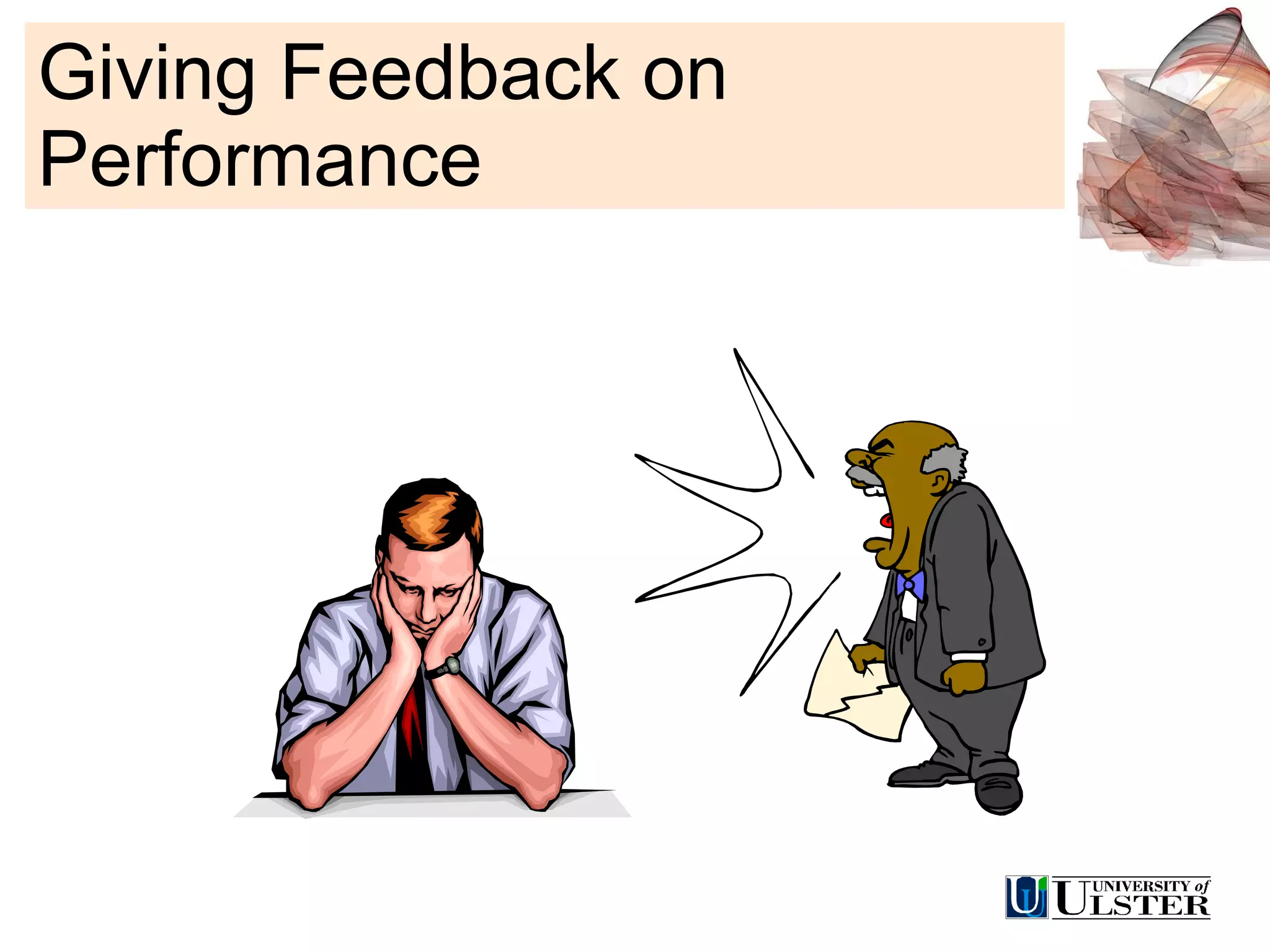
Giving Feedback on Performance
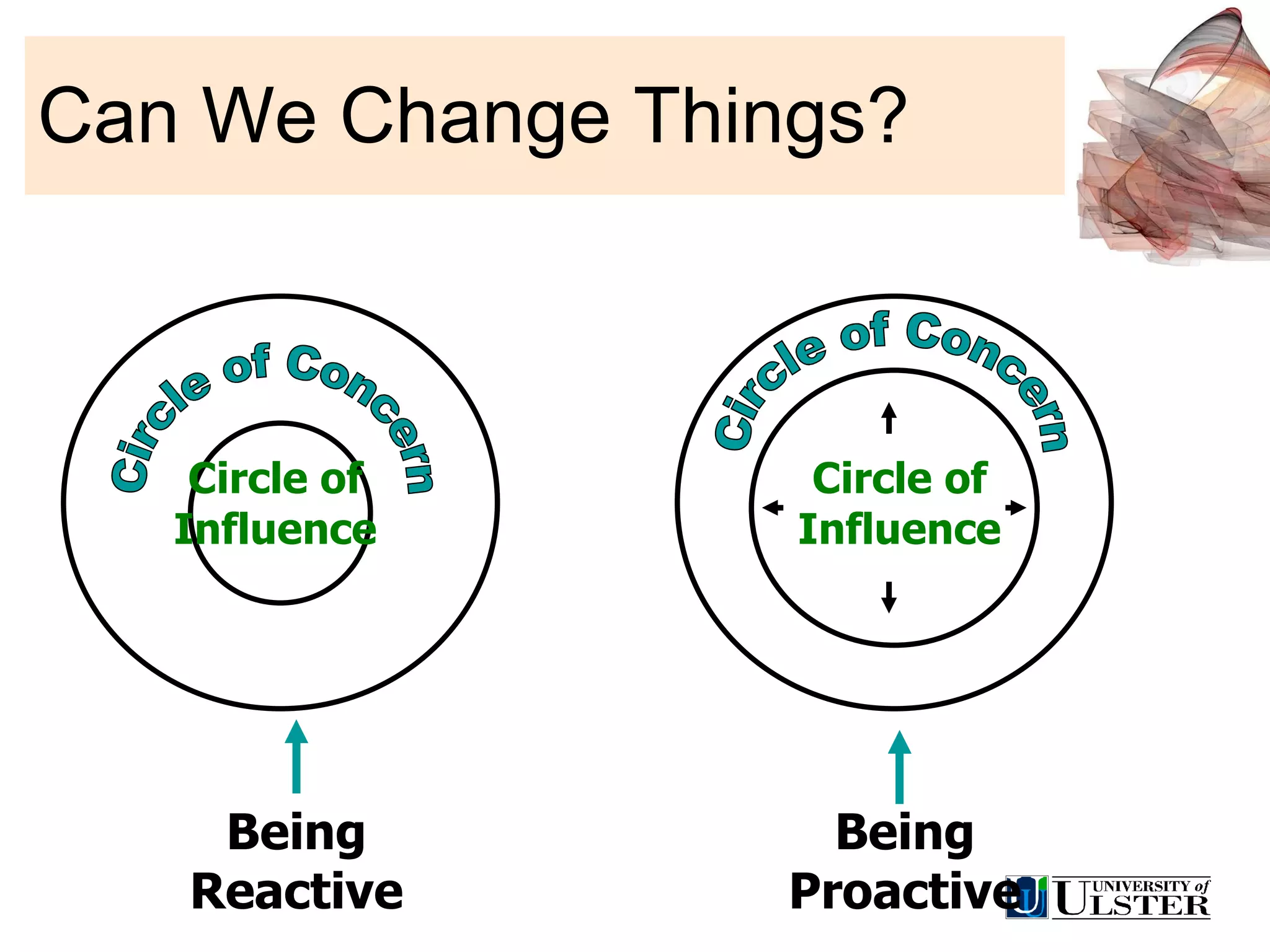
Can We Change Things? Circle of Concern Circle of Influence Circle of Concern Being Reactive Being Proactive Circle of Influence
Performance Management Performance management  is about monitoring performance against targets, identifying opportunities for improvement and  delivering change
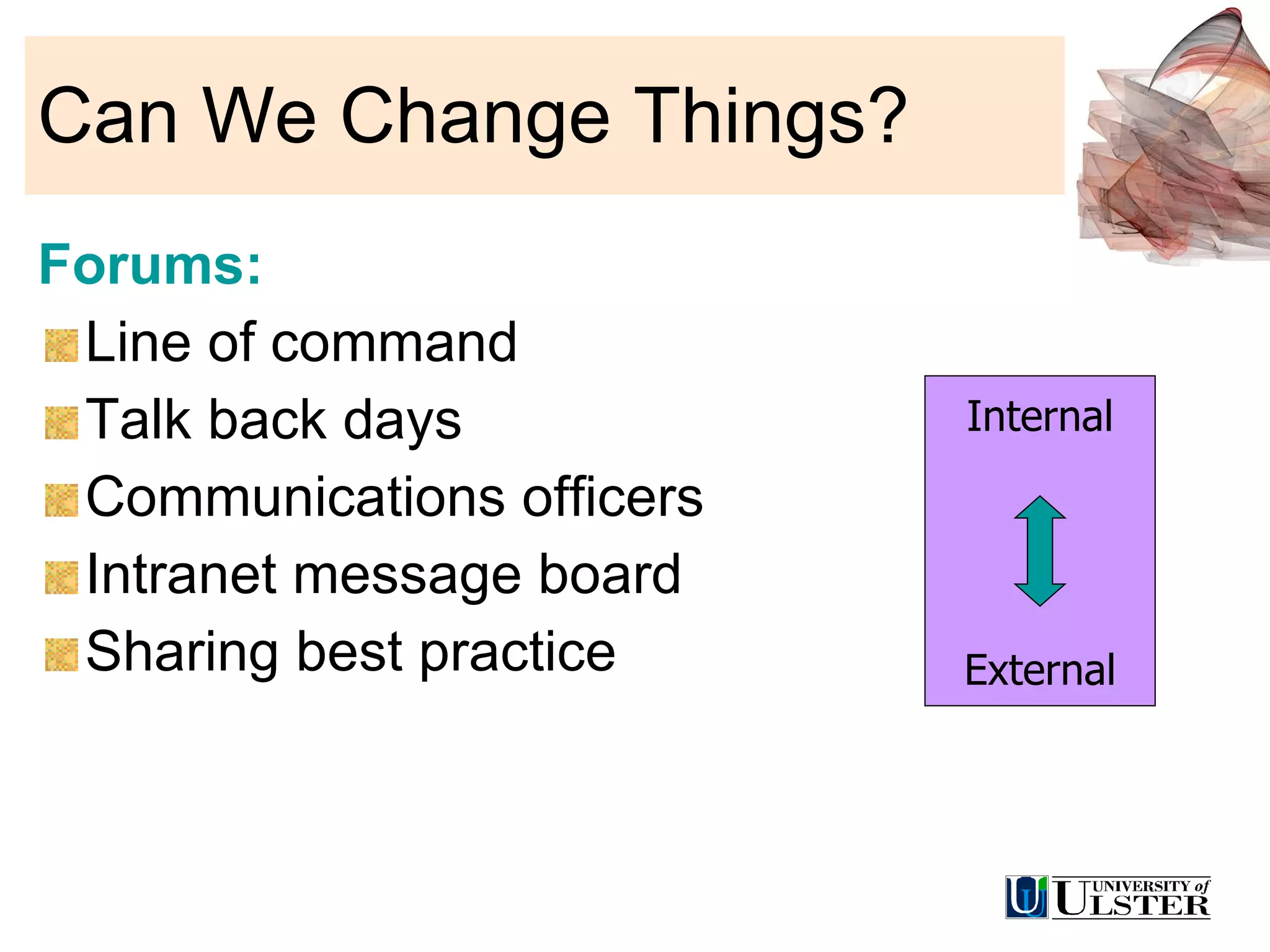
Can We Change Things? Forums: Line of command Talk back days Communications officers Intranet message board Sharing best practice Internal External
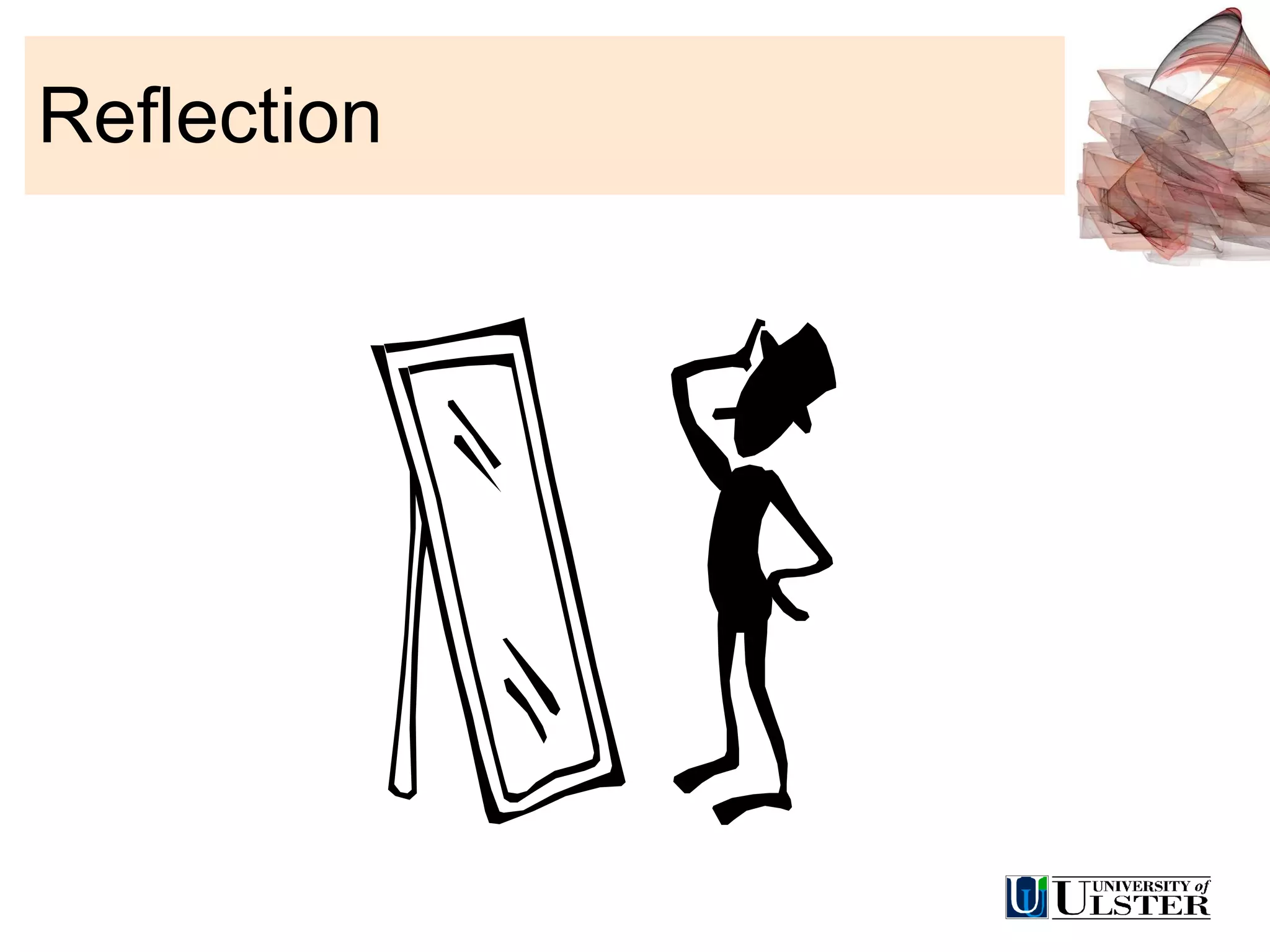
Reflection

Strategy Performance

  • 1.
    Business to ArtsStrategy for Performance Improvement Alan Christie, University of Ulster
  • 2.
    Strategy for PerformanceImprovement Managing strategy - course objectives introduction to strategy-purpose/value tools and techniques-practical formulation strategic thinking- vision and mission developing a strategy- setting objectives
  • 3.
    Get a CompetitivePosition! On what basis will we compete? Which direction should we go? How do we get there? How will we stay there? Where next?
  • 4.
    Successful Companies Understandtheir core competences and use them to develop in unexpected ways Re-write the rules so that only they can win Understand that CULTURE eats STRATEGY for breakfast … .the aim of today is for these lessons to be manifest in your strategy for development
  • 5.
    I Will Use…..Everyday examples e.g. Nokia Tesco Ryanair!!!!! GOH to discover On what basis it competes? In which direction it is headed? How will it get there?
  • 6.
    Defining the PathWhere in the landscape are we? environmental analysis How is the landscape going to change? scenario possibilities
  • 7.
    Defining the PathWhere is it possible to go? Core competency analysis How do we get there? Strategic development
  • 8.
    Strategy Process TransparencyMasters to accompany Operations Management, 5E (Heizer & Render) 2-10 © 1998 by Prentice Hall, Inc. A Simon & Schuster Company Upper Saddle River, N.J. 07458 Environmental Analysis Company Mission Business Strategy Function Area Strategies SWOT Analysis Operations Decisions Marketing Decisions Financial / Acct. Decisions
  • 9.
    DEVELOPMENT STRATEGIES Whatbasis? Which Direction? How? ALTERNATIVE DIRECTIONS Withdrawal Consolidation Market penetration Product development Market Development Diversification Related Unrelated ALTERNATIVE METHODS Internal Development Acquisition Joint Development / Alliances GENERIC STRATEGIES Price based Differentiation Focus
  • 10.
    Elements of StrategicManagement STRATEGIC CHOICE STRATEGIC IMPLEMENTATION STRATEGIC ANALYSIS
  • 11.
    Competitive Advantage Through:Differentiation Low cost Response Transparency Masters to accompany Operations Management, 5E (Heizer & Render) 2-11 © 1998 by Prentice Hall, Inc. A Simon & Schuster Company Upper Saddle River, N.J. 07458
  • 12.
    Competing on DifferentiationUniqueness - can go beyond both the physical characteristics and service attributes to encompass everything that impacts customer’s perception of value Transparency Masters to accompany Operations Management, 5E (Heizer & Render) 2-12 © 1998 by Prentice Hall, Inc. A Simon & Schuster Company Upper Saddle River, N.J. 07458
  • 13.
    Competing on CostMaximum value as defined by customer Does not imply low value or low quality Transparency Masters to accompany Operations Management, 5E (Heizer & Render) 2-13 © 1998 by Prentice Hall, Inc. A Simon & Schuster Company Upper Saddle River, N.J. 07458
  • 14.
    Competing on ResponseFlexible Reliable Quick Requires institutionalization within firm of ability to respond Transparency Masters to accompany Operations Management, 5E (Heizer & Render) 2-14 © 1998 by Prentice Hall, Inc. A Simon & Schuster Company Upper Saddle River, N.J. 07458
  • 15.
    Michael Porter’s FiveCompetitive Forces Competitors in the industry Competition among existing companies Bargaining power Customers Substitutes Suppliers Threat from substitutes Potential New Entrants Bargaining power Threat from substitutes
  • 16.
    GROWTH STRATEGY NEWEXISTING PRODUCTS EXISTING NEW M A R K E T S Product Development Market Development Market Penetration Diversification excluded strategy
  • 17.
    Mission Organization’s purposefor being Provides boundaries & focus Answers ‘How can we satisfy people’s needs?’ Expressed in mission statement Transparency Masters to accompany Operations Management, 5E (Heizer & Render) 2-6 © 1998 by Prentice Hall, Inc. A Simon & Schuster Company Upper Saddle River, N.J. 07458 © 1995 Corel Corp.
  • 18.
    COW DOG STARM A R K E T G R O W T H R A T E 10% 0 10X 1.0X 0.1X 20% RELATIVE MARKET SHARE
  • 19.
    Re Write TheRules! The paradigm Development of Strategy Implementation Company Performance Step 1 Tighter Controls Step 2 Reconstruct or Develop New Strategy Step 3 Abandon Paradigm and Adopt New One
  • 20.
    Performance Management Performanceand Appraisal Steve Pollard, Associate Lecturer
  • 21.
    Measuring Performance Whereare we now? Where do we want to go to? How do we get there? HOW WILL WE KNOW?
  • 22.
    Basic Questions Howwill performance be measured? i.e. by what indicators What are the performance targets set? How will progress be measured? Who will be responsible? How and when will the results be fed back into the planning cycle?
  • 23.
    Performance Measures IncomeResponse Times Satisfaction Value Added Turnover Ratios Quality Attendances Profit ? Cost
  • 24.
    Good Targets ...relate to objectives are achievable … but also stretch are clear and stable over time are easily understood have commitment/are agreed have responsibility made clear are honest and unambiguous
  • 25.
    The Dashboard ApproachMore than one measure A few critical areas: fuel; speed; time etc Much more than the rear view mirror Guides … not automatic pilot!
  • 26.
    Your Dashboard? CostTime ??? Volume ??? Quality
  • 27.
    Further Module AimsTo: Consider how we can achieve high performance Discuss operational planning and apply certain planning tools Evaluate the problem solving/decision making process Assess how we give feedback on performance
  • 28.
    The Organisation PeopleHardware Software Manager’s Task: to deliver the best possible performance from the available resources
  • 29.
    Performance Management Performancemanagement is about monitoring performance against targets, identifying opportunities for improvement and delivering change Lets come back to this..
  • 30.
    The EFQM ExcellenceModel Leadership People Policy and Strategy Partnerships and Resources Processes People Results Customer Results Society Results Key Performance Results Enablers Results
  • 31.
    Think about anoccasion when you/your team performed really well What went well? What or who motivated you? What conditions were in place that enabled your high performance? What lessons does this give you as a line manager in helping others to achieve high performance?
  • 32.
    The DMP AchievingResults Personal Effectiveness Managing People Managing Communications Continuous Improvement Activity: In groups, pick out key factors from each of the 3 modules which ‘enabled’ the achievement of results Managing Change
  • 33.
    Operational Planning Organisation/PersonalAims/ Objectives Planning and Organisation Implementation Monitoring and Control Evaluation
  • 34.
    Aims and ObjectivesWhat is an Aim? What is an Objective? Specific Measurable Achievable Results Related Time Bound
  • 35.
  • 36.
    Aims and ObjectivesActivity: In groups, you are going to plan redecorating a room in your house. This includes some electrical rewiring and a new carpet. For now, we need your aim, objectives (specifications), and milestones.
  • 37.
    Planning Identifying activities/estimatingdurations Allocating responsibilities Skills matrix Communications plan Quality plan Risk assessment and contingency planning
  • 38.
    Planning, Implementation, Monitoringand Control The Gantt Chart
  • 39.
  • 40.
  • 41.
  • 42.
    Improving Performance throughProblem Solving Problem recognition Analysing the factors contributing to the problem Generating solutions Deciding on the solutions Implementation Review and evaluation
  • 43.
    1. Recognisingand Identifying the Problem Key indicators of problems: Productivity Performance Quality Costs Budgets You need: Information Views Agreement that the problem needs resolution Agreed aims and objectives
  • 44.
  • 45.
    2. Analysingthe Causes for the Problem Problem-Solving Tools: Fishbone Diagram Ask Why 5 Times Method
  • 46.
    The Fishbone Diagram20% of service calls are more than one hour late P eople absenteeism overloaded staff untrained staff P lant business location E nvironment traffic roadwork weather E quipment unreliable equipment poor phones M ethods poor scheduling over-ambitious rotas region too big poor admin and filing unavailable spares M aterials
  • 47.
    The Ask Why5 Times Method Change policy Staff judged on activity not results Too busy – why? Include as agenda item Poor communications – why? Fix obvious. Locate less obvious Poor working conditions – why? Low moral – why? Record reasons High abenteeism – why? Consequent Improvement Level of Problem
  • 48.
    3. GeneratingPotential Solutions: the Creative Process Green Light Thinking Red Light Thinking Einstein: ‘Imagination is more important than knowledge’
  • 49.
    3. GeneratingPotential Solutions: the Creative Process
  • 50.
    Developing Creative ThinkingAttitudes Think – can do! Be open-minded to new ideas and the ideas of others Have an enquiring mind Never be satisfied – assume everything can be improved Don’t be put off by ridicule Put aside critical, analytical, judicial thinking while working creatively Look at a range of ideas/solutions – the first may not be the best
  • 51.
    Brainstorming Leaderwrites up problem Group tosses out ideas Accept No editing Build/synergy Cut-off Screen/shortlist Individual scoring?
  • 52.
    Deciding Which Solutionto Implement The Decision Matrix Decision Tree Exercise Implementation Action plan
  • 53.
    Review and EvaluationHave we achieved: our aims and objectives? targets? standards? An effective solution to the problem The journey to excellence through continuous improvement
  • 54.
    Giving Feedback onPerformance
  • 55.
    Can We ChangeThings? Circle of Concern Circle of Influence Circle of Concern Being Reactive Being Proactive Circle of Influence
  • 56.
    Performance Management Performancemanagement is about monitoring performance against targets, identifying opportunities for improvement and delivering change
  • 57.
    Can We ChangeThings? Forums: Line of command Talk back days Communications officers Intranet message board Sharing best practice Internal External
  • 58.

Editor's Notes

  • #27 Mission to provide a high quality patient care that is known to be excellent Initiatives To improve responsible dog ownership To reduce the number of dog fouling complaints