The document contains a science quiz with multiple choice questions covering various topics in science from the human body to the solar system to the Earth's layers. It includes three rounds of questions - Easy, Average, and Difficult - with 10 questions in each round covering topics such as the functions of bones and minerals, the layers of the Earth, the circulatory system, and more. The questions increase in difficulty from the Easy to the Difficult rounds.
Introduction to a science quiz for Grade VI. The quiz consists of multiple-choice questions.
First round of easy questions covering plant nutrition, nerve signals, scientific observation, star twinkling, and basic human biology.
Second round with average difficulty, focusing on ecology, atmospheric science, temperature effects, and energy forms.Third round with difficult questions on ecology, physics, and astronomy, asking about food webs, insecticide resistance, and celestial phenomena.Final clincher round including questions on heart sounds, hereditary disorders, rocket science, and telescope usage.
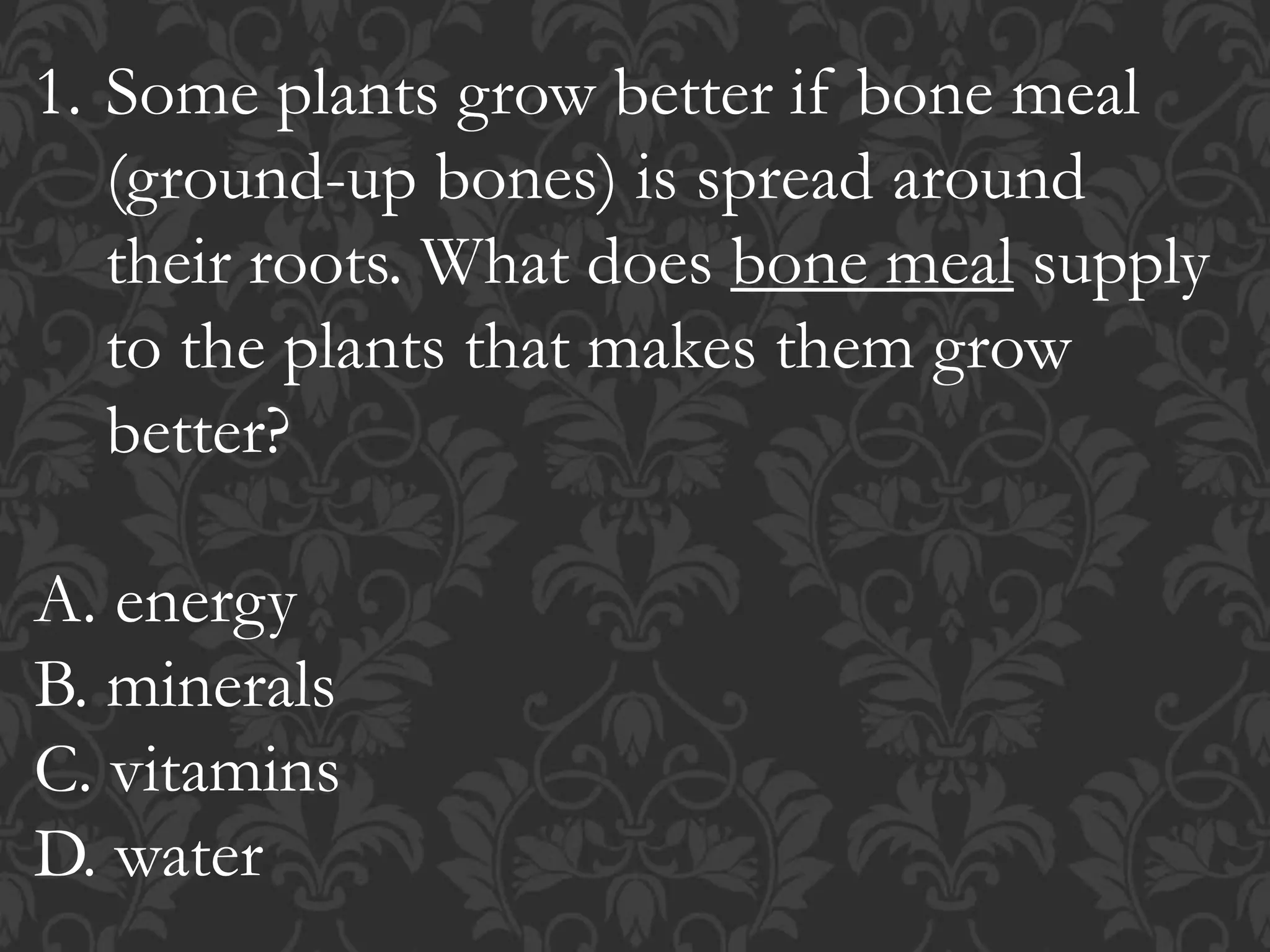
1. Some plantsgrow better if bone meal
(ground-up bones) is spread around
their roots. What does bone meal supply
to the plants that makes them grow
better?
A. energy
B. minerals
C. vitamins
D. water
3. Alexander Flemingnoticed that bacteria
growing on a plate of agar did not grow next to
a mold that was growing on the same plate. He
wrote in his laboratory report “The mold may
be producing a substance that kills bacteria”.
This statement is best described as _________.
A. an observation
B. a hypothesis
C. a generalization
D. a conclusion
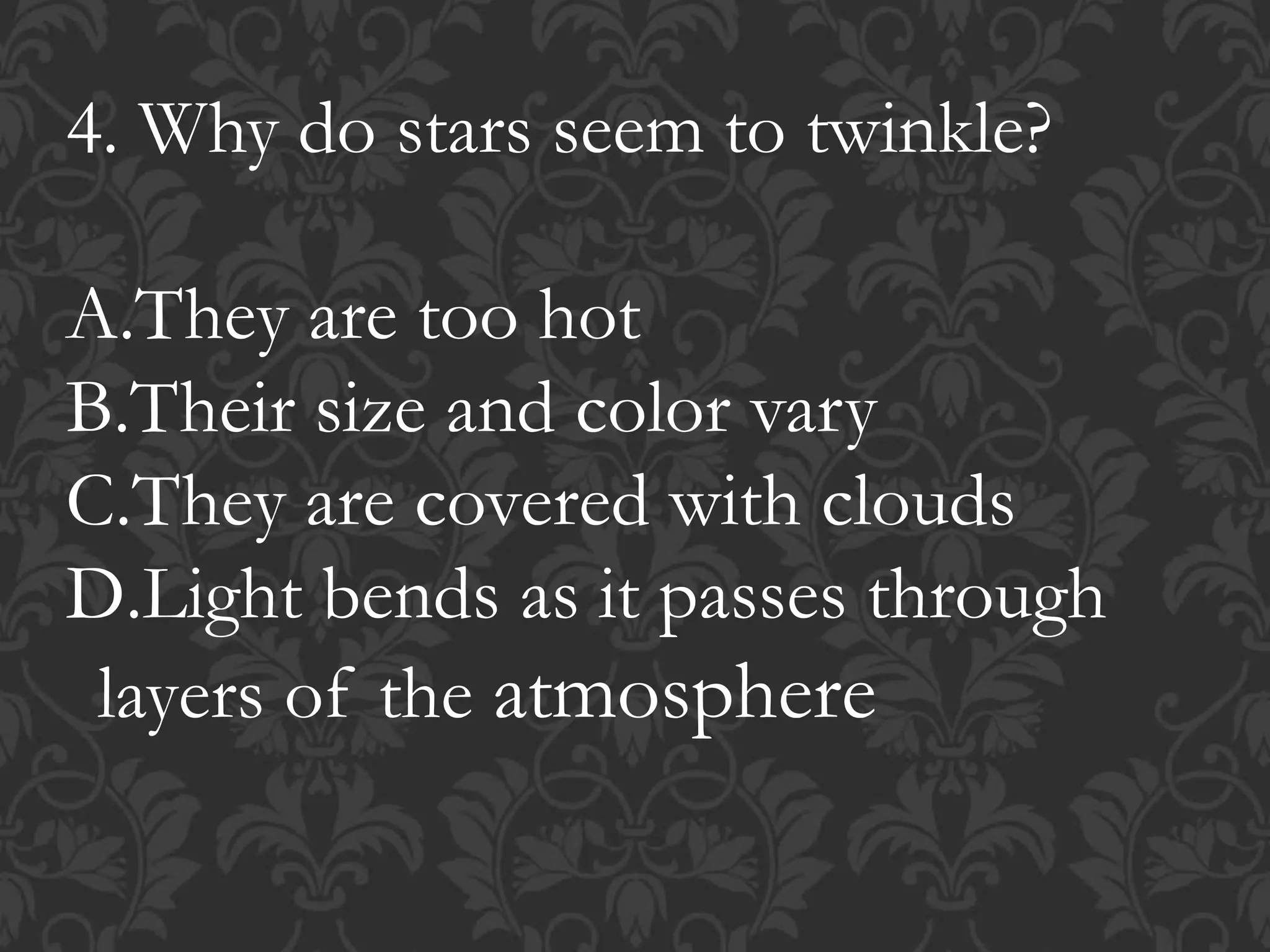
4. Why dostars seem to twinkle?
A.They are too hot
B.Their size and color vary
C.They are covered with clouds
D.Light bends as it passes through
layers of the atmosphere
6. What isthe most important function
of the blood?
A. Collects food nutrients and oxygen
from the body.
B. Carries food nutrients and oxygen to
all parts of the body.
C. Regulates the rise of the body
temperature.
D. Carries impurities to the cells.
7. A beakerwas filled with water up to 40 mL
mark. A small stone was slowly lowered into
the beaker and it was observed that the level
rose to 45 ml. What does the change in the
level of the water represents?
A. volume of water
B. weight of the stone
C. volume of stone
D. weight of the stone
10. Why doesboiling of water in a
kettle overflow and spill?
A. Water increases its volume when
heated.
B. Water forms bubbles when heated.
C. Water expands when heated.
D. Water overflow when heated.
1. The movie“Twilight Zone” has a
wolf - character portrayed by Taylor
Lutner. There are scenes, he, as a wolf
place his scent on trees. Wolves most
likely do this in order to ________.
A. attract prey
B. attract female wolves.
C. mark their territory against other wolves.
D. mark the location of their shelter and
food.
2. Which BESTdescribes the movement of
the plates that make up Earth’s surface over
million of years?
A. They have never moved.
B. They have been continually moving.
C. They stayed the same millions of years
but are now moving.
D. They moved for millions of years but
have now stopped.
4. Why domountain climbers use
oxygen equipment at the top of the world’s
highest mountain?
A. There is less oxygen in the air at
great heights.
B. There is little nitrogen in the air at
great heights.
C. There is a hole in the ozone layer.
D. There is no air at the top of very high
mountains.
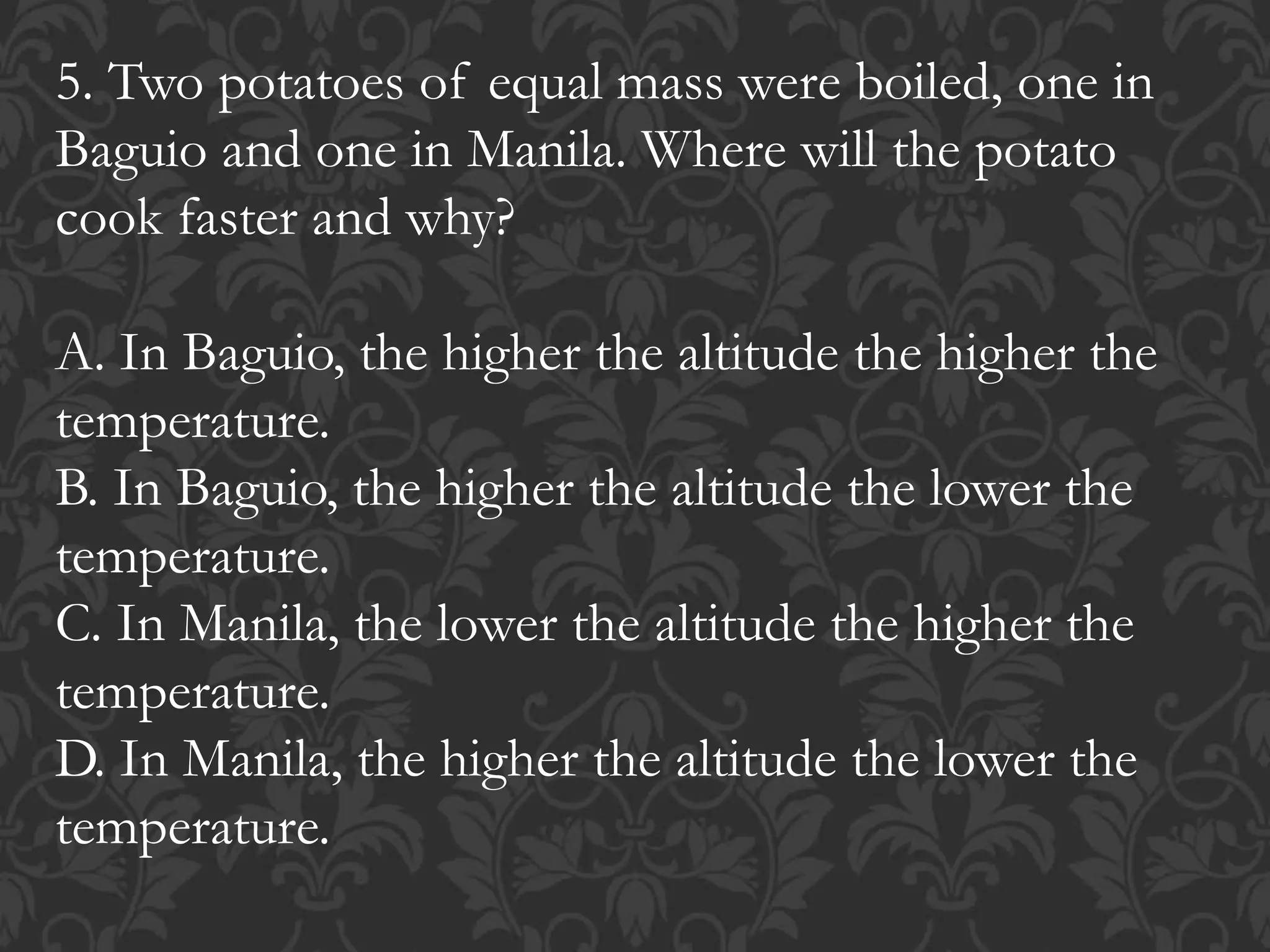
5. Two potatoesof equal mass were boiled, one in
Baguio and one in Manila. Where will the potato
cook faster and why?
A. In Baguio, the higher the altitude the higher the
temperature.
B. In Baguio, the higher the altitude the lower the
temperature.
C. In Manila, the lower the altitude the higher the
temperature.
D. In Manila, the higher the altitude the lower the
temperature.
6. Which ofthe following characterizes
varicose veins?
A. Veins in the brain swell.
B. Veins in the lower extremity shrink.
C. Valves of veins in the legs fail to
function properly.
D. Valves of veins in the heart fail to
function properly.
7. Why wasPioneer - Venus 2 sent to
Venus?
A. To investigate the atmosphere of Venus.
B. To examine the soil in Venus.
C. To probe the interior part of Venus.
D. To discover the possible life forms in
Venus.
8. In general,pages of books turn
brown after a number of years. Why?
A. The paper has become dusty.
B. The paper has become very dry.
C. The paper has reacted with oxygen
from the air.
D. The paper has reacted with
pollutants in the air.
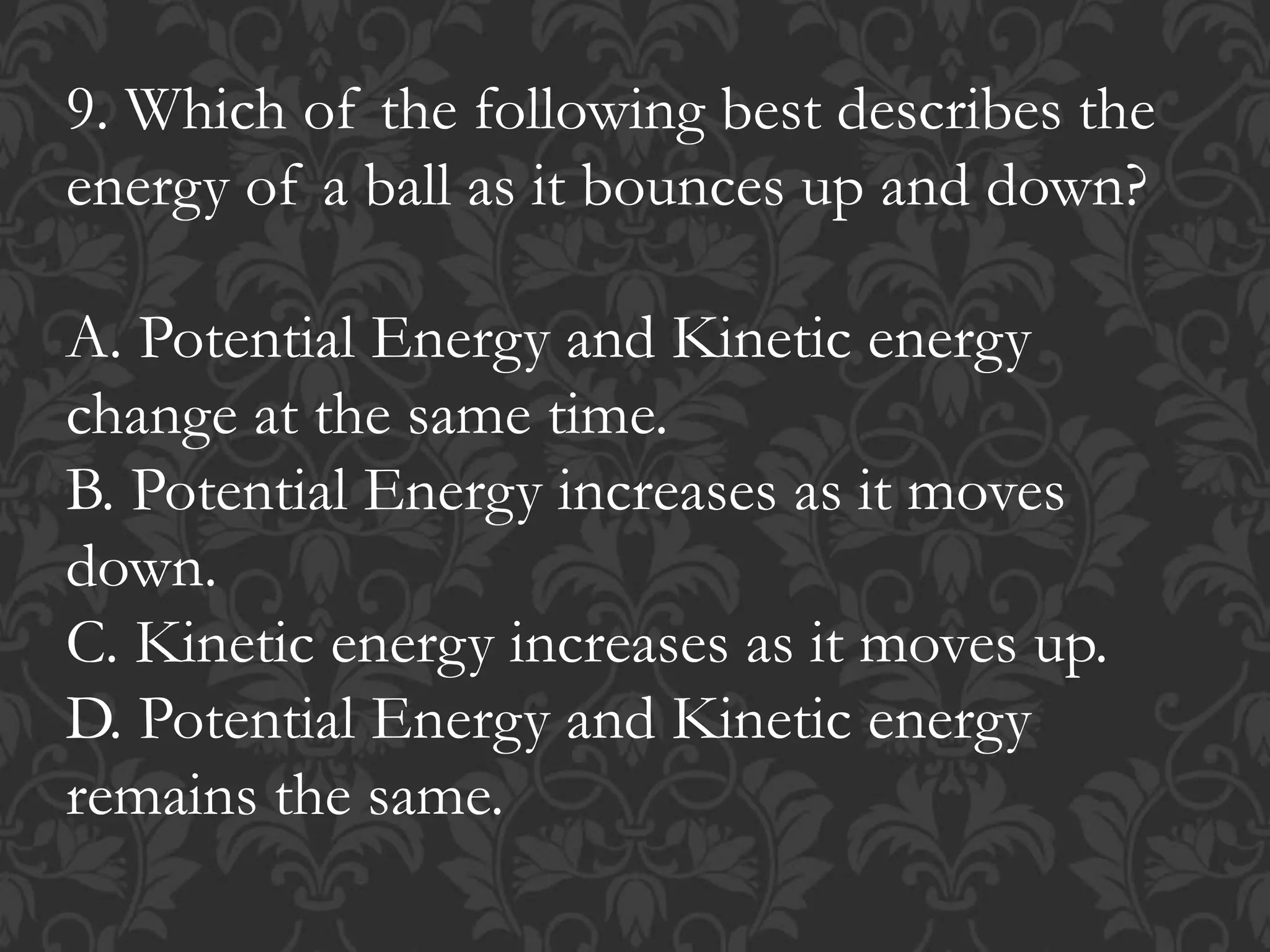
9. Which ofthe following best describes the
energy of a ball as it bounces up and down?
A. Potential Energy and Kinetic energy
change at the same time.
B. Potential Energy increases as it moves
down.
C. Kinetic energy increases as it moves up.
D. Potential Energy and Kinetic energy
remains the same.
10. The mathematicalquestions that
probe the Big Bang Theory were
formulated by ________
A. Alexander Friedman
B. Albert Einstein
C. Edwin Hubble
D. Edwin Aldrin Jr.
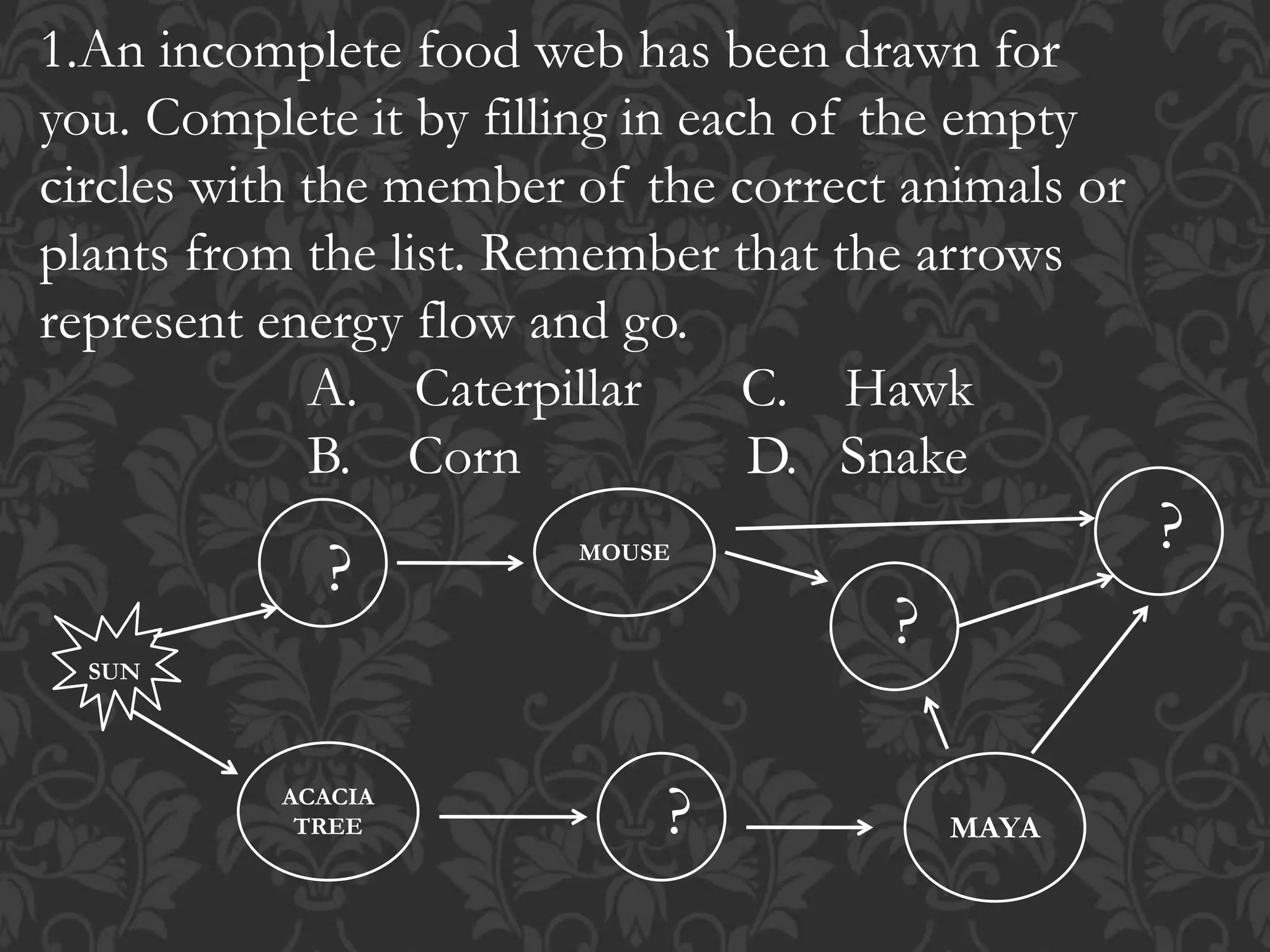
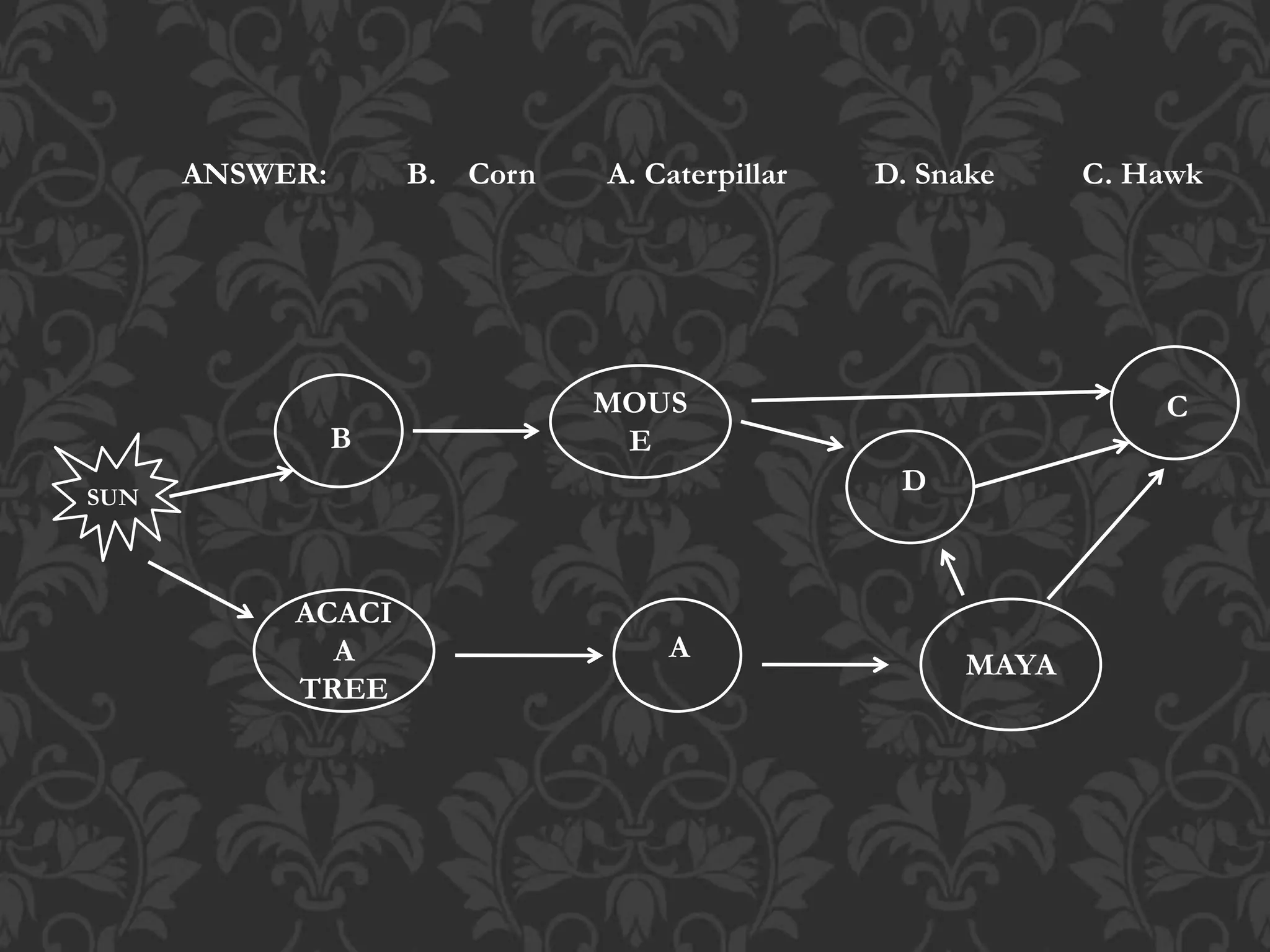
1.An incomplete foodweb has been drawn for
you. Complete it by filling in each of the empty
circles with the member of the correct animals or
plants from the list. Remember that the arrows
represent energy flow and go.
A. Caterpillar C. Hawk
B. Corn D. Snake
ACACIA
TREE
MOUSE
MAYA
SUN
?
?
?
?
2. Insecticides areused to control insect population
so that they do not destroy crops. Overtime some
insecticides become less effective at killing insects and
new insecticides must be developed.
What is most likely reason why insecticides become
less effective overtime?
A. Surviving insects have learned to include
insecticides as a food source.
B. Surviving insects pass their resistance to
insecticides to their offspring.
C. Insecticides build up in the soil.
D. Insecticides are concentrated at the bottom of
the food chain.
4. Why dosailors avoid the doldrums?
A. because their ships woud just stay
in a particular area and would not move
B. because theirips would sail so fast
that they may hit the rocks
C. because their ships would hit polar
icebergs
D. both A and C
5. Which instrumentcan view the
heavenly bodies clearly and without
the filtering effect of Earth's
atmosphere?
A. radio telescope
B. spectrograph
C. space telescope
D. space colony