

 the

faculty by which
external objects or forces
are perceived through
contact with the body


While your other four senses (sight, hearing,
smell, and taste) are located in specific parts of
the body, your sense of touch is found all over.
This is because your sense of touch originates
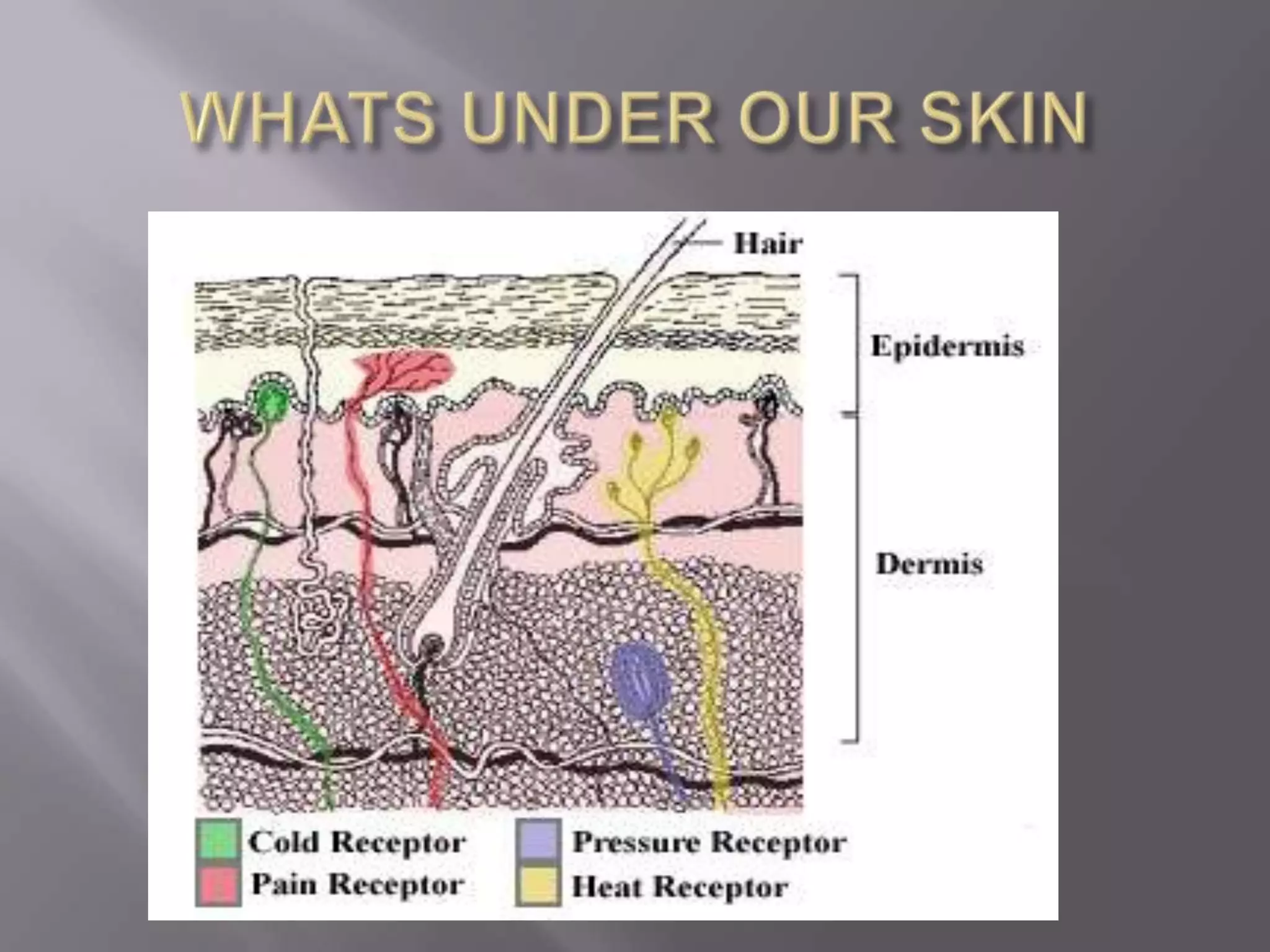
in the bottom layer of your skin called the
dermis. The dermis is filled with many tiny
nerve endings which give you information
about the things with which your body comes
in contact. They do this by carrying the
information to the spinal cord, which sends
messages to the brain where the feeling is
registered.


The nerve endings in your skin can tell
you if something is hot or cold. They can
also feel if something is hurting you.
Your body has about twenty differnt
types of nerve endings that all send
messages to your brain. However, the
most common receptors are heat, cold,
pain, and pressure or touch receptors.
Pain receptors are probably the most
important for your safety because they
can protect you by warning your brain
that your body is hurt!


Some areas of the body are more sensitive than
others because they have more nerve endings.
Have you ever bitten your tongue and wondered
why it hurt so much? It is because the sides of your
tongue have a lot of nerve endings that are very
sensitive to pain. However, your tongue is not as
good at sensing hot or cold. That is why it is easy
to burn your mouth when you eat something
really hot. Your fingertips are also very sensitive.
For example, people who are blind use their
fingertips to read Braille by feeling the patterns of
raised dots on their paper. To learn more about
Braille, click on the word "Braille" located on the
left-hand side of this page












You have more pain nerve endings than any
other type.
The least sensitive part of your body is the
middle of your back.
The most sensitive areas of your body are your
hands, lips, face, neck, tongue, fingertips and
feet.
Shivering is a way your body has of trying to
get warmer.
There are about 100 touch receptors in each of
your fingertips.
Rattlesnakes use their skin to feel the body heat
of other animals.


Generically your sense of touch can be
impaired in three areas:
1.peripheral nerves(diabetic or
alcoholic neuropathy

2.spinal cord(paraplegia, herniated disc)
3.brain(stroke, brain tumor)

Pain, temperature, light touch, proprioception
and vibratory sense all may be taken away in
the above to varying degrees.

Your sense of touch

  • 2.
     the faculty bywhich external objects or forces are perceived through contact with the body
  • 3.
     While your otherfour senses (sight, hearing, smell, and taste) are located in specific parts of the body, your sense of touch is found all over. This is because your sense of touch originates in the bottom layer of your skin called the dermis. The dermis is filled with many tiny nerve endings which give you information about the things with which your body comes in contact. They do this by carrying the information to the spinal cord, which sends messages to the brain where the feeling is registered.
  • 4.
     The nerve endingsin your skin can tell you if something is hot or cold. They can also feel if something is hurting you. Your body has about twenty differnt types of nerve endings that all send messages to your brain. However, the most common receptors are heat, cold, pain, and pressure or touch receptors. Pain receptors are probably the most important for your safety because they can protect you by warning your brain that your body is hurt!
  • 6.
     Some areas ofthe body are more sensitive than others because they have more nerve endings. Have you ever bitten your tongue and wondered why it hurt so much? It is because the sides of your tongue have a lot of nerve endings that are very sensitive to pain. However, your tongue is not as good at sensing hot or cold. That is why it is easy to burn your mouth when you eat something really hot. Your fingertips are also very sensitive. For example, people who are blind use their fingertips to read Braille by feeling the patterns of raised dots on their paper. To learn more about Braille, click on the word "Braille" located on the left-hand side of this page
  • 7.
          You have morepain nerve endings than any other type. The least sensitive part of your body is the middle of your back. The most sensitive areas of your body are your hands, lips, face, neck, tongue, fingertips and feet. Shivering is a way your body has of trying to get warmer. There are about 100 touch receptors in each of your fingertips. Rattlesnakes use their skin to feel the body heat of other animals.
  • 8.
     Generically your senseof touch can be impaired in three areas: 1.peripheral nerves(diabetic or alcoholic neuropathy 2.spinal cord(paraplegia, herniated disc) 3.brain(stroke, brain tumor) Pain, temperature, light touch, proprioception and vibratory sense all may be taken away in the above to varying degrees.