PHYSIOLOGY OF
TASTE PERCEPTION
Dr Aparna Sarojam MD(Ay)
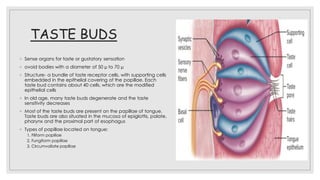
TASTE BUDS
◦ Sense organs for taste or gustatory sensation
◦ ovoid bodies with a diameter of 50 µ to 70 µ
◦ Structure- a bundle of taste receptor cells, with supporting cells
embedded in the epithelial covering of the papillae. Each
taste bud contains about 40 cells, which are the modified
epithelial cells
◦ In old age, many taste buds degenerate and the taste
sensitivity decreases
◦ Most of the taste buds are present on the papillae of tongue.
Taste buds are also situated in the mucosa of epiglottis, palate,
pharynx and the proximal part of esophagus
◦ Types of papillae located on tongue:
1. Filiform papillae
2. Fungiform papillae
3. Circumvallate papillae
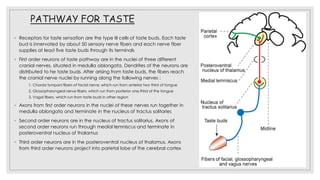
PATHWAY FOR TASTE
◦ Receptors for taste sensation are the type III cells of taste buds. Each taste
bud is innervated by about 50 sensory nerve fibers and each nerve fiber
supplies at least five taste buds through its terminals
◦ First order neurons of taste pathway are in the nuclei of three different
cranial nerves, situated in medulla oblongata. Dendrites of the neurons are
distributed to he taste buds. After arising from taste buds, the fibers reach
the cranial nerve nuclei by running along the following nerves :
1. Chorda tympani fibers of facial nerve, which run from anterior two third of tongue
2. Glossopharyngeal nerve fibers, which run from posterior one third of the tongue
3. Vagal fibers, which run from taste buds in other region
◦ Axons from first order neurons in the nuclei of these nerves run together in
medulla oblongata and terminate in the nucleus of tractus solitaries
◦ Second order neurons are in the nucleus of tractus solitarius. Axons of
second order neurons run through medial lemniscus and terminate in
posteroventral nucleus of thalamus
◦ Third order neurons are in the posteroventral nucleus of thalamus. Axons
from third order neurons project into parietal lobe of the cerebral cortex
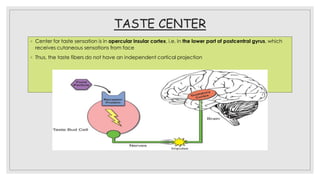
TASTE CENTER
◦ Center for taste sensation is in opercular insular cortex, i.e. in the lower part of postcentral gyrus, which
receives cutaneous sensations from face
◦ Thus, the taste fibers do not have an independent cortical projection
TASTE TRANSDUCTION
◦ The process by which taste receptor converts chemical energy into action potentials in the taste nerve
fiber
◦ Receptors of taste sensation are chemoreceptors, which are stimulated by substances dissolved in
mouth by saliva
◦ The dissolved substances act on microvilli of taste receptors exposed in the taste pore
◦ It causes the development of receptor potential in the receptor cells. This in turn, is responsible for the
generation of action potential in the sensory neurons
◦ Transduction mechanism is different in each taste receptor cells
APPLIED PHYSIOLOGY
◦ Loss of taste sensation is called Ageusia
◦ Hypoguesia is the decrease in taste sensation
◦ Taste blindness is a rare genetic disorder in which the ability to recognize substances by taste is lost
◦ Disturbance in the taste sensation is called Dysgeusia
physiology_of_taste_perception_1638353877.pdf

physiology_of_taste_perception_1638353877.pdf

  • 1.
    PHYSIOLOGY OF TASTE PERCEPTION DrAparna Sarojam MD(Ay)
  • 2.
    TASTE BUDS ◦ Senseorgans for taste or gustatory sensation ◦ ovoid bodies with a diameter of 50 µ to 70 µ ◦ Structure- a bundle of taste receptor cells, with supporting cells embedded in the epithelial covering of the papillae. Each taste bud contains about 40 cells, which are the modified epithelial cells ◦ In old age, many taste buds degenerate and the taste sensitivity decreases ◦ Most of the taste buds are present on the papillae of tongue. Taste buds are also situated in the mucosa of epiglottis, palate, pharynx and the proximal part of esophagus ◦ Types of papillae located on tongue: 1. Filiform papillae 2. Fungiform papillae 3. Circumvallate papillae
  • 3.
    PATHWAY FOR TASTE ◦Receptors for taste sensation are the type III cells of taste buds. Each taste bud is innervated by about 50 sensory nerve fibers and each nerve fiber supplies at least five taste buds through its terminals ◦ First order neurons of taste pathway are in the nuclei of three different cranial nerves, situated in medulla oblongata. Dendrites of the neurons are distributed to he taste buds. After arising from taste buds, the fibers reach the cranial nerve nuclei by running along the following nerves : 1. Chorda tympani fibers of facial nerve, which run from anterior two third of tongue 2. Glossopharyngeal nerve fibers, which run from posterior one third of the tongue 3. Vagal fibers, which run from taste buds in other region ◦ Axons from first order neurons in the nuclei of these nerves run together in medulla oblongata and terminate in the nucleus of tractus solitaries ◦ Second order neurons are in the nucleus of tractus solitarius. Axons of second order neurons run through medial lemniscus and terminate in posteroventral nucleus of thalamus ◦ Third order neurons are in the posteroventral nucleus of thalamus. Axons from third order neurons project into parietal lobe of the cerebral cortex
  • 4.
    TASTE CENTER ◦ Centerfor taste sensation is in opercular insular cortex, i.e. in the lower part of postcentral gyrus, which receives cutaneous sensations from face ◦ Thus, the taste fibers do not have an independent cortical projection
  • 5.
    TASTE TRANSDUCTION ◦ Theprocess by which taste receptor converts chemical energy into action potentials in the taste nerve fiber ◦ Receptors of taste sensation are chemoreceptors, which are stimulated by substances dissolved in mouth by saliva ◦ The dissolved substances act on microvilli of taste receptors exposed in the taste pore ◦ It causes the development of receptor potential in the receptor cells. This in turn, is responsible for the generation of action potential in the sensory neurons ◦ Transduction mechanism is different in each taste receptor cells
  • 6.
    APPLIED PHYSIOLOGY ◦ Lossof taste sensation is called Ageusia ◦ Hypoguesia is the decrease in taste sensation ◦ Taste blindness is a rare genetic disorder in which the ability to recognize substances by taste is lost ◦ Disturbance in the taste sensation is called Dysgeusia