GEC 1 UNDERSTANDING THE SELF
Module 7 (Week 11 - 12)
 The Spiritual Self
Prepared by: Nancy Jane D. Victorino, RPm, LPT
DISCUSSION
CILO (Course Intended Learning Outcome/s):
 Discuss the different meanings of “spirituality”.
 Identify and appreciate the importance of the various
rituals and ceremonies practiced by different groups in the
Philippines.
 Determine the importance of a core belief system in the
development of the Self.
 Apply the concept of Logotherapy in order to get a clearer
understanding of the purpose of life.
I. What is the meaning of “Spirituality”?
Spirituality is a broad concept with room for many
perspectives. In general, it includes a sense of
connection to something bigger than
ourselves, and it typically involves a search for
meaning in life. As such, it is a universal human
experience—something that touches us all. People
may describe a spiritual experience as sacred or
transcendent or simply a deep sense of aliveness
and interconnectedness.
https://i.pinimg.com/originals/1f/0e/c6/1f0ec6a0116a62
41b620dae0f0044483.jpg
Spirituality involves exploring certain universal themes –
love, compassion, altruism, life after death, wisdom and
truth, with the knowledge that some people such as saints or
enlightened individuals have achieved and manifested higher
levels of development than the ordinary person.
I. What is the meaning of “Spirituality”?
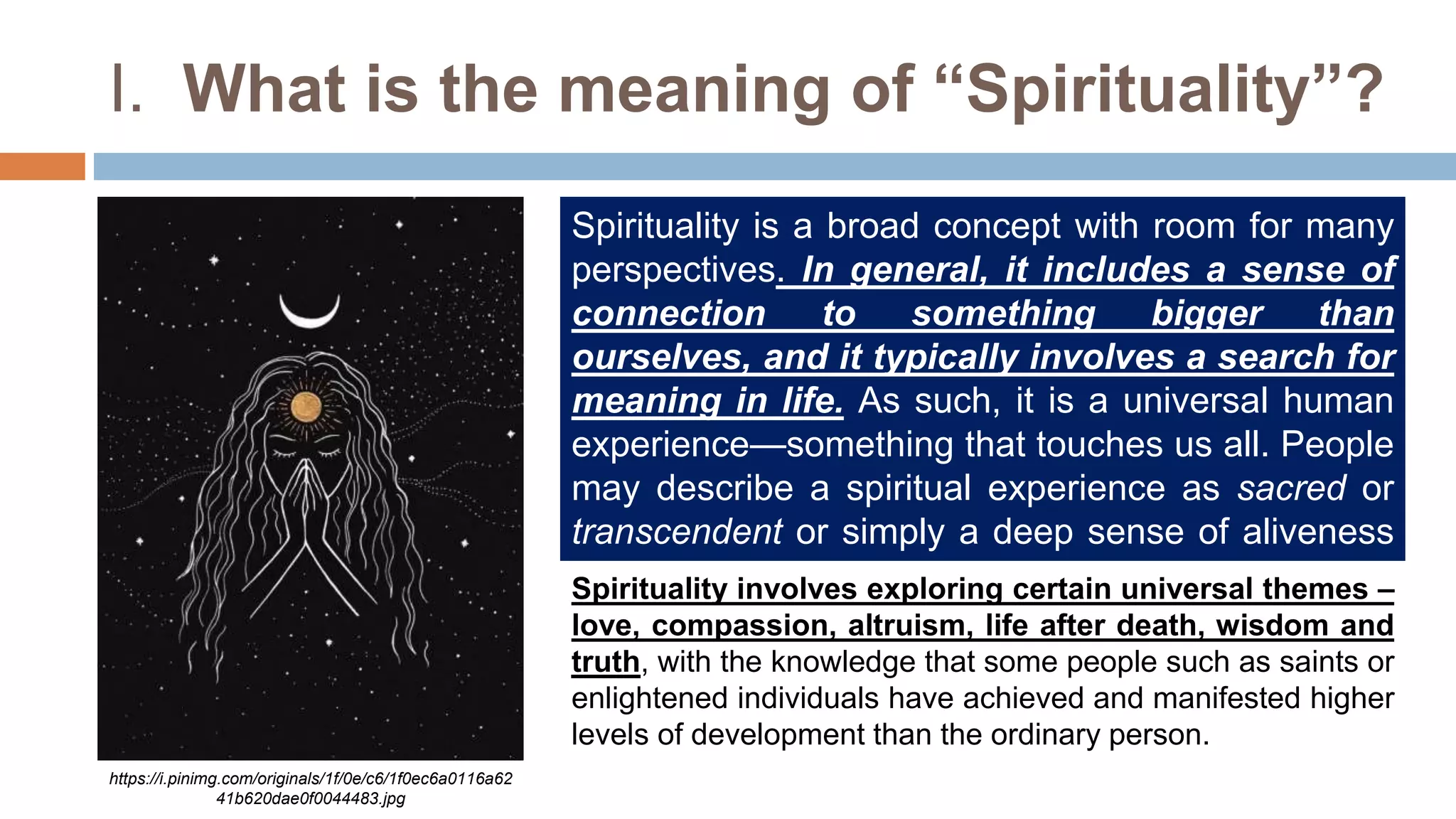
Spiritual development requires
successive degrees of freedom based on
the realization that thoughts are not facts
but simply transient mental phenomena,
as indeed are our emotions.
Neuroscientific research is showing that
with the practice of mindfulness, the
cortex of the brain literally grows, with an
increase in grey matter and more
gyrification.
https://www.livehappy.com/sites/default/files/styles/article_featured/public/main/articles/S
pirituality_Header-2.jpg?itok=1u89ZZhm
II. The SOUL
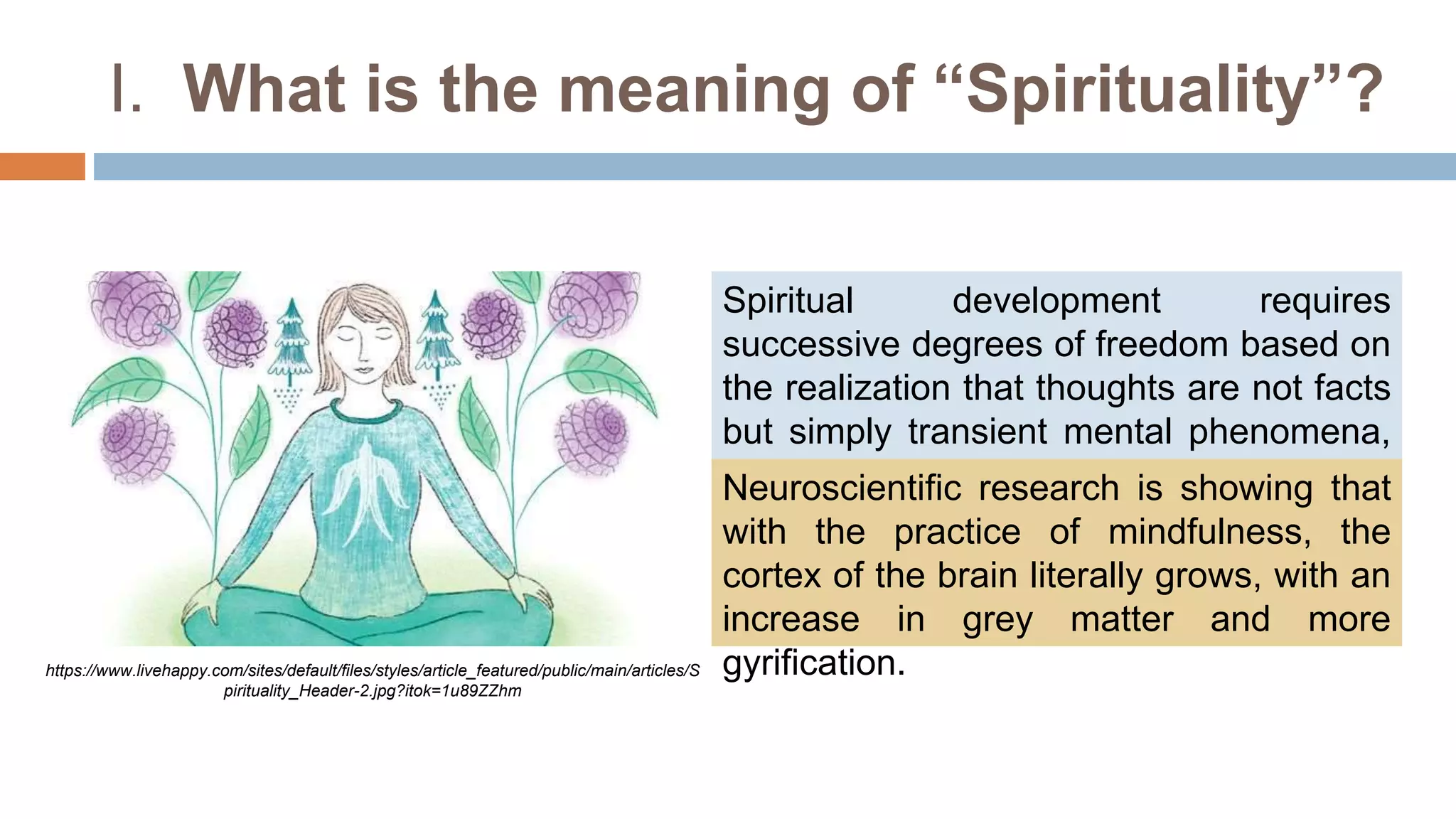
Soul, in religion and philosophy, the
immaterial aspect or essence of a
human being, that which confers
individuality and humanity, often
considered to be synonymous with
the mind or the self. In theology, the
soul is further defined as that part of
the individual which partakes of
divinity and often is considered to
survive the death of the body.
https://static.wixstatic.com/media/cedeef_13e1d7b5fbe44458982a9f51b1426480~mv2_d_3
131_2000_s_2.jpg/v1/fill/w_1000,h_639,al_c,q_90,usm_0.66_1.00_0.01/cedeef_13e1d7b5f
be44458982a9f51b1426480~mv2_d_3131_2000_s_2.jpg
III. Rituals and Ceremonies
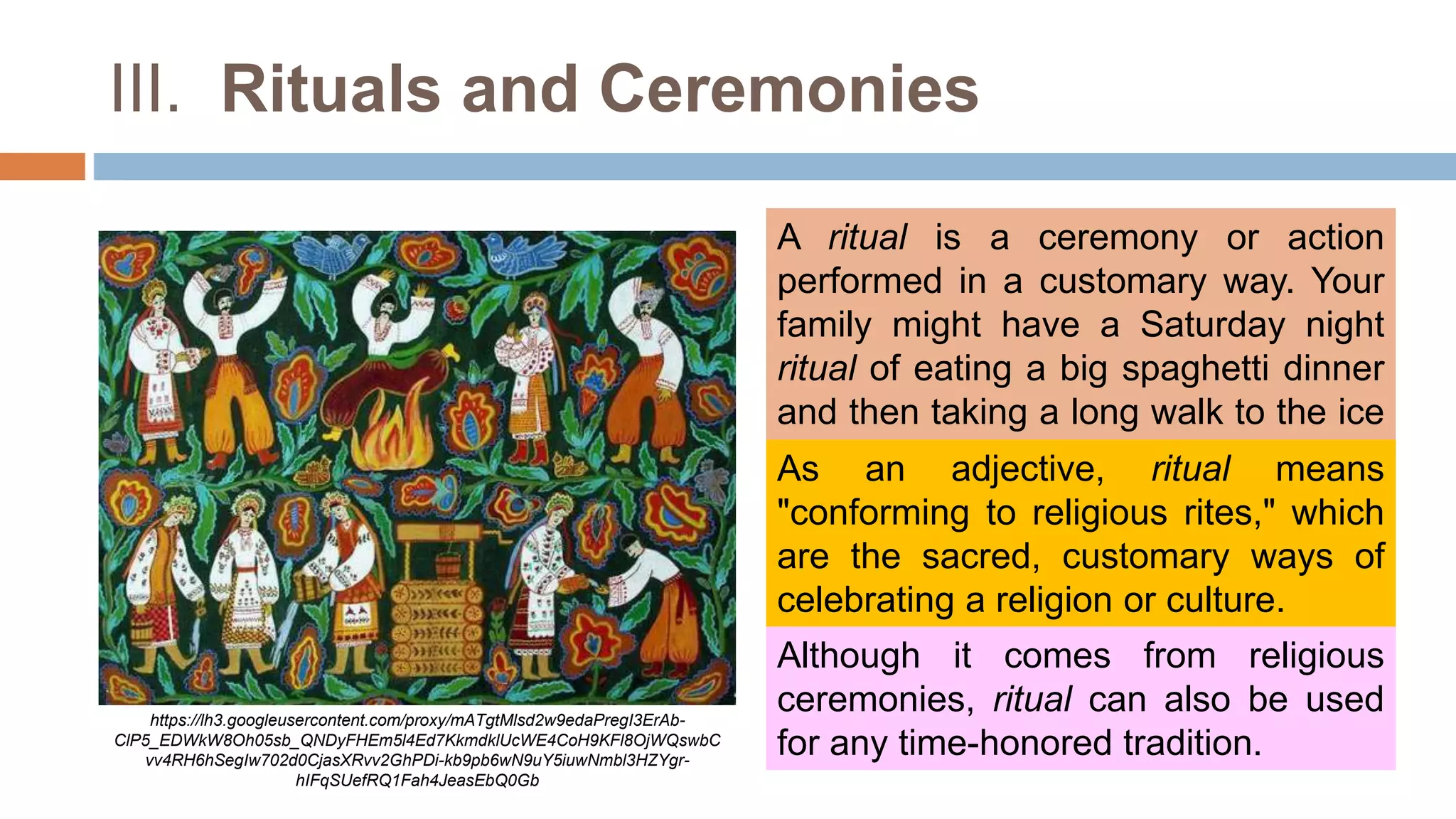
A ritual is a ceremony or action
performed in a customary way. Your
family might have a Saturday night
ritual of eating a big spaghetti dinner
and then taking a long walk to the ice
cream shop.
https://lh3.googleusercontent.com/proxy/mATgtMlsd2w9edaPregI3ErAb-
ClP5_EDWkW8Oh05sb_QNDyFHEm5l4Ed7KkmdklUcWE4CoH9KFl8OjWQswbC
vv4RH6hSegIw702d0CjasXRvv2GhPDi-kb9pb6wN9uY5iuwNmbl3HZYgr-
hIFqSUefRQ1Fah4JeasEbQ0Gb
As an adjective, ritual means
"conforming to religious rites," which
are the sacred, customary ways of
celebrating a religion or culture.
Although it comes from religious
ceremonies, ritual can also be used
for any time-honored tradition.
IV. Religion, Cult, Magic, and Witchcraft
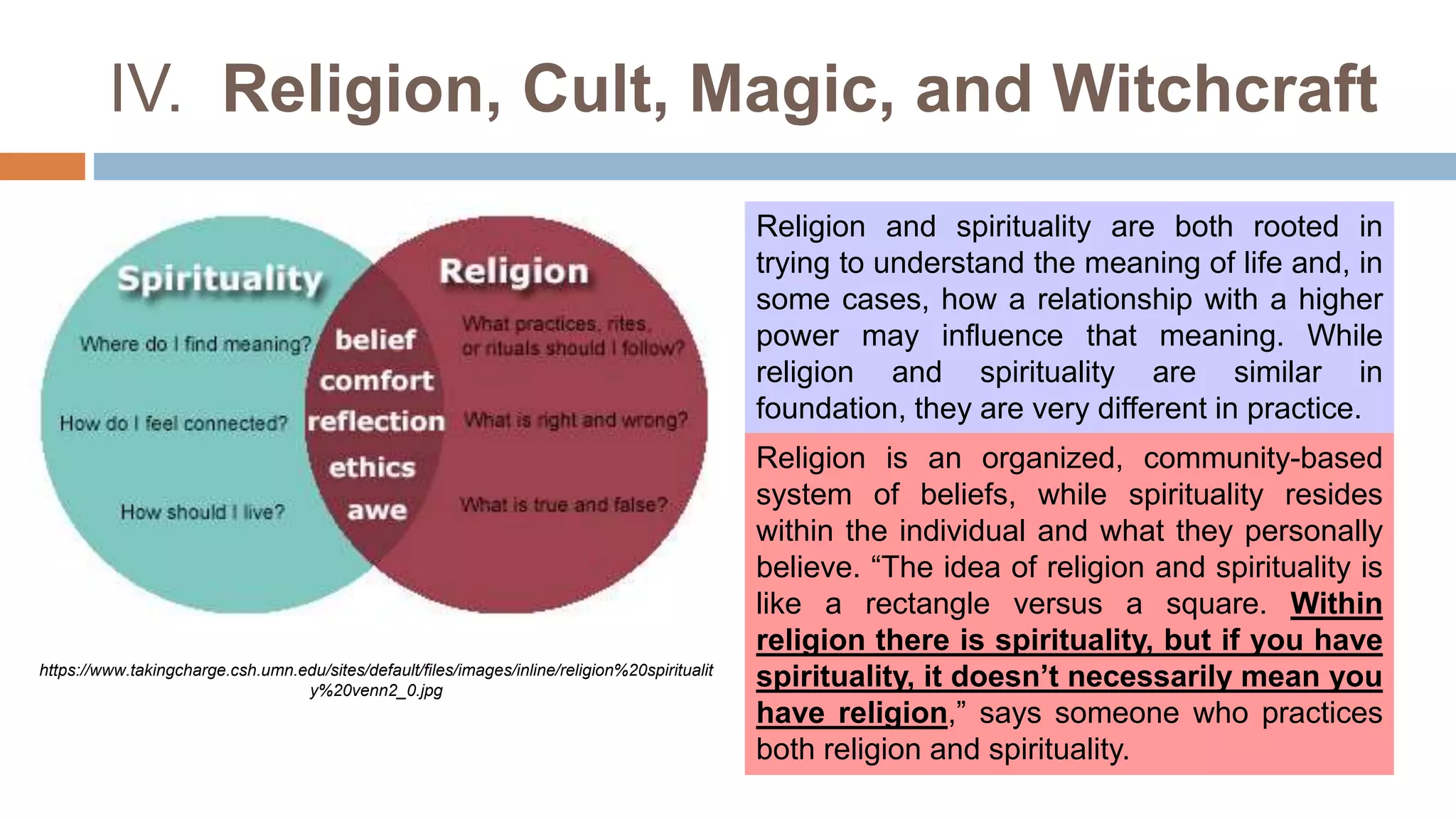
Religion and spirituality are both rooted in
trying to understand the meaning of life and, in
some cases, how a relationship with a higher
power may influence that meaning. While
religion and spirituality are similar in
foundation, they are very different in practice.
Religion is an organized, community-based
system of beliefs, while spirituality resides
within the individual and what they personally
believe. “The idea of religion and spirituality is
like a rectangle versus a square. Within
religion there is spirituality, but if you have
spirituality, it doesn’t necessarily mean you
have religion,” says someone who practices
both religion and spirituality.
https://www.takingcharge.csh.umn.edu/sites/default/files/images/inline/religion%20spiritualit
y%20venn2_0.jpg
IV. Religion, Cult, Magic, and Witchcraft
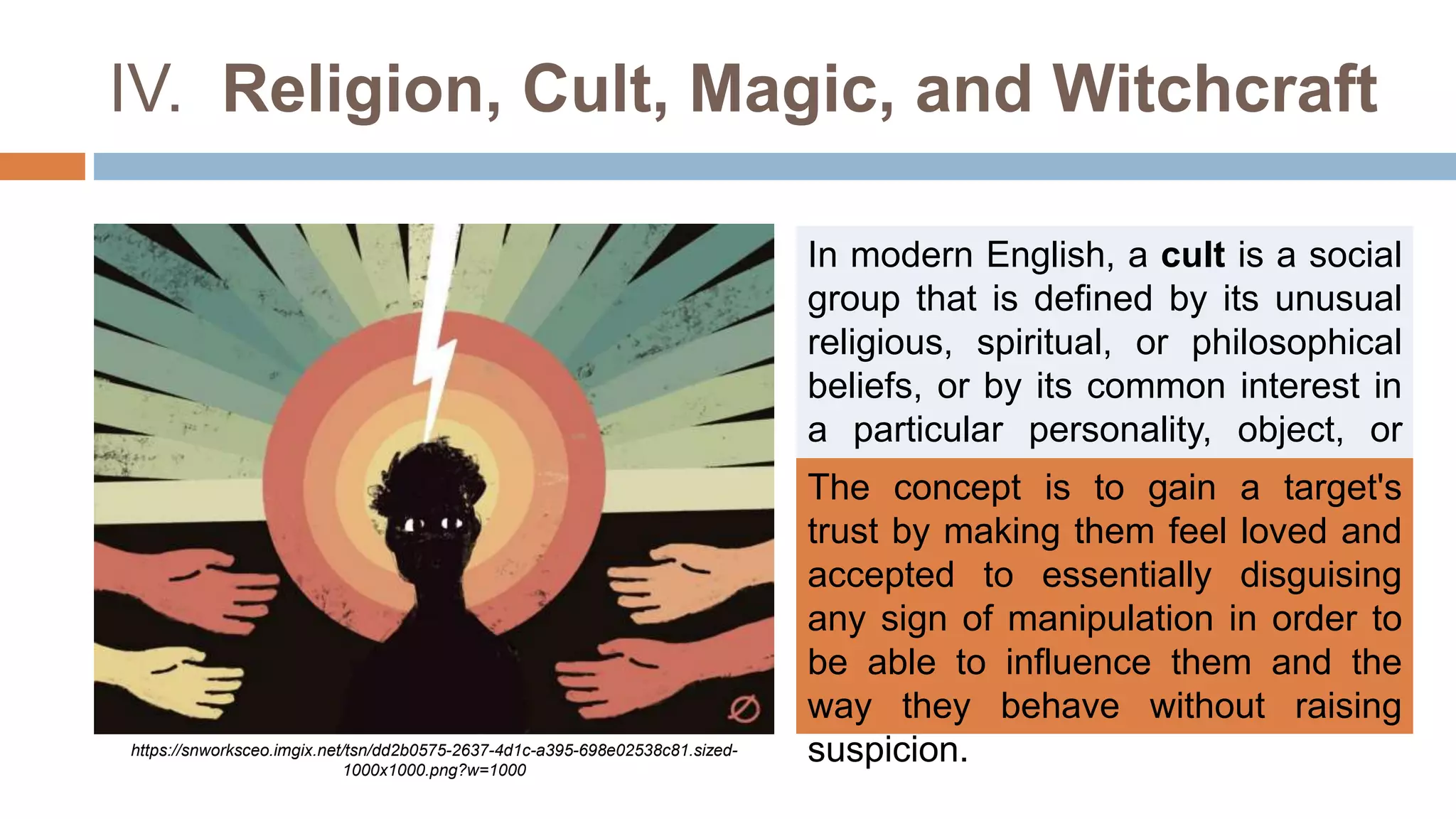
In modern English, a cult is a social
group that is defined by its unusual
religious, spiritual, or philosophical
beliefs, or by its common interest in
a particular personality, object, or
goal.
The concept is to gain a target's
trust by making them feel loved and
accepted to essentially disguising
any sign of manipulation in order to
be able to influence them and the
way they behave without raising
suspicion.
https://snworksceo.imgix.net/tsn/dd2b0575-2637-4d1c-a395-698e02538c81.sized-
1000x1000.png?w=1000
IV. Religion, Cult, Magic, and Witchcraft
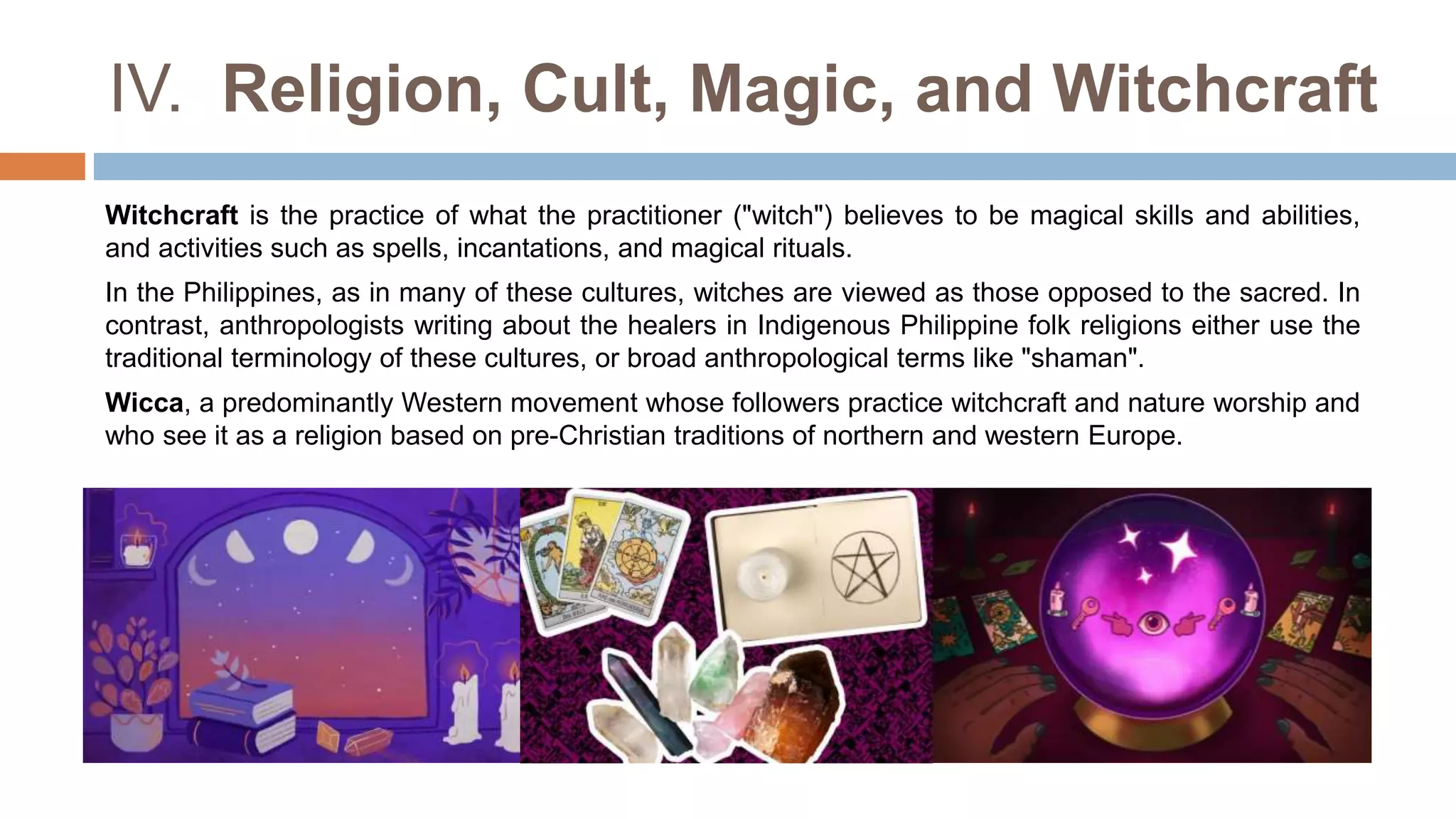
Witchcraft is the practice of what the practitioner ("witch") believes to be magical skills and abilities,
and activities such as spells, incantations, and magical rituals.
In the Philippines, as in many of these cultures, witches are viewed as those opposed to the sacred. In
contrast, anthropologists writing about the healers in Indigenous Philippine folk religions either use the
traditional terminology of these cultures, or broad anthropological terms like "shaman".
Wicca, a predominantly Western movement whose followers practice witchcraft and nature worship and
who see it as a religion based on pre-Christian traditions of northern and western Europe.
V. Viktor Frankl: Logotherapy
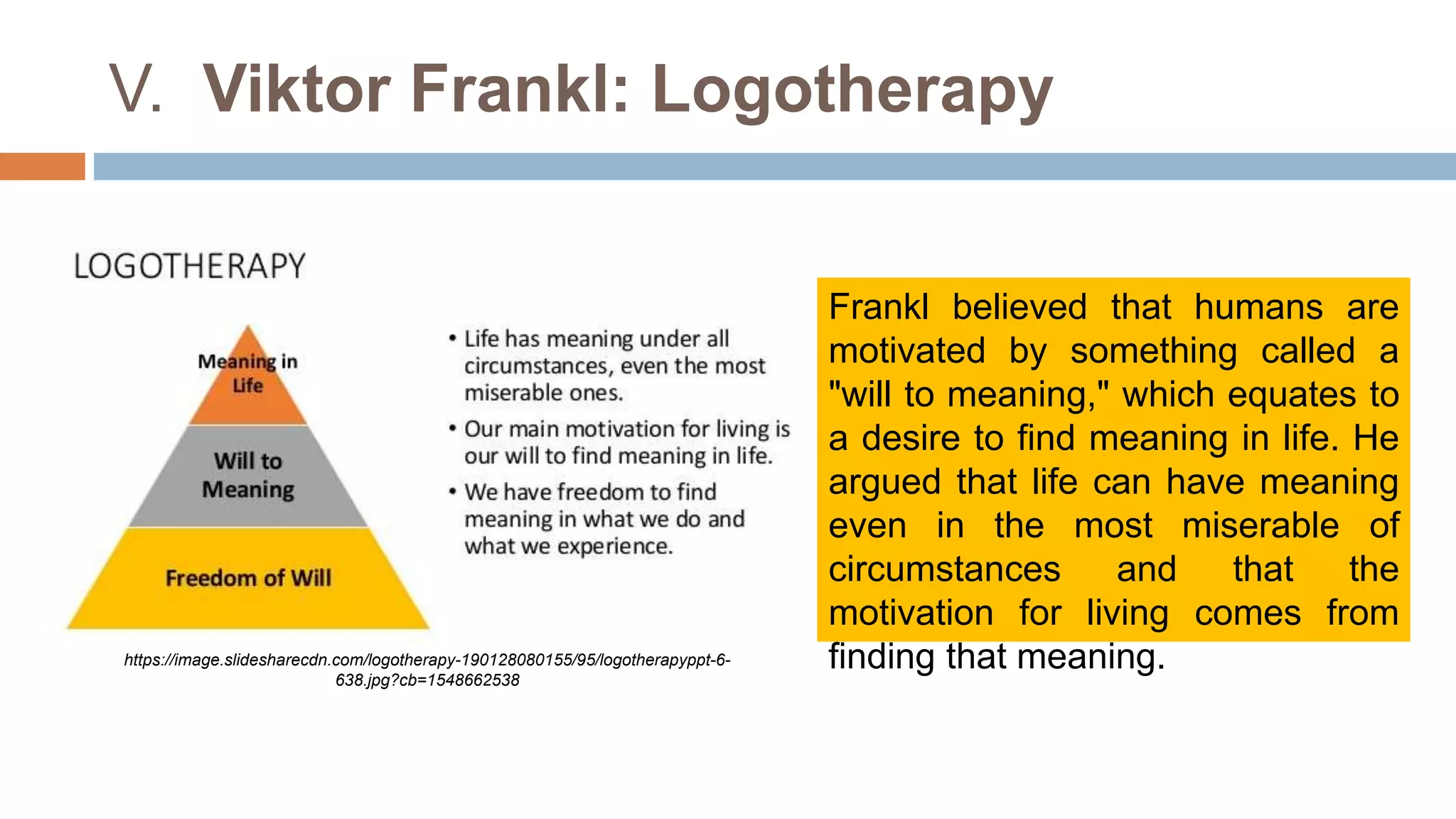
Frankl believed that humans are
motivated by something called a
"will to meaning," which equates to
a desire to find meaning in life. He
argued that life can have meaning
even in the most miserable of
circumstances and that the
motivation for living comes from
finding that meaning.
https://image.slidesharecdn.com/logotherapy-190128080155/95/logotherapyppt-6-
638.jpg?cb=1548662538
V. Viktor Frankl: Logotherapy
https://cdn-prod.medicalnewstoday.com/content/images/articles/320/320814/meaning-of-life-
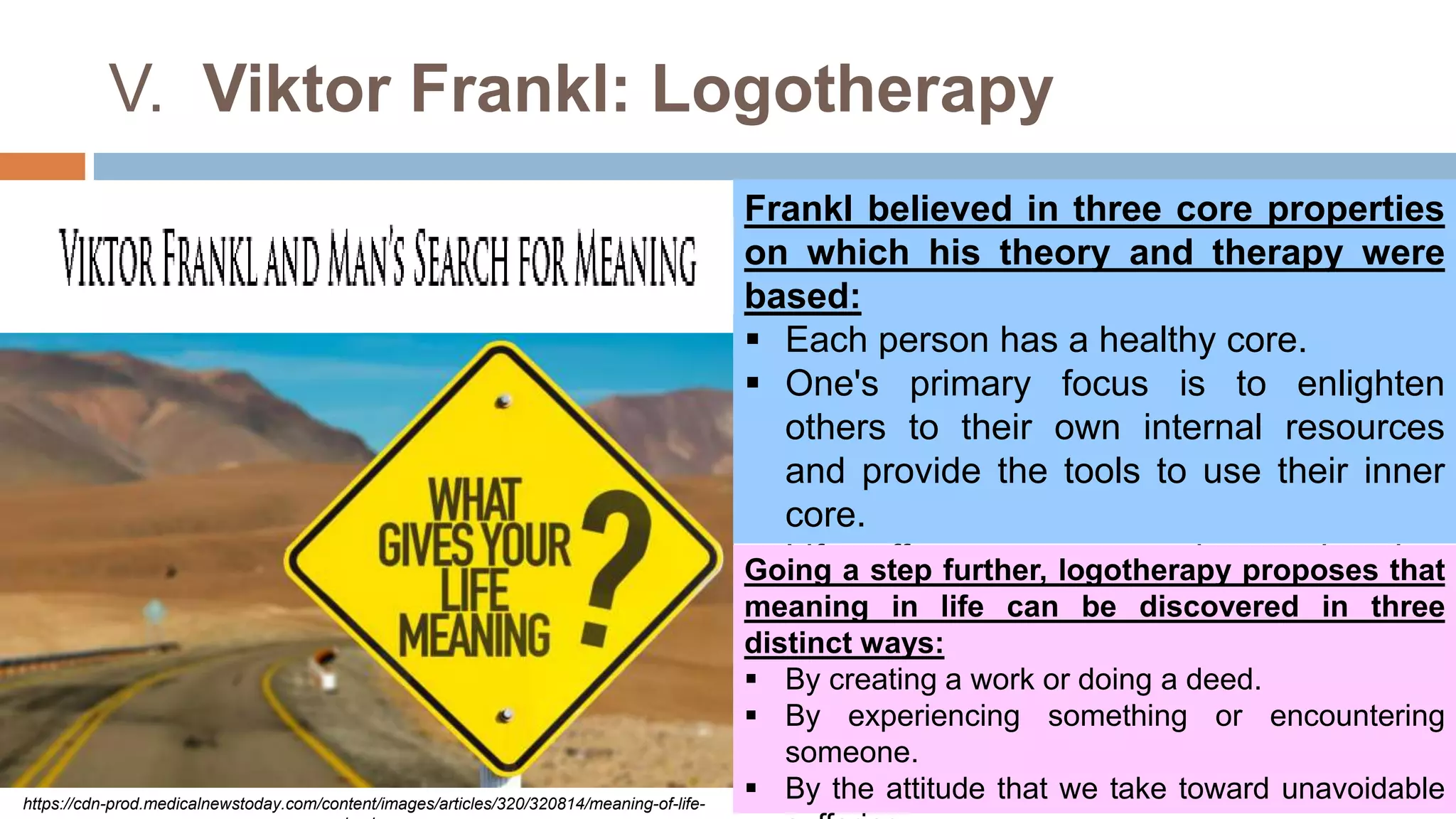
Frankl believed in three core properties
on which his theory and therapy were
based:
 Each person has a healthy core.
 One's primary focus is to enlighten
others to their own internal resources
and provide the tools to use their inner
core.
 Life offers purpose and meaning but
does not promise fulfillment or
happiness.
Going a step further, logotherapy proposes that
meaning in life can be discovered in three
distinct ways:
 By creating a work or doing a deed.
 By experiencing something or encountering
someone.
 By the attitude that we take toward unavoidable
V. Viktor Frankl: Logotherapy
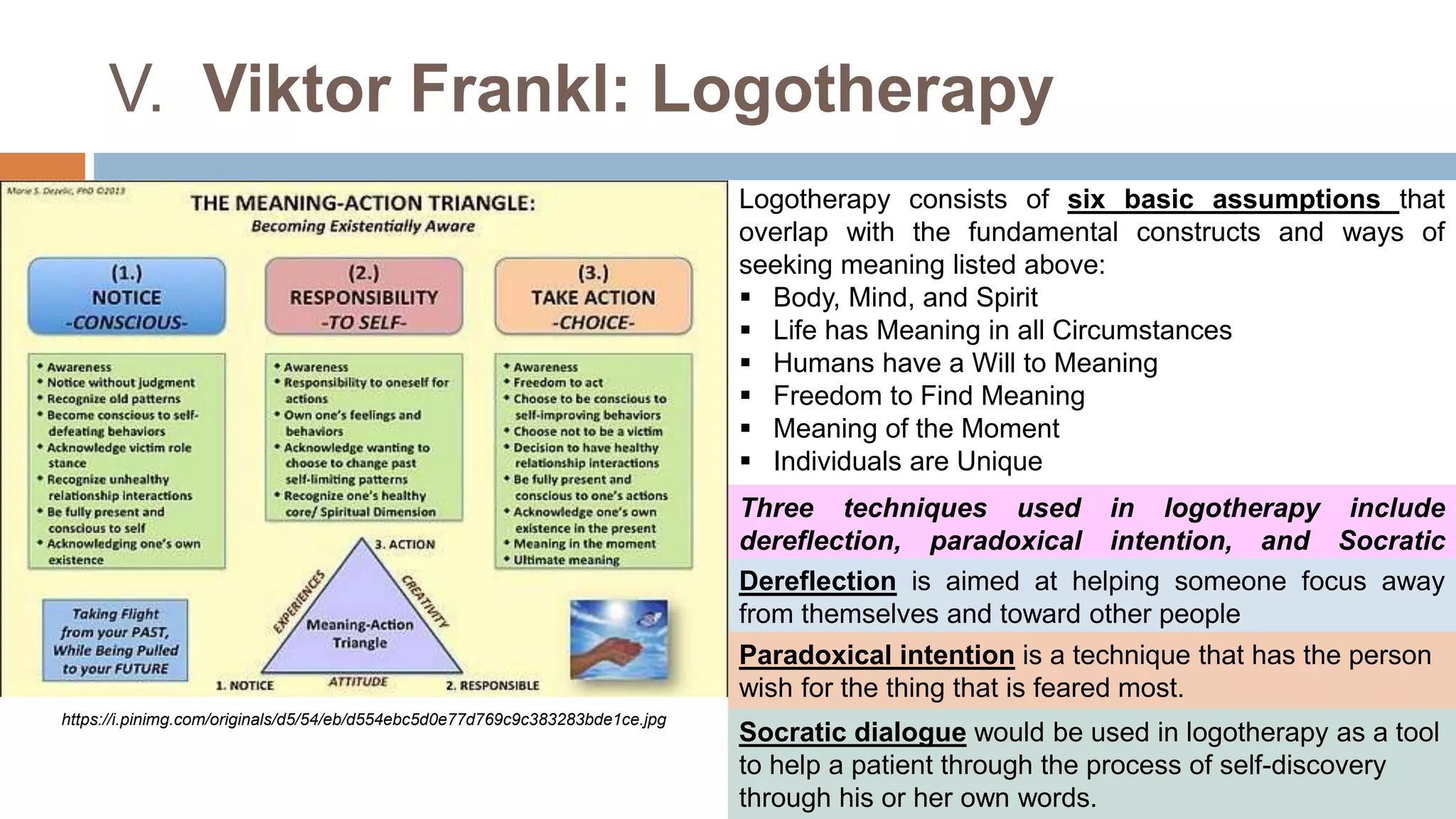
Logotherapy consists of six basic assumptions that
overlap with the fundamental constructs and ways of
seeking meaning listed above:
 Body, Mind, and Spirit
 Life has Meaning in all Circumstances
 Humans have a Will to Meaning
 Freedom to Find Meaning
 Meaning of the Moment
 Individuals are Unique
Three techniques used in logotherapy include
dereflection, paradoxical intention, and Socratic
dialogue.
Dereflection is aimed at helping someone focus away
from themselves and toward other people
Paradoxical intention is a technique that has the person
wish for the thing that is feared most.
Socratic dialogue would be used in logotherapy as a tool
to help a patient through the process of self-discovery
through his or her own words.
https://i.pinimg.com/originals/d5/54/eb/d554ebc5d0e77d769c9c383283bde1ce.jpg
https://i.pinimg.com/originals/ba/c1/35/bac135dee50fd90e179ef46499d2e3d9.png

GEC 1 Understanding the Self (Module 7: The Spiritual Self)

  • 1.
    GEC 1 UNDERSTANDINGTHE SELF Module 7 (Week 11 - 12)  The Spiritual Self Prepared by: Nancy Jane D. Victorino, RPm, LPT
  • 2.
    DISCUSSION CILO (Course IntendedLearning Outcome/s):  Discuss the different meanings of “spirituality”.  Identify and appreciate the importance of the various rituals and ceremonies practiced by different groups in the Philippines.  Determine the importance of a core belief system in the development of the Self.  Apply the concept of Logotherapy in order to get a clearer understanding of the purpose of life.
  • 3.
    I. What isthe meaning of “Spirituality”? Spirituality is a broad concept with room for many perspectives. In general, it includes a sense of connection to something bigger than ourselves, and it typically involves a search for meaning in life. As such, it is a universal human experience—something that touches us all. People may describe a spiritual experience as sacred or transcendent or simply a deep sense of aliveness and interconnectedness. https://i.pinimg.com/originals/1f/0e/c6/1f0ec6a0116a62 41b620dae0f0044483.jpg Spirituality involves exploring certain universal themes – love, compassion, altruism, life after death, wisdom and truth, with the knowledge that some people such as saints or enlightened individuals have achieved and manifested higher levels of development than the ordinary person.
  • 4.
    I. What isthe meaning of “Spirituality”? Spiritual development requires successive degrees of freedom based on the realization that thoughts are not facts but simply transient mental phenomena, as indeed are our emotions. Neuroscientific research is showing that with the practice of mindfulness, the cortex of the brain literally grows, with an increase in grey matter and more gyrification. https://www.livehappy.com/sites/default/files/styles/article_featured/public/main/articles/S pirituality_Header-2.jpg?itok=1u89ZZhm
  • 5.
    II. The SOUL Soul,in religion and philosophy, the immaterial aspect or essence of a human being, that which confers individuality and humanity, often considered to be synonymous with the mind or the self. In theology, the soul is further defined as that part of the individual which partakes of divinity and often is considered to survive the death of the body. https://static.wixstatic.com/media/cedeef_13e1d7b5fbe44458982a9f51b1426480~mv2_d_3 131_2000_s_2.jpg/v1/fill/w_1000,h_639,al_c,q_90,usm_0.66_1.00_0.01/cedeef_13e1d7b5f be44458982a9f51b1426480~mv2_d_3131_2000_s_2.jpg
  • 6.
    III. Rituals andCeremonies A ritual is a ceremony or action performed in a customary way. Your family might have a Saturday night ritual of eating a big spaghetti dinner and then taking a long walk to the ice cream shop. https://lh3.googleusercontent.com/proxy/mATgtMlsd2w9edaPregI3ErAb- ClP5_EDWkW8Oh05sb_QNDyFHEm5l4Ed7KkmdklUcWE4CoH9KFl8OjWQswbC vv4RH6hSegIw702d0CjasXRvv2GhPDi-kb9pb6wN9uY5iuwNmbl3HZYgr- hIFqSUefRQ1Fah4JeasEbQ0Gb As an adjective, ritual means "conforming to religious rites," which are the sacred, customary ways of celebrating a religion or culture. Although it comes from religious ceremonies, ritual can also be used for any time-honored tradition.
  • 7.
    IV. Religion, Cult,Magic, and Witchcraft Religion and spirituality are both rooted in trying to understand the meaning of life and, in some cases, how a relationship with a higher power may influence that meaning. While religion and spirituality are similar in foundation, they are very different in practice. Religion is an organized, community-based system of beliefs, while spirituality resides within the individual and what they personally believe. “The idea of religion and spirituality is like a rectangle versus a square. Within religion there is spirituality, but if you have spirituality, it doesn’t necessarily mean you have religion,” says someone who practices both religion and spirituality. https://www.takingcharge.csh.umn.edu/sites/default/files/images/inline/religion%20spiritualit y%20venn2_0.jpg
  • 8.
    IV. Religion, Cult,Magic, and Witchcraft In modern English, a cult is a social group that is defined by its unusual religious, spiritual, or philosophical beliefs, or by its common interest in a particular personality, object, or goal. The concept is to gain a target's trust by making them feel loved and accepted to essentially disguising any sign of manipulation in order to be able to influence them and the way they behave without raising suspicion. https://snworksceo.imgix.net/tsn/dd2b0575-2637-4d1c-a395-698e02538c81.sized- 1000x1000.png?w=1000
  • 9.
    IV. Religion, Cult,Magic, and Witchcraft Witchcraft is the practice of what the practitioner ("witch") believes to be magical skills and abilities, and activities such as spells, incantations, and magical rituals. In the Philippines, as in many of these cultures, witches are viewed as those opposed to the sacred. In contrast, anthropologists writing about the healers in Indigenous Philippine folk religions either use the traditional terminology of these cultures, or broad anthropological terms like "shaman". Wicca, a predominantly Western movement whose followers practice witchcraft and nature worship and who see it as a religion based on pre-Christian traditions of northern and western Europe.
  • 10.
    V. Viktor Frankl:Logotherapy Frankl believed that humans are motivated by something called a "will to meaning," which equates to a desire to find meaning in life. He argued that life can have meaning even in the most miserable of circumstances and that the motivation for living comes from finding that meaning. https://image.slidesharecdn.com/logotherapy-190128080155/95/logotherapyppt-6- 638.jpg?cb=1548662538
  • 11.
    V. Viktor Frankl:Logotherapy https://cdn-prod.medicalnewstoday.com/content/images/articles/320/320814/meaning-of-life- Frankl believed in three core properties on which his theory and therapy were based:  Each person has a healthy core.  One's primary focus is to enlighten others to their own internal resources and provide the tools to use their inner core.  Life offers purpose and meaning but does not promise fulfillment or happiness. Going a step further, logotherapy proposes that meaning in life can be discovered in three distinct ways:  By creating a work or doing a deed.  By experiencing something or encountering someone.  By the attitude that we take toward unavoidable
  • 12.
    V. Viktor Frankl:Logotherapy Logotherapy consists of six basic assumptions that overlap with the fundamental constructs and ways of seeking meaning listed above:  Body, Mind, and Spirit  Life has Meaning in all Circumstances  Humans have a Will to Meaning  Freedom to Find Meaning  Meaning of the Moment  Individuals are Unique Three techniques used in logotherapy include dereflection, paradoxical intention, and Socratic dialogue. Dereflection is aimed at helping someone focus away from themselves and toward other people Paradoxical intention is a technique that has the person wish for the thing that is feared most. Socratic dialogue would be used in logotherapy as a tool to help a patient through the process of self-discovery through his or her own words. https://i.pinimg.com/originals/d5/54/eb/d554ebc5d0e77d769c9c383283bde1ce.jpg
  • 13.