The Self and the
Development of the
Social World
Prepared by: Krisha Marie Valmores
Group 1 (Members)
Keirt Aban Mancio
Jerome Tamayo
Madel Miranda
Across time and history the self has been debated, discussed
and fruitfully conceptualized by different thinkers in
philosophy. With the advent of social sciences, it became
possible for new ways and paradigms to re-examine the true
nature of self. Tired of the ideas of ancient philosophers
regarding the body and the mind, thinkers settled on the idea
that whatever relationship these two have is less important than
the fact that there is a self.
Introduction
In contemporary literature and in common sense, self is
equated to being separate, self contained, independent,
consistent, unitary, and private.
 This means that self indistinct from others, unique and
has own identity. Even twins have their own self
identity
 Its distinctiveness allows its being self contained with
own thoughts, independence , characteristics and
volition.
What is the Self?
 By consistency, it means that a particular self’s traits , characteristics,
tendencies, and potentials are more or less the drama and can be studies,
described and measured.
 Self is unitary- it is the center of all experiences and thoughts that run
through a certain person.
 Being private – suggests that self is isolated from the external world, living
within its own, however we see the clash between the self and the external
reality- that one can see that the self is always at the mercy of the external
circumstances that bump and collide with it.
The Self and the Development of Social World
 how do children growing up become social beings? how do twins grow from
the same mother turn out so differently when given up for adoption? more
than his givenness (personality, tendencies, propensities, among others) one is
believed to be active participation in the shaping of the self. The unending
terrain of the metamorphosis of the self is mediated by language. Language is
both publicly shared and privately utilized symbol system is the where the
individual and the social make and each other (Schwartz, White and Luke
1993)
01
04
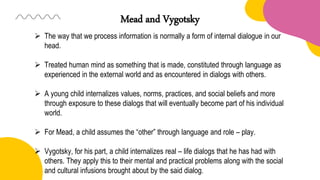
 The way that we process information is normally a form of internal dialogue in our
head.
 Treated human mind as something that is made, constituted through language as
experienced in the external world and as encountered in dialogs with others.
 A young child internalizes values, norms, practices, and social beliefs and more
through exposure to these dialogs that will eventually become part of his individual
world.
 For Mead, a child assumes the “other” through language and role – play.
 Vygotsky, for his part, a child internalizes real – life dialogs that he has had with
others. They apply this to their mental and practical problems along with the social
and cultural infusions brought about by the said dialog.
Mead and Vygotsky
01
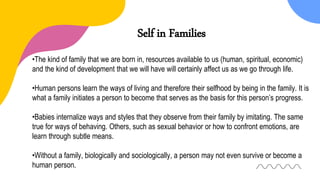
•The kind of family that we are born in, resources available to us (human, spiritual, economic)
and the kind of development that we will have will certainly affect us as we go through life.
•Human persons learn the ways of living and therefore their selfhood by being in the family. It is
what a family initiates a person to become that serves as the basis for this person’s progress.
•Babies internalize ways and styles that they observe from their family by imitating. The same
true for ways of behaving. Others, such as sexual behavior or how to confront emotions, are
learn through subtle means.
•Without a family, biologically and sociologically, a person may not even survive or become a
human person.
Self in Families
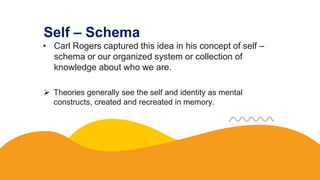
• Carl Rogers captured this idea in his concept of self –
schema or our organized system or collection of
knowledge about who we are.
Self – Schema
 Theories generally see the self and identity as mental
constructs, created and recreated in memory.
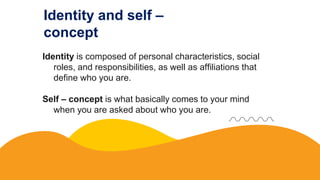
Identity is composed of personal characteristics, social
roles, and responsibilities, as well as affiliations that
define who you are.
Self – concept is what basically comes to your mind
when you are asked about who you are.
Identity and self –
concept
Theory of Symbolic Interactionism
(G.H Mead)
•Self is created and developed through human interaction.
•Three reasons why self and identity are social products.
1.We do not create ourselves out of nothing.
2.Whether we like to admit it or not, we actually need others to affirm
and reinforce who we thin k we are.
3.What we think is important to us may also have been influenced by
what is important in our social or historical context.
Social interaction and group affiliation are vital factors
in creating our self – concept especially in the aspect of
providing us with our social identity or our perception of
who we are based on our membership to certain
groups.
•Carver and Scheier (1981) identified two types of self that we can be aware;
1.The private self or your internal standards and private thoughts and feelings.
2.The public self or your public image commonly geared toward having a good
presentation of yourself to others.
•Self – awareness also present us with at least three other self – schema.
1.The actual self is who you are at the moment
2.The ideal self is who you like to be
3.The ought self is who you think you should be
•Self – awareness can be too much that we are concerned about being
observed and criticized by others, also known as self – consciousness.
•Deindividuation is the loss of individual self – awareness and individual
accountability in groups.
Self – Awareness
-The awareness of our self – concept
a.Social comparison theory
We learn about ourselves, the appropriateness of our behaviors, as well
as our social status by comparing aspects of ourselves with other people.
1.Downward social comparison
We create a positive self – concept by comparing ourselves with those
who are worse off than us.
2.Upward social comparison
Comparing ourselves with those who are better off than us.
 Self – esteem
Our own positive or negative perception or evaluation of ourselves
b. Self – evaluation maintenance theory
We can feel threatened when someone out – performs us,
especially when that person is close to us. In this case, we usually react in
three ways;
1.We distance ourselves from that person or redefine our relationship
with them.
2.We may also reconsider the importance of the aspect or skill in
which you were outperformed.
3.We may also strengthen our resolve to improve that certain aspect
of ourselves.
•Narcissism is a trait characterized by overly high self – esteem,
self – admiration, and self – centeredness.
•Baumeister, Smart, and Boden (1996) concluded that programs,
activities, and parenting styles to boost self – esteem should only be
for rewarding good behavior and other achievements and not for the
purpose of merely trying to make children feel better about
themselves or to appease them when they get angry or sad.

UNDERSTANDING-THE-SELF-Group-1.pptx

  • 1.
    The Self andthe Development of the Social World Prepared by: Krisha Marie Valmores Group 1 (Members) Keirt Aban Mancio Jerome Tamayo Madel Miranda
  • 2.
    Across time andhistory the self has been debated, discussed and fruitfully conceptualized by different thinkers in philosophy. With the advent of social sciences, it became possible for new ways and paradigms to re-examine the true nature of self. Tired of the ideas of ancient philosophers regarding the body and the mind, thinkers settled on the idea that whatever relationship these two have is less important than the fact that there is a self. Introduction
  • 3.
    In contemporary literatureand in common sense, self is equated to being separate, self contained, independent, consistent, unitary, and private.  This means that self indistinct from others, unique and has own identity. Even twins have their own self identity  Its distinctiveness allows its being self contained with own thoughts, independence , characteristics and volition. What is the Self?
  • 4.
     By consistency,it means that a particular self’s traits , characteristics, tendencies, and potentials are more or less the drama and can be studies, described and measured.  Self is unitary- it is the center of all experiences and thoughts that run through a certain person.  Being private – suggests that self is isolated from the external world, living within its own, however we see the clash between the self and the external reality- that one can see that the self is always at the mercy of the external circumstances that bump and collide with it.
  • 5.
    The Self andthe Development of Social World  how do children growing up become social beings? how do twins grow from the same mother turn out so differently when given up for adoption? more than his givenness (personality, tendencies, propensities, among others) one is believed to be active participation in the shaping of the self. The unending terrain of the metamorphosis of the self is mediated by language. Language is both publicly shared and privately utilized symbol system is the where the individual and the social make and each other (Schwartz, White and Luke 1993)
  • 6.
    01 04  The waythat we process information is normally a form of internal dialogue in our head.  Treated human mind as something that is made, constituted through language as experienced in the external world and as encountered in dialogs with others.  A young child internalizes values, norms, practices, and social beliefs and more through exposure to these dialogs that will eventually become part of his individual world.  For Mead, a child assumes the “other” through language and role – play.  Vygotsky, for his part, a child internalizes real – life dialogs that he has had with others. They apply this to their mental and practical problems along with the social and cultural infusions brought about by the said dialog. Mead and Vygotsky
  • 7.
    01 •The kind offamily that we are born in, resources available to us (human, spiritual, economic) and the kind of development that we will have will certainly affect us as we go through life. •Human persons learn the ways of living and therefore their selfhood by being in the family. It is what a family initiates a person to become that serves as the basis for this person’s progress. •Babies internalize ways and styles that they observe from their family by imitating. The same true for ways of behaving. Others, such as sexual behavior or how to confront emotions, are learn through subtle means. •Without a family, biologically and sociologically, a person may not even survive or become a human person. Self in Families
  • 8.
    • Carl Rogerscaptured this idea in his concept of self – schema or our organized system or collection of knowledge about who we are. Self – Schema  Theories generally see the self and identity as mental constructs, created and recreated in memory.
  • 9.
    Identity is composedof personal characteristics, social roles, and responsibilities, as well as affiliations that define who you are. Self – concept is what basically comes to your mind when you are asked about who you are. Identity and self – concept
  • 10.
    Theory of SymbolicInteractionism (G.H Mead) •Self is created and developed through human interaction. •Three reasons why self and identity are social products. 1.We do not create ourselves out of nothing. 2.Whether we like to admit it or not, we actually need others to affirm and reinforce who we thin k we are. 3.What we think is important to us may also have been influenced by what is important in our social or historical context.
  • 11.
    Social interaction andgroup affiliation are vital factors in creating our self – concept especially in the aspect of providing us with our social identity or our perception of who we are based on our membership to certain groups.
  • 12.
    •Carver and Scheier(1981) identified two types of self that we can be aware; 1.The private self or your internal standards and private thoughts and feelings. 2.The public self or your public image commonly geared toward having a good presentation of yourself to others. •Self – awareness also present us with at least three other self – schema. 1.The actual self is who you are at the moment 2.The ideal self is who you like to be 3.The ought self is who you think you should be •Self – awareness can be too much that we are concerned about being observed and criticized by others, also known as self – consciousness. •Deindividuation is the loss of individual self – awareness and individual accountability in groups. Self – Awareness -The awareness of our self – concept
  • 13.
    a.Social comparison theory Welearn about ourselves, the appropriateness of our behaviors, as well as our social status by comparing aspects of ourselves with other people. 1.Downward social comparison We create a positive self – concept by comparing ourselves with those who are worse off than us. 2.Upward social comparison Comparing ourselves with those who are better off than us.  Self – esteem Our own positive or negative perception or evaluation of ourselves
  • 14.
    b. Self –evaluation maintenance theory We can feel threatened when someone out – performs us, especially when that person is close to us. In this case, we usually react in three ways; 1.We distance ourselves from that person or redefine our relationship with them. 2.We may also reconsider the importance of the aspect or skill in which you were outperformed. 3.We may also strengthen our resolve to improve that certain aspect of ourselves.
  • 15.
    •Narcissism is atrait characterized by overly high self – esteem, self – admiration, and self – centeredness. •Baumeister, Smart, and Boden (1996) concluded that programs, activities, and parenting styles to boost self – esteem should only be for rewarding good behavior and other achievements and not for the purpose of merely trying to make children feel better about themselves or to appease them when they get angry or sad.