Less Stress,
More Care
Self-care
“Since stress is inevitable to life,
we have to learn how to handle
and cope up with it. More so, we
have to be familiar with other
approach to a healthy lifestyle,
which is self-care.”
2
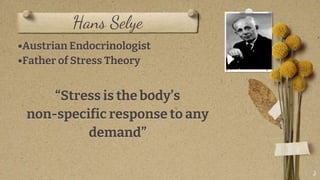
Hans Selye
•Austrian Endocrinologist
•Father of Stress Theory
“Stress is the body’s
non-specific response to any
demand”
3
Let’s start with the first set of slides
Big concept
Bring the attention of your audience over a key
concept using icons or illustrations
6
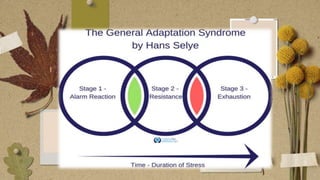
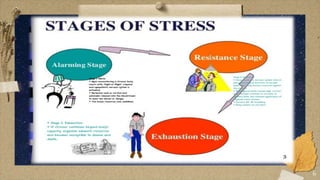
Stage 1: Alarm
✘ It represents a mobilization of the body’s
defensive forces.
✘ The body is preparing for the “fight or
flight” syndrome.
This involves a number of hormones
and chemicals excreted at high levels, as well
as an increase in heart rate, blood pressure,
perspiration, and respiration rate, among
others.
7
The body becomes adaptive to the challenge
and even begins to resist it.
The length of this stage is dependent upon
the body’s innate & stored adaptation energy
reserves and upon the intensity of the stressor.
•Sooner or later, the body will become the victim of
this constant wear or tear process.
•The acquired adaptation is lost if the individual is
subject to still greater exposure to the stressor. The
organism then enters into the third and final stage.
Stage 2: Resistance
8
Stage 3: Exhaustion
If stressor
continues beyond body’s
capacity, organism
exhaust resources and
becomes susceptible to
disease and death.
9
Relaxation Response
-Dr. Herbert Benson-
•Deep abdominal breathing, focus on a soothing
word, visualization of tranquil scenes, repetitive
prayer, yoga, and tai chi.
The results of this response may be worth
trying, although it is not a cure at all.
10
Techniques to Counter Chronic Stress
Physical Activity
-Dr. Herbert Benson-
•People can use exercise to stifle the buildup of stress
in several ways.
•Exercise after feeling stressed, not only deepens
breathing but also helps relieve muscle tension.
•Movement therapies such as yoga, tai chi, and qi
gong combined with fluid movements, with deep
breathing, and mental focus, all of which can induce
calm.
11
Techniques to Counter Chronic Stress
Social Support
-Dr. Herbert Benson-
•Confidants, friends, acquaintances,
co-workers, relatives, spouses, &
companions all provide a life-enhancing
social net, and may increase longevity.
12
The Cultural Dimension of Stress and Coping
13
The findings of Ben Kuo’s research study revealed that;
• A person’s internalized cultural values, beliefs, and
norms affect the appraisal process of stressors and the
perceived appropriateness of coping responses. These
cultural factors delimit the coping options available to an
individual in the face of stress.
•The prevalence of emotion-focused, indirect, passive, or
covert, internally target, or secondary control coping
among individuals of Asian backgrounds, as well as, to a
lesser extent, among the African and Latino
backgrounds.
The Cultural Dimension of Stress and Coping
• Emotion-focused coping has been shown to be
beneficial when it comes in reducing distress for
Asian-Americans and Asian-Canadians in dealing
with various stressors, including family conflict and
racial discrimination.
• Problem-focused coping also found effective for
Asian-Americans and Asian-Canadians when it
comes to responding in male gender conflicts, racial
discrimination, and cross-cultural adjustment.
Note: For non-Asians, emotion-focused coping was shown to be negative increasing stress
of African-American adult caregivers, but problem-focused coping was shown to be
negative in exacerbating stress for Hispanic-American College students in facing family
conflicts.
14
Self-care Therapy
It is one of the positive way in coping
stress. These are the steps in achieving self-
care according to Nancy Apperson;
✘ Stop, breathe, and tell yourself: “This is hard and I
will get through this one step at a time.”
✘ Acknowledge to yourself what you are feeling. All
feelings are normal, so accept whatever you are
feeling.
✘ Find someone who listens and is accepting. You do
not need advice, you need to be heard.
✘ Maintain your normal routine as much as possible.
15
Self-care Therapy
✘ Allow plenty of time for a task.
✘ Take good care of yourself by way of getting
enough rest and sleep, eating regularly, and
making healthy choices, knowing your limits
and when you need to let go, identifying or
creating a nurturing place in your home,
practicing relaxation or meditation and lastly,
escaping for a while through meditation,
reading a book, watching a movie, or taking a
short trip.
16
Self-compassion Therapy
According to the article that was written by Kristin Neff;
✘ Self-compassion entails being warm and understanding
toward ourselves when we suffer, fail, or feel inadequate,
rather than flagellating ourselves with self-criticism.
✘ We cannot always get what we want same goes to we cannot
always be who we want to be and when this reality was being
denied or resisted stress, frustration, and self-criticism
arises. However, if this will be accepted with benevolence, we
generate positive emotions of kindness and care that help us
cope.
✘ Self-compassion recognizes that life challenges and personal
failures are part of being human, an experience we all share.
17
Self-Compassion Phrases
✘ This is a moment of suffering.
✘ Suffering is a part of life.
✘ May I be kind to myself.
✘ May I give myself the compassion I need.
18
Self-Compassion and Emotional well-being
✘ One of the most consistent findings in the
research literature is that greater self-
compassion is linked to less anxiety and
depression.
✘ Self-compassion is a protection against
anxiety and depression when controlling
for self-criticism and negative effect.
19
Self-Compassion and Emotional well-being
✘ Self-compassionate people recognize when
they are suffering, but are kind toward
themselves in these moments, acknowledging
their connectedness with the rest of humanity.
✘ Self-compassion is associated with greater
wisdom and emotional intelligence. It appears
to bolster positive states of being as well.
✘ By wrapping one’s pain in the warm embrace of
self-compassion, positive feelings are
generated that help balance the negative ones
(Neff 2012)
20
Self-compassion, motivation and Health
✘ Research supports the idea that self-compassion enhances
motivation rather than self-indulgence.
✘ For instance, while self-compassion is negatively related to
perfectionism, it has no association with the level of
performance standards adapted for the self.
✘ Self-compassionate people aim just as high, but also
recognize and accept that they cannot always reach their
goals.
✘ Self-compassion is also linked to greater personal initiative-
the desire to reach one’s full potential. Self-compassionate
people have been found to have less motivational anxiety
and engage in fewer self-handicapping behaviors such as
procrastination than those who lack self-compassion.
21
Self-compassion vs. Self-esteem
✘ Research indicates that self-compassion is moderately
associated with at levels of self-esteem.
✘ Self-compassion still predicts greater happiness and
optimism as well as less depression and anxiety when
controlling for self-esteem.
✘ Self-esteem had a robust association with narcissism while
self-compassion had no association with narcissism.
✘ In contrast to those with high self-esteem, self-
compassionate people are less focused on evaluating
themselves, feeling superior to others, worrying about
whether or not others are evaluating them, ending their
viewpoints, or angrily reacting against those who disagree
with them.
22
Self-compassion Letter
Steps in doing the self-compassionate letter exercise as provided by Neff (2012):
• Candidly describe a problem that tends to make you feel bad about yourself.
• Next, think of an imaginary friend who is unconditionally accepting and compassionate.
• Finally, write a letter to yourself from that perspective. What would your friend say
about your perceived problem? What words would he or she use to convey deep
compassion? How would your friend remind you that you are only human? If your friend
were to make any suggestions, how would they reflect unconditional understanding?
• When you are done writing, put the letter down for a while and come back to it later.
Then read the letter again, letting the words sink in allowing yourself to be soothed and
comforted.
Less Stress, More Care
We should be in control of the
stress that confronts us every day.
Otherwise, when we are overwhelmed
by stress, it can be detrimental to our
health. Self-care and self-compassion
are two ways to positively confront
stress. We should low and care for our
self-more and more each day.

Less stress, more care

  • 1.
  • 2.
    Self-care “Since stress isinevitable to life, we have to learn how to handle and cope up with it. More so, we have to be familiar with other approach to a healthy lifestyle, which is self-care.” 2
  • 3.
    Hans Selye •Austrian Endocrinologist •Fatherof Stress Theory “Stress is the body’s non-specific response to any demand” 3
  • 4.
    Let’s start withthe first set of slides
  • 6.
    Big concept Bring theattention of your audience over a key concept using icons or illustrations 6
  • 7.
    Stage 1: Alarm ✘It represents a mobilization of the body’s defensive forces. ✘ The body is preparing for the “fight or flight” syndrome. This involves a number of hormones and chemicals excreted at high levels, as well as an increase in heart rate, blood pressure, perspiration, and respiration rate, among others. 7
  • 8.
    The body becomesadaptive to the challenge and even begins to resist it. The length of this stage is dependent upon the body’s innate & stored adaptation energy reserves and upon the intensity of the stressor. •Sooner or later, the body will become the victim of this constant wear or tear process. •The acquired adaptation is lost if the individual is subject to still greater exposure to the stressor. The organism then enters into the third and final stage. Stage 2: Resistance 8
  • 9.
    Stage 3: Exhaustion Ifstressor continues beyond body’s capacity, organism exhaust resources and becomes susceptible to disease and death. 9
  • 10.
    Relaxation Response -Dr. HerbertBenson- •Deep abdominal breathing, focus on a soothing word, visualization of tranquil scenes, repetitive prayer, yoga, and tai chi. The results of this response may be worth trying, although it is not a cure at all. 10 Techniques to Counter Chronic Stress
  • 11.
    Techniques to CounterChronic Stress Physical Activity -Dr. Herbert Benson- •People can use exercise to stifle the buildup of stress in several ways. •Exercise after feeling stressed, not only deepens breathing but also helps relieve muscle tension. •Movement therapies such as yoga, tai chi, and qi gong combined with fluid movements, with deep breathing, and mental focus, all of which can induce calm. 11
  • 12.
    Techniques to CounterChronic Stress Social Support -Dr. Herbert Benson- •Confidants, friends, acquaintances, co-workers, relatives, spouses, & companions all provide a life-enhancing social net, and may increase longevity. 12
  • 13.
    The Cultural Dimensionof Stress and Coping 13 The findings of Ben Kuo’s research study revealed that; • A person’s internalized cultural values, beliefs, and norms affect the appraisal process of stressors and the perceived appropriateness of coping responses. These cultural factors delimit the coping options available to an individual in the face of stress. •The prevalence of emotion-focused, indirect, passive, or covert, internally target, or secondary control coping among individuals of Asian backgrounds, as well as, to a lesser extent, among the African and Latino backgrounds.
  • 14.
    The Cultural Dimensionof Stress and Coping • Emotion-focused coping has been shown to be beneficial when it comes in reducing distress for Asian-Americans and Asian-Canadians in dealing with various stressors, including family conflict and racial discrimination. • Problem-focused coping also found effective for Asian-Americans and Asian-Canadians when it comes to responding in male gender conflicts, racial discrimination, and cross-cultural adjustment. Note: For non-Asians, emotion-focused coping was shown to be negative increasing stress of African-American adult caregivers, but problem-focused coping was shown to be negative in exacerbating stress for Hispanic-American College students in facing family conflicts. 14
  • 15.
    Self-care Therapy It isone of the positive way in coping stress. These are the steps in achieving self- care according to Nancy Apperson; ✘ Stop, breathe, and tell yourself: “This is hard and I will get through this one step at a time.” ✘ Acknowledge to yourself what you are feeling. All feelings are normal, so accept whatever you are feeling. ✘ Find someone who listens and is accepting. You do not need advice, you need to be heard. ✘ Maintain your normal routine as much as possible. 15
  • 16.
    Self-care Therapy ✘ Allowplenty of time for a task. ✘ Take good care of yourself by way of getting enough rest and sleep, eating regularly, and making healthy choices, knowing your limits and when you need to let go, identifying or creating a nurturing place in your home, practicing relaxation or meditation and lastly, escaping for a while through meditation, reading a book, watching a movie, or taking a short trip. 16
  • 17.
    Self-compassion Therapy According tothe article that was written by Kristin Neff; ✘ Self-compassion entails being warm and understanding toward ourselves when we suffer, fail, or feel inadequate, rather than flagellating ourselves with self-criticism. ✘ We cannot always get what we want same goes to we cannot always be who we want to be and when this reality was being denied or resisted stress, frustration, and self-criticism arises. However, if this will be accepted with benevolence, we generate positive emotions of kindness and care that help us cope. ✘ Self-compassion recognizes that life challenges and personal failures are part of being human, an experience we all share. 17
  • 18.
    Self-Compassion Phrases ✘ Thisis a moment of suffering. ✘ Suffering is a part of life. ✘ May I be kind to myself. ✘ May I give myself the compassion I need. 18
  • 19.
    Self-Compassion and Emotionalwell-being ✘ One of the most consistent findings in the research literature is that greater self- compassion is linked to less anxiety and depression. ✘ Self-compassion is a protection against anxiety and depression when controlling for self-criticism and negative effect. 19
  • 20.
    Self-Compassion and Emotionalwell-being ✘ Self-compassionate people recognize when they are suffering, but are kind toward themselves in these moments, acknowledging their connectedness with the rest of humanity. ✘ Self-compassion is associated with greater wisdom and emotional intelligence. It appears to bolster positive states of being as well. ✘ By wrapping one’s pain in the warm embrace of self-compassion, positive feelings are generated that help balance the negative ones (Neff 2012) 20
  • 21.
    Self-compassion, motivation andHealth ✘ Research supports the idea that self-compassion enhances motivation rather than self-indulgence. ✘ For instance, while self-compassion is negatively related to perfectionism, it has no association with the level of performance standards adapted for the self. ✘ Self-compassionate people aim just as high, but also recognize and accept that they cannot always reach their goals. ✘ Self-compassion is also linked to greater personal initiative- the desire to reach one’s full potential. Self-compassionate people have been found to have less motivational anxiety and engage in fewer self-handicapping behaviors such as procrastination than those who lack self-compassion. 21
  • 22.
    Self-compassion vs. Self-esteem ✘Research indicates that self-compassion is moderately associated with at levels of self-esteem. ✘ Self-compassion still predicts greater happiness and optimism as well as less depression and anxiety when controlling for self-esteem. ✘ Self-esteem had a robust association with narcissism while self-compassion had no association with narcissism. ✘ In contrast to those with high self-esteem, self- compassionate people are less focused on evaluating themselves, feeling superior to others, worrying about whether or not others are evaluating them, ending their viewpoints, or angrily reacting against those who disagree with them. 22
  • 23.
    Self-compassion Letter Steps indoing the self-compassionate letter exercise as provided by Neff (2012): • Candidly describe a problem that tends to make you feel bad about yourself. • Next, think of an imaginary friend who is unconditionally accepting and compassionate. • Finally, write a letter to yourself from that perspective. What would your friend say about your perceived problem? What words would he or she use to convey deep compassion? How would your friend remind you that you are only human? If your friend were to make any suggestions, how would they reflect unconditional understanding? • When you are done writing, put the letter down for a while and come back to it later. Then read the letter again, letting the words sink in allowing yourself to be soothed and comforted.
  • 24.
    Less Stress, MoreCare We should be in control of the stress that confronts us every day. Otherwise, when we are overwhelmed by stress, it can be detrimental to our health. Self-care and self-compassion are two ways to positively confront stress. We should low and care for our self-more and more each day.