Ship Classification and Types

                               Adi Wirawan Husodo

                   Jurusan Teknik Permesinan Kapal
         Politeknik Perkapalan Negeri Surabaya - ITS


                                                       1
Jenis-jenis Kapal (1)
•   Kapal-kapal niaga (merchant ships)
•   High speed craft
•   Yacth
•   Warship
Jenis-jenis Kapal (2)
• Transport
  – Cargo, container ship, passenger ships, etc


• Non Transport
  – Fishing vessels, service craft (tugs, supply
    vessels, warships)
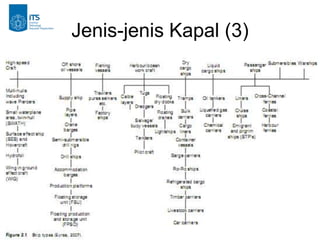
Jenis-jenis Kapal (3)
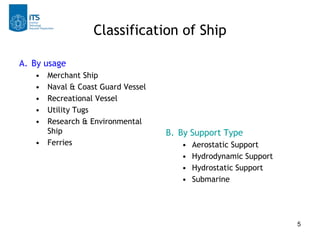
Classification of Ship

A. By usage
   • Merchant Ship
   • Naval & Coast Guard Vessel
   • Recreational Vessel
   • Utility Tugs
   • Research & Environmental
     Ship                         B. By Support Type
   • Ferries                         •   Aerostatic Support
                                     •   Hydrodynamic Support
                                     •   Hydrostatic Support
                                     •   Submarine


                                                                5
Merchant Ships

These ships are intended to earn a profit in the distribution of goods.
General Cargo, Tanker, LPG/LNG Carrier, Bulk Carrier, Container Vessel, etc.

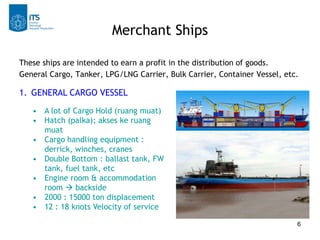
1. GENERAL CARGO VESSEL
   • A lot of Cargo Hold (ruang muat)
   • Hatch (palka); akses ke ruang
     muat
   • Cargo handling equipment :
     derrick, winches, cranes
   • Double Bottom : ballast tank, FW
     tank, fuel tank, etc
   • Engine room & accommodation
     room  backside
   • 2000 : 15000 ton displacement
   • 12 : 18 knots Velocity of service

                                                                           6
Merchant Ships
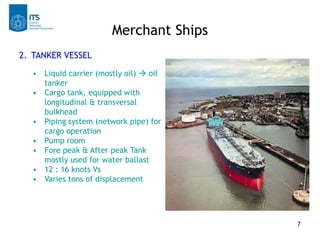
2. TANKER VESSEL
  • Liquid carrier (mostly oil)  oil
    tanker
  • Cargo tank, equipped with
    longitudinal & transversal
    bulkhead
  • Piping system (network pipe) for
    cargo operation
  • Pump room
  • Fore peak & After peak Tank
    mostly used for water ballast
  • 12 : 16 knots Vs
  • Varies tons of displacement


                                        7
Merchant Ships
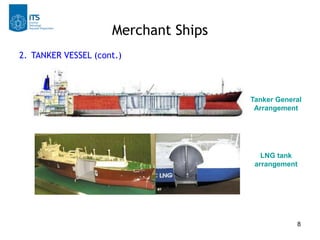
2. TANKER VESSEL (cont.)


                                      Tanker General
                                       Arrangement


                                         LNG tank
                                       arrangement


                                                  8
Merchant Ships
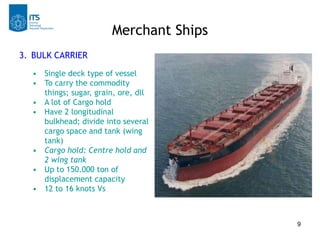
3. BULK CARRIER
  • Single deck type of vessel
  • To carry the commodity
    things; sugar, grain, ore, dll
  • A lot of Cargo hold
  • Have 2 longitudinal
    bulkhead; divide into several
    cargo space and tank (wing
    tank)
  • Cargo hold: Centre hold and
    2 wing tank
  • Up to 150.000 ton of
    displacement capacity
  • 12 to 16 knots Vs


                                        9
Merchant Ships
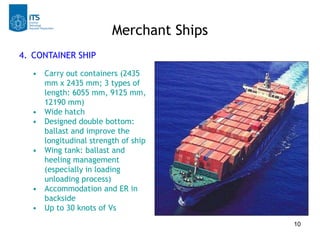
4. CONTAINER SHIP
  • Carry out containers (2435
    mm x 2435 mm; 3 types of
    length: 6055 mm, 9125 mm,
    12190 mm)
  • Wide hatch
  • Designed double bottom:
    ballast and improve the
    longitudinal strength of ship
  • Wing tank: ballast and
    heeling management
    (especially in loading
    unloading process)
  • Accommodation and ER in
    backside
  • Up to 30 knots of Vs
                                        10
Merchant Ships
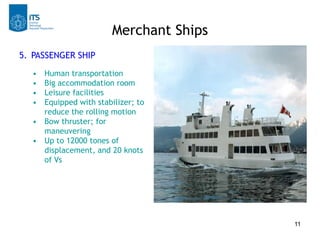
5. PASSENGER SHIP
  • Human transportation
  • Big accommodation room
  • Leisure facilities
  • Equipped with stabilizer; to
    reduce the rolling motion
  • Bow thruster; for
    maneuvering
  • Up to 12000 tones of
    displacement, and 20 knots
    of Vs


                                        11
Naval & Coast Guard Vessel
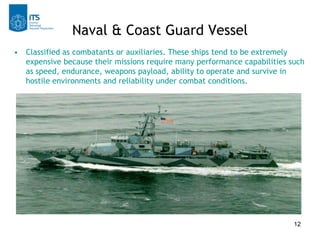
• Classified as combatants or auxiliaries. These ships tend to be extremely
  expensive because their missions require many performance capabilities such
  as speed, endurance, weapons payload, ability to operate and survive in
  hostile environments and reliability under combat conditions.


                                                                          12
By usage (cont.)
• Recreational Vessel
  Personal pleasure craft and cruise liners are a specialized class of ships that
  are run to earn a profit by providing recreation services to the general
  public. Comfort and safety are of utmost importance.

• Utility Tugs
  Designed for long operation and easy maintenance with a no frills approach.

• Research & Environmental Ship
  Highly specialized equipment must be kept and often deployed into and out
  of the water.

• Ferries
  People and Vehicles must be able to be loaded and unloaded with efficiency
  and safety in accordance with a strict time schedule in all weather
  conditions.
                                                                               13
By Support Type


                  14
By Support Type
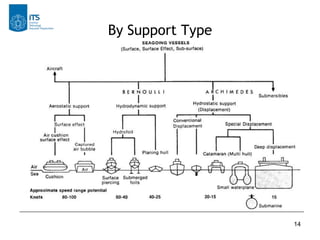
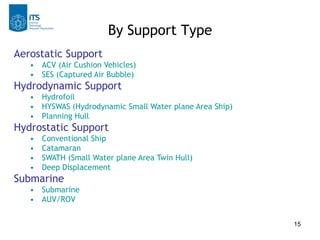
Aerostatic Support
   • ACV (Air Cushion Vehicles)
   • SES (Captured Air Bubble)
Hydrodynamic Support
   • Hydrofoil
   • HYSWAS (Hydrodynamic Small Water plane Area Ship)
   • Planning Hull
Hydrostatic Support
   •   Conventional Ship
   •   Catamaran
   •   SWATH (Small Water plane Area Twin Hull)
   •   Deep Displacement
Submarine
   • Submarine
   • AUV/ROV


                                                         15

[2] ship classification and types

  • 1.
    Ship Classification andTypes Adi Wirawan Husodo Jurusan Teknik Permesinan Kapal Politeknik Perkapalan Negeri Surabaya - ITS 1
  • 2.
    Jenis-jenis Kapal (1) • Kapal-kapal niaga (merchant ships) • High speed craft • Yacth • Warship
  • 3.
    Jenis-jenis Kapal (2) •Transport – Cargo, container ship, passenger ships, etc • Non Transport – Fishing vessels, service craft (tugs, supply vessels, warships)
  • 4.
  • 5.
    Classification of Ship A.By usage • Merchant Ship • Naval & Coast Guard Vessel • Recreational Vessel • Utility Tugs • Research & Environmental Ship B. By Support Type • Ferries • Aerostatic Support • Hydrodynamic Support • Hydrostatic Support • Submarine 5
  • 6.
    Merchant Ships These shipsare intended to earn a profit in the distribution of goods. General Cargo, Tanker, LPG/LNG Carrier, Bulk Carrier, Container Vessel, etc. 1. GENERAL CARGO VESSEL • A lot of Cargo Hold (ruang muat) • Hatch (palka); akses ke ruang muat • Cargo handling equipment : derrick, winches, cranes • Double Bottom : ballast tank, FW tank, fuel tank, etc • Engine room & accommodation room  backside • 2000 : 15000 ton displacement • 12 : 18 knots Velocity of service 6
  • 7.
    Merchant Ships 2. TANKERVESSEL • Liquid carrier (mostly oil)  oil tanker • Cargo tank, equipped with longitudinal & transversal bulkhead • Piping system (network pipe) for cargo operation • Pump room • Fore peak & After peak Tank mostly used for water ballast • 12 : 16 knots Vs • Varies tons of displacement 7
  • 8.
    Merchant Ships 2. TANKERVESSEL (cont.) Tanker General Arrangement LNG tank arrangement 8
  • 9.
    Merchant Ships 3. BULKCARRIER • Single deck type of vessel • To carry the commodity things; sugar, grain, ore, dll • A lot of Cargo hold • Have 2 longitudinal bulkhead; divide into several cargo space and tank (wing tank) • Cargo hold: Centre hold and 2 wing tank • Up to 150.000 ton of displacement capacity • 12 to 16 knots Vs 9
  • 10.
    Merchant Ships 4. CONTAINERSHIP • Carry out containers (2435 mm x 2435 mm; 3 types of length: 6055 mm, 9125 mm, 12190 mm) • Wide hatch • Designed double bottom: ballast and improve the longitudinal strength of ship • Wing tank: ballast and heeling management (especially in loading unloading process) • Accommodation and ER in backside • Up to 30 knots of Vs 10
  • 11.
    Merchant Ships 5. PASSENGERSHIP • Human transportation • Big accommodation room • Leisure facilities • Equipped with stabilizer; to reduce the rolling motion • Bow thruster; for maneuvering • Up to 12000 tones of displacement, and 20 knots of Vs 11
  • 12.
    Naval & CoastGuard Vessel • Classified as combatants or auxiliaries. These ships tend to be extremely expensive because their missions require many performance capabilities such as speed, endurance, weapons payload, ability to operate and survive in hostile environments and reliability under combat conditions. 12
  • 13.
    By usage (cont.) •Recreational Vessel Personal pleasure craft and cruise liners are a specialized class of ships that are run to earn a profit by providing recreation services to the general public. Comfort and safety are of utmost importance. • Utility Tugs Designed for long operation and easy maintenance with a no frills approach. • Research & Environmental Ship Highly specialized equipment must be kept and often deployed into and out of the water. • Ferries People and Vehicles must be able to be loaded and unloaded with efficiency and safety in accordance with a strict time schedule in all weather conditions. 13
  • 14.
  • 15.
    By Support Type AerostaticSupport • ACV (Air Cushion Vehicles) • SES (Captured Air Bubble) Hydrodynamic Support • Hydrofoil • HYSWAS (Hydrodynamic Small Water plane Area Ship) • Planning Hull Hydrostatic Support • Conventional Ship • Catamaran • SWATH (Small Water plane Area Twin Hull) • Deep Displacement Submarine • Submarine • AUV/ROV 15