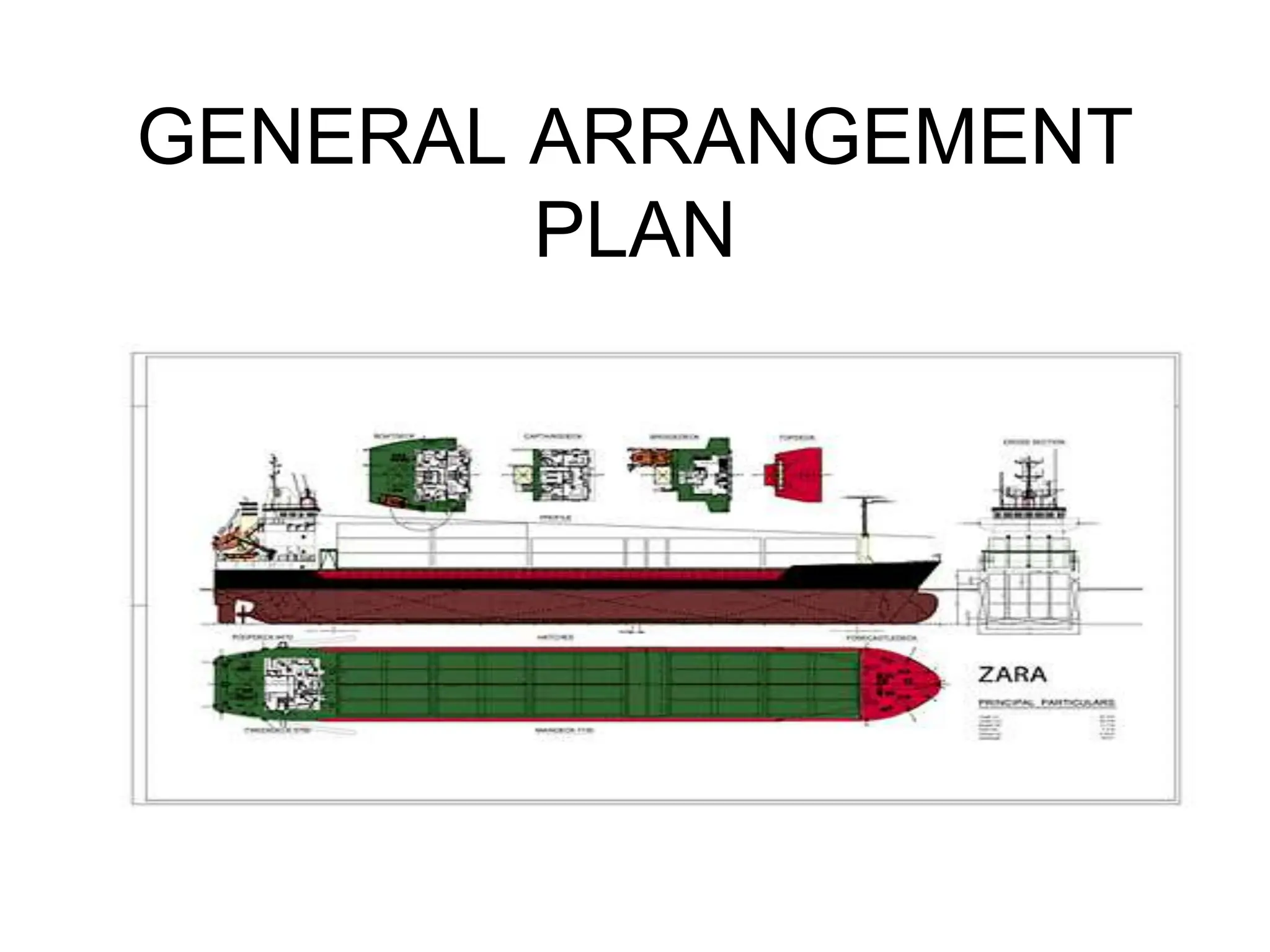
GENERAL ARRANGEMENT
PLAN
SPACES AND SEPARATIONS
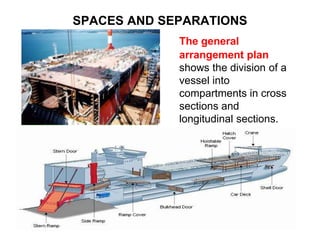
The general
arrangement plan
shows the division of a
vessel into
compartments in cross
sections and
longitudinal sections.
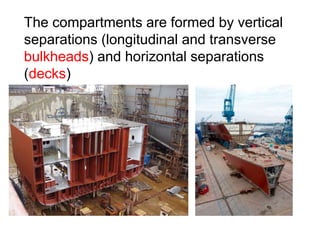
The compartments are formed by vertical
separations (longitudinal and transverse
bulkheads) and horizontal separations
(decks)
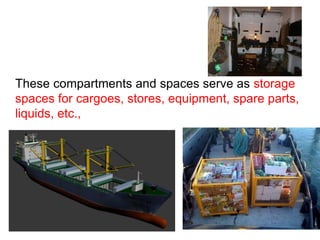
These compartments and spaces serve as storage
spaces for cargoes, stores, equipment, spare parts,
liquids, etc.,
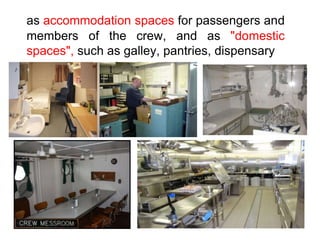
as accommodation spaces for passengers and
members of the crew, and as "domestic
spaces", such as galley, pantries, dispensary
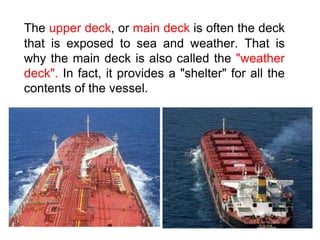
The upper deck, or main deck is often the deck
that is exposed to sea and weather. That is
why the main deck is also called the "weather
deck". In fact, it provides a "shelter" for all the
contents of the vessel.
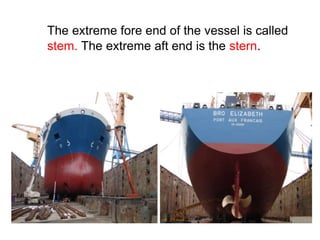
The extreme fore end of the vessel is called
stem. The extreme aft end is the stern.
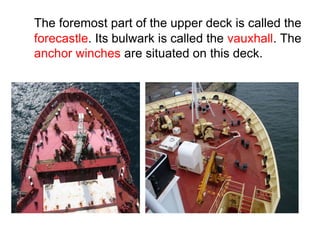
The foremost part of the upper deck is called the
forecastle. Its bulwark is called the vauxhall. The
anchor winches are situated on this deck.
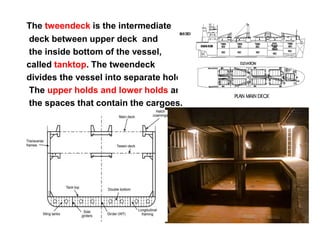
The tweendeck is the intermediate
deck between upper deck and
the inside bottom of the vessel,
called tanktop. The tweendeck
divides the vessel into separate holds.
The upper holds and lower holds are
the spaces that contain the cargoes.
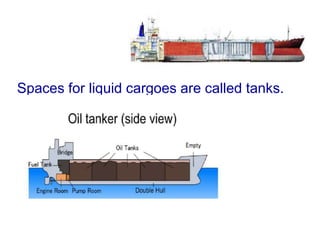
Spaces for liquid cargoes are called tanks.
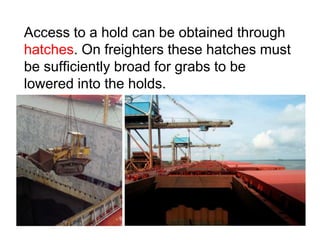
Access to a hold can be obtained through
hatches. On freighters these hatches must
be sufficiently broad for grabs to be
lowered into the holds.
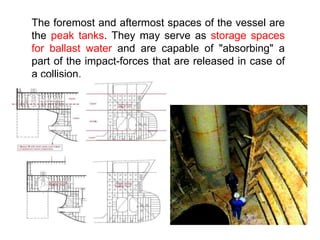
The foremost and aftermost spaces of the vessel are
the peak tanks. They may serve as storage spaces
for ballast water and are capable of "absorbing" a
part of the impact-forces that are released in case of
a collision.
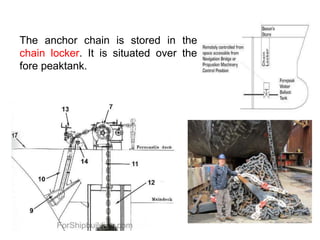
The anchor chain is stored in the
chain locker. It is situated over the
fore peaktank.
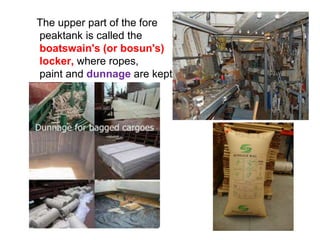
The upper part of the fore
peaktank is called the
boatswain's (or bosun's)
locker, where ropes,
paint and dunnage are kept.
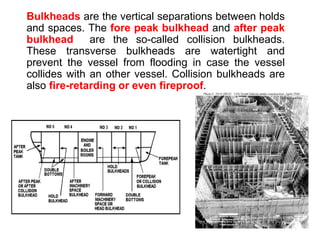
Bulkheads are the vertical separations between holds
and spaces. The fore peak bulkhead and after peak
bulkhead are the so-called collision bulkheads.
These transverse bulkheads are watertight and
prevent the vessel from flooding in case the vessel
collides with an other vessel. Collision bulkheads are
also fire-retarding or even fireproof.
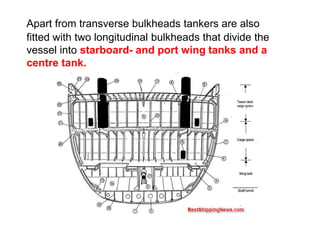
Apart from transverse bulkheads tankers are also
fitted with two longitudinal bulkheads that divide the
vessel into starboard- and port wing tanks and a
centre tank.
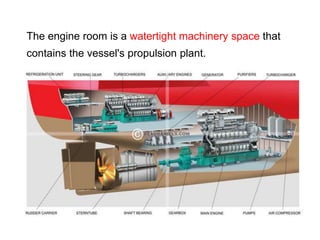
The engine room is a watertight machinery space that
contains the vessel's propulsion plant.
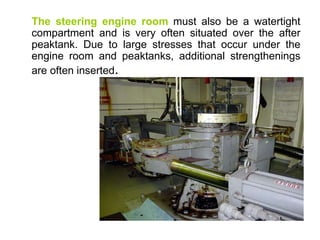
The steering engine room must also be a watertight
compartment and is very often situated over the after
peaktank. Due to large stresses that occur under the
engine room and peaktanks, additional strengthenings
are often inserted.
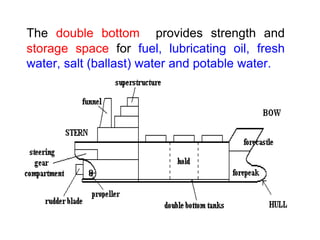
The double bottom provides strength and
storage space for fuel, lubricating oil, fresh
water, salt (ballast) water and potable water.
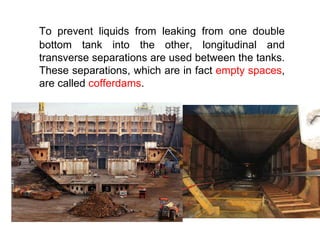
To prevent liquids from leaking from one double
bottom tank into the other, longitudinal and
transverse separations are used between the tanks.
These separations, which are in fact empty spaces,
are called cofferdams.
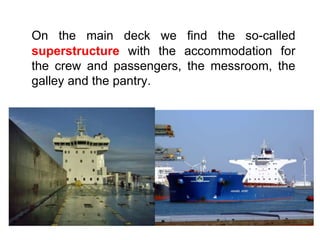
On the main deck we find the so-called
superstructure with the accommodation for
the crew and passengers, the messroom, the
galley and the pantry.
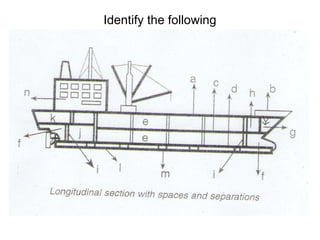
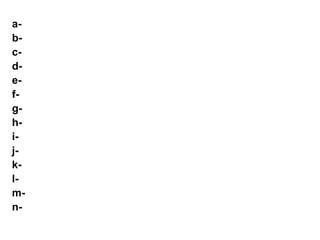
Identify the following
a-
b-
c-
d-
e-
f-
g-
h-
i-
j-
k-
l-
m-
n-
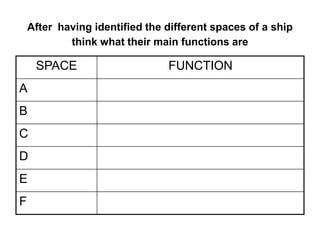
After having identified the different spaces of a ship
think what their main functions are
SPACE FUNCTION
A
B
C
D
E
F
G
H
I
J
K
L
M
N
The navigating bridge contains the wheelhouse
with the control station, the chartroom where
charts, pilot books and publications are kept,
and the radio room.
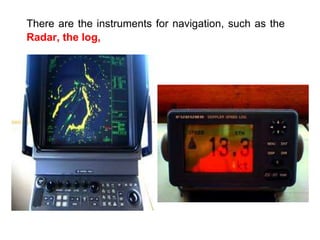
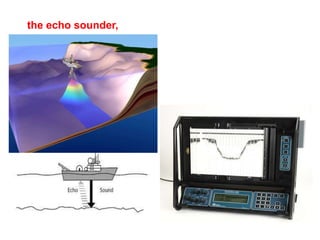
There are the instruments for navigation, such as the
Radar, the log,
the echo sounder,
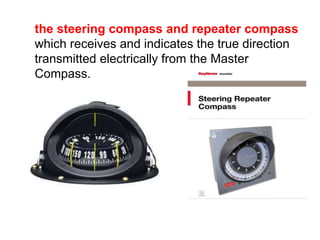
the steering compass and repeater compass
which receives and indicates the true direction
transmitted electrically from the Master
Compass.
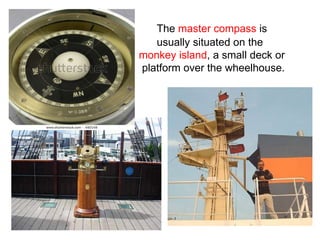
The master compass is
usually situated on the
monkey island, a small deck or
platform over the wheelhouse.
The upper deck
The imaginary line from stem to stern is
called the fore-and-aft line. It divides the
vessel into a starboard- and portside
(when facing forward). "Abeam" is used
to indicate direction at a right angle to the
fore-and-aft line. The terms used to
indicate directions in which the vessel
can proceed are: ahead and astern,
starboard and port.
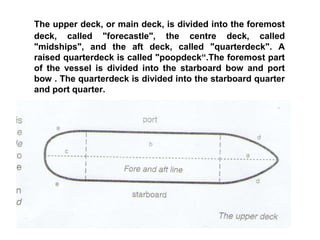
The upper deck, or main deck, is divided into the foremost
deck, called "forecastle", the centre deck, called
"midships", and the aft deck, called "quarterdeck". A
raised quarterdeck is called "poopdeck“.The foremost part
of the vessel is divided into the starboard bow and port
bow . The quarterdeck is divided into the starboard quarter
and port quarter.
Answer the following:
What are bulkheads?
What are decks?
Why is the main deck also called the weather deck?
What can we store in the compartments of a ship?
Where are the anchor winches situated?
Where is the cargo stored in a freighter?
Where is the cargo stored in a tanker?
What do peak tanks serve as?
Where is the anchor chain stored?
What is kept in the bosun’s locker?
Name the watertight and fireproof spaces in a ship.
What is usually stored in the double bottom?
What spaces does the superstructure house?
What does the navigating bridge contain?
What is the fore-and-aft line?
FILL IN THE BLANK SPACES
1. The fore and aft line s……………………….. starboard
from port.
2. Decks and b………………………. are horizontal and
vertical s………………….. that form the holds and spaces.
3. There are three types of decks: u……………………..,
t………………………, l………….. (tanktop).
4. The upper deck is divided into f………………,
a……………………. and q………… decks. The bow is
divided into s…………………… bow and p…………….
bow. The quarters are divided into s…………………….
and p…………………. quarters.
5. The forepeak bulkhead and the afterpeak bulkhead are
w……………………………. bulkheads.
6. There are two peak tanks : the f……………… tank and
the a…………….. tank.
7. Watertight spaces are : e……………………… and
s…………………………….
8. The anchor chain is stored in the
c………………………………………..
9. The double bottom is for s…………………………. and
provides s……………….. for fuel,
………………………………………. and
w………………………….
10. Cofferdams are t…………. or l…………………………
spaces between tanks that p……………….. leaking.

General-Arrangement-Planppt enggineerdad

  • 1.
  • 2.
    SPACES AND SEPARATIONS Thegeneral arrangement plan shows the division of a vessel into compartments in cross sections and longitudinal sections.
  • 3.
    The compartments areformed by vertical separations (longitudinal and transverse bulkheads) and horizontal separations (decks)
  • 4.
    These compartments andspaces serve as storage spaces for cargoes, stores, equipment, spare parts, liquids, etc.,
  • 5.
    as accommodation spacesfor passengers and members of the crew, and as "domestic spaces", such as galley, pantries, dispensary
  • 6.
    The upper deck,or main deck is often the deck that is exposed to sea and weather. That is why the main deck is also called the "weather deck". In fact, it provides a "shelter" for all the contents of the vessel.
  • 7.
    The extreme foreend of the vessel is called stem. The extreme aft end is the stern.
  • 8.
    The foremost partof the upper deck is called the forecastle. Its bulwark is called the vauxhall. The anchor winches are situated on this deck.
  • 9.
    The tweendeck isthe intermediate deck between upper deck and the inside bottom of the vessel, called tanktop. The tweendeck divides the vessel into separate holds. The upper holds and lower holds are the spaces that contain the cargoes.
  • 10.
    Spaces for liquidcargoes are called tanks.
  • 11.
    Access to ahold can be obtained through hatches. On freighters these hatches must be sufficiently broad for grabs to be lowered into the holds.
  • 12.
    The foremost andaftermost spaces of the vessel are the peak tanks. They may serve as storage spaces for ballast water and are capable of "absorbing" a part of the impact-forces that are released in case of a collision.
  • 13.
    The anchor chainis stored in the chain locker. It is situated over the fore peaktank.
  • 14.
    The upper partof the fore peaktank is called the boatswain's (or bosun's) locker, where ropes, paint and dunnage are kept.
  • 15.
    Bulkheads are thevertical separations between holds and spaces. The fore peak bulkhead and after peak bulkhead are the so-called collision bulkheads. These transverse bulkheads are watertight and prevent the vessel from flooding in case the vessel collides with an other vessel. Collision bulkheads are also fire-retarding or even fireproof.
  • 16.
    Apart from transversebulkheads tankers are also fitted with two longitudinal bulkheads that divide the vessel into starboard- and port wing tanks and a centre tank.
  • 17.
    The engine roomis a watertight machinery space that contains the vessel's propulsion plant.
  • 18.
    The steering engineroom must also be a watertight compartment and is very often situated over the after peaktank. Due to large stresses that occur under the engine room and peaktanks, additional strengthenings are often inserted.
  • 19.
    The double bottomprovides strength and storage space for fuel, lubricating oil, fresh water, salt (ballast) water and potable water.
  • 20.
    To prevent liquidsfrom leaking from one double bottom tank into the other, longitudinal and transverse separations are used between the tanks. These separations, which are in fact empty spaces, are called cofferdams.
  • 21.
    On the maindeck we find the so-called superstructure with the accommodation for the crew and passengers, the messroom, the galley and the pantry.
  • 22.
  • 23.
  • 24.
    After having identifiedthe different spaces of a ship think what their main functions are SPACE FUNCTION A B C D E F
  • 25.
  • 26.
    The navigating bridgecontains the wheelhouse with the control station, the chartroom where charts, pilot books and publications are kept, and the radio room.
  • 27.
    There are theinstruments for navigation, such as the Radar, the log,
  • 28.
  • 29.
    the steering compassand repeater compass which receives and indicates the true direction transmitted electrically from the Master Compass.
  • 30.
    The master compassis usually situated on the monkey island, a small deck or platform over the wheelhouse.
  • 31.
    The upper deck Theimaginary line from stem to stern is called the fore-and-aft line. It divides the vessel into a starboard- and portside (when facing forward). "Abeam" is used to indicate direction at a right angle to the fore-and-aft line. The terms used to indicate directions in which the vessel can proceed are: ahead and astern, starboard and port.
  • 32.
    The upper deck,or main deck, is divided into the foremost deck, called "forecastle", the centre deck, called "midships", and the aft deck, called "quarterdeck". A raised quarterdeck is called "poopdeck“.The foremost part of the vessel is divided into the starboard bow and port bow . The quarterdeck is divided into the starboard quarter and port quarter.
  • 33.
    Answer the following: Whatare bulkheads? What are decks? Why is the main deck also called the weather deck? What can we store in the compartments of a ship? Where are the anchor winches situated? Where is the cargo stored in a freighter? Where is the cargo stored in a tanker? What do peak tanks serve as? Where is the anchor chain stored? What is kept in the bosun’s locker? Name the watertight and fireproof spaces in a ship. What is usually stored in the double bottom? What spaces does the superstructure house? What does the navigating bridge contain? What is the fore-and-aft line?
  • 34.
    FILL IN THEBLANK SPACES 1. The fore and aft line s……………………….. starboard from port. 2. Decks and b………………………. are horizontal and vertical s………………….. that form the holds and spaces. 3. There are three types of decks: u…………………….., t………………………, l………….. (tanktop). 4. The upper deck is divided into f………………, a……………………. and q………… decks. The bow is divided into s…………………… bow and p……………. bow. The quarters are divided into s……………………. and p…………………. quarters. 5. The forepeak bulkhead and the afterpeak bulkhead are w……………………………. bulkheads.
  • 35.
    6. There aretwo peak tanks : the f……………… tank and the a…………….. tank. 7. Watertight spaces are : e……………………… and s……………………………. 8. The anchor chain is stored in the c……………………………………….. 9. The double bottom is for s…………………………. and provides s……………….. for fuel, ………………………………………. and w…………………………. 10. Cofferdams are t…………. or l………………………… spaces between tanks that p……………….. leaking.