Note-Taking Skills
Part 2
RUSSELL RODRIGO, M.Ed.
Lesson Outline: Part 2
 Effective research note-taking strategies
 Importance of writing notes in your own words
 How to avoid common errors
 Practice identifying key points
Note-taking from resources
Note-taking is a crucial part of writing assignments.
Three steps to effective notes:
• Understand the information.
• Select the information.
• Record the information.
Modes of Recording
What are the advantages and disadvantages of these modes of recording?
• Writing down every word from source
• Using Outline (linear) notes
• Using diagrams/branching notes
• (Text) Underlining/highlighting in color
• (Text) computer scanning
• (Text) Photocopying
• (Text) making notes in margins
• (Spoken input) Audio recording
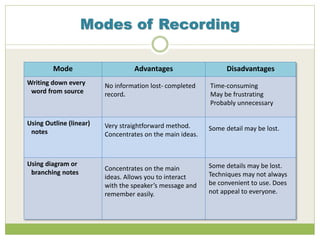
Modes of Recording
Mode Advantages Disadvantages
Writing down every
word from source
Using Outline (linear)
notes
Using diagram or
branching notes
No information lost- completed
record.
Time-consuming
May be frustrating
Probably unnecessary
Very straightforward method.
Concentrates on the main ideas.
Some detail may be lost.
Concentrates on the main
ideas. Allows you to interact
with the speaker’s message and
remember easily.
Some details may be lost.
Techniques may not always
be convenient to use. Does
not appeal to everyone.
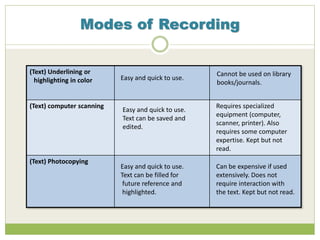
Modes of Recording
(Text) Underlining or
highlighting in color
(Text) computer scanning
(Text) Photocopying
Easy and quick to use.
Cannot be used on library
books/journals.
Easy and quick to use.
Text can be saved and
edited.
Requires specialized
equipment (computer,
scanner, printer). Also
requires some computer
expertise. Kept but not
read.
Easy and quick to use.
Text can be filled for
future reference and
highlighted.
Can be expensive if used
extensively. Does not
require interaction with
the text. Kept but not read.
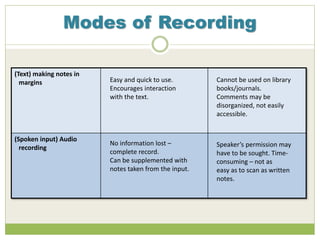
Modes of Recording
(Text) making notes in
margins
(Spoken input) Audio
recording
Easy and quick to use.
Encourages interaction
with the text.
Cannot be used on library
books/journals.
Comments may be
disorganized, not easily
accessible.
No information lost –
complete record.
Can be supplemented with
notes taken from the input.
Speaker’s permission may
have to be sought. Time-
consuming – not as
easy as to scan as written
notes.
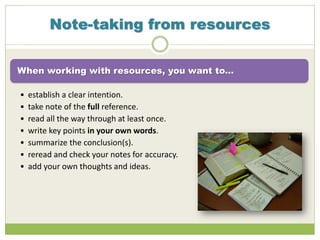
Note-taking from resources
When working with resources, you want to...
• establish a clear intention.
• take note of the full reference.
• read all the way through at least once.
• write key points in your own words.
• summarize the conclusion(s).
• reread and check your notes for accuracy.
• add your own thoughts and ideas.
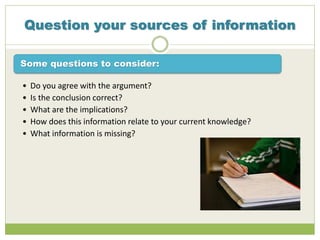
Question your sources of information
Some questions to consider:
• Do you agree with the argument?
• Is the conclusion correct?
• What are the implications?
• How does this information relate to your current knowledge?
• What information is missing?
Common Errors
 Directly copying the source
 Too much information
 Avoid direct quotes
 Note the source and page number
Practice 1: Note Taking Activity
 Watch the video and summarize Ken Robinson’s talk
on how education kills creativity.
 https://www.youtube.com/watch?v=iG9CE55wbtY
Practice 2
1. Take note of the full reference.
2. Read all the way through at least once.
3. Write key points in your own words.
4. Summarize the main idea.
5. Summarize the conclusion(s).
6. Add your own thoughts and ideas.
In adding your own thoughts, use the following guide questions
• Do you agree with the argument?
• Is the conclusion correct?
• What are the implications?
• How does this information relate to your current knowledge?
• What information is missing?
Read the article “Women who post lots of photos of themselves on
Facebook value appearance, need attention, study finds” and answer
the following:

2. note taking skills russell rodrigo

  • 1.
  • 2.
    Lesson Outline: Part2  Effective research note-taking strategies  Importance of writing notes in your own words  How to avoid common errors  Practice identifying key points
  • 3.
    Note-taking from resources Note-takingis a crucial part of writing assignments. Three steps to effective notes: • Understand the information. • Select the information. • Record the information.
  • 4.
    Modes of Recording Whatare the advantages and disadvantages of these modes of recording? • Writing down every word from source • Using Outline (linear) notes • Using diagrams/branching notes • (Text) Underlining/highlighting in color • (Text) computer scanning • (Text) Photocopying • (Text) making notes in margins • (Spoken input) Audio recording
  • 5.
    Modes of Recording ModeAdvantages Disadvantages Writing down every word from source Using Outline (linear) notes Using diagram or branching notes No information lost- completed record. Time-consuming May be frustrating Probably unnecessary Very straightforward method. Concentrates on the main ideas. Some detail may be lost. Concentrates on the main ideas. Allows you to interact with the speaker’s message and remember easily. Some details may be lost. Techniques may not always be convenient to use. Does not appeal to everyone.
  • 6.
    Modes of Recording (Text)Underlining or highlighting in color (Text) computer scanning (Text) Photocopying Easy and quick to use. Cannot be used on library books/journals. Easy and quick to use. Text can be saved and edited. Requires specialized equipment (computer, scanner, printer). Also requires some computer expertise. Kept but not read. Easy and quick to use. Text can be filled for future reference and highlighted. Can be expensive if used extensively. Does not require interaction with the text. Kept but not read.
  • 7.
    Modes of Recording (Text)making notes in margins (Spoken input) Audio recording Easy and quick to use. Encourages interaction with the text. Cannot be used on library books/journals. Comments may be disorganized, not easily accessible. No information lost – complete record. Can be supplemented with notes taken from the input. Speaker’s permission may have to be sought. Time- consuming – not as easy as to scan as written notes.
  • 8.
    Note-taking from resources Whenworking with resources, you want to... • establish a clear intention. • take note of the full reference. • read all the way through at least once. • write key points in your own words. • summarize the conclusion(s). • reread and check your notes for accuracy. • add your own thoughts and ideas.
  • 9.
    Question your sourcesof information Some questions to consider: • Do you agree with the argument? • Is the conclusion correct? • What are the implications? • How does this information relate to your current knowledge? • What information is missing?
  • 10.
    Common Errors  Directlycopying the source  Too much information  Avoid direct quotes  Note the source and page number
  • 11.
    Practice 1: NoteTaking Activity  Watch the video and summarize Ken Robinson’s talk on how education kills creativity.  https://www.youtube.com/watch?v=iG9CE55wbtY
  • 12.
    Practice 2 1. Takenote of the full reference. 2. Read all the way through at least once. 3. Write key points in your own words. 4. Summarize the main idea. 5. Summarize the conclusion(s). 6. Add your own thoughts and ideas. In adding your own thoughts, use the following guide questions • Do you agree with the argument? • Is the conclusion correct? • What are the implications? • How does this information relate to your current knowledge? • What information is missing? Read the article “Women who post lots of photos of themselves on Facebook value appearance, need attention, study finds” and answer the following: