Chapter 4


                            Personality and
                            Emotions

              ORGANIZATIONAL BEHAVIOR
                             S T E P H E N P. R O B B I N S
                                 E L E V E N T H   E D I T I O N
© 2005 Prentice Hall Inc.        WWW.PRENHALL.COM/ROBBINS          PowerPoint Presentation
All rights reserved.                                                      by Charlie Cook
What is Personality?

 Personality
 The sum total of ways in which an individual reacts and
 interacts with others.

 Personality Traits
 Enduring characteristics      Personality
                                Personality
 that describe an              Determinants
                                Determinants
 individual’s behavior.        • •Heredity
                                   Heredity
                               • •Environment
                                   Environment
                               • •Situation
                                   Situation

© 2005 Prentice Hall Inc.
All rights reserved.                               4–2
The Myers-Briggs Type Indicator

 Myers-Briggs Type Indicator (MBTI)
 A personality test that taps four characteristics and
 classifies people into 1 of 16 personality types.


            Personality Types
             Personality Types
            • •Extroverted vs. Introverted (E or I)
                Extroverted vs. Introverted (E or I)
            • •Sensing vs. Intuitive (S or N)
                Sensing vs. Intuitive (S or N)
            • •Thinking vs. Feeling (T or F)
                Thinking vs. Feeling (T or F)
            • •Judging vs. Perceiving (P or J)
                Judging vs. Perceiving (P or J)

© 2005 Prentice Hall Inc.
All rights reserved.                                     4–3
The Big Five Model of Personality Dimensions
 Extroversion
 Sociable, gregarious, and assertive

 Agreeableness
 Good-natured, cooperative, and trusting.

 Conscientiousness
 Responsible, dependable, persistent, and organized.

 Emotional Stability
 Calm, self-confident, secure (positive) versus nervous, depressed,
 and insecure (negative).

 Openness to Experience
 Imaginativeness, artistic, sensitivity, and intellectualism.
© 2005 Prentice Hall Inc.
All rights reserved.                                            4–4
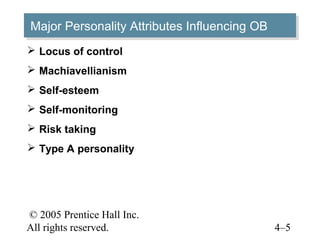
Major Personality Attributes Influencing OB
 Locus of control
 Machiavellianism
 Self-esteem
 Self-monitoring
 Risk taking
 Type A personality


© 2005 Prentice Hall Inc.
All rights reserved.                          4–5
Locus of Control
Locus of Control
  Locus of Control
  The degree to which people believe they are
  masters of their own fate.

     Internals
     Individuals who believe that they control what happens to
     them.

     Externals
     Individuals who believe that what happens to them is
     controlled by outside forces such as luck or chance.


© 2005 Prentice Hall Inc.
All rights reserved.                                         4–6
Machiavellianism
Machiavellianism

 Machiavellianism (Mach)
 Degree to which an individual is pragmatic,
 maintains emotional distance, and believes that
 ends can justify means.


                  Conditions Favoring High Machs
                   Conditions Favoring High Machs
                  ••Direct interaction
                    Direct interaction
                  ••Minimal rules and regulations
                     Minimal rules and regulations
                  ••Emotions distract for others
                     Emotions distract for others
© 2005 Prentice Hall Inc.
All rights reserved.                                 4–7
Self-Esteem and Self-Monitoring

 Self-Esteem (SE)
 Individuals’ degree of liking or disliking themselves.

  Self-Monitoring
  A personality trait that measures an individuals
  ability to adjust his or her behavior to external,
  situational factors.


© 2005 Prentice Hall Inc.
All rights reserved.                                   4–8
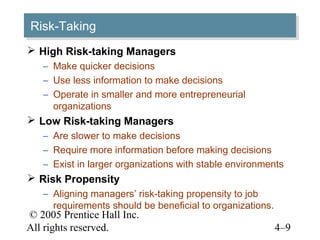
Risk-Taking
Risk-Taking
 High Risk-taking Managers
   – Make quicker decisions
   – Use less information to make decisions
   – Operate in smaller and more entrepreneurial
     organizations
 Low Risk-taking Managers
   – Are slower to make decisions
   – Require more information before making decisions
   – Exist in larger organizations with stable environments
 Risk Propensity
   – Aligning managers’ risk-taking propensity to job
     requirements should be beneficial to organizations.
© 2005 Prentice Hall Inc.
All rights reserved.                                       4–9
Personality Types
Personality Types

  Proactive Personality
  Identifies opportunities, shows initiative, takes
  action, and perseveres until meaningful change
  occurs.
  Creates positive change in the environment,
  regardless or even in spite of constraints or
  obstacles.


© 2005 Prentice Hall Inc.                             4–
All rights reserved.                                  10
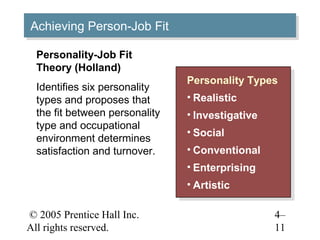
Achieving Person-Job Fit

  Personality-Job Fit
  Theory (Holland)
                                Personality Types
                                 Personality Types
  Identifies six personality
  types and proposes that       ••Realistic
                                  Realistic
  the fit between personality   ••Investigative
                                   Investigative
  type and occupational
                                ••Social
                                   Social
  environment determines
  satisfaction and turnover.    ••Conventional
                                   Conventional
                                ••Enterprising
                                   Enterprising
                                ••Artistic
                                  Artistic

© 2005 Prentice Hall Inc.                          4–
All rights reserved.                               11
Emotions- Why Emotions Were Ignored in OB
 The “myth of rationality”
   – Organizations are not emotion-free.
 Emotions of any kind are disruptive to
  organizations.
   – Original OB focus was solely on the effects of strong
     negative emotions that interfered with individual and
     organizational efficiency.


© 2005 Prentice Hall Inc.                               4–
All rights reserved.                                    12
What Are Emotions? (cont’d)

  Emotional Labor
  A situation in which an employee expresses
  organizationally desired emotions during
  interpersonal transactions.
  Emotional Dissonance
  A situation in which an employee
  must project one emotion while simultaneously
  feeling another.


© 2005 Prentice Hall Inc.                         4–
All rights reserved.                              13
Felt versus Displayed Emotions

  Felt Emotions
  An individual’s actual emotions.

  Displayed Emotions
  Emotions that are organizationally required and
  considered appropriate in a given job.


© 2005 Prentice Hall Inc.                           4–
All rights reserved.                                14
Emotion Dimensions
Emotion Dimensions
 Variety of emotions
   – Positive
   – Negative
 Intensity of emotions
   – Personality
   – Job Requirements
 Frequency and duration of emotions
   – How often emotions are exhibited.
   – How long emotions are displayed.


© 2005 Prentice Hall Inc.                4–
All rights reserved.                     15
Gender and Emotions
Gender and Emotions
 Women
    –   Can show greater emotional expression.
    –   Experience emotions more intensely.
    –   Display emotions more frequently.
    –   Are more comfortable in expressing emotions.
    –   Are better at reading others’ emotions.
 Men
   – Believe that displaying emotions is inconsistent with
     the male image.
   – Are innately less able to read and to identify with
     others’ emotions.
   – Have less need to seek social approval by showing
© 2005 Prentice Hall Inc.
     positive emotions.                                   4–
All rights reserved.                                     16
Affective Events Theory (AET)
 Emotions are negative or positive responses to a work
  environment event.
    – Personality and mood determine the intensity of the
      emotional response.
    – Emotions can influence a broad range of work performance
      and job satisfaction variables.
 Implications of the theory:
    – Individual response reflects emotions and mood cycles.
    – Current and past emotions affect job satisfaction.
    – Emotional fluctuations create variations in job satisfaction.
    – Emotions have only short-term effects on job performance.
   – Both negative and positive emotions can distract workers
© 2005 Prentice job performance.
     and reduce Hall Inc.                                   4–
All rights reserved.                                             17
OB Applications of Understanding Emotions
 Ability and Selection
   – Emotions affect employee effectiveness.
 Decision Making
   – Emotions are an important part of the decision-making
     process in organizations.
 Motivation
   – Emotional commitment to work and high motivation are
     strongly linked.
 Leadership
   – Emotions are important to acceptance of messages
     from organizational leaders.

© 2005 Prentice Hall Inc.                              4–
All rights reserved.                                   18
OB Applications… (cont’d)
 Interpersonal Conflict
    – Conflict in the workplace and individual emotions are
      strongly intertwined.
 Customer Services
    – Emotions affect service quality delivered to customers
      which, in turn, affects customer relationships.
 Deviant Workplace Behaviors
    – Negative emotions lead to employee deviance
      (actions that violate norms and threaten the
      organization).
        • Productivity failures
        • Property theft and destruction
        • Political Hall Inc.
© 2005 Prentice actions                                  4–
        • reserved.
All rightsPersonal aggression                            19
Ability and Selection
  Emotional
  Intelligence
                             Emotional Intelligence (EI)
  An assortment of           Emotional Intelligence (EI)
                               –– Self-awareness
                                   Self-awareness
  noncognitive skills,
                               –– Self-management
                                   Self-management
  capabilities, and
                               –– Self-motivation
  competencies that                Self-motivation
                               –– Empathy
  influence a person’s             Empathy
  ability to succeed in        –– Social skills
                                   Social skills
                             Research Findings
  coping with                Research Findings
  environmental                –– High EI scores, not high
                                   High EI scores, not high
                                  IQ scores, characterize
                                   IQ scores, characterize
  demands and                     high performers.
                                   high performers.
  pressures.
© 2005 Prentice Hall Inc.                               4–
All rights reserved.                                    20

Ob11 04st

  • 1.
    Chapter 4 Personality and Emotions ORGANIZATIONAL BEHAVIOR S T E P H E N P. R O B B I N S E L E V E N T H E D I T I O N © 2005 Prentice Hall Inc. WWW.PRENHALL.COM/ROBBINS PowerPoint Presentation All rights reserved. by Charlie Cook
  • 2.
    What is Personality? Whatis Personality? Personality The sum total of ways in which an individual reacts and interacts with others. Personality Traits Enduring characteristics Personality Personality that describe an Determinants Determinants individual’s behavior. • •Heredity Heredity • •Environment Environment • •Situation Situation © 2005 Prentice Hall Inc. All rights reserved. 4–2
  • 3.
    The Myers-Briggs TypeIndicator The Myers-Briggs Type Indicator Myers-Briggs Type Indicator (MBTI) A personality test that taps four characteristics and classifies people into 1 of 16 personality types. Personality Types Personality Types • •Extroverted vs. Introverted (E or I) Extroverted vs. Introverted (E or I) • •Sensing vs. Intuitive (S or N) Sensing vs. Intuitive (S or N) • •Thinking vs. Feeling (T or F) Thinking vs. Feeling (T or F) • •Judging vs. Perceiving (P or J) Judging vs. Perceiving (P or J) © 2005 Prentice Hall Inc. All rights reserved. 4–3
  • 4.
    The Big FiveModel of Personality Dimensions The Big Five Model of Personality Dimensions Extroversion Sociable, gregarious, and assertive Agreeableness Good-natured, cooperative, and trusting. Conscientiousness Responsible, dependable, persistent, and organized. Emotional Stability Calm, self-confident, secure (positive) versus nervous, depressed, and insecure (negative). Openness to Experience Imaginativeness, artistic, sensitivity, and intellectualism. © 2005 Prentice Hall Inc. All rights reserved. 4–4
  • 5.
    Major Personality AttributesInfluencing OB Major Personality Attributes Influencing OB  Locus of control  Machiavellianism  Self-esteem  Self-monitoring  Risk taking  Type A personality © 2005 Prentice Hall Inc. All rights reserved. 4–5
  • 6.
    Locus of Control Locusof Control Locus of Control The degree to which people believe they are masters of their own fate. Internals Individuals who believe that they control what happens to them. Externals Individuals who believe that what happens to them is controlled by outside forces such as luck or chance. © 2005 Prentice Hall Inc. All rights reserved. 4–6
  • 7.
    Machiavellianism Machiavellianism Machiavellianism (Mach) Degree to which an individual is pragmatic, maintains emotional distance, and believes that ends can justify means. Conditions Favoring High Machs Conditions Favoring High Machs ••Direct interaction Direct interaction ••Minimal rules and regulations Minimal rules and regulations ••Emotions distract for others Emotions distract for others © 2005 Prentice Hall Inc. All rights reserved. 4–7
  • 8.
    Self-Esteem and Self-Monitoring Self-Esteemand Self-Monitoring Self-Esteem (SE) Individuals’ degree of liking or disliking themselves. Self-Monitoring A personality trait that measures an individuals ability to adjust his or her behavior to external, situational factors. © 2005 Prentice Hall Inc. All rights reserved. 4–8
  • 9.
    Risk-Taking Risk-Taking  High Risk-takingManagers – Make quicker decisions – Use less information to make decisions – Operate in smaller and more entrepreneurial organizations  Low Risk-taking Managers – Are slower to make decisions – Require more information before making decisions – Exist in larger organizations with stable environments  Risk Propensity – Aligning managers’ risk-taking propensity to job requirements should be beneficial to organizations. © 2005 Prentice Hall Inc. All rights reserved. 4–9
  • 10.
    Personality Types Personality Types Proactive Personality Identifies opportunities, shows initiative, takes action, and perseveres until meaningful change occurs. Creates positive change in the environment, regardless or even in spite of constraints or obstacles. © 2005 Prentice Hall Inc. 4– All rights reserved. 10
  • 11.
    Achieving Person-Job Fit AchievingPerson-Job Fit Personality-Job Fit Theory (Holland) Personality Types Personality Types Identifies six personality types and proposes that ••Realistic Realistic the fit between personality ••Investigative Investigative type and occupational ••Social Social environment determines satisfaction and turnover. ••Conventional Conventional ••Enterprising Enterprising ••Artistic Artistic © 2005 Prentice Hall Inc. 4– All rights reserved. 11
  • 12.
    Emotions- Why EmotionsWere Ignored in OB Emotions- Why Emotions Were Ignored in OB  The “myth of rationality” – Organizations are not emotion-free.  Emotions of any kind are disruptive to organizations. – Original OB focus was solely on the effects of strong negative emotions that interfered with individual and organizational efficiency. © 2005 Prentice Hall Inc. 4– All rights reserved. 12
  • 13.
    What Are Emotions?(cont’d) What Are Emotions? (cont’d) Emotional Labor A situation in which an employee expresses organizationally desired emotions during interpersonal transactions. Emotional Dissonance A situation in which an employee must project one emotion while simultaneously feeling another. © 2005 Prentice Hall Inc. 4– All rights reserved. 13
  • 14.
    Felt versus DisplayedEmotions Felt versus Displayed Emotions Felt Emotions An individual’s actual emotions. Displayed Emotions Emotions that are organizationally required and considered appropriate in a given job. © 2005 Prentice Hall Inc. 4– All rights reserved. 14
  • 15.
    Emotion Dimensions Emotion Dimensions Variety of emotions – Positive – Negative  Intensity of emotions – Personality – Job Requirements  Frequency and duration of emotions – How often emotions are exhibited. – How long emotions are displayed. © 2005 Prentice Hall Inc. 4– All rights reserved. 15
  • 16.
    Gender and Emotions Genderand Emotions  Women – Can show greater emotional expression. – Experience emotions more intensely. – Display emotions more frequently. – Are more comfortable in expressing emotions. – Are better at reading others’ emotions.  Men – Believe that displaying emotions is inconsistent with the male image. – Are innately less able to read and to identify with others’ emotions. – Have less need to seek social approval by showing © 2005 Prentice Hall Inc. positive emotions. 4– All rights reserved. 16
  • 17.
    Affective Events Theory(AET) Affective Events Theory (AET)  Emotions are negative or positive responses to a work environment event. – Personality and mood determine the intensity of the emotional response. – Emotions can influence a broad range of work performance and job satisfaction variables.  Implications of the theory: – Individual response reflects emotions and mood cycles. – Current and past emotions affect job satisfaction. – Emotional fluctuations create variations in job satisfaction. – Emotions have only short-term effects on job performance. – Both negative and positive emotions can distract workers © 2005 Prentice job performance. and reduce Hall Inc. 4– All rights reserved. 17
  • 18.
    OB Applications ofUnderstanding Emotions OB Applications of Understanding Emotions  Ability and Selection – Emotions affect employee effectiveness.  Decision Making – Emotions are an important part of the decision-making process in organizations.  Motivation – Emotional commitment to work and high motivation are strongly linked.  Leadership – Emotions are important to acceptance of messages from organizational leaders. © 2005 Prentice Hall Inc. 4– All rights reserved. 18
  • 19.
    OB Applications… (cont’d) OBApplications… (cont’d)  Interpersonal Conflict – Conflict in the workplace and individual emotions are strongly intertwined.  Customer Services – Emotions affect service quality delivered to customers which, in turn, affects customer relationships.  Deviant Workplace Behaviors – Negative emotions lead to employee deviance (actions that violate norms and threaten the organization). • Productivity failures • Property theft and destruction • Political Hall Inc. © 2005 Prentice actions 4– • reserved. All rightsPersonal aggression 19
  • 20.
    Ability and Selection Abilityand Selection Emotional Intelligence  Emotional Intelligence (EI) An assortment of  Emotional Intelligence (EI) –– Self-awareness Self-awareness noncognitive skills, –– Self-management Self-management capabilities, and –– Self-motivation competencies that Self-motivation –– Empathy influence a person’s Empathy ability to succeed in –– Social skills Social skills  Research Findings coping with  Research Findings environmental –– High EI scores, not high High EI scores, not high IQ scores, characterize IQ scores, characterize demands and high performers. high performers. pressures. © 2005 Prentice Hall Inc. 4– All rights reserved. 20