Parliament’s Education Service
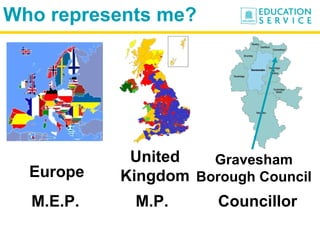
Who represents me?  Gravesham Borough Council United Kingdom Europe M.E.P. M.P. Councillor
The Houses of Parliament Parliament is made up of three parts:
Parliament The House of Commons The House of Lords The Monarch
How do you become an MP? Variety of backgrounds Can belong to a  political party Stand in a  constituency  Pay £500 (which you get back if you get at least 5% of the vote) Campaign!!! (from 6 weeks before) General Election: get the most amount of votes from the people that live in the area
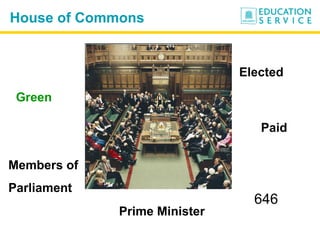
House of Commons Members of Parliament Green Elected Paid 646 Prime Minister
Your MP Paul Truswell MP Constituency:  Pudsey Political Party:  Labour
Pudsey General Election 2005 In the Pudsey constituency there were approx  66,444  people who were eligible to vote. In total  46,444   voted (66%). This means approx  20,000  did not. The voting split: Labour   21,261  (45.8%) Conservative   15,391  (33.1%) Liberal Democrat  8,551  (18.4%) UKIP   1241  (2.7%) The Labour candidate won by a majority of  5,870  votes
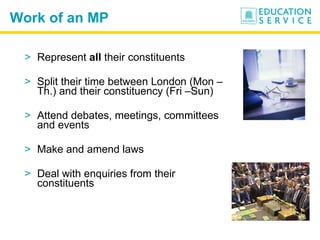
Work of an MP Represent  all  their constituents Split their time between London (Mon – Th.) and their constituency (Fri –Sun) Attend debates, meetings, committees and events Make and amend laws Deal with enquiries from their constituents
How do you become a Lord? The people who sit in the House of Lords are  known as  Peers Inherited their title (Hereditary Peer) Nominated  (Life Peer) Bishops/ Archbishops Law Lords (Judges)
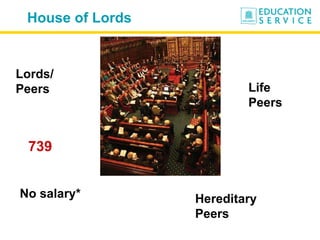
House of Lords Lords/ Peers Life Peers 739 Hereditary Peers No salary*
What do they do? belong to a political party or are independent  some are chosen by the Government to  work in one of their departments look at the bills that have been made in the House of Commons, and makes changes to them come up with suggestions for new laws themselves take part in Committees
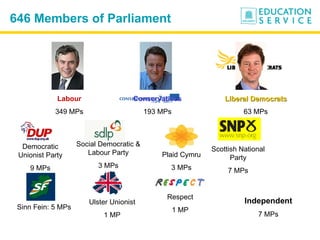
646 Members of Parliament Independent 7 MPs Labour 349 MPs Democratic Unionist Party 9 MPs Social Democratic & Labour Party 3 MPs Sinn Fein: 5 MPs Ulster Unionist 1 MP Plaid Cymru 3 MPs Scottish National Party 7 MPs Respect 1 MP Conservatives 193 MPs Liberal Democrats 63 MPs
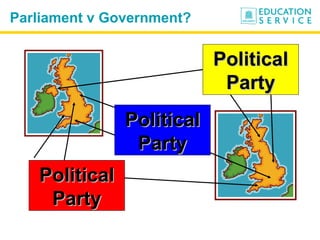
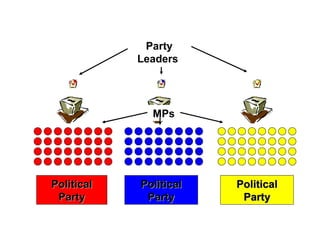
Parliament v Government? Political Party Political Party Political Party
Political Party Political Party Political Party MPs Party Leaders
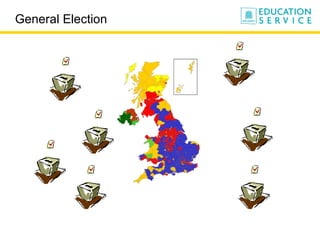
General Election
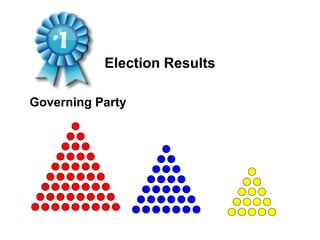
Election Results Governing Party
Party Leader Prime Minister
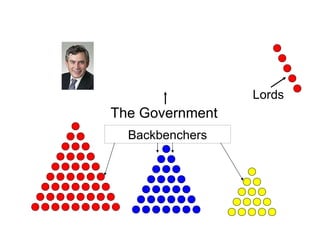
The Government Lords Backbenchers
Government Cabinet
Government
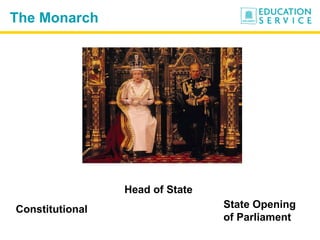
The Monarch Constitutional  Head of State State Opening of Parliament
The Work of Parliament Parliament does many things, including: Looking at suggestions for new laws (bills) Checking to see how the government is spending public money and making sure that they keep to the promises they made in the election Monitoring the work of government departments Debating national issues Making sure that MPs represent the views of the people
What do you think? At the last election, only 37% of people aged 18 – 24 voted. Will you vote at the next election you are able to vote in?
The Big Issue… The Recession? Climate change? The Middle East? Something else?
Parliament’s Education Service

British Politics

  • 1.
  • 2.
    Who represents me? Gravesham Borough Council United Kingdom Europe M.E.P. M.P. Councillor
  • 3.
    The Houses ofParliament Parliament is made up of three parts:
  • 4.
    Parliament The Houseof Commons The House of Lords The Monarch
  • 5.
    How do youbecome an MP? Variety of backgrounds Can belong to a political party Stand in a constituency Pay £500 (which you get back if you get at least 5% of the vote) Campaign!!! (from 6 weeks before) General Election: get the most amount of votes from the people that live in the area
  • 6.
    House of CommonsMembers of Parliament Green Elected Paid 646 Prime Minister
  • 7.
    Your MP PaulTruswell MP Constituency: Pudsey Political Party: Labour
  • 8.
    Pudsey General Election2005 In the Pudsey constituency there were approx 66,444 people who were eligible to vote. In total 46,444 voted (66%). This means approx 20,000 did not. The voting split: Labour 21,261 (45.8%) Conservative 15,391 (33.1%) Liberal Democrat 8,551 (18.4%) UKIP 1241 (2.7%) The Labour candidate won by a majority of 5,870 votes
  • 9.
    Work of anMP Represent all their constituents Split their time between London (Mon – Th.) and their constituency (Fri –Sun) Attend debates, meetings, committees and events Make and amend laws Deal with enquiries from their constituents
  • 10.
    How do youbecome a Lord? The people who sit in the House of Lords are known as Peers Inherited their title (Hereditary Peer) Nominated (Life Peer) Bishops/ Archbishops Law Lords (Judges)
  • 11.
    House of LordsLords/ Peers Life Peers 739 Hereditary Peers No salary*
  • 12.
    What do theydo? belong to a political party or are independent some are chosen by the Government to work in one of their departments look at the bills that have been made in the House of Commons, and makes changes to them come up with suggestions for new laws themselves take part in Committees
  • 13.
    646 Members ofParliament Independent 7 MPs Labour 349 MPs Democratic Unionist Party 9 MPs Social Democratic & Labour Party 3 MPs Sinn Fein: 5 MPs Ulster Unionist 1 MP Plaid Cymru 3 MPs Scottish National Party 7 MPs Respect 1 MP Conservatives 193 MPs Liberal Democrats 63 MPs
  • 14.
    Parliament v Government?Political Party Political Party Political Party
  • 15.
    Political Party PoliticalParty Political Party MPs Party Leaders
  • 16.
  • 17.
  • 18.
  • 19.
  • 20.
  • 21.
  • 22.
    The Monarch Constitutional Head of State State Opening of Parliament
  • 23.
    The Work ofParliament Parliament does many things, including: Looking at suggestions for new laws (bills) Checking to see how the government is spending public money and making sure that they keep to the promises they made in the election Monitoring the work of government departments Debating national issues Making sure that MPs represent the views of the people
  • 24.
    What do youthink? At the last election, only 37% of people aged 18 – 24 voted. Will you vote at the next election you are able to vote in?
  • 25.
    The Big Issue…The Recession? Climate change? The Middle East? Something else?
  • 26.

Editor's Notes

  • #8 Let me know if you would like a photo of your MP The details I got on the election was from www.electoralcommission.org.uk
  • #23 Constitutional monarchy is a form of government in which a king or queen acts as Head of State. The ability to make and pass legislation resides with an elected Parliament, not with the Monarch. As a system of government, constitutional monarchy separates the Head of State’s ceremonial and official duties from party politics. A constitutional monarchy also provides stability, continuity and a national focus, as the Head of State remains the same even as governments change. The Sovereign/Monarch governs according to the constitution - that is, according to rules, rather than according to his or her own free will. The United Kingdom does not have a written constitution which sets out the rights and duties of the Sovereign, they are established by conventions. These are non-statutory rules which can be just as binding as formal constitutional rules. As a constitutional monarch, the Sovereign must remain politically neutral. On almost all matters the Sovereign acts on the advice of ministers. However, the Sovereign retains an important political role as Head of State, formally appointing prime ministers, approving certain legislation and bestowing honours. The Sovereign has other official roles to play such as Head of the Armed Forces.