Microcytic Anemia I
Microcytosis = Impaired (↓) Hemoglobin Synthesis
Abdul-Kader Souid9/26/2018
1
Hypochromic microcytic red cells
Arrow points to a small lymphocyte as a reference for size.
Arrowhead points to a small a red blood cell.
(3) Chronic inflammation (↑hepcidin)
(4) Sideroblastic anemia (↓heme)(1) Iron deficiency anemia
(2) Thalassemia trait
The hemoglobin consists of 2α
(red subunits) & 2β (blue
subunits), each containing an
iron-containing heme group
(green) to which O2 binds.
O2
2+
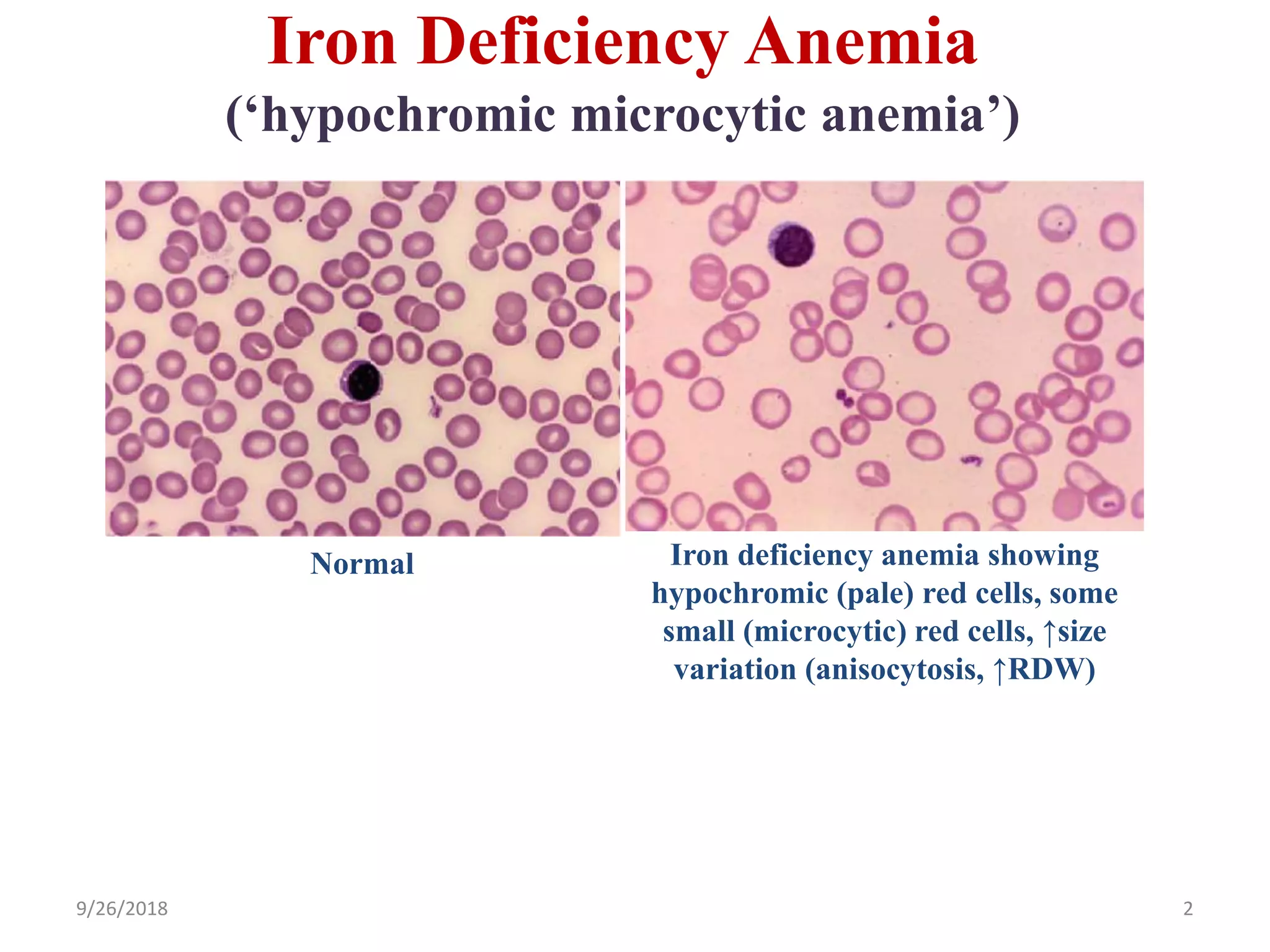
Iron Deficiency Anemia
(‘hypochromic microcytic anemia’)
9/26/2018 2
Normal Iron deficiency anemia showing
hypochromic (pale) red cells, some
small (microcytic) red cells, ↑size
variation (anisocytosis, ↑RDW)
Microcytosis (MCV <80 fL)
Microcytosis =↓hemoglobin synthesis (↓iron, ↓globin, or ↓protoporphyrin):
• Iron deficiency (iron-limiting erythropoiesis; nutritional vs. blood loss)
• Thalassemia trait (↓a or b globin synthesis)
• Inflammation (↓Fe bioavailability due to ↑hepcidin [blocks Fe absorption])
• ↓Protoporphyrin (hereditary sidroblastic anemia)
9/26/2018 3
Must know
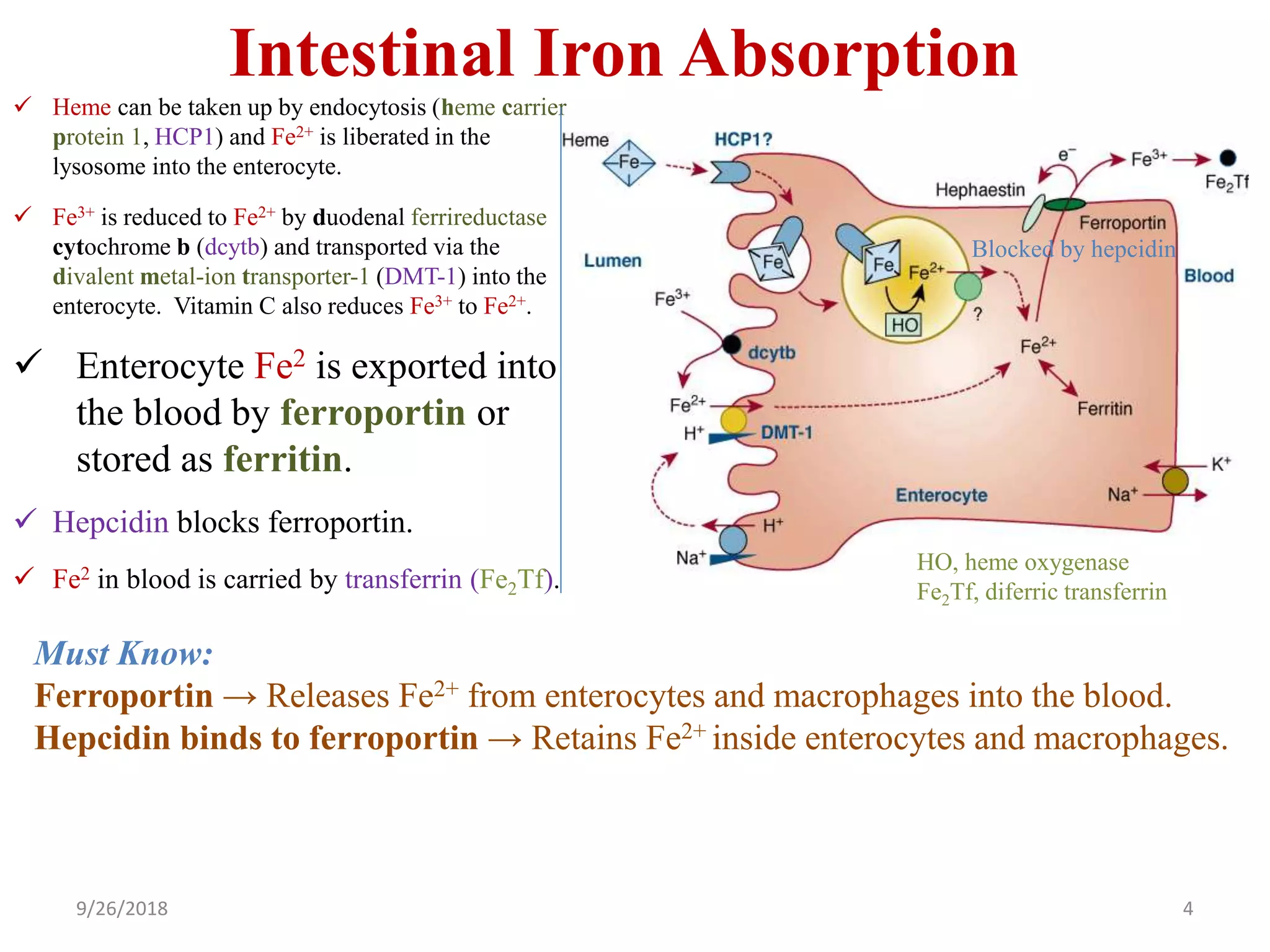
Intestinal Iron Absorption
 Heme can be taken up by endocytosis (heme carrier
protein 1, HCP1) and Fe2+ is liberated in the
lysosome into the enterocyte.
 Fe3+ is reduced to Fe2+ by duodenal ferrireductase
cytochrome b (dcytb) and transported via the
divalent metal-ion transporter-1 (DMT-1) into the
enterocyte. Vitamin C also reduces Fe3+ to Fe2+.
 Enterocyte Fe2 is exported into
the blood by ferroportin or
stored as ferritin.
 Hepcidin blocks ferroportin.
 Fe2 in blood is carried by transferrin (Fe2Tf).
Must Know:
Ferroportin → Releases Fe2+ from enterocytes and macrophages into the blood.
Hepcidin binds to ferroportin → Retains Fe2+ inside enterocytes and macrophages.
9/26/2018 4
HO, heme oxygenase
Fe2Tf, diferric transferrin
Blocked by hepcidin
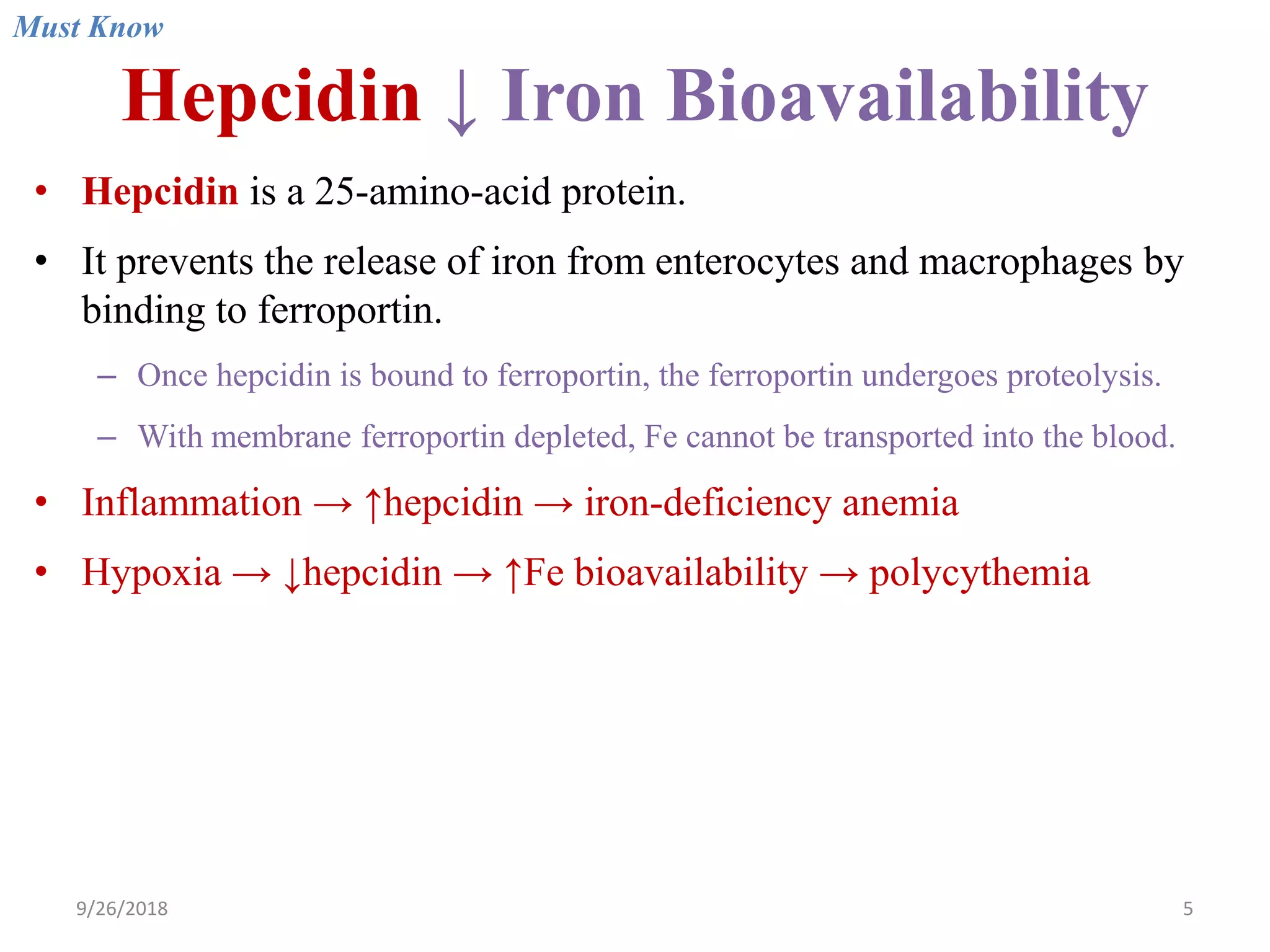
Hepcidin ↓ Iron Bioavailability
• Hepcidin is a 25-amino-acid protein.
• It prevents the release of iron from enterocytes and macrophages by
binding to ferroportin.
– Once hepcidin is bound to ferroportin, the ferroportin undergoes proteolysis.
– With membrane ferroportin depleted, Fe cannot be transported into the blood.
• Inflammation → ↑hepcidin → iron-deficiency anemia
• Hypoxia → ↓hepcidin → ↑Fe bioavailability → polycythemia
9/26/2018 5
Must Know
9/26/2018 6
• Ferritin is a measure of stored iron.
• Serum iron is a measure of circulating iron bound to
transferrin.
• Total iron binding capacity (TIBC) is a measure of
transferrin capacity to bind iron.
• Percent transferrin saturation = serum iron ÷ TIBC.
Serum Iron Studies
serum
iron
UIBC
TIBC
Must watch video:
https://www.youtube.com/watch?v=YczPj71BFPY
Serum
ferritin
Serum
iron
Total iron
binding capacity
(TIBC)
Per cent
transferrin
saturation
Iron deficiency Low Low High Low
Inflammation High Low Low Normal
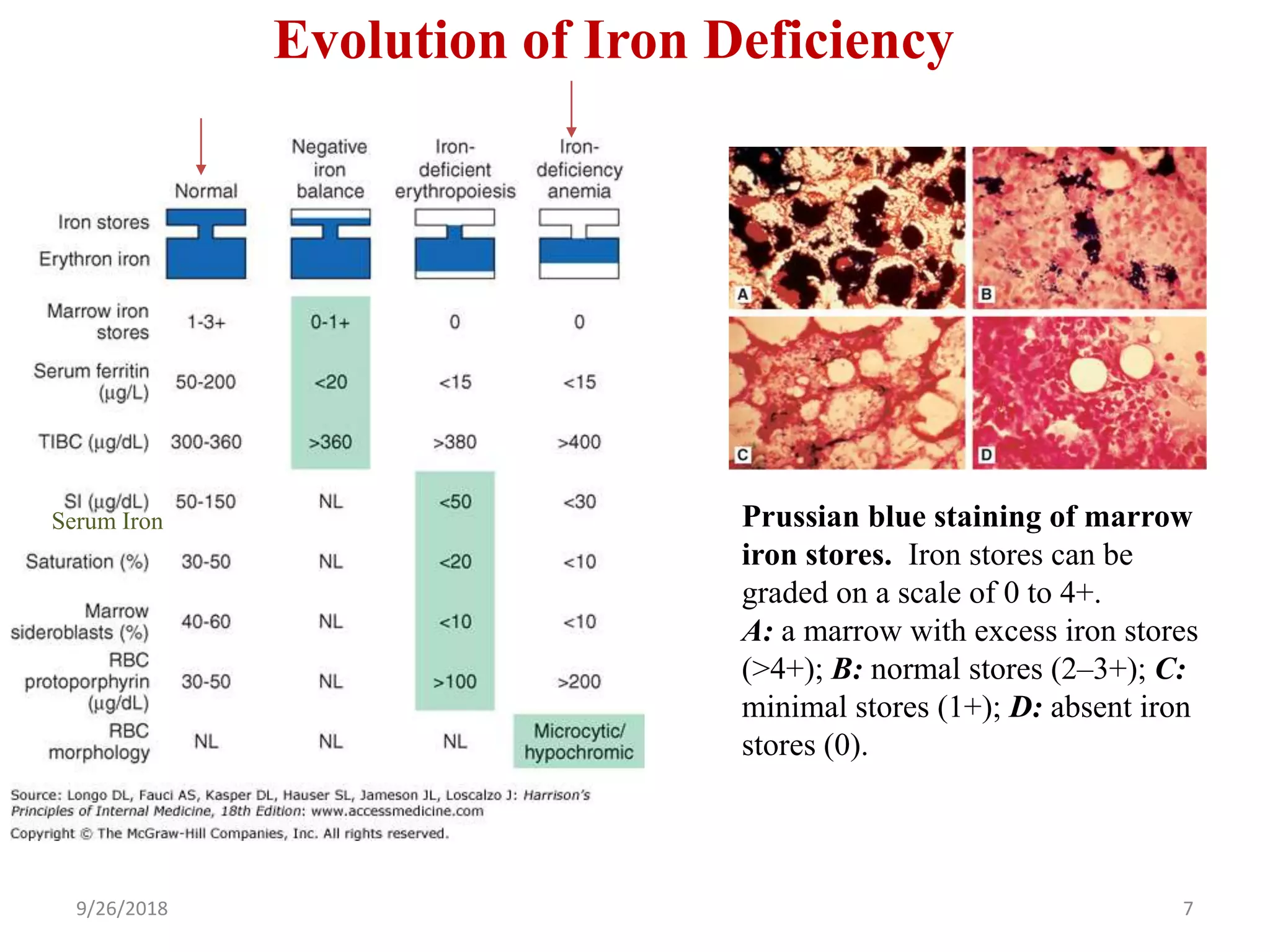
Evolution of Iron Deficiency
9/26/2018 7
Prussian blue staining of marrow
iron stores. Iron stores can be
graded on a scale of 0 to 4+.
A: a marrow with excess iron stores
(>4+); B: normal stores (2–3+); C:
minimal stores (1+); D: absent iron
stores (0).
Serum Iron
Iron Deficiency Anemia: Summary
• Microcytic anemia with  RDW and reticulocytopenia
•  Ferritin
•  Serum iron
•  TIBC (total iron binding capacity)
•  Transferrin saturation
•  ZPP (zinc protoporphyrin)
•  sTfR (serum transferrin receptor)
Must Know
Plasma ferritin <12 µg/L is indicative of absent iron stores.
Iron Deficiency Anemia
Prevalence
• Adult males <1%
• Adult females 20%
Mechanisms of iron deficiency
• ↑ Need for iron: Infants during their rapid growth, premature infants, growth
spurt during puberty, pregnancy, lactation, etc.
• ↓ Iron intake (nutritional iron deficiency due to poor diet): Prolonged
breastfeeding, iron-poor diet (vegetables and milk have low iron bioavailability).
• ↑ Loss: Menorrhagia, GI bleeding (bleeding ulcer, colorectal cancer [fecal
occult blood], infants on whole milk (milk-induced colitis), non-steroidal anti-
inflammatory drug (NSAID)-induced gastritis, hereditary hemorrhagic
telangiectasia (HHT).
• ↓ Absorption (relatively rare): Gastric or duodenal resection, coeliac disease, etc.
Notes: Iron absorption from meat is better than that from plants. Phytates (cereals,
nuts, legumes) inhibit iron absorption. Vitamin C promotes Fe absorption.
Must Know
Who gets Fe-deficiency and why?
• Malabsorption
– Stomach (resection; cancer; H. pylori; gastritis)
– Duodenum (coeliac disease, resection)
• Blood loss
– Hiatus hernia, gastritis, peptic ulcer, H. pylori, esophageal varices, tumors,
NSAID, telangiectasias, menstrual periods, hookworm, Ancylostoma
caninum, nose bleeding.
• Fe absorption from meat is better than from plants.
– Phytates (cereals, nuts, legumes) inhibit absorption of non-hem Fe.
– Vitamin C promotes hem Fe absorption.
Pica
Patient 1
• An 18-month-old boy presents with pallor and irritability.
For the last 6 months, his diet was whole milk.
• Hemoglobin = 50 g/L, RBC = 2 x10¹²/L, reticulocyte
count = 14 x109/L, MCV = 59 fL, and RDW = 21%.
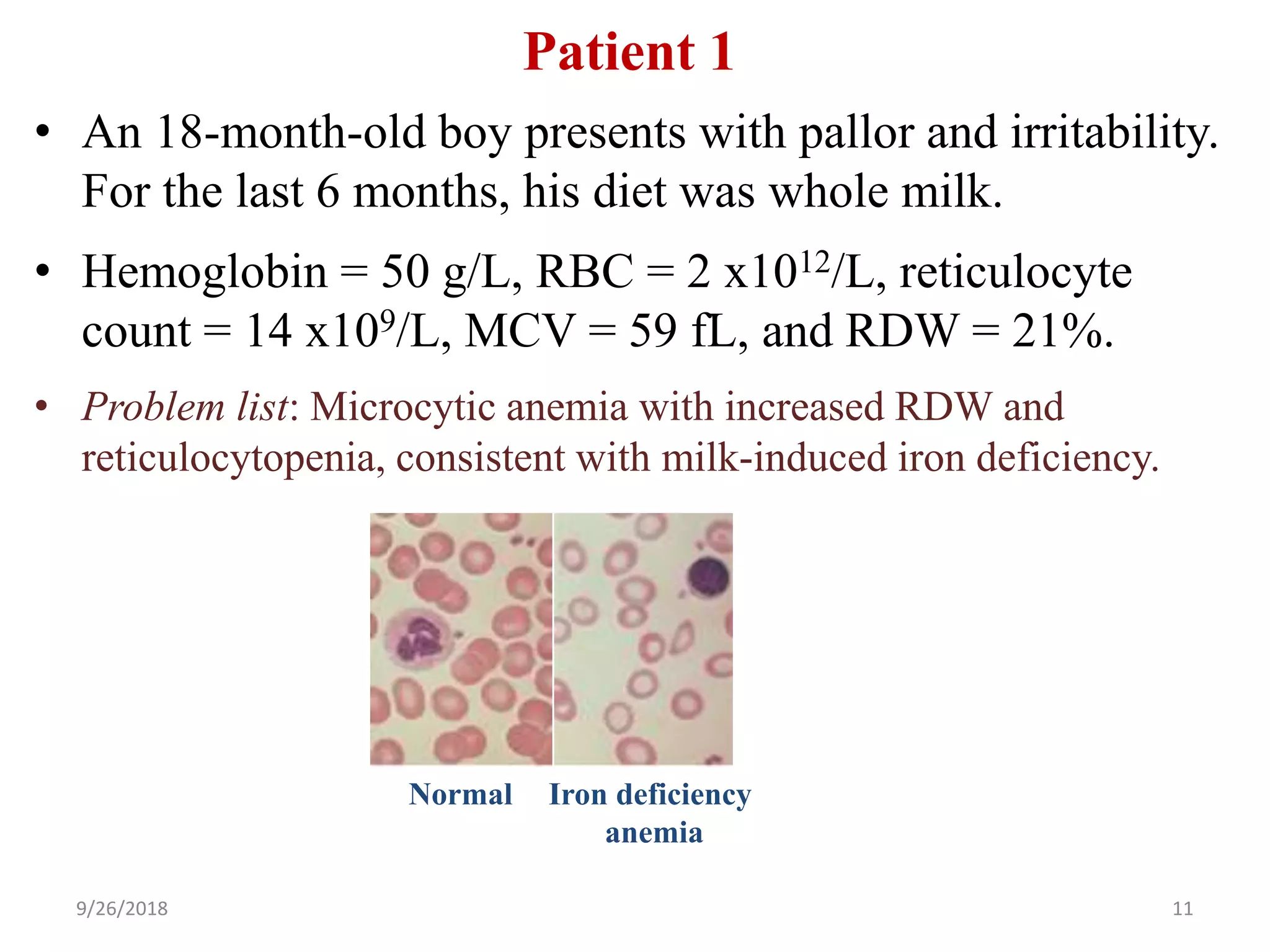
• Problem list: Microcytic anemia with increased RDW and
reticulocytopenia, consistent with milk-induced iron deficiency.
9/26/2018 11
Normal Iron deficiency
anemia
Principles of Treatment
1. Treating the primary cause of iron deficiency
– Diet history
– Identify the site of blood loss (e.g., menorrhagia, stool occult blood,
endoscopy, colonoscopy, video capsule endoscopy)
2. Iron-rich food ± iron supplementation
– Ferrous sulfate (FeSO4), 325 mg once to three times per day:
• 120 to 180 mg elemental Fe/day (adults)
• 2-6 mg/kg elemental Fe/day (children)
• Treat 3 months after correction of anemia.
Required Reading
• Harrison’s Online – Chapter 103 (Iron Deficiency)
• Petry N, Olofin I, Hurrell RF, et al. The proportion of anemia associated with
iron deficiency in low, medium, and high human development index countries:
a systematic analysis of national surveys. Nutrients. 2016;8(11). pii: E693.
• Amin SB, Orlando M, Wang H. Latent iron deficiency in utero is associated
with abnormal auditory neural myelination in ≥ 35 weeks gestational age
infants. J Pediatr. 2013;163:1267-71.
• De-Regil LM, Jefferds ME, Sylvetsky AC, Dowswell T. Intermittent iron
supplementation for improving nutrition and development in children under 12
years of age. Cochrane Database Syst Rev. 2011;12:CD009085.
• Zimmermann MB, Hurrell RF. Nutritional iron deficiency. Lancet
2007;370:511–520.
9/26/2018 13
Optional Reading
Total iron binding capacity (TIBC) is a colorimetric assay that
uses two reagents sequentially. The first one is an acidic reagent
that contains an iron-binding dye. The acidic pH causes
transferrin to release all iron, which are captured by the iron-
binding dye along, producing a colored complex. The second one,
is a neutral reagent that raises the pH and restores transferrin’s
affinity for iron. The transferrin extracts iron from the dye-iron
complex and becomes 100% saturated. The decrease in
absorbance of the colored dye-iron complex is measured
spectrophotometrically at 660 nm and is directly proportional to
the TIBC of the serum sample
(http://www.randox.com/brochures/reagents/LT116.pdf).
9/26/2018 14

2 microcytic anemia i-iron deficiency.ppt

  • 1.
    Microcytic Anemia I Microcytosis= Impaired (↓) Hemoglobin Synthesis Abdul-Kader Souid9/26/2018 1 Hypochromic microcytic red cells Arrow points to a small lymphocyte as a reference for size. Arrowhead points to a small a red blood cell. (3) Chronic inflammation (↑hepcidin) (4) Sideroblastic anemia (↓heme)(1) Iron deficiency anemia (2) Thalassemia trait The hemoglobin consists of 2α (red subunits) & 2β (blue subunits), each containing an iron-containing heme group (green) to which O2 binds. O2 2+
  • 2.
    Iron Deficiency Anemia (‘hypochromicmicrocytic anemia’) 9/26/2018 2 Normal Iron deficiency anemia showing hypochromic (pale) red cells, some small (microcytic) red cells, ↑size variation (anisocytosis, ↑RDW)
  • 3.
    Microcytosis (MCV <80fL) Microcytosis =↓hemoglobin synthesis (↓iron, ↓globin, or ↓protoporphyrin): • Iron deficiency (iron-limiting erythropoiesis; nutritional vs. blood loss) • Thalassemia trait (↓a or b globin synthesis) • Inflammation (↓Fe bioavailability due to ↑hepcidin [blocks Fe absorption]) • ↓Protoporphyrin (hereditary sidroblastic anemia) 9/26/2018 3 Must know
  • 4.
    Intestinal Iron Absorption Heme can be taken up by endocytosis (heme carrier protein 1, HCP1) and Fe2+ is liberated in the lysosome into the enterocyte.  Fe3+ is reduced to Fe2+ by duodenal ferrireductase cytochrome b (dcytb) and transported via the divalent metal-ion transporter-1 (DMT-1) into the enterocyte. Vitamin C also reduces Fe3+ to Fe2+.  Enterocyte Fe2 is exported into the blood by ferroportin or stored as ferritin.  Hepcidin blocks ferroportin.  Fe2 in blood is carried by transferrin (Fe2Tf). Must Know: Ferroportin → Releases Fe2+ from enterocytes and macrophages into the blood. Hepcidin binds to ferroportin → Retains Fe2+ inside enterocytes and macrophages. 9/26/2018 4 HO, heme oxygenase Fe2Tf, diferric transferrin Blocked by hepcidin
  • 5.
    Hepcidin ↓ IronBioavailability • Hepcidin is a 25-amino-acid protein. • It prevents the release of iron from enterocytes and macrophages by binding to ferroportin. – Once hepcidin is bound to ferroportin, the ferroportin undergoes proteolysis. – With membrane ferroportin depleted, Fe cannot be transported into the blood. • Inflammation → ↑hepcidin → iron-deficiency anemia • Hypoxia → ↓hepcidin → ↑Fe bioavailability → polycythemia 9/26/2018 5 Must Know
  • 6.
    9/26/2018 6 • Ferritinis a measure of stored iron. • Serum iron is a measure of circulating iron bound to transferrin. • Total iron binding capacity (TIBC) is a measure of transferrin capacity to bind iron. • Percent transferrin saturation = serum iron ÷ TIBC. Serum Iron Studies serum iron UIBC TIBC Must watch video: https://www.youtube.com/watch?v=YczPj71BFPY Serum ferritin Serum iron Total iron binding capacity (TIBC) Per cent transferrin saturation Iron deficiency Low Low High Low Inflammation High Low Low Normal
  • 7.
    Evolution of IronDeficiency 9/26/2018 7 Prussian blue staining of marrow iron stores. Iron stores can be graded on a scale of 0 to 4+. A: a marrow with excess iron stores (>4+); B: normal stores (2–3+); C: minimal stores (1+); D: absent iron stores (0). Serum Iron
  • 8.
    Iron Deficiency Anemia:Summary • Microcytic anemia with  RDW and reticulocytopenia •  Ferritin •  Serum iron •  TIBC (total iron binding capacity) •  Transferrin saturation •  ZPP (zinc protoporphyrin) •  sTfR (serum transferrin receptor) Must Know Plasma ferritin <12 µg/L is indicative of absent iron stores.
  • 9.
    Iron Deficiency Anemia Prevalence •Adult males <1% • Adult females 20% Mechanisms of iron deficiency • ↑ Need for iron: Infants during their rapid growth, premature infants, growth spurt during puberty, pregnancy, lactation, etc. • ↓ Iron intake (nutritional iron deficiency due to poor diet): Prolonged breastfeeding, iron-poor diet (vegetables and milk have low iron bioavailability). • ↑ Loss: Menorrhagia, GI bleeding (bleeding ulcer, colorectal cancer [fecal occult blood], infants on whole milk (milk-induced colitis), non-steroidal anti- inflammatory drug (NSAID)-induced gastritis, hereditary hemorrhagic telangiectasia (HHT). • ↓ Absorption (relatively rare): Gastric or duodenal resection, coeliac disease, etc. Notes: Iron absorption from meat is better than that from plants. Phytates (cereals, nuts, legumes) inhibit iron absorption. Vitamin C promotes Fe absorption. Must Know
  • 10.
    Who gets Fe-deficiencyand why? • Malabsorption – Stomach (resection; cancer; H. pylori; gastritis) – Duodenum (coeliac disease, resection) • Blood loss – Hiatus hernia, gastritis, peptic ulcer, H. pylori, esophageal varices, tumors, NSAID, telangiectasias, menstrual periods, hookworm, Ancylostoma caninum, nose bleeding. • Fe absorption from meat is better than from plants. – Phytates (cereals, nuts, legumes) inhibit absorption of non-hem Fe. – Vitamin C promotes hem Fe absorption. Pica
  • 11.
    Patient 1 • An18-month-old boy presents with pallor and irritability. For the last 6 months, his diet was whole milk. • Hemoglobin = 50 g/L, RBC = 2 x10¹²/L, reticulocyte count = 14 x109/L, MCV = 59 fL, and RDW = 21%. • Problem list: Microcytic anemia with increased RDW and reticulocytopenia, consistent with milk-induced iron deficiency. 9/26/2018 11 Normal Iron deficiency anemia
  • 12.
    Principles of Treatment 1.Treating the primary cause of iron deficiency – Diet history – Identify the site of blood loss (e.g., menorrhagia, stool occult blood, endoscopy, colonoscopy, video capsule endoscopy) 2. Iron-rich food ± iron supplementation – Ferrous sulfate (FeSO4), 325 mg once to three times per day: • 120 to 180 mg elemental Fe/day (adults) • 2-6 mg/kg elemental Fe/day (children) • Treat 3 months after correction of anemia.
  • 13.
    Required Reading • Harrison’sOnline – Chapter 103 (Iron Deficiency) • Petry N, Olofin I, Hurrell RF, et al. The proportion of anemia associated with iron deficiency in low, medium, and high human development index countries: a systematic analysis of national surveys. Nutrients. 2016;8(11). pii: E693. • Amin SB, Orlando M, Wang H. Latent iron deficiency in utero is associated with abnormal auditory neural myelination in ≥ 35 weeks gestational age infants. J Pediatr. 2013;163:1267-71. • De-Regil LM, Jefferds ME, Sylvetsky AC, Dowswell T. Intermittent iron supplementation for improving nutrition and development in children under 12 years of age. Cochrane Database Syst Rev. 2011;12:CD009085. • Zimmermann MB, Hurrell RF. Nutritional iron deficiency. Lancet 2007;370:511–520. 9/26/2018 13
  • 14.
    Optional Reading Total ironbinding capacity (TIBC) is a colorimetric assay that uses two reagents sequentially. The first one is an acidic reagent that contains an iron-binding dye. The acidic pH causes transferrin to release all iron, which are captured by the iron- binding dye along, producing a colored complex. The second one, is a neutral reagent that raises the pH and restores transferrin’s affinity for iron. The transferrin extracts iron from the dye-iron complex and becomes 100% saturated. The decrease in absorbance of the colored dye-iron complex is measured spectrophotometrically at 660 nm and is directly proportional to the TIBC of the serum sample (http://www.randox.com/brochures/reagents/LT116.pdf). 9/26/2018 14