Learning and Memory
Adaptedfrom:
home.cc.umanitoba.ca/~marotta/3350/Lecture18_memory.ppt
www.hartnell.edu/faculty/.../powerpoint/...PPT/Coon_08... - United States
2.
Why are learningand memory important?
To be able to adapt to changes in the environment
Learning
•Acquire and process information from the
environment
Changes the nervous system
Memory
•Ability to retain this information
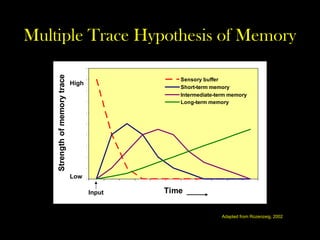
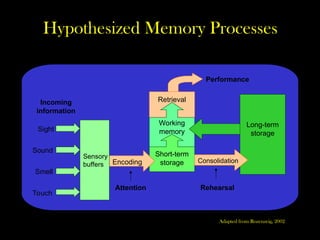
Multiple Trace Hypothesisof Memory
0
1
2
3
4
5
6
7
8
9
1 0
Time
Strength
of
memory
trace
Sensory buffer
Short-term memory
Intermediate-term memory
Long-term memory
High
Low
Input
Adapted from Rozenzeig, 2002
5.
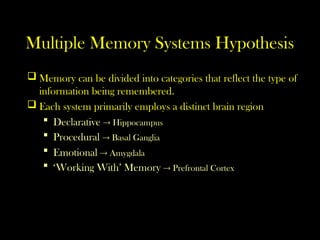
Multiple Memory SystemsHypothesis
Memory can be divided into categories that reflect the type of
information being remembered.
Each system primarily employs a distinct brain region
Declarative Hippocampus
Procedural Basal Ganglia
Emotional Amygdala
‘Working With’ Memory Prefrontal Cortex
7.
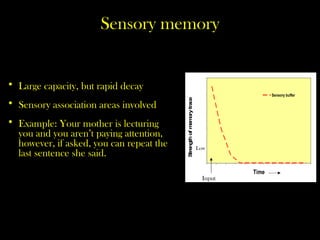
Sensory memory
• Largecapacity, but rapid decay
• Sensory association areas involved
• Example: Your mother is lecturing
you and you aren’t paying attention,
however, if asked, you can repeat the
last sentence she said.
0
1
2
3
4
5
6
7
8
9
1 0
Time
Strength
of
m
em
ory
trace
Sensory buffer
High
Low
Input
8.
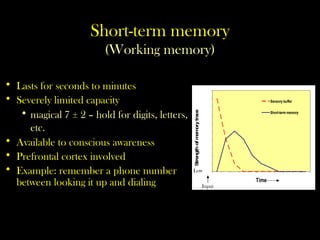
Short-term memory
(Working memory)
•Lasts for seconds to minutes
• Severely limited capacity
• magical 7 ± 2 – hold for digits, letters,
etc.
• Available to conscious awareness
• Prefrontal cortex involved
• Example: remember a phone number
between looking it up and dialing
0
1
2
3
4
5
6
7
8
9
1 0
Time
Strength
of
m
em
ory
trace
Sensory buffer
Short-term memory
High
Low
Input
9.
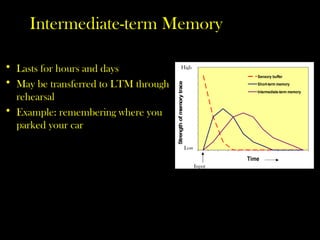
Intermediate-term Memory
• Lastsfor hours and days
• May be transferred to LTM through
rehearsal
• Example: remembering where you
parked your car
0
1
2
3
4
5
6
7
8
9
1 0
Time
Strength
of
memory
trace
Sensory buffer
Short-term memory
Intermediate-term memory
High
Low
Input
10.
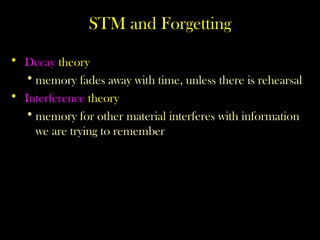
STM and Forgetting
•Decay theory
•memory fades away with time, unless there is rehearsal
• Interference theory
•memory for other material interferes with information
we are trying to remember
11.
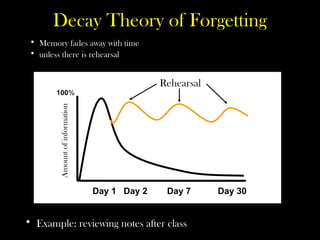
Decay Theory ofForgetting
100%
Rehearsal
Day 1 Day 2 Day 7 Day 30
• Example: reviewing notes after class
Amount
of
information
• Memory fades away with time
• unless there is rehearsal
12.
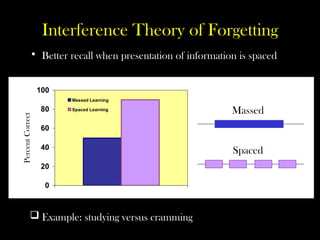
Interference Theory ofForgetting
Example: studying versus cramming
0
20
40
60
80
100
Percent
Correct
Massed Learning
Spaced Learning
• Better recall when presentation of information is spaced
Massed
Spaced
13.
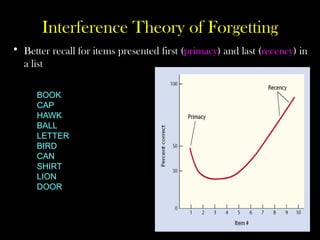
Interference Theory ofForgetting
BOOK
CAP
HAWK
BALL
LETTER
BIRD
CAN
SHIRT
LION
DOOR
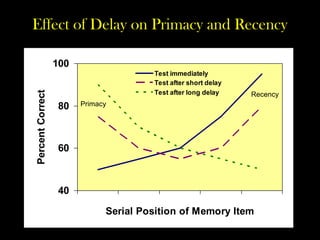
• Better recall for items presented first (primacy) and last (recency) in
a list
14.
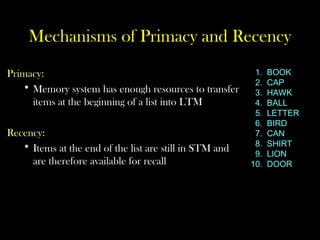
Mechanisms of Primacyand Recency
Primacy:
• Memory system has enough resources to transfer
items at the beginning of a list into LTM
Recency:
• Items at the end of the list are still in STM and
are therefore available for recall
1. BOOK
2. CAP
3. HAWK
4. BALL
5. LETTER
6. BIRD
7. CAN
8. SHIRT
9. LION
10. DOOR
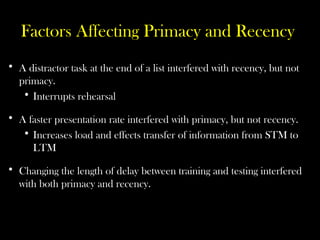
Factors Affecting Primacyand Recency
• A distractor task at the end of a list interfered with recency, but not
primacy.
• Interrupts rehearsal
• A faster presentation rate interfered with primacy, but not recency.
• Increases load and effects transfer of information from STM to
LTM
• Changing the length of delay between training and testing interfered
with both primacy and recency.
17.
Effect of Delayon Primacy and Recency
40
60
80
100
Serial Position of Memory Item
Percent
Correct
Test immediately
Test after short delay
Test after long delay
Primacy
Recency
18.
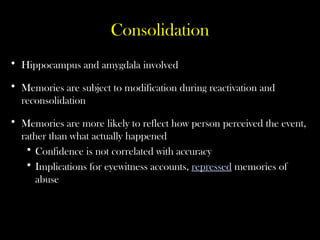
Consolidation
• Hippocampus andamygdala involved
• Memories are subject to modification during reactivation and
reconsolidation
• Memories are more likely to reflect how person perceived the event,
rather than what actually happened
• Confidence is not correlated with accuracy
• Implications for eyewitness accounts, repressed memories of
abuse
19.
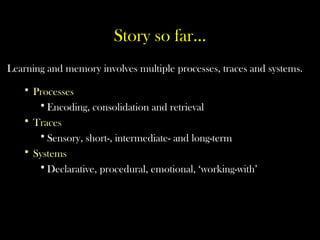
Story so far…
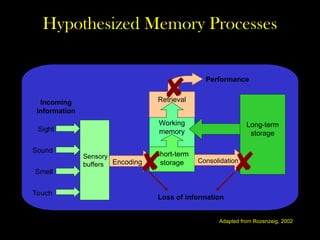
Learningand memory involves multiple processes, traces and systems.
• Processes
•Encoding, consolidation and retrieval
• Traces
•Sensory, short-, intermediate- and long-term
• Systems
•Declarative, procedural, emotional, ‘working-with’
20.
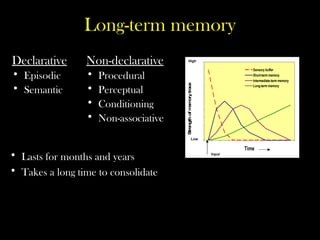
Long-term memory
• Lastsfor months and years
• Takes a long time to consolidate
0
1
2
3
4
5
6
7
8
9
1 0
Time
S
trength
of
m
em
ory
trace
Sensory buffer
Short-term memory
Intermediate-term memory
Long-term memory
High
Low
Input
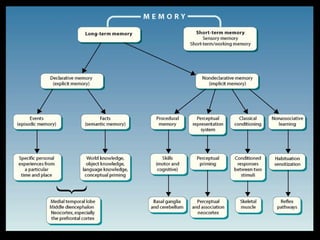
Declarative
• Episodic
• Semantic
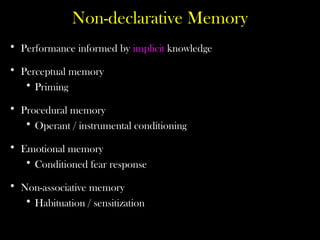
Non-declarative
• Procedural
• Perceptual
• Conditioning
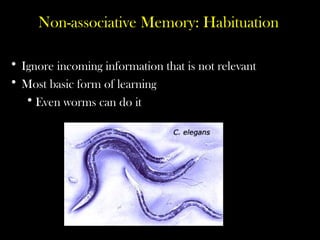
• Non-associative
21.
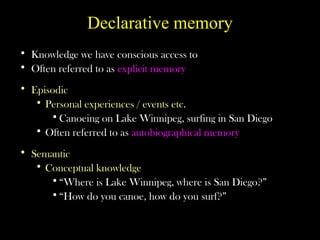
Declarative memory
• Knowledgewe have conscious access to
• Often referred to as explicit memory
• Episodic
• Personal experiences / events etc.
•Canoeing on Lake Winnipeg, surfing in San Diego
• Often referred to as autobiographical memory
• Semantic
• Conceptual knowledge
•“Where is Lake Winnipeg, where is San Diego?”
•“How do you canoe, how do you surf?”
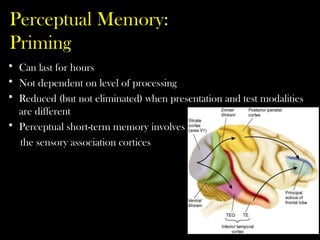
• Can lastfor hours
• Not dependent on level of processing
• Reduced (but not eliminated) when presentation and test modalities
are different
• Perceptual short-term memory involves
the sensory association cortices
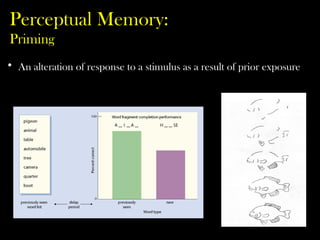
Perceptual Memory:
Priming
25.
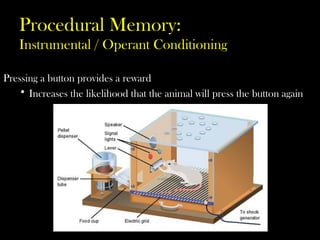
Procedural Memory:
Instrumental /Operant Conditioning
Pressing a button provides a reward
• Increases the likelihood that the animal will press the button again
26.
Procedural Memory:
Instrumental /Operant Conditioning
• Association between stimulus-response
• Stimuli following a behaviour can be either:
• Reinforcing: perceived as positive
• Punishing: perceived as negative
• Basal ganglia are involved
27.
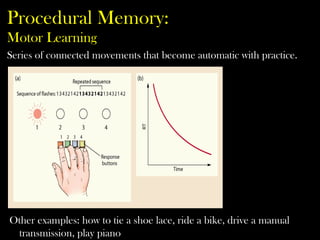
Procedural Memory:
Motor Learning
Otherexamples: how to tie a shoe lace, ride a bike, drive a manual
transmission, play piano
Series of connected movements that become automatic with practice.
28.
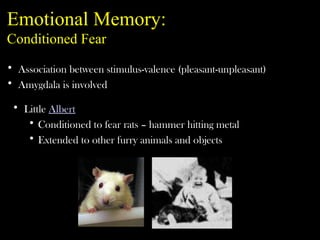
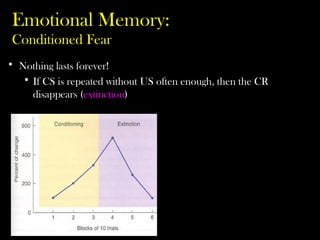
Emotional Memory:
Conditioned Fear
•Little Albert
• Conditioned to fear rats – hammer hitting metal
• Extended to other furry animals and objects
• Association between stimulus-valence (pleasant-unpleasant)
• Amygdala is involved
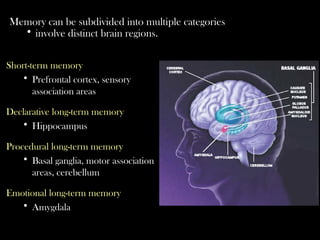
Short-term memory
• Prefrontalcortex, sensory
association areas
Declarative long-term memory
• Hippocampus
Procedural long-term memory
• Basal ganglia, motor association
areas, cerebellum
Emotional long-term memory
• Amygdala
Memory can be subdivided into multiple categories
• involve distinct brain regions.
32.
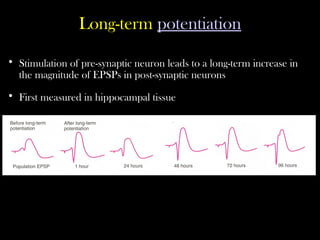
Long-term potentiation
• Stimulationof pre-synaptic neuron leads to a long-term increase in
the magnitude of EPSPs in post-synaptic neurons
• First measured in hippocampal tissue
33.
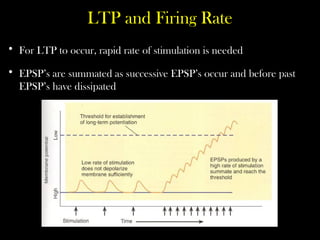
LTP and FiringRate
• For LTP to occur, rapid rate of stimulation is needed
• EPSP’s are summated as successive EPSP’s occur and before past
EPSP’s have dissipated
34.
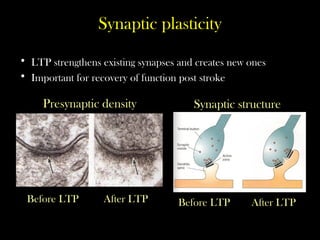
Synaptic plasticity
• LTPstrengthens existing synapses and creates new ones
• Important for recovery of function post stroke
Before LTP
Presynaptic density
After LTP
Synaptic structure
Before LTP After LTP
35.
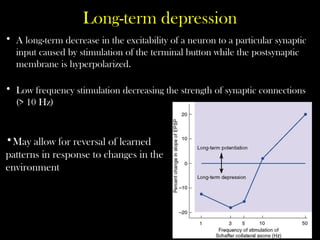
Long-term depression
• Along-term decrease in the excitability of a neuron to a particular synaptic
input caused by stimulation of the terminal button while the postsynaptic
membrane is hyperpolarized.
• Low frequency stimulation decreasing the strength of synaptic connections
(> 10 Hz)
•May allow for reversal of learned
patterns in response to changes in the
environment
36.
Learning: Some KeyTerms
Learning: Relatively permanent change in
behavior due to experience
Does NOT include temporary changes due to
disease, injury, maturation, or drugs, since these
do NOT qualify as learning even though they can
alter behavior
Reinforcement: Any event that increases the
probability that a response will recur
Response: Any identifiable behavior
Internal: Faster heartbeat
Observable: Eating, scratching
37.
Learning: More KeyTerms
Antecedents: Events that precede a response
Consequences: Effects that follow a response