MS1 level 2G curriculum
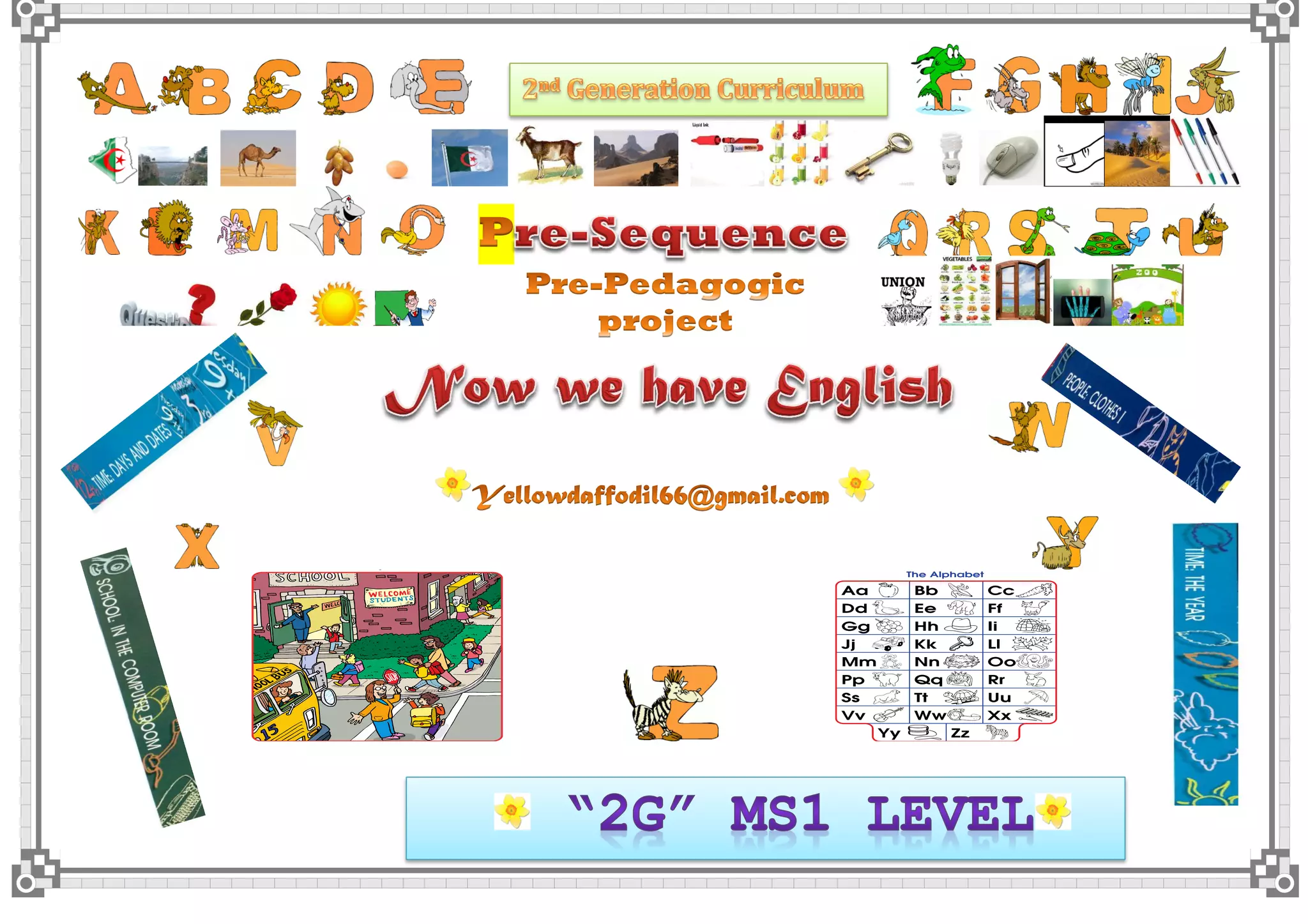
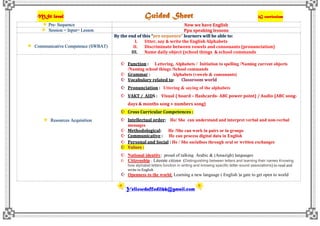
Now we have English
Ppu speaking lessons
I. Utter, say & write the English Alphabets
II. Discriminate between vowels and consonants (pronunciation)
III. Name daily object (school things & school commands
 Function Lettering, Alphabets / Initiation to spelling /Naming current objects
/Naming school things /School commands
 Grammar Alphabets (vowels & consonants)
Vocabulary related to:
Pronunciation Uttering & saying of the alphabets
 VAKT / AIDS : Visual ( board – flashcards- ABC power point) / Audio (ABC song-
days & months song + numbers song)
 Intellectual order: He/ She can understand and interpret verbal and non-verbal
messages
 Methodological: He /She can work in pairs or in groups
 Communicative He can process digital data in English
 Personal and Social : He / She socialises through oral or written exchanges
 : proud of talking Arabic & (Amazigh) languagesNational identity
 : Literate citizen (Distinguishing between letters and learning their names KnowingCitizenship
how alphabet letters function in writing and knowing specific letter-sound associations) to read and
write in English
: Learning a new language ( English )a gate to get open to worldOpenness to the world
Yellowdaffodil66@gmail.com
Time Objective
Type of
Interaction
Steps of the Lesson Competencies VAKT / AIds
5’
10’
15’
10’
15’
Greet in mother
tongue – French
and learn how to
do it in English
Master the right
way of spelling
alphabets and
their rules
Discriminate
between the
components of
the alphabets
Learn alphabets
through an
authentic native
ABC song
Say and write
the alphabets in
English
Teacher
-
Students
Teacher
-
Students
Teacher
-
Students
Teacher
-
Students
Teacher
-
Students
Students
-
Students
Pre-Sequence : Now we have English MS1 level
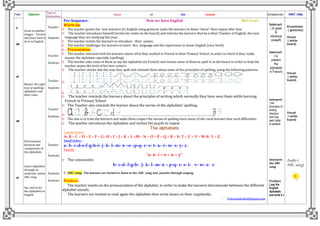
Warm up:
 The teacher greets the new learners (In English using gestures )asks the learners to listen “twice” then repeat after him.
 The teacher introduces himself (writes his name on the board) and informs the learners that he is their Teacher of English, the new
language they are studying this year.
 The teacher invites the learners to introduce their names.
 The teacher challenges his learners to learn this language and the importance to know English (very brief).
 Presentation:
 The teacher interacts with his learners about what they studied in French in their Primary School ,in order to check if they really
master the alphabets specially (spelling).
 The teacher asks some of them to say the alphabets (in French) and invites some of them to spell it on the board in order to help the
teacher assess the level of his new comers.
 The teacher checks also the way they spell and reminds them about some of the principles of spelling, using the following patterns.


 The teacher reminds the learners about the principles of writing which normally they have seen them while learning
French in Primary School
 The Teacher also reminds the learner about the norms of the alphabets’ spelling.
 …………………………………………………………………………………...
 The aim is to train the learners and make them respect the norms of spelling since many of the rural learners face such difficulties.
 The teacher introduces the alphabets and invites the pupils to repeat .
The alphabets
Capital letters:
A- B – C – D – E – F – G- H – I – J – K – L –M – N – O – P – Q – R – S- T – U – V – W-X- Y – Z.
Small letters :
a- b- c-d-e-f-g-h-i- j- k- l- m- n –o –p-q- r- s- t- u- v- w- x- y- z .
Vowels:
"a- e- i – o – u – y"
 The consonants:
b- c-d- f-g-h- j- k- l- m- n – p-q- r- s- t- v- w- x- z .
 ABC song: The learners are invited to listen to the ABC song and practice through singing.
Produce:
 The teacher insists on the pronunciation of the alphabet, in order to make the learners discriminate between the different
alphabet sounds.
 The learners are invited to read again the alphabets then write down on their copybooks.
 Yellowdaffodil66@gmail.com
Interact
( to greet
&
introduce
oneself)
Interact
( to
present
the
alphabets
in French)
Interpret
( the
principles of
writing
direction
and how
each letter
is spelled)
Interpret
the ABC
song
Produce
( say the
English
alphabets
and write it )
Kinesthetic
( gestures)
Visual
( white
board)
Visual
( white
board)
Visual
( white
board)
Audio (
ABC song)
Time Objective
Type of
Interaction
Steps of the Lesson Competencies VAKT / aids
5’
10’
5’
5’
5’
5’
5’
Checking
understanding
of the previous
session
Naming objects
,places through
alphabets
Consolidate the
oral practice with
written one
Lettering
&
Alphabets
Lettering
&
alphabets
Lettering
&
alphabets
Teacher
-
students
students
-
teacher
Teacher
-
Students
Teacher
-
Students
Teacher
-
Students
Students
-
Students
Pre-Sequence : “Now we have English” MS1 level
Warm up:
The teacher greets his learners and welcomes them.
The teacher invites the learners to make a short revision about the last session by singing ABC song
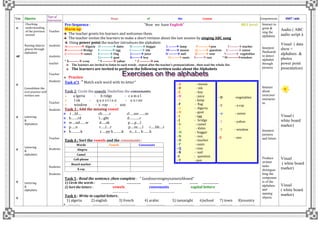
Using power point the teacher introduces the alphabets
A-------------- Algeria D ----------- dates H --------- hoggar L ------- lamp P----------pen T--------- teacher
B--------------> Bridge E ----------- egg I ---------- ink M------- mouse Q ------- question U --------- union
C------------- camel F---------- flag J--------- juice N -------- nail R-------- rose V--------- vegetables
G--------- goat K------- key O-------- oasis S------- sun * W----------window
* X---------- x-ray * Y ---------- yahoo * Z ---------- zoo
The learners are invited to listen to each words , repeat after the teacher’s pronunciations , then read the whole list.
The learners are invited to perform the following written tasks about the Alphabets
Practice:
Task n°1: " Match each word with its letter" - A - mouse
- B - ink
- C - key
- D - juice
- E - lamp
- F - flag
- G - Algeria
- H - goat
- I - egg
- J - bridge
- K - camel
- L - dates
- M - hoggar
- N - sun
- O - teacher
- P - oasis
- Q - rose
- R - nail
-S - question
- T - pen
- U -vegetables
- V - x-ray
- w - union
- X - yahoo
- Y - window
-Z - zoo
Task 2: Circle the vowels. Underline the consonants.
 a lgeria - b ridge - c a m e l
 I nk - q u e s t i o n - u n i on
 window - x -ray - zoo
Task 3 : Add the missing vowel:
 t …bl…. ch……..r cl…..ssr…….m
 b…….rd l….ght d………..r
 w….nd……w d…..sk p…..p….l
 p…..n r…..l….r p….nc…..l r…..bb….r
 b……….k c…..py b………k n….t…. b…….k
Task 4 : Sort the vowels and the consonants :
Words Vowels Consonants
Alegria
Camel
Cell-phone
Board marker
X-ray
Task 5 : Read the sentence ,then complete : “ GoodmorningmynameisAhmed”
1) Circle the words : ……………. …………….. …………… ……………. ………. ……………….
2) Sort the letters : vowels consonants capital letters
…………….. …………………….. ………………………….
Task 6 : Write in capital letters .
1) algeria 2) english 3) french 4) arabic 5) tamazight 6)school 7) town 8)country
 …………… ………………… ……………….. …………………… …………………….. ………………… ……………. ………………..
Interact to
greet &
sing the
alphabets
Interpret
flashcards
to detect
alphabet
through
pictures
Interact
about
exercises’
instructio
ns
Interpret
pictures
and letters
Produce
written
tasks
distinguis
hing the
componen
ts of the
alphabets
and
naming
objects
Audio ( ABC
audio script à
Visual ( data
show +
alphabets &
photos
power point
presentation)
Visual (
white board
marker)
Visual
( white board
marker)
Visual
( white board
marker)
Lettering
&
Alphabets
Naming
School
objects
Word
ordering
Word games
Teacher
-
students
students
-
teacher
Teacher
-
Students
Teacher
-
Students
Teacher
-
Students
Students
-
Students
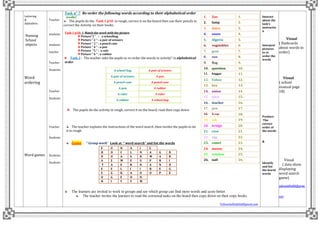
Task n° 7: Re-order the following words according to their alphabetical order
1. Zoo 1.
2. lamp 2.
3. dates 3.
4. oases 4.
5. Algeria 5.
6. vegetables 6.
7. goat 7.
8. sun 8.
9. flag 9.
10. question 10.
11. hoggar 11.
12. Yahoo 12.
13. key 13.
14. union 14.
15. juice 15.
16. teacher 16.
17. pen 17.
18. X-ray 18.
19. ink 19.
20. bridge 20.
21. rose 21.
22. egg 22.
23. camel 23.
24. mouse 24.
25. window 25.
26. nail 26.
(orally)
The pupils do the Task 1 p18 in rough, correct it on the board then use their pencils to
correct the Activity on their books .
Task 1 p18: I Match the word with the picture
Picture"1" : a schoolbag
Picture " 2 " : a pair of scissors
Picture " 3 " : a pencil case
Picture " 4 " : a pen
Picture "5 " : a rule
Picture " 6 " : a rubber
Task 2 : The teacher asks the pupils to re-order the words in activity" in alphabetical
order.
A school bag A pair of scissors
A pair of scissors A pen
A pencil case A pencil case
A pen A rubber
A ruler A ruler
A rubber A school bag
The pupils do the activity in rough, correct it on the board, read then copy down
The teacher explains the instructions of the word search ,then invites the pupils to do
it in rough
Game : “ Group work” Look at “ word search” and list the words
S U N A I L
H O C L N A G B
D O A G K M A R
A Z M E U P B I
T A E R N A N D
E E L I I R E G
S G K A O O P E
O G E O N
H I Y Y M
The learners are invited to work in groups and see which group can find more words and score better.
The teacher invites the learners to read the corrected tasks on the board then copy down on their copy books
Yellowdaffodil66@gmail.com
Interact
about the
task’s
instructio
n
Interpret
pictures
to re
order the
words
Produce
The
correct
order of
the words
&
Identify
and list
the learnt
words
Visual
( flashcards
about words to
order)
Visual
( school
manual page
18)
Visual
( data show
displaying
word search
game)
yellowdaffodi66@gmail.
com
Counting
Writing
numbers
Naming days –
months and
seasons
identify
and spell
numbers ,
days of the
week ;
months of
the year
and
seasons
Teacher
-
students
students
-
teacher
Teacher
-
Students
Teacher
-
Students
Teacher
-
Students
Students
-
Students
Pre-Sequence : Now we have English MS1 level ( 2G)
Warm up:
The teacher greets his learners and welcomes them.
Presentation:
The teacher introduces the "numbers from '0 to 30',the days and week ,the months and seasons. The learners listen then repeat.
1. One
2. Two
3. Three
4. Four
5. Five
6. six
7. seven
8. eight
9. nine
10. ten
11. eleven
12. twelve
13. thirteen
14. fourteen
15. fifteen
16. sixteen
17. seventeen
18. eighteen
19. nineteen
20. twenty
21. twenty-one
22. twenty-two
23. twenty three
24. twenty four
25. twenty five
26. twenty six
27. twenty seven
28. twenty eight
29. twenty nine
30. thirty
 Practice : The learners are invited to listen to a song about numbers , then try to sin it all together .
 Task : Listen to the song and try to write the numbers ( The teacher asks the learners to listen by row then checks
which row writes more correct numbers)
 Presentation :The teacher introduces : “days of the week- months of the year and seasons” then invites the learners
to repeat.
The days.
1. Saturday
2. Sunday
3. Monday
4. Tuesday seven days [01] week.
5. Wednesday
6. Thursday
7. Friday
The months:
1. January
2. February
3. March
4. April
5. May
6. June 12 months=(1
7. July year=(04)
8.August seasons
9.September
10.October
11.November
12.December
The seasons :
1. Winter
2. Spring
3. Summer [04] seasons = (01) year
4. Autumn
P l e a s e
c i r c l e
o n e a f
e t w o
t h r e e u
f i v e r
Practice :The pupils repeat ,then they are invited to perform the following tasks.
Game : Word search:
Please – circle - one – two – three- five – slate – four
Task : Underline the word that contains" o” * book - name - four
Task : Circle the words that contain "r". orange – slate - workbook
Task : Colour the word that contains "t" One – two – four
Task : Underline the common lette four – one – two
Task : Cross the odd one out :
example : three – three – thrre
*hello – hlelo – hello *book – bbok – book * workbook – workbook -
wrkook
Task : Find the odd items.
January – zero- March- April- November- winter- June –July- ten – September-
week – October –December – year- February-May – days- .
 Learners work in rough , teacher supervises their works and offers help , then learners are invited to correct on the
board , read the corrects tasks then copy down on their copy books
Interact
To greet
and
count
Interpret
Number
symbols
and
letters
Interpret
numbers
audio
song
Interact
about
days –
months
and
seasons
Interpret
the
spelling of
days of
the week-
months
and
seasons
Produce
correct
form of
numbers
– days of
the week
– months
and
seasons
visual
( white board
and marker)
Audio
( song about
numbers)
Visual
( board and
markers)
Visual ( board
and markers)
yellowdaffodi66@gmail.
Assessment
of learning
(alphabets-
numbers-
school
objects ….
Describing
colors
Describing
colors
Describing
colors
Describing
colors
Naming
objects and
their colors
Teacher
-
students
students
-
teacher
Teacher
-
Students
Teacher
-
Students
Teacher
-
Students
Students
-
Students
Pre- sequence : Now we have English MS1 level ( 2G)
Warm up: The teacher greets his learners and welcomes them , then invites them to make quick review about the
last session
 Learners are invites to make quick review about:
 Alphabets (consonants- vowels)
 Numbers
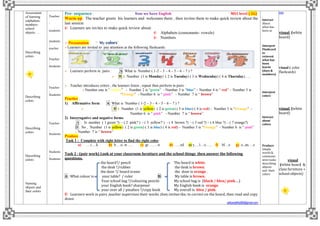
 Presentation : “ My colors”
Learners are invited to pay attention at the following flashcards:
 Learners perform in pairs : A: What is Number ( 1-2 – 3 – 4 – 5 – 6 – 7 ) ?
 B : Number (1 is Monday) ( 2 is Tuesday) ( 3 is Wednesday) ( 4 is Thursday)…..
 Teacher introduces colors , the learners listen , repeat then perform in pairs :
Number one is “ yellow” - Number 2 is “green” - Number 3 is “blue” – Number 4 is “ red” – Number 5 is
“Orange” - Number 6 is “ pink” - Number 7 is “ brown”
Practice :
1) Affirmative form : A: What is Number ( 1-2 – 3 – 4 – 5 – 6 – 7 ) ?
 B : Number (1 is yellow) ( 2 is green) ( 3 is blue) ( 4 is red) - Number 5 is “Orange” -
Number 6 is “ pink” - Number 7 is “ brown”
2) Interrogative and negative forms:
A : Is number ( 1 green ?) - ( 2 pink? ) - ( 3 yellow? ) - ( 4 brown ?) - ( 5 red ?) – ( 6 blue ?) – ( 7 orange?)
B : No , Number (1 is yellow) ( 2 is green) ( 3 is blue) ( 4 is red) - Number 5 is “Orange” - Number 6 is “ pink”
- Number 7 is “ brown”
Produce :
Task 1 : Complete with right letter to find the right color
a) ….i….k b) b….o..w….. c) gr……..n d) …..ed e) y….l…o….. f) bl…e g) o..an….e
Task 2 : (pair work) Look at your classroom furniture and the school things then answer the following
questions.
the board?/ pencil The board is white .
the desk ?/rubber the desk is brown.
the door ?/ board eraser the door is orange .
A : What colour is your table? / ruler B: My table is brown.
Your school bag ?/colouring pencils My school bag is (black / bleu/ pink….)
your English book? sharpener My English book is orange.
your over all / pinafore ?/copy book My overall is bleu / pink.
 Learners work in pairs ,teacher supervises their works ,then invites the; to correct on the board, then read and copy
down
yellowdaffodi66@gmail.com
Interact
About
what has
been se
Interpret
Flashcard
to
reinvest
what has
been
learnt
(days &
numbers)
Interpret
colors
Interact
about
colors
Produce
simple
words &
communic
ative tasks
describing
objects
and their
colors
com
visual (white
board)
visual ( color
flashcards)
visual (white
board)
visual
(white board &
class furniture +
school objects)
2 g    ms1 level  pre-sequence - now we have english

2 g ms1 level pre-sequence - now we have english

  • 2.
    MS1 level 2Gcurriculum Now we have English Ppu speaking lessons I. Utter, say & write the English Alphabets II. Discriminate between vowels and consonants (pronunciation) III. Name daily object (school things & school commands  Function Lettering, Alphabets / Initiation to spelling /Naming current objects /Naming school things /School commands  Grammar Alphabets (vowels & consonants) Vocabulary related to: Pronunciation Uttering & saying of the alphabets  VAKT / AIDS : Visual ( board – flashcards- ABC power point) / Audio (ABC song- days & months song + numbers song)  Intellectual order: He/ She can understand and interpret verbal and non-verbal messages  Methodological: He /She can work in pairs or in groups  Communicative He can process digital data in English  Personal and Social : He / She socialises through oral or written exchanges  : proud of talking Arabic & (Amazigh) languagesNational identity  : Literate citizen (Distinguishing between letters and learning their names KnowingCitizenship how alphabet letters function in writing and knowing specific letter-sound associations) to read and write in English : Learning a new language ( English )a gate to get open to worldOpenness to the world Yellowdaffodil66@gmail.com
  • 3.
    Time Objective Type of Interaction Stepsof the Lesson Competencies VAKT / AIds 5’ 10’ 15’ 10’ 15’ Greet in mother tongue – French and learn how to do it in English Master the right way of spelling alphabets and their rules Discriminate between the components of the alphabets Learn alphabets through an authentic native ABC song Say and write the alphabets in English Teacher - Students Teacher - Students Teacher - Students Teacher - Students Teacher - Students Students - Students Pre-Sequence : Now we have English MS1 level Warm up:  The teacher greets the new learners (In English using gestures )asks the learners to listen “twice” then repeat after him.  The teacher introduces himself (writes his name on the board) and informs the learners that he is their Teacher of English, the new language they are studying this year.  The teacher invites the learners to introduce their names.  The teacher challenges his learners to learn this language and the importance to know English (very brief).  Presentation:  The teacher interacts with his learners about what they studied in French in their Primary School ,in order to check if they really master the alphabets specially (spelling).  The teacher asks some of them to say the alphabets (in French) and invites some of them to spell it on the board in order to help the teacher assess the level of his new comers.  The teacher checks also the way they spell and reminds them about some of the principles of spelling, using the following patterns.    The teacher reminds the learners about the principles of writing which normally they have seen them while learning French in Primary School  The Teacher also reminds the learner about the norms of the alphabets’ spelling.  …………………………………………………………………………………...  The aim is to train the learners and make them respect the norms of spelling since many of the rural learners face such difficulties.  The teacher introduces the alphabets and invites the pupils to repeat . The alphabets Capital letters: A- B – C – D – E – F – G- H – I – J – K – L –M – N – O – P – Q – R – S- T – U – V – W-X- Y – Z. Small letters : a- b- c-d-e-f-g-h-i- j- k- l- m- n –o –p-q- r- s- t- u- v- w- x- y- z . Vowels: "a- e- i – o – u – y"  The consonants: b- c-d- f-g-h- j- k- l- m- n – p-q- r- s- t- v- w- x- z .  ABC song: The learners are invited to listen to the ABC song and practice through singing. Produce:  The teacher insists on the pronunciation of the alphabet, in order to make the learners discriminate between the different alphabet sounds.  The learners are invited to read again the alphabets then write down on their copybooks.  Yellowdaffodil66@gmail.com Interact ( to greet & introduce oneself) Interact ( to present the alphabets in French) Interpret ( the principles of writing direction and how each letter is spelled) Interpret the ABC song Produce ( say the English alphabets and write it ) Kinesthetic ( gestures) Visual ( white board) Visual ( white board) Visual ( white board) Audio ( ABC song)
  • 4.
    Time Objective Type of Interaction Stepsof the Lesson Competencies VAKT / aids 5’ 10’ 5’ 5’ 5’ 5’ 5’ Checking understanding of the previous session Naming objects ,places through alphabets Consolidate the oral practice with written one Lettering & Alphabets Lettering & alphabets Lettering & alphabets Teacher - students students - teacher Teacher - Students Teacher - Students Teacher - Students Students - Students Pre-Sequence : “Now we have English” MS1 level Warm up: The teacher greets his learners and welcomes them. The teacher invites the learners to make a short revision about the last session by singing ABC song Using power point the teacher introduces the alphabets A-------------- Algeria D ----------- dates H --------- hoggar L ------- lamp P----------pen T--------- teacher B--------------> Bridge E ----------- egg I ---------- ink M------- mouse Q ------- question U --------- union C------------- camel F---------- flag J--------- juice N -------- nail R-------- rose V--------- vegetables G--------- goat K------- key O-------- oasis S------- sun * W----------window * X---------- x-ray * Y ---------- yahoo * Z ---------- zoo The learners are invited to listen to each words , repeat after the teacher’s pronunciations , then read the whole list. The learners are invited to perform the following written tasks about the Alphabets Practice: Task n°1: " Match each word with its letter" - A - mouse - B - ink - C - key - D - juice - E - lamp - F - flag - G - Algeria - H - goat - I - egg - J - bridge - K - camel - L - dates - M - hoggar - N - sun - O - teacher - P - oasis - Q - rose - R - nail -S - question - T - pen - U -vegetables - V - x-ray - w - union - X - yahoo - Y - window -Z - zoo Task 2: Circle the vowels. Underline the consonants.  a lgeria - b ridge - c a m e l  I nk - q u e s t i o n - u n i on  window - x -ray - zoo Task 3 : Add the missing vowel:  t …bl…. ch……..r cl…..ssr…….m  b…….rd l….ght d………..r  w….nd……w d…..sk p…..p….l  p…..n r…..l….r p….nc…..l r…..bb….r  b……….k c…..py b………k n….t…. b…….k Task 4 : Sort the vowels and the consonants : Words Vowels Consonants Alegria Camel Cell-phone Board marker X-ray Task 5 : Read the sentence ,then complete : “ GoodmorningmynameisAhmed” 1) Circle the words : ……………. …………….. …………… ……………. ………. ………………. 2) Sort the letters : vowels consonants capital letters …………….. …………………….. …………………………. Task 6 : Write in capital letters . 1) algeria 2) english 3) french 4) arabic 5) tamazight 6)school 7) town 8)country  …………… ………………… ……………….. …………………… …………………….. ………………… ……………. ……………….. Interact to greet & sing the alphabets Interpret flashcards to detect alphabet through pictures Interact about exercises’ instructio ns Interpret pictures and letters Produce written tasks distinguis hing the componen ts of the alphabets and naming objects Audio ( ABC audio script à Visual ( data show + alphabets & photos power point presentation) Visual ( white board marker) Visual ( white board marker) Visual ( white board marker)
  • 5.
    Lettering & Alphabets Naming School objects Word ordering Word games Teacher - students students - teacher Teacher - Students Teacher - Students Teacher - Students Students - Students Task n°7: Re-order the following words according to their alphabetical order 1. Zoo 1. 2. lamp 2. 3. dates 3. 4. oases 4. 5. Algeria 5. 6. vegetables 6. 7. goat 7. 8. sun 8. 9. flag 9. 10. question 10. 11. hoggar 11. 12. Yahoo 12. 13. key 13. 14. union 14. 15. juice 15. 16. teacher 16. 17. pen 17. 18. X-ray 18. 19. ink 19. 20. bridge 20. 21. rose 21. 22. egg 22. 23. camel 23. 24. mouse 24. 25. window 25. 26. nail 26. (orally) The pupils do the Task 1 p18 in rough, correct it on the board then use their pencils to correct the Activity on their books . Task 1 p18: I Match the word with the picture Picture"1" : a schoolbag Picture " 2 " : a pair of scissors Picture " 3 " : a pencil case Picture " 4 " : a pen Picture "5 " : a rule Picture " 6 " : a rubber Task 2 : The teacher asks the pupils to re-order the words in activity" in alphabetical order. A school bag A pair of scissors A pair of scissors A pen A pencil case A pencil case A pen A rubber A ruler A ruler A rubber A school bag The pupils do the activity in rough, correct it on the board, read then copy down The teacher explains the instructions of the word search ,then invites the pupils to do it in rough Game : “ Group work” Look at “ word search” and list the words S U N A I L H O C L N A G B D O A G K M A R A Z M E U P B I T A E R N A N D E E L I I R E G S G K A O O P E O G E O N H I Y Y M The learners are invited to work in groups and see which group can find more words and score better. The teacher invites the learners to read the corrected tasks on the board then copy down on their copy books Yellowdaffodil66@gmail.com Interact about the task’s instructio n Interpret pictures to re order the words Produce The correct order of the words & Identify and list the learnt words Visual ( flashcards about words to order) Visual ( school manual page 18) Visual ( data show displaying word search game) yellowdaffodi66@gmail. com
  • 6.
    Counting Writing numbers Naming days – monthsand seasons identify and spell numbers , days of the week ; months of the year and seasons Teacher - students students - teacher Teacher - Students Teacher - Students Teacher - Students Students - Students Pre-Sequence : Now we have English MS1 level ( 2G) Warm up: The teacher greets his learners and welcomes them. Presentation: The teacher introduces the "numbers from '0 to 30',the days and week ,the months and seasons. The learners listen then repeat. 1. One 2. Two 3. Three 4. Four 5. Five 6. six 7. seven 8. eight 9. nine 10. ten 11. eleven 12. twelve 13. thirteen 14. fourteen 15. fifteen 16. sixteen 17. seventeen 18. eighteen 19. nineteen 20. twenty 21. twenty-one 22. twenty-two 23. twenty three 24. twenty four 25. twenty five 26. twenty six 27. twenty seven 28. twenty eight 29. twenty nine 30. thirty  Practice : The learners are invited to listen to a song about numbers , then try to sin it all together .  Task : Listen to the song and try to write the numbers ( The teacher asks the learners to listen by row then checks which row writes more correct numbers)  Presentation :The teacher introduces : “days of the week- months of the year and seasons” then invites the learners to repeat. The days. 1. Saturday 2. Sunday 3. Monday 4. Tuesday seven days [01] week. 5. Wednesday 6. Thursday 7. Friday The months: 1. January 2. February 3. March 4. April 5. May 6. June 12 months=(1 7. July year=(04) 8.August seasons 9.September 10.October 11.November 12.December The seasons : 1. Winter 2. Spring 3. Summer [04] seasons = (01) year 4. Autumn P l e a s e c i r c l e o n e a f e t w o t h r e e u f i v e r Practice :The pupils repeat ,then they are invited to perform the following tasks. Game : Word search: Please – circle - one – two – three- five – slate – four Task : Underline the word that contains" o” * book - name - four Task : Circle the words that contain "r". orange – slate - workbook Task : Colour the word that contains "t" One – two – four Task : Underline the common lette four – one – two Task : Cross the odd one out : example : three – three – thrre *hello – hlelo – hello *book – bbok – book * workbook – workbook - wrkook Task : Find the odd items. January – zero- March- April- November- winter- June –July- ten – September- week – October –December – year- February-May – days- .  Learners work in rough , teacher supervises their works and offers help , then learners are invited to correct on the board , read the corrects tasks then copy down on their copy books Interact To greet and count Interpret Number symbols and letters Interpret numbers audio song Interact about days – months and seasons Interpret the spelling of days of the week- months and seasons Produce correct form of numbers – days of the week – months and seasons visual ( white board and marker) Audio ( song about numbers) Visual ( board and markers) Visual ( board and markers) yellowdaffodi66@gmail.
  • 7.
    Assessment of learning (alphabets- numbers- school objects …. Describing colors Describing colors Describing colors Describing colors Naming objectsand their colors Teacher - students students - teacher Teacher - Students Teacher - Students Teacher - Students Students - Students Pre- sequence : Now we have English MS1 level ( 2G) Warm up: The teacher greets his learners and welcomes them , then invites them to make quick review about the last session  Learners are invites to make quick review about:  Alphabets (consonants- vowels)  Numbers  Presentation : “ My colors” Learners are invited to pay attention at the following flashcards:  Learners perform in pairs : A: What is Number ( 1-2 – 3 – 4 – 5 – 6 – 7 ) ?  B : Number (1 is Monday) ( 2 is Tuesday) ( 3 is Wednesday) ( 4 is Thursday)…..  Teacher introduces colors , the learners listen , repeat then perform in pairs : Number one is “ yellow” - Number 2 is “green” - Number 3 is “blue” – Number 4 is “ red” – Number 5 is “Orange” - Number 6 is “ pink” - Number 7 is “ brown” Practice : 1) Affirmative form : A: What is Number ( 1-2 – 3 – 4 – 5 – 6 – 7 ) ?  B : Number (1 is yellow) ( 2 is green) ( 3 is blue) ( 4 is red) - Number 5 is “Orange” - Number 6 is “ pink” - Number 7 is “ brown” 2) Interrogative and negative forms: A : Is number ( 1 green ?) - ( 2 pink? ) - ( 3 yellow? ) - ( 4 brown ?) - ( 5 red ?) – ( 6 blue ?) – ( 7 orange?) B : No , Number (1 is yellow) ( 2 is green) ( 3 is blue) ( 4 is red) - Number 5 is “Orange” - Number 6 is “ pink” - Number 7 is “ brown” Produce : Task 1 : Complete with right letter to find the right color a) ….i….k b) b….o..w….. c) gr……..n d) …..ed e) y….l…o….. f) bl…e g) o..an….e Task 2 : (pair work) Look at your classroom furniture and the school things then answer the following questions. the board?/ pencil The board is white . the desk ?/rubber the desk is brown. the door ?/ board eraser the door is orange . A : What colour is your table? / ruler B: My table is brown. Your school bag ?/colouring pencils My school bag is (black / bleu/ pink….) your English book? sharpener My English book is orange. your over all / pinafore ?/copy book My overall is bleu / pink.  Learners work in pairs ,teacher supervises their works ,then invites the; to correct on the board, then read and copy down yellowdaffodi66@gmail.com Interact About what has been se Interpret Flashcard to reinvest what has been learnt (days & numbers) Interpret colors Interact about colors Produce simple words & communic ative tasks describing objects and their colors com visual (white board) visual ( color flashcards) visual (white board) visual (white board & class furniture + school objects)