JUST WORDS
  UNIT 1 DAY 3
OBJECTIVES:


  Retell the information about written
  English
  Justify why Just Words is important
  Locate the sections of the Student
  Notebook
• Practice saying the vowel, consonants
  and blend sounds by tapping
1ST ACTIVATOR:

1. A single written symbol which represents a
  complete word or idea is a logogram.

2. An alphabet is a set of letters or basic
   written symbols that match the sounds that
   we use when we speak.

3. 26 letters
4. 44 sounds
1ST ACTIVATOR:

6. Logographic and alphabetic writing systems
   are different.

• Alphabetic writing systems have characters
  that represent sounds
• logographic systems use characters or
  symbols that represent words
1ST ACTIVATOR:


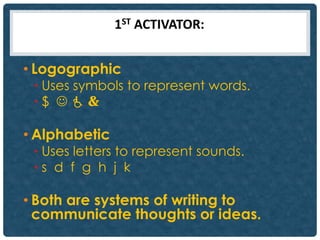
• Logographic
 • Uses symbols to represent words.
 •$ 

• Alphabetic
 • Uses letters to represent sounds.
 •s d f g h j k

• Both are systems of writing to
  communicate thoughts or ideas.
2ND SUMMARIZE PAGE 4


• 8,000 years ago wrote on tortoise shells
• Used logograms to communicate whole words or ideas.
• Chinese writing is an example of logograms still used
  today.
• 5,000 years ago Egyptians wrote characters to represent
  sounds using hieroglyphics
• Our alphabet today is based of the Phoenician symbols
  and evolved from the Greek and Roman letters
• 26 letters are made from a series of a few basic shapes of
  lines, curves, circles, and dots.
• Changing one letter at a time, changes the whole word.
3RD DISCUSS JUST WORDS CLASS


• Most people think of English as a jumbled mix
  of words formed without rhyme or reason.
• However, the majority of words in English
  follow a system. In this class, we will study
  that logical system very carefully to fully
  understand how the letters relate to sounds in
  six different syllable patterns.
• We will also learn spelling
  rules, prefixes, roots, and suffixes.
3RD DISCUSS JUST WORDS CLASS


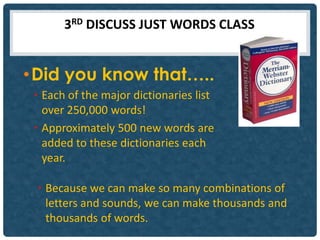
• Did you know that…..
 • Each of the major dictionaries list
   over 250,000 words!
 • Approximately 500 new words are
   added to these dictionaries each
   year.

 • Because we can make so many combinations of
   letters and sounds, we can make thousands and
   thousands of words.
3RD DISCUSS JUST WORDS CLASS

• In Just Words, you will learn how all that
  works. It is really amazing! You will start
  with looking at how we can move around
  three letters to make hundreds of words and
  then build from there. In the Just Words
  class, students will do word construction and
  see just how words work in English.
3RD DISCUSS JUST WORDS CLASS

• Since English is an alphabetical
  writing system, symbols represent
  sounds.
• So, the first step to learning the
  details of English is to be sure you
  know the letters and sounds.
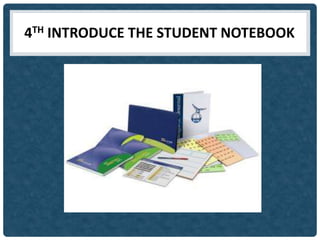
4TH INTRODUCE THE STUDENT NOTEBOOK

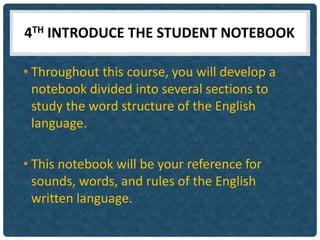
• Throughout this course, you will develop a
  notebook divided into several sections to
  study the word structure of the English
  language.

• This notebook will be your reference for
  sounds, words, and rules of the English
  written language.
4TH INTRODUCE THE STUDENT NOTEBOOK

• Refer to the Contents page and locate the beginning
  of each section:
  o Sounds _______________________________
  o Syllables ______________________________
  o Spelling Rules __________________________
  o Vocabulary ____________________________
  o High frequency/Sight Words _______________
4TH INTRODUCE THE STUDENT NOTEBOOK

•Find the Consonant page in the
 Sound section of your Student
 Notebook. What is missing from
 the alphabet?
5TH TEACH CONSONANTS

• Look at the Sound Card display. You will
  start by learning the most common
  consonant and vowel sounds.
• You already know many, if not most, of
  the consonant sounds.
• However, many people add a vowel
  sound to each consonant.
5TH TEACH CONSONANTS

• Look at the Grapheme Chart

• Why are some cards peach?
• Why are some cards yellow?


• Do you remember the sounds of each letter?
• Sound them off!
5TH TEACH CONSONANTS

• Put a   c and h together. How many sounds does it make?
• What is it called when you put two letters together and make
  one sound?


• digraph
5TH TEACH CONSONANTS

• When you add a vowel to a consonant, like :

 •   m + u = /muh/
• When you remove the [u] card, you just get
  /m/. It is important to clip sounds in order to
  blend them into words.

• m = /m/    not     m = /muh/
5TH TEACH CONSONANTS

• If the sounds are said   /muh/ /ã/ /tuh/
• the word will not blend to make the word mat.

• The sounds /m/ /ã/ /t/
• on the other hand, do blend to make the word mat.

• Notice my chin.

• What happens when I say /t/?
• What happens when I say /tuh/?
5TH TEACH CONSONANTS

• Practice saying the consonant sounds and
  carefully clipping them.
• Each student does 8 and counts as 5
  participation points.
• Tap fingers together as you say each sound of
  a letter.

• Why is this important? In order to blend them into words.
5TH TEACH CONSONANTS

• Show the Basic Keyword
  Reference Chart

• How do the keywords help us in our
  study of Just Words?
• Keywords aid memory and provide
  reference to help you access the sounds
  quicker and like a reflex.
5TH TEACH CONSONANTS

• Practice saying the letter-keyword-sound for the
  consonant sounds.
• Practice until it is a habit to say all three parts at
  once.

        • LETTER       KEYWORD         SOUND

• We will refer to this page to help remind you and
  me of these sounds.
5TH TEACH CONSONANTS

• Keywords are helpful for the consonants
 g and c to emphasize the primary sound
  • g - game /g/
  • c - cat /k/
• For now, we will not use the secondary
  sound for each of these letters when trying to
  decode unfamiliar words
• especially for the letter g   /j/ for /g/
5TH TEACH CONSONANTS


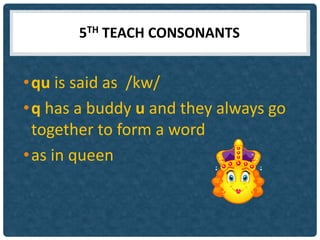
• qu is said as /kw/
• q has a buddy u and they always go
  together to form a word
• as in queen
5TH TEACH CONSONANTS


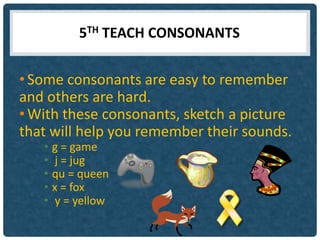
• Some consonants are easy to remember
and others are hard.
• With these consonants, sketch a picture
that will help you remember their sounds.
   • g = game
   • j = jug
   • qu = queen
   • x = fox
   • y = yellow
6TH TEACH SHORT VOWEL SOUNDS

• What do you call the peach cards?
• Vowels

• Vowel sounds are the most important, because
every word and syllable needs a vowel.

• They are easily confused so keywords will be
important for all of the short vowels.
6TH TEACH SHORT VOWEL SOUNDS

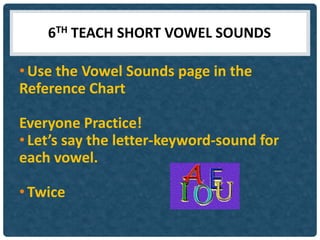
• Use the Vowel Sounds page in the
Reference Chart

Everyone Practice!
• Let’s say the letter-keyword-sound for
each vowel.

• Twice
6TH TEACH SHORT VOWEL SOUNDS

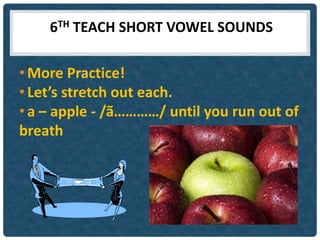
• More Practice!
• Let’s stretch out each.
• a – apple - /ã…………/ until you run out of
breath
6TH TEACH SHORT VOWEL SOUNDS

• Now quickly sketch a picture to
  represent each of the five short vowel
  keywords on the Short Vowels page
  Sounds section) on page 4 of your
  Student Notebook .
6TH TEACH SHORT VOWEL SOUNDS

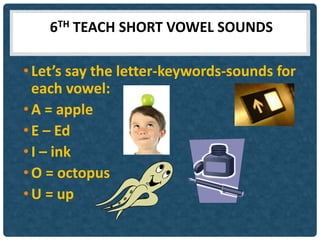
• Let’s say the letter-keywords-sounds for
  each vowel:
• A = apple
• E – Ed
• I – ink
• O = octopus
• U = up
7TH TEACH BLENDING

• Phoneme segmentation is the ability to pull
  apart the sounds of a given word.
• It is a critical skill for reading and spelling
  success.
• You will learn how to blend and segment
  three sounds.
• When you get that, you will move onto
  four, five, and six sounds.
7TH TEACH BLENDING

• Let’s start with familiar words so you can
practice “tapping” out phonemes.

• map /m/ã/p/

•
vat, con, hex, zip, pet, sag, fib, mop, web, dot, h
ip, mix,
7TH TEACH BLENDING

• The tactile input (or touch) to the fingertips
  appears to aid in the blending process.
• You can use this method to decode a word that
  you have never seen before.
• Usually, you will read three-sound words such as
  map without a problem, but there are many
  words that have three sounds that are unfamiliar.
• Tapping out unfamiliar words is a trick to help you
  read words you don’t recognize.
7TH TEACH BLENDING

•Model how to tap out “vim”.
•What does the word “vim”
 mean?
•Energy
7TH TEACH BLENDING

• Tap and clip the following words:
• vat, yen, sod, wax, and quit
• Remember:
     •x   says /ks/
     • qu   says /kw/
7TH TEACH BLENDING

• Practice saying these words and carefully
  clipping them.
• Each student does 8 and counts as 5
  participation points.
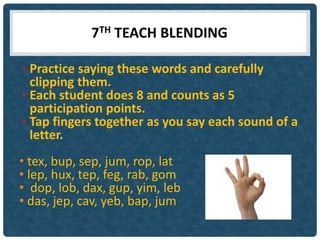
• Tap fingers together as you say each sound of a
  letter.
• tex, bup, sep, jum, rop, lat
• lep, hux, tep, feg, rab, gom
• dop, lob, dax, gup, yim, leb
• das, jep, cav, yeb, bap, jum

Just Words unit 1 day 3

  • 1.
    JUST WORDS UNIT 1 DAY 3
  • 2.
    OBJECTIVES: Retellthe information about written English Justify why Just Words is important Locate the sections of the Student Notebook • Practice saying the vowel, consonants and blend sounds by tapping
  • 3.
    1ST ACTIVATOR: 1. Asingle written symbol which represents a complete word or idea is a logogram. 2. An alphabet is a set of letters or basic written symbols that match the sounds that we use when we speak. 3. 26 letters 4. 44 sounds
  • 4.
    1ST ACTIVATOR: 6. Logographicand alphabetic writing systems are different. • Alphabetic writing systems have characters that represent sounds • logographic systems use characters or symbols that represent words
  • 5.
    1ST ACTIVATOR: • Logographic • Uses symbols to represent words. •$  • Alphabetic • Uses letters to represent sounds. •s d f g h j k • Both are systems of writing to communicate thoughts or ideas.
  • 6.
    2ND SUMMARIZE PAGE4 • 8,000 years ago wrote on tortoise shells • Used logograms to communicate whole words or ideas. • Chinese writing is an example of logograms still used today. • 5,000 years ago Egyptians wrote characters to represent sounds using hieroglyphics • Our alphabet today is based of the Phoenician symbols and evolved from the Greek and Roman letters • 26 letters are made from a series of a few basic shapes of lines, curves, circles, and dots. • Changing one letter at a time, changes the whole word.
  • 7.
    3RD DISCUSS JUSTWORDS CLASS • Most people think of English as a jumbled mix of words formed without rhyme or reason. • However, the majority of words in English follow a system. In this class, we will study that logical system very carefully to fully understand how the letters relate to sounds in six different syllable patterns. • We will also learn spelling rules, prefixes, roots, and suffixes.
  • 8.
    3RD DISCUSS JUSTWORDS CLASS • Did you know that….. • Each of the major dictionaries list over 250,000 words! • Approximately 500 new words are added to these dictionaries each year. • Because we can make so many combinations of letters and sounds, we can make thousands and thousands of words.
  • 9.
    3RD DISCUSS JUSTWORDS CLASS • In Just Words, you will learn how all that works. It is really amazing! You will start with looking at how we can move around three letters to make hundreds of words and then build from there. In the Just Words class, students will do word construction and see just how words work in English.
  • 10.
    3RD DISCUSS JUSTWORDS CLASS • Since English is an alphabetical writing system, symbols represent sounds. • So, the first step to learning the details of English is to be sure you know the letters and sounds.
  • 11.
    4TH INTRODUCE THESTUDENT NOTEBOOK
  • 12.
    4TH INTRODUCE THESTUDENT NOTEBOOK • Throughout this course, you will develop a notebook divided into several sections to study the word structure of the English language. • This notebook will be your reference for sounds, words, and rules of the English written language.
  • 13.
    4TH INTRODUCE THESTUDENT NOTEBOOK • Refer to the Contents page and locate the beginning of each section: o Sounds _______________________________ o Syllables ______________________________ o Spelling Rules __________________________ o Vocabulary ____________________________ o High frequency/Sight Words _______________
  • 14.
    4TH INTRODUCE THESTUDENT NOTEBOOK •Find the Consonant page in the Sound section of your Student Notebook. What is missing from the alphabet?
  • 15.
    5TH TEACH CONSONANTS •Look at the Sound Card display. You will start by learning the most common consonant and vowel sounds. • You already know many, if not most, of the consonant sounds. • However, many people add a vowel sound to each consonant.
  • 16.
    5TH TEACH CONSONANTS •Look at the Grapheme Chart • Why are some cards peach? • Why are some cards yellow? • Do you remember the sounds of each letter? • Sound them off!
  • 17.
    5TH TEACH CONSONANTS •Put a c and h together. How many sounds does it make? • What is it called when you put two letters together and make one sound? • digraph
  • 18.
    5TH TEACH CONSONANTS •When you add a vowel to a consonant, like : • m + u = /muh/ • When you remove the [u] card, you just get /m/. It is important to clip sounds in order to blend them into words. • m = /m/ not m = /muh/
  • 19.
    5TH TEACH CONSONANTS •If the sounds are said /muh/ /ã/ /tuh/ • the word will not blend to make the word mat. • The sounds /m/ /ã/ /t/ • on the other hand, do blend to make the word mat. • Notice my chin. • What happens when I say /t/? • What happens when I say /tuh/?
  • 20.
    5TH TEACH CONSONANTS •Practice saying the consonant sounds and carefully clipping them. • Each student does 8 and counts as 5 participation points. • Tap fingers together as you say each sound of a letter. • Why is this important? In order to blend them into words.
  • 21.
    5TH TEACH CONSONANTS •Show the Basic Keyword Reference Chart • How do the keywords help us in our study of Just Words? • Keywords aid memory and provide reference to help you access the sounds quicker and like a reflex.
  • 22.
    5TH TEACH CONSONANTS •Practice saying the letter-keyword-sound for the consonant sounds. • Practice until it is a habit to say all three parts at once. • LETTER KEYWORD SOUND • We will refer to this page to help remind you and me of these sounds.
  • 23.
    5TH TEACH CONSONANTS •Keywords are helpful for the consonants g and c to emphasize the primary sound • g - game /g/ • c - cat /k/ • For now, we will not use the secondary sound for each of these letters when trying to decode unfamiliar words • especially for the letter g /j/ for /g/
  • 24.
    5TH TEACH CONSONANTS •qu is said as /kw/ • q has a buddy u and they always go together to form a word • as in queen
  • 25.
    5TH TEACH CONSONANTS •Some consonants are easy to remember and others are hard. • With these consonants, sketch a picture that will help you remember their sounds. • g = game • j = jug • qu = queen • x = fox • y = yellow
  • 26.
    6TH TEACH SHORTVOWEL SOUNDS • What do you call the peach cards? • Vowels • Vowel sounds are the most important, because every word and syllable needs a vowel. • They are easily confused so keywords will be important for all of the short vowels.
  • 27.
    6TH TEACH SHORTVOWEL SOUNDS • Use the Vowel Sounds page in the Reference Chart Everyone Practice! • Let’s say the letter-keyword-sound for each vowel. • Twice
  • 28.
    6TH TEACH SHORTVOWEL SOUNDS • More Practice! • Let’s stretch out each. • a – apple - /ã…………/ until you run out of breath
  • 29.
    6TH TEACH SHORTVOWEL SOUNDS • Now quickly sketch a picture to represent each of the five short vowel keywords on the Short Vowels page Sounds section) on page 4 of your Student Notebook .
  • 30.
    6TH TEACH SHORTVOWEL SOUNDS • Let’s say the letter-keywords-sounds for each vowel: • A = apple • E – Ed • I – ink • O = octopus • U = up
  • 31.
    7TH TEACH BLENDING •Phoneme segmentation is the ability to pull apart the sounds of a given word. • It is a critical skill for reading and spelling success. • You will learn how to blend and segment three sounds. • When you get that, you will move onto four, five, and six sounds.
  • 32.
    7TH TEACH BLENDING •Let’s start with familiar words so you can practice “tapping” out phonemes. • map /m/ã/p/ • vat, con, hex, zip, pet, sag, fib, mop, web, dot, h ip, mix,
  • 33.
    7TH TEACH BLENDING •The tactile input (or touch) to the fingertips appears to aid in the blending process. • You can use this method to decode a word that you have never seen before. • Usually, you will read three-sound words such as map without a problem, but there are many words that have three sounds that are unfamiliar. • Tapping out unfamiliar words is a trick to help you read words you don’t recognize.
  • 34.
    7TH TEACH BLENDING •Modelhow to tap out “vim”. •What does the word “vim” mean? •Energy
  • 35.
    7TH TEACH BLENDING •Tap and clip the following words: • vat, yen, sod, wax, and quit • Remember: •x says /ks/ • qu says /kw/
  • 36.
    7TH TEACH BLENDING •Practice saying these words and carefully clipping them. • Each student does 8 and counts as 5 participation points. • Tap fingers together as you say each sound of a letter. • tex, bup, sep, jum, rop, lat • lep, hux, tep, feg, rab, gom • dop, lob, dax, gup, yim, leb • das, jep, cav, yeb, bap, jum