Presented by ,
Dr Harshavardhan Patwal
 The evolution of the dental knowledge base
 The evolution and definition of evidence-based dentistry
(EBD)
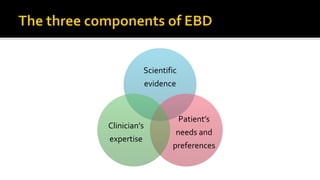
 The three components of EBD: scientific evidence, the
clinician’s expertise, and the patient’s needs and
preferences
 Best evidence
 Applying EBD in practice
 Evidenced based periodontology
 Dentists need to make clinical decisions based on limited
scientific evidence. In clinical practice, a clinician must
weigh a myriad of evidences every day.
 The goal of evidence-based dentistry is to help practitioners
provide their patients with optimal care.This is achieved by
integrating sound research evidence with personal clinical
expertise and patient values to determine the best course of
treatment.
 According to the ADA…
 Evidence-based dentistry (EBD) is an approach to oral health care
that requires the judicious integration of systematic assessments of
clinically relevant scientific evidence, relating to the patient’s oral
and medical condition and history, with the dentist’s clinical
expertise and the patient’s treatment needs and preferences.
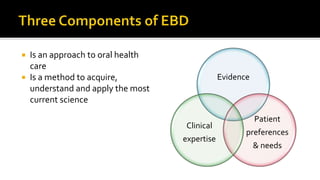
 Is an approach to oral health
care
 Is a method to acquire,
understand and apply the most
current science
Evidence
Patient
preferences
& needs
Clinical
expertise
 Cookbook dentistry
 A standard of care
 A mandate of what must be done
 A substitute for clinical judgment
 The dental knowledge base is simply the collection of all that
is known about oral health and disease and treatment
methods and outcomes.
 Its contents comprise all of the
 extant dental journal articles
 textbooks,
 the minds of all oral health practitioners.
 the foundation of the dental professions and the principal
determinant of how dentists and dental hygienists practice
 informs professional decision making, and portions of it
comprise the content of predoctoral and postdoctoral dental
school curricula.
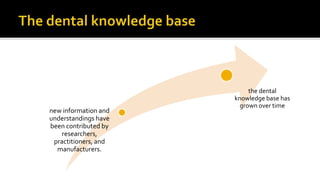
new information and
understandings have
been contributed by
researchers,
practitioners, and
manufacturers.
the dental
knowledge base has
grown over time
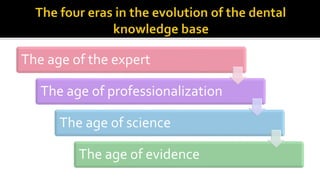
The age of the expert
The age of professionalization
The age of science
The age of evidence
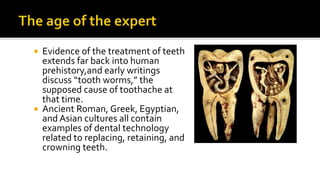
 Evidence of the treatment of teeth
extends far back into human
prehistory,and early writings
discuss “tooth worms,” the
supposed cause of toothache at
that time.
 Ancient Roman, Greek, Egyptian,
and Asian cultures all contain
examples of dental technology
related to replacing, retaining, and
crowning teeth.
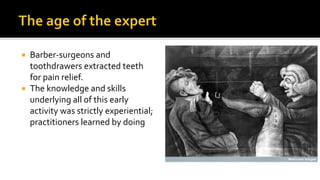
 Barber-surgeons and
toothdrawers extracted teeth
for pain relief.
 The knowledge and skills
underlying all of this early
activity was strictly experiential;
practitioners learned by doing
 18th century
 Pierre Fauchard
 comprehensive textbook
▪ This textbook exemplified a new era in
knowledge synthesis, enabled by better
access to knowledge created by other
 Beginning of the 20th century,
 presaging the profession’s gradual shift from proprietary to
university-based educational institutions
 Scientific studies
 protocol-based
 controlled experimentation became more common,
 causes and prevention of dental diseases.
 Synthesis of knowledge evolved from simple statements of
“fact” based on an expert’s experience and opinion to
identification and consideration of the available information
in the scientific literature.
 Knowledge dissemination enjoyed its most active period yet
 early rapid growth of university-based predoctoral and
postdoctoral dental curricula,
 the proliferation of dental journals,
 organized continuing dental education
 congress
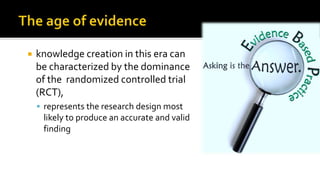
 knowledge creation in this era can
be characterized by the dominance
of the randomized controlled trial
(RCT),
 represents the research design most
likely to produce an accurate and valid
finding
 The hallmark of the age of
evidence is the systematic review
 represent a substantial change in
the paradigm of knowledge
synthesis by
 ensuring inclusion of all relevant
evidence,
 de-emphasizing the role of the expert,
 minimizing bias through strict
protocols demanding objectivity and
transparency in the review process
 EBD is a direct descendent and analog of a similar evolution of
the medical knowledge base, termed evidence-based
medicine (EBM).
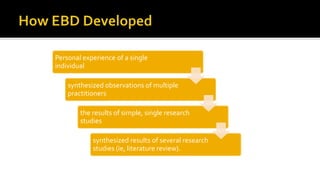
Personal experience of a single
individual
synthesized observations of multiple
practitioners
the results of simple, single research
studies
synthesized results of several research
studies (ie, literature review).
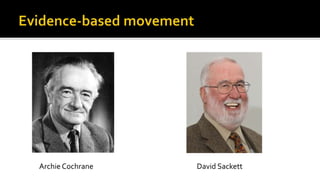
Archie Cochrane David Sackett
 Scottish physician and epidemiologist
 advocated the application of scientific methods, especially
RCTs, to evaluate the effectiveness and efficiency of medical
treatments.
 He is best known for his influential book
 published in 1972
 Effectiveness and Efficiency: Random Reflections on Health Services
 The principles he clearly set out in this book were
straightforward:
 Because resources would always be limited, they should be used to
provide those forms of health care that had been shown in properly
designed evaluations to be effective.
 Evidence from RCTs, he stressed, are likely to provide much more
reliable information than other sources of evidence.
 The Cochrane Collaboration, named after
Archie Cochrane, is an international
network of volunteers that prepares and
updates systematic reviews on a broad
variety of topics as well as maintains the
largest collection of records of RCTs in the
world
 Created by Sackett
 first used at McMaster University in 1990
 describe “an attitude of enlightened
skepticism toward the application of
diagnostic, therapeutic, and prognostic
technologies in day-to-day patient
management.
 The term was first published in 1991 and reached widespread
visibility in 1992 with the publication of a description of the
concept in the Journal of theAmerican MedicalAssociation.
 The classic definition of evidence-based medicine emerged a
few years later from the same group at McMaster University
who pioneered the movement:
 “the conscientious, explicit and judicious use of current best
evidence in making decisions about the care of the individual
patient.”
 This definition focuses on the integration of individual clinical
expertise with the best available external clinical evidence.
 This definition was refined a few years later to incorporate
patient preferences and values
“An approach to oral healthcare that requires the
judicious integration of systematic assessments of
clinically relevant scientific evidence, relating to the
patient’s oral and medical condition and history, with the
dentist’s clinical expertise and the patient’s treatment
needs and preferences.”
Scientific
evidence
Patient’s
needs and
preferences
Clinician’s
expertise
 best evidence and systematic reviews
 Not all evidence is created equal.
 Some evidence is more likely to be valid than other evidence
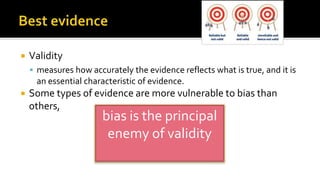
 Validity
 measures how accurately the evidence reflects what is true, and it is
an essential characteristic of evidence.
 Some types of evidence are more vulnerable to bias than
others,
bias is the principal
enemy of validity
 Bias is the existence of factors or processes that can influence
the results or conclusions of a trial.
 Bias occurs when there are important differences in
 (1) the way in which subjects or groups of subjects are treated or
observed or
 (2) how data is measured or analyzed.
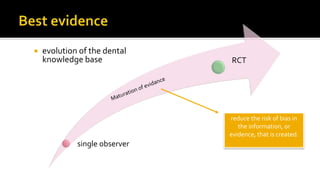
 evolution of the dental
knowledge base
single observer
RCT
reduce the risk of bias in
the information, or
evidence, that is created.
 EBD demands that the evidence upon which treatment
decisions are based have the lowest possible risk of bias.
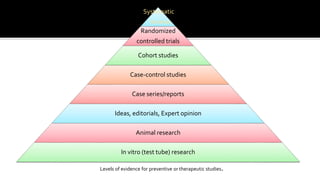
Systematic
reviews
Randomized
controlled trials
Cohort studies
Case-control studies
Case series/reports
Ideas, editorials, Expert opinion
Animal research
In vitro (test tube) research
Levels of evidence for preventive or therapeutic studies.
 RCTs or other low-bias
evidence are not available
to support every decision a
practitioner must make.
 the term best evidence really means the best available
evidence based on this hierarchy of study designs.
 If higher levels of evidence are not available (ie, systematic
reviews or RCTs), then one must seek studies lower in the
hierarchy while at the same time acknowledging the potential
for increased bias.
 In some instances, little more than expert opinion may be the
best evidence currently available.
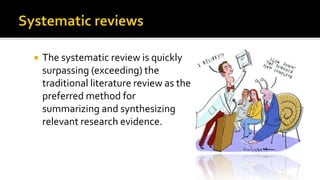
 The systematic review is quickly
surpassing (exceeding) the
traditional literature review as the
preferred method for
summarizing and synthesizing
relevant research evidence.
 Advantage
 providing clinically relevant information to aid in decision
making
 reducing the biases inherent in traditional literature reviews.
 follow strict protocols
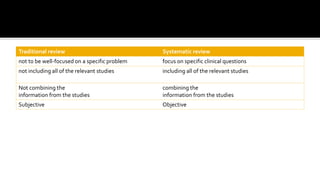
Traditional review Systematic review
not to be well-focused on a specific problem focus on specific clinical questions
not including all of the relevant studies including all of the relevant studies
Not combining the
information from the studies
combining the
information from the studies
Subjective Objective
 identifying the problem or disease of interest,
 the intervention or treatment in question,
 the comparison treatment (usually the alternative treatment),
 the outcome through which the intervention and comparison
treatments will be evaluated
 narrower focus permits a much
more careful and complete
search and selection process to
identify and include all relevant
studies that have addressed the
question of interest.
 Because the topic is limited, the
number of articles that contain
information is also usually quite
limited so that their careful
analysis is feasible
 Systematic review is to think of it
as a scientific study that is
guided by the development of a
protocol that outlines all steps in
the review process
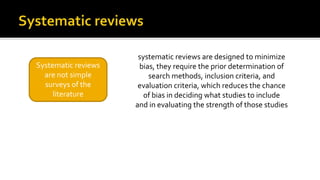
Systematic reviews
are not simple
surveys of the
literature
systematic reviews are designed to minimize
bias, they require the prior determination of
search methods, inclusion criteria, and
evaluation criteria, which reduces the chance
of bias in deciding what studies to include
and in evaluating the strength of those studies
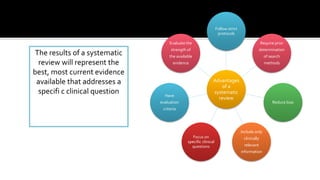
Advantages
of a
systematic
review
Follow strict
protocols
Require prior
determination
of search
methods
Reduce bias
Include only
clinically
relevant
information
Focus on
specific clinical
questions
Have
evaluation
criteria
Evaluate the
strength of
the available
evidence
The results of a systematic
review will represent the
best, most current evidence
available that addresses a
specifi c clinical question
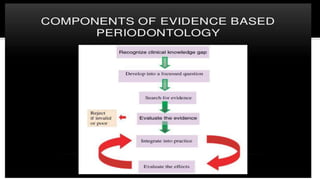
 Using EBD in clinical practice essentially involves identifying
and using the best available scientific evidence in caring for
patients
 EBD also incorporates the clinician’s expertise and the
individual patient’s needs and personal preferences during
treatment decision making.
 These decisions are ultimately made by the patient and are very
personal, and thus they will vary from patient to patient.
!!!!
accessing and using current best
available evidence is at the
forefront of the decision-
making process.
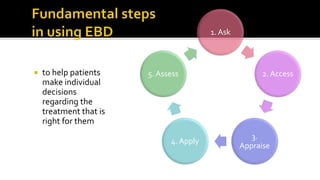
 to help patients
make individual
decisions
regarding the
treatment that is
right for them
1. Ask
2. Access
3.
Appraise
4. Apply
5. Assess
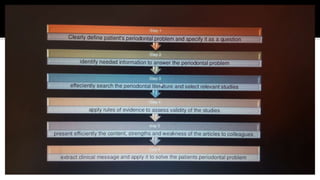
 Ask
 relevant to the condition
of the patient.
 The clinical question is
frequently described in a
PICO format.
 Access
 systematically access the most current scientific evidence on the
clinical question
 critically appraise the identified literature.
 provides insight into the strengths and weaknesses of the
study, which is necessary when deciding if and how to use
evidence from a study in practice.
 Efficient use of research and scholarship needs to be a part of
periodontal practice
 Aims to facilitate an approch , accelerating the introduction of
the best research in patient care .
 Built upon developments in clinical research design through
18th, 19th and 20th centuries .
 Evidenced based periodontology was coined by ALEXIA
ANTEZAK BOUCHKOMS and colleagues in Boston , in the
oral health group part of cochrane collaboration in 1994.
 1996- World Workshop On Periodontology (AAP) included
elements of evidenced based healthcare , supported by Micheal
Newman .
 2001- First cochrane systemic review in periodontology (
researched the effect of GTR for infra-bony defects ).
 2002- EuropeanWorkshop on periodontology – First international
workshop to use rigorous systemic reviews to inform the
consensus.
 2003- International Center for Evidenced Based Oral Health was
launched to produce high quality , evidenced based research with
an emphasis on, but not limited to periodontology and implants .
 Clinicians need to continually update on options , modalities
and rationale as new research emerges .
 By following a systemic approch , evidence can be considered
and applied to clinical practice.This approch is standardised
and repeatable , and facilitates the practice of Evidenced-
Based dentistry .
 The application of evidence is essential in modern dentistry ,
and this approch is the core of the evolution towards an
Evidence – Driven practice .
References :

Evidenced based dentistry - Dr Harshavardhan Patwal

  • 1.
    Presented by , DrHarshavardhan Patwal
  • 2.
     The evolutionof the dental knowledge base  The evolution and definition of evidence-based dentistry (EBD)  The three components of EBD: scientific evidence, the clinician’s expertise, and the patient’s needs and preferences  Best evidence  Applying EBD in practice  Evidenced based periodontology
  • 3.
     Dentists needto make clinical decisions based on limited scientific evidence. In clinical practice, a clinician must weigh a myriad of evidences every day.  The goal of evidence-based dentistry is to help practitioners provide their patients with optimal care.This is achieved by integrating sound research evidence with personal clinical expertise and patient values to determine the best course of treatment.
  • 4.
     According tothe ADA…  Evidence-based dentistry (EBD) is an approach to oral health care that requires the judicious integration of systematic assessments of clinically relevant scientific evidence, relating to the patient’s oral and medical condition and history, with the dentist’s clinical expertise and the patient’s treatment needs and preferences.
  • 5.
     Is anapproach to oral health care  Is a method to acquire, understand and apply the most current science Evidence Patient preferences & needs Clinical expertise
  • 6.
     Cookbook dentistry A standard of care  A mandate of what must be done  A substitute for clinical judgment
  • 7.
     The dentalknowledge base is simply the collection of all that is known about oral health and disease and treatment methods and outcomes.  Its contents comprise all of the  extant dental journal articles  textbooks,  the minds of all oral health practitioners.
  • 8.
     the foundationof the dental professions and the principal determinant of how dentists and dental hygienists practice  informs professional decision making, and portions of it comprise the content of predoctoral and postdoctoral dental school curricula.
  • 9.
    new information and understandingshave been contributed by researchers, practitioners, and manufacturers. the dental knowledge base has grown over time
  • 10.
    The age ofthe expert The age of professionalization The age of science The age of evidence
  • 11.
     Evidence ofthe treatment of teeth extends far back into human prehistory,and early writings discuss “tooth worms,” the supposed cause of toothache at that time.  Ancient Roman, Greek, Egyptian, and Asian cultures all contain examples of dental technology related to replacing, retaining, and crowning teeth.
  • 12.
     Barber-surgeons and toothdrawersextracted teeth for pain relief.  The knowledge and skills underlying all of this early activity was strictly experiential; practitioners learned by doing
  • 13.
     18th century Pierre Fauchard  comprehensive textbook ▪ This textbook exemplified a new era in knowledge synthesis, enabled by better access to knowledge created by other
  • 14.
     Beginning ofthe 20th century,  presaging the profession’s gradual shift from proprietary to university-based educational institutions  Scientific studies  protocol-based  controlled experimentation became more common,  causes and prevention of dental diseases.
  • 15.
     Synthesis ofknowledge evolved from simple statements of “fact” based on an expert’s experience and opinion to identification and consideration of the available information in the scientific literature.
  • 16.
     Knowledge disseminationenjoyed its most active period yet  early rapid growth of university-based predoctoral and postdoctoral dental curricula,  the proliferation of dental journals,  organized continuing dental education  congress
  • 17.
     knowledge creationin this era can be characterized by the dominance of the randomized controlled trial (RCT),  represents the research design most likely to produce an accurate and valid finding
  • 18.
     The hallmarkof the age of evidence is the systematic review  represent a substantial change in the paradigm of knowledge synthesis by  ensuring inclusion of all relevant evidence,  de-emphasizing the role of the expert,  minimizing bias through strict protocols demanding objectivity and transparency in the review process
  • 19.
     EBD isa direct descendent and analog of a similar evolution of the medical knowledge base, termed evidence-based medicine (EBM).
  • 20.
    Personal experience ofa single individual synthesized observations of multiple practitioners the results of simple, single research studies synthesized results of several research studies (ie, literature review).
  • 21.
  • 22.
     Scottish physicianand epidemiologist  advocated the application of scientific methods, especially RCTs, to evaluate the effectiveness and efficiency of medical treatments.  He is best known for his influential book  published in 1972  Effectiveness and Efficiency: Random Reflections on Health Services
  • 23.
     The principleshe clearly set out in this book were straightforward:  Because resources would always be limited, they should be used to provide those forms of health care that had been shown in properly designed evaluations to be effective.  Evidence from RCTs, he stressed, are likely to provide much more reliable information than other sources of evidence.
  • 24.
     The CochraneCollaboration, named after Archie Cochrane, is an international network of volunteers that prepares and updates systematic reviews on a broad variety of topics as well as maintains the largest collection of records of RCTs in the world
  • 25.
     Created bySackett  first used at McMaster University in 1990  describe “an attitude of enlightened skepticism toward the application of diagnostic, therapeutic, and prognostic technologies in day-to-day patient management.
  • 26.
     The termwas first published in 1991 and reached widespread visibility in 1992 with the publication of a description of the concept in the Journal of theAmerican MedicalAssociation.
  • 27.
     The classicdefinition of evidence-based medicine emerged a few years later from the same group at McMaster University who pioneered the movement:  “the conscientious, explicit and judicious use of current best evidence in making decisions about the care of the individual patient.”  This definition focuses on the integration of individual clinical expertise with the best available external clinical evidence.  This definition was refined a few years later to incorporate patient preferences and values
  • 28.
    “An approach tooral healthcare that requires the judicious integration of systematic assessments of clinically relevant scientific evidence, relating to the patient’s oral and medical condition and history, with the dentist’s clinical expertise and the patient’s treatment needs and preferences.”
  • 29.
  • 30.
     best evidenceand systematic reviews
  • 31.
     Not allevidence is created equal.  Some evidence is more likely to be valid than other evidence
  • 32.
     Validity  measureshow accurately the evidence reflects what is true, and it is an essential characteristic of evidence.  Some types of evidence are more vulnerable to bias than others, bias is the principal enemy of validity
  • 33.
     Bias isthe existence of factors or processes that can influence the results or conclusions of a trial.  Bias occurs when there are important differences in  (1) the way in which subjects or groups of subjects are treated or observed or  (2) how data is measured or analyzed.
  • 34.
     evolution ofthe dental knowledge base single observer RCT reduce the risk of bias in the information, or evidence, that is created.
  • 35.
     EBD demandsthat the evidence upon which treatment decisions are based have the lowest possible risk of bias.
  • 36.
    Systematic reviews Randomized controlled trials Cohort studies Case-controlstudies Case series/reports Ideas, editorials, Expert opinion Animal research In vitro (test tube) research Levels of evidence for preventive or therapeutic studies.
  • 37.
     RCTs orother low-bias evidence are not available to support every decision a practitioner must make.
  • 38.
     the termbest evidence really means the best available evidence based on this hierarchy of study designs.  If higher levels of evidence are not available (ie, systematic reviews or RCTs), then one must seek studies lower in the hierarchy while at the same time acknowledging the potential for increased bias.  In some instances, little more than expert opinion may be the best evidence currently available.
  • 39.
     The systematicreview is quickly surpassing (exceeding) the traditional literature review as the preferred method for summarizing and synthesizing relevant research evidence.
  • 40.
     Advantage  providingclinically relevant information to aid in decision making  reducing the biases inherent in traditional literature reviews.  follow strict protocols
  • 41.
    Traditional review Systematicreview not to be well-focused on a specific problem focus on specific clinical questions not including all of the relevant studies including all of the relevant studies Not combining the information from the studies combining the information from the studies Subjective Objective
  • 42.
     identifying theproblem or disease of interest,  the intervention or treatment in question,  the comparison treatment (usually the alternative treatment),  the outcome through which the intervention and comparison treatments will be evaluated
  • 43.
     narrower focuspermits a much more careful and complete search and selection process to identify and include all relevant studies that have addressed the question of interest.  Because the topic is limited, the number of articles that contain information is also usually quite limited so that their careful analysis is feasible
  • 44.
     Systematic reviewis to think of it as a scientific study that is guided by the development of a protocol that outlines all steps in the review process
  • 45.
    Systematic reviews are notsimple surveys of the literature systematic reviews are designed to minimize bias, they require the prior determination of search methods, inclusion criteria, and evaluation criteria, which reduces the chance of bias in deciding what studies to include and in evaluating the strength of those studies
  • 46.
    Advantages of a systematic review Follow strict protocols Requireprior determination of search methods Reduce bias Include only clinically relevant information Focus on specific clinical questions Have evaluation criteria Evaluate the strength of the available evidence The results of a systematic review will represent the best, most current evidence available that addresses a specifi c clinical question
  • 47.
     Using EBDin clinical practice essentially involves identifying and using the best available scientific evidence in caring for patients  EBD also incorporates the clinician’s expertise and the individual patient’s needs and personal preferences during treatment decision making.  These decisions are ultimately made by the patient and are very personal, and thus they will vary from patient to patient.
  • 48.
    !!!! accessing and usingcurrent best available evidence is at the forefront of the decision- making process.
  • 49.
     to helppatients make individual decisions regarding the treatment that is right for them 1. Ask 2. Access 3. Appraise 4. Apply 5. Assess
  • 50.
     Ask  relevantto the condition of the patient.  The clinical question is frequently described in a PICO format.
  • 51.
     Access  systematicallyaccess the most current scientific evidence on the clinical question
  • 52.
     critically appraisethe identified literature.  provides insight into the strengths and weaknesses of the study, which is necessary when deciding if and how to use evidence from a study in practice.
  • 53.
     Efficient useof research and scholarship needs to be a part of periodontal practice  Aims to facilitate an approch , accelerating the introduction of the best research in patient care .
  • 54.
     Built upondevelopments in clinical research design through 18th, 19th and 20th centuries .  Evidenced based periodontology was coined by ALEXIA ANTEZAK BOUCHKOMS and colleagues in Boston , in the oral health group part of cochrane collaboration in 1994.
  • 55.
     1996- WorldWorkshop On Periodontology (AAP) included elements of evidenced based healthcare , supported by Micheal Newman .  2001- First cochrane systemic review in periodontology ( researched the effect of GTR for infra-bony defects ).  2002- EuropeanWorkshop on periodontology – First international workshop to use rigorous systemic reviews to inform the consensus.  2003- International Center for Evidenced Based Oral Health was launched to produce high quality , evidenced based research with an emphasis on, but not limited to periodontology and implants .
  • 59.
     Clinicians needto continually update on options , modalities and rationale as new research emerges .  By following a systemic approch , evidence can be considered and applied to clinical practice.This approch is standardised and repeatable , and facilitates the practice of Evidenced- Based dentistry .  The application of evidence is essential in modern dentistry , and this approch is the core of the evolution towards an Evidence – Driven practice .
  • 60.