REVIEW
• Random Variable
•Types of Random Variable
1. Discrete Random Variable
2. Continuous Random Variable
2.
Motivation
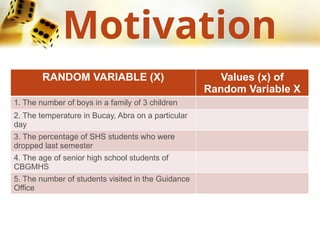
RANDOM VARIABLE (X)Values (x) of
Random Variable X
1. The number of boys in a family of 3 children
2. The temperature in Bucay, Abra on a particular
day
3. The percentage of SHS students who were
dropped last semester
4. The age of senior high school students of
CBGMHS
5. The number of students visited in the Guidance
Office
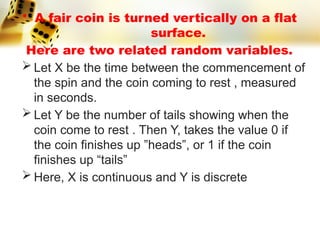
• A faircoin is turned vertically on a flat
surface.
Here are two related random variables.
Let X be the time between the commencement of
the spin and the coin coming to rest , measured
in seconds.
Let Y be the number of tails showing when the
coin come to rest . Then Y, takes the value 0 if
the coin finishes up ”heads”, or 1 if the coin
finishes up “tails”
Here, X is continuous and Y is discrete
OBJECTIVES:
• Find thepossible values of a
random variable
• Illustrate a probability distribution
for a discrete random variable
• Construct a discrete probability
distribution
7.
Discrete Random Probability
Distribution
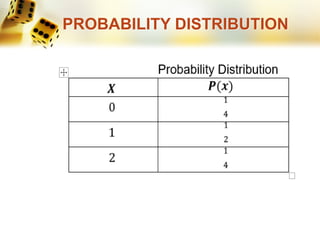
Theprobability distribution of a
discrete random variable, X, is a list
of all possible values of x can
take and the associated
probabilities.
Example 1:
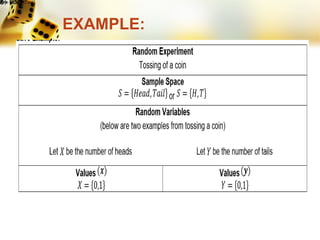
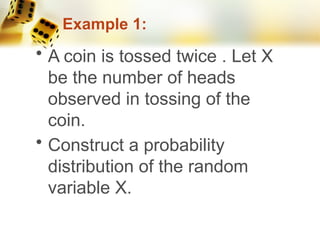
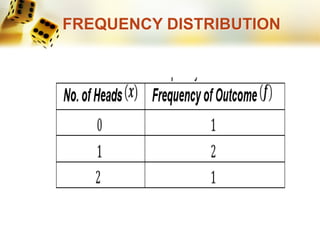
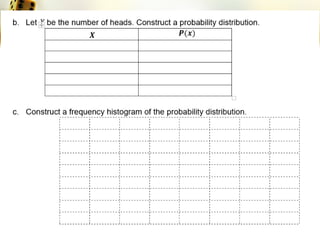
• Acoin is tossed twice . Let X
be the number of heads
observed in tossing of the
coin.
• Construct a probability
distribution of the random
variable X.
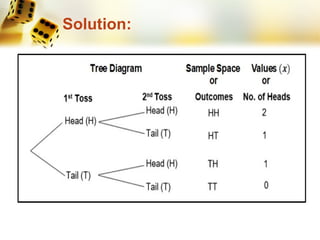
Computing the probabilityof
each outcome
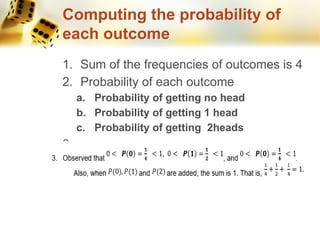
1. Sum of the frequencies of outcomes is 4
2. Probability of each outcome
a. Probability of getting no head
b. Probability of getting 1 head
c. Probability of getting 2heads
3.
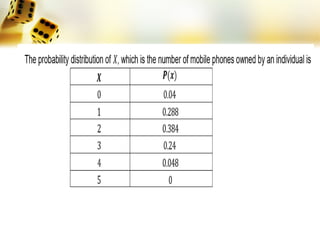
#7 Each value of a discrete random variable can be assigned a probability. By listing each value of the random variable with its corresponding probability, a discrete probability distribution is formed.
As the probability distribution includes all possible outcomes for , and these outcomes are mutually exclusive (only one can occur at once) the probability of each value of the discrete random variable is from 0 to 1.
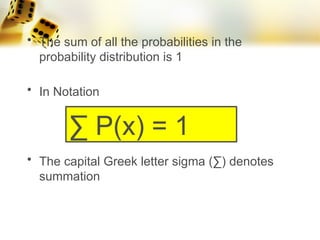
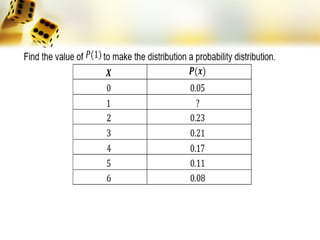
#8 The sum of all the probabilities in the probability distribution is
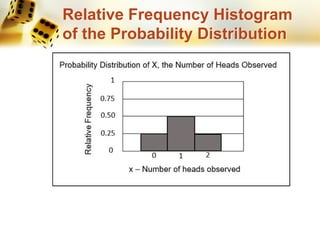
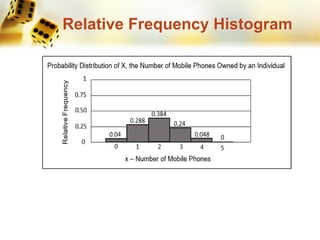
#9 Because probabilities represent relative frequencies, a discrete probability distribution can be graphed with a relative frequency histogram.
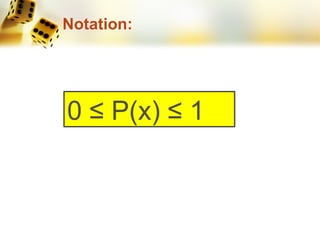
#14 Notice that the probabilities of all outcomes are between 0 and 1 ; and the sum of the probabilities of all outcomes is 1 . Thus, if x is the outcome (Number of heads) and P(x) is the probability, then the probability distribution of X, the number of heads observed is
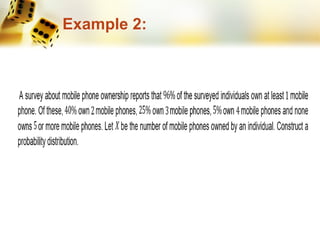
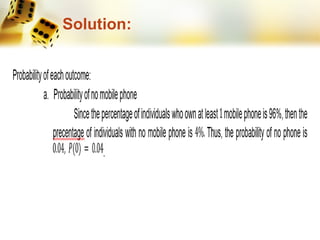
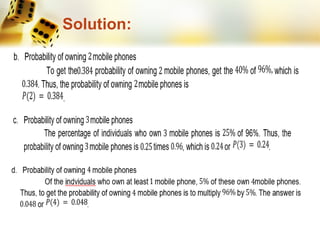
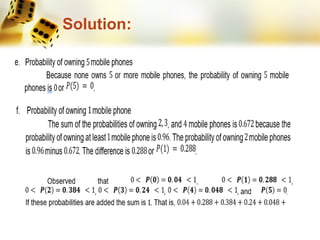
#18 Before one can find the probability of owning 1 mobile phone, the probabilities of owning 2,3 , and 4 mobile phones shall be computed first. The probability of owning 1 mobile phone is equal to the probability of owning at least 1 phone minus the probabilities of owning 2,3 , and 4 mobile phones.
#19 Before one can find the probability of owning 1 mobile phone, the probabilities of owning 2,3 , and 4 mobile phones shall be computed first. The probability of owning 1 mobile phone is equal to the probability of owning at least 1 phone minus the probabilities of owning 2,3 , and 4 mobile phones.
#20 Before one can find the probability of owning 1 mobile phone, the probabilities of owning 2,3 , and 4 mobile phones shall be computed first. The probability of owning 1 mobile phone is equal to the probability of owning at least 1 phone minus the probabilities of owning 2,3 , and 4 mobile phones.