We The People
• Declares who is enacting this Constitution
• The Constitution is “owned” by the
people, not by the government
• Responsible for its continued existence
and its faithful interpretation.
in Order to form a more perfect
Union
• Dissatisfied with the United States under
the Articles of Confederation,
• Framers strived for something better.
in Order to form a more perfect
Union
• The new United States, under this new
Constitution, would be more perfect. Not
perfect, but more perfect.
establish Justice
• Injustice, unfairness of laws and in trade,
was of great concern to the people of 1787.
establish Justice
• Create level playing field
–Courts established with uniformity
–Trade within and outside the borders of
the country would be fair
establish Justice
• Our system of justice that is one of the
fairest in the world.
• We still strive for the justice that the
Framers wrote about.
insure domestic Tranquility
• Shays' Rebellion
• The keeping of the peace was on
everyone's mind
insure domestic Tranquility
• maintenance of tranquility at home was a
prime concern.
• The new powers given the federal
government would prevent any such
rebellions in the future.
provide for the common defense
• The new nation was fearful of attack from
all sides
• Britain and Spain, Indian attacks
promote the general Welfare
• to allow every state and every citizen of
those states to benefit from what the
government could provide.
and secure the Blessings of
Liberty to ourselves and our
Posterity
• blessings of liberty — something they had
all fought hard for just a decade before.
and secure the Blessings of
Liberty to ourselves and our
Posterity
• a nation where citizens could look
forward to being free as opposed to
looking out for the interests of a king
and secure the Blessings of
Liberty to ourselves and our
Posterity
• Framers wanted to be sure that the future
generations of Americans would enjoy the
same.
do ordain and establish this
Constitution for the United States of
America
• Finishes the "We, the people" thought,
• Says what we the people are actually
doing;
• it gives us a name for this document,
do ordain and establish this
Constitution for the United States of
America
• it restates the name of the nation adopting
the Constitution.
• That the Constitution is "ordained"
reminds us of the higher power involved
here —the people themselves.
do ordain and establish this
Constitution for the United States of
America
• That it is "established" reminds us that it
replaces that which came before — the
United States under the Articles
Structure of the Constitution
Articles:
• – I: Legislative Branch
• – II: Executive Branch
• – III: Judicial Branch
• – IV: Relations Among the
• States
• – V: Amendment Process
• – VI: Federal Power
• – VII: Ratification
• • Amendments:
• – 27 Total
• – 1st ten are the Bill of
Rights
Article I: Legislative Branch
Bicameral
• Senate
– 2 Senators for each
state
– 6 year terms
– 30 years old
– citizens of the US for
at least the past nine
years
– they must live in the
states they want to
represent at the time
of their election
• House of
Representatives
– Based on population
– 2 year terms
– 25 years old
– citizen US for the past
seven years
– they must live in the
states they want to
represent at the time
of their election
Article I: Legislative Branch
Powers Given to Congress
• Enumerated
– Given specifically to Congress
• Implied
– given to Congress that are general
• Inherent
– Unlisted but the government is assumed to have
Article I: Legislative Branch
Powers of Congress
• Important Powers
– Make laws
– Set taxes
– Declare war
– Override Vetoes
– Borrow money
– Regulate international
and national trade
– Print money
• Article I, Section
8: Powers of
Congress
Necessary and Proper Clause
• Article I, Section 8, Clause 18
• “elastic clause”
• “The Congress shall have Power ... To
make all Laws which shall be necessary
and proper for carrying into Execution the
foregoing Powers, and all other Powers
vested by this Constitution in the
Government of the United States...”
Powers Given to the Goverment
• Delegated
– Powers given to the national government
• Concurrent
– Powers shared between state and national
governments
• Reserved
– Powers only the states have
Article II: Executive Branch
• President and Vice
• President
– 4 year terms
Qualifications:
• At least 35 years old
• Live in US for 14 years
• Natural born citizen
• Electoral College
Article II: Executive Branch
• Important powers:
• Commander-in-Chief
• Grant pardons
• Make treaties
• Appoint federal officers
• Ensure laws are
executed
Electoral College
What is it?
• Vote for a slate of electors who are
pledged to vote for a particles candidate
• Elections are not a total number of votes
–They are 50 state elections
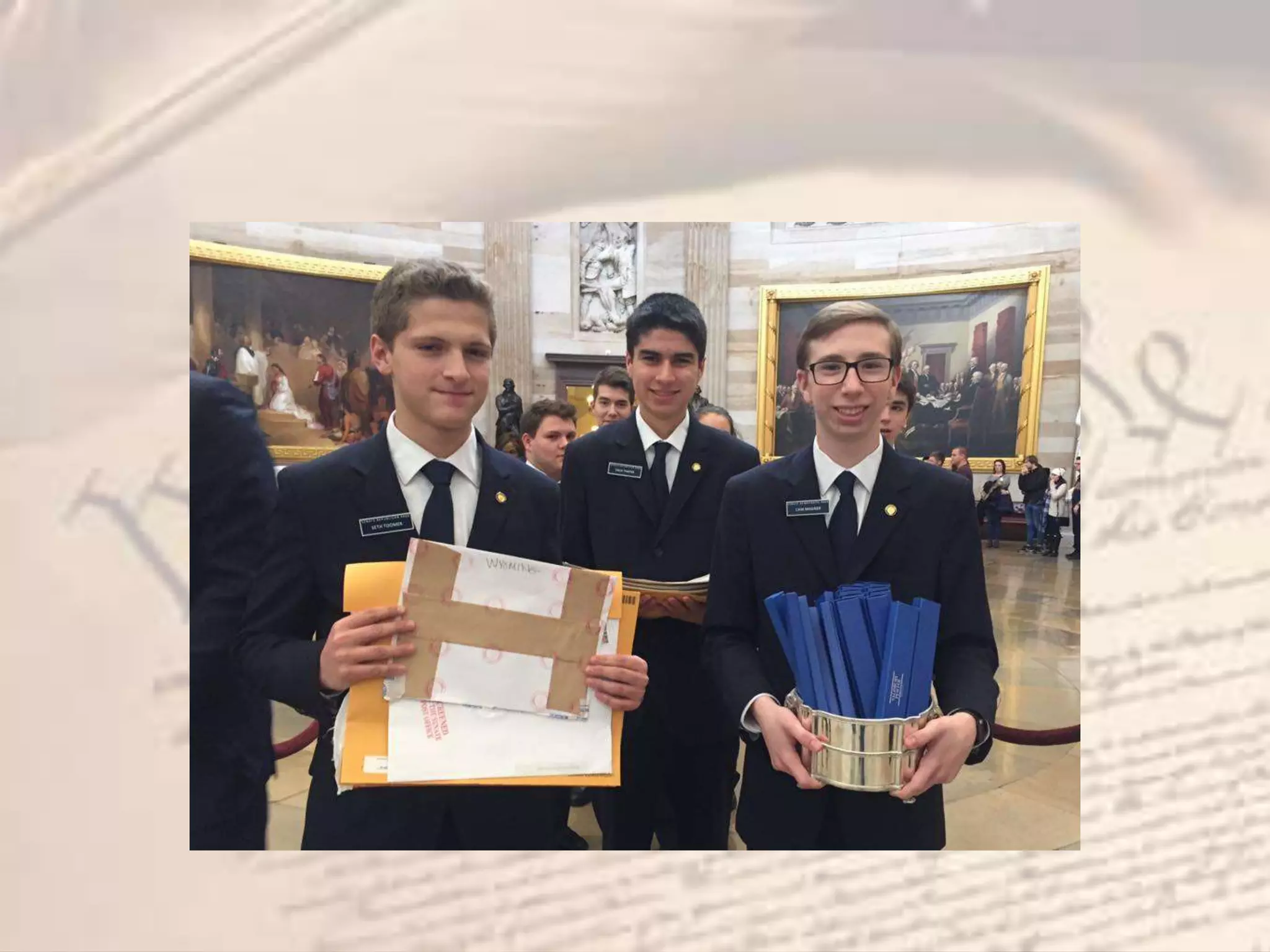
• 538 electors from across America will
make the vote that counts on the first
Monday after the second Wednesday in
December
Why?
• Founding fathers lack of trust in the
judgment of people
• Gives the states a voice in the presidential
election
Electoral College
• 12 Amendment
• Each Elector
– Cast one vote for president
– Cast a separate vote for vice president
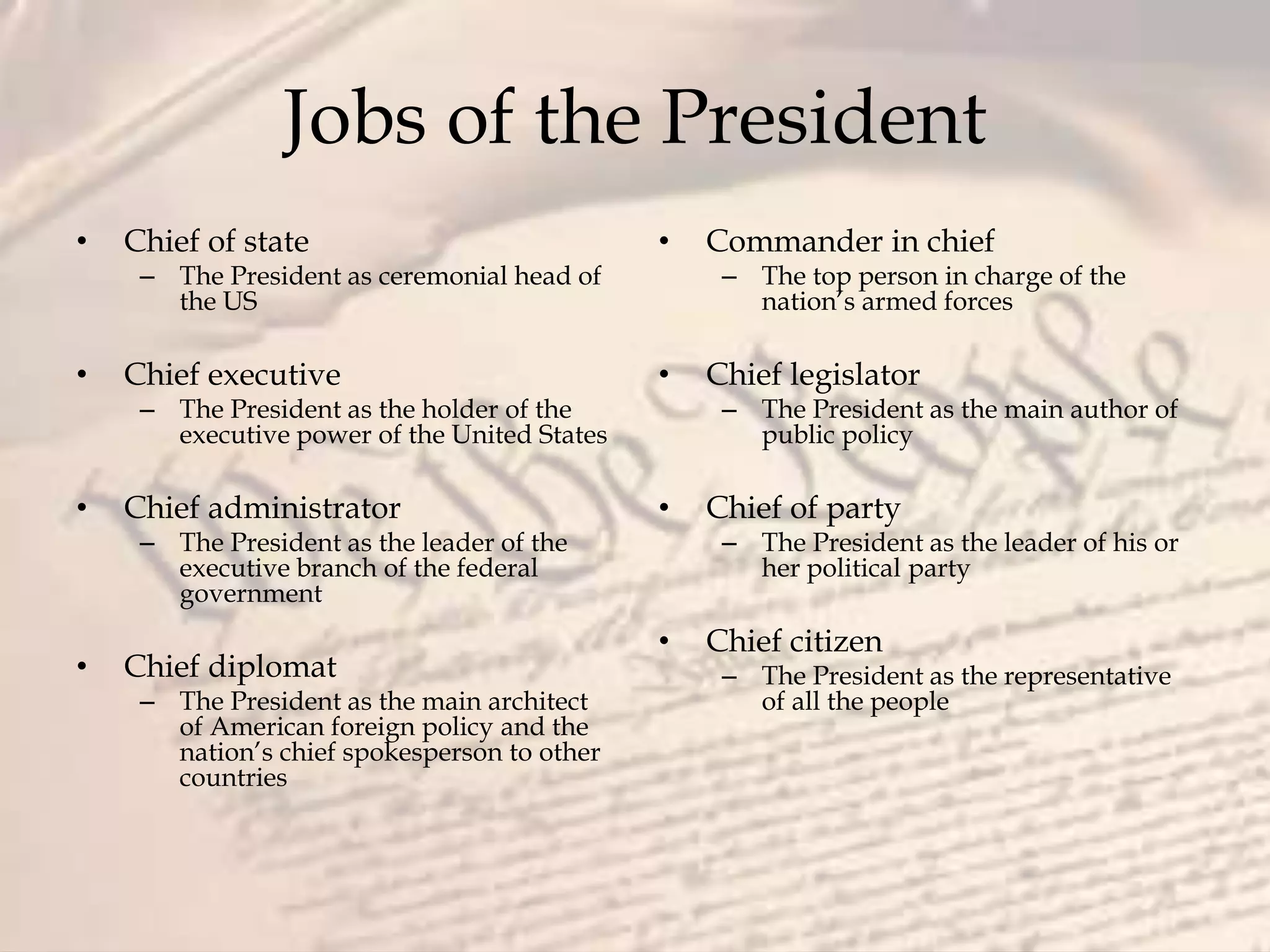
Jobs of the President
• Chief of state
– The President as ceremonial head of
the US
• Chief executive
– The President as the holder of the
executive power of the United States
• Chief administrator
– The President as the leader of the
executive branch of the federal
government
• Chief diplomat
– The President as the main architect
of American foreign policy and the
nation’s chief spokesperson to other
countries
• Commander in chief
– The top person in charge of the
nation’s armed forces
• Chief legislator
– The President as the main author of
public policy
• Chief of party
– The President as the leader of his or
her political party
• Chief citizen
– The President as the representative
of all the people
Article III: Judicial Branch
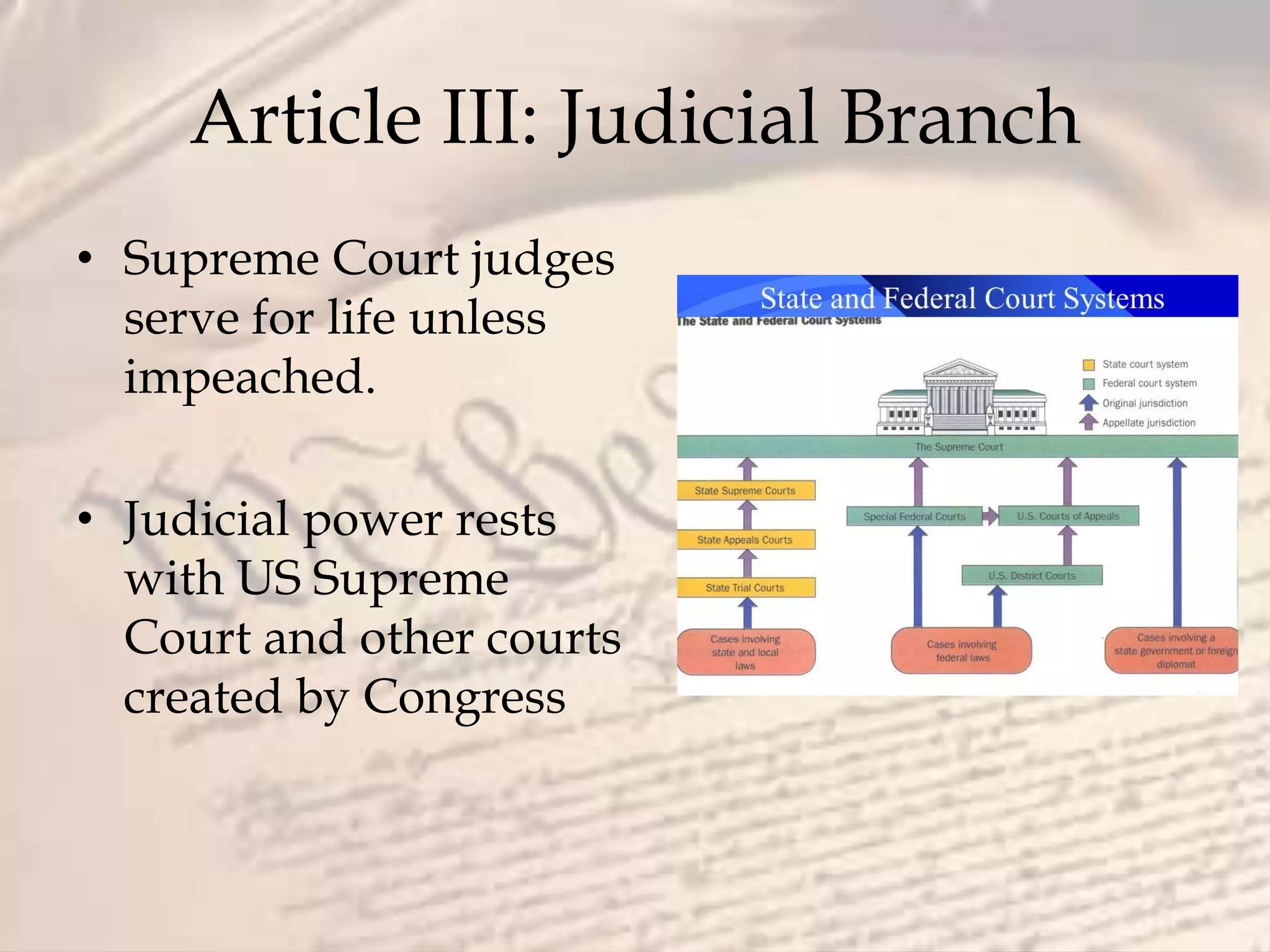
• Supreme Court judges
serve for life unless
impeached.
• Judicial power rests
with US Supreme
Court and other courts
created by Congress
Article III: Judicial Branch
• Important Powers:
• Decides cases of
Constitutional law
and federal law
• Cases involving
ambassadors go
straight to Supreme
Court
• Judicial Review
comes later (1803
Article IV: The States
• All states will honor
the laws of other
states.
• New states can be
admitted (with some
qualifications)
• Ensures a republican
government for all
states.
• Ensures the
government will
protect the states
against foreign or
domestic invasions
& revolutions
Full Faith & Credit Clause
• Article IV Section 1
• “Full Faith and Credit shall be given in
each State to the public Acts, Records and
Judicial proceeding s of every other
state…”
• States must recognize the public acts,
records & judicial proceedings of every
other state
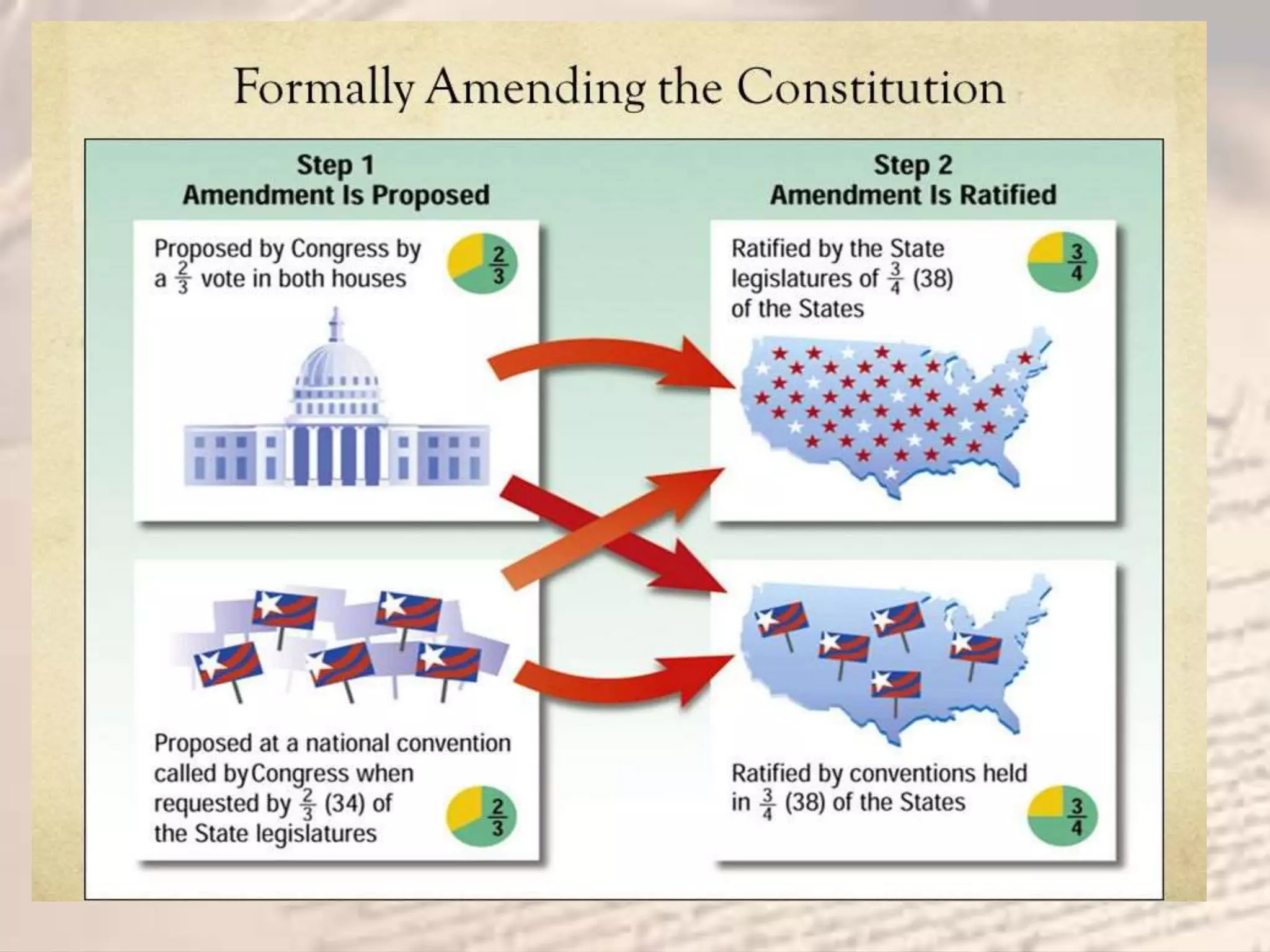
Article V: Amending
• Proposed by 2/3rds
of both houses or by
a national
convention.
• 3/4ths of the states
must agree.
Amendments That Failed
• Nationwide dueling ban (1838)
• Limiting personal wealth to $1 million (1933)
• Abolishing Army/Navy (1893)
• One six-year term for a president with no reelection (1977)
• Put all wars to a vote… and if you vote yes, you’re enlisted
(1916)
• Ban interracial marriage (1912)
• Making divorce illegal (1884)
• A ban on drunkenness (1938)
• Instead of one president, three presidents (1878)
• Ban on pollution (1971)
• Renaming the country “United States of the Earth” (1893)
Article VI: The US
• Government will
assume all debts
entered into by the
U.S. under the
Articles of
Confederation.
• Requires an oath of
allegiance to the U.S.
& the Constitution
when taking office.
Supremacy Clause
• Article VI, Clause 2
• “This Constitution, and the Laws of the
United States which shall be made in
Pursuance thereof; and all Treaties made, or
which shall be made, under the Authority of
the United States, shall be the supreme Law
of the Land; and the Judges in every State
shall be bound thereby, any Thing in the
Constitution or Laws of any State to the
Contrary notwithstanding.”
Article VII: Ratification
• Details the method
for ratification of the
Constitution (making
the Constitution law).
• Nine of the thirteen
states had to accept it
before it could go into
effect.

Preamble Articles of the Constitution 2019

  • 1.
    We The People •Declares who is enacting this Constitution • The Constitution is “owned” by the people, not by the government • Responsible for its continued existence and its faithful interpretation.
  • 2.
    in Order toform a more perfect Union • Dissatisfied with the United States under the Articles of Confederation, • Framers strived for something better.
  • 3.
    in Order toform a more perfect Union • The new United States, under this new Constitution, would be more perfect. Not perfect, but more perfect.
  • 4.
    establish Justice • Injustice,unfairness of laws and in trade, was of great concern to the people of 1787.
  • 5.
    establish Justice • Createlevel playing field –Courts established with uniformity –Trade within and outside the borders of the country would be fair
  • 6.
    establish Justice • Oursystem of justice that is one of the fairest in the world. • We still strive for the justice that the Framers wrote about.
  • 7.
    insure domestic Tranquility •Shays' Rebellion • The keeping of the peace was on everyone's mind
  • 8.
    insure domestic Tranquility •maintenance of tranquility at home was a prime concern. • The new powers given the federal government would prevent any such rebellions in the future.
  • 9.
    provide for thecommon defense • The new nation was fearful of attack from all sides • Britain and Spain, Indian attacks
  • 10.
    promote the generalWelfare • to allow every state and every citizen of those states to benefit from what the government could provide.
  • 11.
    and secure theBlessings of Liberty to ourselves and our Posterity • blessings of liberty — something they had all fought hard for just a decade before.
  • 12.
    and secure theBlessings of Liberty to ourselves and our Posterity • a nation where citizens could look forward to being free as opposed to looking out for the interests of a king
  • 13.
    and secure theBlessings of Liberty to ourselves and our Posterity • Framers wanted to be sure that the future generations of Americans would enjoy the same.
  • 14.
    do ordain andestablish this Constitution for the United States of America • Finishes the "We, the people" thought, • Says what we the people are actually doing; • it gives us a name for this document,
  • 15.
    do ordain andestablish this Constitution for the United States of America • it restates the name of the nation adopting the Constitution. • That the Constitution is "ordained" reminds us of the higher power involved here —the people themselves.
  • 16.
    do ordain andestablish this Constitution for the United States of America • That it is "established" reminds us that it replaces that which came before — the United States under the Articles
  • 17.
    Structure of theConstitution Articles: • – I: Legislative Branch • – II: Executive Branch • – III: Judicial Branch • – IV: Relations Among the • States • – V: Amendment Process • – VI: Federal Power • – VII: Ratification • • Amendments: • – 27 Total • – 1st ten are the Bill of Rights
  • 18.
    Article I: LegislativeBranch Bicameral • Senate – 2 Senators for each state – 6 year terms – 30 years old – citizens of the US for at least the past nine years – they must live in the states they want to represent at the time of their election • House of Representatives – Based on population – 2 year terms – 25 years old – citizen US for the past seven years – they must live in the states they want to represent at the time of their election
  • 19.
    Article I: LegislativeBranch Powers Given to Congress • Enumerated – Given specifically to Congress • Implied – given to Congress that are general • Inherent – Unlisted but the government is assumed to have
  • 20.
    Article I: LegislativeBranch Powers of Congress • Important Powers – Make laws – Set taxes – Declare war – Override Vetoes – Borrow money – Regulate international and national trade – Print money • Article I, Section 8: Powers of Congress
  • 21.
    Necessary and ProperClause • Article I, Section 8, Clause 18 • “elastic clause” • “The Congress shall have Power ... To make all Laws which shall be necessary and proper for carrying into Execution the foregoing Powers, and all other Powers vested by this Constitution in the Government of the United States...”
  • 22.
    Powers Given tothe Goverment • Delegated – Powers given to the national government • Concurrent – Powers shared between state and national governments • Reserved – Powers only the states have
  • 23.
    Article II: ExecutiveBranch • President and Vice • President – 4 year terms Qualifications: • At least 35 years old • Live in US for 14 years • Natural born citizen • Electoral College
  • 24.
    Article II: ExecutiveBranch • Important powers: • Commander-in-Chief • Grant pardons • Make treaties • Appoint federal officers • Ensure laws are executed
  • 25.
  • 26.
    What is it? •Vote for a slate of electors who are pledged to vote for a particles candidate • Elections are not a total number of votes –They are 50 state elections
  • 27.
    • 538 electorsfrom across America will make the vote that counts on the first Monday after the second Wednesday in December
  • 28.
    Why? • Founding fatherslack of trust in the judgment of people • Gives the states a voice in the presidential election
  • 30.
    Electoral College • 12Amendment • Each Elector – Cast one vote for president – Cast a separate vote for vice president
  • 31.
    Jobs of thePresident • Chief of state – The President as ceremonial head of the US • Chief executive – The President as the holder of the executive power of the United States • Chief administrator – The President as the leader of the executive branch of the federal government • Chief diplomat – The President as the main architect of American foreign policy and the nation’s chief spokesperson to other countries • Commander in chief – The top person in charge of the nation’s armed forces • Chief legislator – The President as the main author of public policy • Chief of party – The President as the leader of his or her political party • Chief citizen – The President as the representative of all the people
  • 32.
    Article III: JudicialBranch • Supreme Court judges serve for life unless impeached. • Judicial power rests with US Supreme Court and other courts created by Congress
  • 34.
    Article III: JudicialBranch • Important Powers: • Decides cases of Constitutional law and federal law • Cases involving ambassadors go straight to Supreme Court • Judicial Review comes later (1803
  • 35.
    Article IV: TheStates • All states will honor the laws of other states. • New states can be admitted (with some qualifications) • Ensures a republican government for all states. • Ensures the government will protect the states against foreign or domestic invasions & revolutions
  • 36.
    Full Faith &Credit Clause • Article IV Section 1 • “Full Faith and Credit shall be given in each State to the public Acts, Records and Judicial proceeding s of every other state…” • States must recognize the public acts, records & judicial proceedings of every other state
  • 37.
    Article V: Amending •Proposed by 2/3rds of both houses or by a national convention. • 3/4ths of the states must agree.
  • 38.
    Amendments That Failed •Nationwide dueling ban (1838) • Limiting personal wealth to $1 million (1933) • Abolishing Army/Navy (1893) • One six-year term for a president with no reelection (1977) • Put all wars to a vote… and if you vote yes, you’re enlisted (1916) • Ban interracial marriage (1912) • Making divorce illegal (1884) • A ban on drunkenness (1938) • Instead of one president, three presidents (1878) • Ban on pollution (1971) • Renaming the country “United States of the Earth” (1893)
  • 40.
    Article VI: TheUS • Government will assume all debts entered into by the U.S. under the Articles of Confederation. • Requires an oath of allegiance to the U.S. & the Constitution when taking office.
  • 41.
    Supremacy Clause • ArticleVI, Clause 2 • “This Constitution, and the Laws of the United States which shall be made in Pursuance thereof; and all Treaties made, or which shall be made, under the Authority of the United States, shall be the supreme Law of the Land; and the Judges in every State shall be bound thereby, any Thing in the Constitution or Laws of any State to the Contrary notwithstanding.”
  • 42.
    Article VII: Ratification •Details the method for ratification of the Constitution (making the Constitution law). • Nine of the thirteen states had to accept it before it could go into effect.