Taste and Smell
The Chemical Senses
The Chemical Senses
• Specialized to detect chemicals dissolved in a
fluid
• The fluid may be saliva, mucous, or blood
plasma
• Rely on receptors that interact with specific
molecules to generate an action potential
• Receptors are integrated with two or more
tissue types making them fit the definition of
“organ”
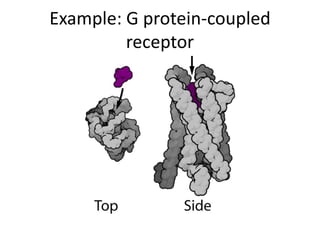
Example: G protein-coupled
receptor
Smell (Olfaction)
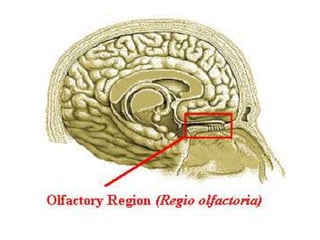
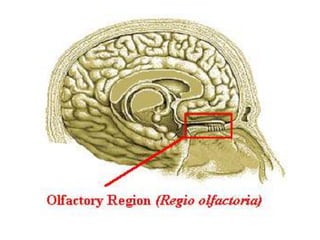
• Detected by thousands of chemoreceptors
located in the upper wall of the nasal cavities
• Receptors located in a small space about ½
square inch and are associated with other
cells to form the olfactory organs
• These receptors are capable of gathering up to
50 individual sensations which are combined
in the brain to an almost infinite number of
smells
Smell
• The number of individual sensations
decreases with age and varies with individuals
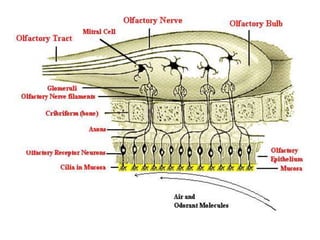
• The receptor cells are neurons embedded
within the mucous membrane of the nasal
epithelium
• The dendrites of these cells are known as
olfactory hairs, which physically interact with
odorants, and the axons extend into the
olfactory bulb of the brain (Animation)
Olfactory Pathway
• Inhaling causes gas molecules to move into
the nasal cavity where they dissolve into
mucous
• Begins with olfactory hairs of receptor cells
interacting with molecules; if an action
potential is generated, it will move up to the
olfactory bulb, located beneath the origin of
the olfactory nerves
Olfactory Pathway
• From the olfactory bulb the impulse continues
along to the frontal lobes of the cerebral
cortex for interpretation
• This makes smells linked very powerfully to
memories
• Video: How Many Smells Can We Smell?
Taste
• The sense of taste is also known as gustation
• Often works with smell to gain a complete
analysis of the sensation
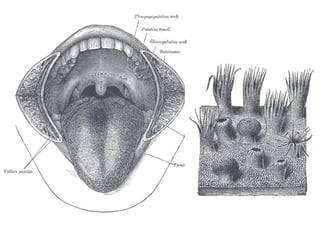
• Special organs of taste are known as “taste
buds” and approximately 10,000 are located
on the surface of the tongue within small
elevations known as papillae
• Other taste buds may be found on the roof of
the mouth and walls of the pharynx
Taste
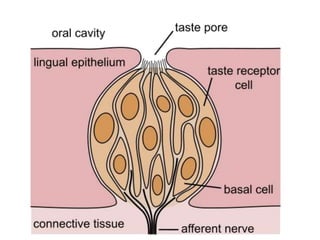
• Each taste bud has several taste receptors,
known as gustatory cells
• The free ends of gustatory cells have
microvilli, called taste hairs that project
through an opening in the taste bud known as
a taste pore
• At the base of the gustatory cells is a network
of sensory nerve fiber endings (Animation)
Taste
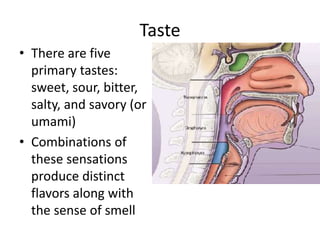
• There are five
primary tastes:
sweet, sour, bitter,
salty, and savory (or
umami)
• Combinations of
these sensations
produce distinct
flavors along with
the sense of smell
Gustatory Pathway
• If an action potential is produced by a
gustatory cell, the nerve impulse travels up
the cranial nerve to the medulla oblongata
before being directed to the gustatory center
in the cerebral cortex

Taste and Smell2.ppt

  • 1.
    Taste and Smell TheChemical Senses
  • 2.
    The Chemical Senses •Specialized to detect chemicals dissolved in a fluid • The fluid may be saliva, mucous, or blood plasma • Rely on receptors that interact with specific molecules to generate an action potential • Receptors are integrated with two or more tissue types making them fit the definition of “organ”
  • 3.
  • 4.
    Smell (Olfaction) • Detectedby thousands of chemoreceptors located in the upper wall of the nasal cavities • Receptors located in a small space about ½ square inch and are associated with other cells to form the olfactory organs • These receptors are capable of gathering up to 50 individual sensations which are combined in the brain to an almost infinite number of smells
  • 7.
    Smell • The numberof individual sensations decreases with age and varies with individuals • The receptor cells are neurons embedded within the mucous membrane of the nasal epithelium • The dendrites of these cells are known as olfactory hairs, which physically interact with odorants, and the axons extend into the olfactory bulb of the brain (Animation)
  • 8.
    Olfactory Pathway • Inhalingcauses gas molecules to move into the nasal cavity where they dissolve into mucous • Begins with olfactory hairs of receptor cells interacting with molecules; if an action potential is generated, it will move up to the olfactory bulb, located beneath the origin of the olfactory nerves
  • 10.
    Olfactory Pathway • Fromthe olfactory bulb the impulse continues along to the frontal lobes of the cerebral cortex for interpretation • This makes smells linked very powerfully to memories • Video: How Many Smells Can We Smell?
  • 11.
    Taste • The senseof taste is also known as gustation • Often works with smell to gain a complete analysis of the sensation • Special organs of taste are known as “taste buds” and approximately 10,000 are located on the surface of the tongue within small elevations known as papillae • Other taste buds may be found on the roof of the mouth and walls of the pharynx
  • 13.
    Taste • Each tastebud has several taste receptors, known as gustatory cells • The free ends of gustatory cells have microvilli, called taste hairs that project through an opening in the taste bud known as a taste pore • At the base of the gustatory cells is a network of sensory nerve fiber endings (Animation)
  • 15.
    Taste • There arefive primary tastes: sweet, sour, bitter, salty, and savory (or umami) • Combinations of these sensations produce distinct flavors along with the sense of smell
  • 16.
    Gustatory Pathway • Ifan action potential is produced by a gustatory cell, the nerve impulse travels up the cranial nerve to the medulla oblongata before being directed to the gustatory center in the cerebral cortex