
© 2002, Cisco Systems, Inc. All rights reserved.
© 2002, Cisco Systems, Inc. All rights reserved. ICND v2.0—5-2© 2002, Cisco Systems, Inc. All rights reserved. 2
Link-State and Balanced Hybrid
Routing
© 2002, Cisco Systems, Inc. All rights reserved. ICND v2.0—5-3
Objectives
Upon completing this lesson, you will be
able to:
• Describe the issues associated with link-state
routing and identify solutions to those issues
• Describe the features of balanced hybrid routing
protocols
© 2002, Cisco Systems, Inc. All rights reserved. ICND v2.0—5-4
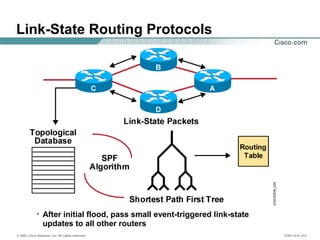
• After initial flood, pass small event-triggered link-state
updates to all other routers
Link-State Routing Protocols
© 2002, Cisco Systems, Inc. All rights reserved. ICND v2.0—5-5
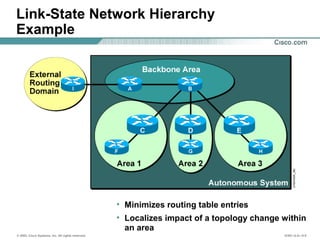
• Minimizes routing table entries
• Localizes impact of a topology change within
an area
Link-State Network Hierarchy
Example
© 2002, Cisco Systems, Inc. All rights reserved. ICND v2.0—5-6
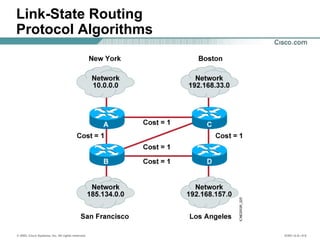
Link-State Routing
Protocol Algorithms
© 2002, Cisco Systems, Inc. All rights reserved. ICND v2.0—5-7
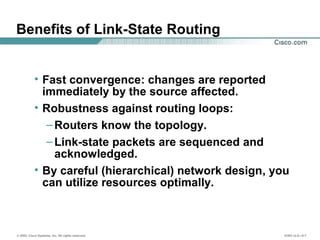
Benefits of Link-State Routing
• Fast convergence: changes are reported
immediately by the source affected.
• Robustness against routing loops:
–Routers know the topology.
–Link-state packets are sequenced and
acknowledged.
• By careful (hierarchical) network design, you
can utilize resources optimally.
© 2002, Cisco Systems, Inc. All rights reserved. ICND v2.0—5-8
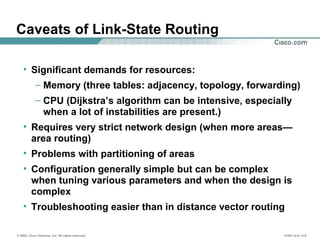
Caveats of Link-State Routing
• Significant demands for resources:
– Memory (three tables: adjacency, topology, forwarding)
– CPU (Dijkstra’s algorithm can be intensive, especially
when a lot of instabilities are present.)
• Requires very strict network design (when more areas—
area routing)
• Problems with partitioning of areas
• Configuration generally simple but can be complex
when tuning various parameters and when the design is
complex
• Troubleshooting easier than in distance vector routing
© 2002, Cisco Systems, Inc. All rights reserved. ICND v2.0—5-9
Drawbacks to Link-State Routing
Protocols
• Initial discovery may cause flooding.
• Memory- and processor-intensive.
© 2002, Cisco Systems, Inc. All rights reserved. ICND v2.0—5-10
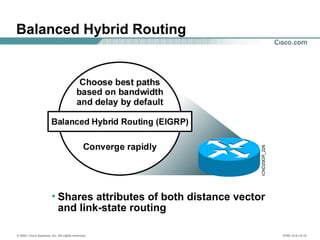
• Shares attributes of both distance vector
and link-state routing
Balanced Hybrid Routing
© 2002, Cisco Systems, Inc. All rights reserved. ICND v2.0—5-11
Summary
• Link-state routing uses LSAs, a topological
database, the SPF algorithm, the resulting SPF tree,
and a routing table of paths and ports to each
network.
• Link-state routing algorithms maintain a complex
database of the network's topology by exchanging
LSAs with other routers in a network.
• Link-state routing may flood the network with LSAs
during initial topology discovery and can be both
memory- and processor-intensive.
• Balanced hybrid routing protocols combine aspects
of both distance vector and link-state protocols.
18   link state - balanced hybrid  routing

18 link state - balanced hybrid routing

  • 1.
    © 2002, CiscoSystems, Inc. All rights reserved.
  • 2.
    © 2002, CiscoSystems, Inc. All rights reserved. ICND v2.0—5-2© 2002, Cisco Systems, Inc. All rights reserved. 2 Link-State and Balanced Hybrid Routing
  • 3.
    © 2002, CiscoSystems, Inc. All rights reserved. ICND v2.0—5-3 Objectives Upon completing this lesson, you will be able to: • Describe the issues associated with link-state routing and identify solutions to those issues • Describe the features of balanced hybrid routing protocols
  • 4.
    © 2002, CiscoSystems, Inc. All rights reserved. ICND v2.0—5-4 • After initial flood, pass small event-triggered link-state updates to all other routers Link-State Routing Protocols
  • 5.
    © 2002, CiscoSystems, Inc. All rights reserved. ICND v2.0—5-5 • Minimizes routing table entries • Localizes impact of a topology change within an area Link-State Network Hierarchy Example
  • 6.
    © 2002, CiscoSystems, Inc. All rights reserved. ICND v2.0—5-6 Link-State Routing Protocol Algorithms
  • 7.
    © 2002, CiscoSystems, Inc. All rights reserved. ICND v2.0—5-7 Benefits of Link-State Routing • Fast convergence: changes are reported immediately by the source affected. • Robustness against routing loops: –Routers know the topology. –Link-state packets are sequenced and acknowledged. • By careful (hierarchical) network design, you can utilize resources optimally.
  • 8.
    © 2002, CiscoSystems, Inc. All rights reserved. ICND v2.0—5-8 Caveats of Link-State Routing • Significant demands for resources: – Memory (three tables: adjacency, topology, forwarding) – CPU (Dijkstra’s algorithm can be intensive, especially when a lot of instabilities are present.) • Requires very strict network design (when more areas— area routing) • Problems with partitioning of areas • Configuration generally simple but can be complex when tuning various parameters and when the design is complex • Troubleshooting easier than in distance vector routing
  • 9.
    © 2002, CiscoSystems, Inc. All rights reserved. ICND v2.0—5-9 Drawbacks to Link-State Routing Protocols • Initial discovery may cause flooding. • Memory- and processor-intensive.
  • 10.
    © 2002, CiscoSystems, Inc. All rights reserved. ICND v2.0—5-10 • Shares attributes of both distance vector and link-state routing Balanced Hybrid Routing
  • 11.
    © 2002, CiscoSystems, Inc. All rights reserved. ICND v2.0—5-11 Summary • Link-state routing uses LSAs, a topological database, the SPF algorithm, the resulting SPF tree, and a routing table of paths and ports to each network. • Link-state routing algorithms maintain a complex database of the network's topology by exchanging LSAs with other routers in a network. • Link-state routing may flood the network with LSAs during initial topology discovery and can be both memory- and processor-intensive. • Balanced hybrid routing protocols combine aspects of both distance vector and link-state protocols.