A Presentation on
TECHNO-ECONOMIC ANALYSIS OF AIR-BLOWN
INTEGRATED GASIFICATION COMBINED CYCLE (IGCC) POWER PLANT
WITH HYBRID CO2 CAPTURE SYSTEM
Sujit Karmakar
Department of Mechanical Engineering
National Institute of Technology Durgapur
West Bengal

Ajit Kumar Kolar
Heat Transfer and Thermal Power Lab
Department of Mechanical Engineering
Indian Institute of Technology Madras
Chennai, Tamil Nadu

Presented by
SUJIT KARMAKAR
IV th ICAER– December 10, 2013

1/17
CONTENTS
 INTRODUCTION
 METHODOLOGY

 IGCC PLANT CONFIGURATION
 COAL CHARACTERISTICS
 PERFORMANCE PARAMETERS
 IGCC PLANT WITH HYBRID CO2 CAPTURE SYSTEM
 RESULT
 CONCLUSIONS
IV th ICAER– December 10, 2013

2/17
INTRODUCTION
 Carbon dioxide (CO2) - key greenhouse gas (GHG)
causing global warming and affects climate adversely

World CO2 emission (2011) : 31 GT/yr
 India's

per capita per yr CO2 emission : 1.4 tonnes, less

than one-third of the world average and about 12 times
less than the United States
 India

accounts for about 5.5% of the world's CO2

emissions
(Source: IEA Key World Energy Statistics, 2011)
IV th ICAER– December 10, 2013
2/44

3/17
INTRODUCTION

(CONTD..)

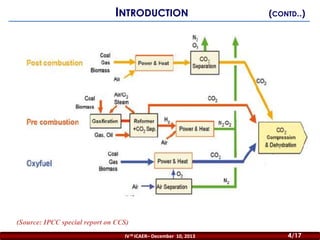
(Source: IPCC special report on CCS)
IV th ICAER– December 10, 2013

4/17
INTRODUCTION

(CONTD..)

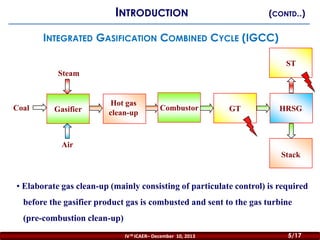
INTEGRATED GASIFICATION COMBINED CYCLE (IGCC)
ST
Steam

Coal

Gasifier

Hot gas
clean-up

Combustor

GT

HRSG

Air
Stack

• Elaborate gas clean-up (mainly consisting of particulate control) is required
before the gasifier product gas is combusted and sent to the gas turbine
(pre-combustion clean-up)
5

IV th ICAER– December 10, 2013

5/17
METHODOLOGY
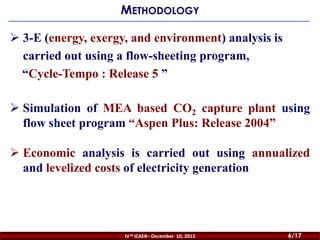
 3-E (energy, exergy, and environment) analysis is
carried out using a flow-sheeting program,
“Cycle-Tempo : Release 5 ”
 Simulation of MEA based CO2 capture plant using
flow sheet program “Aspen Plus: Release 2004”
 Economic analysis is carried out using annualized
and levelized costs of electricity generation

IV th ICAER– December 10, 2013

6/20
6/17
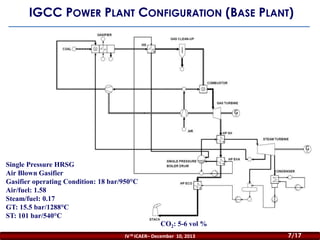
IGCC POWER PLANT CONFIGURATION (BASE PLANT)

Single Pressure HRSG
Air Blown Gasifier
Gasifier operating Condition: 18 bar/950°C
Air/fuel: 1.58
Steam/fuel: 0.17
GT: 15.5 bar/1288°C
ST: 101 bar/540°C
CO2: 5-6 vol %
IV th ICAER– December 10, 2013

7/17
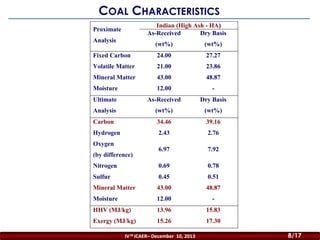
COAL CHARACTERISTICS
Indian (High Ash - HA)
As-Received
Dry Basis

Proximate
Analysis

(wt%)

(wt%)

Fixed Carbon

24.00

27.27

Volatile Matter

21.00

23.86

Mineral Matter

43.00

48.87

Moisture

12.00

-

Ultimate

As-Received

Dry Basis

Analysis

(wt%)

(wt%)

Carbon

34.46

39.16

Hydrogen

2.43

2.76

6.97

7.92

Nitrogen

0.69

0.78

Sulfur

0.45

0.51

Mineral Matter

43.00

48.87

Moisture

12.00

-

HHV (MJ/kg)

13.96

15.83

Exergy (MJ/kg)

15.26

17.30

Oxygen
(by difference)

IV th ICAER– December 10, 2013

8/17
PERFORMANCE PARAMETERS


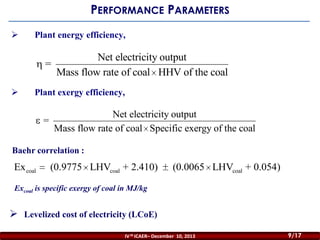
Plant energy efficiency,

=


Net electricity output
Mass flow rate of coal HHV of the coal

Plant exergy efficiency,

Net electricity output
=
Mass flow rate of coal Specific exergy of the coal
Baehr correlation :

Ex coal

(0.9775 LHVcoal + 2.410)

(0.0065 LHVcoal + 0.054)

Excoal is specific exergy of coal in MJ/kg

 Levelized cost of electricity (LCoE)
IV th ICAER– December 10, 2013

9/17
IGCC POWER PLANT WITH HYBRID CO2 CAPTURE SYSTEM
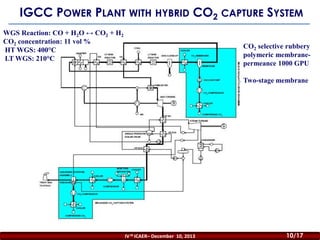
WGS Reaction: CO + H2O ↔ CO2 + H2
CO2 concentration: 11 vol %
HT WGS: 400°C
LT WGS: 210°C

CO2 selective rubbery
polymeric membranepermeance 1000 GPU

Two-stage membrane

IV th ICAER– December 10, 2013

10/17
MEA BASED CO2 CAPTURE SYSTEM

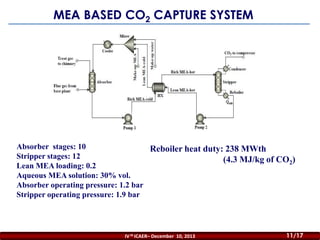
Absorber stages: 10
Reboiler heat duty: 238 MWth
Stripper stages: 12
(4.3 MJ/kg of CO2)
Lean MEA loading: 0.2
Aqueous MEA solution: 30% vol.
Absorber operating pressure: 1.2 bar
Stripper operating pressure: 1.9 bar

IV th ICAER– December 10, 2013

11/17
RESULT-PERFORMANCE
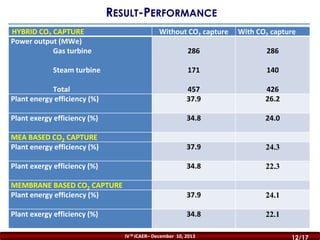
HYBRID CO2 CAPTURE
Power output (MWe)
Gas turbine

Without CO2 capture

With CO2 capture

286

286

Steam turbine

171

140

Total
Plant energy efficiency (%)

457
37.9

426
26.2

Plant exergy efficiency (%)

34.8

24.0

MEA BASED CO2 CAPTURE
Plant energy efficiency (%)

37.9

24.3

Plant exergy efficiency (%)

34.8

22.3

MEMBRANE BASED CO2 CAPTURE
Plant energy efficiency (%)

37.9

24.1

Plant exergy efficiency (%)

34.8

22.1

IV th ICAER– December 10, 2013

12/16
12/17
RESULT-PERFORMANCE
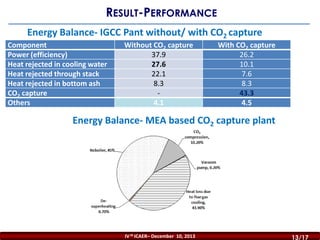
Energy Balance- IGCC Pant without/ with CO2 capture
Component
Power (efficiency)
Heat rejected in cooling water
Heat rejected through stack
Heat rejected in bottom ash
CO2 capture
Others

Without CO2 capture
37.9
27.6
22.1
8.3
4.1

With CO2 capture
26.2
10.1
7.6
8.3
43.3
4.5

Energy Balance- MEA based CO2 capture plant

IV th ICAER– December 10, 2013

13/16
13/17
RESULT-PERFORMANCE
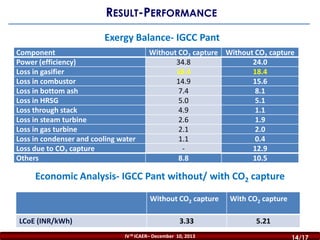
Exergy Balance- IGCC Pant
Component
Power (efficiency)
Loss in gasifier
Loss in combustor
Loss in bottom ash
Loss in HRSG
Loss through stack
Loss in steam turbine
Loss in gas turbine
Loss in condenser and cooling water
Loss due to CO2 capture
Others

Without CO2 capture Without CO2 capture
34.8
24.0
18.4
18.4
14.9
15.6
7.4
8.1
5.0
5.1
4.9
1.1
2.6
1.9
2.1
2.0
1.1
0.4
12.9
8.8
10.5

Economic Analysis- IGCC Pant without/ with CO2 capture
Without CO2 capture
LCoE (INR/kWh)

3.33
IV th ICAER– December 10, 2013

With CO2 capture
5.21
14/16
14/17
CONCLUSIONS
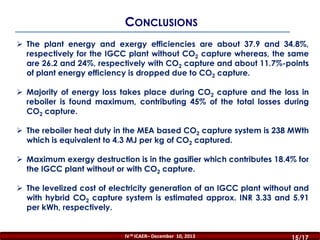
 The plant energy and exergy efficiencies are about 37.9 and 34.8%,
respectively for the IGCC plant without CO2 capture whereas, the same
are 26.2 and 24%, respectively with CO2 capture and about 11.7%-points
of plant energy efficiency is dropped due to CO2 capture.
 Majority of energy loss takes place during CO2 capture and the loss in
reboiler is found maximum, contributing 45% of the total losses during
CO2 capture.
 The reboiler heat duty in the MEA based CO2 capture system is 238 MWth
which is equivalent to 4.3 MJ per kg of CO2 captured.
 Maximum exergy destruction is in the gasifier which contributes 18.4% for
the IGCC plant without or with CO2 capture.

 The levelized cost of electricity generation of an IGCC plant without and
with hybrid CO2 capture system is estimated approx. INR 3.33 and 5.91
per kWh, respectively.

IV th ICAER– December 10, 2013

15/16
15/17
REFERENCES
[1] Central Electricity Authority [CEA] (2011) Operation performance of generating stations in the country during

the year 2010-11: An overview, Government of India.
[2] IPCC (2005) IPCC special report on Carbon Dioxide and Storage. Prepared by Working Group III of the
Intergovernmental panel on climate change. Edited by: Metz. B; Davidson. O.; Conick de H.; Loos. M; Meyer. L.
[3] Kohl A, Nielsen R (1997) Gas Purification, 5th edition, Gulf Publishing Company, Houston, Texas.
[4] Aroonwilas, A., and Veawab, A., (2007) Integration of CO2 capture unit using single- and blended- amines into
supercritical coal-fired power plants: Implications for emission and energy management, Int J. Greenhouse Gas
Control, 1, pp. 143-150.
[5] Rao, A.B., and Rubin, E.S., (2002) A Technical, Economics, and Environmental Assessment of Amine-based CO2
capture Technologies for Power Plant Greenhouse Gas Control, Environ. Sci. Technology, 36, pp. 4467-4475.
[6] Zhao, L., Rienche, E., Menzer, R., Blum, L., and Skolten, D., (2008) A parametric study of CO2/N2 gas separation
membrane processes for post-combustion capture, Int J. Membrane Sc., 325, pp. 284-294.
[7] Suresh M.V.J.J. (2012), 4-E (Energy, Exergy, Environment, and Economic) Analysis of Advanced Coal
Technologies for Power Generation, Ph.D. Thesis, Indian Institute of Technology Madras, India.
[8] Merkel, T.C., Zhou, M., and Baker, (2012) Carbon dioxide capture with membranes at an IGCC power plant, Int
J. Membrane Sc., 389, pp. 441-450.
[9] Osikowska, A.S., Szymańska, K.J., and Kotowicz, J., (2012) Modeling and analysis of selected Carbon dioxide
capture methods in IGCC system, Energy, 45, pp. 92-100.
[10] Suresh, M.V.J.J., Reddy, K.S., and Kolar, A.K., (2010) 3-E analysis of advanced power plants based on high
ash coal, Int J. Energy Res., 34, pp. 716-735.
[11] Aspen Plus (2004) Aspen Plus, Aspen technology Inc., Cambridge, MA, USA
[12] Desideri, U., and Paolucci, A., (1999) Performance modeling of a carbon dioxide removal system for power
plants. Energy Convers. Manage., 40, pp. 1899-1915.
[13] Abu-Zahra, M.R.M., Schneiders, L.H.J., Niederer, J.P.M., Feron, P.H.M., and Versteeg, G.F., (2007) CO2 capture
from power plants Part 1. A parametric study of the technical performance based on monoethanolamine. Int. J.
Greenhouse Gas Control, 1, pp. 37-46.
[14] Cycle-Tempo release 5.0 (2007) Delft University of Technology.
[15] Romeo, L.M., Bolea, I., Escosa, J.M., (2008) Integration of power plant and amine scrubbing to reduce CO2
capture costs. Appl. Therm. Eng., 28, pp.1039-1046.

IV th ICAER– December 10, 2013

16/16
16/17
Thank You

IV th ICAER– December 10, 2013

17/16
17/17

175 sujit

  • 1.
    A Presentation on TECHNO-ECONOMICANALYSIS OF AIR-BLOWN INTEGRATED GASIFICATION COMBINED CYCLE (IGCC) POWER PLANT WITH HYBRID CO2 CAPTURE SYSTEM Sujit Karmakar Department of Mechanical Engineering National Institute of Technology Durgapur West Bengal Ajit Kumar Kolar Heat Transfer and Thermal Power Lab Department of Mechanical Engineering Indian Institute of Technology Madras Chennai, Tamil Nadu Presented by SUJIT KARMAKAR IV th ICAER– December 10, 2013 1/17
  • 2.
    CONTENTS  INTRODUCTION  METHODOLOGY IGCC PLANT CONFIGURATION  COAL CHARACTERISTICS  PERFORMANCE PARAMETERS  IGCC PLANT WITH HYBRID CO2 CAPTURE SYSTEM  RESULT  CONCLUSIONS IV th ICAER– December 10, 2013 2/17
  • 3.
    INTRODUCTION  Carbon dioxide(CO2) - key greenhouse gas (GHG) causing global warming and affects climate adversely World CO2 emission (2011) : 31 GT/yr  India's per capita per yr CO2 emission : 1.4 tonnes, less than one-third of the world average and about 12 times less than the United States  India accounts for about 5.5% of the world's CO2 emissions (Source: IEA Key World Energy Statistics, 2011) IV th ICAER– December 10, 2013 2/44 3/17
  • 4.
    INTRODUCTION (CONTD..) (Source: IPCC specialreport on CCS) IV th ICAER– December 10, 2013 4/17
  • 5.
    INTRODUCTION (CONTD..) INTEGRATED GASIFICATION COMBINEDCYCLE (IGCC) ST Steam Coal Gasifier Hot gas clean-up Combustor GT HRSG Air Stack • Elaborate gas clean-up (mainly consisting of particulate control) is required before the gasifier product gas is combusted and sent to the gas turbine (pre-combustion clean-up) 5 IV th ICAER– December 10, 2013 5/17
  • 6.
    METHODOLOGY  3-E (energy,exergy, and environment) analysis is carried out using a flow-sheeting program, “Cycle-Tempo : Release 5 ”  Simulation of MEA based CO2 capture plant using flow sheet program “Aspen Plus: Release 2004”  Economic analysis is carried out using annualized and levelized costs of electricity generation IV th ICAER– December 10, 2013 6/20 6/17
  • 7.
    IGCC POWER PLANTCONFIGURATION (BASE PLANT) Single Pressure HRSG Air Blown Gasifier Gasifier operating Condition: 18 bar/950°C Air/fuel: 1.58 Steam/fuel: 0.17 GT: 15.5 bar/1288°C ST: 101 bar/540°C CO2: 5-6 vol % IV th ICAER– December 10, 2013 7/17
  • 8.
    COAL CHARACTERISTICS Indian (HighAsh - HA) As-Received Dry Basis Proximate Analysis (wt%) (wt%) Fixed Carbon 24.00 27.27 Volatile Matter 21.00 23.86 Mineral Matter 43.00 48.87 Moisture 12.00 - Ultimate As-Received Dry Basis Analysis (wt%) (wt%) Carbon 34.46 39.16 Hydrogen 2.43 2.76 6.97 7.92 Nitrogen 0.69 0.78 Sulfur 0.45 0.51 Mineral Matter 43.00 48.87 Moisture 12.00 - HHV (MJ/kg) 13.96 15.83 Exergy (MJ/kg) 15.26 17.30 Oxygen (by difference) IV th ICAER– December 10, 2013 8/17
  • 9.
    PERFORMANCE PARAMETERS  Plant energyefficiency, =  Net electricity output Mass flow rate of coal HHV of the coal Plant exergy efficiency, Net electricity output = Mass flow rate of coal Specific exergy of the coal Baehr correlation : Ex coal (0.9775 LHVcoal + 2.410) (0.0065 LHVcoal + 0.054) Excoal is specific exergy of coal in MJ/kg  Levelized cost of electricity (LCoE) IV th ICAER– December 10, 2013 9/17
  • 10.
    IGCC POWER PLANTWITH HYBRID CO2 CAPTURE SYSTEM WGS Reaction: CO + H2O ↔ CO2 + H2 CO2 concentration: 11 vol % HT WGS: 400°C LT WGS: 210°C CO2 selective rubbery polymeric membranepermeance 1000 GPU Two-stage membrane IV th ICAER– December 10, 2013 10/17
  • 11.
    MEA BASED CO2CAPTURE SYSTEM Absorber stages: 10 Reboiler heat duty: 238 MWth Stripper stages: 12 (4.3 MJ/kg of CO2) Lean MEA loading: 0.2 Aqueous MEA solution: 30% vol. Absorber operating pressure: 1.2 bar Stripper operating pressure: 1.9 bar IV th ICAER– December 10, 2013 11/17
  • 12.
    RESULT-PERFORMANCE HYBRID CO2 CAPTURE Poweroutput (MWe) Gas turbine Without CO2 capture With CO2 capture 286 286 Steam turbine 171 140 Total Plant energy efficiency (%) 457 37.9 426 26.2 Plant exergy efficiency (%) 34.8 24.0 MEA BASED CO2 CAPTURE Plant energy efficiency (%) 37.9 24.3 Plant exergy efficiency (%) 34.8 22.3 MEMBRANE BASED CO2 CAPTURE Plant energy efficiency (%) 37.9 24.1 Plant exergy efficiency (%) 34.8 22.1 IV th ICAER– December 10, 2013 12/16 12/17
  • 13.
    RESULT-PERFORMANCE Energy Balance- IGCCPant without/ with CO2 capture Component Power (efficiency) Heat rejected in cooling water Heat rejected through stack Heat rejected in bottom ash CO2 capture Others Without CO2 capture 37.9 27.6 22.1 8.3 4.1 With CO2 capture 26.2 10.1 7.6 8.3 43.3 4.5 Energy Balance- MEA based CO2 capture plant IV th ICAER– December 10, 2013 13/16 13/17
  • 14.
    RESULT-PERFORMANCE Exergy Balance- IGCCPant Component Power (efficiency) Loss in gasifier Loss in combustor Loss in bottom ash Loss in HRSG Loss through stack Loss in steam turbine Loss in gas turbine Loss in condenser and cooling water Loss due to CO2 capture Others Without CO2 capture Without CO2 capture 34.8 24.0 18.4 18.4 14.9 15.6 7.4 8.1 5.0 5.1 4.9 1.1 2.6 1.9 2.1 2.0 1.1 0.4 12.9 8.8 10.5 Economic Analysis- IGCC Pant without/ with CO2 capture Without CO2 capture LCoE (INR/kWh) 3.33 IV th ICAER– December 10, 2013 With CO2 capture 5.21 14/16 14/17
  • 15.
    CONCLUSIONS  The plantenergy and exergy efficiencies are about 37.9 and 34.8%, respectively for the IGCC plant without CO2 capture whereas, the same are 26.2 and 24%, respectively with CO2 capture and about 11.7%-points of plant energy efficiency is dropped due to CO2 capture.  Majority of energy loss takes place during CO2 capture and the loss in reboiler is found maximum, contributing 45% of the total losses during CO2 capture.  The reboiler heat duty in the MEA based CO2 capture system is 238 MWth which is equivalent to 4.3 MJ per kg of CO2 captured.  Maximum exergy destruction is in the gasifier which contributes 18.4% for the IGCC plant without or with CO2 capture.  The levelized cost of electricity generation of an IGCC plant without and with hybrid CO2 capture system is estimated approx. INR 3.33 and 5.91 per kWh, respectively. IV th ICAER– December 10, 2013 15/16 15/17
  • 16.
    REFERENCES [1] Central ElectricityAuthority [CEA] (2011) Operation performance of generating stations in the country during the year 2010-11: An overview, Government of India. [2] IPCC (2005) IPCC special report on Carbon Dioxide and Storage. Prepared by Working Group III of the Intergovernmental panel on climate change. Edited by: Metz. B; Davidson. O.; Conick de H.; Loos. M; Meyer. L. [3] Kohl A, Nielsen R (1997) Gas Purification, 5th edition, Gulf Publishing Company, Houston, Texas. [4] Aroonwilas, A., and Veawab, A., (2007) Integration of CO2 capture unit using single- and blended- amines into supercritical coal-fired power plants: Implications for emission and energy management, Int J. Greenhouse Gas Control, 1, pp. 143-150. [5] Rao, A.B., and Rubin, E.S., (2002) A Technical, Economics, and Environmental Assessment of Amine-based CO2 capture Technologies for Power Plant Greenhouse Gas Control, Environ. Sci. Technology, 36, pp. 4467-4475. [6] Zhao, L., Rienche, E., Menzer, R., Blum, L., and Skolten, D., (2008) A parametric study of CO2/N2 gas separation membrane processes for post-combustion capture, Int J. Membrane Sc., 325, pp. 284-294. [7] Suresh M.V.J.J. (2012), 4-E (Energy, Exergy, Environment, and Economic) Analysis of Advanced Coal Technologies for Power Generation, Ph.D. Thesis, Indian Institute of Technology Madras, India. [8] Merkel, T.C., Zhou, M., and Baker, (2012) Carbon dioxide capture with membranes at an IGCC power plant, Int J. Membrane Sc., 389, pp. 441-450. [9] Osikowska, A.S., Szymańska, K.J., and Kotowicz, J., (2012) Modeling and analysis of selected Carbon dioxide capture methods in IGCC system, Energy, 45, pp. 92-100. [10] Suresh, M.V.J.J., Reddy, K.S., and Kolar, A.K., (2010) 3-E analysis of advanced power plants based on high ash coal, Int J. Energy Res., 34, pp. 716-735. [11] Aspen Plus (2004) Aspen Plus, Aspen technology Inc., Cambridge, MA, USA [12] Desideri, U., and Paolucci, A., (1999) Performance modeling of a carbon dioxide removal system for power plants. Energy Convers. Manage., 40, pp. 1899-1915. [13] Abu-Zahra, M.R.M., Schneiders, L.H.J., Niederer, J.P.M., Feron, P.H.M., and Versteeg, G.F., (2007) CO2 capture from power plants Part 1. A parametric study of the technical performance based on monoethanolamine. Int. J. Greenhouse Gas Control, 1, pp. 37-46. [14] Cycle-Tempo release 5.0 (2007) Delft University of Technology. [15] Romeo, L.M., Bolea, I., Escosa, J.M., (2008) Integration of power plant and amine scrubbing to reduce CO2 capture costs. Appl. Therm. Eng., 28, pp.1039-1046. IV th ICAER– December 10, 2013 16/16 16/17
  • 17.
    Thank You IV thICAER– December 10, 2013 17/16 17/17