“Asymmetrical Cascaded
H-Bridge Multilevel
Inverter”
Authors- Dr. S. S. Bharatkar
Mr. R. R. Bhoyar
Mr. S. A. Khadtare

1
OUTLINE OF PRESENTATION Abstract
 Introduction
 Concept of CHB MLI
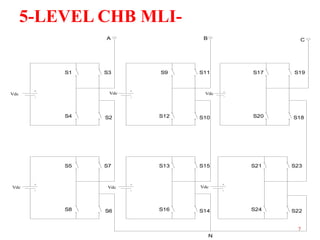
 5-Level CHB MLI
 7- Level Symmetrical CHB MLI
 7- Level Asymmetrical CHB MLI
 9- Level Asymmetrical CHB MLI
 Result
 Conclusion
2
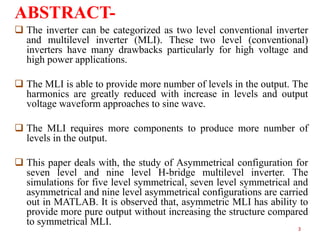
ABSTRACT The inverter can be categorized as two level conventional inverter
and multilevel inverter (MLI). These two level (conventional)
inverters have many drawbacks particularly for high voltage and
high power applications.
 The MLI is able to provide more number of levels in the output. The
harmonics are greatly reduced with increase in levels and output
voltage waveform approaches to sine wave.
 The MLI requires more components to produce more number of
levels in the output.
 This paper deals with, the study of Asymmetrical configuration for
seven level and nine level H-bridge multilevel inverter. The
simulations for five level symmetrical, seven level symmetrical and
asymmetrical and nine level asymmetrical configurations are carried
out in MATLAB. It is observed that, asymmetric MLI has ability to
provide more pure output without increasing the structure compared
to symmetrical MLI.
3
INTRODUCTIONINVERTER

TWO LEVEL

NCP MLI

MULTILEVEL

FLYING
CAPACITOR
MLI

CHB MLI

SYMMETRICAL
CHB MLI

ASYMMETRICAL
CHB MLI

4
Concept of CHB MLI-

Fig. 1 Structure of m-cells cascaded multilevel inverter 5
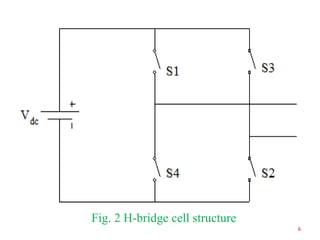
Fig. 2 H-bridge cell structure
6
5-LEVEL CHB MLIA

S1

S3

B

S9

Vdc

Vdc

C

S11

S2

S12

S10

S5

S7

S13

S15

S6

S20

S18

S21

S23

S24

S22

Vdc

Vdc

S8

S19

Vdc

S4

Vdc

S17

S16

S14

7
N
7-LEVEL SYMMETRICAL CHB MLIA

S1

S3

B

S13

Vdc

Vdc

S4

S2

S5

S7

C

S15

S25

S27

S28

S26

Vdc

S16

S9

Vdc

S6

S20

S18

S11

S21

S32

S30

S35

S36

S34

S23

Vdc

S12

S31

Vdc

Vdc

S8

S19

S29

S33

Vdc

S17

S14

S10

Vdc

S24

S22

8
N
7-LEVEL ASYMMETRICAL CHB MLI-

9
Fig. 3 Seven level Asymmetrical cascaded H-bridge MLI for
10
Phase A
LEVELS

SWITCHES

3Vdc

S1, S5

2Vdc

S1

Vdc

S5

0
-Vdc

S1, S3, S5, S7 (OFF) &
S2, S4, S6, S8 (ON)
S7

-2Vdc

S3

-3Vdc

S3, S7

11
9-LEVEL ASYMMETRICAL CHB MLI-

12
400

Result-

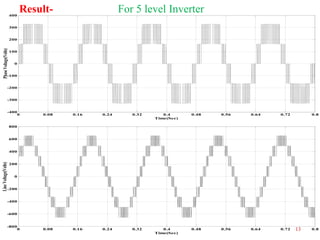
For 5 level Inverter

300

Phase Voltage(Volts)

200

100

0

-100

-200

-300

-400
0

0.08

0.16

0.24

0.32

0.4
Time(Sec)

0.48

0.56

0.64

0.72

0.08

0.16

0.24

0.32

0.4
Time(Sec)

0.48

0.56

0.64

0.72

0.8

800

600

Line Voltage(Volts)

400

200

0

-200

-400

-600

-800
0

13

0.8
400

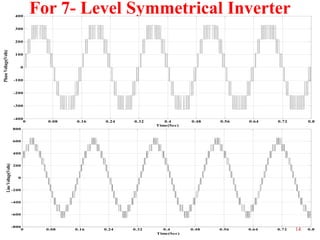
For 7- Level Symmetrical Inverter

300

Phase Voltage(Volts)

200

100

0

-100

-200

-300

-400
0

0.08

0.16

0.24

0.32

0.4
Time(Sec)

0.48

0.56

0.64

0.72

0.4
Time(Sec)

0.48

0.56

0.64

0.72

0.8

800

600

Line Voltage(Volts)

400

200

0

-200

-400

-600

-800
0

0.08

0.16

0.24

0.32

14

0.8
For 7- Level Asymmetrical Inverter

400

300

Phase Voltage(Volts)

200

100

0

-100

-200

-300

-400
0

0.08

0.16

0.24

0.32

0.4
Time(Sec)

0.48

0.56

0.64

0.72

0.4
Time(Sec)

0.48

0.56

0.64

0.72

0.8

800

600

Line Voltage(Volts)

400

200

0

-200

-400

-600

-800
0

0.08

0.16

0.24

0.32

15

0.8
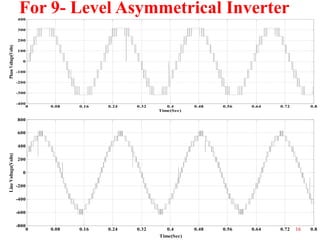
For 9- Level Asymmetrical Inverter
400
300

Phase Voltage(Volts)

200
100
0
-100
-200
-300
-400
0

0.08

0.16

0.24

0.32

0.4
Time(Sec)

0.48

0.56

0.64

0.72

0.08

0.16

0.24

0.32

0.4
Time(Sec)

0.48

0.56

0.64

0.72

0.8

800
600

Line Voltage(Volts)

400
200
0
-200
-400
-600
-800
0

16

0.8
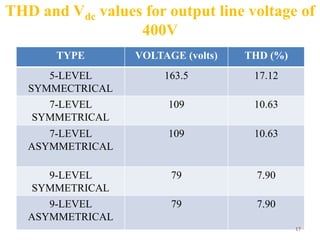
THD and Vdc values for output line voltage of
400V
TYPE

VOLTAGE (volts)

THD (%)

5-LEVEL
SYMMECTRICAL
7-LEVEL
SYMMETRICAL

163.5

17.12

109

10.63

7-LEVEL
ASYMMETRICAL

109

10.63

9-LEVEL
SYMMETRICAL

79

7.90

9-LEVEL
ASYMMETRICAL

79

7.90
17
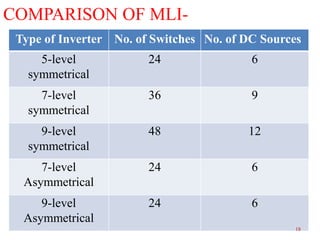
COMPARISON OF MLIType of Inverter No. of Switches No. of DC Sources
5-level
symmetrical

24

6

7-level
symmetrical

36

9

9-level
symmetrical

48

12

7-level
Asymmetrical

24

6

9-level
Asymmetrical

24

6
18
CONCLUSIONFrom the simulation results it is concluded
that, by taking different geometric progression
factor the output levels of Asymmetrical MLI can
be increased without any increased in
components. So the output of ACMLI has very
less amount of harmonic content i.e., the output
is smoother. As compare to SCMLI, the numbers
of bridges, DC sources required in ACMLI are
less for attaining same number of levels. So the
problem of requirement of more components to
achieve more number of output levels are
eliminated with proposed ACMLI topology.
19
REFERENCES Mr. M.H. Rashid, "Power Electronics Circuit, Devices
and Applications", 3rd edition, Pearson publication sou
th Asia, 2007.
 Mr. Bin Wu "High Power Converters & AC Drives" 2
nd edition, John Wiley publication, California, U.S.A.,
2007.
 Jannu Ramu, S.J.V. Prakash, K. Satya Srinivasu, R.N.
D. Pattabhi Ram, M. Vishnu Prasad and Md. Mazhar
Hussain, ''Comparison between Symmetrical and Asy
mmetrical Single Phase Seven Level Cascade H-Bridg
e Multilevel Inverter with PWM Topology", Internatio
nal Journal of Multidisciplinary Sciences and Enginee
ring, Vol. 3, No. 4, pp.16-20, April 2012.
20
 F. Khoucha, M. S Lagoun, K. Marouani, A. Kheloui,
and M.E.H. Benbouzid, “Hybrid cascaded H-bridge
multilevel inverter induction motor drive direct torqu
e control for automotive applications”, IEEE Trans. I
nd. Electron., vol. 57, no.3, pp.892–899, Mar. 2010.
 Farid Khoucha, Mouna Soumia Lagoun, Abdelaziz
Kheloui, and Mohamed El Hachemi Benbouzid, "A
Comparison of Symmetrical and Asymmetrical Thre
e-Phase H-Bridge Multilevel Inverter for DTC Induc
tion Motor Drives'', IEEE Trans. on Energy Conversi
on, vol. 26, no. 1, pp.64-72, March 2011.
 Hemant Joshi, P.N. Tekwani and Amar Hinduja, "Im
plementation of A five-level Inverter using reversing
voltage topology: A competitive solution for high-po
wer IM drive applications", National power electroni
cs conference 2010, pp.1-8, 2010.
21
 Bindeshwar Singh, Nupur Mittal , Dr. K.S. Verma , D
r. Deependra Singh, S.P.Singh, Rahul Dixit, Manvendr
a Singh and Aanchal Baranwa, "Multi-level inverter: A
literature survey on topologies and control strategies",
International Journal of Reviews in Computing, Vol. 1
0, 31st July 2012.
 K.Surya Suresh and M.Vishnu Prasad, "PV Cell Based
Five Level Inverter Using Multicarrier PWM", Interna
tional Journal of Modern Engineering Research (IJME
R), Vol.1, Issue.2, pp-545-551.
 Bipin Singh, K.P. Singh and A.N. Tiwari, ''Modeling
of 5-Level Inverter Controlled with DVR Technique'',
VSRD-IJEECE, Vol. 2 (1), pp.16-21, 2012.
22
23

36 sarang

  • 1.
    “Asymmetrical Cascaded H-Bridge Multilevel Inverter” Authors-Dr. S. S. Bharatkar Mr. R. R. Bhoyar Mr. S. A. Khadtare 1
  • 2.
    OUTLINE OF PRESENTATIONAbstract  Introduction  Concept of CHB MLI  5-Level CHB MLI  7- Level Symmetrical CHB MLI  7- Level Asymmetrical CHB MLI  9- Level Asymmetrical CHB MLI  Result  Conclusion 2
  • 3.
    ABSTRACT The invertercan be categorized as two level conventional inverter and multilevel inverter (MLI). These two level (conventional) inverters have many drawbacks particularly for high voltage and high power applications.  The MLI is able to provide more number of levels in the output. The harmonics are greatly reduced with increase in levels and output voltage waveform approaches to sine wave.  The MLI requires more components to produce more number of levels in the output.  This paper deals with, the study of Asymmetrical configuration for seven level and nine level H-bridge multilevel inverter. The simulations for five level symmetrical, seven level symmetrical and asymmetrical and nine level asymmetrical configurations are carried out in MATLAB. It is observed that, asymmetric MLI has ability to provide more pure output without increasing the structure compared to symmetrical MLI. 3
  • 4.
  • 5.
    Concept of CHBMLI- Fig. 1 Structure of m-cells cascaded multilevel inverter 5
  • 6.
    Fig. 2 H-bridgecell structure 6
  • 7.
  • 8.
    7-LEVEL SYMMETRICAL CHBMLIA S1 S3 B S13 Vdc Vdc S4 S2 S5 S7 C S15 S25 S27 S28 S26 Vdc S16 S9 Vdc S6 S20 S18 S11 S21 S32 S30 S35 S36 S34 S23 Vdc S12 S31 Vdc Vdc S8 S19 S29 S33 Vdc S17 S14 S10 Vdc S24 S22 8 N
  • 9.
  • 10.
    Fig. 3 Sevenlevel Asymmetrical cascaded H-bridge MLI for 10 Phase A
  • 11.
    LEVELS SWITCHES 3Vdc S1, S5 2Vdc S1 Vdc S5 0 -Vdc S1, S3,S5, S7 (OFF) & S2, S4, S6, S8 (ON) S7 -2Vdc S3 -3Vdc S3, S7 11
  • 12.
  • 13.
    400 Result- For 5 levelInverter 300 Phase Voltage(Volts) 200 100 0 -100 -200 -300 -400 0 0.08 0.16 0.24 0.32 0.4 Time(Sec) 0.48 0.56 0.64 0.72 0.08 0.16 0.24 0.32 0.4 Time(Sec) 0.48 0.56 0.64 0.72 0.8 800 600 Line Voltage(Volts) 400 200 0 -200 -400 -600 -800 0 13 0.8
  • 14.
    400 For 7- LevelSymmetrical Inverter 300 Phase Voltage(Volts) 200 100 0 -100 -200 -300 -400 0 0.08 0.16 0.24 0.32 0.4 Time(Sec) 0.48 0.56 0.64 0.72 0.4 Time(Sec) 0.48 0.56 0.64 0.72 0.8 800 600 Line Voltage(Volts) 400 200 0 -200 -400 -600 -800 0 0.08 0.16 0.24 0.32 14 0.8
  • 15.
    For 7- LevelAsymmetrical Inverter 400 300 Phase Voltage(Volts) 200 100 0 -100 -200 -300 -400 0 0.08 0.16 0.24 0.32 0.4 Time(Sec) 0.48 0.56 0.64 0.72 0.4 Time(Sec) 0.48 0.56 0.64 0.72 0.8 800 600 Line Voltage(Volts) 400 200 0 -200 -400 -600 -800 0 0.08 0.16 0.24 0.32 15 0.8
  • 16.
    For 9- LevelAsymmetrical Inverter 400 300 Phase Voltage(Volts) 200 100 0 -100 -200 -300 -400 0 0.08 0.16 0.24 0.32 0.4 Time(Sec) 0.48 0.56 0.64 0.72 0.08 0.16 0.24 0.32 0.4 Time(Sec) 0.48 0.56 0.64 0.72 0.8 800 600 Line Voltage(Volts) 400 200 0 -200 -400 -600 -800 0 16 0.8
  • 17.
    THD and Vdcvalues for output line voltage of 400V TYPE VOLTAGE (volts) THD (%) 5-LEVEL SYMMECTRICAL 7-LEVEL SYMMETRICAL 163.5 17.12 109 10.63 7-LEVEL ASYMMETRICAL 109 10.63 9-LEVEL SYMMETRICAL 79 7.90 9-LEVEL ASYMMETRICAL 79 7.90 17
  • 18.
    COMPARISON OF MLITypeof Inverter No. of Switches No. of DC Sources 5-level symmetrical 24 6 7-level symmetrical 36 9 9-level symmetrical 48 12 7-level Asymmetrical 24 6 9-level Asymmetrical 24 6 18
  • 19.
    CONCLUSIONFrom the simulationresults it is concluded that, by taking different geometric progression factor the output levels of Asymmetrical MLI can be increased without any increased in components. So the output of ACMLI has very less amount of harmonic content i.e., the output is smoother. As compare to SCMLI, the numbers of bridges, DC sources required in ACMLI are less for attaining same number of levels. So the problem of requirement of more components to achieve more number of output levels are eliminated with proposed ACMLI topology. 19
  • 20.
    REFERENCES Mr. M.H.Rashid, "Power Electronics Circuit, Devices and Applications", 3rd edition, Pearson publication sou th Asia, 2007.  Mr. Bin Wu "High Power Converters & AC Drives" 2 nd edition, John Wiley publication, California, U.S.A., 2007.  Jannu Ramu, S.J.V. Prakash, K. Satya Srinivasu, R.N. D. Pattabhi Ram, M. Vishnu Prasad and Md. Mazhar Hussain, ''Comparison between Symmetrical and Asy mmetrical Single Phase Seven Level Cascade H-Bridg e Multilevel Inverter with PWM Topology", Internatio nal Journal of Multidisciplinary Sciences and Enginee ring, Vol. 3, No. 4, pp.16-20, April 2012. 20
  • 21.
     F. Khoucha,M. S Lagoun, K. Marouani, A. Kheloui, and M.E.H. Benbouzid, “Hybrid cascaded H-bridge multilevel inverter induction motor drive direct torqu e control for automotive applications”, IEEE Trans. I nd. Electron., vol. 57, no.3, pp.892–899, Mar. 2010.  Farid Khoucha, Mouna Soumia Lagoun, Abdelaziz Kheloui, and Mohamed El Hachemi Benbouzid, "A Comparison of Symmetrical and Asymmetrical Thre e-Phase H-Bridge Multilevel Inverter for DTC Induc tion Motor Drives'', IEEE Trans. on Energy Conversi on, vol. 26, no. 1, pp.64-72, March 2011.  Hemant Joshi, P.N. Tekwani and Amar Hinduja, "Im plementation of A five-level Inverter using reversing voltage topology: A competitive solution for high-po wer IM drive applications", National power electroni cs conference 2010, pp.1-8, 2010. 21
  • 22.
     Bindeshwar Singh,Nupur Mittal , Dr. K.S. Verma , D r. Deependra Singh, S.P.Singh, Rahul Dixit, Manvendr a Singh and Aanchal Baranwa, "Multi-level inverter: A literature survey on topologies and control strategies", International Journal of Reviews in Computing, Vol. 1 0, 31st July 2012.  K.Surya Suresh and M.Vishnu Prasad, "PV Cell Based Five Level Inverter Using Multicarrier PWM", Interna tional Journal of Modern Engineering Research (IJME R), Vol.1, Issue.2, pp-545-551.  Bipin Singh, K.P. Singh and A.N. Tiwari, ''Modeling of 5-Level Inverter Controlled with DVR Technique'', VSRD-IJEECE, Vol. 2 (1), pp.16-21, 2012. 22
  • 23.