
ICAER 2013, IIT
BOMBAY

Classification and Energy Recovery from
Municipal Solid Waste, Generated by Greater
Metropolitan Regions of Kolkata, India
PRESENTED BY

S DAS
CO-AUTHOR:-

PROF B K BHATTACHARYYA

DEPARTMENT OF MECHANICAL ENGINEERING
BESU, SHIBPUR, HOWRAH-03
ICAER 2013, IIT BOMBAY

OUTLINE
 Introduction
Municipal solid waste generation
Composition of municipal solid waste
Recyclable waste recovery

 Waste – to – energy
Incineration process

 Precautions for Land filling
 Conclusions
2
ICAER 2013, IIT BOMBAY

3
ICAER 2013, IIT BOMBAY

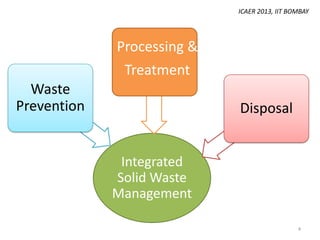
Processing &
Treatment
Waste
Prevention

Disposal
Integrated
Solid Waste
Management
4
ICAER 2013, IIT BOMBAY

MUNICIPAL SOLID WASTE GENERATION
Major Sources
1. Residential areas.
2. Commercial or market areas.
3. Offices.
4. Institutions.
5
ICAER 2013, IIT BOMBAY

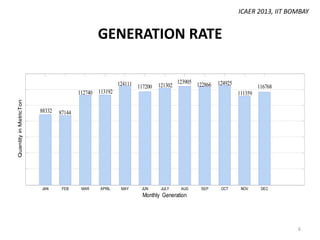
GENERATION RATE

Quantity in MetricTon

112740 113192
88332

FEB

121302

123905 122866

124925

116768
111359

87144

JAN

124111 117200

MAR

APRIL

MAY

JUN

JULY

AUG

SEP

OCT

NOV

DEC

Monthly Generation

6
ICAER 2013, IIT BOMBAY

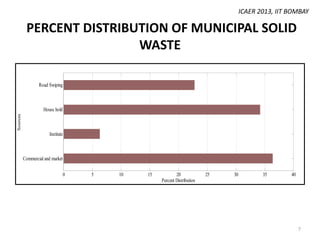
PERCENT DISTRIBUTION OF MUNICIPAL SOLID
WASTE
Road Swiping

Sources

House hold

Institute

Commercial and market
0

5

10

15

20
Percent Distribution

25

30

35

40

7
ICAER 2013, IIT BOMBAY

COMPOSITION FACTORS OF MUNICIPAL SOLID
WASTE
•
•
•
•
•
•

Nature of local activities.
Food habits.
Cultural traditions.
Socio-economic factors.
Climatic conditions.
Seasons.
8
ICAER 2013, IIT BOMBAY

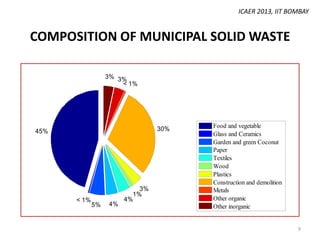
COMPOSITION OF MUNICIPAL SOLID WASTE
3% 3%
< 1%

30%

45%

< 1%

5%

4%

3%
1%
4%

Food and vegetable
Glass and Ceramics
Garden and green Coconut
Paper
Textiles
Wood
Plastics
Construction and demolition
Metals
Other organic
Other inorganic

9
ICAER 2013, IIT BOMBAY

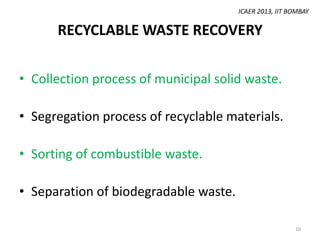
RECYCLABLE WASTE RECOVERY
• Collection process of municipal solid waste.
• Segregation process of recyclable materials.

• Sorting of combustible waste.
• Separation of biodegradable waste.
10
ICAER 2013, IIT BOMBAY

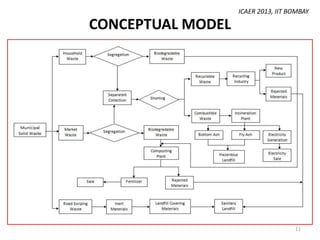
CONCEPTUAL MODEL

11
ICAER 2013, IIT BOMBAY

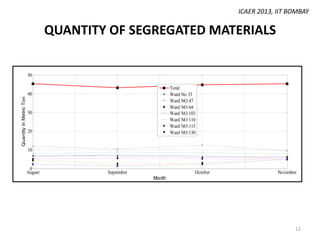
QUANTITY OF SEGREGATED MATERIALS
50
Total
Ward No 33
Ward NO 47
Ward NO 64
Ward NO 103
Ward NO 110
Ward NO 115
Ward NO 130

Quantity in Metric Ton

40

30

20

10

0
August

September

October

November

Month

12
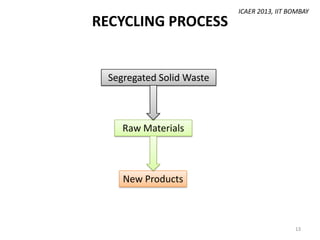
RECYCLING PROCESS

ICAER 2013, IIT BOMBAY

Segregated Solid Waste

Raw Materials

New Products

13
ICAER 2013, IIT BOMBAY

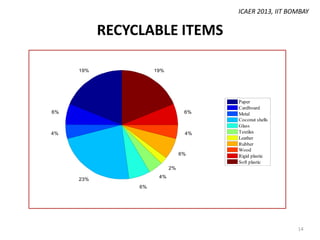
RECYCLABLE ITEMS
19%

19%

6%

6%

4%

4%

6%

Paper
Cardboard
Metal
Coconut shells
Glass
Textiles
Leather
Rubber
Wood
Rigid plastic
Soft plastic

2%
4%

23%
6%

14
ICAER 2013, IIT BOMBAY

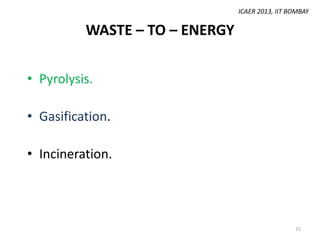
WASTE – TO – ENERGY
• Pyrolysis.
• Gasification.

• Incineration.

15
ICAER 2013, IIT BOMBAY

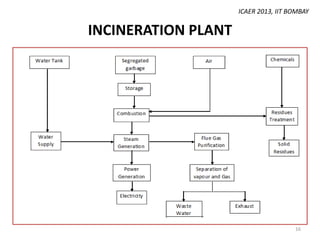
INCINERATION PLANT

16
ICAER 2013, IIT BOMBAY

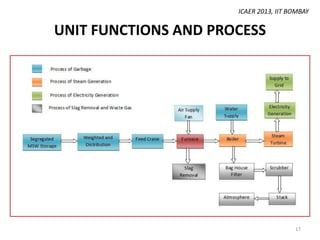
UNIT FUNCTIONS AND PROCESS

17
ICAER 2013, IIT BOMBAY

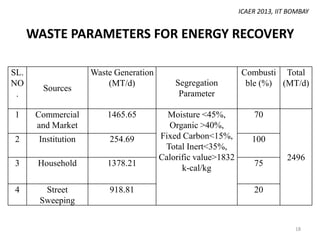
WASTE PARAMETERS FOR ENERGY RECOVERY
SL.
NO
.

Sources

Waste Generation
(MT/d)

1

Commercial
and Market

1465.65

2

Institution

254.69

3

Household

1378.21

4

Street
Sweeping

918.81

Segregation
Parameter
Moisture <45%,
Organic >40%,
Fixed Carbon<15%,
Total Inert<35%,
Calorific value>1832
k-cal/kg

Combusti Total
ble (%) (MT/d)

70

100
75

2496

20

18
ICAER 2013, IIT BOMBAY

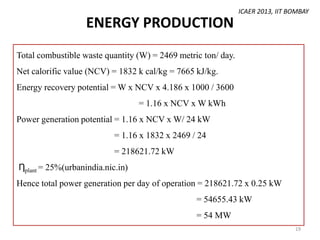
ENERGY PRODUCTION
Total combustible waste quantity (W) = 2469 metric ton/ day.
Net calorific value (NCV) = 1832 k cal/kg = 7665 kJ/kg.
Energy recovery potential = W x NCV x 4.186 x 1000 / 3600
= 1.16 x NCV x W kWh
Power generation potential = 1.16 x NCV x W/ 24 kW
= 1.16 x 1832 x 2469 / 24

= 218621.72 kW
Ƞplant = 25%(urbanindia.nic.in)
Hence total power generation per day of operation = 218621.72 x 0.25 kW
= 54655.43 kW
= 54 MW
19
ICAER 2013, IIT BOMBAY

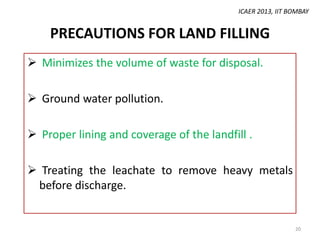
PRECAUTIONS FOR LAND FILLING
 Minimizes the volume of waste for disposal.
 Ground water pollution.
 Proper lining and coverage of the landfill .
 Treating the leachate to remove heavy metals
before discharge.

20
ICAER 2013, IIT BOMBAY

CONCLUSIONS
• Coupled with necessary legislative and control measures for
the success of this technology.
• The current costs still favour the landfill option of managing
the MSW.
• This technology reduce considerably the amount of land
consigned annually to landfilling.
• Effectively bridge between waste recycling, composting and

landfilling.
21
ICAER 2013, IIT BOMBAY

REFERENCES
1.

Zaman, A. U. (2010) Comparative study of municipal solid waste treatme
nt technologies using life cycle assessment method, International Journal

of Environmental Science and Technology, 7 (2), pp. 225-234.
2.

Ruth, L. A. (1998) Energy from municipal solid waste: a comparison with
coal combustion technology, Prog. Energy Combust. Sci., 24, pp. 545564.

3.

http://urbanindia.nic.in/publicinfo/swm/chap15.pdf.

4.

Bovea, M.D., Fores, V. I., Gallardo, A., and Mendoza F.J. C. (2010)
Environmental

assessment

of

alternative

municipal

solid

waste

management strategies. A Spanish case study, Waste Management, 30, pp.
2383–2395.
22
ICAER 2013, IIT BOMBAY

THANKS FOR YOUR KIND ATTENTION

S DAS
PhD Scholar
Department of Mechanical Engineering
Bengal Engineering and Science University, Shibpur
Howrah-711103
E-mail- swapan2009sajal@gmail.com

23

302 swapan

  • 1.
    ICAER 2013, IIT BOMBAY Classificationand Energy Recovery from Municipal Solid Waste, Generated by Greater Metropolitan Regions of Kolkata, India PRESENTED BY S DAS CO-AUTHOR:- PROF B K BHATTACHARYYA DEPARTMENT OF MECHANICAL ENGINEERING BESU, SHIBPUR, HOWRAH-03
  • 2.
    ICAER 2013, IITBOMBAY OUTLINE  Introduction Municipal solid waste generation Composition of municipal solid waste Recyclable waste recovery  Waste – to – energy Incineration process  Precautions for Land filling  Conclusions 2
  • 3.
  • 4.
    ICAER 2013, IITBOMBAY Processing & Treatment Waste Prevention Disposal Integrated Solid Waste Management 4
  • 5.
    ICAER 2013, IITBOMBAY MUNICIPAL SOLID WASTE GENERATION Major Sources 1. Residential areas. 2. Commercial or market areas. 3. Offices. 4. Institutions. 5
  • 6.
    ICAER 2013, IITBOMBAY GENERATION RATE Quantity in MetricTon 112740 113192 88332 FEB 121302 123905 122866 124925 116768 111359 87144 JAN 124111 117200 MAR APRIL MAY JUN JULY AUG SEP OCT NOV DEC Monthly Generation 6
  • 7.
    ICAER 2013, IITBOMBAY PERCENT DISTRIBUTION OF MUNICIPAL SOLID WASTE Road Swiping Sources House hold Institute Commercial and market 0 5 10 15 20 Percent Distribution 25 30 35 40 7
  • 8.
    ICAER 2013, IITBOMBAY COMPOSITION FACTORS OF MUNICIPAL SOLID WASTE • • • • • • Nature of local activities. Food habits. Cultural traditions. Socio-economic factors. Climatic conditions. Seasons. 8
  • 9.
    ICAER 2013, IITBOMBAY COMPOSITION OF MUNICIPAL SOLID WASTE 3% 3% < 1% 30% 45% < 1% 5% 4% 3% 1% 4% Food and vegetable Glass and Ceramics Garden and green Coconut Paper Textiles Wood Plastics Construction and demolition Metals Other organic Other inorganic 9
  • 10.
    ICAER 2013, IITBOMBAY RECYCLABLE WASTE RECOVERY • Collection process of municipal solid waste. • Segregation process of recyclable materials. • Sorting of combustible waste. • Separation of biodegradable waste. 10
  • 11.
    ICAER 2013, IITBOMBAY CONCEPTUAL MODEL 11
  • 12.
    ICAER 2013, IITBOMBAY QUANTITY OF SEGREGATED MATERIALS 50 Total Ward No 33 Ward NO 47 Ward NO 64 Ward NO 103 Ward NO 110 Ward NO 115 Ward NO 130 Quantity in Metric Ton 40 30 20 10 0 August September October November Month 12
  • 13.
    RECYCLING PROCESS ICAER 2013,IIT BOMBAY Segregated Solid Waste Raw Materials New Products 13
  • 14.
    ICAER 2013, IITBOMBAY RECYCLABLE ITEMS 19% 19% 6% 6% 4% 4% 6% Paper Cardboard Metal Coconut shells Glass Textiles Leather Rubber Wood Rigid plastic Soft plastic 2% 4% 23% 6% 14
  • 15.
    ICAER 2013, IITBOMBAY WASTE – TO – ENERGY • Pyrolysis. • Gasification. • Incineration. 15
  • 16.
    ICAER 2013, IITBOMBAY INCINERATION PLANT 16
  • 17.
    ICAER 2013, IITBOMBAY UNIT FUNCTIONS AND PROCESS 17
  • 18.
    ICAER 2013, IITBOMBAY WASTE PARAMETERS FOR ENERGY RECOVERY SL. NO . Sources Waste Generation (MT/d) 1 Commercial and Market 1465.65 2 Institution 254.69 3 Household 1378.21 4 Street Sweeping 918.81 Segregation Parameter Moisture <45%, Organic >40%, Fixed Carbon<15%, Total Inert<35%, Calorific value>1832 k-cal/kg Combusti Total ble (%) (MT/d) 70 100 75 2496 20 18
  • 19.
    ICAER 2013, IITBOMBAY ENERGY PRODUCTION Total combustible waste quantity (W) = 2469 metric ton/ day. Net calorific value (NCV) = 1832 k cal/kg = 7665 kJ/kg. Energy recovery potential = W x NCV x 4.186 x 1000 / 3600 = 1.16 x NCV x W kWh Power generation potential = 1.16 x NCV x W/ 24 kW = 1.16 x 1832 x 2469 / 24 = 218621.72 kW Ƞplant = 25%(urbanindia.nic.in) Hence total power generation per day of operation = 218621.72 x 0.25 kW = 54655.43 kW = 54 MW 19
  • 20.
    ICAER 2013, IITBOMBAY PRECAUTIONS FOR LAND FILLING  Minimizes the volume of waste for disposal.  Ground water pollution.  Proper lining and coverage of the landfill .  Treating the leachate to remove heavy metals before discharge. 20
  • 21.
    ICAER 2013, IITBOMBAY CONCLUSIONS • Coupled with necessary legislative and control measures for the success of this technology. • The current costs still favour the landfill option of managing the MSW. • This technology reduce considerably the amount of land consigned annually to landfilling. • Effectively bridge between waste recycling, composting and landfilling. 21
  • 22.
    ICAER 2013, IITBOMBAY REFERENCES 1. Zaman, A. U. (2010) Comparative study of municipal solid waste treatme nt technologies using life cycle assessment method, International Journal of Environmental Science and Technology, 7 (2), pp. 225-234. 2. Ruth, L. A. (1998) Energy from municipal solid waste: a comparison with coal combustion technology, Prog. Energy Combust. Sci., 24, pp. 545564. 3. http://urbanindia.nic.in/publicinfo/swm/chap15.pdf. 4. Bovea, M.D., Fores, V. I., Gallardo, A., and Mendoza F.J. C. (2010) Environmental assessment of alternative municipal solid waste management strategies. A Spanish case study, Waste Management, 30, pp. 2383–2395. 22
  • 23.
    ICAER 2013, IITBOMBAY THANKS FOR YOUR KIND ATTENTION S DAS PhD Scholar Department of Mechanical Engineering Bengal Engineering and Science University, Shibpur Howrah-711103 E-mail- swapan2009sajal@gmail.com 23