
Heat and Mass Transfer Characteristics of Direct
Methanol Fuel Cell: Experiments and Model
By
B. Mullai Sudaroli
and
Prof. Ajit Kumar Kolar

Department of Mechanical Engineering
Indian Institute of Technology Madras
4th International Conference on Advances in Energy Research
(ICAER 2013)
Indian Institute of Technology Bombay, Mumbai, India.
Introduction
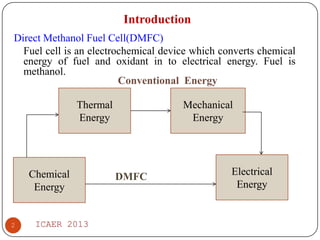
Direct Methanol Fuel Cell(DMFC)
Fuel cell is an electrochemical device which converts chemical
energy of fuel and oxidant in to electrical energy. Fuel is
methanol.
Conventional Energy
Thermal
Energy

Chemical
Energy

2

ICAER 2013

Mechanical
Energy

DMFC

Electrical
Energy
Advantages and Applications
Advantages
 Electrical Efficiency 40-60%
 No harmful emissions
 No moving parts-no noise and less maintenance
 Low temperature
 Operates as long as fuel is supplied
 Direct use of fuel- Reformer is not required
 High energy density-10 times higher than hydrogen
 Safe, easy to handle and transport
Applications
 Portable applications (mW-W)
Mobile phones, Laptops
 Sensors (W)
 Distributed power generation(kW)
3

ICAER 2013
Working Principle
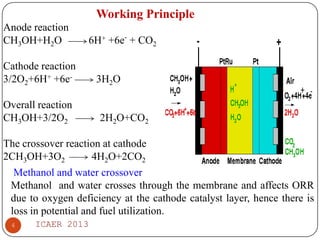
Anode reaction
CH3OH+H2O
Cathode reaction
3/2O2+6H+ +6eOverall reaction
CH3OH+3/2O2

6H+ +6e- + CO2

3H2O

2H2O+CO2

The crossover reaction at cathode
2CH3OH+3O2
4H2O+2CO2
Methanol and water crossover
Methanol and water crosses through the membrane and affects ORR
due to oxygen deficiency at the cathode catalyst layer, hence there is
loss in potential and fuel utilization.
4

ICAER 2013
Objective and Scope
Objective
Heat and mass transfer characteristics of DMFC and its effect on
cell performance.
Scope
 To develop a full cell model for anode side of DMFC and to
predict methanol and temperature distribution.
 To study the methanol and water transfer process through the
membrane with varying methanol concentration and cell
current density.
 The effect of double channel serpentine flow field on cell
performance
5

ICAER 2013
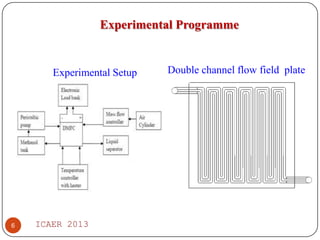
Experimental Programme

Experimental Setup

6

ICAER 2013

Double channel flow field plate
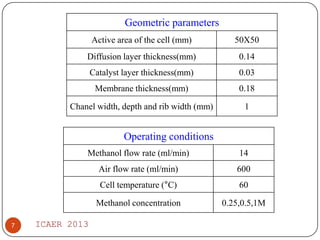
Geometric parameters
Active area of the cell (mm)

50X50

Diffusion layer thickness(mm)

0.14

Catalyst layer thickness(mm)

0.03

Membrane thickness(mm)

0.18

Chanel width, depth and rib width (mm)

1

Operating conditions
Methanol flow rate (ml/min)
Air flow rate (ml/min)

600

Cell temperature (°C)

60

Methanol concentration
7

14

0.25,0.5,1M

ICAER 2013
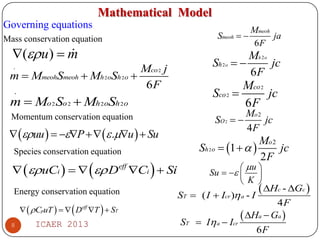
Mathematical Model
Governing equations

Smeoh  

Mass conservation equation


( u )  m

Mmeoh
ja
6F

.

Mh 2 o
Sh 2 o  
jc
6F

.

Mco 2
Sco 2 
jc
6F

Mco 2 j
m  MmeohSmeoh  Mh 2 oSh 2 o 
6F

m  Mo 2 So 2  Mh 2 oSh 2o

Mo 2
SO 2  
jc
4F

Momentum conservation equation

 uu   P    .u   Su

Mo 2
Sh 2 o  1   
jc
2F

Species conservation equation

 uCi     Deff Ci   Si
Energy conservation equation
  CpuT     D T   ST

 u 
Su   

 K 

ST 

 Hc - Gc 
( I  Icr ) a - I

eff

8

ICAER 2013

ST  I a  Icr

4F
 Ha  Ga 

6F
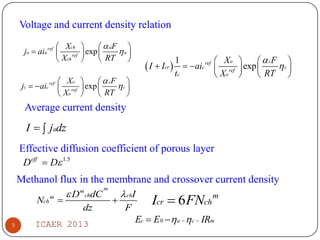
Voltage and current density relation
 Xch
ja  aia ref 
ref
 Xch


  aF 
exp 
a 


 RT


 Xo
jc  aic ref  ref
 Xo


  cF 
exp 
c 


 RT 

 I  Icr 

1
 Xo
 aic ref  ref
tc
 Xo


  cF 
exp 
c 


 RT 

Average current density

I   jadz
Effective diffusion coefficient of porous layer
Deff  D 1.5
Methanol flux in the membrane and crossover current density
m
 D m chdC
 chI
m
m
Nch 

9

dz

ICAER 2013



F

Icr  6 FNch

Ec  E 0  a   c  IRm
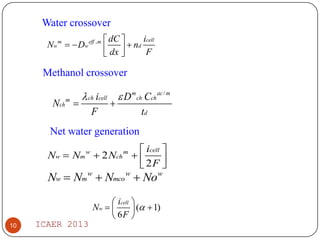
Water crossover
icell
 dC 
Nw m   Dw eff ,m    nd
F
 dx 

Methanol crossover
Nch m

 ch icell  D m ch Cch ac / m


F
td

Net water generation
Nw  Nm  2 Nch
w

m

 icell 

 2F 


Nw  Nm w  Nmco w  Now

10

ICAER 2013

 icell 
Nw  
 (  1)
 6F 
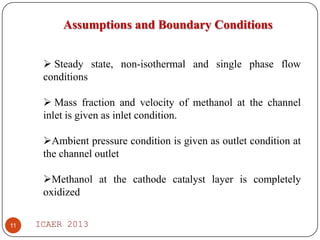
Assumptions and Boundary Conditions
 Steady state, non-isothermal and single phase flow
conditions
 Mass fraction and velocity of methanol at the channel
inlet is given as inlet condition.

Ambient pressure condition is given as outlet condition at
the channel outlet
Methanol at the cathode catalyst layer is completely
oxidized
11

ICAER 2013
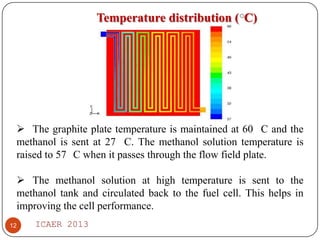
Temperature distribution ( C)

 The graphite plate temperature is maintained at 60 C and the
methanol is sent at 27 C. The methanol solution temperature is
raised to 57 C when it passes through the flow field plate.
 The methanol solution at high temperature is sent to the
methanol tank and circulated back to the fuel cell. This helps in
improving the cell performance.
12

ICAER 2013
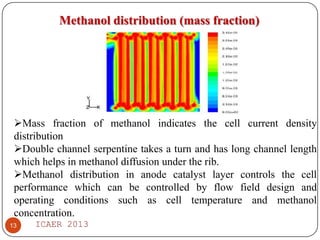
Methanol distribution (mass fraction)

Mass fraction of methanol indicates the cell current density
distribution
Double channel serpentine takes a turn and has long channel length
which helps in methanol diffusion under the rib.
Methanol distribution in anode catalyst layer controls the cell
performance which can be controlled by flow field design and
operating conditions such as cell temperature and methanol
concentration.
13

ICAER 2013
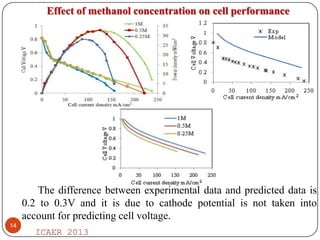
Effect of methanol concentration on cell performance

The difference between experimental data and predicted data is
0.2 to 0.3V and it is due to cathode potential is not taken into
account for predicting cell voltage.
14

ICAER 2013
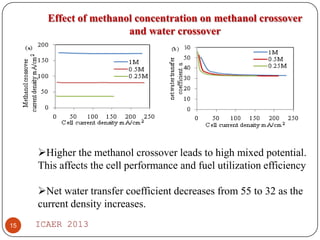
Effect of methanol concentration on methanol crossover
and water crossover

Higher the methanol crossover leads to high mixed potential.
This affects the cell performance and fuel utilization efficiency

Net water transfer coefficient decreases from 55 to 32 as the
current density increases.
15

ICAER 2013
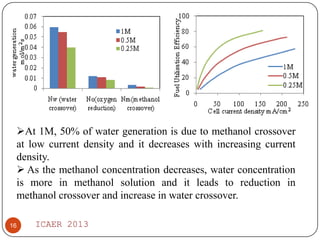
At 1M, 50% of water generation is due to methanol crossover
at low current density and it decreases with increasing current
density.
 As the methanol concentration decreases, water concentration
is more in methanol solution and it leads to reduction in
methanol crossover and increase in water crossover.
16

ICAER 2013
Conclusions
 A three dimensional non-isothermal model is developed for anode

side of DMFC. The model results are compared with experimental
data.
 Methanol and temperature distribution in anode are found.

 The methanol concentration doesn’t have significant impact on net

water generation.
 Even though the methanol crossover is high at 1M, FUE is 57% at

230mA/cm2.
17

ICAER 2013
References
1.

2.

3.

4.

5.

18

Jiabin Ge, Hongtan Liu, 2006, “A Three-Dimensional Mathematical
Model for Liquid-Fed Direct Methanol Fuel Cells”, International Journal
of Power Sources 160: 413–421.
Marcos Vera, 2007, “A Single-phase Model for Liquid-feed DMFCs with
Non-Tafel kinetics”, International Journal of Power Sources 171: 763–
777
Li, X.Y., Yang, W.W., He, Y.L., Zhao, T.S., Qu, Z.G., “Effect of Anode
Microporous Layer on Species Crossover through the Membrane of the
Liquid-Feed Direct Methanol Fuel Cells”, International Journal of
Applied ThermalEngineering,doi:10.1016/j.applthermaleng.2011.10.051.
Yang, W.W., Zhao, T.S., Xu, C., 2007, “Three-dimensional Two-phase
Mass Transport Model for Direct Methanol Fuel Cells”, International
Journal of Electrochimica Acta 52: 6125–6140.
Nobuyoshi Nakagawa, Mohammad Ali Abdelkareem, Kazuya
Sekimoto, 2006, “Control of Methanol Transport and Separation in a
DMFC with a Porous Support” International Journal of Power Sources
160: 105–115.

ICAER 2013
19

ICAER 2013
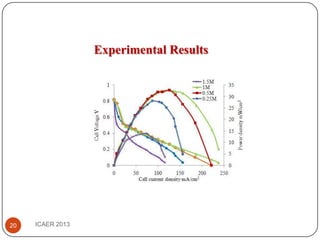
Experimental Results

20

ICAER 2013

195 b.m. sudaroli

  • 1.
    Heat and MassTransfer Characteristics of Direct Methanol Fuel Cell: Experiments and Model By B. Mullai Sudaroli and Prof. Ajit Kumar Kolar Department of Mechanical Engineering Indian Institute of Technology Madras 4th International Conference on Advances in Energy Research (ICAER 2013) Indian Institute of Technology Bombay, Mumbai, India.
  • 2.
    Introduction Direct Methanol FuelCell(DMFC) Fuel cell is an electrochemical device which converts chemical energy of fuel and oxidant in to electrical energy. Fuel is methanol. Conventional Energy Thermal Energy Chemical Energy 2 ICAER 2013 Mechanical Energy DMFC Electrical Energy
  • 3.
    Advantages and Applications Advantages Electrical Efficiency 40-60%  No harmful emissions  No moving parts-no noise and less maintenance  Low temperature  Operates as long as fuel is supplied  Direct use of fuel- Reformer is not required  High energy density-10 times higher than hydrogen  Safe, easy to handle and transport Applications  Portable applications (mW-W) Mobile phones, Laptops  Sensors (W)  Distributed power generation(kW) 3 ICAER 2013
  • 4.
    Working Principle Anode reaction CH3OH+H2O Cathodereaction 3/2O2+6H+ +6eOverall reaction CH3OH+3/2O2 6H+ +6e- + CO2 3H2O 2H2O+CO2 The crossover reaction at cathode 2CH3OH+3O2 4H2O+2CO2 Methanol and water crossover Methanol and water crosses through the membrane and affects ORR due to oxygen deficiency at the cathode catalyst layer, hence there is loss in potential and fuel utilization. 4 ICAER 2013
  • 5.
    Objective and Scope Objective Heatand mass transfer characteristics of DMFC and its effect on cell performance. Scope  To develop a full cell model for anode side of DMFC and to predict methanol and temperature distribution.  To study the methanol and water transfer process through the membrane with varying methanol concentration and cell current density.  The effect of double channel serpentine flow field on cell performance 5 ICAER 2013
  • 6.
    Experimental Programme Experimental Setup 6 ICAER2013 Double channel flow field plate
  • 7.
    Geometric parameters Active areaof the cell (mm) 50X50 Diffusion layer thickness(mm) 0.14 Catalyst layer thickness(mm) 0.03 Membrane thickness(mm) 0.18 Chanel width, depth and rib width (mm) 1 Operating conditions Methanol flow rate (ml/min) Air flow rate (ml/min) 600 Cell temperature (°C) 60 Methanol concentration 7 14 0.25,0.5,1M ICAER 2013
  • 8.
    Mathematical Model Governing equations Smeoh  Mass conservation equation  ( u )  m Mmeoh ja 6F . Mh 2 o Sh 2 o   jc 6F . Mco 2 Sco 2  jc 6F Mco 2 j m  MmeohSmeoh  Mh 2 oSh 2 o  6F m  Mo 2 So 2  Mh 2 oSh 2o Mo 2 SO 2   jc 4F Momentum conservation equation  uu   P    .u   Su Mo 2 Sh 2 o  1    jc 2F Species conservation equation  uCi     Deff Ci   Si Energy conservation equation   CpuT     D T   ST  u  Su      K  ST   Hc - Gc  ( I  Icr ) a - I eff 8 ICAER 2013 ST  I a  Icr 4F  Ha  Ga  6F
  • 9.
    Voltage and currentdensity relation  Xch ja  aia ref  ref  Xch    aF  exp  a     RT   Xo jc  aic ref  ref  Xo    cF  exp  c     RT   I  Icr  1  Xo  aic ref  ref tc  Xo    cF  exp  c     RT  Average current density I   jadz Effective diffusion coefficient of porous layer Deff  D 1.5 Methanol flux in the membrane and crossover current density m  D m chdC  chI m m Nch  9 dz ICAER 2013  F Icr  6 FNch Ec  E 0  a   c  IRm
  • 10.
    Water crossover icell  dC Nw m   Dw eff ,m    nd F  dx  Methanol crossover Nch m  ch icell  D m ch Cch ac / m   F td Net water generation Nw  Nm  2 Nch w m  icell    2F   Nw  Nm w  Nmco w  Now 10 ICAER 2013  icell  Nw    (  1)  6F 
  • 11.
    Assumptions and BoundaryConditions  Steady state, non-isothermal and single phase flow conditions  Mass fraction and velocity of methanol at the channel inlet is given as inlet condition. Ambient pressure condition is given as outlet condition at the channel outlet Methanol at the cathode catalyst layer is completely oxidized 11 ICAER 2013
  • 12.
    Temperature distribution (C)  The graphite plate temperature is maintained at 60 C and the methanol is sent at 27 C. The methanol solution temperature is raised to 57 C when it passes through the flow field plate.  The methanol solution at high temperature is sent to the methanol tank and circulated back to the fuel cell. This helps in improving the cell performance. 12 ICAER 2013
  • 13.
    Methanol distribution (massfraction) Mass fraction of methanol indicates the cell current density distribution Double channel serpentine takes a turn and has long channel length which helps in methanol diffusion under the rib. Methanol distribution in anode catalyst layer controls the cell performance which can be controlled by flow field design and operating conditions such as cell temperature and methanol concentration. 13 ICAER 2013
  • 14.
    Effect of methanolconcentration on cell performance The difference between experimental data and predicted data is 0.2 to 0.3V and it is due to cathode potential is not taken into account for predicting cell voltage. 14 ICAER 2013
  • 15.
    Effect of methanolconcentration on methanol crossover and water crossover Higher the methanol crossover leads to high mixed potential. This affects the cell performance and fuel utilization efficiency Net water transfer coefficient decreases from 55 to 32 as the current density increases. 15 ICAER 2013
  • 16.
    At 1M, 50%of water generation is due to methanol crossover at low current density and it decreases with increasing current density.  As the methanol concentration decreases, water concentration is more in methanol solution and it leads to reduction in methanol crossover and increase in water crossover. 16 ICAER 2013
  • 17.
    Conclusions  A threedimensional non-isothermal model is developed for anode side of DMFC. The model results are compared with experimental data.  Methanol and temperature distribution in anode are found.  The methanol concentration doesn’t have significant impact on net water generation.  Even though the methanol crossover is high at 1M, FUE is 57% at 230mA/cm2. 17 ICAER 2013
  • 18.
    References 1. 2. 3. 4. 5. 18 Jiabin Ge, HongtanLiu, 2006, “A Three-Dimensional Mathematical Model for Liquid-Fed Direct Methanol Fuel Cells”, International Journal of Power Sources 160: 413–421. Marcos Vera, 2007, “A Single-phase Model for Liquid-feed DMFCs with Non-Tafel kinetics”, International Journal of Power Sources 171: 763– 777 Li, X.Y., Yang, W.W., He, Y.L., Zhao, T.S., Qu, Z.G., “Effect of Anode Microporous Layer on Species Crossover through the Membrane of the Liquid-Feed Direct Methanol Fuel Cells”, International Journal of Applied ThermalEngineering,doi:10.1016/j.applthermaleng.2011.10.051. Yang, W.W., Zhao, T.S., Xu, C., 2007, “Three-dimensional Two-phase Mass Transport Model for Direct Methanol Fuel Cells”, International Journal of Electrochimica Acta 52: 6125–6140. Nobuyoshi Nakagawa, Mohammad Ali Abdelkareem, Kazuya Sekimoto, 2006, “Control of Methanol Transport and Separation in a DMFC with a Porous Support” International Journal of Power Sources 160: 105–115. ICAER 2013
  • 19.
  • 20.

Editor's Notes