E-GAZARCHIN UNIVERSITY 
Approved by Head of Department Training Enkhjargal .D/MA/ 
Prepared by Orkhontuya. B /Inspector/ 
17th November 2014 
English Language Teacher 
Orkhontuya. B /MA/ 
Seminar 10
The truth is out there! 
Stars / pole stars 
Comet 
unidentified 
flying object
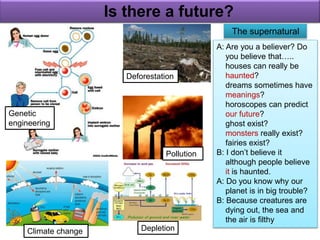
Is there a future? 
Climate change 
Pollution 
Depletion 
Genetic 
engineering 
Deforestation 
The supernatural 
A: Are you a believer? Do 
you believe that….. 
houses can really be 
haunted? 
dreams sometimes have 
meanings? 
horoscopes can predict 
our future? 
ghost exist? 
monsters really exist? 
fairies exist? 
B: I don’t believe it 
although people believe 
it is haunted. 
A: Do you know why our 
planet is in big trouble? 
B: Because creatures are 
dying out, the sea and 
the air is filthy
Exchanging opinions 
Giving Opinions 
 In my opinion… 
 I (strongly) believe/ think (that)… 
 The idea that…………………..is totally right/ simply 
wrong 
 There’s this idea that 
 As I see it … 
Replying to opinions 
 That’s true./ That’s right.  I see what you mean, but… 
 I agree. Definitely.  I suppose you are right, but… 
 You’re (dead) right. 
 You’ve got a point there. 
e.g. A: I strongly believe that we can down on rubbish. We can all 
recycle. 
B: That’s true. Everything can be recycled.
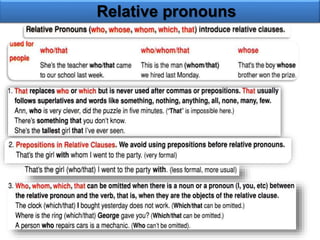
Relative pronouns
Relative adverbs
Identifying / non-identifying clauses 
There are two types of relative clauses: identifying clauses and non-identifying 
relative clauses. 
 An identifying relative clauses gives necessary information and is 
essential to the meaning of the main sentence. The clause is not put 
commas. Who, which and that can be omitted when they are object of the 
the relative clause. 
e.g. a) People risk their lives. ( Which people? We don’t know. The meaning 
of the sentence is not clear.) 
People who/that drive dangerously risk their lives. 
b) The woman who is standing near the desk is my teacher. 
 A non-identifying relative clause gives extra information and is not 
essential to the meaning of the main sentence. In non-identifying relative 
clauses the relative pronouns can not be omitted. That can not replace who 
or which. The clause is put in commas. 
e.g. a) Mr Stevenson is my neighbor. ( The meaning of the sentence is clear.) 
Mr Stevenson, who used to work in a bank, is my neighbor. (The 
relative clause gives extra information.) 
b) His sister, who studies in America, is coming back day after tomorrow.
Please conduct us: 
elearning.english@yahoo.com

17 nov ele class u 10

  • 1.
    E-GAZARCHIN UNIVERSITY Approvedby Head of Department Training Enkhjargal .D/MA/ Prepared by Orkhontuya. B /Inspector/ 17th November 2014 English Language Teacher Orkhontuya. B /MA/ Seminar 10
  • 2.
    The truth isout there! Stars / pole stars Comet unidentified flying object
  • 3.
    Is there afuture? Climate change Pollution Depletion Genetic engineering Deforestation The supernatural A: Are you a believer? Do you believe that….. houses can really be haunted? dreams sometimes have meanings? horoscopes can predict our future? ghost exist? monsters really exist? fairies exist? B: I don’t believe it although people believe it is haunted. A: Do you know why our planet is in big trouble? B: Because creatures are dying out, the sea and the air is filthy
  • 4.
    Exchanging opinions GivingOpinions  In my opinion…  I (strongly) believe/ think (that)…  The idea that…………………..is totally right/ simply wrong  There’s this idea that  As I see it … Replying to opinions  That’s true./ That’s right.  I see what you mean, but…  I agree. Definitely.  I suppose you are right, but…  You’re (dead) right.  You’ve got a point there. e.g. A: I strongly believe that we can down on rubbish. We can all recycle. B: That’s true. Everything can be recycled.
  • 5.
  • 8.
  • 9.
    Identifying / non-identifyingclauses There are two types of relative clauses: identifying clauses and non-identifying relative clauses.  An identifying relative clauses gives necessary information and is essential to the meaning of the main sentence. The clause is not put commas. Who, which and that can be omitted when they are object of the the relative clause. e.g. a) People risk their lives. ( Which people? We don’t know. The meaning of the sentence is not clear.) People who/that drive dangerously risk their lives. b) The woman who is standing near the desk is my teacher.  A non-identifying relative clause gives extra information and is not essential to the meaning of the main sentence. In non-identifying relative clauses the relative pronouns can not be omitted. That can not replace who or which. The clause is put in commas. e.g. a) Mr Stevenson is my neighbor. ( The meaning of the sentence is clear.) Mr Stevenson, who used to work in a bank, is my neighbor. (The relative clause gives extra information.) b) His sister, who studies in America, is coming back day after tomorrow.
  • 11.
    Please conduct us: elearning.english@yahoo.com