Multiplication II

http://www.lahc.edu/math/frankma.htm
Multiplication II
In the last section we covered the arithmetic mechanics of
multiplying two numbers in the vertical format where in modern
day most of this work is delegated to calculators or software.
Multiplication II
In the last section we covered the arithmetic mechanics of
multiplying two numbers in the vertical format where in modern
day most of this work is delegated to calculators or software.
In mathematics, we are also interested in the properties and
relations.
Multiplication II
In the last section we covered the arithmetic mechanics of
multiplying two numbers in the vertical format where in modern
day most of this work is delegated to calculators or software.
In mathematics, we are also interested in the properties and
relations.
Properties of Multiplication
Multiplication II
In the last section we covered the arithmetic mechanics of
multiplying two numbers in the vertical format where in modern
day most of this work is delegated to calculators or software.
In mathematics, we are also interested in the properties and
relations.
Properties of Multiplication
We note from before before that

* (0 * x = 0 * x = 0) The product of zero with any number is 0.
Multiplication II
In the last section we covered the arithmetic mechanics of
multiplying two numbers in the vertical format where in modern
day most of this work is delegated to calculators or software.
In mathematics, we are also interested in the properties and
relations.
Properties of Multiplication
We note from before before that

* (0 * x = 0 * x = 0) The product of zero with any number is 0.
In other words, 0 is the “annihilator” in multiplication.
It demolishes anything multiplied with it .
Multiplication II
In the last section we covered the arithmetic mechanics of
multiplying two numbers in the vertical format where in modern
day most of this work is delegated to calculators or software.
In mathematics, we are also interested in the properties and
relations.
Properties of Multiplication
We note from before before that

* (0 * x = 0 * x = 0) The product of zero with any number is 0.
In other words, 0 is the “annihilator” in multiplication.
It demolishes anything multiplied with it .
For example, A*B*0*C = 0 where A, B ,and C are numbers.
Multiplication II
In the last section we covered the arithmetic mechanics of
multiplying two numbers in the vertical format where in modern
day most of this work is delegated to calculators or software.
In mathematics, we are also interested in the properties and
relations.
Properties of Multiplication
We note from before before that

* (0 * x = 0 * x = 0) The product of zero with any number is 0.
In other words, 0 is the “annihilator” in multiplication.
It demolishes anything multiplied with it .
For example, A*B*0*C = 0 where A, B ,and C are numbers.
* (1 * x = x * 1 = x) The product of 1 with any number x is x.
Multiplication II
In the last section we covered the arithmetic mechanics of
multiplying two numbers in the vertical format where in modern
day most of this work is delegated to calculators or software.
In mathematics, we are also interested in the properties and
relations.
Properties of Multiplication
We note from before before that

* (0 * x = 0 * x = 0) The product of zero with any number is 0.
In other words, 0 is the “annihilator” in multiplication.
It demolishes anything multiplied with it .
For example, A*B*0*C = 0 where A, B ,and C are numbers.
* (1 * x = x * 1 = x) The product of 1 with any number x is x.
In other words, 1 is the “preserver” in multiplication,
It preserves anything multiplies with it .
Multiplication II
In the last section we covered the arithmetic mechanics of
multiplying two numbers in the vertical format where in modern
day most of this work is delegated to calculators or software.
In mathematics, we are also interested in the properties and
relations.
Properties of Multiplication
We note from before before that

* (0 * x = 0 * x = 0) The product of zero with any number is 0.
In other words, 0 is the “annihilator” in multiplication.
It demolishes anything multiplied with it .
For example, A*B*0*C = 0 where A, B ,and C are numbers.
* (1 * x = x * 1 = x) The product of 1 with any number x is x.
In other words, 1 is the “preserver” in multiplication,
It preserves anything multiplies with it .
For example, A*1*B*1*C = A*B*C.
Multiplication II
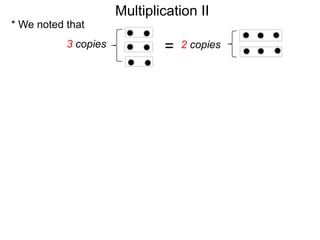
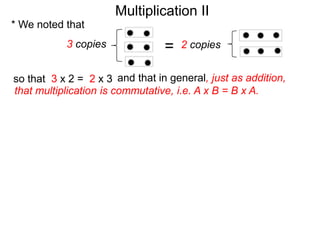
* We noted that
3 copies

=

2 copies
Multiplication II
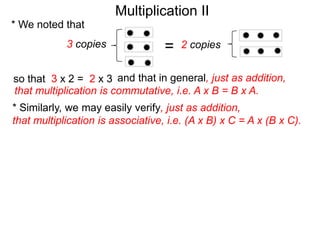
* We noted that
3 copies

=

2 copies

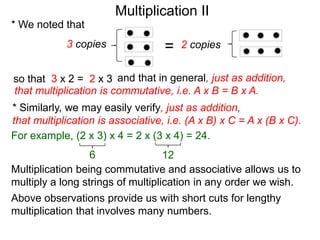
so that 3 x 2 = 2 x 3 and that in general, just as addition,
that multiplication is commutative, i.e. A x B = B x A.
Multiplication II
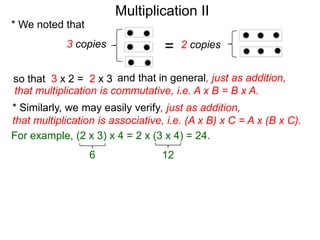
* We noted that
3 copies

=

2 copies

so that 3 x 2 = 2 x 3 and that in general, just as addition,
that multiplication is commutative, i.e. A x B = B x A.

* Similarly, we may easily verify, just as addition,
that multiplication is associative, i.e. (A x B) x C = A x (B x C).
Multiplication II
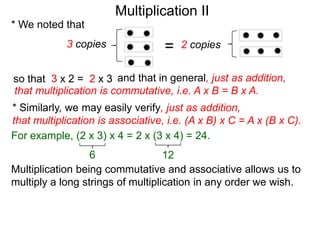
* We noted that
3 copies

=

2 copies

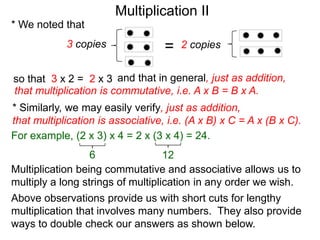
so that 3 x 2 = 2 x 3 and that in general, just as addition,
that multiplication is commutative, i.e. A x B = B x A.

* Similarly, we may easily verify, just as addition,
that multiplication is associative, i.e. (A x B) x C = A x (B x C).
For example, (2 x 3) x 4 = 2 x (3 x 4) = 24.
6

12
Multiplication II
* We noted that
3 copies

=

2 copies

so that 3 x 2 = 2 x 3 and that in general, just as addition,
that multiplication is commutative, i.e. A x B = B x A.

* Similarly, we may easily verify, just as addition,
that multiplication is associative, i.e. (A x B) x C = A x (B x C).
For example, (2 x 3) x 4 = 2 x (3 x 4) = 24.
6
12
Multiplication being commutative and associative allows us to
multiply a long strings of multiplication in any order we wish.
Multiplication II
* We noted that
3 copies

=

2 copies

so that 3 x 2 = 2 x 3 and that in general, just as addition,
that multiplication is commutative, i.e. A x B = B x A.

* Similarly, we may easily verify, just as addition,
that multiplication is associative, i.e. (A x B) x C = A x (B x C).
For example, (2 x 3) x 4 = 2 x (3 x 4) = 24.
6
12
Multiplication being commutative and associative allows us to
multiply a long strings of multiplication in any order we wish.
Above observations provide us with short cuts for lengthy
multiplication that involves many numbers.
Multiplication II
* We noted that
3 copies

=

2 copies

so that 3 x 2 = 2 x 3 and that in general, just as addition,
that multiplication is commutative, i.e. A x B = B x A.

* Similarly, we may easily verify, just as addition,
that multiplication is associative, i.e. (A x B) x C = A x (B x C).
For example, (2 x 3) x 4 = 2 x (3 x 4) = 24.
6
12
Multiplication being commutative and associative allows us to
multiply a long strings of multiplication in any order we wish.
Above observations provide us with short cuts for lengthy
multiplication that involves many numbers. They also provide
ways to double check our answers as shown below.
Multiplication II
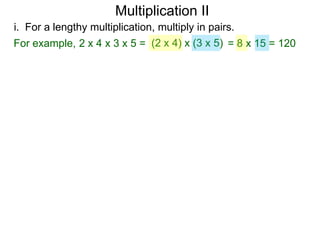
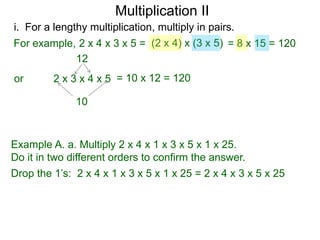
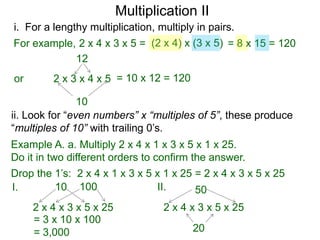
i. For a lengthy multiplication, multiply in pairs.
Multiplication II
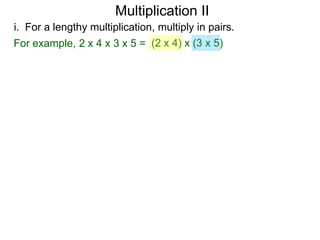
i. For a lengthy multiplication, multiply in pairs.
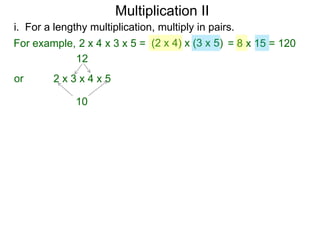
For example, 2 x 4 x 3 x 5 = (2 x 4) x (3 x 5)
Multiplication II
i. For a lengthy multiplication, multiply in pairs.
For example, 2 x 4 x 3 x 5 = (2 x 4) x (3 x 5) = 8 x 15 = 120
Multiplication II
i. For a lengthy multiplication, multiply in pairs.
For example, 2 x 4 x 3 x 5 = (2 x 4) x (3 x 5) = 8 x 15 = 120
12
or

2x3x4x5
10
Multiplication II
i. For a lengthy multiplication, multiply in pairs.
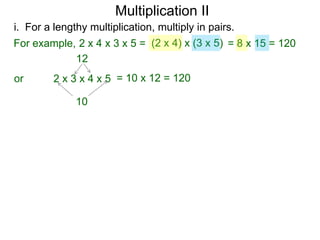
For example, 2 x 4 x 3 x 5 = (2 x 4) x (3 x 5) = 8 x 15 = 120
12
or

2 x 3 x 4 x 5 = 10 x 12 = 120
10
Multiplication II
i. For a lengthy multiplication, multiply in pairs.
For example, 2 x 4 x 3 x 5 = (2 x 4) x (3 x 5) = 8 x 15 = 120
12
or

2 x 3 x 4 x 5 = 10 x 12 = 120
10

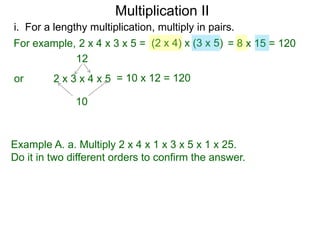
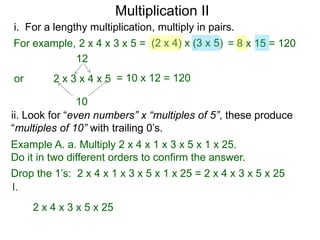
Example A. a. Multiply 2 x 4 x 1 x 3 x 5 x 1 x 25.
Do it in two different orders to confirm the answer.
Multiplication II
i. For a lengthy multiplication, multiply in pairs.
For example, 2 x 4 x 3 x 5 = (2 x 4) x (3 x 5) = 8 x 15 = 120
12
or

2 x 3 x 4 x 5 = 10 x 12 = 120
10

Example A. a. Multiply 2 x 4 x 1 x 3 x 5 x 1 x 25.
Do it in two different orders to confirm the answer.

Drop the 1’s: 2 x 4 x 1 x 3 x 5 x 1 x 25 = 2 x 4 x 3 x 5 x 25
Multiplication II
i. For a lengthy multiplication, multiply in pairs.
For example, 2 x 4 x 3 x 5 = (2 x 4) x (3 x 5) = 8 x 15 = 120
12
or

2 x 3 x 4 x 5 = 10 x 12 = 120

10
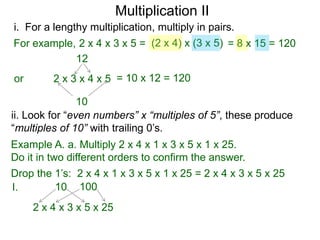
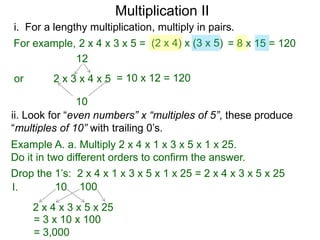
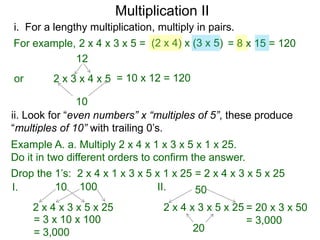
ii. Look for “even numbers” x “multiples of 5”, these produce
“multiples of 10” with trailing 0’s.
Example A. a. Multiply 2 x 4 x 1 x 3 x 5 x 1 x 25.
Do it in two different orders to confirm the answer.

Drop the 1’s: 2 x 4 x 1 x 3 x 5 x 1 x 25 = 2 x 4 x 3 x 5 x 25
I.
2 x 4 x 3 x 5 x 25
Multiplication II
i. For a lengthy multiplication, multiply in pairs.
For example, 2 x 4 x 3 x 5 = (2 x 4) x (3 x 5) = 8 x 15 = 120
12
or

2 x 3 x 4 x 5 = 10 x 12 = 120

10
ii. Look for “even numbers” x “multiples of 5”, these produce
“multiples of 10” with trailing 0’s.
Example A. a. Multiply 2 x 4 x 1 x 3 x 5 x 1 x 25.
Do it in two different orders to confirm the answer.

Drop the 1’s: 2 x 4 x 1 x 3 x 5 x 1 x 25 = 2 x 4 x 3 x 5 x 25
10 100
I.
2 x 4 x 3 x 5 x 25
Multiplication II
i. For a lengthy multiplication, multiply in pairs.
For example, 2 x 4 x 3 x 5 = (2 x 4) x (3 x 5) = 8 x 15 = 120
12
or

2 x 3 x 4 x 5 = 10 x 12 = 120

10
ii. Look for “even numbers” x “multiples of 5”, these produce
“multiples of 10” with trailing 0’s.
Example A. a. Multiply 2 x 4 x 1 x 3 x 5 x 1 x 25.
Do it in two different orders to confirm the answer.

Drop the 1’s: 2 x 4 x 1 x 3 x 5 x 1 x 25 = 2 x 4 x 3 x 5 x 25
10 100
I.
2 x 4 x 3 x 5 x 25
= 3 x 10 x 100
= 3,000
Multiplication II
i. For a lengthy multiplication, multiply in pairs.
For example, 2 x 4 x 3 x 5 = (2 x 4) x (3 x 5) = 8 x 15 = 120
12
or

2 x 3 x 4 x 5 = 10 x 12 = 120

10
ii. Look for “even numbers” x “multiples of 5”, these produce
“multiples of 10” with trailing 0’s.
Example A. a. Multiply 2 x 4 x 1 x 3 x 5 x 1 x 25.
Do it in two different orders to confirm the answer.

Drop the 1’s: 2 x 4 x 1 x 3 x 5 x 1 x 25 = 2 x 4 x 3 x 5 x 25
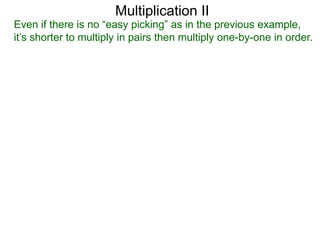
10 100
II.
I.
50
2 x 4 x 3 x 5 x 25
= 3 x 10 x 100
= 3,000

2 x 4 x 3 x 5 x 25
20
Multiplication II
i. For a lengthy multiplication, multiply in pairs.
For example, 2 x 4 x 3 x 5 = (2 x 4) x (3 x 5) = 8 x 15 = 120
12
or

2 x 3 x 4 x 5 = 10 x 12 = 120

10
ii. Look for “even numbers” x “multiples of 5”, these produce
“multiples of 10” with trailing 0’s.
Example A. a. Multiply 2 x 4 x 1 x 3 x 5 x 1 x 25.
Do it in two different orders to confirm the answer.

Drop the 1’s: 2 x 4 x 1 x 3 x 5 x 1 x 25 = 2 x 4 x 3 x 5 x 25
10 100
II.
I.
50
2 x 4 x 3 x 5 x 25
= 3 x 10 x 100
= 3,000

2 x 4 x 3 x 5 x 25 = 20 x 3 x 50
= 3,000
20
Multiplication II

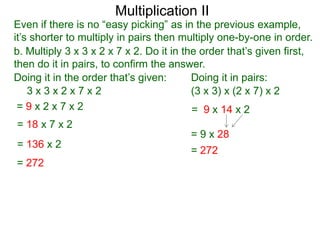
Even if there is no “easy picking” as in the previous example,
it’s shorter to multiply in pairs then multiply one-by-one in order.
Multiplication II

Even if there is no “easy picking” as in the previous example,
it’s shorter to multiply in pairs then multiply one-by-one in order.
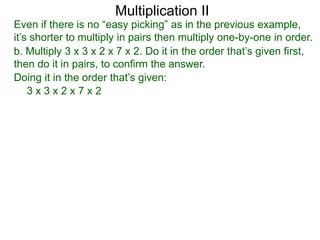
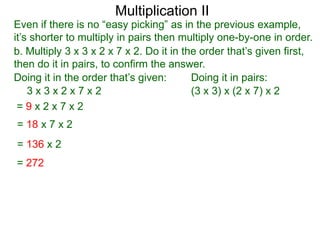
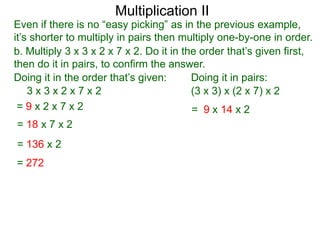
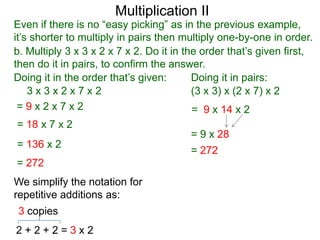
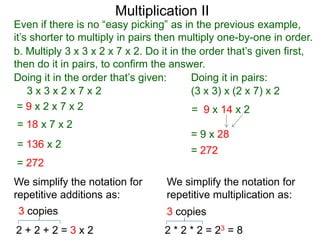
b. Multiply 3 x 3 x 2 x 7 x 2. Do it in the order that’s given first,
then do it in pairs, to confirm the answer.
Multiplication II

Even if there is no “easy picking” as in the previous example,
it’s shorter to multiply in pairs then multiply one-by-one in order.
b. Multiply 3 x 3 x 2 x 7 x 2. Do it in the order that’s given first,
then do it in pairs, to confirm the answer.
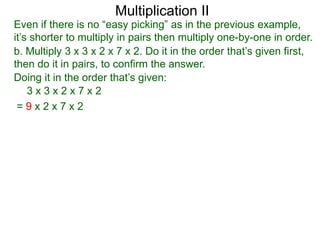
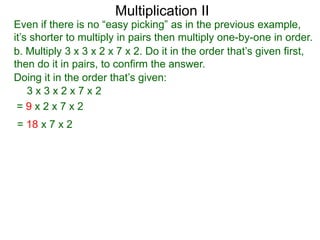
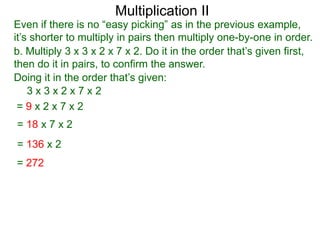
Doing it in the order that’s given:
3x3x2x7x2
Multiplication II

Even if there is no “easy picking” as in the previous example,
it’s shorter to multiply in pairs then multiply one-by-one in order.
b. Multiply 3 x 3 x 2 x 7 x 2. Do it in the order that’s given first,
then do it in pairs, to confirm the answer.
Doing it in the order that’s given:
3x3x2x7x2
=9x2x7x2
Multiplication II

Even if there is no “easy picking” as in the previous example,
it’s shorter to multiply in pairs then multiply one-by-one in order.
b. Multiply 3 x 3 x 2 x 7 x 2. Do it in the order that’s given first,
then do it in pairs, to confirm the answer.
Doing it in the order that’s given:
3x3x2x7x2
=9x2x7x2
= 18 x 7 x 2
Multiplication II

Even if there is no “easy picking” as in the previous example,
it’s shorter to multiply in pairs then multiply one-by-one in order.
b. Multiply 3 x 3 x 2 x 7 x 2. Do it in the order that’s given first,
then do it in pairs, to confirm the answer.
Doing it in the order that’s given:
3x3x2x7x2
=9x2x7x2
= 18 x 7 x 2
= 136 x 2
= 272
Multiplication II

Even if there is no “easy picking” as in the previous example,
it’s shorter to multiply in pairs then multiply one-by-one in order.
b. Multiply 3 x 3 x 2 x 7 x 2. Do it in the order that’s given first,
then do it in pairs, to confirm the answer.
Doing it in the order that’s given:
Doing it in pairs:
3x3x2x7x2
(3 x 3) x (2 x 7) x 2
=9x2x7x2
= 18 x 7 x 2
= 136 x 2
= 272
Multiplication II

Even if there is no “easy picking” as in the previous example,
it’s shorter to multiply in pairs then multiply one-by-one in order.
b. Multiply 3 x 3 x 2 x 7 x 2. Do it in the order that’s given first,
then do it in pairs, to confirm the answer.
Doing it in the order that’s given:
Doing it in pairs:
3x3x2x7x2
(3 x 3) x (2 x 7) x 2
=9x2x7x2
= 9 x 14 x 2
= 18 x 7 x 2
= 136 x 2
= 272
Multiplication II

Even if there is no “easy picking” as in the previous example,
it’s shorter to multiply in pairs then multiply one-by-one in order.
b. Multiply 3 x 3 x 2 x 7 x 2. Do it in the order that’s given first,
then do it in pairs, to confirm the answer.
Doing it in the order that’s given:
Doing it in pairs:
3x3x2x7x2
(3 x 3) x (2 x 7) x 2
=9x2x7x2
= 9 x 14 x 2
= 18 x 7 x 2
= 136 x 2
= 272

= 9 x 28
= 272
Multiplication II

Even if there is no “easy picking” as in the previous example,
it’s shorter to multiply in pairs then multiply one-by-one in order.
b. Multiply 3 x 3 x 2 x 7 x 2. Do it in the order that’s given first,
then do it in pairs, to confirm the answer.
Doing it in the order that’s given:
Doing it in pairs:
3x3x2x7x2
(3 x 3) x (2 x 7) x 2
=9x2x7x2
= 9 x 14 x 2
= 18 x 7 x 2
= 136 x 2
= 272
We simplify the notation for
repetitive additions as:
3 copies

2+2+2=3x2

= 9 x 28
= 272
Multiplication II

Even if there is no “easy picking” as in the previous example,
it’s shorter to multiply in pairs then multiply one-by-one in order.
b. Multiply 3 x 3 x 2 x 7 x 2. Do it in the order that’s given first,
then do it in pairs, to confirm the answer.
Doing it in the order that’s given:
Doing it in pairs:
3x3x2x7x2
(3 x 3) x (2 x 7) x 2
=9x2x7x2
= 9 x 14 x 2
= 18 x 7 x 2
= 136 x 2

= 9 x 28
= 272

= 272
We simplify the notation for
repetitive additions as:

We simplify the notation for
repetitive multiplication as:

3 copies

3 copies

2+2+2=3x2

2 * 2 * 2 = 23 = 8
Multiplication II
About the Notation
Multiplication II
About the Notation
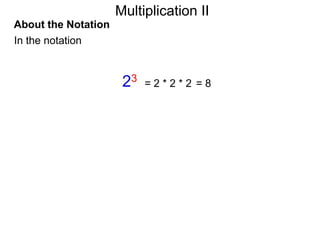
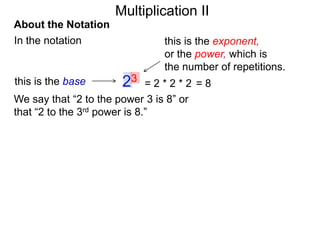
In the notation

23

=2*2*2 =8
Multiplication II
About the Notation
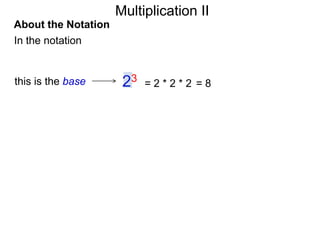
In the notation

this is the base

23

=2*2*2 =8
Multiplication II
About the Notation
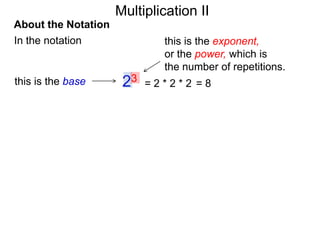
In the notation

this is the base

this is the exponent,
or the power, which is
the number of repetitions.

23

=2*2*2 =8
Multiplication II
About the Notation
In the notation

this is the base

this is the exponent,
or the power, which is
the number of repetitions.

23

=2*2*2 =8
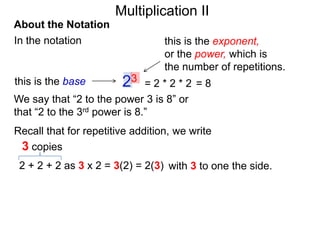
We say that “2 to the power 3 is 8” or
that “2 to the 3rd power is 8.”
Multiplication II
About the Notation
In the notation

this is the base

this is the exponent,
or the power, which is
the number of repetitions.

23

=2*2*2 =8
We say that “2 to the power 3 is 8” or
that “2 to the 3rd power is 8.”
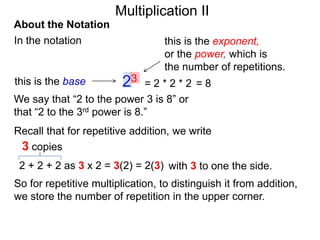
Recall that for repetitive addition, we write
3 copies
2 + 2 + 2 as 3 x 2 = 3(2) = 2(3) with 3 to one the side.
Multiplication II
About the Notation
In the notation

this is the base

this is the exponent,
or the power, which is
the number of repetitions.

23

=2*2*2 =8
We say that “2 to the power 3 is 8” or
that “2 to the 3rd power is 8.”
Recall that for repetitive addition, we write
3 copies
2 + 2 + 2 as 3 x 2 = 3(2) = 2(3) with 3 to one the side.
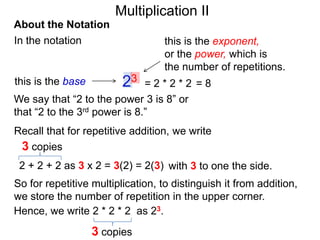
So for repetitive multiplication, to distinguish it from addition,
we store the number of repetition in the upper corner.
Multiplication II
About the Notation
In the notation

this is the base

this is the exponent,
or the power, which is
the number of repetitions.

23

=2*2*2 =8
We say that “2 to the power 3 is 8” or
that “2 to the 3rd power is 8.”
Recall that for repetitive addition, we write
3 copies
2 + 2 + 2 as 3 x 2 = 3(2) = 2(3) with 3 to one the side.
So for repetitive multiplication, to distinguish it from addition,
we store the number of repetition in the upper corner.
Hence, we write 2 * 2 * 2 as 23.

3 copies
Multiplication II
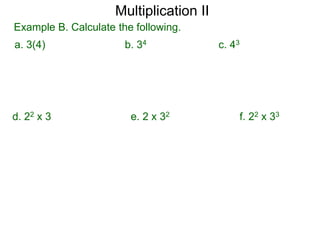
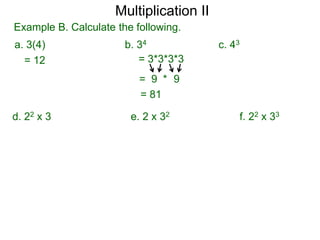
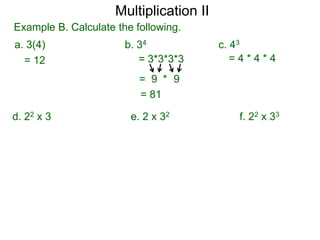
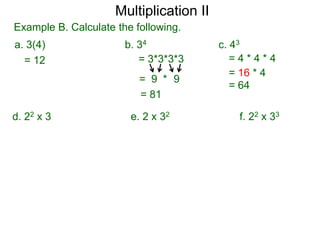
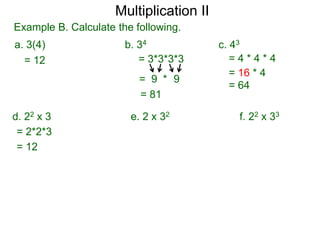
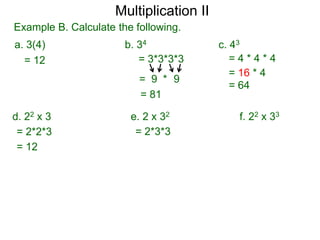
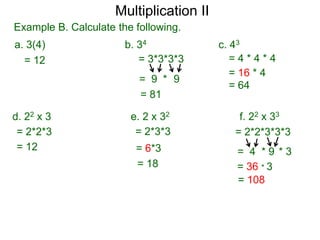
Example B. Calculate the following.
a. 3(4)

d. 22 x 3

b. 34

e. 2 x 32

c. 43

f. 22 x 33
Multiplication II
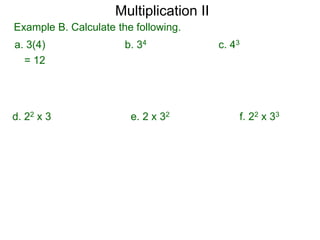
Example B. Calculate the following.
a. 3(4)
= 12

d. 22 x 3

b. 34

e. 2 x 32

c. 43

f. 22 x 33
Multiplication II
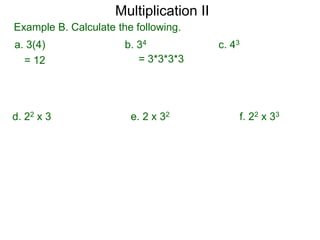
Example B. Calculate the following.
a. 3(4)
= 12

d. 22 x 3

b. 34
= 3*3*3*3

e. 2 x 32

c. 43

f. 22 x 33
Multiplication II
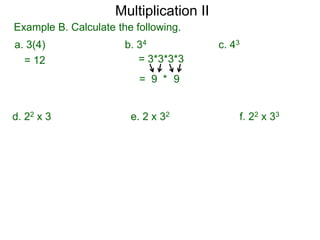
Example B. Calculate the following.
a. 3(4)
= 12

b. 34
= 3*3*3*3

c. 43

= 9 * 9

d. 22 x 3

e. 2 x 32

f. 22 x 33
Multiplication II
Example B. Calculate the following.
a. 3(4)
= 12

b. 34
= 3*3*3*3

c. 43

= 9 * 9
= 81

d. 22 x 3

e. 2 x 32

f. 22 x 33
Multiplication II
Example B. Calculate the following.
a. 3(4)
= 12

b. 34
= 3*3*3*3

c. 43
=4*4*4

= 9 * 9
= 81

d. 22 x 3

e. 2 x 32

f. 22 x 33
Multiplication II
Example B. Calculate the following.
a. 3(4)
= 12

b. 34
= 3*3*3*3
= 9 * 9
= 81

d. 22 x 3

e. 2 x 32

c. 43
=4*4*4
= 16 * 4
= 64

f. 22 x 33
Multiplication II
Example B. Calculate the following.
a. 3(4)
= 12

b. 34
= 3*3*3*3
= 9 * 9
= 81

d. 22 x 3
= 2*2*3
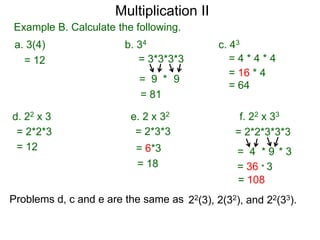
= 12

e. 2 x 32

c. 43
=4*4*4
= 16 * 4
= 64

f. 22 x 33
Multiplication II
Example B. Calculate the following.
a. 3(4)
= 12

b. 34
= 3*3*3*3
= 9 * 9
= 81

d. 22 x 3
= 2*2*3
= 12

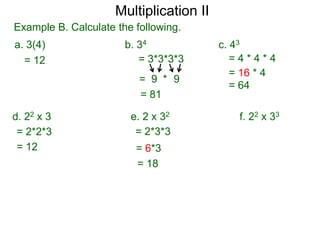
e. 2 x 32
= 2*3*3

c. 43
=4*4*4
= 16 * 4
= 64

f. 22 x 33
Multiplication II
Example B. Calculate the following.
a. 3(4)
= 12

b. 34
= 3*3*3*3
= 9 * 9
= 81

d. 22 x 3
= 2*2*3
= 12

e. 2 x 32
= 2*3*3
= 6*3
= 18

c. 43
=4*4*4
= 16 * 4
= 64

f. 22 x 33
Multiplication II
Example B. Calculate the following.
a. 3(4)
= 12

b. 34
= 3*3*3*3
= 9 * 9
= 81

d. 22 x 3
= 2*2*3
= 12

e. 2 x 32
= 2*3*3
= 6*3
= 18

c. 43
=4*4*4
= 16 * 4
= 64

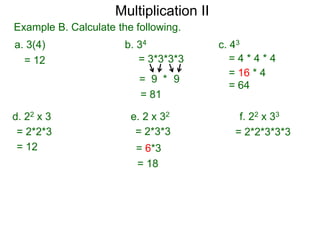
f. 22 x 33
= 2*2*3*3*3
Multiplication II
Example B. Calculate the following.
a. 3(4)
= 12

b. 34
= 3*3*3*3
= 9 * 9
= 81

d. 22 x 3
= 2*2*3
= 12

c. 43
=4*4*4
= 16 * 4
= 64

e. 2 x 32
= 2*3*3

f. 22 x 33
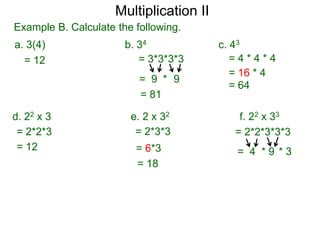
= 2*2*3*3*3

= 6*3
= 18

= 4 *9 *3
Multiplication II
Example B. Calculate the following.
a. 3(4)
= 12

b. 34
= 3*3*3*3
= 9 * 9
= 81

d. 22 x 3
= 2*2*3
= 12

c. 43
=4*4*4
= 16 * 4
= 64

e. 2 x 32
= 2*3*3

f. 22 x 33
= 2*2*3*3*3

= 6*3
= 18

= 4 *9 *3
= 36 * 3
= 108
Multiplication II
Example B. Calculate the following.
a. 3(4)
= 12

b. 34
= 3*3*3*3
= 9 * 9
= 81

d. 22 x 3
= 2*2*3
= 12

c. 43
=4*4*4
= 16 * 4
= 64

e. 2 x 32
= 2*3*3

f. 22 x 33
= 2*2*3*3*3

= 6*3
= 18

= 4 *9 *3
= 36 * 3
= 108

Problems d, c and e are the same as 22(3), 2(32), and 22(33).

1.7 multiplication ii w

  • 1.
  • 2.
    Multiplication II In thelast section we covered the arithmetic mechanics of multiplying two numbers in the vertical format where in modern day most of this work is delegated to calculators or software.
  • 3.
    Multiplication II In thelast section we covered the arithmetic mechanics of multiplying two numbers in the vertical format where in modern day most of this work is delegated to calculators or software. In mathematics, we are also interested in the properties and relations.
  • 4.
    Multiplication II In thelast section we covered the arithmetic mechanics of multiplying two numbers in the vertical format where in modern day most of this work is delegated to calculators or software. In mathematics, we are also interested in the properties and relations. Properties of Multiplication
  • 5.
    Multiplication II In thelast section we covered the arithmetic mechanics of multiplying two numbers in the vertical format where in modern day most of this work is delegated to calculators or software. In mathematics, we are also interested in the properties and relations. Properties of Multiplication We note from before before that * (0 * x = 0 * x = 0) The product of zero with any number is 0.
  • 6.
    Multiplication II In thelast section we covered the arithmetic mechanics of multiplying two numbers in the vertical format where in modern day most of this work is delegated to calculators or software. In mathematics, we are also interested in the properties and relations. Properties of Multiplication We note from before before that * (0 * x = 0 * x = 0) The product of zero with any number is 0. In other words, 0 is the “annihilator” in multiplication. It demolishes anything multiplied with it .
  • 7.
    Multiplication II In thelast section we covered the arithmetic mechanics of multiplying two numbers in the vertical format where in modern day most of this work is delegated to calculators or software. In mathematics, we are also interested in the properties and relations. Properties of Multiplication We note from before before that * (0 * x = 0 * x = 0) The product of zero with any number is 0. In other words, 0 is the “annihilator” in multiplication. It demolishes anything multiplied with it . For example, A*B*0*C = 0 where A, B ,and C are numbers.
  • 8.
    Multiplication II In thelast section we covered the arithmetic mechanics of multiplying two numbers in the vertical format where in modern day most of this work is delegated to calculators or software. In mathematics, we are also interested in the properties and relations. Properties of Multiplication We note from before before that * (0 * x = 0 * x = 0) The product of zero with any number is 0. In other words, 0 is the “annihilator” in multiplication. It demolishes anything multiplied with it . For example, A*B*0*C = 0 where A, B ,and C are numbers. * (1 * x = x * 1 = x) The product of 1 with any number x is x.
  • 9.
    Multiplication II In thelast section we covered the arithmetic mechanics of multiplying two numbers in the vertical format where in modern day most of this work is delegated to calculators or software. In mathematics, we are also interested in the properties and relations. Properties of Multiplication We note from before before that * (0 * x = 0 * x = 0) The product of zero with any number is 0. In other words, 0 is the “annihilator” in multiplication. It demolishes anything multiplied with it . For example, A*B*0*C = 0 where A, B ,and C are numbers. * (1 * x = x * 1 = x) The product of 1 with any number x is x. In other words, 1 is the “preserver” in multiplication, It preserves anything multiplies with it .
  • 10.
    Multiplication II In thelast section we covered the arithmetic mechanics of multiplying two numbers in the vertical format where in modern day most of this work is delegated to calculators or software. In mathematics, we are also interested in the properties and relations. Properties of Multiplication We note from before before that * (0 * x = 0 * x = 0) The product of zero with any number is 0. In other words, 0 is the “annihilator” in multiplication. It demolishes anything multiplied with it . For example, A*B*0*C = 0 where A, B ,and C are numbers. * (1 * x = x * 1 = x) The product of 1 with any number x is x. In other words, 1 is the “preserver” in multiplication, It preserves anything multiplies with it . For example, A*1*B*1*C = A*B*C.
  • 11.
    Multiplication II * Wenoted that 3 copies = 2 copies
  • 12.
    Multiplication II * Wenoted that 3 copies = 2 copies so that 3 x 2 = 2 x 3 and that in general, just as addition, that multiplication is commutative, i.e. A x B = B x A.
  • 13.
    Multiplication II * Wenoted that 3 copies = 2 copies so that 3 x 2 = 2 x 3 and that in general, just as addition, that multiplication is commutative, i.e. A x B = B x A. * Similarly, we may easily verify, just as addition, that multiplication is associative, i.e. (A x B) x C = A x (B x C).
  • 14.
    Multiplication II * Wenoted that 3 copies = 2 copies so that 3 x 2 = 2 x 3 and that in general, just as addition, that multiplication is commutative, i.e. A x B = B x A. * Similarly, we may easily verify, just as addition, that multiplication is associative, i.e. (A x B) x C = A x (B x C). For example, (2 x 3) x 4 = 2 x (3 x 4) = 24. 6 12
  • 15.
    Multiplication II * Wenoted that 3 copies = 2 copies so that 3 x 2 = 2 x 3 and that in general, just as addition, that multiplication is commutative, i.e. A x B = B x A. * Similarly, we may easily verify, just as addition, that multiplication is associative, i.e. (A x B) x C = A x (B x C). For example, (2 x 3) x 4 = 2 x (3 x 4) = 24. 6 12 Multiplication being commutative and associative allows us to multiply a long strings of multiplication in any order we wish.
  • 16.
    Multiplication II * Wenoted that 3 copies = 2 copies so that 3 x 2 = 2 x 3 and that in general, just as addition, that multiplication is commutative, i.e. A x B = B x A. * Similarly, we may easily verify, just as addition, that multiplication is associative, i.e. (A x B) x C = A x (B x C). For example, (2 x 3) x 4 = 2 x (3 x 4) = 24. 6 12 Multiplication being commutative and associative allows us to multiply a long strings of multiplication in any order we wish. Above observations provide us with short cuts for lengthy multiplication that involves many numbers.
  • 17.
    Multiplication II * Wenoted that 3 copies = 2 copies so that 3 x 2 = 2 x 3 and that in general, just as addition, that multiplication is commutative, i.e. A x B = B x A. * Similarly, we may easily verify, just as addition, that multiplication is associative, i.e. (A x B) x C = A x (B x C). For example, (2 x 3) x 4 = 2 x (3 x 4) = 24. 6 12 Multiplication being commutative and associative allows us to multiply a long strings of multiplication in any order we wish. Above observations provide us with short cuts for lengthy multiplication that involves many numbers. They also provide ways to double check our answers as shown below.
  • 18.
    Multiplication II i. Fora lengthy multiplication, multiply in pairs.
  • 19.
    Multiplication II i. Fora lengthy multiplication, multiply in pairs. For example, 2 x 4 x 3 x 5 = (2 x 4) x (3 x 5)
  • 20.
    Multiplication II i. Fora lengthy multiplication, multiply in pairs. For example, 2 x 4 x 3 x 5 = (2 x 4) x (3 x 5) = 8 x 15 = 120
  • 21.
    Multiplication II i. Fora lengthy multiplication, multiply in pairs. For example, 2 x 4 x 3 x 5 = (2 x 4) x (3 x 5) = 8 x 15 = 120 12 or 2x3x4x5 10
  • 22.
    Multiplication II i. Fora lengthy multiplication, multiply in pairs. For example, 2 x 4 x 3 x 5 = (2 x 4) x (3 x 5) = 8 x 15 = 120 12 or 2 x 3 x 4 x 5 = 10 x 12 = 120 10
  • 23.
    Multiplication II i. Fora lengthy multiplication, multiply in pairs. For example, 2 x 4 x 3 x 5 = (2 x 4) x (3 x 5) = 8 x 15 = 120 12 or 2 x 3 x 4 x 5 = 10 x 12 = 120 10 Example A. a. Multiply 2 x 4 x 1 x 3 x 5 x 1 x 25. Do it in two different orders to confirm the answer.
  • 24.
    Multiplication II i. Fora lengthy multiplication, multiply in pairs. For example, 2 x 4 x 3 x 5 = (2 x 4) x (3 x 5) = 8 x 15 = 120 12 or 2 x 3 x 4 x 5 = 10 x 12 = 120 10 Example A. a. Multiply 2 x 4 x 1 x 3 x 5 x 1 x 25. Do it in two different orders to confirm the answer. Drop the 1’s: 2 x 4 x 1 x 3 x 5 x 1 x 25 = 2 x 4 x 3 x 5 x 25
  • 25.
    Multiplication II i. Fora lengthy multiplication, multiply in pairs. For example, 2 x 4 x 3 x 5 = (2 x 4) x (3 x 5) = 8 x 15 = 120 12 or 2 x 3 x 4 x 5 = 10 x 12 = 120 10 ii. Look for “even numbers” x “multiples of 5”, these produce “multiples of 10” with trailing 0’s. Example A. a. Multiply 2 x 4 x 1 x 3 x 5 x 1 x 25. Do it in two different orders to confirm the answer. Drop the 1’s: 2 x 4 x 1 x 3 x 5 x 1 x 25 = 2 x 4 x 3 x 5 x 25 I. 2 x 4 x 3 x 5 x 25
  • 26.
    Multiplication II i. Fora lengthy multiplication, multiply in pairs. For example, 2 x 4 x 3 x 5 = (2 x 4) x (3 x 5) = 8 x 15 = 120 12 or 2 x 3 x 4 x 5 = 10 x 12 = 120 10 ii. Look for “even numbers” x “multiples of 5”, these produce “multiples of 10” with trailing 0’s. Example A. a. Multiply 2 x 4 x 1 x 3 x 5 x 1 x 25. Do it in two different orders to confirm the answer. Drop the 1’s: 2 x 4 x 1 x 3 x 5 x 1 x 25 = 2 x 4 x 3 x 5 x 25 10 100 I. 2 x 4 x 3 x 5 x 25
  • 27.
    Multiplication II i. Fora lengthy multiplication, multiply in pairs. For example, 2 x 4 x 3 x 5 = (2 x 4) x (3 x 5) = 8 x 15 = 120 12 or 2 x 3 x 4 x 5 = 10 x 12 = 120 10 ii. Look for “even numbers” x “multiples of 5”, these produce “multiples of 10” with trailing 0’s. Example A. a. Multiply 2 x 4 x 1 x 3 x 5 x 1 x 25. Do it in two different orders to confirm the answer. Drop the 1’s: 2 x 4 x 1 x 3 x 5 x 1 x 25 = 2 x 4 x 3 x 5 x 25 10 100 I. 2 x 4 x 3 x 5 x 25 = 3 x 10 x 100 = 3,000
  • 28.
    Multiplication II i. Fora lengthy multiplication, multiply in pairs. For example, 2 x 4 x 3 x 5 = (2 x 4) x (3 x 5) = 8 x 15 = 120 12 or 2 x 3 x 4 x 5 = 10 x 12 = 120 10 ii. Look for “even numbers” x “multiples of 5”, these produce “multiples of 10” with trailing 0’s. Example A. a. Multiply 2 x 4 x 1 x 3 x 5 x 1 x 25. Do it in two different orders to confirm the answer. Drop the 1’s: 2 x 4 x 1 x 3 x 5 x 1 x 25 = 2 x 4 x 3 x 5 x 25 10 100 II. I. 50 2 x 4 x 3 x 5 x 25 = 3 x 10 x 100 = 3,000 2 x 4 x 3 x 5 x 25 20
  • 29.
    Multiplication II i. Fora lengthy multiplication, multiply in pairs. For example, 2 x 4 x 3 x 5 = (2 x 4) x (3 x 5) = 8 x 15 = 120 12 or 2 x 3 x 4 x 5 = 10 x 12 = 120 10 ii. Look for “even numbers” x “multiples of 5”, these produce “multiples of 10” with trailing 0’s. Example A. a. Multiply 2 x 4 x 1 x 3 x 5 x 1 x 25. Do it in two different orders to confirm the answer. Drop the 1’s: 2 x 4 x 1 x 3 x 5 x 1 x 25 = 2 x 4 x 3 x 5 x 25 10 100 II. I. 50 2 x 4 x 3 x 5 x 25 = 3 x 10 x 100 = 3,000 2 x 4 x 3 x 5 x 25 = 20 x 3 x 50 = 3,000 20
  • 30.
    Multiplication II Even ifthere is no “easy picking” as in the previous example, it’s shorter to multiply in pairs then multiply one-by-one in order.
  • 31.
    Multiplication II Even ifthere is no “easy picking” as in the previous example, it’s shorter to multiply in pairs then multiply one-by-one in order. b. Multiply 3 x 3 x 2 x 7 x 2. Do it in the order that’s given first, then do it in pairs, to confirm the answer.
  • 32.
    Multiplication II Even ifthere is no “easy picking” as in the previous example, it’s shorter to multiply in pairs then multiply one-by-one in order. b. Multiply 3 x 3 x 2 x 7 x 2. Do it in the order that’s given first, then do it in pairs, to confirm the answer. Doing it in the order that’s given: 3x3x2x7x2
  • 33.
    Multiplication II Even ifthere is no “easy picking” as in the previous example, it’s shorter to multiply in pairs then multiply one-by-one in order. b. Multiply 3 x 3 x 2 x 7 x 2. Do it in the order that’s given first, then do it in pairs, to confirm the answer. Doing it in the order that’s given: 3x3x2x7x2 =9x2x7x2
  • 34.
    Multiplication II Even ifthere is no “easy picking” as in the previous example, it’s shorter to multiply in pairs then multiply one-by-one in order. b. Multiply 3 x 3 x 2 x 7 x 2. Do it in the order that’s given first, then do it in pairs, to confirm the answer. Doing it in the order that’s given: 3x3x2x7x2 =9x2x7x2 = 18 x 7 x 2
  • 35.
    Multiplication II Even ifthere is no “easy picking” as in the previous example, it’s shorter to multiply in pairs then multiply one-by-one in order. b. Multiply 3 x 3 x 2 x 7 x 2. Do it in the order that’s given first, then do it in pairs, to confirm the answer. Doing it in the order that’s given: 3x3x2x7x2 =9x2x7x2 = 18 x 7 x 2 = 136 x 2 = 272
  • 36.
    Multiplication II Even ifthere is no “easy picking” as in the previous example, it’s shorter to multiply in pairs then multiply one-by-one in order. b. Multiply 3 x 3 x 2 x 7 x 2. Do it in the order that’s given first, then do it in pairs, to confirm the answer. Doing it in the order that’s given: Doing it in pairs: 3x3x2x7x2 (3 x 3) x (2 x 7) x 2 =9x2x7x2 = 18 x 7 x 2 = 136 x 2 = 272
  • 37.
    Multiplication II Even ifthere is no “easy picking” as in the previous example, it’s shorter to multiply in pairs then multiply one-by-one in order. b. Multiply 3 x 3 x 2 x 7 x 2. Do it in the order that’s given first, then do it in pairs, to confirm the answer. Doing it in the order that’s given: Doing it in pairs: 3x3x2x7x2 (3 x 3) x (2 x 7) x 2 =9x2x7x2 = 9 x 14 x 2 = 18 x 7 x 2 = 136 x 2 = 272
  • 38.
    Multiplication II Even ifthere is no “easy picking” as in the previous example, it’s shorter to multiply in pairs then multiply one-by-one in order. b. Multiply 3 x 3 x 2 x 7 x 2. Do it in the order that’s given first, then do it in pairs, to confirm the answer. Doing it in the order that’s given: Doing it in pairs: 3x3x2x7x2 (3 x 3) x (2 x 7) x 2 =9x2x7x2 = 9 x 14 x 2 = 18 x 7 x 2 = 136 x 2 = 272 = 9 x 28 = 272
  • 39.
    Multiplication II Even ifthere is no “easy picking” as in the previous example, it’s shorter to multiply in pairs then multiply one-by-one in order. b. Multiply 3 x 3 x 2 x 7 x 2. Do it in the order that’s given first, then do it in pairs, to confirm the answer. Doing it in the order that’s given: Doing it in pairs: 3x3x2x7x2 (3 x 3) x (2 x 7) x 2 =9x2x7x2 = 9 x 14 x 2 = 18 x 7 x 2 = 136 x 2 = 272 We simplify the notation for repetitive additions as: 3 copies 2+2+2=3x2 = 9 x 28 = 272
  • 40.
    Multiplication II Even ifthere is no “easy picking” as in the previous example, it’s shorter to multiply in pairs then multiply one-by-one in order. b. Multiply 3 x 3 x 2 x 7 x 2. Do it in the order that’s given first, then do it in pairs, to confirm the answer. Doing it in the order that’s given: Doing it in pairs: 3x3x2x7x2 (3 x 3) x (2 x 7) x 2 =9x2x7x2 = 9 x 14 x 2 = 18 x 7 x 2 = 136 x 2 = 9 x 28 = 272 = 272 We simplify the notation for repetitive additions as: We simplify the notation for repetitive multiplication as: 3 copies 3 copies 2+2+2=3x2 2 * 2 * 2 = 23 = 8
  • 41.
  • 42.
    Multiplication II About theNotation In the notation 23 =2*2*2 =8
  • 43.
    Multiplication II About theNotation In the notation this is the base 23 =2*2*2 =8
  • 44.
    Multiplication II About theNotation In the notation this is the base this is the exponent, or the power, which is the number of repetitions. 23 =2*2*2 =8
  • 45.
    Multiplication II About theNotation In the notation this is the base this is the exponent, or the power, which is the number of repetitions. 23 =2*2*2 =8 We say that “2 to the power 3 is 8” or that “2 to the 3rd power is 8.”
  • 46.
    Multiplication II About theNotation In the notation this is the base this is the exponent, or the power, which is the number of repetitions. 23 =2*2*2 =8 We say that “2 to the power 3 is 8” or that “2 to the 3rd power is 8.” Recall that for repetitive addition, we write 3 copies 2 + 2 + 2 as 3 x 2 = 3(2) = 2(3) with 3 to one the side.
  • 47.
    Multiplication II About theNotation In the notation this is the base this is the exponent, or the power, which is the number of repetitions. 23 =2*2*2 =8 We say that “2 to the power 3 is 8” or that “2 to the 3rd power is 8.” Recall that for repetitive addition, we write 3 copies 2 + 2 + 2 as 3 x 2 = 3(2) = 2(3) with 3 to one the side. So for repetitive multiplication, to distinguish it from addition, we store the number of repetition in the upper corner.
  • 48.
    Multiplication II About theNotation In the notation this is the base this is the exponent, or the power, which is the number of repetitions. 23 =2*2*2 =8 We say that “2 to the power 3 is 8” or that “2 to the 3rd power is 8.” Recall that for repetitive addition, we write 3 copies 2 + 2 + 2 as 3 x 2 = 3(2) = 2(3) with 3 to one the side. So for repetitive multiplication, to distinguish it from addition, we store the number of repetition in the upper corner. Hence, we write 2 * 2 * 2 as 23. 3 copies
  • 49.
    Multiplication II Example B.Calculate the following. a. 3(4) d. 22 x 3 b. 34 e. 2 x 32 c. 43 f. 22 x 33
  • 50.
    Multiplication II Example B.Calculate the following. a. 3(4) = 12 d. 22 x 3 b. 34 e. 2 x 32 c. 43 f. 22 x 33
  • 51.
    Multiplication II Example B.Calculate the following. a. 3(4) = 12 d. 22 x 3 b. 34 = 3*3*3*3 e. 2 x 32 c. 43 f. 22 x 33
  • 52.
    Multiplication II Example B.Calculate the following. a. 3(4) = 12 b. 34 = 3*3*3*3 c. 43 = 9 * 9 d. 22 x 3 e. 2 x 32 f. 22 x 33
  • 53.
    Multiplication II Example B.Calculate the following. a. 3(4) = 12 b. 34 = 3*3*3*3 c. 43 = 9 * 9 = 81 d. 22 x 3 e. 2 x 32 f. 22 x 33
  • 54.
    Multiplication II Example B.Calculate the following. a. 3(4) = 12 b. 34 = 3*3*3*3 c. 43 =4*4*4 = 9 * 9 = 81 d. 22 x 3 e. 2 x 32 f. 22 x 33
  • 55.
    Multiplication II Example B.Calculate the following. a. 3(4) = 12 b. 34 = 3*3*3*3 = 9 * 9 = 81 d. 22 x 3 e. 2 x 32 c. 43 =4*4*4 = 16 * 4 = 64 f. 22 x 33
  • 56.
    Multiplication II Example B.Calculate the following. a. 3(4) = 12 b. 34 = 3*3*3*3 = 9 * 9 = 81 d. 22 x 3 = 2*2*3 = 12 e. 2 x 32 c. 43 =4*4*4 = 16 * 4 = 64 f. 22 x 33
  • 57.
    Multiplication II Example B.Calculate the following. a. 3(4) = 12 b. 34 = 3*3*3*3 = 9 * 9 = 81 d. 22 x 3 = 2*2*3 = 12 e. 2 x 32 = 2*3*3 c. 43 =4*4*4 = 16 * 4 = 64 f. 22 x 33
  • 58.
    Multiplication II Example B.Calculate the following. a. 3(4) = 12 b. 34 = 3*3*3*3 = 9 * 9 = 81 d. 22 x 3 = 2*2*3 = 12 e. 2 x 32 = 2*3*3 = 6*3 = 18 c. 43 =4*4*4 = 16 * 4 = 64 f. 22 x 33
  • 59.
    Multiplication II Example B.Calculate the following. a. 3(4) = 12 b. 34 = 3*3*3*3 = 9 * 9 = 81 d. 22 x 3 = 2*2*3 = 12 e. 2 x 32 = 2*3*3 = 6*3 = 18 c. 43 =4*4*4 = 16 * 4 = 64 f. 22 x 33 = 2*2*3*3*3
  • 60.
    Multiplication II Example B.Calculate the following. a. 3(4) = 12 b. 34 = 3*3*3*3 = 9 * 9 = 81 d. 22 x 3 = 2*2*3 = 12 c. 43 =4*4*4 = 16 * 4 = 64 e. 2 x 32 = 2*3*3 f. 22 x 33 = 2*2*3*3*3 = 6*3 = 18 = 4 *9 *3
  • 61.
    Multiplication II Example B.Calculate the following. a. 3(4) = 12 b. 34 = 3*3*3*3 = 9 * 9 = 81 d. 22 x 3 = 2*2*3 = 12 c. 43 =4*4*4 = 16 * 4 = 64 e. 2 x 32 = 2*3*3 f. 22 x 33 = 2*2*3*3*3 = 6*3 = 18 = 4 *9 *3 = 36 * 3 = 108
  • 62.
    Multiplication II Example B.Calculate the following. a. 3(4) = 12 b. 34 = 3*3*3*3 = 9 * 9 = 81 d. 22 x 3 = 2*2*3 = 12 c. 43 =4*4*4 = 16 * 4 = 64 e. 2 x 32 = 2*3*3 f. 22 x 33 = 2*2*3*3*3 = 6*3 = 18 = 4 *9 *3 = 36 * 3 = 108 Problems d, c and e are the same as 22(3), 2(32), and 22(33).