RA-031 – Geotechnical Core Drilling
1
RISK ASSESSMENT NUMBER: RA-031
BTE Document Number:
RISK ASSESSMENT SCOPE: Geotechnical Core Drilling
MEHTOD STATEMENT NO & DESCRIPTION: Geotechnical Core Drilling
BRIEF DESCRIPTION OF WORK THAT WILL BE PERFOMED: Geotechnical Core Drilling and Underground Investigation
AREA THE WORK WILL BE PERFORMED IN:
CONTRACT NUMBER:
RISK ASSESMENT DATE: 27/02/2019
REVISION NUMBER: 01
REVIEW DATE: 27/02/2019
NATURE OF REVISION: Initial Submittal
Revision and Approval Block
Rev Date Nature of Revision Prepared by
Reviewed Approved
RA-031 – Geotechnical Core Drilling
2
RISK ASSESSMENT RECORD
RISK ASSESSMENT NUMBER RISK ASSESSMENT SCOPE Geotechnical Core Drilling
CONTRACT NUMBER AREA WORK WILL BE PERFORMED IN
RISK ASSESSMENT DATE 27/02/2019 METHOD STATEMENT NO & DESCRIPTION Geotechnical Core Drilling
REVISION NUMBER 01 BRIEF DESCRIPTION OF WORK Geotechnical Core Drilling and Underground Investigation
PREPARED BY: Reviewed Yes No
Initials and Surname Principle Contractor Designation Signature Communicated Yes No
G Prinsloo Earthtech Geotechnical Services Administrator Risk Assessment team:
Comments:
REVIEWED BY:
Initials and Surname Owner Designation Signature AVAILABLE AQEQUATE
Method Statement Yes Yes
Procedures Yes Yes
Training Yes Yes
APPROVED BY:
Initials and Surname Client Designation Signature Expected Review date: Transmittal:
All activities covered? Yes No
All activities risk ranked? Yes No
* REQUIRED AND EXISTING CONTROL MEASURE/S - SUBMIT AND ATTACH TO RISK ASSESSMENT
3
* ALL RELEVANT PROCEDURES TO BE ATTACHED
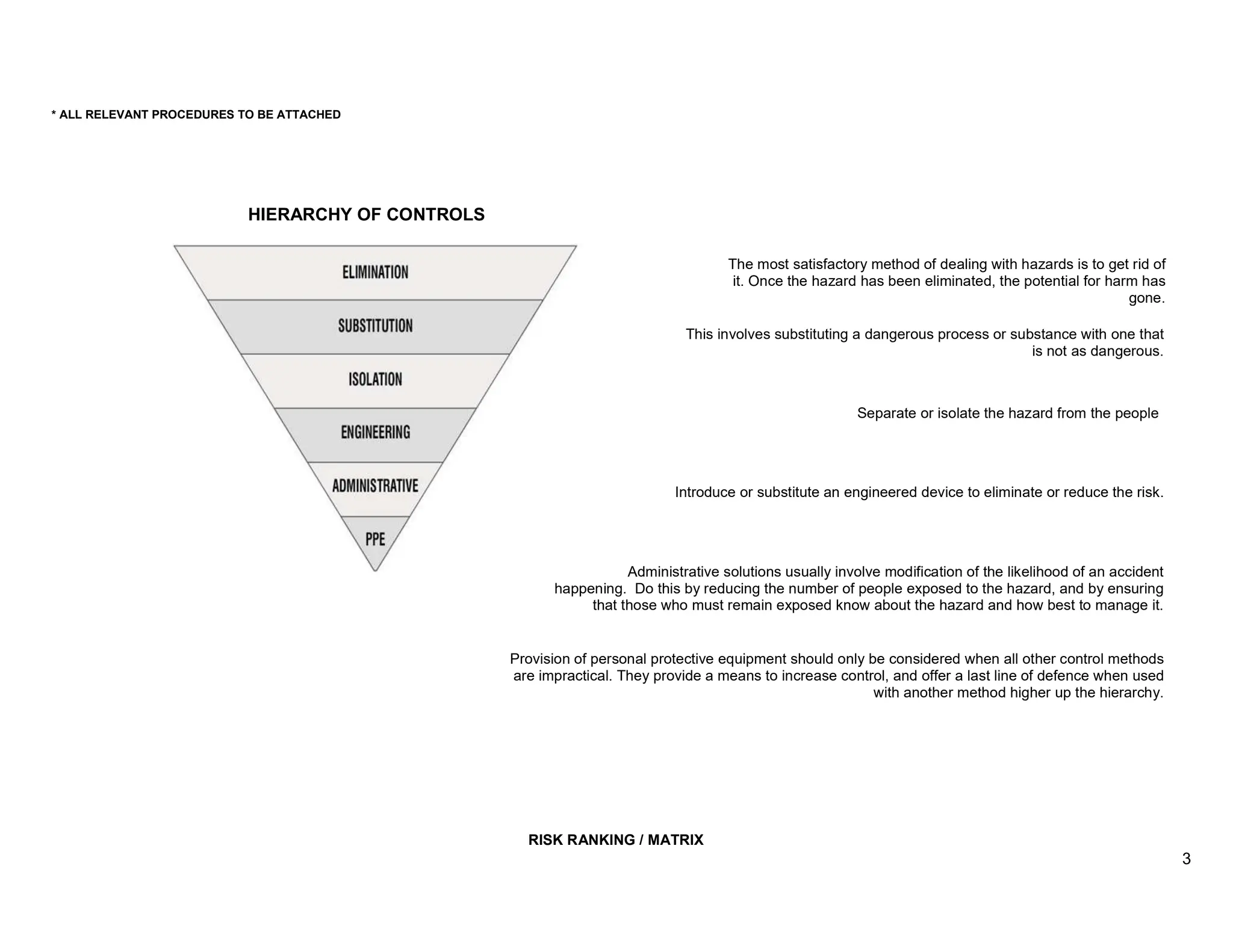
HIERARCHY OF CONTROLS
RISK RANKING / MATRIX
The most satisfactory method of dealing with hazards is to get rid of
it. Once the hazard has been eliminated, the potential for harm has
gone.
This involves substituting a dangerous process or substance with one that
is not as dangerous.
Separate or isolate the hazard from the people
Introduce or substitute an engineered device to eliminate or reduce the risk.
Administrative solutions usually involve modification of the likelihood of an accident
happening. Do this by reducing the number of people exposed to the hazard, and by ensuring
that those who must remain exposed know about the hazard and how best to manage it.
Provision of personal protective equipment should only be considered when all other control methods
are impractical. They provide a means to increase control, and offer a last line of defence when used
with another method higher up the hierarchy.
4
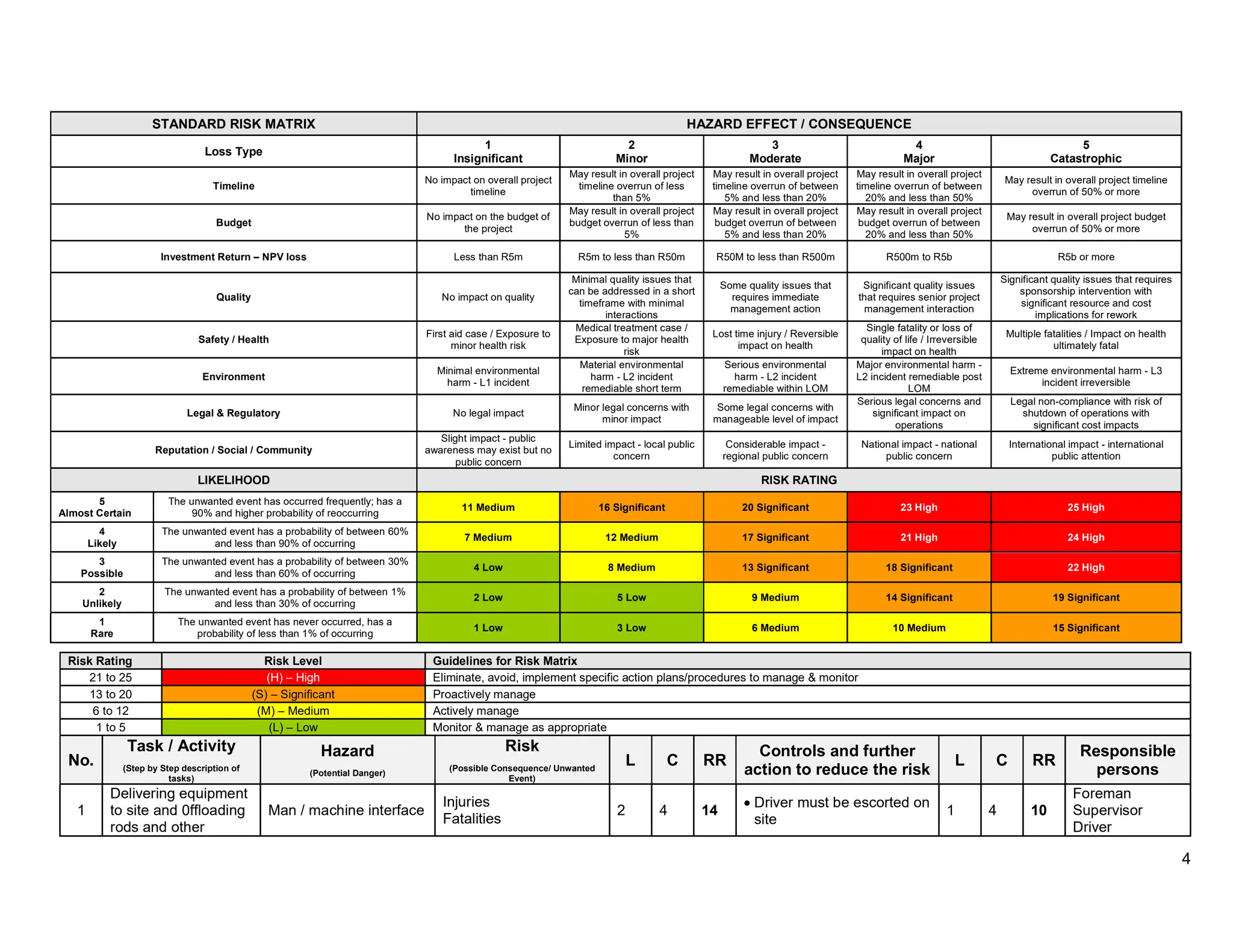
STANDARD RISK MATRIX HAZARD EFFECT / CONSEQUENCE
Loss Type
1
Insignificant
2
Minor
3
Moderate
4
Major
5
Catastrophic
Timeline
No impact on overall project
timeline
May result in overall project
timeline overrun of less
than 5%
May result in overall project
timeline overrun of between
5% and less than 20%
May result in overall project
timeline overrun of between
20% and less than 50%
May result in overall project timeline
overrun of 50% or more
Budget
No impact on the budget of
the project
May result in overall project
budget overrun of less than
5%
May result in overall project
budget overrun of between
5% and less than 20%
May result in overall project
budget overrun of between
20% and less than 50%
May result in overall project budget
overrun of 50% or more
Investment Return – NPV loss Less than R5m R5m to less than R50m R50M to less than R500m R500m to R5b R5b or more
Quality No impact on quality
Minimal quality issues that
can be addressed in a short
timeframe with minimal
interactions
Some quality issues that
requires immediate
management action
Significant quality issues
that requires senior project
management interaction
Significant quality issues that requires
sponsorship intervention with
significant resource and cost
implications for rework
Safety / Health
First aid case / Exposure to
minor health risk
Medical treatment case /
Exposure to major health
risk
Lost time injury / Reversible
impact on health
Single fatality or loss of
quality of life / Irreversible
impact on health
Multiple fatalities / Impact on health
ultimately fatal
Environment
Minimal environmental
harm - L1 incident
Material environmental
harm - L2 incident
remediable short term
Serious environmental
harm - L2 incident
remediable within LOM
Major environmental harm -
L2 incident remediable post
LOM
Extreme environmental harm - L3
incident irreversible
Legal & Regulatory No legal impact
Minor legal concerns with
minor impact
Some legal concerns with
manageable level of impact
Serious legal concerns and
significant impact on
operations
Legal non-compliance with risk of
shutdown of operations with
significant cost impacts
Reputation / Social / Community
Slight impact - public
awareness may exist but no
public concern
Limited impact - local public
concern
Considerable impact -
regional public concern
National impact - national
public concern
International impact - international
public attention
LIKELIHOOD RISK RATING
5
Almost Certain
The unwanted event has occurred frequently; has a
90% and higher probability of reoccurring
11 Medium 16 Significant 20 Significant 23 High 25 High
4
Likely
The unwanted event has a probability of between 60%
and less than 90% of occurring
7 Medium 12 Medium 17 Significant 21 High 24 High
3
Possible
The unwanted event has a probability of between 30%
and less than 60% of occurring
4 Low 8 Medium 13 Significant 18 Significant 22 High
2
Unlikely
The unwanted event has a probability of between 1%
and less than 30% of occurring
2 Low 5 Low 9 Medium 14 Significant 19 Significant
1
Rare
The unwanted event has never occurred, has a
probability of less than 1% of occurring
1 Low 3 Low 6 Medium 10 Medium 15 Significant
Risk Rating Risk Level Guidelines for Risk Matrix
21 to 25 (H) – High Eliminate, avoid, implement specific action plans/procedures to manage & monitor
13 to 20 (S) – Significant Proactively manage
6 to 12 (M) – Medium Actively manage
1 to 5 (L) – Low Monitor & manage as appropriate
No.
Task / Activity
(Step by Step description of
tasks)
Hazard
(Potential Danger)
Risk
(Possible Consequence/ Unwanted
Event)
L C RR
Controls and further
action to reduce the risk
L C RR
Responsible
persons
1
Delivering equipment
to site and 0ffloading
rods and other
Man / machine interface
Injuries
Fatalities
2 4 14
 Driver must be escorted on
site
1 4 10
Foreman
Supervisor
Driver
5
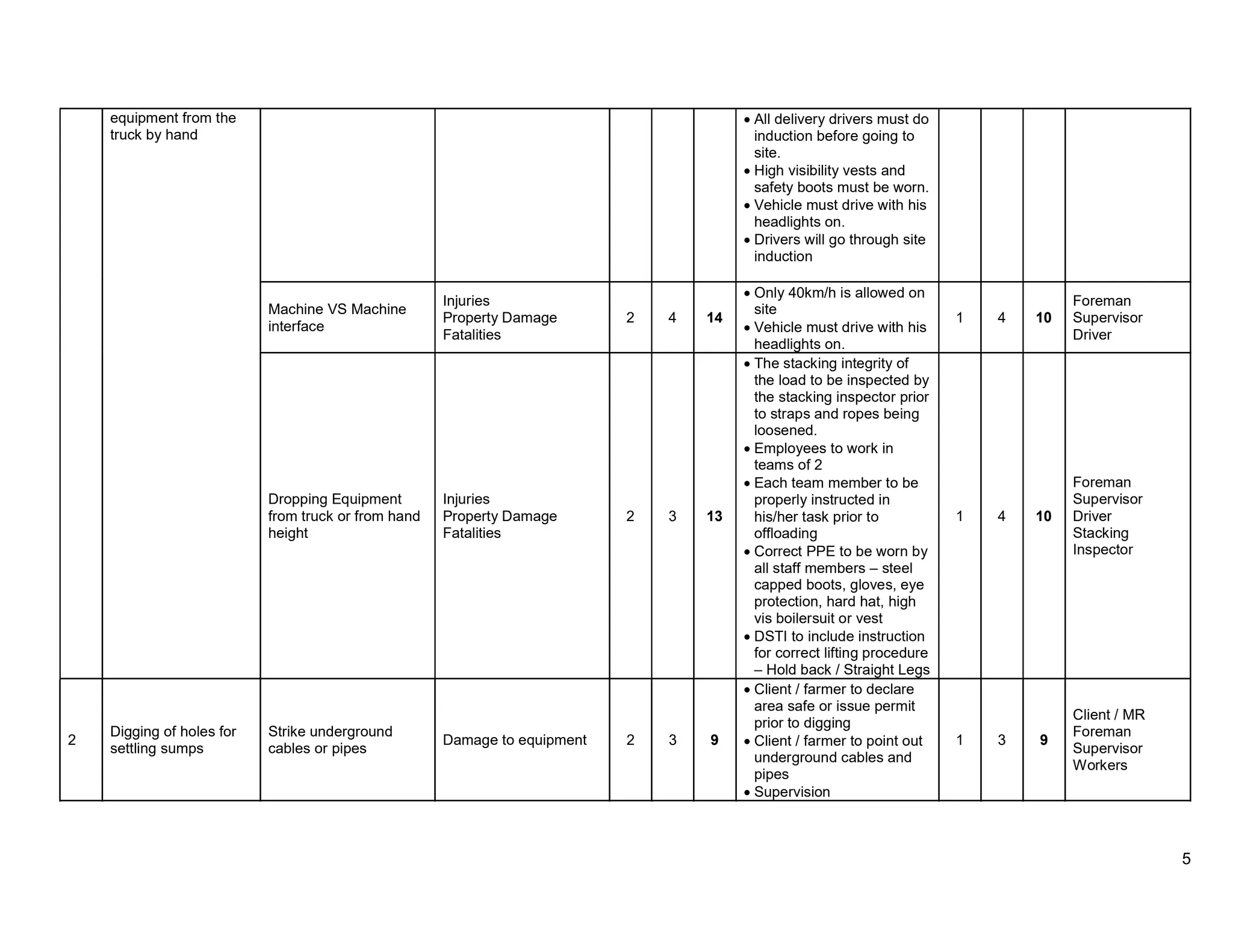
equipment from the
truck by hand
 All delivery drivers must do
induction before going to
site.
 High visibility vests and
safety boots must be worn.
 Vehicle must drive with his
headlights on.
 Drivers will go through site
induction
Machine VS Machine
interface
Injuries
Property Damage
Fatalities
2 4 14
 Only 40km/h is allowed on
site
 Vehicle must drive with his
headlights on.
1 4 10
Foreman
Supervisor
Driver
Dropping Equipment
from truck or from hand
height
Injuries
Property Damage
Fatalities
2 3 13
 The stacking integrity of
the load to be inspected by
the stacking inspector prior
to straps and ropes being
loosened.
 Employees to work in
teams of 2
 Each team member to be
properly instructed in
his/her task prior to
offloading
 Correct PPE to be worn by
all staff members – steel
capped boots, gloves, eye
protection, hard hat, high
vis boilersuit or vest
 DSTI to include instruction
for correct lifting procedure
– Hold back / Straight Legs
1 4 10
Foreman
Supervisor
Driver
Stacking
Inspector
2
Digging of holes for
settling sumps
Strike underground
cables or pipes
Damage to equipment 2 3 9
 Client / farmer to declare
area safe or issue permit
prior to digging
 Client / farmer to point out
underground cables and
pipes
 Supervision
1 3 9
Client / MR
Foreman
Supervisor
Workers
6
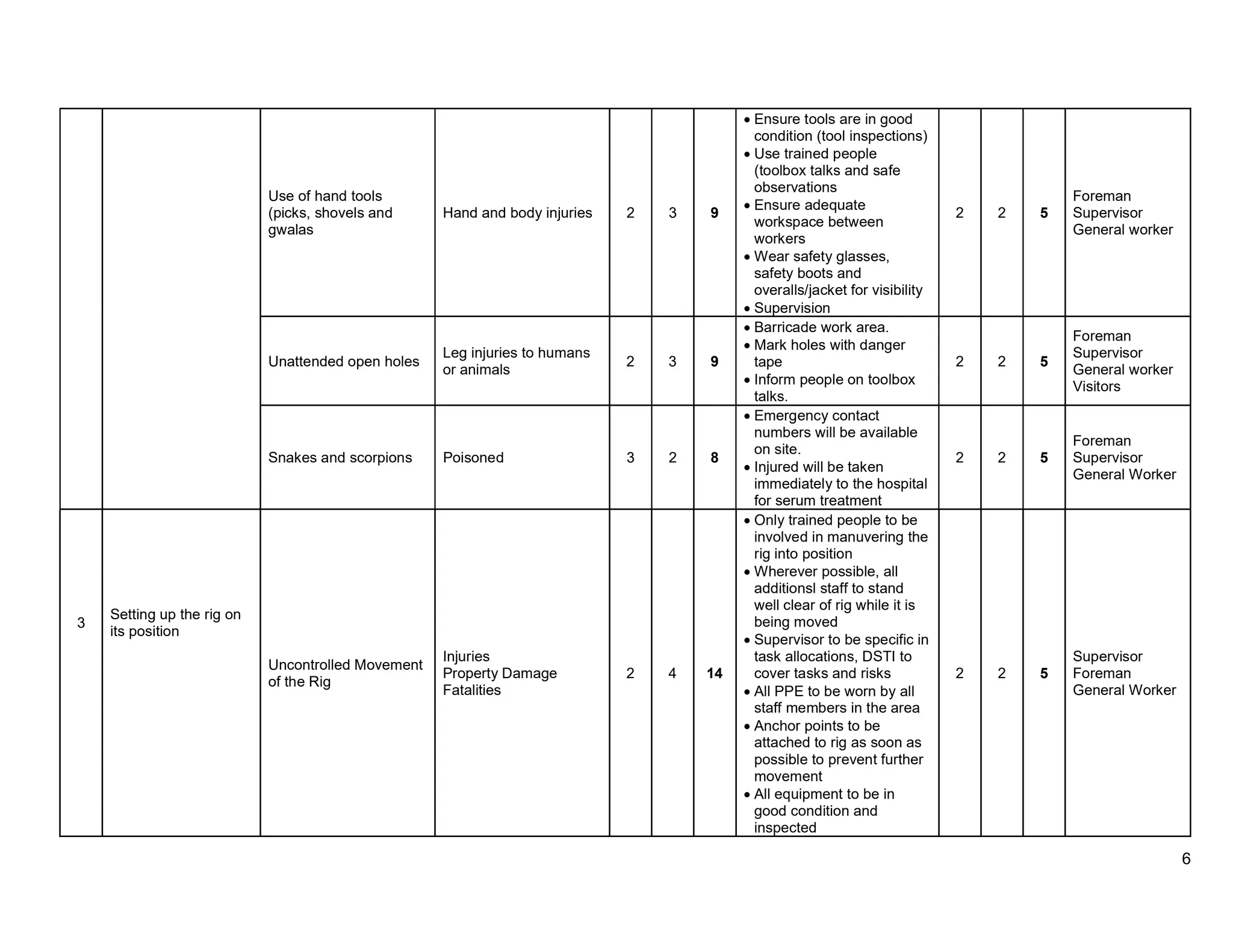
Use of hand tools
(picks, shovels and
gwalas
Hand and body injuries 2 3 9
 Ensure tools are in good
condition (tool inspections)
 Use trained people
(toolbox talks and safe
observations
 Ensure adequate
workspace between
workers
 Wear safety glasses,
safety boots and
overalls/jacket for visibility
 Supervision
2 2 5
Foreman
Supervisor
General worker
Unattended open holes
Leg injuries to humans
or animals
2 3 9
 Barricade work area.
 Mark holes with danger
tape
 Inform people on toolbox
talks.
2 2 5
Foreman
Supervisor
General worker
Visitors
Snakes and scorpions Poisoned 3 2 8
 Emergency contact
numbers will be available
on site.
 Injured will be taken
immediately to the hospital
for serum treatment
2 2 5
Foreman
Supervisor
General Worker
3
Setting up the rig on
its position
Uncontrolled Movement
of the Rig
Injuries
Property Damage
Fatalities
2 4 14
 Only trained people to be
involved in manuvering the
rig into position
 Wherever possible, all
additionsl staff to stand
well clear of rig while it is
being moved
 Supervisor to be specific in
task allocations, DSTI to
cover tasks and risks
 All PPE to be worn by all
staff members in the area
 Anchor points to be
attached to rig as soon as
possible to prevent further
movement
 All equipment to be in
good condition and
inspected
2 2 5
Supervisor
Foreman
General Worker
7
Spills Contamination 3 2 8
 Drilling position to be
covered with plastic, rig to
be set up on bunding.
 Settling sumps to be lined
with bunding
 All fuels and oils to be
carried to the position in
sealed containers and
stored in demarcated area,
or stored on the truck,
attached via strap to the
frame in the bin
2 2 5
Supervisor
Foreman
General worker
4 Drilling
Loose Clothing being
caught in the gears or
fanbelts
Injury
Damage to Equipment
2 4 14
 No loose clothing to be
work on or around the site
 Supervisor to inspect that
no loose clothing is worn
1 3 9
Supervisor
General worker
Noise Damage to Hearing 2 3 9
 Hearing protection to be
worn
 All additional staff to stand
clear of rig while in use
2 2 5
Foreman
General worker
Man / machine interface
Injuries
Fatalities
2 4 14
 Drilling rig operator to
maintain line of sight with
crew members.
 No one to stand under
hoist or elevated cable at
any time
 Drill rig operator to
maintain clear
communication with team
 High visibility vests,
gloves, hard hats, eye
protection, hearing
protection and safety boots
must be worn.
 All additional staff to stand
clear of working area
 No unauthorised entry to
working area
1 4 10
Foreman
General worker
Visitors
8
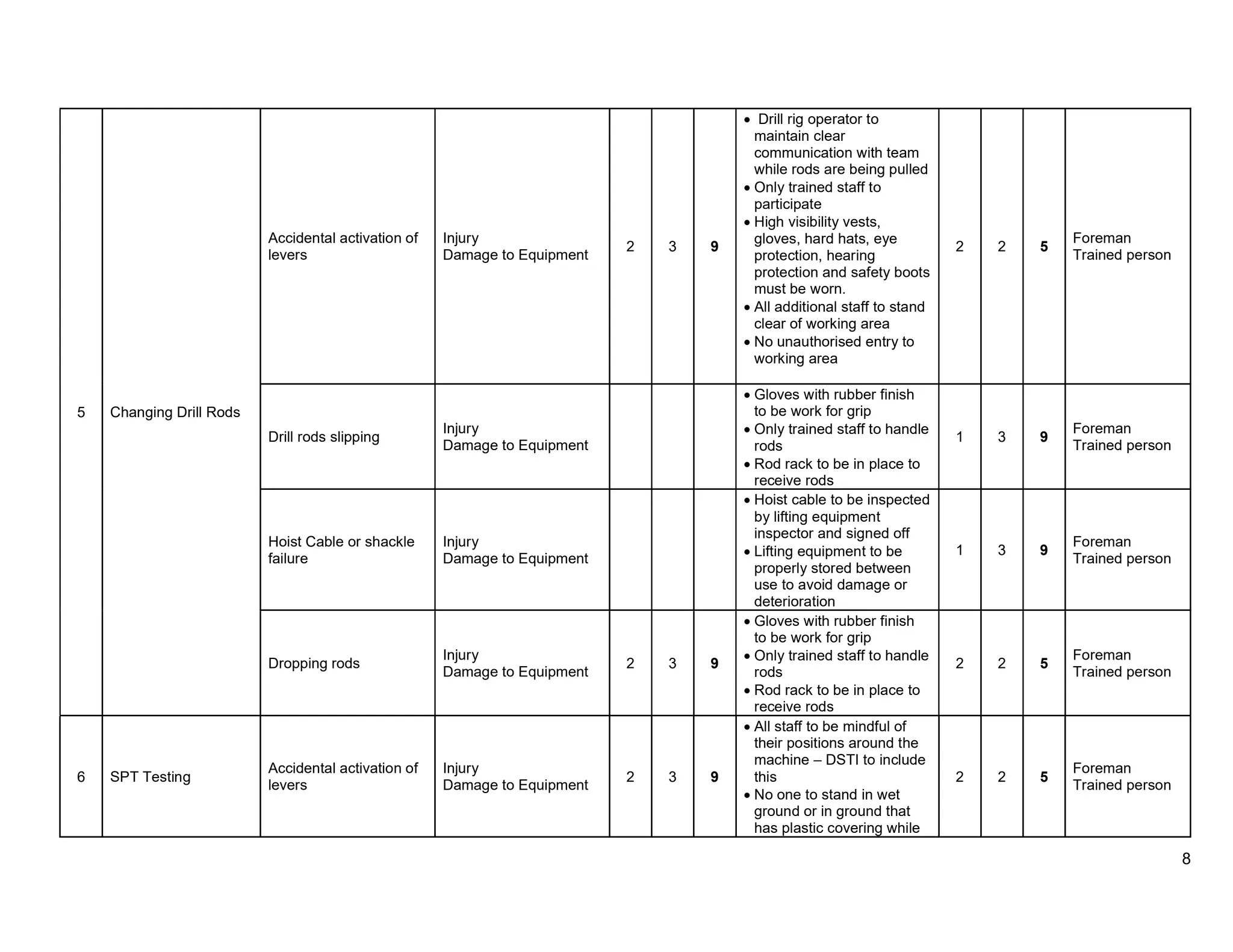
5 Changing Drill Rods
Accidental activation of
levers
Injury
Damage to Equipment
2 3 9
 Drill rig operator to
maintain clear
communication with team
while rods are being pulled
 Only trained staff to
participate
 High visibility vests,
gloves, hard hats, eye
protection, hearing
protection and safety boots
must be worn.
 All additional staff to stand
clear of working area
 No unauthorised entry to
working area
2 2 5
Foreman
Trained person
Drill rods slipping
Injury
Damage to Equipment
 Gloves with rubber finish
to be work for grip
 Only trained staff to handle
rods
 Rod rack to be in place to
receive rods
1 3 9
Foreman
Trained person
Hoist Cable or shackle
failure
Injury
Damage to Equipment
 Hoist cable to be inspected
by lifting equipment
inspector and signed off
 Lifting equipment to be
properly stored between
use to avoid damage or
deterioration
1 3 9
Foreman
Trained person
Dropping rods
Injury
Damage to Equipment
2 3 9
 Gloves with rubber finish
to be work for grip
 Only trained staff to handle
rods
 Rod rack to be in place to
receive rods
2 2 5
Foreman
Trained person
6 SPT Testing
Accidental activation of
levers
Injury
Damage to Equipment
2 3 9
 All staff to be mindful of
their positions around the
machine – DSTI to include
this
 No one to stand in wet
ground or in ground that
has plastic covering while
2 2 5
Foreman
Trained person
9
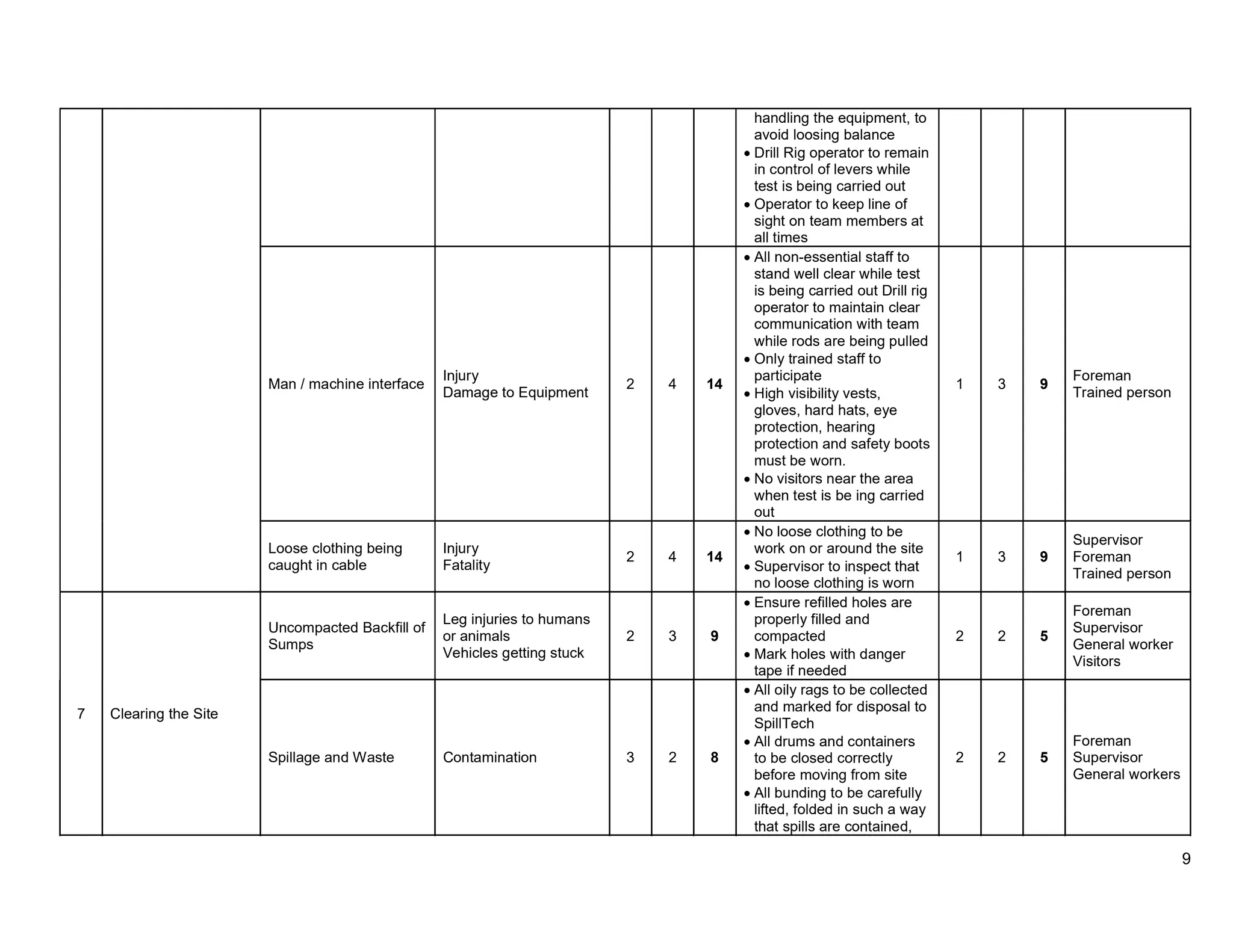
handling the equipment, to
avoid loosing balance
 Drill Rig operator to remain
in control of levers while
test is being carried out
 Operator to keep line of
sight on team members at
all times
Man / machine interface
Injury
Damage to Equipment
2 4 14
 All non-essential staff to
stand well clear while test
is being carried out Drill rig
operator to maintain clear
communication with team
while rods are being pulled
 Only trained staff to
participate
 High visibility vests,
gloves, hard hats, eye
protection, hearing
protection and safety boots
must be worn.
 No visitors near the area
when test is be ing carried
out
1 3 9
Foreman
Trained person
Loose clothing being
caught in cable
Injury
Fatality
2 4 14
 No loose clothing to be
work on or around the site
 Supervisor to inspect that
no loose clothing is worn
1 3 9
Supervisor
Foreman
Trained person
7 Clearing the Site
Uncompacted Backfill of
Sumps
Leg injuries to humans
or animals
Vehicles getting stuck
2 3 9
 Ensure refilled holes are
properly filled and
compacted
 Mark holes with danger
tape if needed
2 2 5
Foreman
Supervisor
General worker
Visitors
Spillage and Waste Contamination 3 2 8
 All oily rags to be collected
and marked for disposal to
SpillTech
 All drums and containers
to be closed correctly
before moving from site
 All bunding to be carefully
lifted, folded in such a way
that spills are contained,
2 2 5
Foreman
Supervisor
General workers
10
and marked for disposal to
SpillTech
11
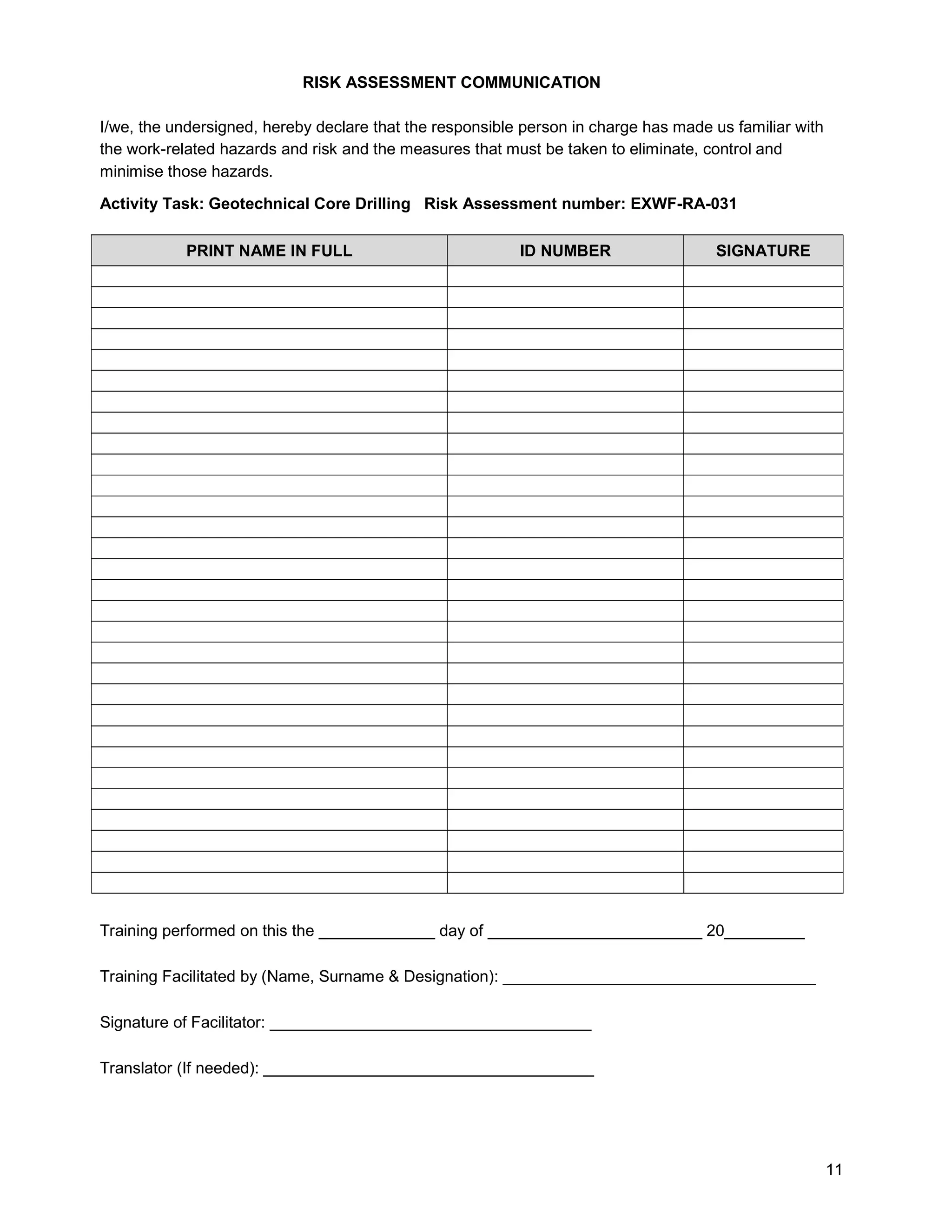
RISK ASSESSMENT COMMUNICATION
I/we, the undersigned, hereby declare that the responsible person in charge has made us familiar with
the work-related hazards and risk and the measures that must be taken to eliminate, control and
minimise those hazards.
Activity Task: Geotechnical Core Drilling Risk Assessment number: EXWF-RA-031
PRINT NAME IN FULL ID NUMBER SIGNATURE
Training performed on this the _____________ day of ________________________ 20_________
Training Facilitated by (Name, Surname & Designation): ___________________________________
Signature of Facilitator: ____________________________________
Translator (If needed): _____________________________________

17 1 Drilling Operations Risk assessment

  • 1.
    RA-031 – GeotechnicalCore Drilling 1 RISK ASSESSMENT NUMBER: RA-031 BTE Document Number: RISK ASSESSMENT SCOPE: Geotechnical Core Drilling MEHTOD STATEMENT NO & DESCRIPTION: Geotechnical Core Drilling BRIEF DESCRIPTION OF WORK THAT WILL BE PERFOMED: Geotechnical Core Drilling and Underground Investigation AREA THE WORK WILL BE PERFORMED IN: CONTRACT NUMBER: RISK ASSESMENT DATE: 27/02/2019 REVISION NUMBER: 01 REVIEW DATE: 27/02/2019 NATURE OF REVISION: Initial Submittal Revision and Approval Block Rev Date Nature of Revision Prepared by Reviewed Approved
  • 2.
    RA-031 – GeotechnicalCore Drilling 2 RISK ASSESSMENT RECORD RISK ASSESSMENT NUMBER RISK ASSESSMENT SCOPE Geotechnical Core Drilling CONTRACT NUMBER AREA WORK WILL BE PERFORMED IN RISK ASSESSMENT DATE 27/02/2019 METHOD STATEMENT NO & DESCRIPTION Geotechnical Core Drilling REVISION NUMBER 01 BRIEF DESCRIPTION OF WORK Geotechnical Core Drilling and Underground Investigation PREPARED BY: Reviewed Yes No Initials and Surname Principle Contractor Designation Signature Communicated Yes No G Prinsloo Earthtech Geotechnical Services Administrator Risk Assessment team: Comments: REVIEWED BY: Initials and Surname Owner Designation Signature AVAILABLE AQEQUATE Method Statement Yes Yes Procedures Yes Yes Training Yes Yes APPROVED BY: Initials and Surname Client Designation Signature Expected Review date: Transmittal: All activities covered? Yes No All activities risk ranked? Yes No * REQUIRED AND EXISTING CONTROL MEASURE/S - SUBMIT AND ATTACH TO RISK ASSESSMENT
  • 3.
    3 * ALL RELEVANTPROCEDURES TO BE ATTACHED HIERARCHY OF CONTROLS RISK RANKING / MATRIX The most satisfactory method of dealing with hazards is to get rid of it. Once the hazard has been eliminated, the potential for harm has gone. This involves substituting a dangerous process or substance with one that is not as dangerous. Separate or isolate the hazard from the people Introduce or substitute an engineered device to eliminate or reduce the risk. Administrative solutions usually involve modification of the likelihood of an accident happening. Do this by reducing the number of people exposed to the hazard, and by ensuring that those who must remain exposed know about the hazard and how best to manage it. Provision of personal protective equipment should only be considered when all other control methods are impractical. They provide a means to increase control, and offer a last line of defence when used with another method higher up the hierarchy.
  • 4.
    4 STANDARD RISK MATRIXHAZARD EFFECT / CONSEQUENCE Loss Type 1 Insignificant 2 Minor 3 Moderate 4 Major 5 Catastrophic Timeline No impact on overall project timeline May result in overall project timeline overrun of less than 5% May result in overall project timeline overrun of between 5% and less than 20% May result in overall project timeline overrun of between 20% and less than 50% May result in overall project timeline overrun of 50% or more Budget No impact on the budget of the project May result in overall project budget overrun of less than 5% May result in overall project budget overrun of between 5% and less than 20% May result in overall project budget overrun of between 20% and less than 50% May result in overall project budget overrun of 50% or more Investment Return – NPV loss Less than R5m R5m to less than R50m R50M to less than R500m R500m to R5b R5b or more Quality No impact on quality Minimal quality issues that can be addressed in a short timeframe with minimal interactions Some quality issues that requires immediate management action Significant quality issues that requires senior project management interaction Significant quality issues that requires sponsorship intervention with significant resource and cost implications for rework Safety / Health First aid case / Exposure to minor health risk Medical treatment case / Exposure to major health risk Lost time injury / Reversible impact on health Single fatality or loss of quality of life / Irreversible impact on health Multiple fatalities / Impact on health ultimately fatal Environment Minimal environmental harm - L1 incident Material environmental harm - L2 incident remediable short term Serious environmental harm - L2 incident remediable within LOM Major environmental harm - L2 incident remediable post LOM Extreme environmental harm - L3 incident irreversible Legal & Regulatory No legal impact Minor legal concerns with minor impact Some legal concerns with manageable level of impact Serious legal concerns and significant impact on operations Legal non-compliance with risk of shutdown of operations with significant cost impacts Reputation / Social / Community Slight impact - public awareness may exist but no public concern Limited impact - local public concern Considerable impact - regional public concern National impact - national public concern International impact - international public attention LIKELIHOOD RISK RATING 5 Almost Certain The unwanted event has occurred frequently; has a 90% and higher probability of reoccurring 11 Medium 16 Significant 20 Significant 23 High 25 High 4 Likely The unwanted event has a probability of between 60% and less than 90% of occurring 7 Medium 12 Medium 17 Significant 21 High 24 High 3 Possible The unwanted event has a probability of between 30% and less than 60% of occurring 4 Low 8 Medium 13 Significant 18 Significant 22 High 2 Unlikely The unwanted event has a probability of between 1% and less than 30% of occurring 2 Low 5 Low 9 Medium 14 Significant 19 Significant 1 Rare The unwanted event has never occurred, has a probability of less than 1% of occurring 1 Low 3 Low 6 Medium 10 Medium 15 Significant Risk Rating Risk Level Guidelines for Risk Matrix 21 to 25 (H) – High Eliminate, avoid, implement specific action plans/procedures to manage & monitor 13 to 20 (S) – Significant Proactively manage 6 to 12 (M) – Medium Actively manage 1 to 5 (L) – Low Monitor & manage as appropriate No. Task / Activity (Step by Step description of tasks) Hazard (Potential Danger) Risk (Possible Consequence/ Unwanted Event) L C RR Controls and further action to reduce the risk L C RR Responsible persons 1 Delivering equipment to site and 0ffloading rods and other Man / machine interface Injuries Fatalities 2 4 14  Driver must be escorted on site 1 4 10 Foreman Supervisor Driver
  • 5.
    5 equipment from the truckby hand  All delivery drivers must do induction before going to site.  High visibility vests and safety boots must be worn.  Vehicle must drive with his headlights on.  Drivers will go through site induction Machine VS Machine interface Injuries Property Damage Fatalities 2 4 14  Only 40km/h is allowed on site  Vehicle must drive with his headlights on. 1 4 10 Foreman Supervisor Driver Dropping Equipment from truck or from hand height Injuries Property Damage Fatalities 2 3 13  The stacking integrity of the load to be inspected by the stacking inspector prior to straps and ropes being loosened.  Employees to work in teams of 2  Each team member to be properly instructed in his/her task prior to offloading  Correct PPE to be worn by all staff members – steel capped boots, gloves, eye protection, hard hat, high vis boilersuit or vest  DSTI to include instruction for correct lifting procedure – Hold back / Straight Legs 1 4 10 Foreman Supervisor Driver Stacking Inspector 2 Digging of holes for settling sumps Strike underground cables or pipes Damage to equipment 2 3 9  Client / farmer to declare area safe or issue permit prior to digging  Client / farmer to point out underground cables and pipes  Supervision 1 3 9 Client / MR Foreman Supervisor Workers
  • 6.
    6 Use of handtools (picks, shovels and gwalas Hand and body injuries 2 3 9  Ensure tools are in good condition (tool inspections)  Use trained people (toolbox talks and safe observations  Ensure adequate workspace between workers  Wear safety glasses, safety boots and overalls/jacket for visibility  Supervision 2 2 5 Foreman Supervisor General worker Unattended open holes Leg injuries to humans or animals 2 3 9  Barricade work area.  Mark holes with danger tape  Inform people on toolbox talks. 2 2 5 Foreman Supervisor General worker Visitors Snakes and scorpions Poisoned 3 2 8  Emergency contact numbers will be available on site.  Injured will be taken immediately to the hospital for serum treatment 2 2 5 Foreman Supervisor General Worker 3 Setting up the rig on its position Uncontrolled Movement of the Rig Injuries Property Damage Fatalities 2 4 14  Only trained people to be involved in manuvering the rig into position  Wherever possible, all additionsl staff to stand well clear of rig while it is being moved  Supervisor to be specific in task allocations, DSTI to cover tasks and risks  All PPE to be worn by all staff members in the area  Anchor points to be attached to rig as soon as possible to prevent further movement  All equipment to be in good condition and inspected 2 2 5 Supervisor Foreman General Worker
  • 7.
    7 Spills Contamination 32 8  Drilling position to be covered with plastic, rig to be set up on bunding.  Settling sumps to be lined with bunding  All fuels and oils to be carried to the position in sealed containers and stored in demarcated area, or stored on the truck, attached via strap to the frame in the bin 2 2 5 Supervisor Foreman General worker 4 Drilling Loose Clothing being caught in the gears or fanbelts Injury Damage to Equipment 2 4 14  No loose clothing to be work on or around the site  Supervisor to inspect that no loose clothing is worn 1 3 9 Supervisor General worker Noise Damage to Hearing 2 3 9  Hearing protection to be worn  All additional staff to stand clear of rig while in use 2 2 5 Foreman General worker Man / machine interface Injuries Fatalities 2 4 14  Drilling rig operator to maintain line of sight with crew members.  No one to stand under hoist or elevated cable at any time  Drill rig operator to maintain clear communication with team  High visibility vests, gloves, hard hats, eye protection, hearing protection and safety boots must be worn.  All additional staff to stand clear of working area  No unauthorised entry to working area 1 4 10 Foreman General worker Visitors
  • 8.
    8 5 Changing DrillRods Accidental activation of levers Injury Damage to Equipment 2 3 9  Drill rig operator to maintain clear communication with team while rods are being pulled  Only trained staff to participate  High visibility vests, gloves, hard hats, eye protection, hearing protection and safety boots must be worn.  All additional staff to stand clear of working area  No unauthorised entry to working area 2 2 5 Foreman Trained person Drill rods slipping Injury Damage to Equipment  Gloves with rubber finish to be work for grip  Only trained staff to handle rods  Rod rack to be in place to receive rods 1 3 9 Foreman Trained person Hoist Cable or shackle failure Injury Damage to Equipment  Hoist cable to be inspected by lifting equipment inspector and signed off  Lifting equipment to be properly stored between use to avoid damage or deterioration 1 3 9 Foreman Trained person Dropping rods Injury Damage to Equipment 2 3 9  Gloves with rubber finish to be work for grip  Only trained staff to handle rods  Rod rack to be in place to receive rods 2 2 5 Foreman Trained person 6 SPT Testing Accidental activation of levers Injury Damage to Equipment 2 3 9  All staff to be mindful of their positions around the machine – DSTI to include this  No one to stand in wet ground or in ground that has plastic covering while 2 2 5 Foreman Trained person
  • 9.
    9 handling the equipment,to avoid loosing balance  Drill Rig operator to remain in control of levers while test is being carried out  Operator to keep line of sight on team members at all times Man / machine interface Injury Damage to Equipment 2 4 14  All non-essential staff to stand well clear while test is being carried out Drill rig operator to maintain clear communication with team while rods are being pulled  Only trained staff to participate  High visibility vests, gloves, hard hats, eye protection, hearing protection and safety boots must be worn.  No visitors near the area when test is be ing carried out 1 3 9 Foreman Trained person Loose clothing being caught in cable Injury Fatality 2 4 14  No loose clothing to be work on or around the site  Supervisor to inspect that no loose clothing is worn 1 3 9 Supervisor Foreman Trained person 7 Clearing the Site Uncompacted Backfill of Sumps Leg injuries to humans or animals Vehicles getting stuck 2 3 9  Ensure refilled holes are properly filled and compacted  Mark holes with danger tape if needed 2 2 5 Foreman Supervisor General worker Visitors Spillage and Waste Contamination 3 2 8  All oily rags to be collected and marked for disposal to SpillTech  All drums and containers to be closed correctly before moving from site  All bunding to be carefully lifted, folded in such a way that spills are contained, 2 2 5 Foreman Supervisor General workers
  • 10.
    10 and marked fordisposal to SpillTech
  • 11.
    11 RISK ASSESSMENT COMMUNICATION I/we,the undersigned, hereby declare that the responsible person in charge has made us familiar with the work-related hazards and risk and the measures that must be taken to eliminate, control and minimise those hazards. Activity Task: Geotechnical Core Drilling Risk Assessment number: EXWF-RA-031 PRINT NAME IN FULL ID NUMBER SIGNATURE Training performed on this the _____________ day of ________________________ 20_________ Training Facilitated by (Name, Surname & Designation): ___________________________________ Signature of Facilitator: ____________________________________ Translator (If needed): _____________________________________