Pipeline Construction Safety
Improving the
Pipeline Construction Safety
Culture
INGAA Safety Committee
Activities 2010-2014
Foundation Membership
• Pipeline Operators
• Pipeline Construction Companies
• Pipeline Service Companies
• Pipeline Equipment Manufacturers
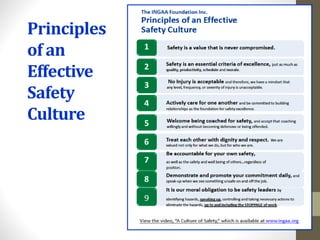
Principles
of an
Effective
Safety
Culture
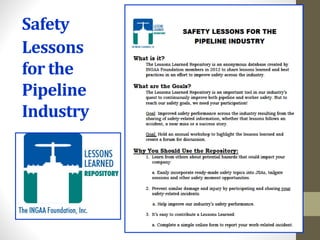
Safety
Lessons
for the
Pipeline
Industry
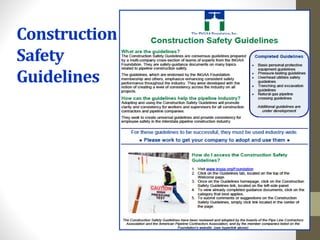
Construction
Safety
Guidelines
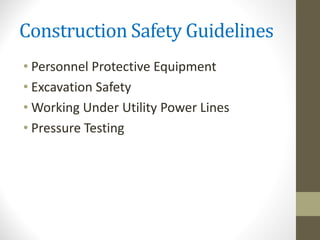
Construction Safety Guidelines
• Personnel Protective Equipment
• Excavation Safety
• Working Under Utility Power Lines
• Pressure Testing
Guidelines Under Development
• Vehicle Safety
Excavation Safety
Excavation Safety
• OSHA Special Emphasis program
• WHY? Protect employees from collapse or
harm from the work in progress..
• WHY? To prevent damage or harm to existing
underground facilities.
• WHY? There is always something in the
ground that you did not foresee.
Excavation Safety (continued)
• Hazard Assessment –
• Analyze what you are faced with
• See what has changed since the last shift.
• Develop a new plan based on changes found or new
(potential) issues
• Roles and Responsibilities-
• Who does what?
• One Calls
• Protection of public.
• Competent person
• Protect other facilities
• Stop Work Authority.
Excavation Safety (continued)
• Health and Safety of Employees:
• One call current and active
• Work plan to dig safely and protect employees/public
• Stop work authority
• Atmospheric monitoring (exiting utilities, methane in the ground..)
• Access/Egress
• Spoil piles protected
• Protect employees from accumulating water, moving
equipment or materials (installation of pipe), Spoil
piles
Excavation Safety (continued)
• Protective Systems for Excavations
• Soil classification
AND
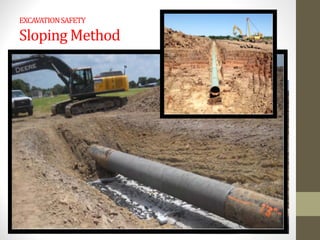
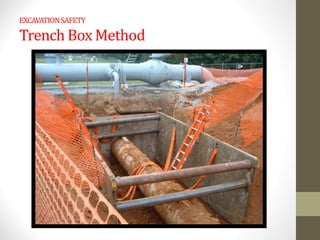
• Benching, Sloping and/or Trench Boxes are the most
common methods utilized.
• Others methods include timber shoring, hydraulic
shoring, or an engineered excavation.
EXCAVATIONSAFETY
Sloping Method
EXCAVATIONSAFETY
Trench Box Method
EXCAVATIONSAFETY
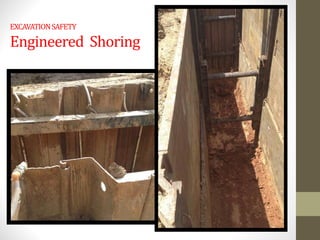
Engineered Shoring
EXCAVATIONSAFETY
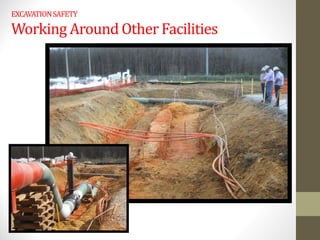
Working Around Other Facilities
EXCAVATIONSAFETY
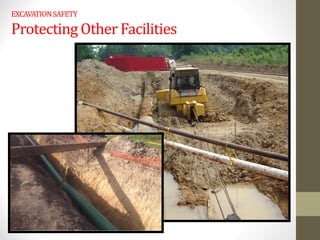
Protecting Other Facilities
Overhead Utilities Safety
• WHY? Protect employees from overhead
utility contact (or fall if contacted)..
• WHY? To prevent damage or harm to
existing overhead utilities.
• WHY? Overhead utilities not only pose a
potential danger, but can limit workspace
and create “worksite congestion” issues.
Overhead Utilities Safety (continued)
• Hazard Assessment –
• Analyze what you are faced with…
• See what has changed since the last shift (temperature
shifts/load demands allow change in power line
height.
• Revise the standard work plan if workspace is limited.
• Develop a new plan based on changes found or new
(potential) issues (Example- newly acquired ROW,
other construction in the area…)
Overhead Utilities Safety (continued)
• Roles and Responsibilities-
• Who does what?
• Protection of public
• Protect other facilities
• Protects current work from existing conditions
• Plans the proper equipment for safe execution of
work (reach of equipment –vs- height of utility)
• Deploys the use of a spotter
• Stop Work Authority
• .
OVERHEADUTILITIESSAFETY
Hazard Mitigation
• THREE LAYERS OF CONTROLS AT ANY GIVEN TIME…?
• INGAA recommends the use of a minimum of 3
layers of controls if overhead utility contact is a
potential at your worksite. Layers Include:
1. Spotters
2. Signage
3. Physical Barriers
4. Proximity Alarm(s)
5. Utility Controls
OVERHEADUTILITIESSAFETY
Methods of Protection
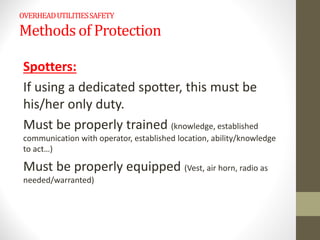
Spotters:
If using a dedicated spotter, this must be
his/her only duty.
Must be properly trained (knowledge, established
communication with operator, established location, ability/knowledge
to act…)
Must be properly equipped (Vest, air horn, radio as
needed/warranted)
OVERHEADUTILITIESSAFETY
Methods of Protection
Signage:
Must be visible to all of those working
(Low/ground level, Medium, and High) to
provide a visible warning device to those on
the ground, vehicles and equipment.
OVERHEADUTILITIESSAFETY
Methods of Protection
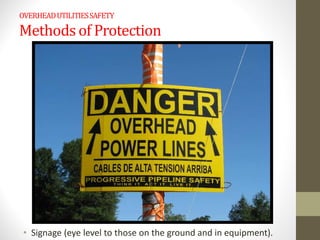
• Signage (eye level to those on the ground and in equipment).
OVERHEADUTILITIESSAFETY
Methods of Protection
OVERHEADUTILITIESSAFETY
Methods of Protection
Physical Barriers:
Located between the equipment and the
overhead utility.
“Goal Post” – must be highly visible and
non-conductive.
INGAA recommends the installation on
Upstream (coming in) and Downstream
(going away) sides of the overhead utility
when conditions warrant.
OVERHEADUTILITIESSAFETY
Methods of Protection
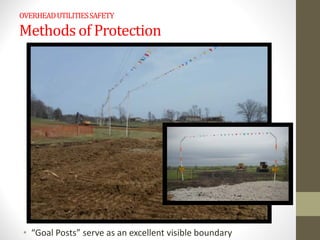
• “Goal Posts” serve as an excellent visible boundary
OVERHEADUTILITIESSAFETY
Methods of Protection
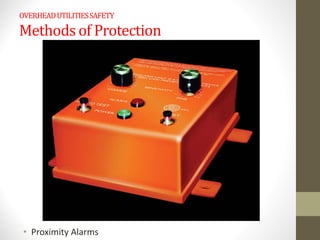
Proximity Alarms:
Physical alarm system installed on the
specific machinery.
If the machine gets too close, it alerts the
operator.
OVERHEADUTILITIESSAFETY
Methods of Protection
• Proximity Alarms
OVERHEADUTILITIESSAFETY
Methods of Protection
Utility Controls:
“Direct Assistance” from utility owner.
Includes, blinding, shielding, insulating, de-
energizing, bonding, or taking out of
service.
OVERHEADUTILITIESSAFETY
Methods of Protection
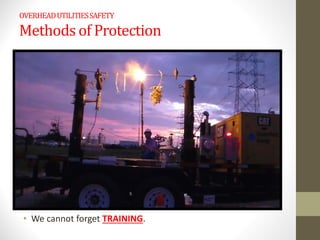
• We cannot forget TRAINING.
Pressure Testing
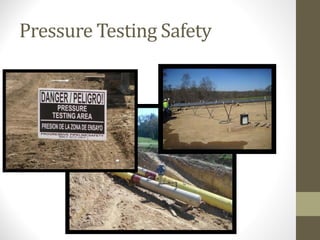
Pressure Testing Safety
• Work procedures
• Public protection
• Employee Protection
Pressure Testing Safety
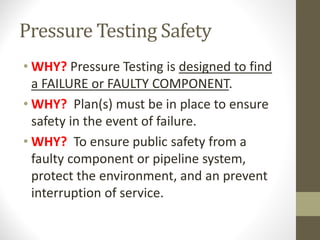
• WHY? Pressure Testing is designed to find
a FAILURE or FAULTY COMPONENT.
• WHY? Plan(s) must be in place to ensure
safety in the event of failure.
• WHY? To ensure public safety from a
faulty component or pipeline system,
protect the environment, and an prevent
interruption of service.
Pressure Testing Safety
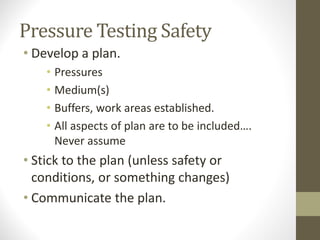
• Develop a plan.
• Pressures
• Medium(s)
• Buffers, work areas established.
• All aspects of plan are to be included….
Never assume
• Stick to the plan (unless safety or
conditions, or something changes)
• Communicate the plan.
Pressure Testing Safety
With these Construction Safety
Guidelines or others, there is
one essential key component….
Communication.
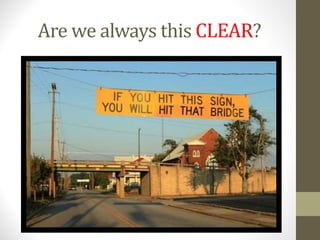
Are we always this CLEAR?

Pipeline Construction Safety