Example risk assessment for a warehouse
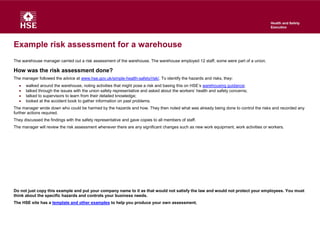
The warehouse manager carried out a risk assessment of the warehouse. The warehouse employed 12 staff, some were part of a union.
How was the risk assessment done?
The manager followed the advice at www.hse.gov.uk/simple-health-safety/risk/. To identify the hazards and risks, they:
 walked around the warehouse, noting activities that might pose a risk and basing this on HSE’s warehousing guidance;
 talked through the issues with the union safety representative and asked about the workers’ health and safety concerns;
 talked to supervisors to learn from their detailed knowledge;
 looked at the accident book to gather information on past problems.
The manager wrote down who could be harmed by the hazards and how. They then noted what was already being done to control the risks and recorded any
further actions required.
They discussed the findings with the safety representative and gave copies to all members of staff.
The manager will review the risk assessment whenever there are any significant changes such as new work equipment, work activities or workers.
Do not just copy this example and put your company name to it as that would not satisfy the law and would not protect your employees. You must
think about the specific hazards and controls your business needs.
The HSE site has a template and other examples to help you produce your own assessment.
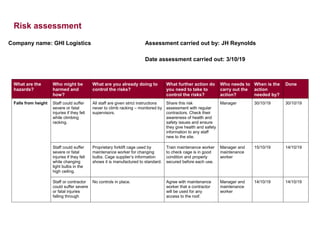
Risk assessment
Company name: GHI Logistics Assessment carried out by: JH Reynolds
Date assessment carried out: 3/10/19
What are the
hazards?
Who might be
harmed and
how?
What are you already doing to
control the risks?
What further action do
you need to take to
control the risks?
Who needs to
carry out the
action?
When is the
action
needed by?
Done
Falls from height Staff could suffer
severe or fatal
injuries if they fell
while climbing
racking.
All staff are given strict instructions
never to climb racking – monitored by
supervisors.
Share this risk
assessment with regular
contractors. Check their
awareness of health and
safety issues and ensure
they give health and safety
information to any staff
new to the site.
Manager 30/10/19 30/10/19
Staff could suffer
severe or fatal
injuries if they fell
while changing
light bulbs in the
high ceiling.
Proprietary forklift cage used by
maintenance worker for changing
bulbs. Cage supplier’s information
shows it is manufactured to standard.
Train maintenance worker
to check cage is in good
condition and properly
secured before each use.
Manager and
maintenance
worker
15/10/19 14/10/19
Staff or contractor
could suffer severe
or fatal injuries
falling through
No controls in place. Agree with maintenance
worker that a contractor
will be used for any
access to the roof.
Manager and
maintenance
worker
14/10/19 14/10/19
What are the
hazards?
Who might be
harmed and
how?
What are you already doing to
control the risks?
What further action do
you need to take to
control the risks?
Who needs to
carry out the
action?
When is the
action
needed by?
Done
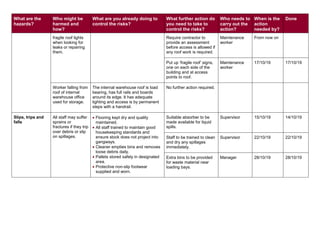
fragile roof lights
when looking for
leaks or repairing
them.
Require contractor to
provide an assessment
before access is allowed if
any roof work is required.
Maintenance
worker
From now on
Put up ‘fragile roof’ signs,
one on each side of the
building and at access
points to roof.
Maintenance
worker
17/10/19 17/10/19
Worker falling from
roof of internal
warehouse office
used for storage.
The internal warehouse roof is load
bearing, has full rails and boards
around its edge. It has adequate
lighting and access is by permanent
steps with a handrail.
No further action required.
Slips, trips and
falls
All staff may suffer
sprains or
fractures if they trip
over debris or slip
on spillages.
 Flooring kept dry and quality
maintained.
 All staff trained to maintain good
housekeeping standards and
ensure stock does not project into
gangways.
 Cleaner empties bins and removes
loose debris daily.
 Pallets stored safely in designated
area.
 Protective non-slip footwear
supplied and worn.
Suitable absorber to be
made available for liquid
spills.
Supervisor 15/10/19 14/10/19
Staff to be trained to clean
and dry any spillages
immediately.
Supervisor 22/10/19 22/10/19
Extra bins to be provided
for waste material near
loading bays.
Manager 28/10/19 28/10/19
What are the
hazards?
Who might be
harmed and
how?
What are you already doing to
control the risks?
What further action do
you need to take to
control the risks?
Who needs to
carry out the
action?
When is the
action
needed by?
Done
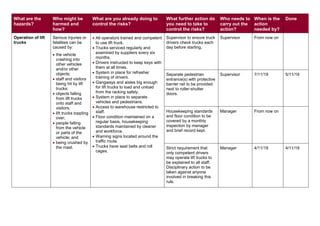
Operation of lift
trucks
Serious injuries or
fatalities can be
caused by:
 the vehicle
crashing into
other vehicles
and/or other
objects;
 staff and visitors
being hit by lift
trucks;
 objects falling
from lift trucks
onto staff and
visitors;
 lift trucks toppling
over;
 people falling
from the vehicle
or parts of the
vehicle; and
 being crushed by
the mast.
 All operators trained and competent
to use lift truck.
 Trucks serviced regularly and
examined by suppliers every six
months.
 Drivers instructed to keep keys with
them at all times.
 System in place for refresher
training of drivers.
 Gangways and aisles big enough
for lift trucks to load and unload
from the racking safely.
 System in place to separate
vehicles and pedestrians.
 Access to warehouse restricted to
staff.
 Floor condition maintained on a
regular basis, housekeeping
standards maintained by cleaner
and workforce.
 Warning signs located around the
traffic route.
 Trucks have seat belts and roll
cages.
Supervisor to ensure truck
drivers check trucks each
day before starting.
Supervisor From now on
Separate pedestrian
entrance(s) with protective
barrier rail to be provided
next to roller-shutter
doors.
Supervisor 7/11/19 5/11/19
Housekeeping standards
and floor condition to be
covered by a monthly
inspection by manager
and brief record kept.
Manager From now on
Strict requirement that
only competent drivers
may operate lift trucks to
be explained to all staff.
Disciplinary action to be
taken against anyone
involved in breaking this
rule.
Manager 4/11/19 4/11/19
What are the
hazards?
Who might be
harmed and
how?
What are you already doing to
control the risks?
What further action do
you need to take to
control the risks?
Who needs to
carry out the
action?
When is the
action
needed by?
Done
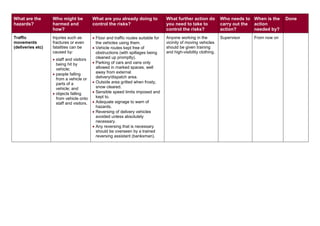
Traffic
movements
(deliveries etc)
Injuries such as
fractures or even
fatalities can be
caused by:
 staff and visitors
being hit by
vehicle;
 people falling
from a vehicle or
parts of a
vehicle; and
 objects falling
from vehicle onto
staff and visitors.
 Floor and traffic routes suitable for
the vehicles using them.
 Vehicle routes kept free of
obstructions (with spillages being
cleaned up promptly).
 Parking of cars and vans only
allowed in marked spaces, well
away from external
delivery/dispatch area.
 Outside area gritted when frosty,
snow cleared.
 Sensible speed limits imposed and
kept to.
 Adequate signage to warn of
hazards.
 Reversing of delivery vehicles
avoided unless absolutely
necessary.
 Any reversing that is necessary
should be overseen by a trained
reversing assistant (banksman).
Anyone working in the
vicinity of moving vehicles
should be given training
and high-visibility clothing.
Supervisor From now on
What are the
hazards?
Who might be
harmed and
how?
What are you already doing to
control the risks?
What further action do
you need to take to
control the risks?
Who needs to
carry out the
action?
When is the
action
needed by?
Done
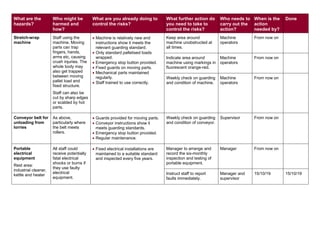
Stretch-wrap
machine
Staff using the
machine. Moving
parts can trap
fingers, hands,
arms etc, causing
crush injuries. The
whole body may
also get trapped
between moving
pallet load and
fixed structure.
Staff can also be
cut by sharp edges
or scalded by hot
parts.
 Machine is relatively new and
instructions show it meets the
relevant guarding standard.
 Only standard palletised loads
wrapped.
 Emergency stop button provided.
 Fixed guards on moving parts.
 Mechanical parts maintained
regularly.
 Staff trained to use correctly.
Keep area around
machine unobstructed at
all times.
Machine
operators
From now on
Indicate area around
machine using markings in
fluorescent orange-red.
Machine
operators
From now on
Weekly check on guarding
and condition of machine.
Machine
operators
From now on
Conveyor belt for
unloading from
lorries
As above,
particularly where
the belt meets
rollers.
 Guards provided for moving parts.
 Conveyor instructions show it
meets guarding standards.
 Emergency stop button provided.
 Regular maintenance.
Weekly check on guarding
and condition of conveyor.
Supervisor From now on
Portable
electrical
equipment
Rest area:
industrial cleaner,
kettle and heater
All staff could
receive potentially
fatal electrical
shocks or burns if
they use faulty
electrical
equipment.
 Fixed electrical installations are
maintained to a suitable standard
and inspected every five years.
Manager to arrange and
record the six-monthly
inspection and testing of
portable equipment.
Manager From now on
Instruct staff to report
faults immediately.
Manager and
supervisor
15/10/19 15/10/19
What are the
hazards?
Who might be
harmed and
how?
What are you already doing to
control the risks?
What further action do
you need to take to
control the risks?
Who needs to
carry out the
action?
When is the
action
needed by?
Done
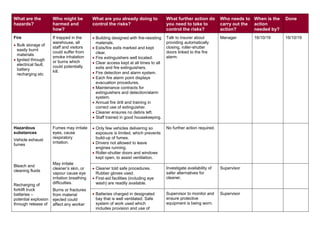
Fire
 Bulk storage of
easily burnt
materials
 Ignited through
electrical fault,
battery
recharging etc
If trapped in the
warehouse, all
staff and visitors
could suffer from
smoke inhalation
or burns which
could potentially
kill.
 Building designed with fire-resisting
materials.
 Exits/fire exits marked and kept
clear.
 Fire extinguishers well located.
 Clear access kept at all times to all
exits and fire extinguishers.
 Fire detection and alarm system.
 Each fire alarm point displays
evacuation procedures.
 Maintenance contracts for
extinguishers and detection/alarm
system.
 Annual fire drill and training in
correct use of extinguisher.
 Cleaner ensures no debris left.
 Staff trained in good housekeeping.
Talk to insurer about
providing automatically
closing, roller-shutter
doors linked to the fire
alarm.
Manager 16/10/19 16/10/19
Hazardous
substances
Vehicle exhaust
fumes
Bleach and
cleaning fluids
Recharging of
forklift truck
batteries –
potential explosion
through release of
Fumes may irritate
eyes, cause
respiratory
irritation.
May irritate
cleaner’s skin, or
vapour cause eye
irritation breathing
difficulties.
Burns or fractures
from material
ejected could
affect any worker
 Only few vehicles delivering so
exposure is limited, which prevents
build-up of fumes.
 Drivers not allowed to leave
engines running.
 Roller-shutter doors and windows
kept open, to assist ventilation.
No further action required.
 Cleaner told safe procedures.
Rubber gloves used.
 First-aid facilities (including eye
wash) are readily available.
Investigate availability of
safer alternatives for
cleaner.
Supervisor
 Batteries charged in designated
bay that is well ventilated. Safe
system of work used which
includes provision and use of
Supervisor to monitor and
ensure protective
equipment is being worn.
Supervisor
What are the
hazards?
Who might be
harmed and
how?
What are you already doing to
control the risks?
What further action do
you need to take to
control the risks?
Who needs to
carry out the
action?
When is the
action
needed by?
Done
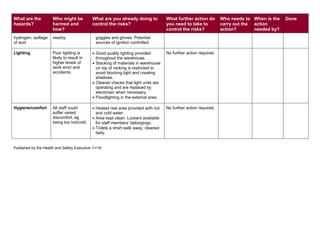
hydrogen, spillage
of acid
nearby. goggles and gloves. Potential
sources of ignition controlled.
Lighting Poor lighting is
likely to result in
higher levels of
work error and
accidents.
 Good quality lighting provided
throughout the warehouse.
 Stacking of materials in warehouse
on top of racking is restricted to
avoid blocking light and creating
shadows.
 Cleaner checks that light units are
operating and are replaced by
electrician when necessary.
 Floodlighting in the external area.
No further action required.
Hygiene/comfort All staff could
suffer varied
discomfort, eg
being too hot/cold.
 Heated rest area provided with hot
and cold water.
 Area kept clean. Lockers available
for staff members’ belongings.
 Toilets a short walk away, cleaned
daily.
No further action required.
Published by the Health and Safety Executive 11/19

warehouse.pdf

  • 1.
    Example risk assessmentfor a warehouse The warehouse manager carried out a risk assessment of the warehouse. The warehouse employed 12 staff, some were part of a union. How was the risk assessment done? The manager followed the advice at www.hse.gov.uk/simple-health-safety/risk/. To identify the hazards and risks, they:  walked around the warehouse, noting activities that might pose a risk and basing this on HSE’s warehousing guidance;  talked through the issues with the union safety representative and asked about the workers’ health and safety concerns;  talked to supervisors to learn from their detailed knowledge;  looked at the accident book to gather information on past problems. The manager wrote down who could be harmed by the hazards and how. They then noted what was already being done to control the risks and recorded any further actions required. They discussed the findings with the safety representative and gave copies to all members of staff. The manager will review the risk assessment whenever there are any significant changes such as new work equipment, work activities or workers. Do not just copy this example and put your company name to it as that would not satisfy the law and would not protect your employees. You must think about the specific hazards and controls your business needs. The HSE site has a template and other examples to help you produce your own assessment.
  • 2.
    Risk assessment Company name:GHI Logistics Assessment carried out by: JH Reynolds Date assessment carried out: 3/10/19 What are the hazards? Who might be harmed and how? What are you already doing to control the risks? What further action do you need to take to control the risks? Who needs to carry out the action? When is the action needed by? Done Falls from height Staff could suffer severe or fatal injuries if they fell while climbing racking. All staff are given strict instructions never to climb racking – monitored by supervisors. Share this risk assessment with regular contractors. Check their awareness of health and safety issues and ensure they give health and safety information to any staff new to the site. Manager 30/10/19 30/10/19 Staff could suffer severe or fatal injuries if they fell while changing light bulbs in the high ceiling. Proprietary forklift cage used by maintenance worker for changing bulbs. Cage supplier’s information shows it is manufactured to standard. Train maintenance worker to check cage is in good condition and properly secured before each use. Manager and maintenance worker 15/10/19 14/10/19 Staff or contractor could suffer severe or fatal injuries falling through No controls in place. Agree with maintenance worker that a contractor will be used for any access to the roof. Manager and maintenance worker 14/10/19 14/10/19
  • 3.
    What are the hazards? Whomight be harmed and how? What are you already doing to control the risks? What further action do you need to take to control the risks? Who needs to carry out the action? When is the action needed by? Done fragile roof lights when looking for leaks or repairing them. Require contractor to provide an assessment before access is allowed if any roof work is required. Maintenance worker From now on Put up ‘fragile roof’ signs, one on each side of the building and at access points to roof. Maintenance worker 17/10/19 17/10/19 Worker falling from roof of internal warehouse office used for storage. The internal warehouse roof is load bearing, has full rails and boards around its edge. It has adequate lighting and access is by permanent steps with a handrail. No further action required. Slips, trips and falls All staff may suffer sprains or fractures if they trip over debris or slip on spillages.  Flooring kept dry and quality maintained.  All staff trained to maintain good housekeeping standards and ensure stock does not project into gangways.  Cleaner empties bins and removes loose debris daily.  Pallets stored safely in designated area.  Protective non-slip footwear supplied and worn. Suitable absorber to be made available for liquid spills. Supervisor 15/10/19 14/10/19 Staff to be trained to clean and dry any spillages immediately. Supervisor 22/10/19 22/10/19 Extra bins to be provided for waste material near loading bays. Manager 28/10/19 28/10/19
  • 4.
    What are the hazards? Whomight be harmed and how? What are you already doing to control the risks? What further action do you need to take to control the risks? Who needs to carry out the action? When is the action needed by? Done Operation of lift trucks Serious injuries or fatalities can be caused by:  the vehicle crashing into other vehicles and/or other objects;  staff and visitors being hit by lift trucks;  objects falling from lift trucks onto staff and visitors;  lift trucks toppling over;  people falling from the vehicle or parts of the vehicle; and  being crushed by the mast.  All operators trained and competent to use lift truck.  Trucks serviced regularly and examined by suppliers every six months.  Drivers instructed to keep keys with them at all times.  System in place for refresher training of drivers.  Gangways and aisles big enough for lift trucks to load and unload from the racking safely.  System in place to separate vehicles and pedestrians.  Access to warehouse restricted to staff.  Floor condition maintained on a regular basis, housekeeping standards maintained by cleaner and workforce.  Warning signs located around the traffic route.  Trucks have seat belts and roll cages. Supervisor to ensure truck drivers check trucks each day before starting. Supervisor From now on Separate pedestrian entrance(s) with protective barrier rail to be provided next to roller-shutter doors. Supervisor 7/11/19 5/11/19 Housekeeping standards and floor condition to be covered by a monthly inspection by manager and brief record kept. Manager From now on Strict requirement that only competent drivers may operate lift trucks to be explained to all staff. Disciplinary action to be taken against anyone involved in breaking this rule. Manager 4/11/19 4/11/19
  • 5.
    What are the hazards? Whomight be harmed and how? What are you already doing to control the risks? What further action do you need to take to control the risks? Who needs to carry out the action? When is the action needed by? Done Traffic movements (deliveries etc) Injuries such as fractures or even fatalities can be caused by:  staff and visitors being hit by vehicle;  people falling from a vehicle or parts of a vehicle; and  objects falling from vehicle onto staff and visitors.  Floor and traffic routes suitable for the vehicles using them.  Vehicle routes kept free of obstructions (with spillages being cleaned up promptly).  Parking of cars and vans only allowed in marked spaces, well away from external delivery/dispatch area.  Outside area gritted when frosty, snow cleared.  Sensible speed limits imposed and kept to.  Adequate signage to warn of hazards.  Reversing of delivery vehicles avoided unless absolutely necessary.  Any reversing that is necessary should be overseen by a trained reversing assistant (banksman). Anyone working in the vicinity of moving vehicles should be given training and high-visibility clothing. Supervisor From now on
  • 6.
    What are the hazards? Whomight be harmed and how? What are you already doing to control the risks? What further action do you need to take to control the risks? Who needs to carry out the action? When is the action needed by? Done Stretch-wrap machine Staff using the machine. Moving parts can trap fingers, hands, arms etc, causing crush injuries. The whole body may also get trapped between moving pallet load and fixed structure. Staff can also be cut by sharp edges or scalded by hot parts.  Machine is relatively new and instructions show it meets the relevant guarding standard.  Only standard palletised loads wrapped.  Emergency stop button provided.  Fixed guards on moving parts.  Mechanical parts maintained regularly.  Staff trained to use correctly. Keep area around machine unobstructed at all times. Machine operators From now on Indicate area around machine using markings in fluorescent orange-red. Machine operators From now on Weekly check on guarding and condition of machine. Machine operators From now on Conveyor belt for unloading from lorries As above, particularly where the belt meets rollers.  Guards provided for moving parts.  Conveyor instructions show it meets guarding standards.  Emergency stop button provided.  Regular maintenance. Weekly check on guarding and condition of conveyor. Supervisor From now on Portable electrical equipment Rest area: industrial cleaner, kettle and heater All staff could receive potentially fatal electrical shocks or burns if they use faulty electrical equipment.  Fixed electrical installations are maintained to a suitable standard and inspected every five years. Manager to arrange and record the six-monthly inspection and testing of portable equipment. Manager From now on Instruct staff to report faults immediately. Manager and supervisor 15/10/19 15/10/19
  • 7.
    What are the hazards? Whomight be harmed and how? What are you already doing to control the risks? What further action do you need to take to control the risks? Who needs to carry out the action? When is the action needed by? Done Fire  Bulk storage of easily burnt materials  Ignited through electrical fault, battery recharging etc If trapped in the warehouse, all staff and visitors could suffer from smoke inhalation or burns which could potentially kill.  Building designed with fire-resisting materials.  Exits/fire exits marked and kept clear.  Fire extinguishers well located.  Clear access kept at all times to all exits and fire extinguishers.  Fire detection and alarm system.  Each fire alarm point displays evacuation procedures.  Maintenance contracts for extinguishers and detection/alarm system.  Annual fire drill and training in correct use of extinguisher.  Cleaner ensures no debris left.  Staff trained in good housekeeping. Talk to insurer about providing automatically closing, roller-shutter doors linked to the fire alarm. Manager 16/10/19 16/10/19 Hazardous substances Vehicle exhaust fumes Bleach and cleaning fluids Recharging of forklift truck batteries – potential explosion through release of Fumes may irritate eyes, cause respiratory irritation. May irritate cleaner’s skin, or vapour cause eye irritation breathing difficulties. Burns or fractures from material ejected could affect any worker  Only few vehicles delivering so exposure is limited, which prevents build-up of fumes.  Drivers not allowed to leave engines running.  Roller-shutter doors and windows kept open, to assist ventilation. No further action required.  Cleaner told safe procedures. Rubber gloves used.  First-aid facilities (including eye wash) are readily available. Investigate availability of safer alternatives for cleaner. Supervisor  Batteries charged in designated bay that is well ventilated. Safe system of work used which includes provision and use of Supervisor to monitor and ensure protective equipment is being worn. Supervisor
  • 8.
    What are the hazards? Whomight be harmed and how? What are you already doing to control the risks? What further action do you need to take to control the risks? Who needs to carry out the action? When is the action needed by? Done hydrogen, spillage of acid nearby. goggles and gloves. Potential sources of ignition controlled. Lighting Poor lighting is likely to result in higher levels of work error and accidents.  Good quality lighting provided throughout the warehouse.  Stacking of materials in warehouse on top of racking is restricted to avoid blocking light and creating shadows.  Cleaner checks that light units are operating and are replaced by electrician when necessary.  Floodlighting in the external area. No further action required. Hygiene/comfort All staff could suffer varied discomfort, eg being too hot/cold.  Heated rest area provided with hot and cold water.  Area kept clean. Lockers available for staff members’ belongings.  Toilets a short walk away, cleaned daily. No further action required. Published by the Health and Safety Executive 11/19