“they understood nature better
because it was now mechanical;
and mechanics better because it
was now mathematical”
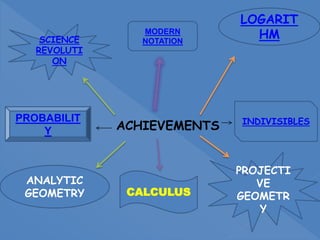
ACHIEVEMENTS
SCIENCE
REVOLUTI
ON
MODERN
NOTATION
LOGARIT
HM
INDIVISIBLES
PROJECTI
VE
GEOMETR
Y
CALCULUS
PROBABILIT
Y
ANALYTIC
GEOMETRY
 1608 – telescope by Hans Lippershey
(Denmark)
 1609 – thermostat by Cornelius Drebbel
(Britain)
 1631 – multiplication sign x is first used.
 1644 – barometer by Evangelista Torrecelli
(Italy)
 1650 – air pump by Otto von Guericke
 1660 – Royal Society founded in London
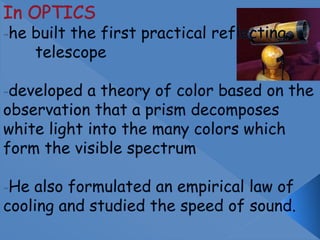
 1668 – reflecting telescope by Newton
 1680 – clocks have minute hand
born March 31, 1596 in Touraine, France
Father of Modern Philosophy
Father of Analytic Geometry
TIMELINE
1604 – enrolled in the Jesuit School
1612 – left school and followed the
usual path of a young man of
wealth going to Paris
to taste the pleasures of its social
life
1617 – joined the army as gentleman volunteer in the
Dutch Republic
>Descartes' theory provided the basis for the
calculus of Newton and Leibniz, by applying
infinitesimal calculus to the tangent line problem
>He created analytic geometry
>Descartes rule of signs which is commonly used
to determine the negative and positive roots of
a polynomial.
>discovered an early form of the law of
conservation of momentum
>invented the notation which uses superscript to
show the powers or exponents
>introduced the algebraic notation still in used
today.
>Theory of Vortices - the solar system was filled
with vaguely defined primordial matter, the so-
called plenum or ether. The motion of the
stellar mass set up an immense whirlpool or
vortex, in the middle of which was the sun.
He died in Denmark on February 11, 1650 at the
age of 53

 Did you know . . .?
 The man who invented analytic geometry, never
Descartes never married, but he lived
with a Dutch woman for several years
and they had an illegitimate child named
Francine who died at age of 5.
Descartes wrote to a friend that her
death brought him the deepest sorrow
he had ever known.
Newton’s Apples???
“If I have seen farther than others,
it is because I have stood on the
shoulders of giants.”
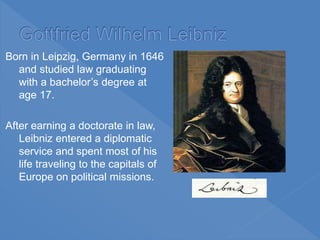
Born in Leipzig, Germany in 1646
and studied law graduating
with a bachelor’s degree at
age 17.
After earning a doctorate in law,
Leibniz entered a diplomatic
service and spent most of his
life traveling to the capitals of
Europe on political missions.
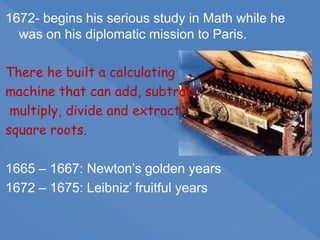
1672- begins his serious study in Math while he
was on his diplomatic mission to Paris.
There he built a calculating
machine that can add, subtract,
multiply, divide and extract
square roots.
1665 – 1667: Newton’s golden years
1672 – 1675: Leibniz’ fruitful years
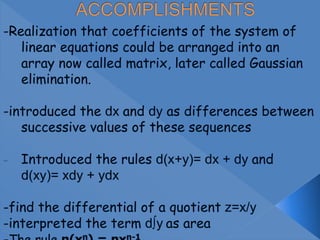
Though Newton invented calculus first,
almost all of the notation that we use
for calculus today is Leibniz's.
Leibniz also chose many of the terms that we use
for graphing. He was the first person to use
the word "coordinates," and he used the
term "axes of coordinates." Leibniz also
invented the terms "function" and
"variable."
During the 18th century
the prevalent opinion was against
Leibniz guilty of plagiarism but
today the majority of writers
incline to think that the inventions
were independent.
Mathematics may not teach
us to breathe oxygen and
exhale carbon dioxide, or to
love a friend and to forgive
an enemy; but it gives us
every reason to hope that
every problem has a
solution…<gudnight.//>
Galileo Galilei (1564 – 1642) – his name is associated
with events of profound significance:
- - with the birth of modern science
- - with the Copernican revolution
- (heliocentric theory)
- - with the dethronement of Aristotle as the
supreme authority in schools
- - with the struggle against the external
restrictions on scientific inquiry
William Oughtred introduced the symbol x for multiplication.
Leibniz used a period/dot
> or < by Thomas Harriot
the use of the letters x, y, z for unknown quantities, and a, b,
c for known &
successive powers of x denoted by exponents {Descartes}
3 Stages in the Development of Algebraic Notation:
Rhetorical – statements and equations were written out in
ordinary language.
Syncopated – familiar terms were abbreviated.
Symbolic – every part of expression was characterized by an
ad hoc symbol.
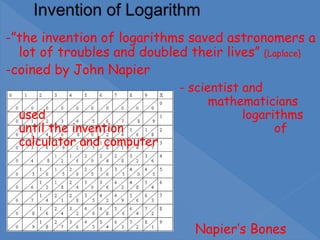
-”the invention of logarithms saved astronomers a
lot of troubles and doubled their lives” {Laplace}
-coined by John Napier
- scientist and
mathematicians
used logarithms
until the invention of
calculator and computer
Napier’s Bones
Method of Indivisibles –area is made up of
segments which are indivisibles and solid
consists of areas which are indivisibles too.
-became the base of conception of definite
integral.
Projective geometry- a kind of geometry which
mathematicians study unchanging property to
be drawn by projection.
Ex. A circle is change by projection into conic
sections.
But the projection geometry was so difficult and
different nature from former geometrical
conceptions. Thus; it wasn't acknowledged for
Beginning of Probability
-started with the correspondence of Pascal and
Fermat in the problem of gambling.
-Mathematicians were interested in distributing
gambling money.
Appearance of Analytic Geometry
-while Desargues and Pascal were opening the new
field of projective geometry, Descartes and
Fermat were conceiving ideas of modern
analytic geometry.
-The projective geometry a ‘branch’ of geometry
whereas the analytic geometry a ‘method’ of
geometry.
-it combines algebra with geometry by
17th Century Mathematics

17th Century Mathematics

  • 2.
    “they understood naturebetter because it was now mechanical; and mechanics better because it was now mathematical”
  • 3.
  • 4.
     1608 –telescope by Hans Lippershey (Denmark)  1609 – thermostat by Cornelius Drebbel (Britain)  1631 – multiplication sign x is first used.  1644 – barometer by Evangelista Torrecelli (Italy)  1650 – air pump by Otto von Guericke  1660 – Royal Society founded in London  1668 – reflecting telescope by Newton  1680 – clocks have minute hand
  • 5.
    born March 31,1596 in Touraine, France Father of Modern Philosophy Father of Analytic Geometry TIMELINE 1604 – enrolled in the Jesuit School 1612 – left school and followed the usual path of a young man of wealth going to Paris to taste the pleasures of its social life 1617 – joined the army as gentleman volunteer in the Dutch Republic
  • 6.
    >Descartes' theory providedthe basis for the calculus of Newton and Leibniz, by applying infinitesimal calculus to the tangent line problem >He created analytic geometry >Descartes rule of signs which is commonly used to determine the negative and positive roots of a polynomial. >discovered an early form of the law of conservation of momentum >invented the notation which uses superscript to show the powers or exponents
  • 7.
    >introduced the algebraicnotation still in used today. >Theory of Vortices - the solar system was filled with vaguely defined primordial matter, the so- called plenum or ether. The motion of the stellar mass set up an immense whirlpool or vortex, in the middle of which was the sun. He died in Denmark on February 11, 1650 at the age of 53   Did you know . . .?  The man who invented analytic geometry, never
  • 8.
    Descartes never married,but he lived with a Dutch woman for several years and they had an illegitimate child named Francine who died at age of 5. Descartes wrote to a friend that her death brought him the deepest sorrow he had ever known.
  • 13.
    Newton’s Apples??? “If Ihave seen farther than others, it is because I have stood on the shoulders of giants.”
  • 14.
    Born in Leipzig,Germany in 1646 and studied law graduating with a bachelor’s degree at age 17. After earning a doctorate in law, Leibniz entered a diplomatic service and spent most of his life traveling to the capitals of Europe on political missions.
  • 15.
    1672- begins hisserious study in Math while he was on his diplomatic mission to Paris. There he built a calculating machine that can add, subtract, multiply, divide and extract square roots. 1665 – 1667: Newton’s golden years 1672 – 1675: Leibniz’ fruitful years
  • 17.
    Though Newton inventedcalculus first, almost all of the notation that we use for calculus today is Leibniz's. Leibniz also chose many of the terms that we use for graphing. He was the first person to use the word "coordinates," and he used the term "axes of coordinates." Leibniz also invented the terms "function" and "variable."
  • 18.
    During the 18thcentury the prevalent opinion was against Leibniz guilty of plagiarism but today the majority of writers incline to think that the inventions were independent.
  • 19.
    Mathematics may notteach us to breathe oxygen and exhale carbon dioxide, or to love a friend and to forgive an enemy; but it gives us every reason to hope that every problem has a solution…<gudnight.//>
  • 20.
    Galileo Galilei (1564– 1642) – his name is associated with events of profound significance: - - with the birth of modern science - - with the Copernican revolution - (heliocentric theory) - - with the dethronement of Aristotle as the supreme authority in schools - - with the struggle against the external restrictions on scientific inquiry
  • 21.
    William Oughtred introducedthe symbol x for multiplication. Leibniz used a period/dot > or < by Thomas Harriot the use of the letters x, y, z for unknown quantities, and a, b, c for known & successive powers of x denoted by exponents {Descartes} 3 Stages in the Development of Algebraic Notation: Rhetorical – statements and equations were written out in ordinary language. Syncopated – familiar terms were abbreviated. Symbolic – every part of expression was characterized by an ad hoc symbol.
  • 22.
    -”the invention oflogarithms saved astronomers a lot of troubles and doubled their lives” {Laplace} -coined by John Napier - scientist and mathematicians used logarithms until the invention of calculator and computer Napier’s Bones
  • 23.
    Method of Indivisibles–area is made up of segments which are indivisibles and solid consists of areas which are indivisibles too. -became the base of conception of definite integral. Projective geometry- a kind of geometry which mathematicians study unchanging property to be drawn by projection. Ex. A circle is change by projection into conic sections. But the projection geometry was so difficult and different nature from former geometrical conceptions. Thus; it wasn't acknowledged for
  • 24.
    Beginning of Probability -startedwith the correspondence of Pascal and Fermat in the problem of gambling. -Mathematicians were interested in distributing gambling money. Appearance of Analytic Geometry -while Desargues and Pascal were opening the new field of projective geometry, Descartes and Fermat were conceiving ideas of modern analytic geometry. -The projective geometry a ‘branch’ of geometry whereas the analytic geometry a ‘method’ of geometry. -it combines algebra with geometry by