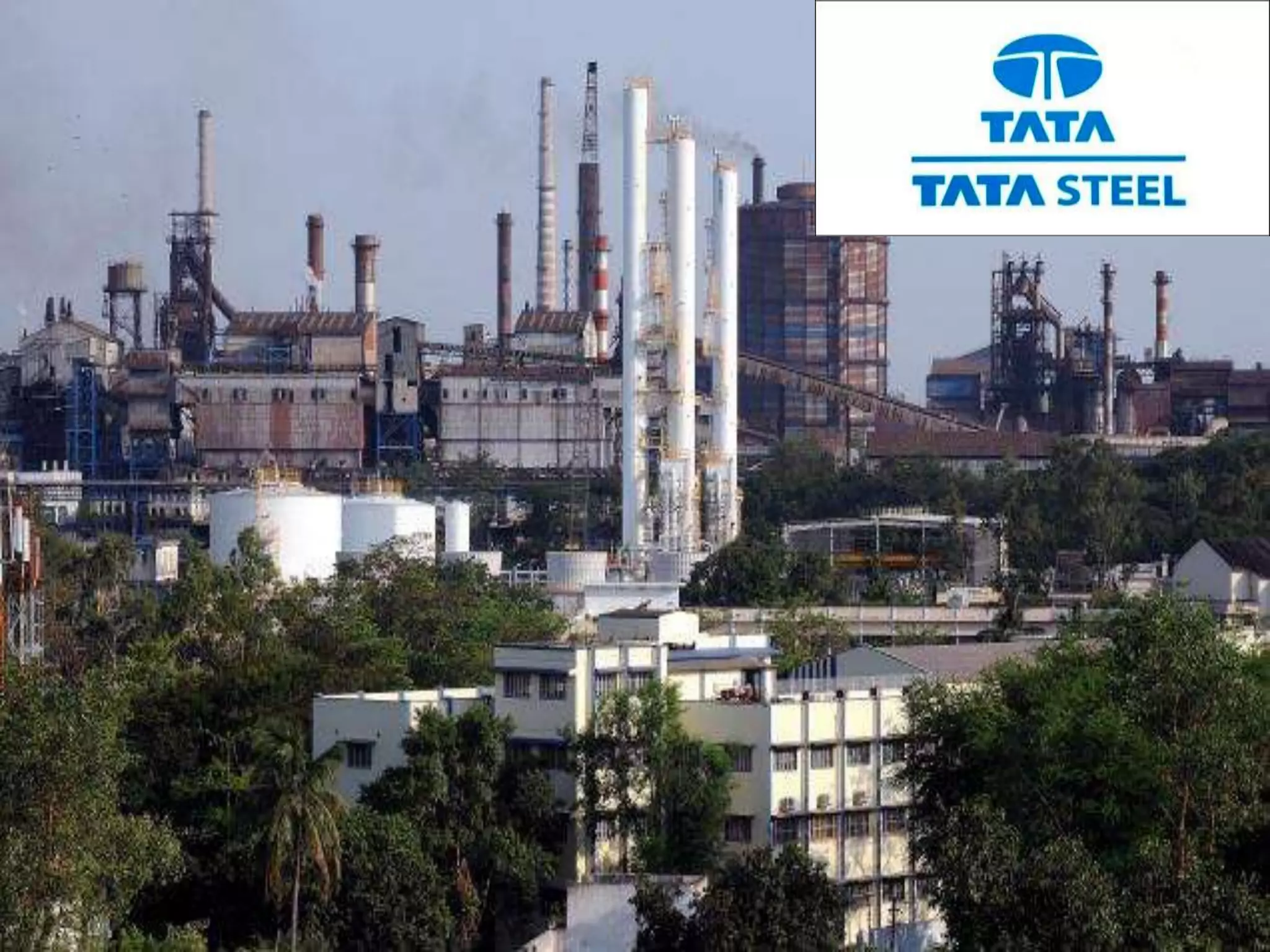
ERP Implementation At
Tata Steel
ERP Implementation
at TATA Steel
TISCO BACKGROUND
• India’s largest integrated private sector steel company
• Established in the year 1907
• Tata Steel runs state-of-the-art Cold Rolling Mill
complex at Jamshedpur, Eastern India
• Products include hot and cold rolled coils and sheets,
galvanized sheets, tubes, wire rods, construction re-
bars, rings and bearings
• Introduced brands like Tata Steelium (the world's first
branded Cold Rolled Steel), Tata Shaktee ,Tata Tiscon,
Tata Pipes, Tata Bearings, Tata Agrico and Tata Wiron.
What is ERP?
• IT software that integrates business activities
across an enterprise
• From product planning, parts purchasing,
inventory control, and product distribution, to
order tracking
• Application modules for the finance, accounting
and human resources aspects of a business
• SAP and Oracle are the two ERP leading vendors
• Evolved technologically from a monolithic legacy
implementation into flexible, tiered, client-server
architecture
ERP Design Challenges for Steel
Companies
• More than one planning strategy
• Complex product variations
• Flexible planning
• Specific Customer Service Requirements
• Complex production scheduling combining
both continuous and batch production
• Detailed margin analysis
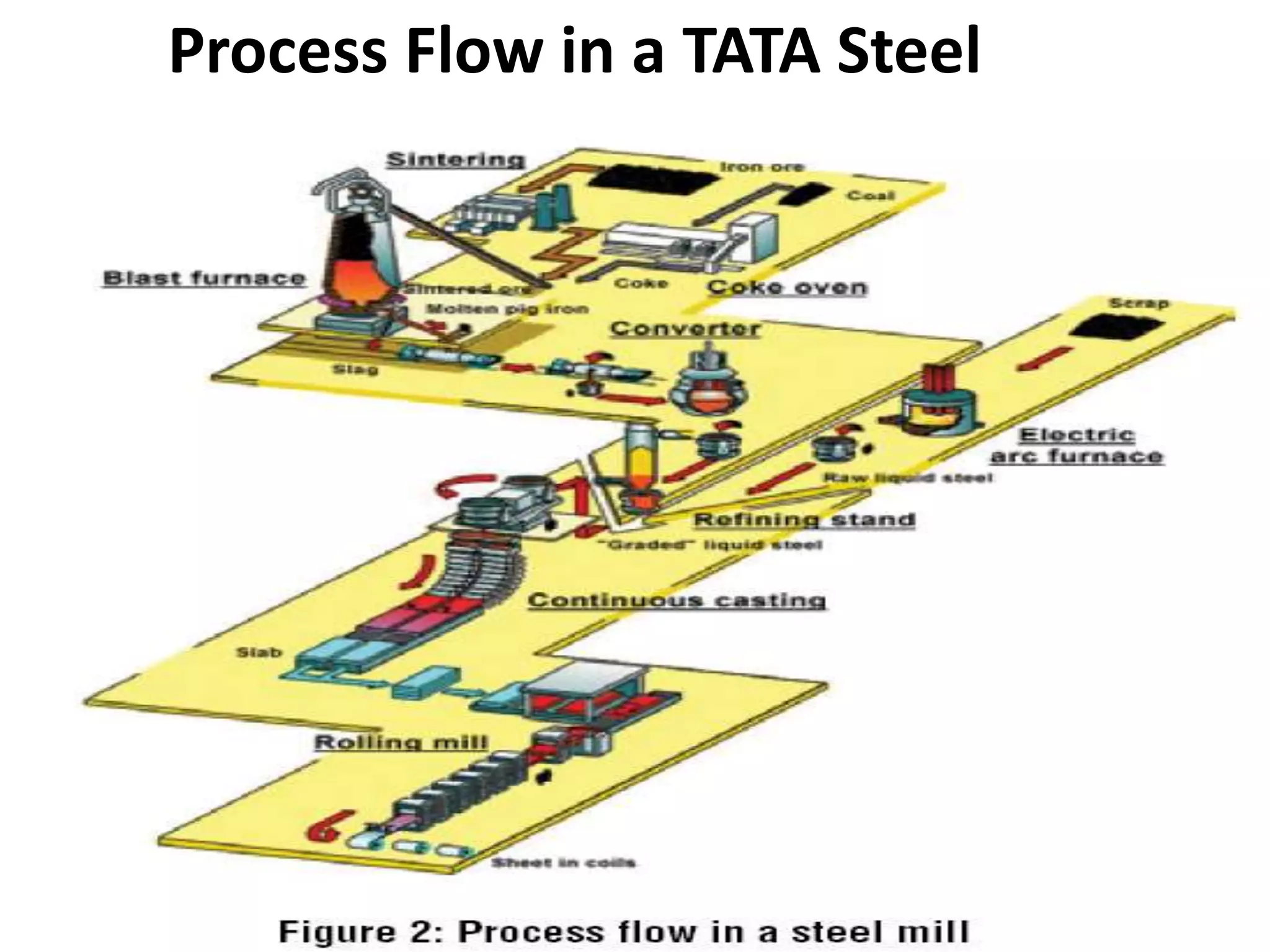
Process Flow in a TATA Steel
Integrated IT Model for Steel
• The Supply Chain Management (SCM) application provides the
rough-cut planning
• When orders are being entered, availability checks assign the order
to a block and feeds back a promise date
• The mill optimizer then typically would re-shuffle orders in between
the blocks, and feed results back into the SCM application in order
to optimize the load balancing
• Right before production starts, planned orders from the SCM
application are converted into production orders and, via the ERP
system
• Detailed scheduling then takes place, sequencing and combining
pieces from various orders throughout the mill into lots for
optimization
• Production completion then posts an updated status of the orders
into the ERP system, including stock receipts of finished products,
and so forth.
faced a cumbersome task exchanging and retrieving information from the system.faced a cumbersome task exchanging and retrieving information from the system.
Implementation Process At Tata Steel
• Had a tough time especially to implement the software in one
stroke
• Meets the demands of a big firm like TISCO
• Associating and implanting TISCO to all the stakeholders
• time granted for the process was 8 months
• Business process was divided into two main segments:
 Core functions
 Supporting functions
• The company took all efforts to ensure that the change did not
produce any sort of resentment in the organization
• transited seamlessly from a production-driven company to a
customer-driven one
• faced a cumbersome task exchanging and retrieving information
from the system.
• Reliability of information
Design
• Arthur D. Little (Strategy Consultants) and IBM Global
Services (BPR Consultants) redesigned the two core
business processes:
• Order Generation &
• Fulfillment and the Marketing Development
processes.
• To improve customer focus, facilitating better credit
control, and reduction of stocks.
• Adopted the latest production and business
practices to offer innovative processes
The Real Challenge
• B Muthuraman, MD (Designate), said,
"Implementing any ERP system is a challenge for
an organization because of the declining success
rate of ERP implementations world-wide.”
• Successfully implementing SAP to 46-odd
geographic locations across the country under a
big bang approach in just eight months
• Building a conducive environment where SAP will
be embedded in the hearts and minds of the
people and the customers of Tata steel
Choosing The Platform And
Technology
• SAP software was associated with certain
strategic goals
• TISCO wanted to bring forth a culture of
continuous learning and change
• Enable TISCO to achieve a world-class status for
its products and services and strengthen its
leadership position in the industry
• wanted the software to result in quick decision-
making, transparency and credibility of data and
improve responsiveness to customers across all
areas.
Mapping Technology To Business Processes
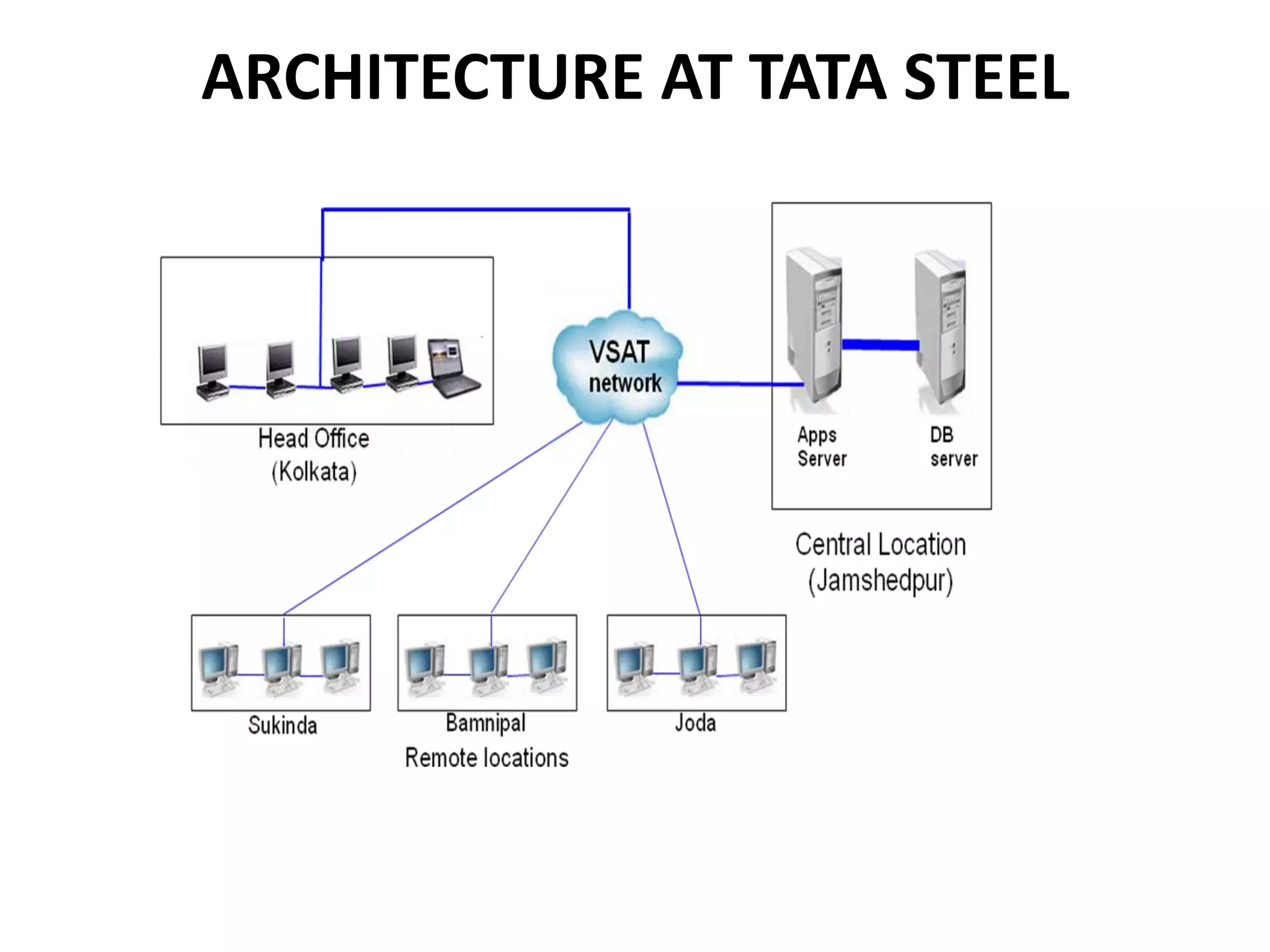
• Huge numbers of transactions and complexity, were
identified as a HUB
• Smaller branches were defined as SPOKES
• 'Change Management' - to reach out to people involved
non-directly in the project to apprise them of the
developments taking place
• Tata Steel planned a big-bang approach of going
live
• Pulled off a big bang implementation of all SAP
modules at one go across 46 countrywide
locations
Achieving Business Agility Through SAP
• Web enabling of SAP R/3 is on the cards
• Plans to adopt the my SAP Customer Relationship
Management solution to enhance its customer
relationships in the near term
ARCHITECTURE AT TATA STEEL
THE OUTCOME
• Remarkable result in terms of financial technical
and managerial parameters
• The effective handling and speed delivery
resulted in greater sales .
• Drastic fall in the amount owned to creditors.
• The systems were made more user friendly.
• This improved the quality of work thereby
increased the productivity.
• Massive change in terms of accountability
administration and control
• Spent close to Rs 40 crore on its implementation and
• Has saved Rs 33 crore within a few months," said Ramesh C.
Nadrajog, Vice President, Finance.
• "The manpower cost has reduced from over $200 per ton two years
ago, to about $140 per ton in 2000.
• The overdue outstanding has been brought down from Rs 5,170
million in 1999 to Rs 4,033 million by June 2000.
• The inventory carrying cost has drastically deflated from Rs 190 per
ton to Rs 155 per ton.
• Significant costs savings through management of resources with the
implementation of SAP.
• With SAP's solution improving customer management.
• The availability of online information has facilitated quicker and
reliable trend analysis
Future Moves
• Motivating factor for both companies and ERP
vendors.
• TISCO is not determined to stop ERP or attain a
saturation point now.
• Improve and increase the scopes of ERP software
• A model guide
• Critical success factors for ERP implementation in
order to enjoy ERP success
Conclusion
• ERP is a key backbone application for companies in a
fast changing industry like steel.
• The risks in an ERP implementation are usually
outweighed by the benefits.
• The ERP discussion is often one of mindset more than
one of standalone business cases.
• Implementing ERP can be challenging and demands
sustained commitment from top executive levels,
• It is fundamental to enhancing the competitive
position of a company in the dynamic environment of
the steel industry today.

Final erp ppt

  • 2.
  • 3.
  • 4.
    TISCO BACKGROUND • India’slargest integrated private sector steel company • Established in the year 1907 • Tata Steel runs state-of-the-art Cold Rolling Mill complex at Jamshedpur, Eastern India • Products include hot and cold rolled coils and sheets, galvanized sheets, tubes, wire rods, construction re- bars, rings and bearings • Introduced brands like Tata Steelium (the world's first branded Cold Rolled Steel), Tata Shaktee ,Tata Tiscon, Tata Pipes, Tata Bearings, Tata Agrico and Tata Wiron.
  • 5.
    What is ERP? •IT software that integrates business activities across an enterprise • From product planning, parts purchasing, inventory control, and product distribution, to order tracking • Application modules for the finance, accounting and human resources aspects of a business • SAP and Oracle are the two ERP leading vendors • Evolved technologically from a monolithic legacy implementation into flexible, tiered, client-server architecture
  • 6.
    ERP Design Challengesfor Steel Companies • More than one planning strategy • Complex product variations • Flexible planning • Specific Customer Service Requirements • Complex production scheduling combining both continuous and batch production • Detailed margin analysis
  • 7.
    Process Flow ina TATA Steel
  • 8.
    Integrated IT Modelfor Steel • The Supply Chain Management (SCM) application provides the rough-cut planning • When orders are being entered, availability checks assign the order to a block and feeds back a promise date • The mill optimizer then typically would re-shuffle orders in between the blocks, and feed results back into the SCM application in order to optimize the load balancing • Right before production starts, planned orders from the SCM application are converted into production orders and, via the ERP system • Detailed scheduling then takes place, sequencing and combining pieces from various orders throughout the mill into lots for optimization • Production completion then posts an updated status of the orders into the ERP system, including stock receipts of finished products, and so forth. faced a cumbersome task exchanging and retrieving information from the system.faced a cumbersome task exchanging and retrieving information from the system.
  • 9.
    Implementation Process AtTata Steel • Had a tough time especially to implement the software in one stroke • Meets the demands of a big firm like TISCO • Associating and implanting TISCO to all the stakeholders • time granted for the process was 8 months • Business process was divided into two main segments:  Core functions  Supporting functions • The company took all efforts to ensure that the change did not produce any sort of resentment in the organization • transited seamlessly from a production-driven company to a customer-driven one • faced a cumbersome task exchanging and retrieving information from the system. • Reliability of information
  • 10.
    Design • Arthur D.Little (Strategy Consultants) and IBM Global Services (BPR Consultants) redesigned the two core business processes: • Order Generation & • Fulfillment and the Marketing Development processes. • To improve customer focus, facilitating better credit control, and reduction of stocks. • Adopted the latest production and business practices to offer innovative processes
  • 11.
    The Real Challenge •B Muthuraman, MD (Designate), said, "Implementing any ERP system is a challenge for an organization because of the declining success rate of ERP implementations world-wide.” • Successfully implementing SAP to 46-odd geographic locations across the country under a big bang approach in just eight months • Building a conducive environment where SAP will be embedded in the hearts and minds of the people and the customers of Tata steel
  • 12.
    Choosing The PlatformAnd Technology • SAP software was associated with certain strategic goals • TISCO wanted to bring forth a culture of continuous learning and change • Enable TISCO to achieve a world-class status for its products and services and strengthen its leadership position in the industry • wanted the software to result in quick decision- making, transparency and credibility of data and improve responsiveness to customers across all areas.
  • 13.
    Mapping Technology ToBusiness Processes • Huge numbers of transactions and complexity, were identified as a HUB • Smaller branches were defined as SPOKES • 'Change Management' - to reach out to people involved non-directly in the project to apprise them of the developments taking place • Tata Steel planned a big-bang approach of going live • Pulled off a big bang implementation of all SAP modules at one go across 46 countrywide locations
  • 14.
    Achieving Business AgilityThrough SAP • Web enabling of SAP R/3 is on the cards • Plans to adopt the my SAP Customer Relationship Management solution to enhance its customer relationships in the near term
  • 15.
  • 16.
    THE OUTCOME • Remarkableresult in terms of financial technical and managerial parameters • The effective handling and speed delivery resulted in greater sales . • Drastic fall in the amount owned to creditors. • The systems were made more user friendly. • This improved the quality of work thereby increased the productivity. • Massive change in terms of accountability administration and control
  • 17.
    • Spent closeto Rs 40 crore on its implementation and • Has saved Rs 33 crore within a few months," said Ramesh C. Nadrajog, Vice President, Finance. • "The manpower cost has reduced from over $200 per ton two years ago, to about $140 per ton in 2000. • The overdue outstanding has been brought down from Rs 5,170 million in 1999 to Rs 4,033 million by June 2000. • The inventory carrying cost has drastically deflated from Rs 190 per ton to Rs 155 per ton. • Significant costs savings through management of resources with the implementation of SAP. • With SAP's solution improving customer management. • The availability of online information has facilitated quicker and reliable trend analysis
  • 18.
    Future Moves • Motivatingfactor for both companies and ERP vendors. • TISCO is not determined to stop ERP or attain a saturation point now. • Improve and increase the scopes of ERP software • A model guide • Critical success factors for ERP implementation in order to enjoy ERP success
  • 19.
    Conclusion • ERP isa key backbone application for companies in a fast changing industry like steel. • The risks in an ERP implementation are usually outweighed by the benefits. • The ERP discussion is often one of mindset more than one of standalone business cases. • Implementing ERP can be challenging and demands sustained commitment from top executive levels, • It is fundamental to enhancing the competitive position of a company in the dynamic environment of the steel industry today.