Human Resource Management
Employee Performance Appraisal
& Reward Management
Introduction
 Importance
 Manage and improve employees’
performance
 Compensation
 Training needs analysis
 Make more valid staffing decisions
 Enhance overall effectiveness of firm
Advantages of Quarterly Appraisals
 Employees efforts and capabilities are
recognised promptly and they are suitably
rewarded for their performance resulting in
enhanced performance level of the individual
employees in terms of productivity and low
material losses due to defects in
workmanship.
 The employer can ensure that the quality
specifications of its products are strictly
adhered to.
Advantages of Quarterly Appraisals
 The employer is able to identify and retain
the highly skilled workers and promptly
replace those workers who are unable to
meet the quality standards
 Employees make sustained efforts
throughout the year, rather than strive to
achieve high levels of performance close to
the year end to earn good appraisal rating.
What should be measured?
 Worker or work performance
 Performance outcomes
 Example of instructor
 Clear distinction between competencies and
performance
Appraisal System
 Who devises an appraisal system
 Measurement content
 Measurement process
 Rater
 Ratee
 Administrative characteristics
Measurement Content
 Person
 Work
 Record of outcomes
 Domino’s
 Sheraton Hotel
 Others
 Important outcome categories
Quality, Quantity, Timeliness, Cost Effectiveness, Need
for supervision, Interpersonal Impact
Measurement Process
 Comparison among ratees
 Paired comparison
 Straight ranking
 Forced distribution (GE example)
 Comparison among performance anchors
 Pairs of behavior statements
 Forced choice
 Comparison to performance level anchors
 Graphic rating scales
 Behaviorally anchored rating scales
 MBOs
 Summated scales
 Performance Distribution Assessment
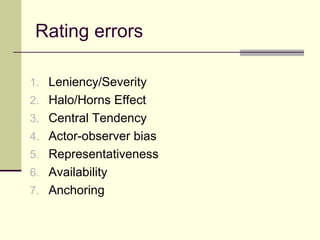
Rating errors
1. Leniency/Severity
2. Halo/Horns Effect
3. Central Tendency
4. Actor-observer bias
5. Representativeness
6. Availability
7. Anchoring
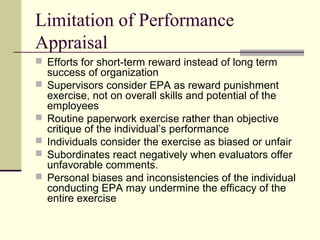
Limitation of Performance
Appraisal
 Efforts for short-term reward instead of long term
success of organization
 Supervisors consider EPA as reward punishment
exercise, not on overall skills and potential of the
employees
 Routine paperwork exercise rather than objective
critique of the individual’s performance
 Individuals consider the exercise as biased or unfair
 Subordinates react negatively when evaluators offer
unfavorable comments.
 Personal biases and inconsistencies of the individual
conducting EPA may undermine the efficacy of the
entire exercise
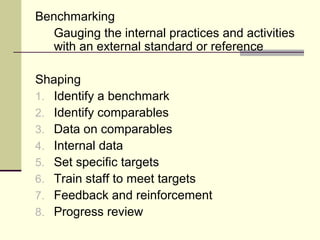
Benchmarking
Gauging the internal practices and activities
with an external standard or reference
Shaping
1. Identify a benchmark
2. Identify comparables
3. Data on comparables
4. Internal data
5. Set specific targets
6. Train staff to meet targets
7. Feedback and reinforcement
8. Progress review
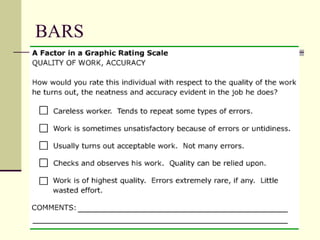
BARS
Employee Compensation Package
refers to all forms of pay and
rewards received by the employees
for the performance of their jobs,
including cash, bonuses, benefits,
facilities and perquisites.
Well Conceived Employee
Compensation Strategy
 Identification of the Objectives of the
Employee Compensation Strategy
 Review of Compensation Plan
 Identification of the Positions and Prepare
their Job Descriptions
Well Conceived Employee
Compensation Strategy
 Evaluation of the relative importance of
the Positions and their significance for
achieving the objectives
 Comparison of the Compensation
Packages with the packages offered by
the competitors
 Administration of the Compensation
Program
 Communication of the Compensation
Package
Objectives of Reward & Employee
Compensation System
 Obtaining support of employees
 Building relationship between the employer
and the employees.
 Deriving significant value-addition at all the
stages of customer service
 Inducting and retaining a pool of suitably
skilled and motivated work force.
Objectives of Reward & Employee
Compensation System
 Inculcating a sense of financial transparency
and fairness of the compensation and reward
system among the employees.
 Articulating in precise terms the
organization’s expectations of employee
performance and service standards to create
a competitive business advantage.
 Aligning the compensation and reward
packages with the comparative packages
offered by the competitors.

10 epa

  • 1.
    Human Resource Management EmployeePerformance Appraisal & Reward Management
  • 2.
    Introduction  Importance  Manageand improve employees’ performance  Compensation  Training needs analysis  Make more valid staffing decisions  Enhance overall effectiveness of firm
  • 3.
    Advantages of QuarterlyAppraisals  Employees efforts and capabilities are recognised promptly and they are suitably rewarded for their performance resulting in enhanced performance level of the individual employees in terms of productivity and low material losses due to defects in workmanship.  The employer can ensure that the quality specifications of its products are strictly adhered to.
  • 4.
    Advantages of QuarterlyAppraisals  The employer is able to identify and retain the highly skilled workers and promptly replace those workers who are unable to meet the quality standards  Employees make sustained efforts throughout the year, rather than strive to achieve high levels of performance close to the year end to earn good appraisal rating.
  • 5.
    What should bemeasured?  Worker or work performance  Performance outcomes  Example of instructor  Clear distinction between competencies and performance
  • 6.
    Appraisal System  Whodevises an appraisal system  Measurement content  Measurement process  Rater  Ratee  Administrative characteristics
  • 7.
    Measurement Content  Person Work  Record of outcomes  Domino’s  Sheraton Hotel  Others  Important outcome categories Quality, Quantity, Timeliness, Cost Effectiveness, Need for supervision, Interpersonal Impact
  • 8.
    Measurement Process  Comparisonamong ratees  Paired comparison  Straight ranking  Forced distribution (GE example)  Comparison among performance anchors  Pairs of behavior statements  Forced choice
  • 9.
     Comparison toperformance level anchors  Graphic rating scales  Behaviorally anchored rating scales  MBOs  Summated scales  Performance Distribution Assessment
  • 10.
    Rating errors 1. Leniency/Severity 2.Halo/Horns Effect 3. Central Tendency 4. Actor-observer bias 5. Representativeness 6. Availability 7. Anchoring
  • 11.
    Limitation of Performance Appraisal Efforts for short-term reward instead of long term success of organization  Supervisors consider EPA as reward punishment exercise, not on overall skills and potential of the employees  Routine paperwork exercise rather than objective critique of the individual’s performance  Individuals consider the exercise as biased or unfair  Subordinates react negatively when evaluators offer unfavorable comments.  Personal biases and inconsistencies of the individual conducting EPA may undermine the efficacy of the entire exercise
  • 12.
    Benchmarking Gauging the internalpractices and activities with an external standard or reference Shaping 1. Identify a benchmark 2. Identify comparables 3. Data on comparables 4. Internal data 5. Set specific targets 6. Train staff to meet targets 7. Feedback and reinforcement 8. Progress review
  • 13.
  • 14.
    Employee Compensation Package EmployeeCompensation Package refers to all forms of pay and rewards received by the employees for the performance of their jobs, including cash, bonuses, benefits, facilities and perquisites.
  • 15.
    Well Conceived Employee CompensationStrategy  Identification of the Objectives of the Employee Compensation Strategy  Review of Compensation Plan  Identification of the Positions and Prepare their Job Descriptions
  • 16.
    Well Conceived Employee CompensationStrategy  Evaluation of the relative importance of the Positions and their significance for achieving the objectives  Comparison of the Compensation Packages with the packages offered by the competitors  Administration of the Compensation Program  Communication of the Compensation Package
  • 17.
    Objectives of Reward& Employee Compensation System  Obtaining support of employees  Building relationship between the employer and the employees.  Deriving significant value-addition at all the stages of customer service  Inducting and retaining a pool of suitably skilled and motivated work force.
  • 18.
    Objectives of Reward& Employee Compensation System  Inculcating a sense of financial transparency and fairness of the compensation and reward system among the employees.  Articulating in precise terms the organization’s expectations of employee performance and service standards to create a competitive business advantage.  Aligning the compensation and reward packages with the comparative packages offered by the competitors.