Prolog Language
Prof. Qasim Ali
MSCS (CS)
Introduction
Prolog is a logic programming language associated
with artificial intelligence and computational linguistics.
Prolog has its roots in first-order logic, a formal logic, and
unlike many other programming languages, Prolog is
intended primarily as a declarative programming language:
the program logic is expressed in terms of relations,
represented as facts and rules.
A computation is initiated by running a query over these
relations
Data types
Prolog's single data type is the term. T
Terms are either atoms, numbers, variables or compound
terms.
An atom is a general-purpose name with no inherent
meaning. Examples of atoms include x, red, 'Taco', and
'some atom'.
Numbers can be floats or integers. ISO standard compatible
Prolog systems can check the Prolog flag "bounded". Most of
the major Prolog systems support arbitrary length integer
numbers.
Data types
Variables are denoted by a string consisting of letters,
numbers and underscore characters, and beginning with an
upper-case letter or underscore.
Variables closely resemble variables in logic in that they are
placeholders for arbitrary terms.
A compound term is composed of an atom called a "functor"
and a number of "arguments", which are again terms.
Compound terms are ordinarily written as a functor followed
by a comma-separated list of argument terms, which is
contained in parentheses.
Data types
Special cases of compound terms:
A List is an ordered collection of terms. It is denoted by
square brackets with the terms separated by commas or in
the case of the empty list, []. For example, [1,2,3] or
[red,green,blue].
Strings: A sequence of characters surrounded by quotes is
equivalent to either a list of (numeric) character codes, a list
of characters (atoms of length 1), or an atom depending on
the value of the Prolog flag double_quotes. For example, "to
be, or not to be".
Prolog
 www.gprolog.org/setup-gprolog-1.4.5-msvc-x64.exe
 Save your programs in “Prolog workspace” folder inside “Prolog”
folder.
 Open Prolog console. Goto File → Change Dir.
 Goto the folder containing your prolog programs. i.e. “Prolog
workspace”.
 Press Ok.
Loading and Running the code:
 [Program_file_name]. Loading
 Run according to your requirement.
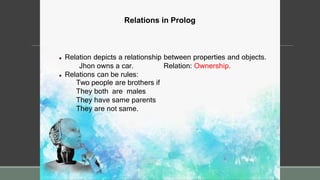
Relations in Prolog
 Relation depicts a relationship between properties and objects.
Relation: Ownership.
Jhon owns a car.
 Relations can be rules:
Two people are brothers if
They both are males
They have same parents
They are not same.
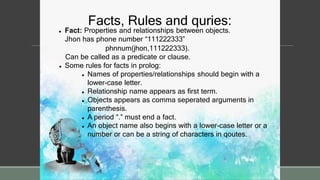
Facts, Rules and quries:
 Fact: Properties and relationships between objects.
Jhon has phone number “111222333”
phnnum(jhon,111222333).
Can be called as a predicate or clause.
 Some rules for facts in prolog:
 Names of properties/relationships should begin with a
lower-case letter.
 Relationship name appears as first term.
 Objects appears as comma seperated arguments in
parenthesis.
 A period “.” must end a fact.
 An object name also begins with a lower-case letter or a
number or can be a string of characters in qoutes.
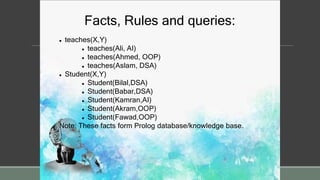
Facts, Rules and queries:
 teaches(X,Y)
 teaches(Ali, AI)
 teaches(Ahmed, OOP)
 teaches(Aslam, DSA)
 Student(X,Y)
 Student(Bilal,DSA)
 Student(Babar,DSA)
 Student(Kamran,AI)
 Student(Akram,OOP)
 Student(Fawad,OOP)
Note: These facts form Prolog database/knowledge base.
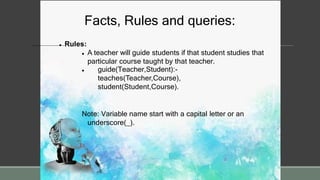
Facts, Rules and queries:
 Rules:
 A teacher will guide students if that student studies that
particular course taught by that teacher.
 guide(Teacher,Student):-
teaches(Teacher,Course),
student(Student,Course).
Note: Variable name start with a capital letter or an
underscore(_).
Difference between Rule and Fact
Facts, Rules and queries:
 Queries:
 Queries will be based on facts and rules. We can ask
questions based on stored information.
 Suppose we want to know that Ali teaches AI or not?
?- teaches(Ali,AI).
 Queries are terminated by full-stop.
 To ask this query, Prolog will consult database.
 Similarly, we can also ask:
?- teaches(Ali,X).
Facts, Rules and queries:
 Syntax of a Clause:
 :- this means “if” or “is implied by”. Also called neck
symbol.
 Left hand side of neck is called head.
 Right hand side of neck is called body.
 , stands for AND/Conjunction.
 ; stands for OR/Disjunction.
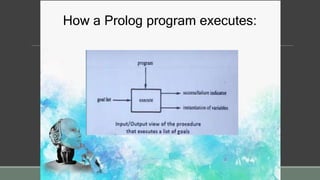
How a Prolog program executes:
Example
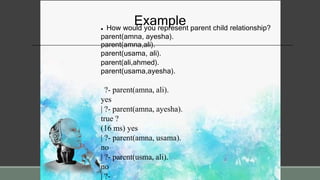
 How would you represent parent child relationship?
parent(amna, ayesha).
parent(amna,ali).
parent(usama, ali).
parent(ali,ahmed).
parent(usama,ayesha).
yes
| ?- parent(amna, ali).
yes
| ?- parent(amna, ayesha).
true ?
(16 ms) yes
| ?- parent(amna, usama).
no
| ?- parent(usma, ali).
no
| ?-
Example
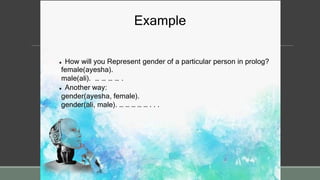
 How will you Represent gender of a particular person in prolog?
female(ayesha).
male(ali). … … … … .
 Another way:
gender(ayesha, female).
gender(ali, male). … … … … … . . .
Example:
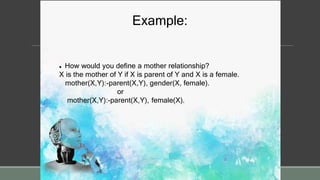
 How would you define a mother relationship?
X is the mother of Y if X is parent of Y and X is a female.
mother(X,Y):-parent(X,Y), gender(X, female).
or
mother(X,Y):-parent(X,Y), female(X).
Example:
 How would you define a mother relationship?
X is the mother of Y if X is parent of Y and X is a female.
mother(X,Y):-parent(X,Y), gender(X, female).
or
mother(X,Y):-parent(X,Y), female(X).
Example:
 How would you define a sister relationship?
 Has child relationship?
Anonymous Variable???
Sample Prolog Program
 Usually contains three parts:
domain (used for declarations)
i.e. domain
name=symbol
predicate
parent(name,name)
gender(name)
mother(name,name) n
haschild(name)
sister(name,name)
brother(name,name)
clauses
define all facts and rules.
 GNU Prolog doesn’t support these sections.
Comments
 Single-Line:
 %this is a program
 Multi-Line:
 /*this is a program
and these are comments*/
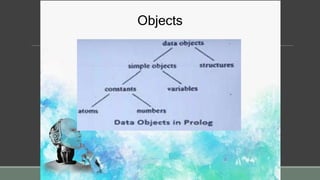
Objects
What if a query has more than one
answers.
On asking query Prolog will display you single answer.
After getting answer press enter to exit.
Or press ; to get all answers
Atoms
 Start with lower-case letters, may contain digits and letters.
x_1
abc
a_AB
 Atoms may be strings of special characters:
< … … . >
=======>
Need to be careful while using strings of special characters
because some strings of special characters are predefined in
prolog for special purpose. i.e. :-
 Strings of characters enclosed in quotes. Are usefull when we
want an atom to start with a capital letter.
i.e. ‘Bob’
Numbers
 Integers i.e. 4, 100, -8
 Normal Range (-16383 to 16383)
 Treatment of real number depends on version of prolog.
 Example: Ali has phone number ‘9489578’.
Structures
 Objects with multiple components.
 i.e.
date(9, june, 2017)
or d1: date(9, june, 2017)
 Note: date here is a functor.
Lists
 Collection of multiple elements:
[green, red, blue, black] [ ]
empty List
 List has 2 parts:
 First element: head
 Remaining elements: tail
 Can also write as:
Tail=[b, c] List=[a|Tail]
[1,2,3] is an abbreviation for .(1, .(2, .(3,[])))
Lists
 Checking membership:
list_member(Item,[Item|R]).
list_member(Item,[D|Tail]):-
list_member(Item,Tail).
Querying the above facts and rules:
list_member(a,[a,b,c]).
 We also have a built in function:
member(x,[a,b,c])
Lists
 Calculating length:
findlen([],X):-
X=0.
findlen([X|Tail],Count):-
findlen(Tail,Prev),
Count = Prev + 1.
 Built in way:
length([a,b,c],L)
Built In functions of list
reverse([1,2], What).
listsplit([a,b,c,d,e], A, B).
member(Element, [a, b, c]).
last([a,b,c,d,e],X).
append([],[2,3],[2,3]) .
perm([1,2,3],X).
Thanks……
Prof.Qasim Ali
MSCS (CS)

UOS-BSIT-3811-Artificial-Intelligence-Introduction-to-prolog-PDF.pptx

  • 1.
  • 2.
    Introduction Prolog is alogic programming language associated with artificial intelligence and computational linguistics. Prolog has its roots in first-order logic, a formal logic, and unlike many other programming languages, Prolog is intended primarily as a declarative programming language: the program logic is expressed in terms of relations, represented as facts and rules. A computation is initiated by running a query over these relations
  • 3.
    Data types Prolog's singledata type is the term. T Terms are either atoms, numbers, variables or compound terms. An atom is a general-purpose name with no inherent meaning. Examples of atoms include x, red, 'Taco', and 'some atom'. Numbers can be floats or integers. ISO standard compatible Prolog systems can check the Prolog flag "bounded". Most of the major Prolog systems support arbitrary length integer numbers.
  • 4.
    Data types Variables aredenoted by a string consisting of letters, numbers and underscore characters, and beginning with an upper-case letter or underscore. Variables closely resemble variables in logic in that they are placeholders for arbitrary terms. A compound term is composed of an atom called a "functor" and a number of "arguments", which are again terms. Compound terms are ordinarily written as a functor followed by a comma-separated list of argument terms, which is contained in parentheses.
  • 5.
    Data types Special casesof compound terms: A List is an ordered collection of terms. It is denoted by square brackets with the terms separated by commas or in the case of the empty list, []. For example, [1,2,3] or [red,green,blue]. Strings: A sequence of characters surrounded by quotes is equivalent to either a list of (numeric) character codes, a list of characters (atoms of length 1), or an atom depending on the value of the Prolog flag double_quotes. For example, "to be, or not to be".
  • 6.
    Prolog  www.gprolog.org/setup-gprolog-1.4.5-msvc-x64.exe  Saveyour programs in “Prolog workspace” folder inside “Prolog” folder.  Open Prolog console. Goto File → Change Dir.  Goto the folder containing your prolog programs. i.e. “Prolog workspace”.  Press Ok.
  • 7.
    Loading and Runningthe code:  [Program_file_name]. Loading  Run according to your requirement.
  • 8.
    Relations in Prolog Relation depicts a relationship between properties and objects. Relation: Ownership. Jhon owns a car.  Relations can be rules: Two people are brothers if They both are males They have same parents They are not same.
  • 9.
    Facts, Rules andquries:  Fact: Properties and relationships between objects. Jhon has phone number “111222333” phnnum(jhon,111222333). Can be called as a predicate or clause.  Some rules for facts in prolog:  Names of properties/relationships should begin with a lower-case letter.  Relationship name appears as first term.  Objects appears as comma seperated arguments in parenthesis.  A period “.” must end a fact.  An object name also begins with a lower-case letter or a number or can be a string of characters in qoutes.
  • 10.
    Facts, Rules andqueries:  teaches(X,Y)  teaches(Ali, AI)  teaches(Ahmed, OOP)  teaches(Aslam, DSA)  Student(X,Y)  Student(Bilal,DSA)  Student(Babar,DSA)  Student(Kamran,AI)  Student(Akram,OOP)  Student(Fawad,OOP) Note: These facts form Prolog database/knowledge base.
  • 11.
    Facts, Rules andqueries:  Rules:  A teacher will guide students if that student studies that particular course taught by that teacher.  guide(Teacher,Student):- teaches(Teacher,Course), student(Student,Course). Note: Variable name start with a capital letter or an underscore(_).
  • 12.
  • 13.
    Facts, Rules andqueries:  Queries:  Queries will be based on facts and rules. We can ask questions based on stored information.  Suppose we want to know that Ali teaches AI or not? ?- teaches(Ali,AI).  Queries are terminated by full-stop.  To ask this query, Prolog will consult database.  Similarly, we can also ask: ?- teaches(Ali,X).
  • 14.
    Facts, Rules andqueries:  Syntax of a Clause:  :- this means “if” or “is implied by”. Also called neck symbol.  Left hand side of neck is called head.  Right hand side of neck is called body.  , stands for AND/Conjunction.  ; stands for OR/Disjunction.
  • 15.
    How a Prologprogram executes:
  • 16.
    Example  How wouldyou represent parent child relationship? parent(amna, ayesha). parent(amna,ali). parent(usama, ali). parent(ali,ahmed). parent(usama,ayesha). yes | ?- parent(amna, ali). yes | ?- parent(amna, ayesha). true ? (16 ms) yes | ?- parent(amna, usama). no | ?- parent(usma, ali). no | ?-
  • 17.
    Example  How willyou Represent gender of a particular person in prolog? female(ayesha). male(ali). … … … … .  Another way: gender(ayesha, female). gender(ali, male). … … … … … . . .
  • 18.
    Example:  How wouldyou define a mother relationship? X is the mother of Y if X is parent of Y and X is a female. mother(X,Y):-parent(X,Y), gender(X, female). or mother(X,Y):-parent(X,Y), female(X).
  • 19.
    Example:  How wouldyou define a mother relationship? X is the mother of Y if X is parent of Y and X is a female. mother(X,Y):-parent(X,Y), gender(X, female). or mother(X,Y):-parent(X,Y), female(X).
  • 20.
    Example:  How wouldyou define a sister relationship?  Has child relationship? Anonymous Variable???
  • 21.
    Sample Prolog Program Usually contains three parts: domain (used for declarations) i.e. domain name=symbol predicate parent(name,name) gender(name) mother(name,name) n haschild(name) sister(name,name) brother(name,name) clauses define all facts and rules.  GNU Prolog doesn’t support these sections.
  • 22.
    Comments  Single-Line:  %thisis a program  Multi-Line:  /*this is a program and these are comments*/
  • 23.
  • 24.
    What if aquery has more than one answers. On asking query Prolog will display you single answer. After getting answer press enter to exit. Or press ; to get all answers
  • 25.
    Atoms  Start withlower-case letters, may contain digits and letters. x_1 abc a_AB  Atoms may be strings of special characters: < … … . > =======> Need to be careful while using strings of special characters because some strings of special characters are predefined in prolog for special purpose. i.e. :-  Strings of characters enclosed in quotes. Are usefull when we want an atom to start with a capital letter. i.e. ‘Bob’
  • 26.
    Numbers  Integers i.e.4, 100, -8  Normal Range (-16383 to 16383)  Treatment of real number depends on version of prolog.  Example: Ali has phone number ‘9489578’.
  • 27.
    Structures  Objects withmultiple components.  i.e. date(9, june, 2017) or d1: date(9, june, 2017)  Note: date here is a functor.
  • 28.
    Lists  Collection ofmultiple elements: [green, red, blue, black] [ ] empty List  List has 2 parts:  First element: head  Remaining elements: tail  Can also write as: Tail=[b, c] List=[a|Tail] [1,2,3] is an abbreviation for .(1, .(2, .(3,[])))
  • 29.
    Lists  Checking membership: list_member(Item,[Item|R]). list_member(Item,[D|Tail]):- list_member(Item,Tail). Queryingthe above facts and rules: list_member(a,[a,b,c]).  We also have a built in function: member(x,[a,b,c])
  • 30.
  • 31.
    Built In functionsof list reverse([1,2], What). listsplit([a,b,c,d,e], A, B). member(Element, [a, b, c]). last([a,b,c,d,e],X). append([],[2,3],[2,3]) . perm([1,2,3],X).
  • 32.